Overview
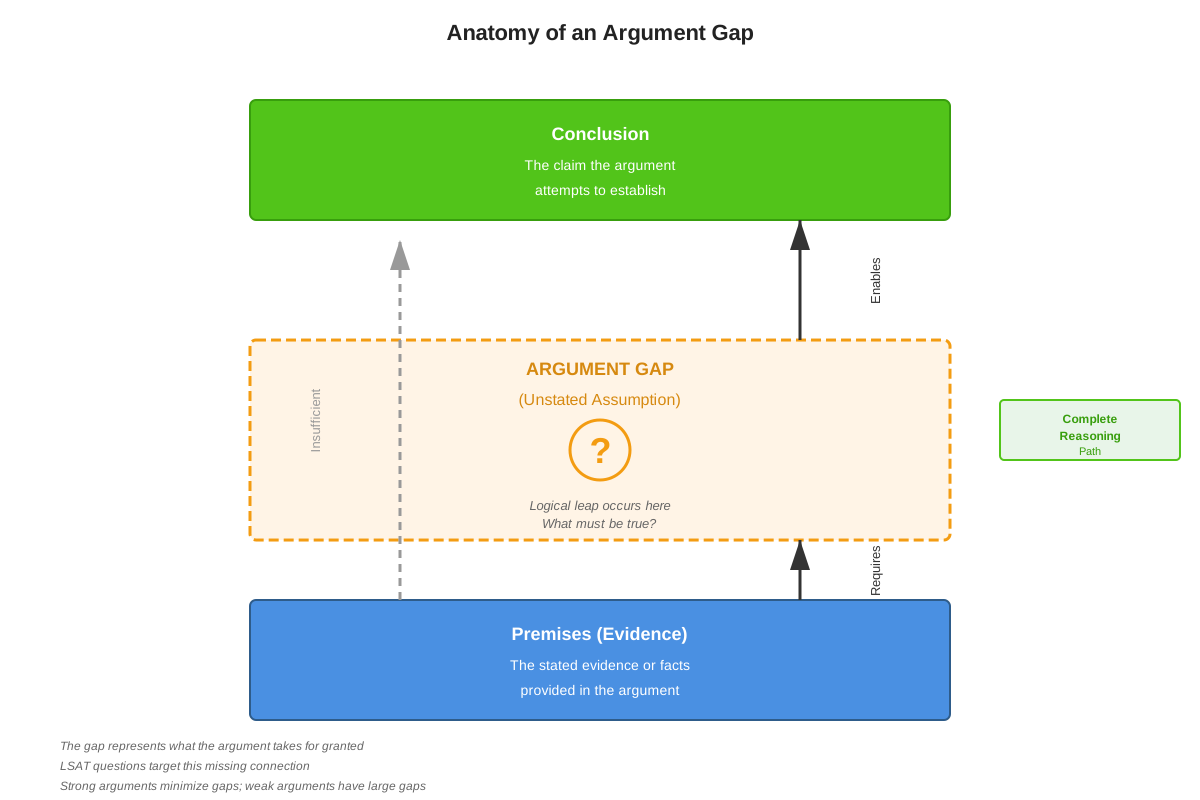
Argument gaps represent one of the most fundamental and frequently tested concepts in LSAT logical reasoning. An argument gap is the logical space between an argument's premises (evidence) and its conclusion—the unstated assumptions that must be true for the reasoning to hold. Understanding LSAT argument gaps is essential because the majority of Logical Reasoning questions either directly test your ability to identify these gaps or require you to understand them to evaluate, strengthen, weaken, or complete arguments.
Every LSAT argument with a gap contains premises that do not fully support the conclusion without additional assumptions. The test makers deliberately construct arguments where the evidence provided is insufficient on its own, creating a logical "leap" that test-takers must recognize. Mastering this skill enables students to predict what an argument needs, identify its vulnerabilities, and select correct answers with confidence across multiple question types including Necessary Assumption, Sufficient Assumption, Strengthen, Weaken, and Flaw questions.
Within the broader framework of argument fundamentals, recognizing gaps sits at the intersection of premise identification, conclusion recognition, and assumption analysis. Once students can deconstruct an argument into its component parts, the next critical skill is identifying what's missing—the unstated connections that bridge evidence to conclusion. This foundational skill underlies virtually all advanced Logical Reasoning techniques and directly impacts performance on approximately 60-70% of all Logical Reasoning questions on any given LSAT.
Learning Objectives
- [ ] Identify how Argument gaps appears in LSAT questions
- [ ] Explain the reasoning pattern behind Argument gaps
- [ ] Apply Argument gaps to solve LSAT-style problems accurately
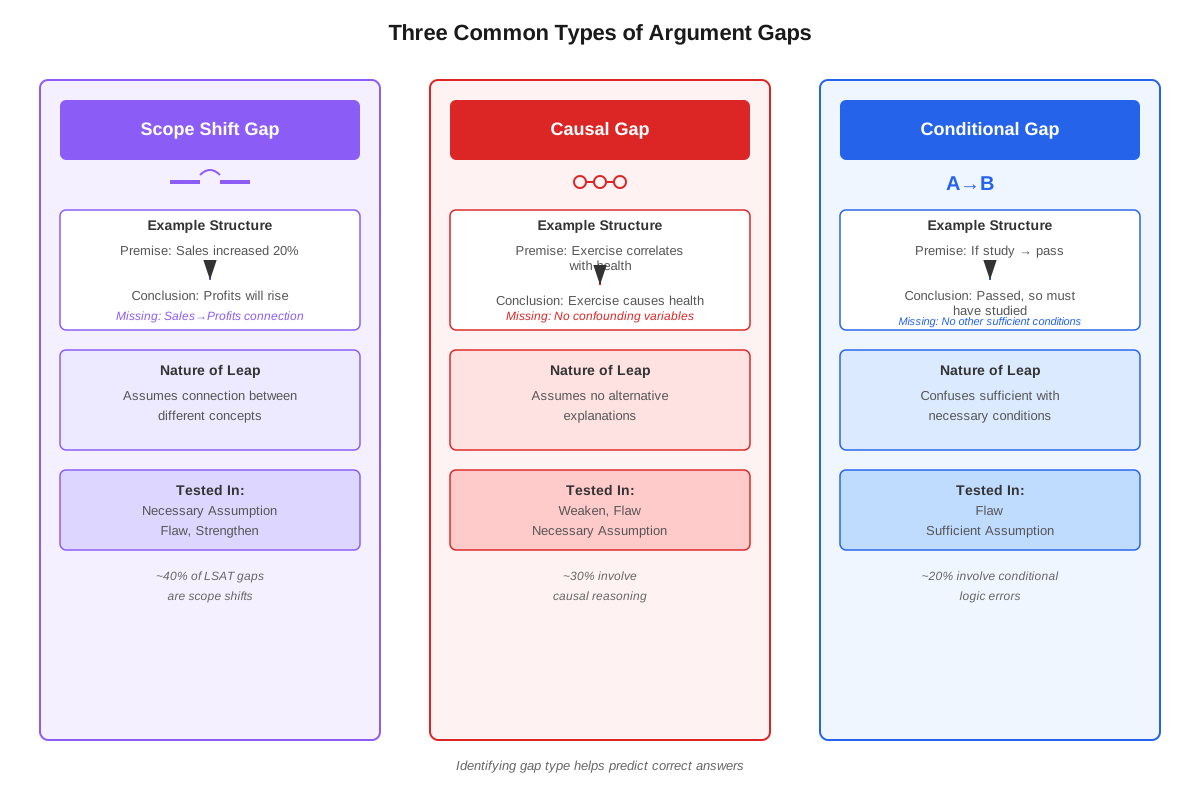
- [ ] Distinguish between different types of argument gaps (scope shifts, causal gaps, conditional gaps)
- [ ] Predict the content of missing assumptions before reviewing answer choices
- [ ] Evaluate whether a given statement closes or addresses an argument gap
Prerequisites
- Argument structure identification: Understanding how to distinguish premises from conclusions is essential because gaps exist specifically between these elements
- Indicator word recognition: Familiarity with conclusion and premise indicators helps locate where gaps occur in argument structure
- Basic logical relationships: Knowledge of how evidence typically supports conclusions provides the foundation for recognizing when that support is incomplete
- Conditional reasoning basics: Many argument gaps involve conditional statements, requiring understanding of sufficient and necessary conditions
Why This Topic Matters
Argument gaps appear in the real world whenever someone makes a claim based on incomplete evidence—in legal briefs, policy debates, scientific reasoning, and everyday persuasion. Attorneys must identify gaps in opposing arguments to challenge them effectively, while also ensuring their own arguments contain no exploitable weaknesses. This skill translates directly to critical thinking in professional and academic contexts where evaluating the strength of reasoning is paramount.
On the LSAT, argument gaps appear in approximately 12-16 questions per test across both Logical Reasoning sections. This represents roughly 45-60% of all Logical Reasoning questions, making it the single most important concept for score improvement. Question types that directly test gap recognition include Necessary Assumption (3-5 questions), Sufficient Assumption (2-3 questions), Flaw (3-4 questions), Strengthen (2-3 questions), and Weaken (2-3 questions). Even Inference and Parallel Reasoning questions often require understanding gaps to eliminate incorrect answers.
The LSAT presents argument gaps in several characteristic ways: scope shifts where the conclusion discusses something not mentioned in the premises, causal reasoning that assumes correlation implies causation, comparative arguments that assume no relevant differences exist, and conditional reasoning that confuses necessary and sufficient conditions. Recognizing these patterns allows test-takers to anticipate correct answers and avoid attractive wrong answer choices that address irrelevant issues.
Core Concepts
What Constitutes an Argument Gap
An argument gap is the logical distance between what an argument explicitly states (its premises) and what it claims to prove (its conclusion). This gap represents unstated assumptions—propositions that must be true for the argument to work but that the author has not explicitly provided. Every gap creates vulnerability in an argument because if the assumption proves false, the reasoning fails.
Consider this simple example: "Sarah scored in the 99th percentile on the LSAT. Therefore, she will be an excellent lawyer." The premises tell us about Sarah's test performance, while the conclusion makes a claim about her future professional competence. The gap is enormous: the argument assumes that LSAT performance predicts lawyering ability, that no other factors matter, and that test-taking skills translate to practical legal work. None of these assumptions appear in the argument, yet all must be true for the reasoning to succeed.
Types of Argument Gaps
Scope Shifts
A scope shift occurs when the conclusion introduces a concept, term, or category not present in the premises. This is the most common type of gap on the LSAT. The premises discuss X, but the conclusion makes a claim about Y, assuming without justification that X and Y are connected.
Example: "This medication reduced symptoms in 80% of trial participants. Therefore, it will be profitable for the pharmaceutical company." The premises address clinical effectiveness while the conclusion concerns profitability—a clear scope shift. The gap assumes that clinical success translates to commercial success, ignoring factors like production costs, market competition, and insurance coverage.
Causal Gaps
Causal gaps appear when an argument observes a correlation or temporal sequence and concludes a causal relationship exists. The argument assumes that no alternative explanations account for the observed pattern—no reverse causation, no common cause, and no coincidence.
Example: "Countries with higher chocolate consumption have more Nobel Prize winners per capita. Therefore, eating chocolate improves cognitive function." The argument leaps from correlation to causation, failing to consider that wealth might cause both chocolate consumption and educational investment, or that the relationship is entirely coincidental.
Conditional Reasoning Gaps
These gaps involve misapplying conditional logic, typically by confusing necessary and sufficient conditions or by assuming that meeting one condition guarantees an outcome when multiple conditions are required.
Example: "To become a licensed architect, one must pass the licensing exam. John passed the exam, so he will become a licensed architect." The argument treats passing the exam (a necessary condition) as if it were sufficient, ignoring other requirements like education credentials, experience hours, and application approval.
Comparison Gaps
Comparison gaps occur when an argument compares two things and assumes they are similar in all relevant respects, or when it assumes that a difference in one characteristic explains a difference in outcomes.
Example: "City A implemented traffic cameras and saw accidents decrease by 20%. City B should implement cameras to reduce accidents." The gap assumes the cities are comparable in relevant ways—similar traffic patterns, driver demographics, road infrastructure, and enforcement mechanisms.
How to Identify Argument Gaps
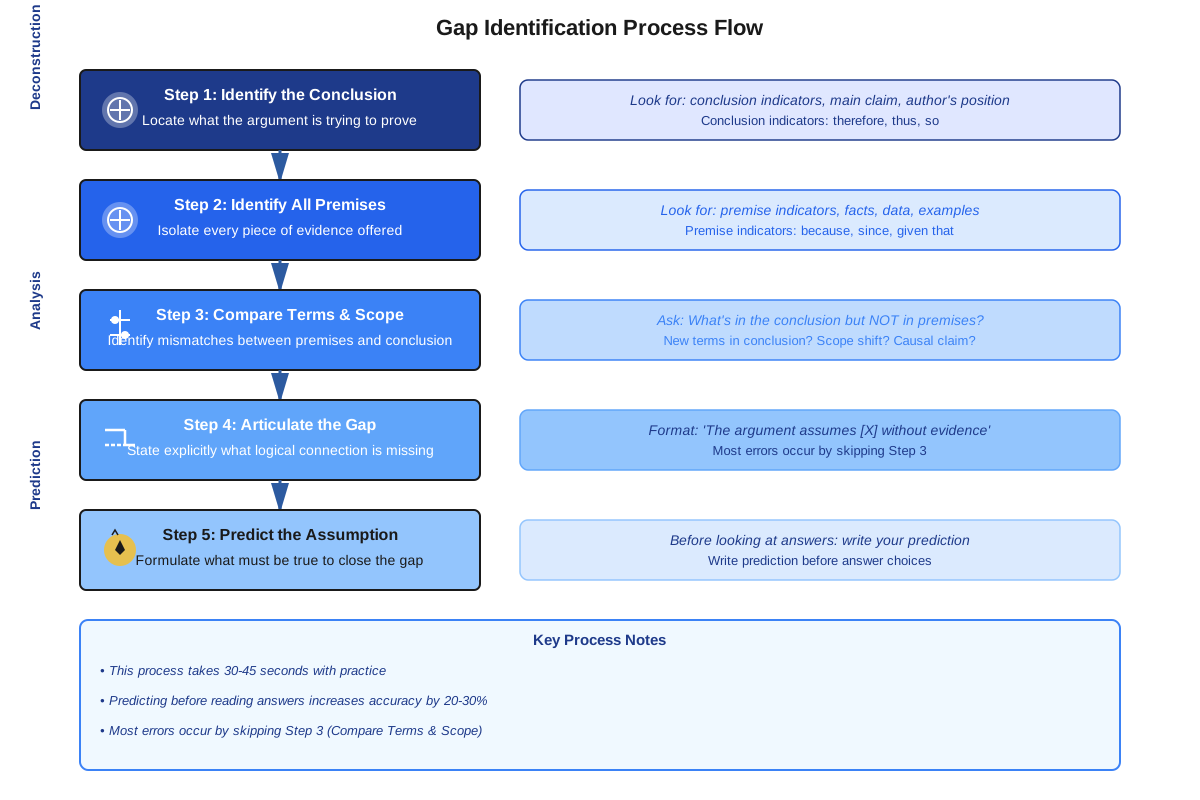
The systematic process for identifying gaps involves four steps:
- Isolate the conclusion: Determine exactly what the argument is trying to prove
- Identify the premises: List all evidence provided to support that conclusion
- Compare scope and terms: Note any concepts in the conclusion absent from premises
- Articulate the assumption: State what must be true to connect premises to conclusion
The gap always exists in the logical space between the last premise and the conclusion. Ask: "What would need to be true for this evidence to actually prove this claim?" The answer reveals the gap.
The Assumption That Fills the Gap
Assumptions that fill gaps come in two varieties: necessary assumptions (minimum requirements for the argument to work) and sufficient assumptions (guarantees that make the argument logically valid).
A necessary assumption is something that must be true—if it's false, the argument completely fails. Using the negation test helps identify necessary assumptions: negate the statement and see if the argument falls apart. If it does, you've found a necessary assumption.
A sufficient assumption is something that, if true, makes the conclusion follow logically from the premises. Sufficient assumptions often feel stronger than necessary because they completely close the gap, while necessary assumptions merely keep the argument alive.
| Assumption Type | Definition | Strength | Test Method |
|---|---|---|---|
| Necessary | Must be true for argument to work | Minimum requirement | Negation test |
| Sufficient | Guarantees conclusion follows | Complete proof | Logical validity check |
Concept Relationships
The concept of argument gaps serves as the central hub connecting multiple Logical Reasoning skills. Understanding argument structure (premises + conclusion) → enables identification of → argument gaps → which allows evaluation of → argument strength and validity.
Argument gaps connect directly to assumption questions because assumptions are precisely what fill gaps. When a Necessary Assumption question asks what the argument requires, it's asking you to identify what must be true to close the gap. When a Sufficient Assumption question asks what would make the argument valid, it's asking what would completely bridge the gap.
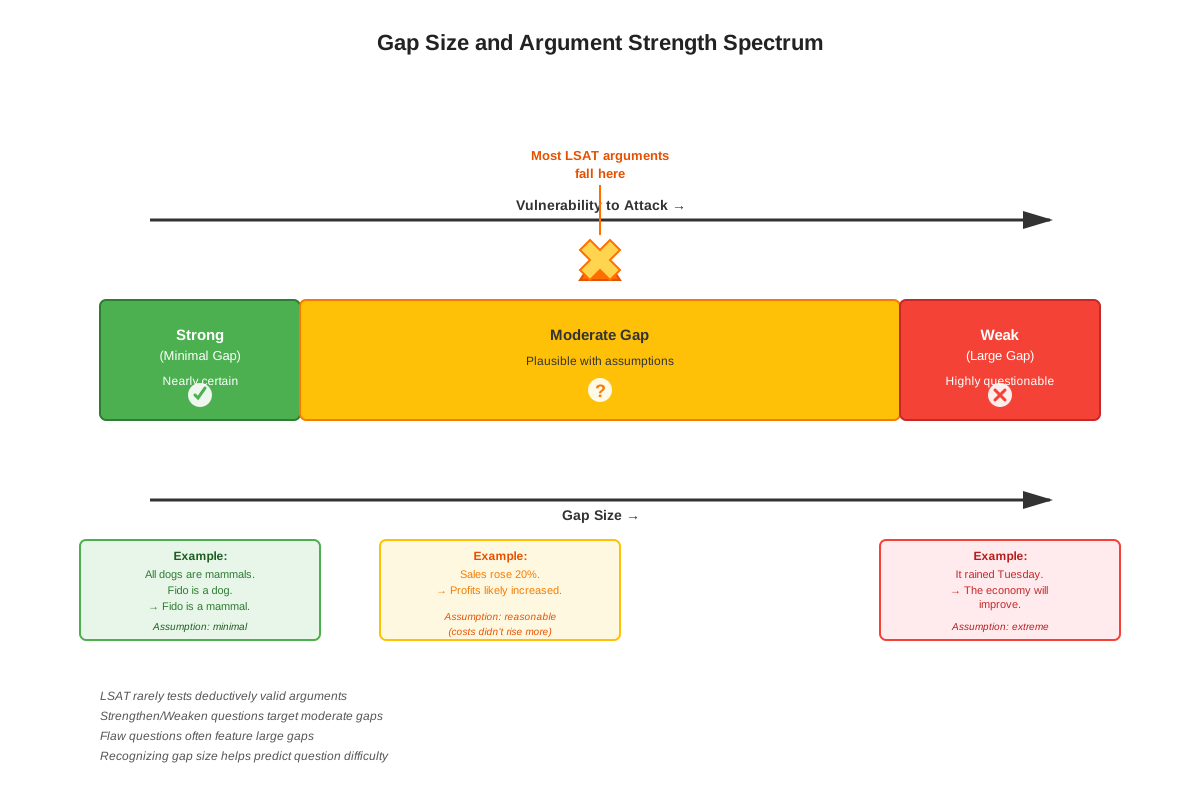
Gap recognition also enables Strengthen and Weaken question analysis. Strengthening an argument means providing evidence that closes or narrows the gap, making the unstated assumption more plausible. Weakening an argument means exposing the gap by showing the assumption is questionable or false. Flaw questions explicitly ask test-takers to describe the gap in the argument's reasoning.
The relationship flows: Argument Structure Analysis → Gap Identification → Assumption Recognition → Answer Prediction → Correct Answer Selection. Each skill builds on the previous, with gap identification serving as the critical middle step that transforms structural understanding into strategic answer selection.
Quick check — test yourself on Argument gaps so far.
Try Flashcards →High-Yield Facts
⭐ Every LSAT argument with a gap contains at least one unstated assumption connecting premises to conclusion
⭐ Scope shifts—where the conclusion introduces new terms not in the premises—represent the most common type of argument gap
⭐ The negation test identifies necessary assumptions: if negating a statement destroys the argument, that statement is a necessary assumption
⭐ Causal arguments always contain gaps because correlation never proves causation without additional assumptions
⭐ Sufficient assumptions make arguments logically valid but often feel too strong; necessary assumptions feel more moderate
- Comparison arguments assume no relevant differences exist between the things being compared
- Conditional reasoning gaps often involve treating necessary conditions as sufficient or vice versa
- The gap always exists between the final premise and the conclusion, never between premises
- Arguments can contain multiple gaps, though LSAT questions typically focus on one primary gap
- Recognizing the gap before reading answer choices dramatically improves accuracy and speed
- Wrong answers on assumption questions often address issues outside the argument's scope rather than closing the actual gap
- Strengthening an argument requires addressing its gap; irrelevant evidence, even if true, doesn't strengthen
- The larger the gap, the more vulnerable the argument is to criticism
Common Misconceptions
Misconception: Every argument on the LSAT contains a gap that needs to be identified.
Correction: Only arguments (premise + conclusion structures) contain gaps. Some stimuli present only facts, descriptions, or conditional chains without making arguments, and these have no gaps to identify.
Misconception: The gap is always about something completely new that wasn't mentioned at all in the premises.
Correction: While scope shifts are common, gaps can also involve unstated relationships between concepts that were mentioned, such as assuming causation from correlation or assuming sufficiency from necessity.
Misconception: Necessary assumptions must be obviously true or common sense.
Correction: Necessary assumptions are often subtle and may not be intuitively obvious. They're "necessary" in the logical sense—required for the argument to work—not in the sense of being self-evident truths.
Misconception: If an answer choice strengthens an argument, it must be a necessary assumption.
Correction: Many statements can strengthen an argument without being necessary. A necessary assumption is specifically something that, if false, destroys the argument entirely. Strengtheners can be helpful without being essential.
Misconception: The correct answer to an assumption question will make the argument perfect or completely proven.
Correction: Necessary assumptions only keep arguments alive; they don't make them bulletproof. Even with all necessary assumptions in place, an argument can still be weak or have other vulnerabilities.
Misconception: Longer, more detailed answer choices are more likely to correctly identify the gap.
Correction: LSAT answer choices vary in length for stylistic reasons. The correct answer might be concise or detailed. Focus on whether the content addresses the actual gap, not the length of the statement.
Worked Examples
Example 1: Scope Shift Gap
Stimulus: "The new highway reduced commute times for workers traveling from the suburbs to downtown by an average of 15 minutes. Therefore, the highway has improved quality of life for suburban residents."
Analysis:
Step 1 - Identify the conclusion: The highway has improved quality of life for suburban residents.
Step 2 - Identify the premises: The highway reduced commute times by 15 minutes for workers traveling from suburbs to downtown.
Step 3 - Identify the gap: The premises discuss commute time reduction, while the conclusion makes a claim about overall quality of life. This is a scope shift. The argument assumes that reduced commute time translates to improved quality of life, ignoring potential negative factors like increased noise pollution, reduced property values near the highway, environmental damage, or increased traffic accidents.
Step 4 - Articulate the assumption: The argument assumes that the benefits of reduced commute time outweigh any negative impacts of the highway, and that commute time is a significant factor in quality of life for suburban residents.
Application to question types:
- Necessary Assumption: "The highway's negative impacts do not outweigh the benefits of reduced commute time" (negating this destroys the argument)
- Weaken: "The highway increased noise pollution so severely that property values declined 20%, causing significant stress for homeowners"
- Strengthen: "Surveys show that commute time is the primary factor suburban residents cite when evaluating their quality of life"
Example 2: Causal Gap
Stimulus: "After the city installed brighter streetlights in the downtown area, reported crime decreased by 30% over the following year. The brighter lighting clearly deterred criminal activity."
Analysis:
Step 1 - Identify the conclusion: The brighter lighting deterred criminal activity (caused the crime reduction).
Step 2 - Identify the premises: Brighter streetlights were installed, and reported crime decreased by 30% afterward.
Step 3 - Identify the gap: This is a causal gap. The argument observes a temporal sequence (lights installed, then crime decreased) and concludes causation. It assumes no alternative explanations exist for the crime reduction.
Step 4 - Articulate the assumption: The argument assumes that the lighting caused the decrease rather than other factors like increased police presence, demographic changes, economic improvement, seasonal variation, or changes in crime reporting practices. It also assumes the correlation isn't coincidental.
Application to question types:
- Necessary Assumption: "No other significant factor that would reduce crime was introduced during the same period"
- Weaken: "The city also doubled police patrols in the downtown area at the same time the lights were installed"
- Strengthen: "Crime rates in similar neighborhoods without lighting improvements remained constant during the same period"
- Flaw: "The argument treats a correlation as evidence of causation without ruling out alternative explanations"
Exam Strategy
When approaching LSAT questions involving argument gaps, follow this systematic process:
Before reading answer choices, actively identify the gap. Read the stimulus, locate the conclusion, identify the premises, and articulate to yourself what assumption connects them. This pre-phrasing dramatically improves accuracy because you'll recognize the correct answer rather than being swayed by attractive wrong answers.
Watch for trigger words that signal gaps:
- "Therefore," "thus," "consequently" → conclusion follows, check if premises actually support it
- "Because," "since," "due to" → causal language often indicates causal gaps
- "Will," "must," "should" → strong predictions often outpace the evidence
- Comparative language ("better," "more," "superior") → comparison gaps likely exist
Use the negation test for Necessary Assumption questions. Take each answer choice, negate it, and ask whether the argument falls apart. If negating the statement destroys the argument, you've found the necessary assumption. If the argument survives the negation, eliminate that choice.
For Sufficient Assumption questions, look for answer choices that create logical validity. The correct answer will be strong enough to guarantee the conclusion follows from the premises. Don't be afraid of answers that seem "too strong"—sufficient assumptions are meant to be powerful.
Eliminate answers that address the wrong gap. Wrong answers often discuss real issues but not the specific gap in the argument. An answer might be true, relevant to the topic, and even strengthen the argument slightly, but if it doesn't address the primary gap between the stated premises and conclusion, it's wrong.
Time allocation: Spend 15-20 seconds identifying the gap before reading choices. This upfront investment saves time by allowing you to move quickly through wrong answers and confidently select the correct one. Students who skip this step often waste time reconsidering each answer multiple times.
Exam Tip: The correct answer to an assumption question will always connect concepts from the premises to concepts in the conclusion. If an answer introduces entirely new concepts unrelated to either, it's almost certainly wrong.
Memory Techniques
GAPS Acronym for identifying argument gaps:
- Get the conclusion clear
- Analyze the premises
- Pinpoint new concepts in conclusion
- State the assumption needed
Scope Shift Visualization: Picture the premises as one circle and the conclusion as another. If the circles don't overlap completely, you have a scope shift. The gap is the non-overlapping area.
Causal Gap Mnemonic - "RACE": When you see causal reasoning, remember to check for:
- Reverse causation (does B cause A instead of A causing B?)
- Alternative causes (could C cause B?)
- Coincidence (is the correlation accidental?)
- Evidence of actual causation (is there proof beyond correlation?)
Negation Test Reminder: "If NOT, then SHOT" - If the statement is NOT true, is the argument SHOT (destroyed)? If yes, it's a necessary assumption.
Assumption Strength Spectrum: Picture a bridge across a canyon. Necessary assumptions are the minimum support cables needed to keep the bridge from collapsing. Sufficient assumptions are a solid concrete roadway that guarantees safe passage. Both connect the same two points (premises to conclusion) but with different levels of support.
Summary
Argument gaps represent the logical space between an argument's premises and conclusion—the unstated assumptions required for the reasoning to work. Recognizing these gaps is fundamental to LSAT success because they appear in the majority of Logical Reasoning questions across multiple question types. The most common gaps involve scope shifts (where conclusions introduce new concepts), causal reasoning (where correlation is treated as causation), conditional logic errors (confusing necessary and sufficient conditions), and comparison assumptions (assuming relevant similarity). Identifying gaps requires systematically comparing what the premises state to what the conclusion claims, then articulating what must be true to bridge that distance. Mastering this skill enables test-takers to predict correct answers, efficiently eliminate wrong choices, and approach Necessary Assumption, Sufficient Assumption, Strengthen, Weaken, and Flaw questions with confidence and accuracy.
Key Takeaways
- Argument gaps are the unstated assumptions between premises and conclusions that make arguments vulnerable to criticism
- Scope shifts—where conclusions introduce terms not in premises—represent the most frequent type of gap on the LSAT
- Identifying gaps before reading answer choices dramatically improves accuracy and speed across all assumption-based question types
- The negation test reliably identifies necessary assumptions: if negating a statement destroys the argument, it's necessary
- Causal arguments always contain gaps because observing correlation never proves causation without additional assumptions
- Every correct answer to an assumption question must connect concepts from the premises to concepts in the conclusion
- Recognizing argument gaps is essential for approximately 60-70% of all Logical Reasoning questions on the LSAT
Related Topics
Necessary vs. Sufficient Assumptions: Deep dive into the distinction between minimum requirements and complete guarantees, building directly on gap identification skills to master both assumption question types.
Strengthen and Weaken Questions: Learn how to evaluate answer choices that make arguments more or less convincing by addressing or exploiting their gaps—a direct application of gap recognition.
Flaw Questions: Study how to describe reasoning errors in precise terms, which requires identifying the gap and explaining why the argument's logic fails to bridge it properly.
Conditional Logic: Explore how conditional statements create specific types of gaps when necessary and sufficient conditions are confused or misapplied.
Causal Reasoning: Examine the specific patterns of causal arguments and the standard gaps they contain, including alternative causes, reverse causation, and correlation-causation confusion.
Practice CTA
Now that you understand how to identify and analyze argument gaps, it's time to apply these skills to actual LSAT questions. Work through the practice questions associated with this topic, focusing on articulating the gap before reviewing answer choices. Create flashcards for the different gap types and practice the negation test until it becomes automatic. Remember: recognizing gaps is a skill that improves dramatically with deliberate practice. Each question you analyze strengthens your pattern recognition and builds the confidence you need to excel on test day. You've learned the framework—now make it instinctive through consistent application.
Sign up free to keep reading
Create a free AnvayaPrep account to finish this LSAT guide on Argument gaps — plus flashcards and practice questions.