Overview
Common LSAT argument patterns represent recurring logical structures that appear throughout the Logical Reasoning sections of the LSAT. These patterns form the backbone of how arguments are constructed, evaluated, and challenged on the exam. Recognizing these patterns is not merely an academic exercise—it is a critical skill that separates high-scoring test-takers from those who struggle. When students can quickly identify whether an argument follows a causal reasoning pattern, a conditional logic structure, or an argument by analogy, they can anticipate weaknesses, predict correct answers, and work through questions with remarkable efficiency.
The LSAT tests logical reasoning through approximately 50 questions across two scored sections, making it the most heavily weighted component of the exam. Within these sections, certain argument fundamentals appear repeatedly in predictable configurations. Understanding these lsat common lsat argument patterns allows test-takers to develop pattern recognition skills that dramatically reduce the cognitive load required for each question. Rather than treating every argument as a novel puzzle, students who master these patterns can leverage their knowledge to identify the argument's structure within seconds, immediately recognizing its vulnerabilities and strengths.
These patterns connect intimately with other Logical Reasoning concepts, including assumption identification, flaw recognition, strengthening and weakening arguments, and inference drawing. Each pattern carries its own characteristic assumptions and typical weaknesses. For instance, causal arguments consistently make assumptions about alternative explanations and the direction of causation, while arguments from analogy depend on the relevance and strength of the comparison being drawn. Mastering these patterns provides a framework for approaching virtually every Logical Reasoning question type, from Must Be True questions to Parallel Reasoning tasks.
Learning Objectives
- [ ] Identify how Common LSAT argument patterns appears in LSAT questions
- [ ] Explain the reasoning pattern behind Common LSAT argument patterns
- [ ] Apply Common LSAT argument patterns to solve LSAT-style problems accurately
- [ ] Distinguish between different argument patterns based on structural indicators and conclusion types
- [ ] Predict the characteristic weaknesses and assumptions associated with each major argument pattern
- [ ] Recognize hybrid arguments that combine multiple patterns and analyze their compound vulnerabilities
Prerequisites
- Basic argument structure: Understanding premises, conclusions, and how to identify each component is essential because argument patterns describe how these elements relate to one another
- Conditional logic fundamentals: Familiarity with if-then statements and their contrapositives enables recognition of conditional reasoning patterns that pervade LSAT arguments
- Distinction between facts and inferences: Recognizing the difference between stated information and drawn conclusions allows students to see where logical leaps occur within argument patterns
- Common logical fallacies: Basic knowledge of flawed reasoning helps identify when argument patterns are being misapplied or contain inherent weaknesses
Why This Topic Matters
In real-world contexts, recognizing argument patterns is fundamental to critical thinking across law, business, medicine, and public policy. Attorneys must identify when opposing counsel relies on weak analogies or unsupported causal claims. Business leaders evaluate whether correlational data truly supports causal conclusions about market trends. Medical professionals distinguish between correlation and causation when interpreting research findings. The patterns tested on the LSAT mirror the reasoning structures encountered in professional decision-making and persuasive communication.
On the LSAT itself, argument patterns appear with remarkable frequency and predictability. Approximately 60-70% of Logical Reasoning questions involve arguments that follow one of the major patterns discussed in this guide. Causal reasoning appears in roughly 20-25% of all Logical Reasoning questions, making it the single most common pattern. Conditional reasoning structures appear in another 15-20% of questions, while arguments from analogy, sampling arguments, and arguments from absence of evidence each appear in 5-10% of questions. Questions asking test-takers to identify flaws, assumptions, strengthen, or weaken arguments almost always require pattern recognition as the first step toward the correct answer.
These patterns manifest across multiple question types. Flaw questions frequently test whether students can identify the characteristic weakness of a causal or analogical argument. Assumption questions require understanding what unstated premises each pattern depends upon. Strengthen and Weaken questions demand knowledge of what evidence would support or undermine each pattern's logical structure. Even Parallel Reasoning questions, which ask students to match argument structures, become significantly more manageable when approached through the lens of pattern recognition. The ability to quickly categorize an argument's pattern is perhaps the single most valuable skill for improving speed and accuracy in Logical Reasoning sections.
Core Concepts
Causal Arguments
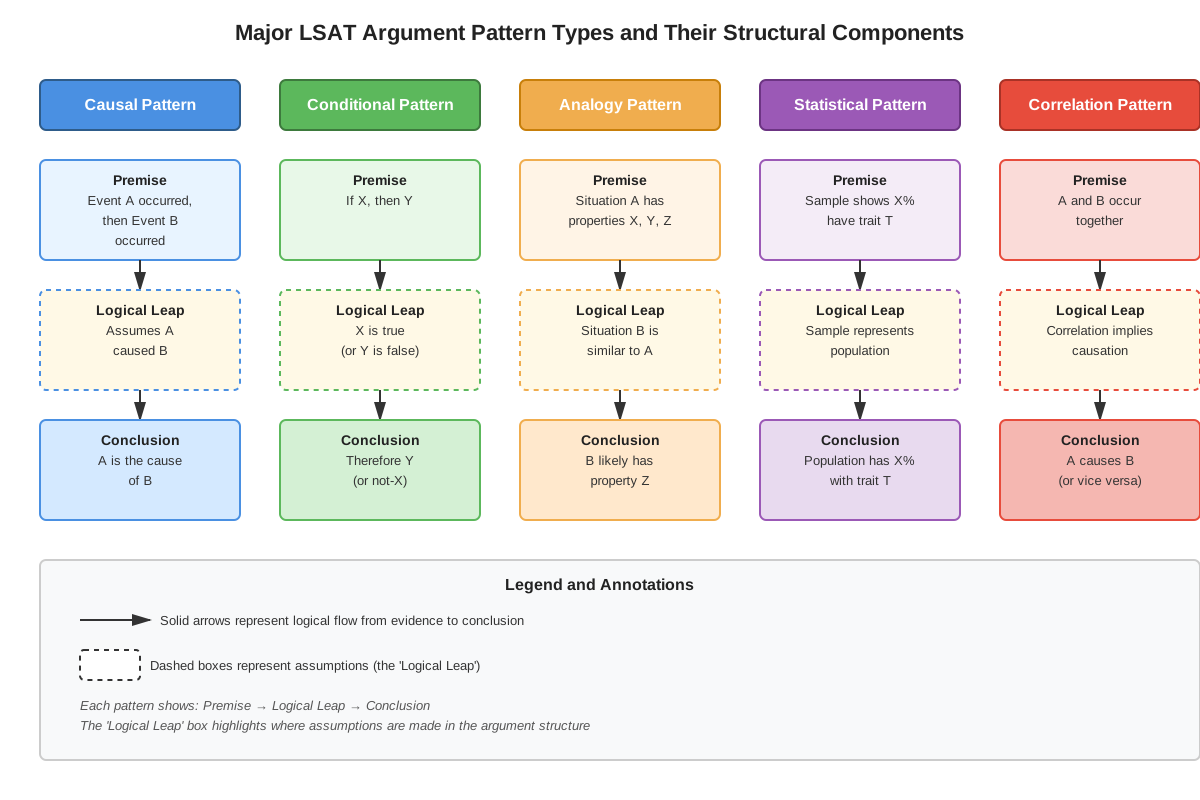
Causal arguments represent the most prevalent pattern on the LSAT, appearing in approximately one-quarter of all Logical Reasoning questions. These arguments claim that one phenomenon (the cause) brings about or produces another phenomenon (the effect). The basic structure follows this template: "X causes Y" or "X is responsible for Y" or "Y occurs because of X."
The hallmark of causal reasoning is the assertion of a productive relationship between two events or conditions. The argument moves beyond merely observing that two things occur together (correlation) to claiming that one actually produces or brings about the other. Key linguistic indicators include: "causes," "leads to," "brings about," "produces," "results in," "is responsible for," "explains why," and "accounts for."
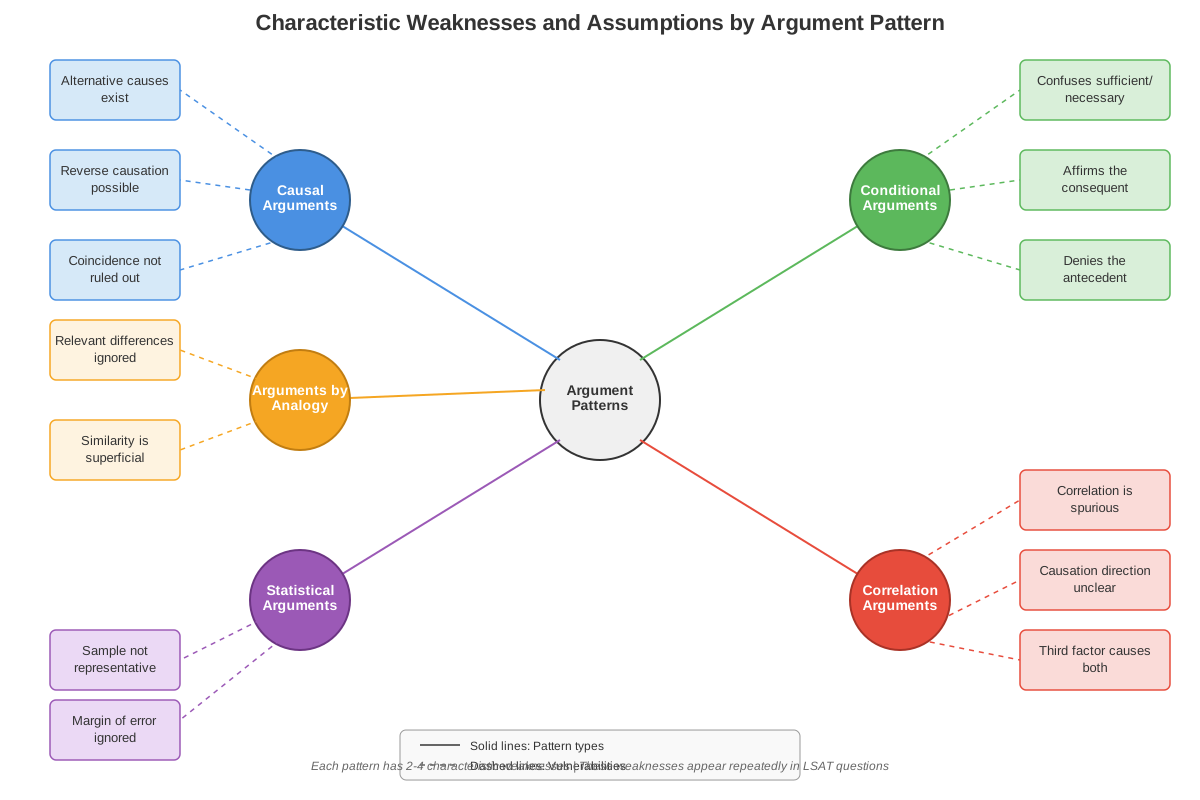
Characteristic assumptions of causal arguments include:
- No alternative causes: The argument assumes no other factor could explain the effect
- Correct causal direction: The argument assumes the cause-effect relationship isn't reversed
- No coincidence: The argument assumes the correlation isn't merely accidental
- Causation from correlation: The argument typically moves from observed correlation to claimed causation
Common weaknesses in causal arguments include confusing correlation with causation, failing to consider alternative explanations, reversing cause and effect, and overlooking the possibility that both observed phenomena result from a common underlying cause.
Conditional Arguments
Conditional arguments rely on if-then logical structures to draw conclusions. These arguments establish relationships where one condition guarantees or necessitates another. The pattern follows: "If A, then B" (sufficient condition → necessary condition). Conditional reasoning appears in 15-20% of LSAT Logical Reasoning questions and is particularly common in Must Be True and Parallel Reasoning question types.
The logical structure of conditional statements creates specific valid and invalid inference patterns:
| Valid Inferences | Invalid Inferences |
|---|---|
| If A → B, and A is true, then B is true (Affirming the Antecedent) | If A → B, and B is true, then A is true (Affirming the Consequent) |
| If A → B, and B is false, then A is false (Denying the Consequent/Contrapositive) | If A → B, and A is false, then B is false (Denying the Antecedent) |
Conditional arguments often chain multiple conditional statements together: If A → B, and If B → C, therefore If A → C. The LSAT frequently tests whether students can recognize valid versus invalid conditional inferences, particularly the common errors of affirming the consequent or denying the antecedent.
Characteristic assumptions: The argument assumes the conditional relationship holds universally without exceptions, and that the sufficient condition is the only way to guarantee the necessary condition (unless explicitly stated otherwise).
Arguments from Analogy
Arguments from analogy draw conclusions about one situation based on its similarity to another situation. The pattern follows: "Situation X has characteristics A, B, and C, and outcome D. Situation Y also has characteristics A, B, and C. Therefore, Situation Y will also have outcome D." These arguments appear in 5-10% of Logical Reasoning questions and are particularly common in Flaw and Weaken question types.
The strength of an analogical argument depends on:
- Relevance of similarities: The shared characteristics must be relevant to the outcome being predicted
- Absence of relevant differences: The situations must not differ in ways that affect the outcome
- Number and significance of similarities: More numerous and more significant similarities strengthen the analogy
- Specificity of the comparison: More specific, detailed analogies tend to be stronger than vague comparisons
Characteristic assumptions: The argument assumes the similarities between the two situations are relevant to the conclusion, that there are no relevant differences that would undermine the comparison, and that the outcome in the original situation actually occurred as claimed.
Common weaknesses: Analogical arguments often fail because they compare situations that differ in crucial ways, rely on superficial similarities while ignoring deeper differences, or draw conclusions about outcomes that depend on factors not shared between the situations.
Sampling and Statistical Arguments
Sampling arguments draw conclusions about a larger population based on observations of a subset (sample) of that population. The pattern follows: "In sample S, X% exhibited characteristic C. Therefore, approximately X% of the entire population exhibits characteristic C." These arguments appear in 5-8% of Logical Reasoning questions.
For a sampling argument to be strong, the sample must be:
- Representative: The sample must accurately reflect the diversity of the full population
- Sufficiently large: The sample must be large enough to avoid random variation
- Randomly selected: The sample selection method must not introduce bias
- Relevant: The characteristic being measured must be relevant to the conclusion
Characteristic assumptions: The argument assumes the sample is representative of the population, that the sample size is adequate, that the sampling method was unbiased, and that conditions haven't changed between sampling and conclusion.
Common weaknesses: Sampling arguments frequently fail due to biased samples (self-selection bias, convenience sampling), samples that are too small, samples drawn from unrepresentative subgroups, or conclusions drawn about populations that differ from the sampled population.
Arguments from Absence of Evidence
Arguments from absence of evidence conclude that something is false, didn't happen, or doesn't exist because there is no evidence that it is true, did happen, or does exist. The pattern follows: "There is no evidence that X is true. Therefore, X is false (or probably false)." These arguments appear in 3-5% of Logical Reasoning questions but are particularly important because they represent a common logical error.
The critical distinction is between:
- Absence of evidence: No evidence has been found
- Evidence of absence: Evidence has been found that something doesn't exist
A valid argument from absence of evidence requires the assumption that if X were true, evidence would likely have been found. This assumption is reasonable only when:
- A thorough search for evidence has been conducted
- Evidence would be detectable if it existed
- Sufficient time has passed for evidence to emerge
- The search methods were appropriate and adequate
Characteristic assumptions: The argument assumes that evidence would exist and be discoverable if the claim were true, that an adequate search has been conducted, and that the absence of evidence is not due to limitations in search methods or evidence preservation.
Common weaknesses: These arguments often fail because evidence might exist but hasn't been found yet, the search was inadequate, the evidence would be difficult to detect, or the type of claim being made wouldn't necessarily leave evidence.
Correlation Arguments
Correlation arguments observe that two phenomena occur together or vary together and may or may not claim a causal relationship. Pure correlation arguments simply note the co-occurrence: "When X increases, Y increases." However, LSAT arguments often implicitly or explicitly move from correlation to causation, making them a subset of causal arguments.
The key distinction is:
- Correlation: X and Y occur together or vary together
- Causation: X produces or brings about Y
Possible explanations for correlation:
- X causes Y
- Y causes X (reverse causation)
- Z causes both X and Y (common cause)
- The correlation is coincidental
- The correlation results from the way variables are defined or measured
Prescriptive Arguments (Ought from Is)
Prescriptive arguments move from descriptive premises (what is the case) to prescriptive conclusions (what ought to be the case or what should be done). The pattern follows: "Situation X exists. Therefore, action Y should be taken." These arguments appear in 8-12% of Logical Reasoning questions, particularly in Assumption and Flaw questions.
Characteristic assumptions: The argument assumes that the described situation is problematic or undesirable, that the proposed action would address the situation, that the action is feasible, that the benefits outweigh the costs, and that there are no better alternative actions.
Common weaknesses: Prescriptive arguments often fail to establish that the situation requires action, that the proposed action would be effective, that the action is practical or affordable, or that the action wouldn't create worse problems than it solves.
Concept Relationships
The argument patterns form an interconnected web of logical structures, with several patterns frequently appearing in combination. Causal arguments often incorporate correlation arguments as their evidential basis—the argument observes a correlation and then claims causation. When a causal argument attempts to rule out alternative explanations, it may employ arguments from absence of evidence (no evidence of alternative causes exists, therefore they don't exist).
Conditional arguments can support causal claims when the conditional relationship implies a causal mechanism, though the two patterns remain logically distinct. A statement like "If you heat water to 100°C, it boils" expresses both a conditional relationship and a causal one. Sampling arguments frequently appear as evidence within larger causal or prescriptive arguments—a sample shows a correlation, which is then used to support a causal claim about the population.
Arguments from analogy often serve as the basis for prescriptive arguments: "Policy X worked in Country A, which is similar to Country B. Therefore, Country B should adopt Policy X." This combination creates compound assumptions—both the analogical assumptions (relevant similarities, no relevant differences) and prescriptive assumptions (the policy is desirable, feasible, and optimal).
The relationship map flows as follows:
Observation/Evidence → Correlation Arguments (X and Y occur together) → Causal Arguments (X causes Y) → Prescriptive Arguments (We should manipulate X to affect Y)
Alternatively: Observation in Situation A → Arguments from Analogy (Situation B is similar to A) → Prescriptive Arguments (We should expect similar outcomes or take similar actions in B)
Or: Sample Data → Sampling Arguments (Sample represents population) → Causal or Prescriptive Arguments (Population-level conclusions)
Understanding these relationships enables test-takers to recognize when an argument employs multiple patterns and therefore carries multiple layers of assumptions and potential weaknesses. A question asking for an assumption might require identifying either the causal assumption, the sampling assumption, or both, depending on the argument's structure.
Quick check — test yourself on Common LSAT argument patterns so far.
Try Flashcards →High-Yield Facts
⭐ Causal arguments appear in approximately 20-25% of all Logical Reasoning questions, making them the single most common argument pattern on the LSAT.
⭐ The most common flaw in causal arguments is confusing correlation with causation—observing that two things occur together and concluding one causes the other without ruling out alternative explanations.
⭐ Conditional arguments have exactly two valid inference forms: affirming the antecedent (if A→B and A is true, then B is true) and the contrapositive (if A→B and B is false, then A is false).
⭐ Arguments from analogy are weakened by identifying relevant differences between the compared situations and strengthened by identifying additional relevant similarities.
⭐ Sampling arguments require representative samples—the most common flaw is using a biased or unrepresentative sample to draw conclusions about a population.
- Arguments from absence of evidence commit a logical error unless they establish that evidence would likely exist and be discoverable if the claim were true.
- Prescriptive arguments (ought from is) always require value assumptions—assumptions about what is desirable, important, or worth pursuing.
- Reverse causation is a common alternative explanation in causal arguments—the supposed effect might actually be causing the supposed cause.
- Common cause (third factor) explanations can account for correlations without either observed factor causing the other—both might result from an underlying variable.
- Conditional chains (if A→B and B→C, then A→C) are valid, but test-takers must carefully track the direction of the arrows to avoid reversal errors.
- Self-selection bias occurs in sampling arguments when the sample consists of volunteers or self-selected participants who differ systematically from the general population.
- Temporal correlation (X precedes Y) does not establish causation—the temporal sequence is necessary but not sufficient for a causal relationship.
Common Misconceptions
Misconception: All arguments that mention two things occurring together are causal arguments.
Correction: Correlation arguments simply observe co-occurrence without claiming causation. An argument becomes causal only when it claims one phenomenon produces or brings about the other. The LSAT often includes correlation in premises but tests whether the conclusion validly follows—sometimes the conclusion is causal (requiring additional assumptions), and sometimes it merely extends the correlation (requiring fewer assumptions).
Misconception: Conditional statements (if-then) are the same as causal statements.
Correction: Conditional statements establish logical relationships (if A, then necessarily B), while causal statements claim productive relationships (A brings about B). A conditional can be true without any causal connection—"If you're in Boston, you're in Massachusetts" is conditional but not causal. However, some statements express both relationships simultaneously.
Misconception: Arguments from analogy are strengthened by any similarity between the compared situations.
Correction: Only relevant similarities strengthen analogical arguments. Irrelevant similarities (both cities start with the letter "B") provide no logical support. The similarities must be relevant to the characteristic or outcome being predicted. Additionally, the absence of relevant differences is often more important than the presence of similarities.
Misconception: A large sample size automatically makes a sampling argument strong.
Correction: Sample size matters, but representativeness is more critical. A sample of 10,000 volunteers is weaker than a random sample of 500 if the volunteers differ systematically from the population. The LSAT frequently tests this by presenting large but biased samples.
Misconception: If no evidence exists for a claim, the claim is definitely false.
Correction: Absence of evidence is not evidence of absence unless we have reason to believe evidence would exist and be discoverable if the claim were true. Many true claims lack evidence due to inadequate investigation, difficulty of detection, or loss of evidence over time. The strength of an argument from absence of evidence depends entirely on whether evidence should be expected.
Misconception: Temporal sequence (A before B) proves causation (A causes B).
Correction: While causes must precede effects, temporal sequence alone doesn't establish causation. Many events precede other events without causing them. The rooster crows before sunrise, but doesn't cause sunrise. Causal arguments require more than temporal correlation—they need to rule out coincidence, common causes, and other alternative explanations.
Misconception: Prescriptive conclusions can be drawn from purely descriptive premises without additional assumptions.
Correction: Moving from "is" to "ought" always requires value assumptions about what is desirable, important, or worth pursuing. Describing a situation never, by itself, establishes what should be done about it. The LSAT frequently tests this by asking for assumptions in prescriptive arguments—the correct answer typically supplies the missing value judgment.
Worked Examples
Example 1: Causal Argument with Correlation Evidence
Argument: "A recent study found that people who drink coffee daily have a 30% lower risk of developing Parkinson's disease than those who don't drink coffee. Therefore, drinking coffee protects against Parkinson's disease."
Analysis:
Step 1: Identify the pattern. This is a causal argument built on correlation evidence. The premise establishes a correlation (coffee drinking and lower Parkinson's rates occur together), and the conclusion claims causation (coffee drinking protects against/prevents Parkinson's).
Step 2: Identify the logical structure.
- Premise: Correlation between coffee drinking and lower Parkinson's rates
- Conclusion: Coffee drinking causes lower Parkinson's rates (protective effect)
- Logical leap: From correlation to causation
Step 3: Identify characteristic assumptions. As a causal argument, this reasoning assumes:
- No reverse causation: Early Parkinson's symptoms don't cause people to avoid coffee
- No common cause: No third factor causes both coffee drinking and lower Parkinson's rates
- No coincidence: The correlation isn't accidental
- The correlation is genuine and not due to study methodology flaws
Step 4: Identify potential weaknesses. This argument could be weakened by:
- Evidence of reverse causation (early Parkinson's symptoms cause coffee aversion)
- Evidence of a common cause (genetic factors that both increase coffee tolerance and decrease Parkinson's risk)
- Evidence that coffee drinkers differ from non-drinkers in other relevant ways (exercise, diet, healthcare access)
- Evidence of confounding variables not controlled in the study
Step 5: Consider question applications.
- Assumption question: "Which of the following is assumed?" → "Early symptoms of Parkinson's disease do not cause people to reduce coffee consumption."
- Weaken question: "Which of the following, if true, most weakens the argument?" → "People genetically predisposed to enjoy coffee are also genetically protected against Parkinson's disease."
- Strengthen question: "Which of the following, if true, most strengthens the argument?" → "People who began drinking coffee later in life showed decreased Parkinson's risk only after beginning coffee consumption."
Example 2: Argument from Analogy with Prescriptive Conclusion
Argument: "City A implemented a congestion pricing system that charges drivers to enter the downtown area during peak hours. Traffic decreased by 25% and air quality improved significantly. City B has similar population density, downtown layout, and traffic patterns to City A. Therefore, City B should implement congestion pricing."
Analysis:
Step 1: Identify the pattern. This is an argument from analogy (City B is like City A) combined with a prescriptive argument (City B should take action).
Step 2: Identify the logical structure.
- Premise 1: City A implemented congestion pricing with positive results
- Premise 2: City B is similar to City A in certain respects
- Conclusion: City B should implement congestion pricing
- Logical leaps: (1) The similarities are relevant to the policy's success; (2) The policy is desirable for City B
Step 3: Identify characteristic assumptions. As an analogical argument, this assumes:
- The stated similarities (population density, downtown layout, traffic patterns) are relevant to congestion pricing success
- There are no relevant differences between the cities that would affect the policy's effectiveness
- The policy actually caused the positive outcomes in City A (not coincidental or due to other factors)
As a prescriptive argument, this additionally assumes:
- Reduced traffic and improved air quality are desirable goals for City B
- The benefits outweigh the costs (implementation costs, political costs, burden on drivers)
- There are no better alternative solutions
- The policy is feasible in City B (politically, economically, legally)
Step 4: Identify potential weaknesses. This argument could be weakened by:
- Relevant differences: City B has better public transportation alternatives, different commuting patterns, different economic structure
- Alternative explanations for City A's success: Other policies implemented simultaneously, economic downturn reducing traffic
- Costs or drawbacks: Congestion pricing would disproportionately harm low-income residents, businesses would relocate
- Better alternatives: Improved public transit would be more effective and equitable
Step 5: Consider question applications.
- Assumption question: "The argument depends on which of the following assumptions?" → "There are no differences between City A and City B that would make congestion pricing less effective in City B."
- Weaken question: "Which of the following, if true, most weakens the argument?" → "Unlike City A, City B lacks adequate public transportation alternatives for commuters who would be priced out of driving."
- Flaw question: "The reasoning is flawed in that it" → "presumes, without providing justification, that what was effective in one city will necessarily be effective in another."
Exam Strategy
When approaching LSAT Logical Reasoning questions involving argument patterns, employ this systematic process:
Step 1: Read the question stem first to understand what task you'll perform (identify assumption, flaw, strengthen, weaken, etc.). This primes your mind to focus on relevant aspects of the argument.
Step 2: Identify the conclusion as you read the argument. The conclusion tells you what the argument is trying to prove, which helps you recognize the pattern.
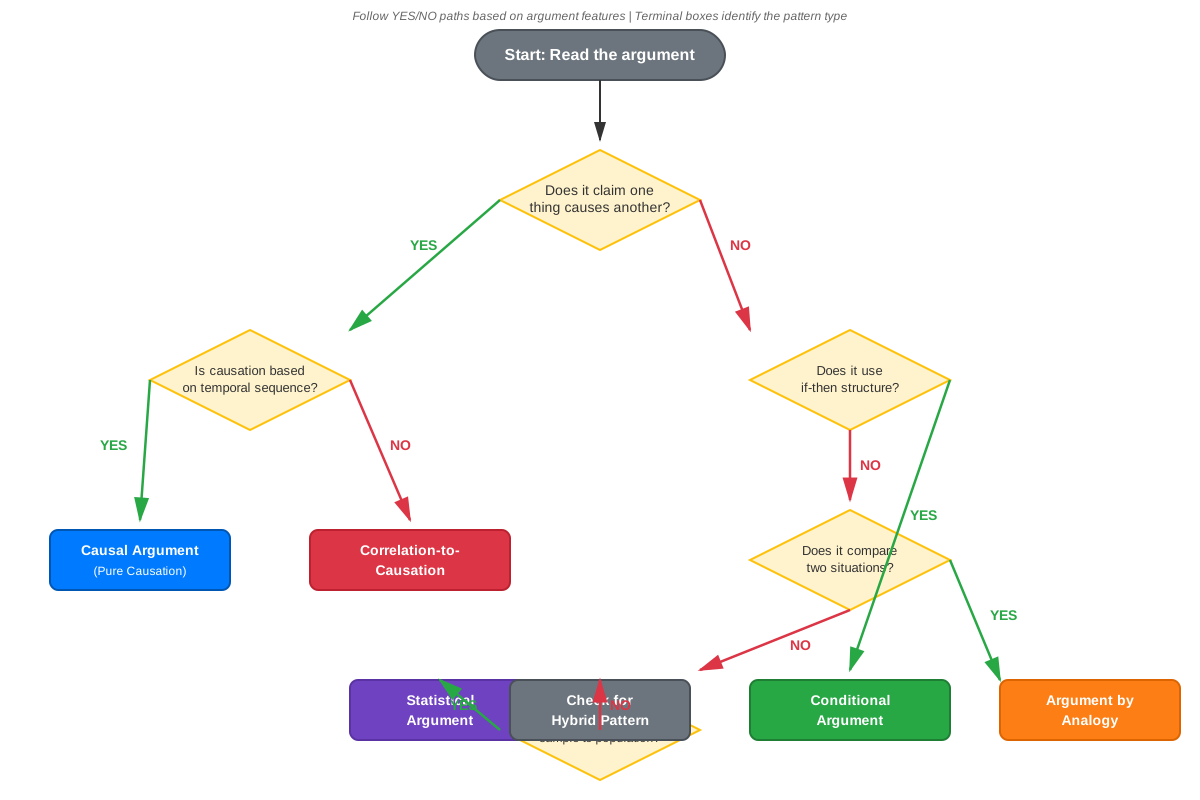
Step 3: Recognize the pattern using trigger words and structural indicators:
Trigger words for causal arguments: "causes," "leads to," "results in," "produces," "brings about," "explains," "is responsible for," "accounts for"
Trigger words for conditional arguments: "if," "only if," "unless," "when," "whenever," "all," "any," "every," "no," "none"
Trigger words for analogical arguments: "similarly," "likewise," "in the same way," "just as," "analogous to," "comparable to"
Trigger words for sampling arguments: "survey," "study," "poll," "sample," "percentage," "proportion," "most," "many"
Trigger words for absence of evidence: "no evidence," "no reason to believe," "lack of evidence," "nothing suggests"
Step 4: Anticipate the characteristic assumptions or weaknesses before looking at answer choices. Each pattern has predictable vulnerabilities:
- Causal: Alternative causes? Reverse causation? Common cause?
- Conditional: Valid inference form? Mistaken reversal or negation?
- Analogical: Relevant differences? Irrelevant similarities?
- Sampling: Representative sample? Adequate size? Bias?
- Absence of evidence: Would evidence exist if claim were true?
Step 5: Eliminate answers that don't address the identified pattern's characteristic issues. If you've identified a causal argument, eliminate answers about conditional logic errors or sampling bias.
Time allocation: Spend 15-20 seconds identifying the pattern and anticipating the answer. This investment pays dividends by making answer choice evaluation faster and more accurate. Students who skip pattern identification often waste 45+ seconds evaluating each answer choice without a clear framework.
Process of elimination tips:
- Eliminate answers that address the wrong pattern (conditional logic answers for causal arguments)
- Eliminate answers that are irrelevant to the conclusion (they might address premises but not the logical leap)
- Eliminate answers that go in the wrong direction (strengthen when you need weaken)
- Keep answers that address the gap between premises and conclusion specific to the identified pattern
Memory Techniques
CAUSAL mnemonic for causal argument assumptions:
- Common cause ruled out
- Alternative explanations eliminated
- Unidirectional (not reversed)
- Sufficient evidence for causation
- Actual correlation exists
- Link is not coincidental
RANDS mnemonic for sampling argument requirements:
- Representative of population
- Adequate sample size
- No self-selection bias
- Data collection method sound
- Sample randomly selected
Conditional Logic Validity Check: "Affirm the Antecedent or Deny the Dependent" (consequent). These are the two valid inference forms. If you affirm the consequent or deny the antecedent, the inference is invalid.
Analogy Strength Visualization: Picture two buildings (the compared situations). The argument claims they'll behave the same way. Strong analogies have:
- Same foundation (relevant similarities)
- No structural differences (absence of relevant differences)
- Same materials (shared characteristics relevant to outcome)
Absence of Evidence Decision Tree:
- Would evidence exist if claim were true?
- If NO → Argument fails
- If YES → Continue
- Would evidence be discoverable?
- If NO → Argument fails
- If YES → Continue
- Has adequate search been conducted?
- If NO → Argument fails
- If YES → Argument has merit
Pattern Recognition Acronym - CCAPS: The five most common patterns spell CCAPS:
- Causal
- Conditional
- Analogy
- Prescriptive
- Sampling
Summary
Common LSAT argument patterns represent recurring logical structures that appear throughout Logical Reasoning sections, with causal arguments, conditional arguments, arguments from analogy, sampling arguments, and arguments from absence of evidence comprising the most frequently tested patterns. Each pattern follows a predictable structure with characteristic assumptions and typical weaknesses. Causal arguments claim one phenomenon produces another and assume no alternative causes, correct causal direction, and genuine causation rather than mere correlation. Conditional arguments establish if-then relationships with only two valid inference forms. Arguments from analogy draw conclusions about one situation based on similarity to another, assuming relevant similarities and no relevant differences. Sampling arguments generalize from samples to populations, requiring representative, adequately sized, randomly selected samples. Arguments from absence of evidence conclude something is false because no evidence supports it, requiring the assumption that evidence would exist and be discoverable if the claim were true. Recognizing these patterns enables test-takers to anticipate assumptions, predict weaknesses, and efficiently evaluate answer choices across all Logical Reasoning question types.
Key Takeaways
- Causal arguments are the most common pattern (20-25% of questions) and typically confuse correlation with causation while failing to rule out alternative explanations, reverse causation, or common causes
- Pattern recognition should be the first step in analyzing any Logical Reasoning argument—identify the pattern, then anticipate its characteristic assumptions and weaknesses
- Conditional arguments have exactly two valid inference forms (affirming the antecedent and contrapositive), while affirming the consequent and denying the antecedent are invalid
- Arguments from analogy succeed or fail based on relevant similarities and the absence of relevant differences, not on superficial or irrelevant similarities
- Sampling arguments require representative samples more than large samples—a biased sample of 10,000 is weaker than a random sample of 500
- Multiple patterns often appear in combination (correlation → causation → prescription), creating compound assumptions that must all be satisfied for the argument to succeed
- Trigger words provide rapid pattern identification—"causes" signals causal reasoning, "if/then" signals conditional reasoning, "similarly" signals analogy, "survey/study" signals sampling
Related Topics
Assumption Questions: Understanding argument patterns is foundational for assumption questions because each pattern has characteristic unstated premises. Mastering patterns enables students to predict what assumptions the argument requires before evaluating answer choices.
Flaw Questions: Each argument pattern has typical flaws—causal arguments confuse correlation with causation, conditional arguments make invalid inferences, analogical arguments rely on weak comparisons. Pattern recognition makes flaw identification systematic rather than intuitive.
Strengthen and Weaken Questions: These questions test understanding of what evidence would support or undermine each pattern. Causal arguments are strengthened by ruling out alternatives and weakened by providing alternative explanations. Analogical arguments are strengthened by relevant similarities and weakened by relevant differences.
Parallel Reasoning Questions: These questions require matching argument structures, which becomes manageable when approached through pattern recognition. Identifying that both arguments follow causal reasoning or conditional logic narrows the answer choices dramatically.
Formal Logic and Conditional Chains: Advanced conditional reasoning builds on the conditional argument pattern, introducing complex chains, multiple sufficient or necessary conditions, and formal logic notation.
Practice CTA
Now that you understand the major argument patterns that appear throughout LSAT Logical Reasoning sections, it's time to put this knowledge into practice. Attempt the practice questions to test your ability to identify patterns, anticipate their characteristic assumptions and weaknesses, and apply this understanding to solve LSAT-style problems. Use the flashcards to reinforce pattern recognition and memorize the characteristic features of each pattern. Remember: pattern recognition is a skill that improves dramatically with deliberate practice. Each question you analyze strengthens your ability to spot patterns instantly, transforming what initially seems like a collection of unique puzzles into familiar structures you can navigate with confidence and speed. Your investment in mastering these patterns will pay dividends across every Logical Reasoning question type you encounter.
Sign up free to keep reading
Create a free AnvayaPrep account to finish this LSAT guide on Common LSAT argument patterns — plus flashcards and practice questions.