Overview
In LSAT Logical Reasoning, the ability to identify and understand conclusions forms the bedrock of argument analysis. A conclusion is the main claim or point that an argument is trying to establish—the statement that the author wants the reader to accept based on the evidence provided. Every argument on the LSAT contains a conclusion, and recognizing it quickly and accurately is essential for success across multiple question types. Whether the question asks you to identify the main point, strengthen or weaken an argument, find an assumption, or evaluate reasoning, you must first pinpoint what the author is actually arguing.
Understanding conclusions is not merely about finding the final sentence of a passage. Conclusions can appear anywhere in an argument—at the beginning, middle, or end—and they are often disguised by complex sentence structures or embedded within multiple claims. Mastering conclusion identification requires recognizing structural indicators, understanding the logical flow of reasoning, and distinguishing between the main point and supporting premises. This skill directly impacts performance on approximately 25-30% of all Logical Reasoning questions, making it one of the highest-yield topics in LSAT preparation.
The relationship between conclusions and other argument fundamentals is hierarchical and interconnected. Conclusions represent the "destination" of an argument, while premises serve as the "path" to reach that destination. Assumptions bridge gaps between premises and conclusions, while inferences extend beyond what's explicitly stated. Understanding conclusions provides the foundation for analyzing argument structure, evaluating logical validity, and identifying reasoning flaws—all critical competencies tested throughout the logical reasoning sections of the LSAT.
Learning Objectives
- [ ] Identify how Conclusions appears in LSAT questions
- [ ] Explain the reasoning pattern behind Conclusions
- [ ] Apply Conclusions to solve LSAT-style problems accurately
- [ ] Distinguish between main conclusions and subsidiary conclusions within complex arguments
- [ ] Recognize conclusion indicator words and structural patterns that signal conclusions
- [ ] Differentiate conclusions from premises, background information, and counterarguments
- [ ] Analyze arguments where conclusions are implied rather than explicitly stated
Prerequisites
- Basic sentence structure and grammar: Understanding subject-verb relationships and clause structure helps parse complex argumentative sentences where conclusions may be embedded.
- Reading comprehension fundamentals: The ability to identify main ideas versus supporting details in general reading passages translates directly to distinguishing conclusions from premises.
- Logical connectives: Familiarity with words like "therefore," "because," "since," and "thus" provides initial clues about argument structure, though deeper analysis is required for LSAT-level questions.
Why This Topic Matters
In real-world contexts, identifying conclusions is fundamental to critical thinking across professional fields. Lawyers must identify the central claim in legal arguments, business analysts must recognize the main recommendations in reports, and researchers must distinguish hypotheses from supporting data. The ability to cut through complex reasoning and identify what someone is actually arguing—rather than what they're using as support—is invaluable in any analytical profession.
On the LSAT, conclusion-related content appears with remarkable frequency. Approximately 25-30% of Logical Reasoning questions directly test conclusion identification, including Main Point questions (which explicitly ask for the conclusion), Point at Issue questions (which require identifying what two speakers are disagreeing about), and Role of Statement questions (which ask whether a particular claim serves as a conclusion or premise). Additionally, every other question type—Strengthen, Weaken, Assumption, Flaw, Parallel Reasoning—requires accurate conclusion identification as a prerequisite step before applying the specific question task.
Common manifestations in LSAT passages include: arguments where the conclusion appears in the middle of the passage with additional commentary following it; complex arguments with multiple layers where a subsidiary conclusion serves as a premise for the main conclusion; arguments that present counterarguments before stating the author's actual position; and arguments where the conclusion is implied by the overall reasoning but never explicitly stated. The test makers deliberately construct arguments to challenge superficial reading strategies, rewarding students who can systematically analyze argument structure.
Core Concepts
Definition and Function of Conclusions
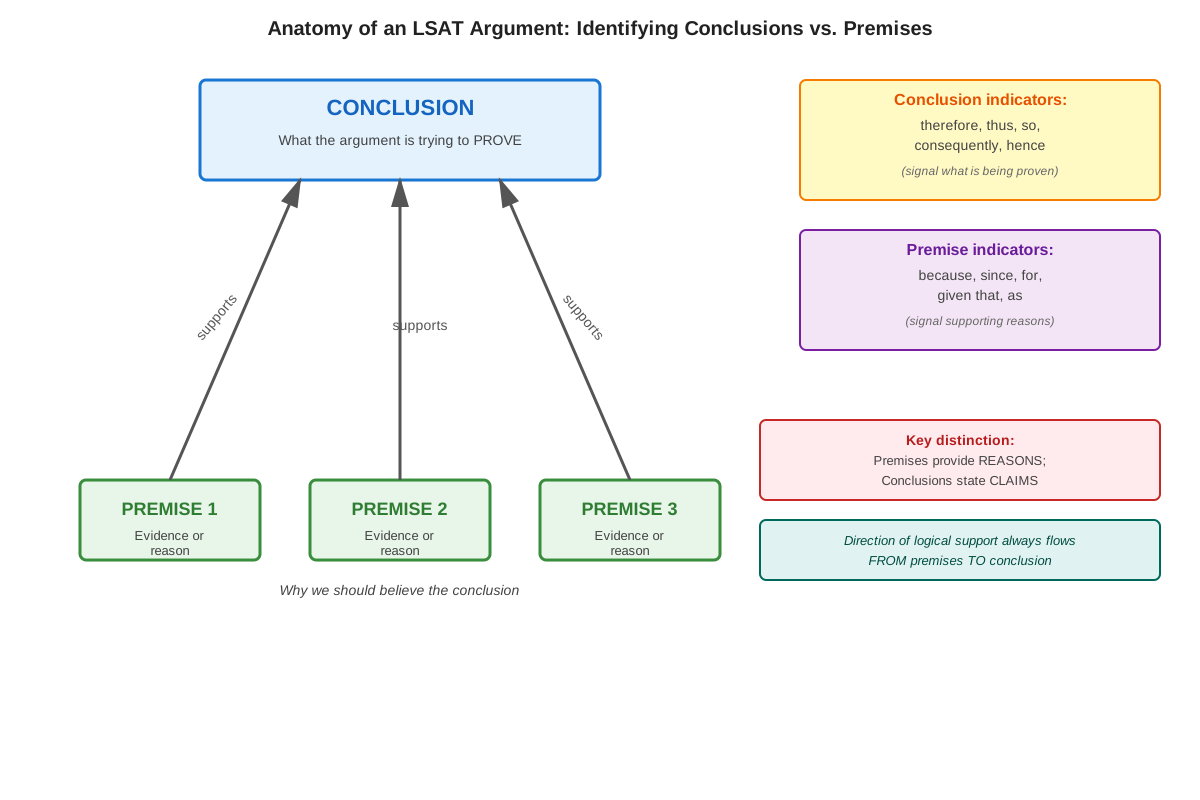
A conclusion is the primary claim that an argument attempts to establish or prove. It represents the author's main point—the statement that all other parts of the argument are designed to support. In logical structure, the conclusion is the "target" of the reasoning: if the premises are true, they should make the conclusion more likely to be true or provide justification for accepting it.
Conclusions serve several functions in argumentative discourse. First, they express the author's position on a debatable issue. Second, they provide the focal point around which all evidence and reasoning is organized. Third, they represent the claim that requires justification—unlike premises, which are offered as given facts or accepted starting points. Understanding this functional role helps distinguish conclusions from other statement types even when structural indicators are absent.
Conclusion Indicator Words
Conclusion indicator words are linguistic signals that typically precede or follow a conclusion. These words explicitly mark the logical relationship between statements, indicating that what follows (or precedes) is the claim being supported rather than the supporting evidence. Common conclusion indicators include:
- Therefore
- Thus
- Hence
- Consequently
- So
- It follows that
- This shows that
- This demonstrates that
- This proves that
- We can conclude that
- The point is that
- This means that
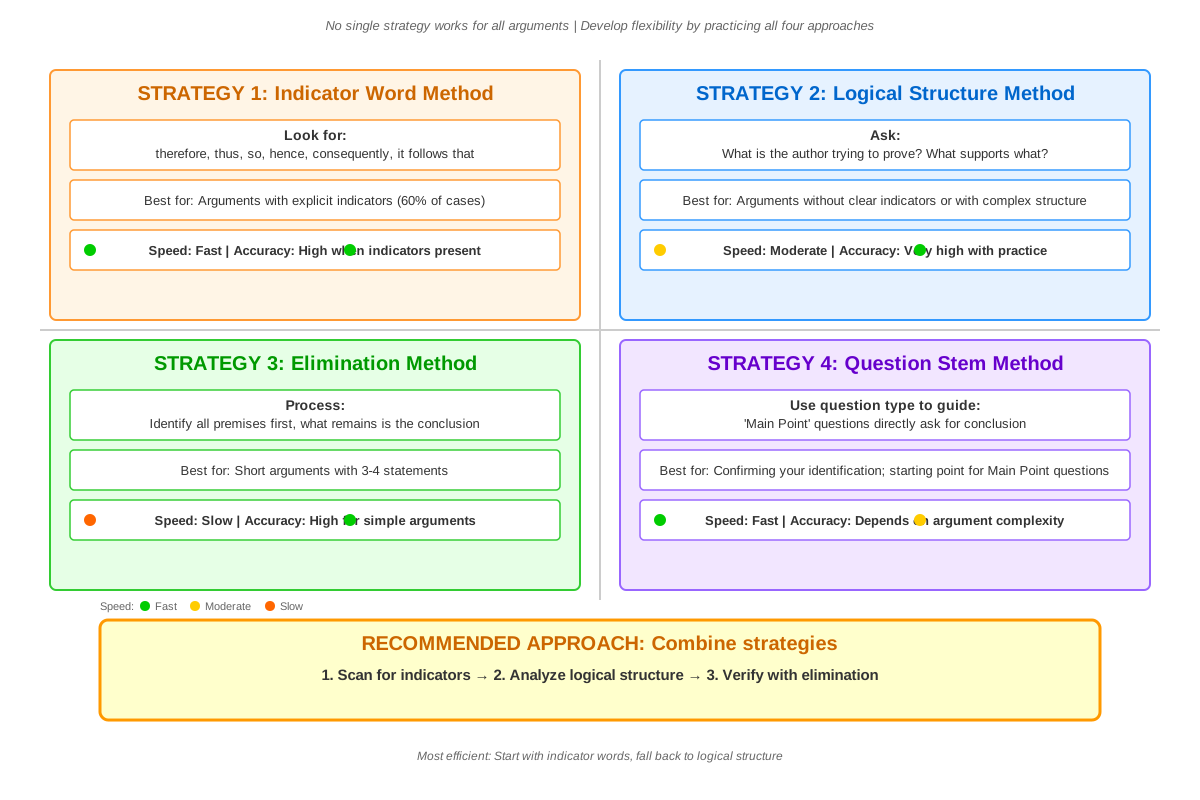
However, reliance solely on indicator words is insufficient for LSAT success. Test makers frequently construct arguments without explicit indicators, place indicator words in misleading positions, or use them to mark subsidiary rather than main conclusions. Indicator words should serve as initial clues rather than definitive proof of conclusion location.
Positional Patterns
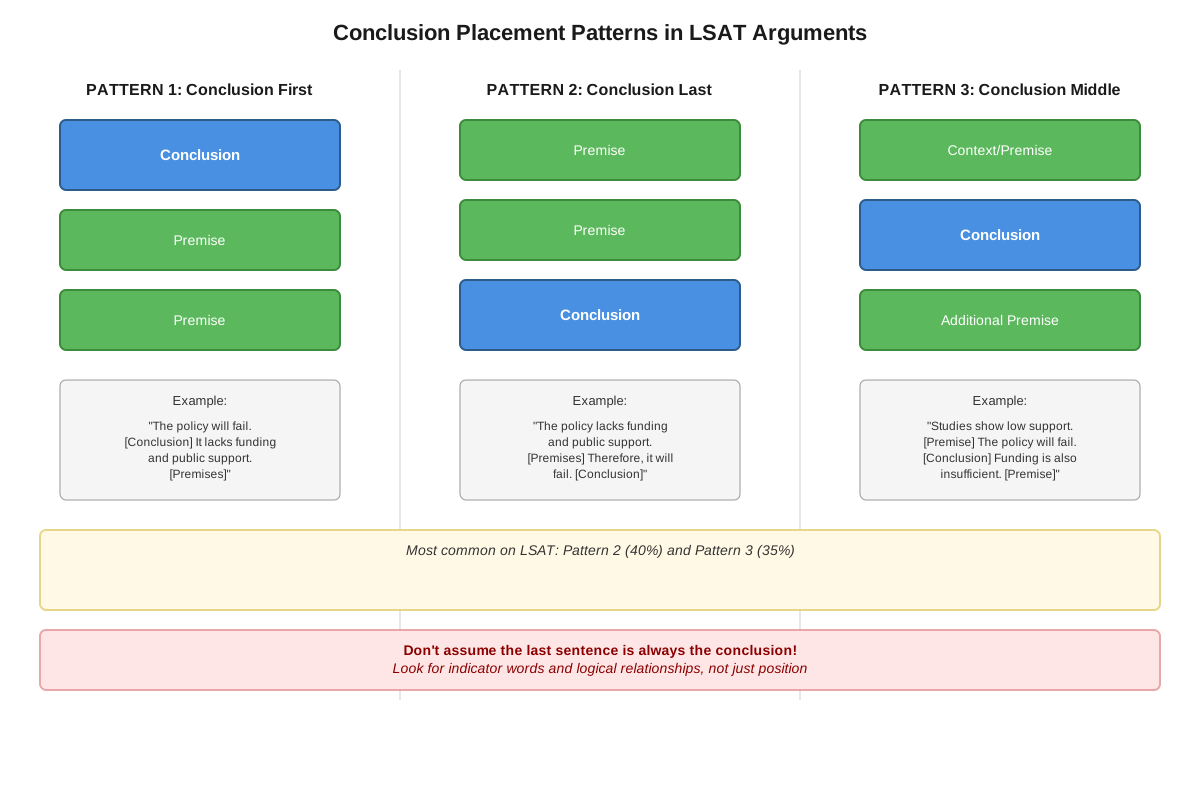
Conclusions can appear in any position within an LSAT argument:
Initial Position: The conclusion appears in the first sentence, followed by supporting premises. This structure is common in scientific and academic writing.
Example: "The new policy will reduce costs. Implementation requires minimal training, and similar policies have succeeded elsewhere."
Final Position: The conclusion appears in the last sentence, following the presentation of evidence. This structure mirrors natural persuasive flow.
Example: "Implementation requires minimal training, and similar policies have succeeded elsewhere. Therefore, the new policy will reduce costs."
Middle Position: The conclusion appears in the middle, with some premises preceding it and additional support or elaboration following it. This structure is particularly common on the LSAT and challenges students who assume conclusions always appear at the end.
Example: "Implementation requires minimal training. The new policy will reduce costs. Similar policies have succeeded elsewhere, and our budget allows for the transition."
Main Conclusions vs. Subsidiary Conclusions
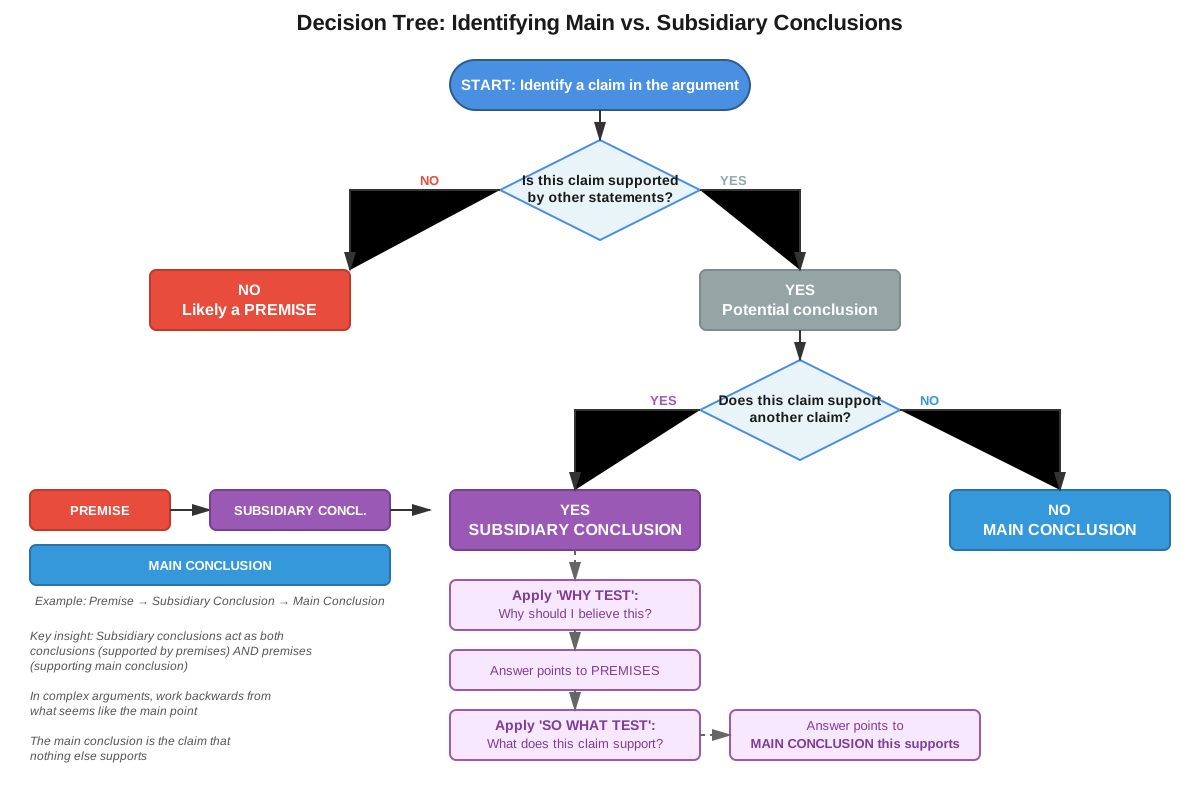
Complex arguments often contain multiple conclusions at different levels of the logical hierarchy. A subsidiary conclusion (also called an intermediate conclusion or sub-conclusion) is a claim that is supported by some premises but itself serves as a premise for the main conclusion. The main conclusion is the ultimate point of the argument—the claim that is supported by everything else but doesn't itself support any other claim.
| Feature | Main Conclusion | Subsidiary Conclusion |
|---|---|---|
| Support received | Supported by all other elements | Supported by some premises |
| Support given | Supports nothing else | Supports the main conclusion |
| Logical priority | Ultimate target of argument | Intermediate step in reasoning |
| Removal impact | Argument loses its point | Argument structure weakens but main point remains |
Identifying the main conclusion requires asking: "What is the ultimate point the author wants me to accept?" and "Which claim is supported by everything else but doesn't support anything further?"
Implied Conclusions
Some LSAT arguments present premises and evidence without explicitly stating the conclusion. These implied conclusions require the reader to infer what the author is arguing based on the logical direction of the evidence. While less common than explicit conclusions, implied conclusions appear regularly enough to warrant systematic practice.
To identify implied conclusions, examine what all the premises collectively point toward. Ask: "If someone presented these facts to me, what would they be trying to convince me of?" The implied conclusion should be the most reasonable inference that the premises are designed to support.
Distinguishing Conclusions from Other Statement Types
Conclusions vs. Premises: Premises provide support; conclusions receive support. A simple test: If statement A is offered as a reason to believe statement B, then A is a premise and B is a conclusion.
Conclusions vs. Background Information: Background information provides context but doesn't directly support the conclusion. It sets the stage for the argument without serving as evidence.
Conclusions vs. Counterarguments: Counterarguments present opposing views that the author will refute. They represent positions the author disagrees with, not the author's own conclusion.
Conclusions vs. Predictions: While conclusions can be predictive, not all predictions are conclusions. A prediction might serve as a premise supporting a broader conclusion about policy or action.
Structural Analysis Method
A systematic approach to conclusion identification involves:
- Read the entire argument before attempting to identify the conclusion
- Identify all claims (statements that could be true or false)
- Map support relationships by asking which statements support which others
- Locate the ultimate target of support—the claim that receives support but gives none
- Verify with the "because test": The argument structure should make sense when phrased as "Conclusion BECAUSE premise(s)"
- Check for subsidiary conclusions by identifying any claims that both receive and give support
Concept Relationships
The concepts within conclusion identification form an integrated analytical framework. Conclusion indicator words serve as initial signals that guide attention toward potential conclusions, but they must be verified through structural analysis to distinguish main conclusions from subsidiary conclusions. Positional patterns interact with indicator words—when a conclusion appears in the middle position, subsequent statements might elaborate on implications rather than provide additional support, which can be clarified by mapping support relationships.
The distinction between main and subsidiary conclusions depends entirely on understanding the hierarchical structure of support relationships. A subsidiary conclusion functions as both a conclusion (receiving support from some premises) and a premise (providing support to the main conclusion), creating a logical chain: Premise → Subsidiary Conclusion → Main Conclusion. This chain structure connects directly to the prerequisite understanding of logical connectives, as different connectives signal different positions in the support hierarchy.
Implied conclusions represent the most advanced application of conclusion identification, requiring synthesis of all other concepts. When no explicit conclusion exists, students must use their understanding of support relationships, typical argument structures, and the logical direction of premises to infer what the author is arguing. This skill builds on the ability to distinguish conclusions from other statement types, as recognizing what is NOT the conclusion (background, counterarguments, predictions) helps narrow the field of possibilities.
The relationship to broader argument fundamentals flows outward from conclusions: Once the conclusion is identified, premises can be recognized as the statements supporting it, assumptions can be identified as the unstated connections between premises and conclusion, and inferences can be evaluated based on whether they follow from the conclusion or go beyond it. In this way, conclusion identification serves as the entry point for all subsequent argument analysis.
High-Yield Facts
⭐ The conclusion is the claim that receives support from other statements but does not itself support any other claim in the argument.
⭐ Conclusion indicator words (therefore, thus, hence, so) provide clues but are not definitive—always verify through structural analysis.
⭐ Conclusions can appear at the beginning, middle, or end of an argument; position alone does not determine conclusion status.
⭐ Main Point questions explicitly ask for the conclusion and typically appear 2-3 times per Logical Reasoning section.
⭐ Every LSAT Logical Reasoning question requires identifying the conclusion as a prerequisite step, even when not explicitly asked.
- Subsidiary conclusions both receive support (from premises) and provide support (to the main conclusion), creating a logical hierarchy.
- The "because test" helps verify conclusions: the argument should make sense when phrased as "[Conclusion] because [premises]."
- Background information and counterarguments are not conclusions, even though they may appear prominently in the argument.
- When a conclusion appears in the middle of an argument, statements following it typically elaborate on implications or provide additional context rather than additional support.
- Implied conclusions require inferring the author's main point from the logical direction of the premises when no explicit conclusion is stated.
- Complex arguments may contain multiple claims that look like conclusions; the main conclusion is the one that represents the ultimate point of the entire argument.
- Conclusion identification accuracy directly impacts performance on Strengthen, Weaken, Assumption, Flaw, and Parallel Reasoning questions.
Quick check — test yourself on Conclusions so far.
Try Flashcards →Common Misconceptions
Misconception: The conclusion is always the last sentence of the argument.
Correction: Conclusions can appear anywhere—beginning, middle, or end. LSAT test makers frequently place conclusions in the middle with additional commentary following, specifically to challenge students who rely on positional assumptions rather than structural analysis.
Misconception: Any sentence with "therefore" or "thus" is the main conclusion.
Correction: Conclusion indicator words can mark subsidiary conclusions or even appear in premises that draw intermediate inferences. Always verify by checking whether the statement receives support from everything else without supporting anything further.
Misconception: The longest or most complex sentence is usually the conclusion.
Correction: Conclusions are often stated simply and directly, while premises may contain complex data, statistics, or detailed evidence. Complexity and length correlate with information density, not with conclusion status.
Misconception: If an argument presents multiple viewpoints, the last viewpoint mentioned is the author's conclusion.
Correction: Arguments often present counterarguments or alternative positions before stating the author's actual conclusion. The author's conclusion is the claim that the evidence in the argument is designed to support, regardless of when other viewpoints are mentioned.
Misconception: Background information at the beginning of an argument is never part of the conclusion.
Correction: While background information typically provides context rather than serving as the conclusion, some arguments state their conclusion first and then provide background that serves as premises. The functional role (receiving vs. providing support) matters more than the type of information.
Misconception: Every argument has exactly one conclusion.
Correction: Arguments can have both main conclusions and subsidiary conclusions. The key is identifying which conclusion is the ultimate point (main conclusion) versus which conclusions serve as intermediate steps (subsidiary conclusions) in the reasoning chain.
Misconception: Implied conclusions are rare and can be ignored in LSAT preparation.
Correction: While less common than explicit conclusions, implied conclusions appear regularly enough (approximately 5-10% of arguments) that students must practice identifying them. Additionally, recognizing when a conclusion is implied versus explicit helps avoid misidentifying premises as conclusions.
Worked Examples
Example 1: Middle-Position Conclusion with Subsidiary Conclusion
Argument: "Recent studies show that regular exercise reduces stress hormones in the bloodstream. Therefore, exercise improves mental health. This is why employers should offer gym memberships to all employees. Companies that invest in employee wellness see higher productivity and lower healthcare costs."
Analysis:
Step 1 - Identify all claims:
- Recent studies show regular exercise reduces stress hormones
- Exercise improves mental health
- Employers should offer gym memberships to all employees
- Companies that invest in employee wellness see higher productivity and lower healthcare costs
Step 2 - Map support relationships:
- Claim 1 supports Claim 2 (indicated by "therefore")
- Claim 2 supports Claim 3 (indicated by "this is why")
- Claim 4 supports Claim 3
Step 3 - Identify the hierarchy:
- Claim 2 is a subsidiary conclusion (receives support from Claim 1, provides support to Claim 3)
- Claim 3 is the main conclusion (receives support from Claims 2 and 4, provides support to nothing)
Step 4 - Verify with the because test:
"Employers should offer gym memberships to all employees BECAUSE exercise improves mental health AND companies that invest in employee wellness see higher productivity and lower healthcare costs." ✓ This makes logical sense.
Answer: The main conclusion is "Employers should offer gym memberships to all employees." This appears in the middle of the argument, with supporting evidence both before and after it.
Connection to Learning Objectives: This example demonstrates how conclusions appear in LSAT questions (middle position with subsidiary conclusion), explains the reasoning pattern (hierarchical support structure), and applies the systematic method to solve the problem accurately.
Example 2: Implied Conclusion with Counterargument
Argument: "Some critics argue that the new traffic law will reduce personal freedom. However, the law only restricts behavior that endangers others. Studies from cities with similar laws show a 30% reduction in traffic fatalities. The law includes provisions for emergency exceptions and has been endorsed by both safety advocates and civil liberties organizations."
Analysis:
Step 1 - Identify statement types:
- "Some critics argue..." = Counterargument (opposing view)
- "However, the law only restricts..." = Response to counterargument
- "Studies from cities..." = Premise (evidence)
- "The law includes provisions..." = Premise (evidence)
- No explicit conclusion statement
Step 2 - Determine what the premises collectively support:
All the evidence (limited restrictions, proven effectiveness, emergency exceptions, broad endorsement) points toward a positive evaluation of the law.
Step 3 - Formulate the implied conclusion:
The author is arguing that "The new traffic law should be supported/adopted" or "The critics' concerns about the new traffic law are unfounded."
Step 4 - Verify logical coherence:
"The new traffic law should be supported BECAUSE it only restricts dangerous behavior, has proven effective in reducing fatalities, includes reasonable exceptions, and has broad support." ✓ This captures the argument's logical direction.
Answer: The implied conclusion is that the new traffic law is justified or should be supported. The argument structure presents a counterargument and then systematically refutes it with evidence, a common pattern when conclusions are implied rather than stated.
Connection to Learning Objectives: This example shows how conclusions appear in LSAT questions (implied rather than explicit), explains the reasoning pattern (counterargument followed by refutation), and applies analytical skills to identify the unstated main point accurately.
Exam Strategy
Systematic Approach for Main Point Questions
When a question explicitly asks "Which one of the following most accurately expresses the main conclusion?" follow this process:
- Read the argument completely before looking at answer choices
- Identify the conclusion independently using structural analysis
- Predict the answer in your own words
- Scan answer choices for a match to your prediction
- Eliminate answers that are premises, background, or subsidiary conclusions
- Verify the remaining answer using the "because test"
Trigger Words and Phrases
High-priority conclusion indicators (most reliable):
- "Therefore" / "Thus" / "Hence" / "So"
- "It follows that"
- "This shows/demonstrates/proves that"
- "We can conclude that"
Medium-priority indicators (require verification):
- "This means that"
- "This suggests that"
- "The point is"
- "Clearly" / "Obviously"
Premise indicators (signal what is NOT the conclusion):
- "Because" / "Since" / "For"
- "Given that"
- "As indicated by"
- "The reason is"
Process of Elimination Tips
Eliminate answers that:
- Restate premises or evidence without making the main claim
- Represent counterarguments or opposing views
- Go beyond what the argument actually claims (too strong)
- Focus on subsidiary points rather than the main point
- Provide background context without stating the argument's target
Keep answers that:
- Represent the ultimate point the author wants to establish
- Are supported by multiple other statements in the argument
- Match the logical direction of the reasoning
- Could be preceded by "therefore" based on the argument's structure
Time Allocation
For Main Point questions: 60-75 seconds total
- 20-30 seconds: Read and analyze the argument
- 10-15 seconds: Identify the conclusion independently
- 20-30 seconds: Evaluate answer choices
- 10 seconds: Verify and select
For other question types where conclusion identification is a prerequisite step: 15-20 seconds to identify the conclusion before proceeding to the specific question task.
Common Traps to Avoid
The "Last Sentence Trap": Don't automatically select the last sentence as the conclusion. Read structurally, not positionally.
The "Indicator Word Trap": Don't assume every "therefore" marks the main conclusion. Verify through support relationships.
The "Complexity Trap": Don't assume the most complex or detailed statement is the conclusion. Conclusions are often stated simply.
The "First Mention Trap": In arguments with multiple viewpoints, don't confuse the first position mentioned with the author's conclusion.
Memory Techniques
The SUPPORT Acronym for Conclusion Identification
Scan for indicator words (therefore, thus, hence)
Understand the argument completely before deciding
Position is irrelevant—check beginning, middle, and end
Premises provide support; conclusions receive it
One claim receives support from all others—that's the main conclusion
Reverse the "because test" to verify
Target of the argument is the conclusion
Visualization Strategy: The Argument Tree
Visualize arguments as trees:
- Roots = Premises (foundation, providing support)
- Trunk = Main Conclusion (central structure, receiving support from roots)
- Branches = Subsidiary Conclusions (intermediate, connecting roots to trunk)
- Leaves = Implications or elaborations (extending from the conclusion)
When analyzing an argument, mentally draw this tree structure to see which claim serves as the trunk (main conclusion) versus the roots (premises).
The "Because Test" Mnemonic
Build the structure: [Conclusion] because [premises]
Evaluate if it makes logical sense
Check that the conclusion receives support
Avoid confusing premises with conclusions
Use this test for every argument
Structure should flow naturally
Ensure the conclusion is the ultimate point
Positional Pattern Memory Aid
"BEginning, Middle, End—ALL are fair game"
Remember: B.M.E. = A.L.L. (Beginning, Middle, End = All Locations Likely)
This reminds you to check every position rather than assuming conclusions appear in one standard location.
Summary
Conclusions represent the central claims that arguments attempt to establish—the ultimate points that authors want readers to accept based on the evidence provided. Mastering conclusion identification requires understanding that conclusions receive support from premises but do not themselves support other claims, making them the logical target of argumentative reasoning. Conclusion indicator words like "therefore," "thus," and "hence" provide helpful clues, but structural analysis through mapping support relationships is essential for accuracy, especially when conclusions appear in non-final positions or when subsidiary conclusions create hierarchical complexity. The systematic approach involves reading the complete argument, identifying all claims, mapping which statements support which others, and locating the ultimate target of support through the "because test." This foundational skill enables success across all Logical Reasoning question types, as every argument analysis begins with accurately identifying what the author is actually arguing. Students must overcome common misconceptions about positional patterns and indicator word reliability, instead developing the analytical discipline to distinguish main conclusions from premises, background information, counterarguments, and subsidiary conclusions through functional role rather than superficial features.
Key Takeaways
- Conclusions are defined by function, not position: They receive support from all other elements but provide support to nothing else in the argument.
- Structural analysis trumps indicator words: While "therefore" and "thus" provide clues, always verify through mapping support relationships and applying the "because test."
- Main Point questions appear 2-3 times per section and test conclusion identification directly, but every Logical Reasoning question requires this skill as a prerequisite.
- Subsidiary conclusions create hierarchical complexity: They both receive support (from premises) and provide support (to the main conclusion), forming intermediate steps in reasoning chains.
- The systematic approach—read completely, identify claims, map support, locate ultimate target, verify—ensures accuracy even in complex arguments with multiple layers.
- Common traps include assuming conclusions appear last, over-relying on indicator words, and confusing complexity with conclusion status; avoid these through disciplined structural analysis.
- Implied conclusions require inferring the author's main point from the logical direction of premises, a skill that builds on the ability to distinguish conclusions from other statement types.
Related Topics
Premises and Evidence: Understanding how premises function to support conclusions enables deeper analysis of argument strength and validity. Mastering conclusions provides the foundation for identifying what counts as evidence versus what counts as the claim being established.
Assumptions: Once conclusions are identified, assumptions can be recognized as the unstated connections between premises and conclusions. The gap between explicit support and the conclusion represents the assumption space.
Argument Structure: Advanced analysis of how arguments are constructed, including complex structures with multiple layers of reasoning, builds directly on the ability to identify main and subsidiary conclusions.
Main Point Questions: Specific question type that explicitly tests conclusion identification, requiring application of all the skills developed in this topic.
Strengthen and Weaken Questions: These question types require identifying the conclusion first, then evaluating what would make it more or less likely to be true based on the premises.
Practice CTA
Now that you understand the fundamental principles of conclusion identification, it's time to apply these skills to actual LSAT-style problems. The practice questions and flashcards will challenge you to identify conclusions in various positions, distinguish main from subsidiary conclusions, and recognize implied conclusions—all essential skills for test day success. Remember that conclusion identification is not just tested directly in Main Point questions; it's the critical first step for every Logical Reasoning question you'll encounter. Consistent practice with these materials will build the analytical reflexes you need to quickly and accurately identify conclusions under timed conditions, setting the foundation for mastery across all Logical Reasoning question types. Approach each practice problem systematically, and you'll develop the confidence and precision that separate top scorers from the rest.
Sign up free to keep reading
Create a free AnvayaPrep account to finish this LSAT guide on Conclusions — plus flashcards and practice questions.