Overview
Logical force is a foundational concept in LSAT logical reasoning that describes the strength and nature of the connection between an argument's premises and its conclusion. Understanding logical force enables test-takers to distinguish between arguments that claim absolute certainty versus those that suggest probability or possibility. This distinction is critical because the LSAT frequently tests whether students can identify when an author overstates their case, draws an inappropriately strong conclusion from limited evidence, or conversely, makes a claim that is appropriately modest given the supporting premises.
Mastering logical force is essential for success on the LSAT because it underlies virtually every question type in the Logical Reasoning section. Whether evaluating assumptions, identifying flaws, strengthening or weakening arguments, or determining what must be true versus what could be true, students must recognize the degree of certainty an argument claims. An argument with strong logical force asserts that its conclusion necessarily follows from its premises, while an argument with weak logical force suggests only that its conclusion is likely, possible, or probable. The LSAT exploits students' inability to recognize these distinctions by presenting arguments where the logical force of the conclusion exceeds what the premises can support—a common flaw pattern.
Within argument fundamentals, logical force connects intimately with premise-conclusion structure, assumption identification, and validity assessment. It serves as the bridge between understanding what an argument says and evaluating whether the argument succeeds in proving its point. Students who master logical force gain a powerful analytical tool that applies across all Logical Reasoning question types and significantly improves their ability to predict correct answers before reviewing answer choices.
Learning Objectives
- [ ] Identify how logical force appears in LSAT questions
- [ ] Explain the reasoning pattern behind logical force
- [ ] Apply logical force to solve LSAT-style problems accurately
- [ ] Distinguish between strong logical force (necessity/certainty) and weak logical force (probability/possibility) in arguments
- [ ] Recognize when an argument's conclusion contains logical force that exceeds what its premises support
- [ ] Evaluate whether answer choices in Strengthen/Weaken questions appropriately match the logical force of the original argument
Prerequisites
- Basic argument structure: Understanding premises and conclusions is necessary because logical force describes the relationship between these components
- Indicator words: Familiarity with conclusion and premise indicators helps identify where logical force claims appear in arguments
- Deductive vs. inductive reasoning: This distinction provides the framework for understanding different types of logical force
- Conditional reasoning basics: Many strong logical force claims involve conditional relationships that guarantee conclusions
Why This Topic Matters
Logical force appears in approximately 60-70% of all Logical Reasoning questions on the LSAT, making it one of the highest-yield concepts for test preparation. While not always explicitly tested, understanding logical force is the underlying skill required to correctly answer Flaw questions (where conclusions often claim too much), Assumption questions (where the gap between premises and conclusion must be bridged), Strengthen/Weaken questions (where the degree of impact matters), and Must Be True/Most Strongly Supported questions (where the logical force of the correct answer must match what the stimulus supports).
In real-world applications, recognizing logical force helps professionals evaluate the strength of legal arguments, scientific claims, policy recommendations, and everyday reasoning. Lawyers must distinguish between what evidence proves beyond reasonable doubt versus what it merely suggests. Scientists differentiate between findings that demonstrate causation versus correlation. Policy analysts assess whether data supports definitive recommendations or merely indicates trends worth monitoring.
On the LSAT, logical force most commonly appears in questions that ask students to identify reasoning flaws, particularly when arguments move from limited evidence to overly strong conclusions. For example, an argument might observe a correlation and conclude causation (moving from weak evidence to a strong causal claim), or generalize from a small sample to an entire population (moving from limited data to a universal conclusion). The test also frequently presents Strengthen/Weaken questions where wrong answers fail because they don't match the logical force of the argument—attempting to prove something with certainty when the argument only claims probability, or vice versa.
Core Concepts
Defining Logical Force
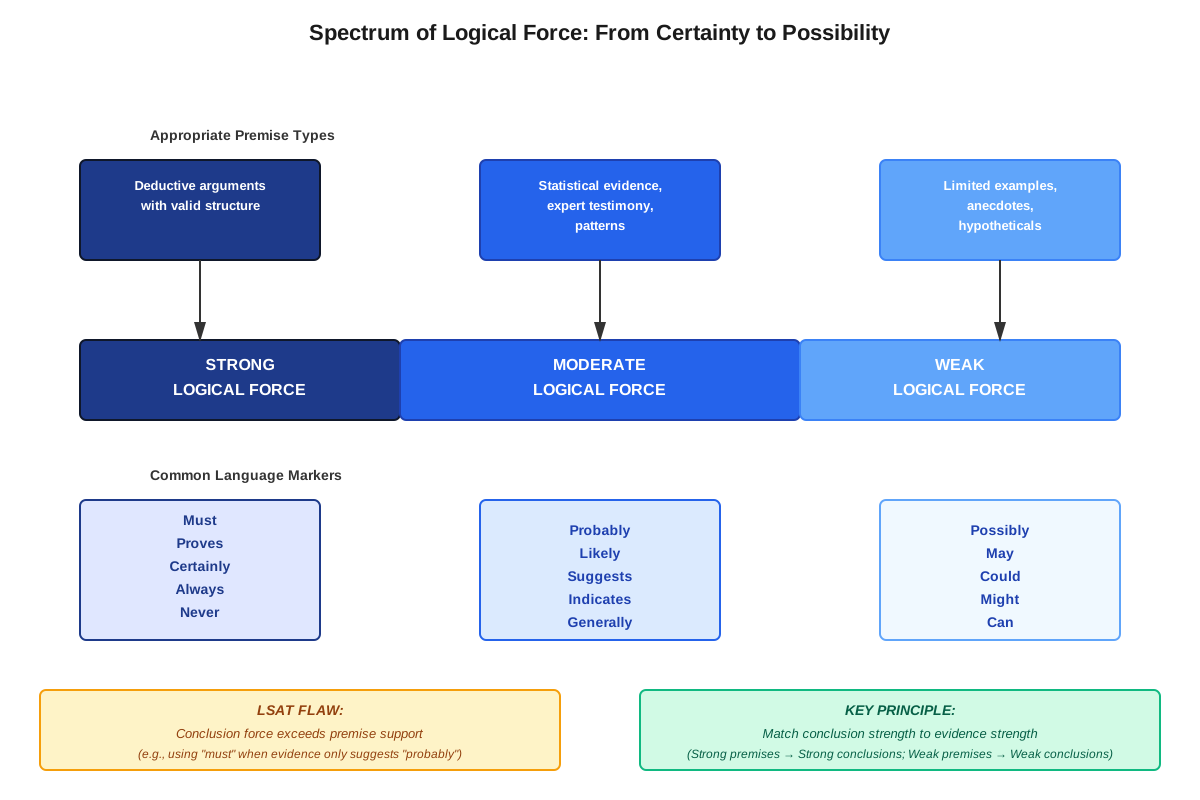
Logical force refers to the degree of certainty or strength with which an argument's premises are claimed to support its conclusion. It exists on a spectrum from absolute certainty (the conclusion must be true if the premises are true) to mere possibility (the conclusion could be true if the premises are true). Understanding this spectrum is crucial because the LSAT tests whether students can identify when an argument's logical force is appropriate given its evidence.
Arguments with strong logical force use language indicating necessity, certainty, or universality. These arguments claim their conclusions are guaranteed, proven, or must follow from the premises. Common indicators include: "must," "certainly," "proves," "establishes," "demonstrates," "always," "never," "all," "none," "impossible," and "necessary." When an argument uses strong logical force appropriately, its premises genuinely guarantee the conclusion (as in valid deductive arguments).
Arguments with weak logical force use language indicating probability, likelihood, or possibility. These arguments claim their conclusions are suggested, supported, or made more likely by the premises. Common indicators include: "probably," "likely," "suggests," "indicates," "supports," "may," "might," "could," "some," "most," "tends to," and "evidence for." Weak logical force is appropriate when premises make a conclusion more plausible without guaranteeing it.
The Logical Force Spectrum
| Strength Level | Language Indicators | Claim Type | Example |
|---|---|---|---|
| Absolute Certainty | must, proves, certainly, always, all | Deductive/Necessary | "All mammals are warm-blooded. Whales are mammals. Therefore, whales must be warm-blooded." |
| High Probability | very likely, almost certainly, strongly suggests | Strong Inductive | "95% of patients with these symptoms have the disease. This patient has these symptoms. Therefore, this patient very likely has the disease." |
| Moderate Probability | probably, likely, suggests | Moderate Inductive | "Most students who study extensively pass the exam. Sarah studied extensively. Therefore, Sarah will probably pass." |
| Possibility | may, might, could, possible | Weak Inductive | "Some people who exercise regularly lose weight. John exercises regularly. Therefore, John might lose weight." |
Logical Force Mismatches: The Core LSAT Flaw
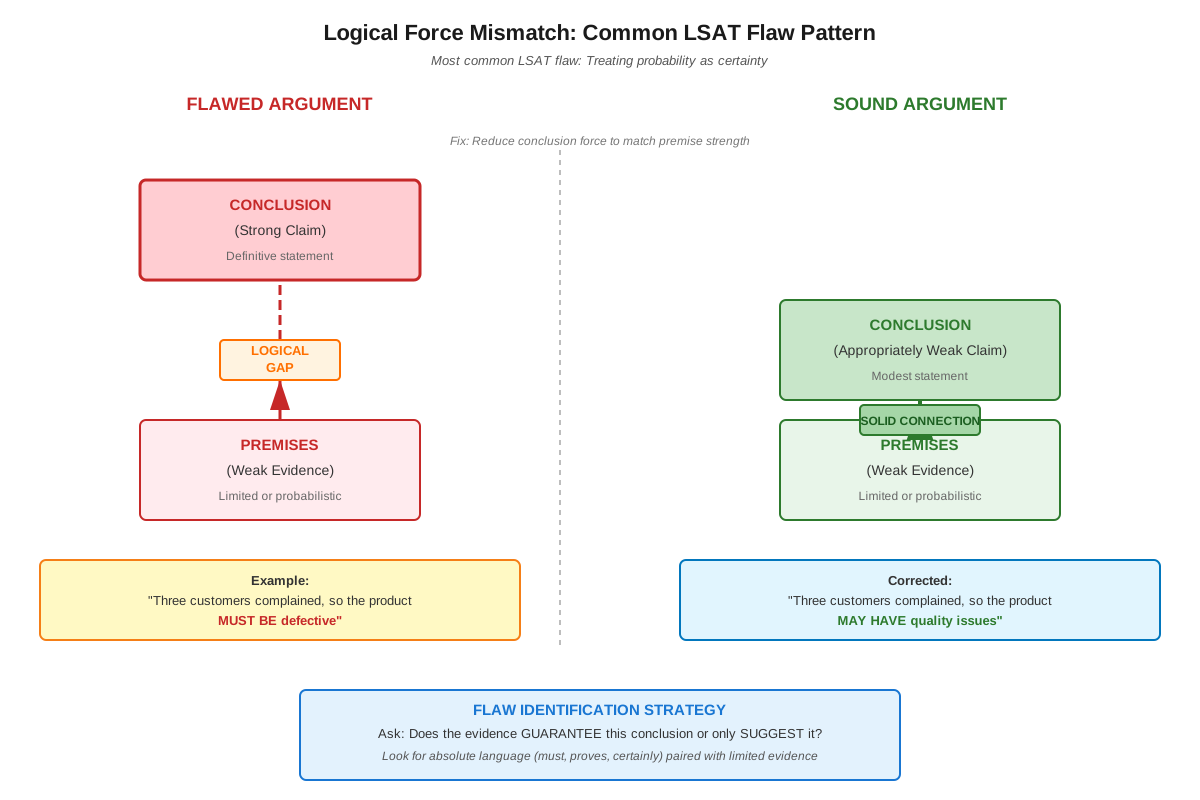
The most frequently tested concept involving logical force is the mismatch between the strength of the premises and the strength of the conclusion. This occurs when an argument's conclusion claims a higher degree of certainty than its premises can support. The LSAT exploits this pattern because it mirrors a common reasoning error: drawing overly strong conclusions from limited evidence.
Consider this flawed argument: "Most doctors recommend this medication. Therefore, this medication must be safe." The premise uses weak logical force ("most"), indicating a majority but not unanimity. The conclusion uses strong logical force ("must"), claiming certainty. This mismatch creates a logical gap—even if most doctors recommend the medication, the possibility remains that it's unsafe, making the certain conclusion unwarranted.
The reverse mismatch—where a conclusion claims less certainty than premises support—rarely appears on the LSAT because it doesn't constitute a logical flaw. If premises guarantee a conclusion, stating that conclusion with weak logical force (as merely probable) is technically correct, just unnecessarily modest.
Logical Force in Different Argument Types
Deductive arguments aim for strong logical force, claiming their conclusions necessarily follow from their premises. When valid, these arguments succeed—the truth of the premises guarantees the truth of the conclusion. The LSAT tests whether students recognize when deductive arguments fail by using strong logical force inappropriately (claiming necessity when premises don't guarantee the conclusion).
Inductive arguments use weak logical force, claiming their conclusions are probable or supported by their premises. These arguments acknowledge that even if premises are true, conclusions might be false. The LSAT tests whether students recognize when inductive arguments inappropriately use strong logical force, transforming a probabilistic claim into a certain one.
Causal arguments frequently exhibit logical force problems. Observing a correlation (weak evidence) doesn't justify concluding a definite causal relationship (strong claim). The LSAT repeatedly tests this pattern: "Event A occurred before Event B. Therefore, A caused B." The temporal relationship (premise) provides weak support, while the causal conclusion claims strong certainty.
Recognizing Logical Force in Context
Beyond explicit indicator words, logical force appears in argument structure and context. An argument stating "The only explanation for this phenomenon is X" uses strong logical force by eliminating alternatives, even without using words like "must" or "certainly." Similarly, an argument that presents evidence and asks "What can we conclude?" expects an answer matching the logical force of that evidence—if the evidence is statistical, the conclusion should be probabilistic, not certain.
The LST also tests logical force through quantifiers. "All," "every," and "none" create strong logical force, while "some," "many," and "most" create weaker logical force. An argument moving from "some" in the premises to "all" in the conclusion exhibits a logical force mismatch, a common flaw pattern.
Concept Relationships
Logical force connects directly to argument structure because it describes the claimed relationship between premises and conclusions. Before evaluating logical force, students must identify which statements serve as premises and which as conclusions. The strength of the logical force claim determines how thoroughly premises must support the conclusion.
The relationship flows as follows: Argument Structure → identifies premises and conclusion → Logical Force → describes the strength of connection claimed → Validity/Strength Assessment → evaluates whether the claim is justified. This sequence underlies most Logical Reasoning questions.
Logical force also connects to assumptions because assumptions fill gaps between premises and conclusions. When an argument exhibits a logical force mismatch (weak premises, strong conclusion), the assumption must bridge that gap. For example, if premises establish "most X are Y" but the conclusion claims "all X are Y," the assumption must account for the remaining X not covered by "most."
Within conditional reasoning, logical force appears in the certainty of conditional claims. "If A, then B" establishes strong logical force—when A occurs, B must follow. Arguments that weaken this certainty ("If A, then probably B") change the logical force and alter what can be validly concluded.
The concept extends to Strengthen/Weaken questions because the correct answer must impact the argument's logical force appropriately. Strengthening answers increase the degree to which premises support the conclusion, while weakening answers decrease it. Understanding the original argument's logical force helps predict what type of impact is needed.
High-Yield Facts
⭐ Logical force describes the degree of certainty with which premises are claimed to support a conclusion, ranging from absolute necessity to mere possibility.
⭐ The most common LSAT flaw involving logical force is when a conclusion claims stronger certainty than the premises can support.
⭐ Strong logical force indicators include: must, proves, certainly, always, all, none, impossible, necessary, demonstrates, establishes.
⭐ Weak logical force indicators include: probably, likely, suggests, indicates, may, might, could, some, most, tends to, possible.
⭐ Arguments that move from correlation (weak evidence) to causation (strong claim) exhibit a logical force mismatch.
- Deductive arguments aim for strong logical force, claiming conclusions necessarily follow from premises.
- Inductive arguments use weak logical force, claiming conclusions are probable or supported by premises.
- Quantifiers affect logical force: "all" and "none" create strong force, while "some" and "most" create weak force.
- An argument claiming "the only explanation" or "must be the case" uses strong logical force and requires premises that eliminate all alternatives.
- Recognizing logical force helps predict correct answers in Flaw, Assumption, Strengthen, Weaken, and Must Be True questions.
- When evaluating answer choices, match the logical force of the answer to the logical force established in the stimulus.
- Arguments using statistical evidence (percentages, majorities) should draw probabilistic conclusions, not certain ones.
- The phrase "most strongly supported" in question stems signals that the correct answer should match the weak logical force of inductive evidence.
- Conditional statements ("if...then") establish strong logical force for what must happen when the sufficient condition is met.
- Logical force mismatches often appear in arguments that generalize from samples to populations or from specific cases to universal rules.
Quick check — test yourself on Logical force so far.
Try Flashcards →Common Misconceptions
Misconception: All LSAT arguments with strong logical force are flawed. → Correction: Strong logical force is appropriate when premises genuinely guarantee the conclusion, as in valid deductive arguments. The flaw occurs only when strong logical force exceeds what the premises support.
Misconception: Weak logical force makes an argument bad or incorrect. → Correction: Weak logical force is appropriate for inductive arguments where premises make conclusions probable rather than certain. Many strong LSAT arguments use weak logical force appropriately.
Misconception: The word "therefore" indicates strong logical force. → Correction: "Therefore" is a conclusion indicator that signals the conclusion's location but doesn't specify the strength of the logical connection. The logical force depends on other language in the conclusion and the nature of the premises.
Misconception: If an argument uses words like "suggests" or "indicates," it cannot be flawed. → Correction: Even arguments with appropriately weak logical force can be flawed in other ways (false premises, irrelevant evidence, overlooked alternatives). Logical force is one dimension of argument evaluation, not the only one.
Misconception: Strengthening an argument means making its conclusion certain. → Correction: Strengthening means increasing the degree to which premises support the conclusion, which might move an argument from weak support to moderate support, or from moderate to strong—not necessarily to absolute certainty.
Misconception: All causal conclusions use inappropriate logical force. → Correction: Causal conclusions can be appropriate if supported by sufficient evidence (controlled experiments, elimination of alternative explanations). The flaw occurs when causal conclusions claim certainty based only on correlation or temporal sequence.
Misconception: Logical force only matters in Flaw questions. → Correction: Logical force is relevant across all question types—Assumption questions require bridging logical force gaps, Strengthen/Weaken questions require matching the argument's logical force level, and Must Be True questions require matching the logical force of what the stimulus supports.
Worked Examples
Example 1: Identifying Logical Force Mismatch
Stimulus: "A recent survey found that 65% of consumers who purchased Brand X detergent reported satisfaction with the product. Therefore, Brand X detergent must be the highest quality detergent available on the market."
Question: Which one of the following most accurately describes a flaw in the reasoning above?
Analysis:
Step 1: Identify the argument structure.
- Premise: 65% of Brand X purchasers reported satisfaction
- Conclusion: Brand X must be the highest quality detergent available
Step 2: Assess the logical force of the premise.
The premise uses weak logical force—it presents a statistical majority (65%), not unanimity. This indicates probability, not certainty. The evidence shows that most, but not all, purchasers were satisfied.
Step 3: Assess the logical force of the conclusion.
The conclusion uses strong logical force—"must be" indicates certainty and necessity. Additionally, it makes a comparative claim ("highest quality") that goes beyond what satisfaction ratings alone can establish.
Step 4: Identify the mismatch.
The argument moves from weak evidence (a majority satisfaction rate for one product) to a strong, certain conclusion (definitive superiority over all competitors). This is a classic logical force mismatch.
Step 5: Identify additional problems.
Beyond the logical force mismatch, the argument assumes that satisfaction ratings directly correlate with quality, that 65% satisfaction is higher than competitors' ratings, and that no other factors determine quality.
Correct answer pattern: The flaw is that the argument treats evidence that supports a conclusion as evidence that establishes it with certainty, or that it draws a definitive conclusion from evidence that provides only partial support.
Connection to learning objectives: This example demonstrates how to identify logical force in LSAT questions (weak premise indicators like percentages, strong conclusion indicators like "must be") and apply this understanding to recognize a common flaw pattern.
Example 2: Matching Logical Force in Must Be True Questions
Stimulus: "In the past decade, the city has installed bike lanes on 40% of its major streets. Studies show that streets with bike lanes experience 30% fewer severe traffic accidents than streets without bike lanes. The city plans to install bike lanes on an additional 20% of major streets next year."
Question: If the statements above are true, which one of the following must also be true?
Answer Choices:
(A) Installing bike lanes on all major streets would eliminate severe traffic accidents.
(B) The city's major streets will likely experience fewer severe traffic accidents next year than this year.
(C) Some of the city's major streets currently lack bike lanes.
(D) Bike lanes are the most effective method for reducing traffic accidents.
(E) The city has prioritized traffic safety over other urban planning concerns.
Analysis:
Step 1: Determine what logical force the question stem requires.
"Must also be true" requires strong logical force—the correct answer must be guaranteed by the stimulus, not merely suggested or made probable.
Step 2: Evaluate each answer choice's logical force requirement and support.
(A) Uses strong logical force ("would eliminate") but the stimulus only supports that bike lanes reduce accidents by 30%, not eliminate them entirely. The logical force exceeds what the stimulus supports. Incorrect.
(B) Uses weak logical force ("likely") which might seem appropriate, but the question asks what "must" be true, not what is probable. Additionally, while bike lanes reduce accidents, we don't know if the reduction from adding 20% more bike lanes will offset other factors that might increase accidents. The stimulus doesn't guarantee this outcome. Incorrect.
(C) Uses weak logical force ("some") and is guaranteed by the stimulus. If 40% of streets have bike lanes and 20% more will be added, then currently 60% of streets lack bike lanes (after the addition). Therefore, some streets currently lack bike lanes. This must be true. Correct.
(D) Uses strong logical force ("most effective") but the stimulus only discusses bike lanes, not other methods. No comparison is provided. Incorrect.
(E) Makes a claim about city priorities that goes beyond the information provided. The stimulus doesn't establish what the city has prioritized. Incorrect.
Key insight: In Must Be True questions, the correct answer's logical force must match what the stimulus guarantees. Answer choice (C) succeeds because it makes a modest claim (some streets lack bike lanes) that is definitively supported by the mathematical facts in the stimulus. Wrong answers often fail by claiming too much certainty or by addressing topics the stimulus doesn't adequately support.
Connection to learning objectives: This example shows how to apply logical force understanding to solve LSAT-style problems by matching the logical force of answer choices to what the stimulus supports, and demonstrates the reasoning pattern where strong question stems ("must be true") require answers with appropriate logical force.
Exam Strategy
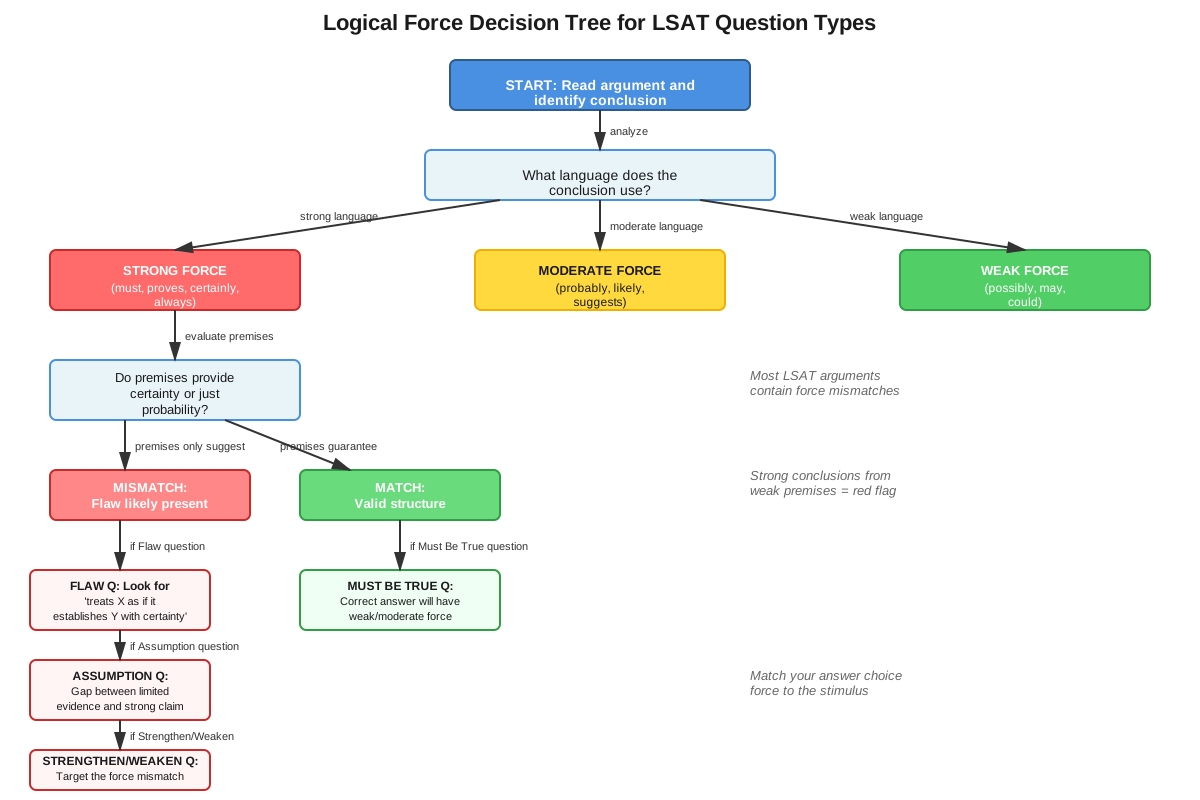
When approaching LSAT questions involving logical force, begin by identifying the conclusion and noting its logical force indicators. Circle or mentally flag words like "must," "proves," "certainly" (strong force) or "probably," "suggests," "may" (weak force). This immediate recognition helps predict potential flaws and correct answer patterns.
Trigger words for strong logical force: must, proves, certainly, always, never, all, none, only, impossible, necessary, demonstrates, establishes, guarantees, ensures, definitely, undoubtedly, clearly shows, the explanation is.
Trigger words for weak logical force: probably, likely, suggests, indicates, supports, may, might, could, possibly, some, many, most, tends to, generally, usually, evidence for, reason to believe, makes it more likely.
For Flaw questions, immediately check whether the conclusion's logical force exceeds the premises' support. If you spot strong conclusion language ("must be," "proves," "certainly") paired with weak premise evidence (statistics, correlations, limited samples), you've likely identified the flaw. Predict that the correct answer will describe this mismatch, often phrased as "treats evidence that suggests a conclusion as evidence that establishes it with certainty" or "draws a universal conclusion from limited evidence."
For Assumption questions, the logical force gap between premises and conclusion indicates what the assumption must bridge. If premises establish "most X are Y" but the conclusion claims "all X are Y," the assumption must account for the remaining X. Look for answer choices that close this logical force gap.
For Strengthen/Weaken questions, match the logical force of your answer choice to the argument's logical force. If the argument claims causation with certainty, strengthening requires evidence that eliminates alternative explanations. If the argument suggests probability, strengthening requires evidence that increases likelihood. Don't select answers that prove certainty when the argument only claims probability, or vice versa.
For Must Be True/Most Strongly Supported questions, pay careful attention to the question stem's logical force requirement. "Must be true" requires strong logical force—select only what the stimulus guarantees. "Most strongly supported" allows weak logical force—select what the stimulus makes most probable. Wrong answers often use logical force that exceeds what the stimulus supports.
Time allocation: Spend 5-10 seconds identifying logical force indicators before diving into detailed analysis. This upfront investment prevents wasting time on wrong answer choices that fail due to logical force mismatches. If you're stuck between two answers, compare their logical force to the stimulus—the answer that matches the stimulus's degree of certainty is usually correct.
Process of elimination: Eliminate answer choices that use stronger logical force than the stimulus supports (claiming certainty when the stimulus suggests probability) or that address the wrong degree of certainty (proving something when the argument only claims to suggest it). In Flaw questions, eliminate answers that describe logical force mismatches in the wrong direction (claiming the argument is too modest when it's actually too strong).
Memory Techniques
Mnemonic for strong logical force indicators: "MAPCAN" - Must, Always, Proves, Certainly, All, Never. When you see MAPCAN words in a conclusion, check whether premises can support that level of certainty.
Mnemonic for weak logical force indicators: "SLIM POPS" - Suggests, Likely, Indicates, May/Might, Probably, Often, Possibly, Some. SLIM POPS conclusions need only probabilistic support, not certainty.
Visualization strategy: Picture logical force as a bridge between premises and conclusion. Strong logical force is a steel bridge—rigid, guaranteed to hold. Weak logical force is a rope bridge—flexible, probably safe but not certain. When premises build a rope bridge but the conclusion claims a steel bridge, the structure fails. Visualize this mismatch when analyzing arguments.
The "Certainty Spectrum" acronym: CPPM - Certainty, Probability, Possibility, Mere speculation. Arguments should move along this spectrum consistently, not jump from Possibility in premises to Certainty in conclusion.
Pattern recognition technique: Create a mental template: "The argument observes [weak evidence] and concludes [strong claim]." Common fills: "correlation → causation," "some → all," "past → future certainty," "sample → population." When you spot these patterns, you've identified a logical force flaw.
Summary
Logical force represents the degree of certainty with which an argument claims its premises support its conclusion, ranging from absolute necessity to mere possibility. This concept is fundamental to LSAT Logical Reasoning because the test frequently exploits the gap between what evidence actually supports and what conclusions claim. Strong logical force uses language indicating certainty, necessity, or universality (must, proves, always, all), while weak logical force uses language indicating probability or possibility (suggests, likely, may, some). The most common LSAT flaw pattern involves conclusions that claim stronger certainty than premises can support—moving from statistical evidence to certain conclusions, from correlation to definitive causation, or from limited samples to universal generalizations. Mastering logical force requires recognizing these indicator words, assessing whether the claimed strength of connection is justified, and matching answer choices to the appropriate level of certainty. This skill applies across all Logical Reasoning question types: identifying flaws in reasoning, determining necessary assumptions, evaluating strengthening and weakening evidence, and selecting what must be true versus what is merely supported. Success on the LSAT demands constant attention to whether arguments claim too much certainty from their evidence.
Key Takeaways
- Logical force describes the strength of connection between premises and conclusions, from absolute certainty to mere possibility
- The most tested pattern is logical force mismatch: conclusions claiming stronger certainty than premises support
- Strong force indicators (must, proves, always, all) require premises that guarantee conclusions; weak force indicators (suggests, likely, may, some) require only probabilistic support
- Recognizing logical force helps predict correct answers across all Logical Reasoning question types, especially Flaw, Assumption, and Must Be True questions
- Match answer choice logical force to stimulus logical force: don't select answers claiming certainty when the stimulus only suggests probability
- Common flawed patterns include: correlation to causation, statistical evidence to certain conclusions, and limited samples to universal claims
- In Must Be True questions, select only what the stimulus guarantees; in Most Strongly Supported questions, select what the stimulus makes most probable
Related Topics
Conditional Reasoning: Logical force appears in conditional statements where "if...then" structures create strong logical force for necessary conclusions. Mastering logical force provides the foundation for understanding when conditional conclusions are guaranteed versus merely suggested.
Causal Reasoning: Causal arguments frequently exhibit logical force problems when moving from correlational evidence to causal conclusions. Understanding logical force helps identify when causal claims are appropriately supported versus overstated.
Formal Logic and Validity: The distinction between valid and invalid arguments directly relates to logical force—valid arguments have premises that guarantee conclusions (strong logical force), while invalid arguments claim strong force inappropriately.
Sufficient and Necessary Assumptions: Assumptions bridge logical force gaps between premises and conclusions. Mastering logical force enables precise identification of what assumptions must add to make conclusions appropriately supported.
Strengthen and Weaken Questions: These question types require understanding how additional evidence affects the logical force of arguments—increasing or decreasing the degree to which premises support conclusions.
Practice CTA
Now that you understand logical force and its critical role in LSAT Logical Reasoning, test your mastery with practice questions and flashcards. Focus on identifying logical force indicators in conclusions, assessing whether premises provide appropriate support, and predicting answer choices based on logical force patterns. The more you practice recognizing these patterns, the faster and more accurate you'll become on test day. Remember: every minute spent mastering logical force pays dividends across multiple question types. You've built the foundation—now apply it to achieve your target score!
Sign up free to keep reading
Create a free AnvayaPrep account to finish this LSAT guide on Logical force — plus flashcards and practice questions.