Overview
Normative reasoning is a fundamental pattern of argumentation that appears frequently throughout the LSAT Logical Reasoning section. Unlike descriptive reasoning, which deals with what is the case (facts, observations, empirical claims), normative reasoning concerns what ought to be, what should happen, or what is morally, ethically, or practically desirable. This type of reasoning involves value judgments, prescriptions, recommendations, and evaluations about how things should be rather than merely how they are. On the LSAT, recognizing normative reasoning is crucial because it often forms the backbone of arguments about policy recommendations, ethical obligations, legal principles, and practical advice.
Understanding lsat normative reasoning is essential for success on the exam because it appears across multiple question types, including Strengthen/Weaken questions, Assumption questions, Flaw questions, and Principle questions. The LSAT frequently tests whether students can identify the logical gap between descriptive premises (factual claims) and normative conclusions (value judgments or recommendations), or whether they can recognize when an argument improperly derives an "ought" from an "is." This pattern represents one of the most common logical structures tested on the exam, making it a high-yield topic for focused study.
Within the broader framework of argument fundamentals in logical reasoning, normative reasoning connects directly to core concepts like premise-conclusion structure, assumption identification, and argument evaluation. Mastering normative reasoning enables students to quickly categorize arguments, predict likely assumptions, and efficiently eliminate incorrect answer choices. This topic serves as a bridge between basic argument structure and more advanced reasoning patterns, making it an indispensable component of LSAT preparation.
Learning Objectives
- [ ] Identify how Normative reasoning appears in LSAT questions
- [ ] Explain the reasoning pattern behind Normative reasoning
- [ ] Apply Normative reasoning to solve LSAT-style problems accurately
- [ ] Distinguish between normative and descriptive claims in complex arguments
- [ ] Recognize the logical gap between factual premises and normative conclusions
- [ ] Evaluate whether normative conclusions are adequately supported by their premises
- [ ] Identify common assumption patterns in normative arguments
Prerequisites
- Basic argument structure (premise-conclusion identification): Essential for recognizing where normative claims appear within an argument's logical framework
- Understanding of logical indicators: Necessary to identify conclusion indicators that often signal normative claims ("therefore," "thus," "should")
- Familiarity with assumption concepts: Required to recognize the unstated bridges between descriptive premises and normative conclusions
- Knowledge of argument evaluation principles: Foundational for assessing whether normative conclusions follow logically from their supporting evidence
Why This Topic Matters
Normative reasoning appears in real-world contexts constantly—from policy debates and legal arguments to ethical discussions and business recommendations. Every time someone argues for what a government should do, what policy would be best, or what action is morally required, they engage in normative reasoning. Legal reasoning, which forms the conceptual foundation of the LSAT, frequently involves normative claims about rights, obligations, and proper interpretations of law. Understanding this reasoning pattern develops critical thinking skills applicable far beyond the exam itself.
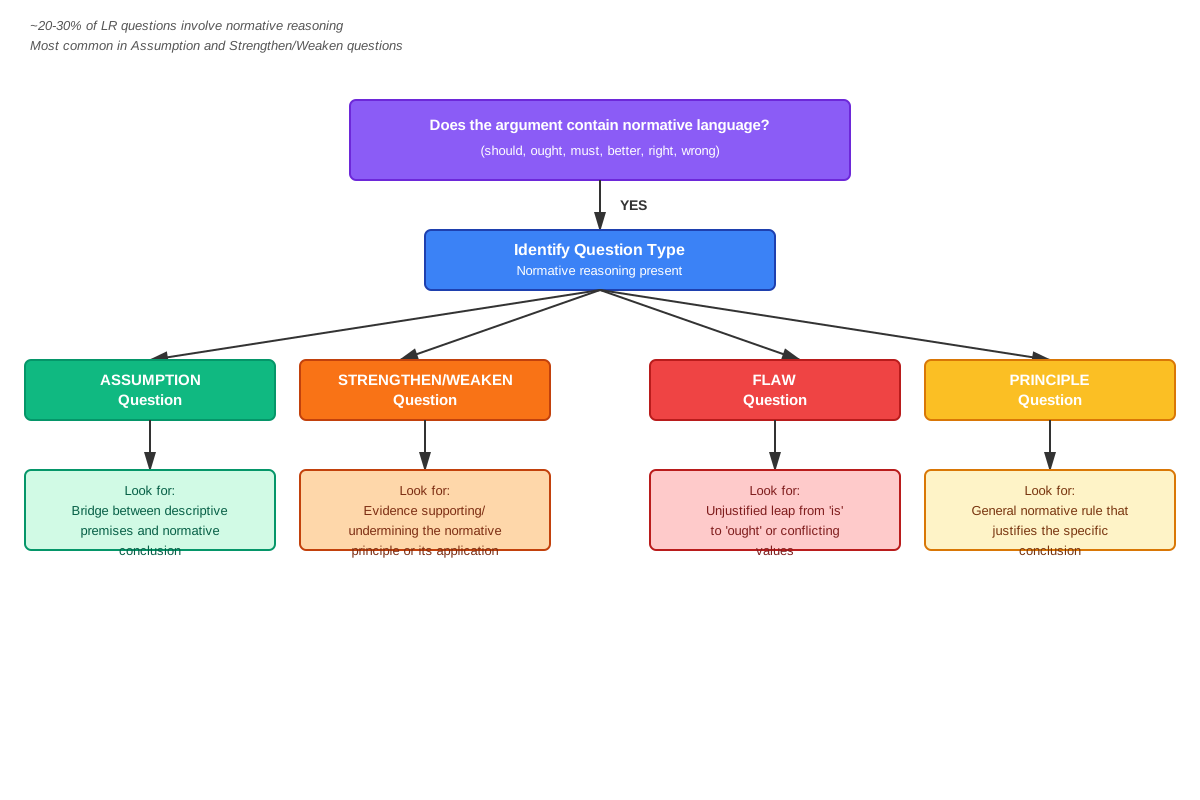
On the LSAT, normative reasoning appears in approximately 20-30% of Logical Reasoning questions, making it one of the most frequently tested patterns. It appears most commonly in Strengthen/Weaken questions (where students must identify what would support or undermine a normative recommendation), Assumption questions (where the gap between descriptive facts and normative conclusions must be bridged), Flaw questions (where arguments improperly derive normative conclusions from insufficient premises), and Principle questions (where general normative principles must be applied to specific situations or identified from examples).
Common manifestations include arguments recommending policy changes based on empirical data, ethical arguments about what actions are permissible or required, legal arguments about how laws should be interpreted or applied, and practical arguments about what course of action would be best. The LSAT particularly favors arguments that move from descriptive premises about consequences, facts, or circumstances to normative conclusions about what should be done, creating a logical gap that students must recognize and evaluate.
Core Concepts
Defining Normative vs. Descriptive Claims
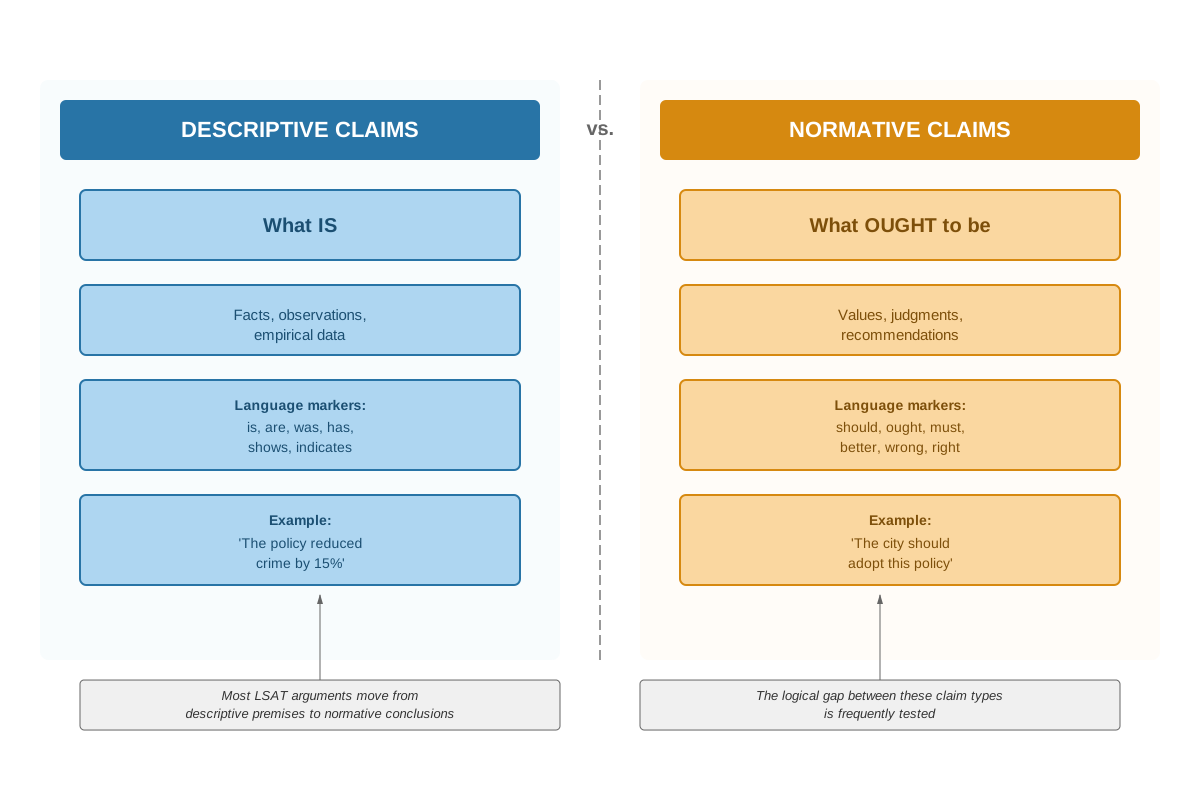
Normative reasoning involves claims about values, obligations, permissions, recommendations, or evaluations—statements about what ought to be rather than what is. Normative claims use modal language like "should," "ought," "must," "better," "worse," "right," "wrong," "justified," "permissible," and "obligatory." These claims cannot be verified through empirical observation alone because they involve value judgments.
In contrast, descriptive claims state facts, observations, or empirical realities that can, in principle, be verified or falsified through observation or evidence. Descriptive claims use language like "is," "are," "will," "causes," "results in," and "happens." The distinction is crucial because the LSAT frequently tests whether arguments properly support normative conclusions with adequate premises.
| Normative Claims | Descriptive Claims |
|---|---|
| "The government should increase funding for education" | "The government increased funding for education by 10%" |
| "It would be wrong to implement this policy" | "This policy was implemented last year" |
| "Companies ought to prioritize environmental protection" | "Companies that prioritize environmental protection see increased profits" |
| "The best course of action is to delay the decision" | "The decision was delayed by three months" |
The Is-Ought Gap
A fundamental concept in normative reasoning is the is-ought gap (also called Hume's Law), which recognizes that normative conclusions do not automatically follow from purely descriptive premises. An argument that moves from "is" statements to "ought" statements requires an additional normative premise—either stated or assumed—to bridge this logical gap.
For example, consider this argument:
- Premise: "This policy will reduce unemployment by 5%."
- Conclusion: "Therefore, we should implement this policy."
The logical gap here is that reducing unemployment being desirable is assumed but not stated. The argument needs an additional normative premise like "We should implement policies that reduce unemployment" to be logically complete. The LSAT frequently tests recognition of this gap through Assumption questions and Flaw questions.
Types of Normative Claims
Prescriptive claims recommend specific actions or policies: "The city should build more public transportation." These are the most common normative claims on the LSAT and typically appear in policy recommendation arguments.
Evaluative claims make value judgments about whether something is good, bad, better, or worse: "This approach is superior to the alternative." These often appear in comparative arguments where the LSAT tests whether the evaluation is adequately supported.
Obligation claims state what is required, permitted, or forbidden: "Companies must disclose financial information to shareholders." These frequently appear in legal and ethical reasoning contexts.
Prudential claims concern what is practically wise or in someone's best interest: "It would be imprudent to invest all resources in a single project." These often involve risk assessment and practical reasoning.
Common Normative Argument Patterns
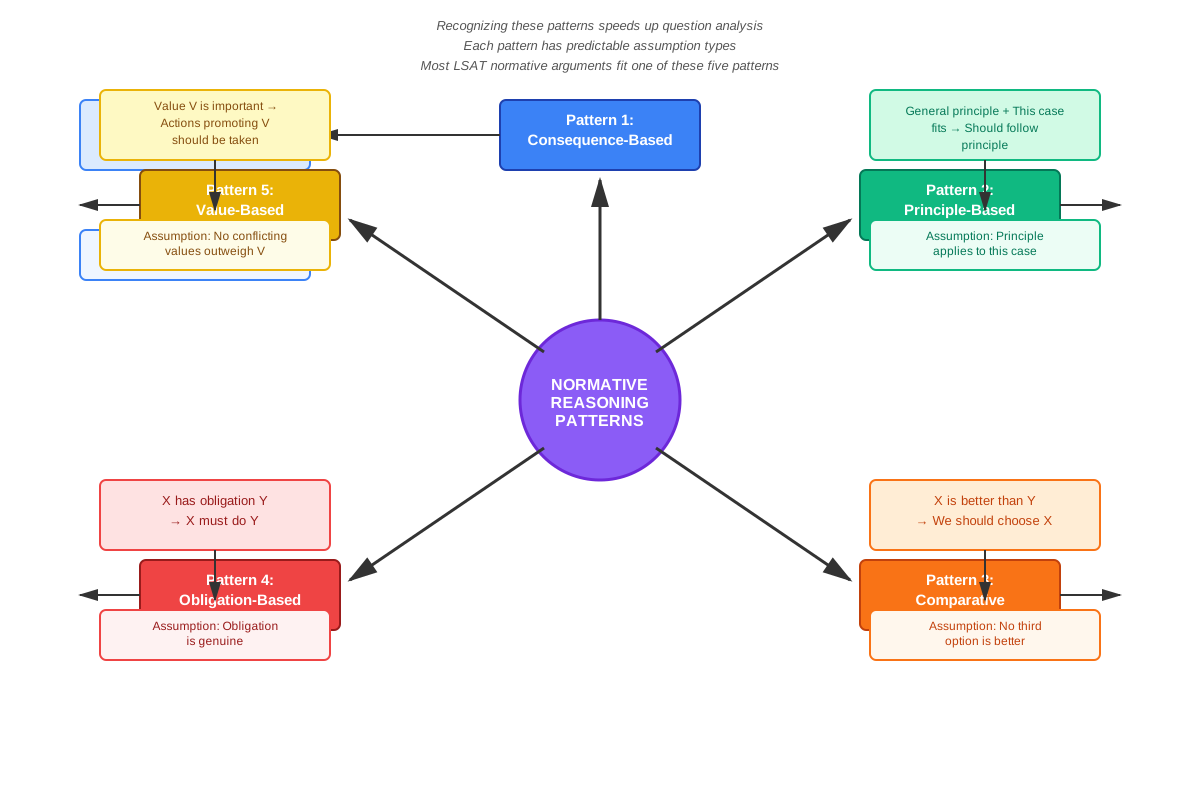
Consequentialist arguments justify normative conclusions based on outcomes or consequences. Pattern: "Action X will produce outcome Y. Outcome Y is desirable. Therefore, we should do X." The assumption is that producing desirable outcomes justifies the action.
Principle-based arguments apply general normative principles to specific cases. Pattern: "Principle P states that actions with property Q are wrong. Action X has property Q. Therefore, action X is wrong." The assumption is that the principle applies to this case and that the action indeed has the relevant property.
Comparative arguments recommend one option over alternatives based on relative merits. Pattern: "Option A has advantages X, Y, Z. Option B lacks these advantages. Therefore, option A is better." The assumption is that these particular advantages are the relevant criteria for comparison and that no countervailing considerations favor option B.
Normative Assumptions
Normative arguments typically require value assumptions—unstated premises about what is good, desirable, important, or worth pursuing. When an argument concludes "We should do X because it will produce Y," it assumes that Y is desirable or valuable.
They also require priority assumptions when multiple values conflict. An argument recommending a policy that increases efficiency but reduces fairness assumes that efficiency should be prioritized over fairness in this context.
Applicability assumptions are needed when general principles are applied to specific cases, assuming the principle is relevant and applicable to the particular situation at hand.
Concept Relationships
Normative reasoning connects fundamentally to premise-conclusion structure because identifying whether a conclusion is normative or descriptive determines what type of support it requires. Descriptive conclusions need empirical evidence, while normative conclusions require both factual premises and value-based premises or assumptions.
The relationship flows as follows: Argument structure identification → Claim type classification (normative vs. descriptive) → Gap identification (is-ought gap) → Assumption recognition → Argument evaluation. Understanding normative reasoning enables students to quickly identify when arguments contain the is-ought gap, which then directs them toward the type of assumption needed.
Normative reasoning also connects to sufficient and necessary assumptions. In normative arguments, the value assumption bridging the is-ought gap is typically a necessary assumption—the argument cannot succeed without it. For example, if an argument concludes "We should implement policy X because it reduces costs," the assumption "We should implement policies that reduce costs" (or something similar) is necessary for the argument to work.
The concept links to strengthen and weaken questions because recognizing normative reasoning helps predict what would support or undermine the argument. Strengtheners for normative arguments often provide additional support for the value assumption or show that the recommended action aligns with accepted principles. Weakeners often challenge the value assumption or show that the action conflicts with other important values.
High-Yield Facts
⭐ Normative claims use modal language: "should," "ought," "must," "better," "right," "wrong," "justified"—watch for these trigger words to identify normative reasoning.
⭐ The is-ought gap is the most commonly tested logical gap: Arguments moving from purely descriptive premises to normative conclusions require an unstated value assumption.
⭐ Normative conclusions cannot be proven false through empirical evidence alone: They involve value judgments that go beyond observable facts.
⭐ Most policy recommendation arguments on the LSAT are normative: When an argument recommends what should be done, it requires both factual support and value-based justification.
⭐ Comparative normative claims assume the criteria used for comparison are the relevant ones: An argument that X is better than Y because of property Z assumes property Z is what matters for this comparison.
- Normative arguments can have descriptive premises but must have at least one normative premise (stated or assumed) to reach a normative conclusion validly.
- Principle questions almost always involve normative reasoning because principles are general normative rules applied to specific cases.
- Flaw questions frequently feature arguments that derive normative conclusions from insufficient normative support.
- Strengthen questions for normative arguments often require answer choices that provide the missing value assumption or show alignment with accepted principles.
- Weaken questions for normative arguments often introduce competing values or show negative consequences that outweigh the stated benefits.
- Assumption questions with normative conclusions typically require identifying the value assumption that bridges the is-ought gap.
Quick check — test yourself on Normative reasoning so far.
Try Flashcards →Common Misconceptions
Misconception: Any argument with "should" in the conclusion is automatically flawed because it derives an "ought" from an "is."
Correction: Normative conclusions are not inherently flawed; they simply require adequate normative support. An argument with both descriptive and normative premises can validly support a normative conclusion. The flaw occurs only when the normative support is missing or insufficient.
Misconception: Descriptive evidence about consequences is irrelevant to normative conclusions.
Correction: Descriptive premises about consequences, effects, and outcomes are highly relevant to normative conclusions—they just aren't sufficient alone. Consequentialist normative arguments properly combine factual claims about outcomes with value claims about which outcomes are desirable.
Misconception: All normative claims are subjective opinions that cannot be evaluated logically.
Correction: While normative claims involve values, normative arguments can still be evaluated for logical validity and soundness. The LSAT tests whether normative conclusions are adequately supported by their premises, not whether the values themselves are "correct."
Misconception: If an argument states a fact about what most people believe is right, it has provided normative support for its conclusion.
Correction: Descriptive claims about what people believe to be right are still descriptive claims (facts about beliefs), not normative claims. An argument that says "Most people think X is wrong, therefore X is wrong" commits an appeal to popularity fallacy unless it includes a normative premise about why popular opinion determines rightness.
Misconception: Normative reasoning only appears in ethics questions about right and wrong.
Correction: Normative reasoning appears in any argument about what should be done, what would be best, what is justified, or what is recommended—including policy arguments, practical advice, legal interpretations, and strategic recommendations. The scope is much broader than ethics alone.
Misconception: Identifying a normative argument means the argument is weak or problematic.
Correction: Normative reasoning is neither inherently strong nor weak—it's simply a type of reasoning pattern. The strength depends on whether the normative conclusion is adequately supported. Many strong, valid arguments have normative conclusions.
Worked Examples
Example 1: Assumption Question
Argument: "Studies show that implementing a four-day workweek increases employee productivity by 15% and reduces burnout. Therefore, all companies should adopt a four-day workweek."
Question: Which of the following is an assumption required by the argument?
Analysis:
- Identify the conclusion: "All companies should adopt a four-day workweek" (normative claim—uses "should")
- Identify the premises:
- Four-day workweek increases productivity by 15% (descriptive)
- Four-day workweek reduces burnout (descriptive)
- Recognize the pattern: This is a classic is-ought gap. The premises are purely descriptive (stating facts about consequences), but the conclusion is normative (recommending what should be done).
- Identify the gap: The argument assumes that these particular benefits (increased productivity and reduced burnout) are sufficient reasons to adopt the policy. It assumes these benefits outweigh any potential costs or drawbacks, and that companies should implement policies that produce these outcomes.
- Predict the assumption: Something like "Companies should implement policies that increase productivity and reduce burnout" or "The benefits of increased productivity and reduced burnout outweigh any disadvantages of a four-day workweek."
Correct answer type: An answer choice stating that the benefits mentioned justify the recommendation, or that no countervailing considerations outweigh these benefits.
Connection to learning objectives: This example demonstrates how to identify normative reasoning (the "should" conclusion), explain the reasoning pattern (consequentialist argument with is-ought gap), and apply this understanding to predict the required assumption.
Example 2: Flaw Question
Argument: "Recent data indicates that countries with stricter gun control laws have lower rates of gun violence. This clearly demonstrates that stricter gun control laws are morally superior to permissive gun laws."
Question: The reasoning in the argument is flawed because it:
Analysis:
- Identify the conclusion: "Stricter gun control laws are morally superior to permissive gun laws" (normative evaluative claim)
- Identify the premise: "Countries with stricter gun control laws have lower rates of gun violence" (descriptive claim about correlation)
- Recognize the pattern: The argument moves from a descriptive premise about outcomes to a normative conclusion about moral superiority.
- Identify the flaw: The argument commits the is-ought fallacy by deriving a moral evaluation from purely empirical data without establishing that lower gun violence rates are the sole or primary criterion for moral superiority. It assumes that the empirical correlation establishes moral superiority without considering other relevant moral factors (individual rights, liberty, effectiveness of enforcement, etc.).
- Predict the flaw description: The argument improperly infers a value judgment from factual data alone, or it assumes that a single consequence (lower gun violence) is sufficient to establish overall moral superiority.
Correct answer type: An answer choice stating that the argument improperly derives a normative conclusion from descriptive premises, or that it assumes a single factor determines moral superiority without considering other relevant moral considerations.
Connection to learning objectives: This example shows how to identify normative reasoning in conclusions, explain why the reasoning pattern is flawed (insufficient normative support), and apply this understanding to predict the correct flaw description.
Exam Strategy
Trigger word identification: Immediately flag arguments containing "should," "ought," "must," "better," "best," "right," "wrong," "justified," "permissible," or "obligatory" in their conclusions. These signal normative reasoning and should prompt you to look for the is-ought gap.
Two-step analysis for normative arguments:
- Classify all premises as normative or descriptive
- If the conclusion is normative but all premises are descriptive, the argument has an is-ought gap requiring a value assumption
For Assumption questions with normative conclusions: The correct answer will typically provide the missing normative premise that bridges the gap between descriptive facts and the normative conclusion. Predict this bridge before looking at answer choices.
For Strengthen questions: Look for answer choices that either (a) provide additional normative support for the value assumption, (b) show the recommended action aligns with accepted principles or widely held values, or (c) provide additional descriptive evidence about positive consequences while the value assumption is already implicit.
For Weaken questions: Look for answer choices that either (a) challenge the value assumption by introducing competing values, (b) show negative consequences that outweigh the stated benefits, or (c) demonstrate that the action conflicts with other important principles or values.
For Flaw questions: When you spot normative reasoning, immediately check whether the argument has adequate normative support. If it derives a normative conclusion from purely descriptive premises, the flaw is the is-ought gap.
Process of elimination: Eliminate answer choices that treat normative claims as if they were descriptive claims requiring only empirical evidence, or that suggest normative reasoning is inherently flawed rather than simply requiring appropriate support.
Time allocation: Normative reasoning questions are typically medium difficulty. Spend 1:15-1:30 on these questions. The pattern recognition should be quick (15-20 seconds), leaving time for careful answer choice evaluation.
Exam Tip: In Principle questions, the principle is almost always normative. When applying a principle to a case, ensure both that the case meets the descriptive conditions specified in the principle AND that the normative conclusion follows.
Memory Techniques
IS-OUGHT mnemonic:
- Identify the conclusion type
- Spot descriptive premises
- Observe the gap
- Uncover the value assumption
- Gauge whether support is adequate
- Highlight modal language
- Test for necessary assumptions
Modal Language Checklist - Remember "SHOULD BETTER JUSTIFY":
- Should
- Have to
- Ought
- Unwarranted (when used evaluatively)
- Lawful/unlawful
- Desirable
- Better/best
- Ethical/unethical
- To be done
- True course
- Expected (in normative sense)
- Right/wrong
- Justified/unjustified
- Understandable (evaluatively)
- Superior/inferior
- To be pursued
- Ideal
- Fitting
- Yielding (what should yield)
Visualization: Picture a bridge with "IS" on one side (descriptive facts) and "OUGHT" on the other side (normative conclusions). The bridge itself represents the value assumption needed to cross the gap. When analyzing arguments, visualize whether the bridge is present or missing.
The Three Questions for Normative Arguments:
- What does the argument say SHOULD be done? (Identify normative conclusion)
- What FACTS support this? (Identify descriptive premises)
- What VALUE connects them? (Identify the assumption)
Summary
Normative reasoning involves arguments about what ought to be, what should be done, or what is valuable, right, or justified—as opposed to descriptive reasoning about what is factually the case. This reasoning pattern appears in 20-30% of LSAT Logical Reasoning questions and is tested across multiple question types, particularly Assumption, Strengthen/Weaken, Flaw, and Principle questions. The key concept is the is-ought gap: normative conclusions cannot be derived from purely descriptive premises without an additional normative premise or assumption about values, priorities, or principles. Recognizing this gap enables students to quickly identify necessary assumptions, predict strengtheners and weakeners, and spot common flaws in normative arguments. Success with normative reasoning requires distinguishing normative from descriptive claims, identifying modal language that signals normative conclusions, recognizing when arguments lack adequate normative support, and understanding common patterns like consequentialist arguments and principle-based reasoning. Mastering this topic provides a systematic approach to a large category of LSAT questions and builds critical thinking skills essential for legal reasoning.
Key Takeaways
- Normative reasoning concerns what ought to be, not what is—watch for modal language like "should," "ought," "better," and "right" to identify normative claims
- The is-ought gap is the most frequently tested logical gap on the LSAT—arguments moving from descriptive premises to normative conclusions require value assumptions
- Normative arguments require both factual and value-based support—descriptive evidence about consequences is necessary but not sufficient for normative conclusions
- Assumption questions with normative conclusions typically require identifying the value assumption that bridges the gap between facts and recommendations
- Strengthen and weaken questions for normative arguments focus on value assumptions and competing considerations—strengtheners support the values assumed; weakeners introduce conflicting values or negative consequences
- Recognizing normative reasoning enables efficient question-type prediction and answer choice elimination—this pattern recognition is a high-yield skill for improving speed and accuracy
- Normative reasoning is not inherently flawed—it simply requires appropriate normative support, which may be stated or assumed
Related Topics
Sufficient and Necessary Assumptions: Understanding normative reasoning deepens comprehension of necessary assumptions because the value assumptions in normative arguments are typically necessary for the argument to succeed. Mastering normative reasoning provides practice in identifying what must be true for an argument to work.
Strengthen and Weaken Questions: Normative reasoning connects directly to these question types because recognizing the value assumptions in normative arguments enables prediction of what would strengthen (support the values) or weaken (challenge the values or introduce competing considerations) the argument.
Flaw Questions: Many common flaws involve normative reasoning, particularly arguments that improperly derive normative conclusions from insufficient premises. Understanding normative reasoning enables quick identification of is-ought gap flaws.
Principle Questions: These questions almost always involve normative reasoning because principles are general normative rules. Mastering normative reasoning is essential for both applying principles to cases and identifying principles from examples.
Causal Reasoning: Normative arguments frequently rely on causal claims about consequences (if we do X, Y will result), then evaluate whether those consequences justify the action. Understanding both reasoning types together enables analysis of complex policy arguments.
Practice CTA
Now that you understand normative reasoning—one of the most frequently tested patterns on the LSAT—it's time to apply this knowledge to actual LSAT questions. Work through the practice questions to reinforce your ability to identify normative reasoning, recognize the is-ought gap, and predict the assumptions that bridge descriptive premises to normative conclusions. Use the flashcards to drill the key distinctions and trigger words until recognizing normative reasoning becomes automatic. Remember: this reasoning pattern appears in roughly one out of every four Logical Reasoning questions, making it one of the highest-yield topics for your study time. Master this concept, and you'll see immediate improvement in your accuracy and speed across multiple question types. You've got this!
Sign up free to keep reading
Create a free AnvayaPrep account to finish this LSAT guide on Normative reasoning — plus flashcards and practice questions.