Overview
Predictive reasoning is a fundamental pattern of argumentation that appears frequently throughout the LSAT Logical Reasoning section. This reasoning pattern involves drawing conclusions about future events, outcomes, or states of affairs based on current evidence, past patterns, or established trends. When an argument employs predictive reasoning, it moves from observations about what has happened or what currently exists to claims about what will happen or what is likely to occur. Understanding this reasoning structure is essential because the LSAT regularly tests students' ability to identify, evaluate, and strengthen or weaken arguments that make predictions.
The importance of mastering lsat predictive reasoning cannot be overstated. Questions involving predictive arguments appear across multiple question types, including Strengthen, Weaken, Assumption, Flaw, and Evaluate questions. These arguments are particularly vulnerable to specific types of criticism—such as the possibility of changed circumstances, alternative causal factors, or unrepresentative samples—making them ideal targets for LSAT question writers. Students who can quickly recognize predictive reasoning patterns and understand their inherent vulnerabilities gain a significant strategic advantage on test day.
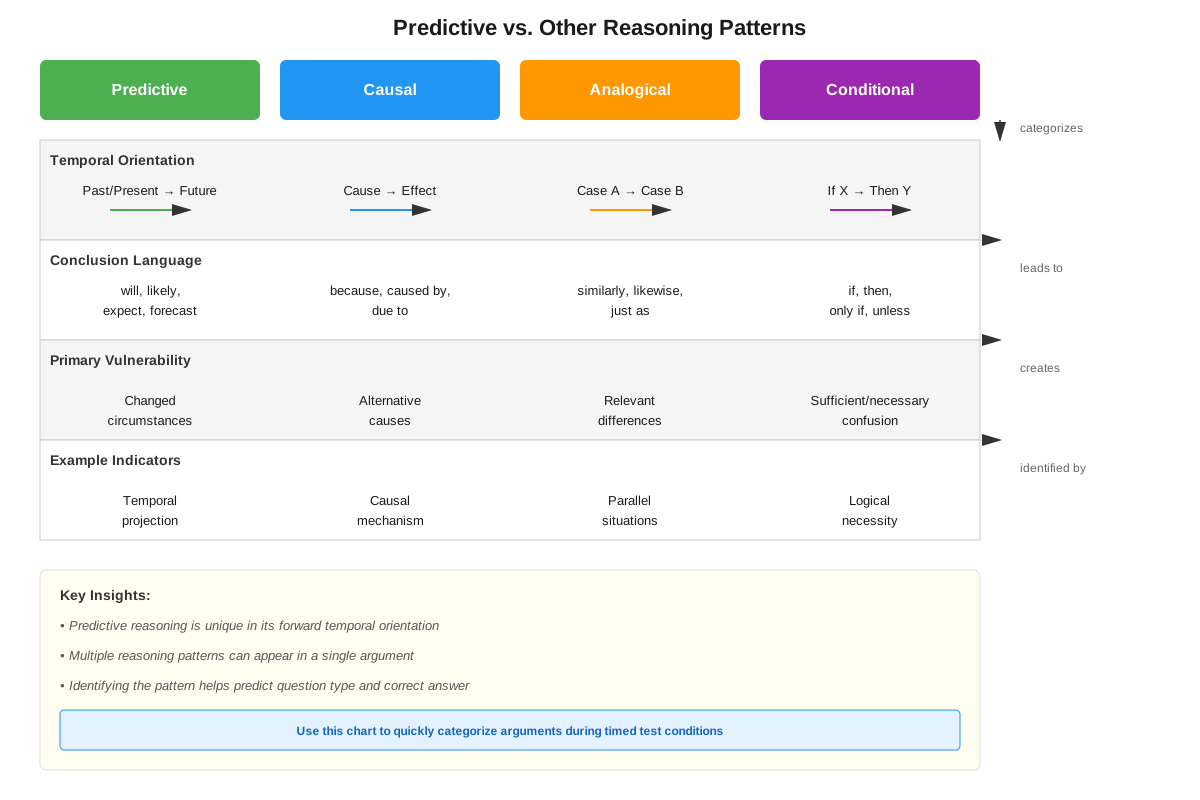
Within the broader framework of argument fundamentals, predictive reasoning represents one of several core reasoning patterns that form the building blocks of logical reasoning on the LSAT. While causal reasoning examines why something happened and analogical reasoning draws parallels between similar situations, predictive reasoning specifically focuses on projecting forward in time. This temporal dimension creates unique logical challenges and opportunities for error, which the LSAT exploits systematically. Mastering predictive reasoning also strengthens understanding of related concepts such as conditional reasoning, statistical reasoning, and the relationship between evidence and conclusions.
Learning Objectives
- [ ] Identify how Predictive reasoning appears in LSAT questions
- [ ] Explain the reasoning pattern behind Predictive reasoning
- [ ] Apply Predictive reasoning to solve LSAT-style problems accurately
- [ ] Distinguish predictive reasoning from other argument patterns (causal, analogical, conditional)
- [ ] Recognize the common vulnerabilities and assumptions underlying predictive arguments
- [ ] Evaluate the strength of evidence supporting predictive conclusions
- [ ] Generate effective strengtheners and weakeners for predictive arguments
Prerequisites
- Basic argument structure: Understanding premises and conclusions is essential because predictive reasoning is fundamentally about how evidence supports forward-looking claims
- Indicator words: Recognizing conclusion and premise indicators helps identify when an argument shifts from describing current/past states to making predictions
- Assumption identification: Predictive arguments always contain gaps between evidence and conclusion that must be bridged by assumptions
- Conditional logic basics: Many predictions involve "if-then" structures or claims about what will happen under certain conditions
Why This Topic Matters
Predictive reasoning appears in real-world contexts constantly: business forecasts, policy debates, scientific hypotheses, medical prognoses, and personal decision-making all rely on making informed predictions about future outcomes. Legal reasoning—the domain the LSAT is designed to assess—frequently involves predicting how courts will rule, how laws will affect behavior, or what consequences will follow from legal decisions. Attorneys must regularly evaluate the strength of predictive claims made by opposing counsel, expert witnesses, and their own clients.
On the LSAT specifically, predictive reasoning appears in approximately 15-20% of Logical Reasoning questions, making it one of the most frequently tested reasoning patterns. This topic appears most commonly in:
- Weaken questions: Where students must identify information that undermines a prediction
- Strengthen questions: Where students must find evidence that makes a prediction more likely
- Assumption questions: Where students must identify what must be true for a prediction to follow
- Flaw questions: Where students must recognize errors in predictive reasoning
- Evaluate questions: Where students must determine what information would help assess a prediction's validity
The LSAT particularly favors predictive reasoning because it creates natural opportunities for logical gaps. Every prediction involves an implicit assumption that current patterns will continue, that no interfering factors will emerge, or that the evidence is representative of future conditions. These gaps allow test writers to create challenging questions that reward careful logical analysis.
Core Concepts
The Structure of Predictive Arguments
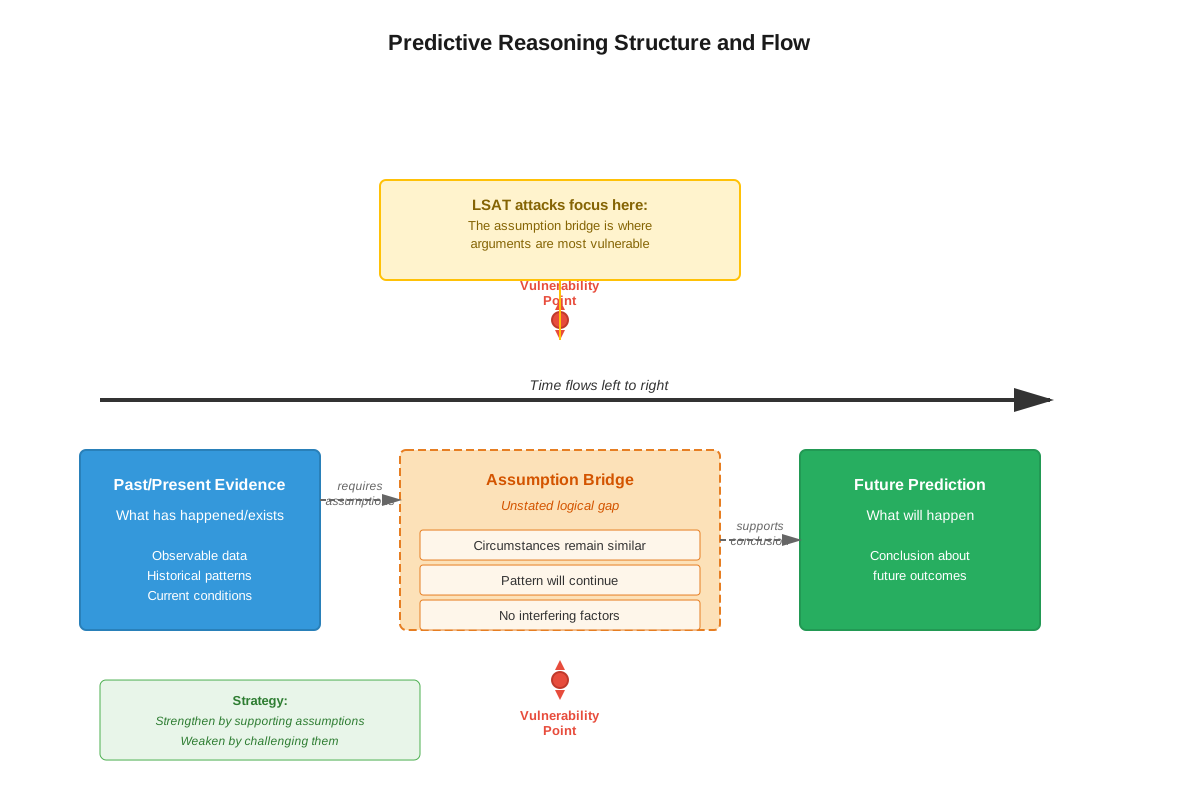
A predictive argument contains three essential components: evidence about the past or present, an inferential leap forward in time, and a conclusion about the future. The evidence typically consists of observations, data, trends, or established patterns. The conclusion makes a claim about what will happen, what is likely to occur, or what should be expected. The critical element is the temporal shift—the argument moves from "what is" or "what was" to "what will be."
Consider this basic structure:
- Premise: Company X's sales have increased 10% annually for the past five years
- Conclusion: Company X's sales will increase 10% next year
The reasoning pattern assumes continuity between past and future, which may or may not be warranted depending on circumstances.
Types of Predictive Reasoning
Trend-based predictions extrapolate from observed patterns over time. These arguments identify a trajectory and project it forward. For example: "Enrollment has declined each year since 2015, so enrollment will decline next year." The strength of such predictions depends on the consistency of the trend, the length of the observation period, and whether factors driving the trend remain constant.
Analogy-based predictions use past situations to forecast outcomes in similar future situations. The reasoning follows this pattern: "When we implemented policy A in the past, result B occurred; therefore, implementing policy A again will produce result B." These predictions assume relevant similarities between past and future contexts.
Causal predictions identify a cause-and-effect relationship and predict that the same cause will produce the same effect in the future. For instance: "Raising interest rates has always slowed inflation in the past, so raising interest rates now will slow current inflation." These predictions assume the causal mechanism remains operative and that no confounding factors interfere.
Statistical predictions use data about populations or samples to forecast individual cases or future populations. Example: "85% of students who score above 170 on the LSAT gain admission to top-tier law schools, so this student who scored 172 will likely gain admission." These predictions assume the sample is representative and that conditions remain stable.
Key Assumptions in Predictive Reasoning
Every predictive argument rests on critical assumptions that bridge the gap between evidence and conclusion. The continuity assumption holds that conditions, patterns, or relationships observed in the past will persist into the future. This assumption is vulnerable when circumstances change, new factors emerge, or the context shifts significantly.
The no-interference assumption presumes that no new factors will disrupt the predicted outcome. Predictive arguments often fail to account for potential obstacles, competing causes, or intervening events that could prevent the predicted result from occurring.
The representativeness assumption applies when predictions generalize from samples to populations or from past instances to future cases. The argument assumes that the evidence cited is typical, not anomalous, and that it accurately represents the broader pattern.
The mechanism stability assumption underlies causal predictions—it assumes that the causal process or mechanism that produced past results will function the same way in the future. Changes in how systems operate can invalidate predictions even when surface conditions appear similar.
Vulnerabilities of Predictive Arguments
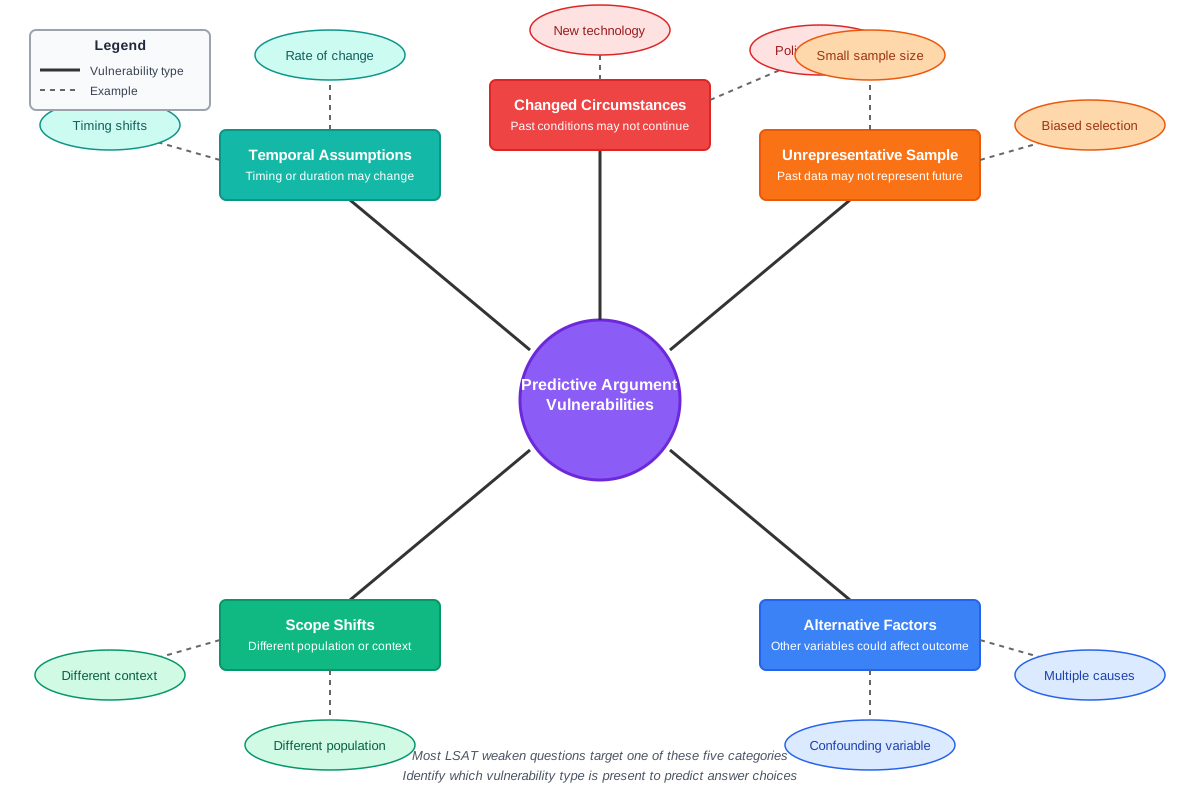
Predictive reasoning is inherently uncertain because the future has not yet occurred. Several common vulnerabilities make these arguments susceptible to criticism on the LSAT:
Changed circumstances: Conditions that held in the past may no longer apply. New technologies, regulations, competitors, or social factors can disrupt established patterns.
Small or unrepresentative samples: Predictions based on limited data or atypical cases may not generalize reliably.
Confounding variables: Other factors besides those cited may have caused past results, or new factors may influence future outcomes.
Temporal limitations: Short-term trends may not continue long-term; seasonal or cyclical patterns may be mistaken for permanent trends.
Overlooked alternatives: Multiple possible futures may exist, but the argument considers only one predicted outcome.
Evaluating Predictive Strength
Strong predictive arguments share several characteristics. They cite extensive, consistent evidence spanning sufficient time periods or sample sizes. They acknowledge and address potential disruptions to the predicted pattern. They specify conditions under which the prediction holds rather than making unconditional claims. They recognize degrees of likelihood rather than claiming certainty.
Weak predictive arguments often rely on limited evidence, ignore obvious alternative possibilities, assume perfect continuity without justification, or fail to consider relevant differences between past and future contexts.
Concept Relationships
Predictive reasoning connects intimately with other core logical reasoning patterns. Causal reasoning often underlies predictions—when an argument predicts that X will cause Y, it typically relies on evidence that X has caused Y in the past. Understanding causal relationships thus strengthens the ability to evaluate predictions. The relationship flows: Causal evidence → Predictive conclusion.
Statistical reasoning provides the quantitative foundation for many predictions. When arguments cite percentages, rates, or probabilities to support predictions, they combine statistical evidence with predictive conclusions. The connection: Statistical data → Probability assessment → Predictive claim.
Analogical reasoning supports predictions by drawing parallels between past and future situations. The logic: Past situation A had outcome B → Future situation resembles A → Future situation will have outcome B. Recognizing when analogies are strong or weak directly affects the evaluation of predictions based on them.
Assumption identification is crucial for all predictive reasoning because the gap between past evidence and future conclusions always requires bridging assumptions. The relationship: Evidence about past/present → [Assumptions about continuity, representativeness, no interference] → Prediction about future.
Within the topic itself, concepts connect as follows: Understanding the basic structure of predictive arguments → Recognizing different types of predictions → Identifying common assumptions → Spotting vulnerabilities → Evaluating argument strength → Applying strategies to strengthen or weaken predictions.
High-Yield Facts
⭐ Predictive reasoning moves from evidence about the past or present to conclusions about the future—this temporal shift is the defining characteristic.
⭐ Every predictive argument assumes that current patterns, conditions, or relationships will continue—this continuity assumption is the most common vulnerability.
⭐ Changed circumstances are the most powerful way to weaken a prediction—showing that conditions have shifted undermines the relevance of past evidence.
⭐ Predictive arguments appear most frequently in Weaken, Strengthen, and Assumption questions—recognizing the pattern helps trigger appropriate strategies.
⭐ Small sample sizes or short time periods weaken predictive arguments—the LSAT regularly exploits this vulnerability.
- Predictions based on analogies are only as strong as the similarity between past and future situations.
- Causal predictions assume the causal mechanism remains operative and no interfering factors emerge.
- Statistical predictions require representative samples and stable conditions.
- Trend-based predictions are vulnerable to cyclical patterns being mistaken for permanent trends.
- Strong predictions acknowledge uncertainty and specify conditions rather than claiming absolute certainty.
- Alternative possible outcomes weaken predictions that present only one scenario.
- Predictions about specific cases based on general patterns commit the fallacy of division if they ignore individual variation.
- The longer and more consistent the pattern cited as evidence, the stronger the prediction.
- Predictions are strengthened by evidence that potentially disruptive factors have been considered and ruled out.
- Temporal proximity matters—predictions about the near future are generally stronger than predictions about the distant future.
Quick check — test yourself on Predictive reasoning so far.
Try Flashcards →Common Misconceptions
Misconception: All arguments about the future involve predictive reasoning. → Correction: Some arguments make conditional claims ("if X happens, then Y will happen") without predicting that X will actually occur. Predictive reasoning specifically forecasts that something will happen, not merely what would happen under certain conditions.
Misconception: Predictive reasoning is inherently weak or fallacious. → Correction: Predictions can be strong or weak depending on the quality and quantity of evidence. Well-supported predictions based on extensive, consistent data and careful consideration of variables can be quite reliable. The LSAT tests the ability to distinguish strong from weak predictions, not to reject all predictions.
Misconception: To weaken a prediction, you must prove it will definitely not occur. → Correction: Weakening a prediction only requires making it less likely or less certain. Showing that the prediction might not occur, or that alternative outcomes are possible, is sufficient to weaken the argument.
Misconception: Past patterns always provide strong evidence for future predictions. → Correction: The strength of past patterns as evidence depends on whether the conditions that produced those patterns remain in place. A perfect past record provides weak evidence if circumstances have fundamentally changed.
Misconception: Predictive reasoning and causal reasoning are the same thing. → Correction: While they often overlap, they are distinct. Causal reasoning explains why something happened; predictive reasoning forecasts what will happen. A prediction may be based on causal reasoning, but not all predictions involve causal claims, and not all causal arguments make predictions.
Misconception: Statistical evidence always strengthens predictions. → Correction: Statistics strengthen predictions only when the sample is representative, the sample size is adequate, and conditions remain stable. Misleading statistics, unrepresentative samples, or changed conditions can make statistical evidence irrelevant to predictions.
Worked Examples
Example 1: Identifying and Evaluating Predictive Reasoning
Argument: "Over the past decade, the city's public transportation ridership has increased by an average of 5% annually. The city council predicts that ridership will increase by 5% next year and has budgeted accordingly."
Analysis:
Step 1: Identify the reasoning pattern
This is clearly predictive reasoning. The evidence concerns past trends (10 years of 5% annual increases), and the conclusion makes a claim about the future (next year's ridership will increase 5%).
Step 2: Identify the conclusion
"Ridership will increase by 5% next year" is the predictive conclusion.
Step 3: Identify the evidence
The premise is the consistent 5% annual increase over the past decade.
Step 4: Identify assumptions
The argument assumes:
- The factors driving past increases will continue to operate
- No new factors will emerge to disrupt the trend
- The past decade is representative of future patterns
- The 5% rate is not coincidental or due to temporary conditions
Step 5: Evaluate vulnerabilities
This prediction could be weakened by:
- Evidence of changed circumstances (new competing transportation options, economic downturn, population shifts)
- Information suggesting the past trend was driven by temporary factors (one-time infrastructure improvements now complete)
- Data showing the trend is slowing or becoming inconsistent
Step 6: Consider strengtheners
The prediction would be strengthened by:
- Evidence that factors driving past growth remain in place or are intensifying
- Data showing the trend is accelerating or becoming more consistent
- Information ruling out potential disruptions
Connection to learning objectives: This example demonstrates how to identify predictive reasoning (Objective 1), explains the underlying pattern of using past trends to forecast future outcomes (Objective 2), and shows how to evaluate the argument's assumptions and vulnerabilities (Objectives 5-6).
Example 2: Applying Predictive Reasoning to a Weaken Question
Argument: "The Acme Corporation has launched five new products in the past three years, and each achieved profitability within six months. Acme's newest product, launched last month, will therefore be profitable within six months."
Question: Which of the following, if true, most weakens the argument?
Answer choices:
(A) Some of Acme's competitors have launched products that failed to achieve profitability
(B) The newest product targets a different market segment than the previous five products
(C) Acme has invested more in marketing the newest product than in marketing previous products
(D) Consumer demand for Acme's products has remained stable over the past three years
(E) The newest product has received positive reviews from industry experts
Analysis:
Step 1: Recognize the predictive pattern
The argument uses past success (five products became profitable within six months) to predict future success (the newest product will be profitable within six months).
Step 2: Identify the key assumption
The argument assumes the newest product is relevantly similar to the previous five products—that whatever factors made them successful will also apply to the new product.
Step 3: Evaluate each answer choice
(A) Information about competitors doesn't directly affect whether Acme's pattern will continue. This is irrelevant to the prediction about Acme's newest product.
(B) CORRECT. This directly attacks the representativeness assumption. If the newest product targets a different market segment, the success of products in other segments provides weak evidence for predicting this product's success. The past pattern may not apply to different circumstances.
(C) This would strengthen the prediction by suggesting additional factors supporting success, not weaken it.
(D) Stable demand supports the prediction that patterns will continue; this strengthens rather than weakens.
(E) Positive reviews would strengthen the prediction of success.
Step 4: Confirm the answer
Choice (B) weakens the argument by showing that the newest product differs from previous products in a potentially relevant way, undermining the assumption that past patterns will continue.
Connection to learning objectives: This example demonstrates how to identify predictive reasoning in LSAT questions (Objective 1), apply understanding of the reasoning pattern to solve problems (Objective 3), recognize assumptions (Objective 5), and generate effective weakeners (Objective 7).
Exam Strategy
Recognition Triggers
Watch for temporal language that signals predictive reasoning: "will," "is likely to," "should," "can be expected to," "probably," "is predicted to," "forecast," "anticipate," and "project." When you see conclusions using these terms, immediately recognize you're dealing with a prediction and activate your predictive reasoning analysis framework.
Pay attention to evidence that describes past patterns, trends, historical data, or previous instances. When premises discuss what has happened before and conclusions discuss what will happen next, predictive reasoning is at work.
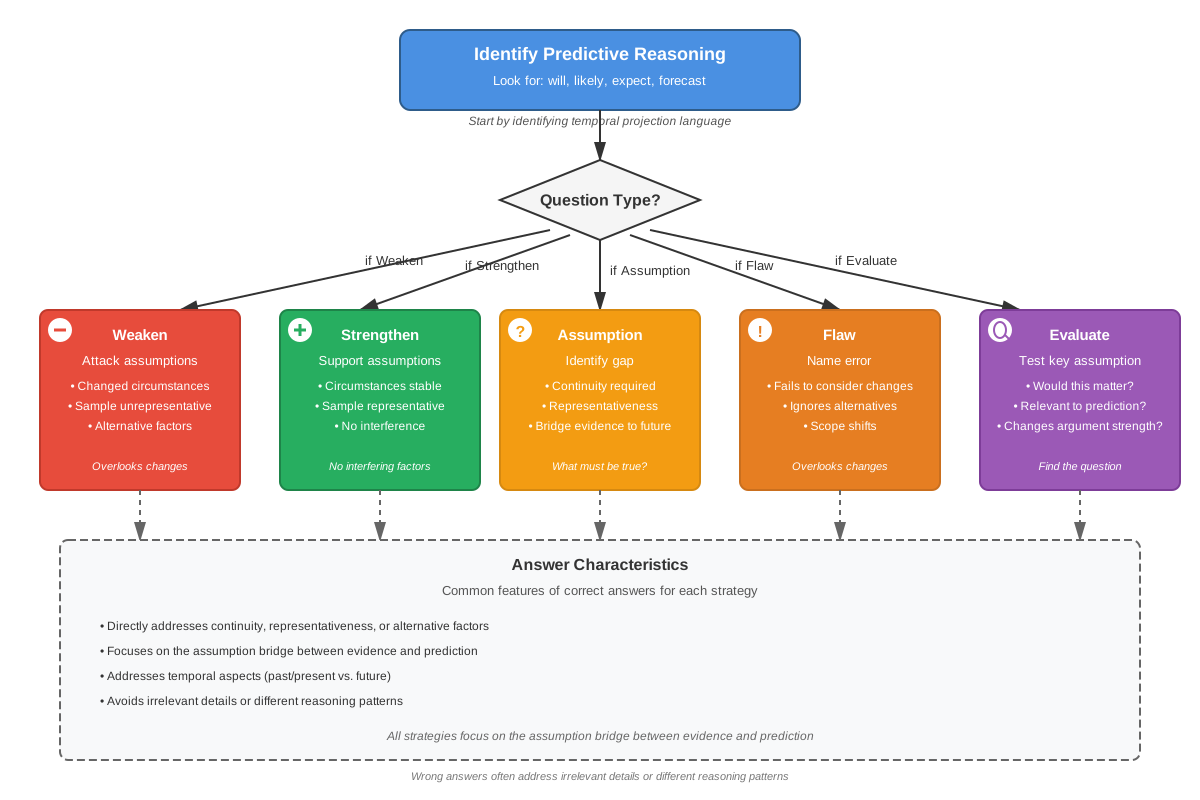
Approach Strategy by Question Type
For Weaken questions: Look for answer choices that suggest changed circumstances, identify relevant differences between past and future, introduce interfering factors, or show the past evidence was unrepresentative or based on small samples. The most effective weakeners often demonstrate that conditions have shifted in ways that make past patterns irrelevant.
For Strengthen questions: Seek answer choices that confirm continuity of conditions, rule out potential disruptions, show the evidence is extensive and representative, or demonstrate that factors driving past patterns remain operative. Strengtheners often address the most obvious vulnerabilities in the prediction.
For Assumption questions: Focus on what must be true for the past evidence to support the future prediction. Common assumptions include: no relevant changes have occurred, the sample is representative, no interfering factors will emerge, and the causal mechanism remains stable.
For Flaw questions: Predictive arguments commonly commit these flaws: assuming without justification that past patterns will continue, generalizing from unrepresentative samples, failing to consider alternative possibilities, or ignoring relevant differences between past and future contexts.
Process of Elimination Tips
Eliminate answer choices that:
- Discuss only the past without connecting to the future prediction
- Address factors irrelevant to the specific prediction being made
- In Weaken questions, actually strengthen the prediction or are neutral
- In Strengthen questions, introduce new vulnerabilities or are irrelevant
- Confuse correlation with causation when the prediction doesn't involve causal claims
Time Management
Predictive reasoning questions are typically medium difficulty and should take 1:15-1:30 minutes. Spend 20-30 seconds identifying the predictive pattern and the key assumption, then 45-60 seconds evaluating answer choices. If you quickly recognize the pattern and assumption, these questions can be answered efficiently, making them good candidates for confident, quick points.
Exam Tip: When you identify predictive reasoning, immediately ask yourself: "What would need to change or stay the same for this prediction to hold?" This question naturally leads you to the argument's assumptions and vulnerabilities.
Memory Techniques
PAST → FUTURE mnemonic for identifying predictive reasoning:
- Premises about Previous patterns
- Assumptions about continuity
- Similarity between past and future contexts
- Temporal shift in the conclusion
CHANGE weakens predictions - Remember that the most effective way to weaken a prediction is to show that something has Changed: Circumstances, Historical patterns, Assumptions, New factors, Grounds for the prediction, Evidence relevance.
The Three C's of Strong Predictions:
- Consistency: Evidence shows consistent patterns over time
- Continuity: Conditions remain stable from past to future
- Comprehensiveness: Evidence is extensive and representative
Visualization strategy: Picture a bridge extending from the past (evidence) to the future (conclusion). The bridge's supports are the assumptions. Ask yourself: "What could cause this bridge to collapse?" Those are the vulnerabilities. "What would make the bridge stronger?" Those are potential strengtheners.
TREND acronym for evaluating trend-based predictions:
- Time period: Is it long enough?
- Representativeness: Is the sample typical?
- Evidence quality: Is it consistent and reliable?
- New factors: Could anything disrupt the trend?
- Differences: Are there relevant changes between past and future?
Summary
Predictive reasoning is a fundamental argument pattern on the LSAT that involves drawing conclusions about future events based on evidence about the past or present. This reasoning pattern appears in 15-20% of Logical Reasoning questions and is particularly common in Weaken, Strengthen, and Assumption questions. The core structure involves a temporal shift from evidence about what has happened to conclusions about what will happen. Every predictive argument rests on critical assumptions—primarily that current patterns will continue, that no interfering factors will emerge, and that past evidence is representative of future conditions. These assumptions create natural vulnerabilities that the LSAT exploits systematically. Strong predictive arguments cite extensive, consistent evidence and acknowledge potential disruptions, while weak predictions rely on limited data, ignore changed circumstances, or fail to consider alternative possibilities. Success on predictive reasoning questions requires quickly recognizing the pattern, identifying the key assumptions, and understanding how changed circumstances, unrepresentative samples, or interfering factors can strengthen or weaken predictions. Mastering this topic provides a significant strategic advantage because it appears frequently and follows predictable patterns that, once learned, enable efficient and accurate question analysis.
Key Takeaways
- Predictive reasoning moves from past/present evidence to future conclusions—the temporal shift is the defining characteristic
- Every prediction assumes continuity of patterns and conditions; this assumption is the primary vulnerability
- Changed circumstances are the most powerful way to weaken predictions on the LSAT
- Strong predictions are based on extensive, consistent evidence and acknowledge potential disruptions
- Recognize predictive reasoning through temporal language ("will," "likely to," "expected to") and past-to-future structure
- Different types of predictions (trend-based, analogy-based, causal, statistical) have specific vulnerabilities
- Effective LSAT strategy involves immediately identifying assumptions and asking what could change to disrupt the prediction
Related Topics
Causal Reasoning: Understanding cause-and-effect relationships is essential for evaluating causal predictions, which forecast that identified causes will produce specific effects in the future. Mastering predictive reasoning provides a foundation for analyzing how causal claims support or undermine predictions.
Statistical Reasoning: Many predictions rely on statistical evidence, percentages, and probability claims. Strengthening your understanding of how statistics support predictions enhances your ability to evaluate both statistical and predictive arguments.
Assumption Questions: Since all predictive arguments contain assumptions bridging past evidence and future conclusions, mastering predictive reasoning directly improves performance on assumption questions across all argument types.
Analogical Reasoning: Predictions often rest on analogies between past and future situations. Understanding when analogies are strong or weak is crucial for evaluating analogy-based predictions.
Conditional Reasoning: Many predictions involve conditional structures ("if X continues, then Y will occur"). Combining predictive and conditional reasoning skills enables analysis of complex arguments involving both patterns.
Practice CTA
Now that you understand the fundamentals of predictive reasoning, it's time to apply these concepts to actual LSAT questions. Work through the practice questions and flashcards to reinforce your recognition of predictive patterns, strengthen your ability to identify assumptions, and develop your skills in generating effective strengtheners and weakeners. Remember: predictive reasoning appears in approximately one out of every five Logical Reasoning questions, making it one of the highest-yield topics you can master. Each practice question you complete builds the pattern recognition and analytical skills that will serve you throughout the LSAT. Approach each question systematically, identify the temporal shift from past to future, spot the key assumptions, and evaluate the argument's vulnerabilities. Your investment in mastering this topic will pay dividends on test day!
Sign up free to keep reading
Create a free AnvayaPrep account to finish this LSAT guide on Predictive reasoning — plus flashcards and practice questions.