Overview
Recognizing unsupported conclusions is a foundational skill in LSAT Logical Reasoning that requires test-takers to identify when an argument's conclusion extends beyond what its premises actually establish. This critical thinking skill appears throughout the LSAT in various question types, including Flaw questions, Strengthen/Weaken questions, Necessary Assumption questions, and Sufficient Assumption questions. The ability to spot the gap between what an argument proves and what it claims to prove is essential for achieving a competitive score on the LSAT.
At its core, this topic involves analyzing the logical structure of arguments to determine whether the evidence provided genuinely supports the conclusion drawn. An unsupported conclusion occurs when an argument makes a claim that its premises do not adequately justify—either because the premises are insufficient, irrelevant, or fail to address key aspects of the conclusion. This differs from arguments with false premises; an unsupported conclusion can rest on true premises that simply don't connect logically to the claim being made.
Understanding unsupported conclusions is fundamental to mastering argument fundamentals because it underlies nearly every critical reasoning task on the LSAT. Whether identifying flaws, finding assumptions, or evaluating argument strength, test-takers must first recognize when and how a conclusion lacks proper support. This skill connects directly to assumption identification, argument structure analysis, and the evaluation of reasoning patterns—making it an indispensable component of LSAT preparation.
Learning Objectives
- [ ] Identify how recognizing unsupported conclusions appears in LSAT questions
- [ ] Explain the reasoning pattern behind recognizing unsupported conclusions
- [ ] Apply recognizing unsupported conclusions to solve LSAT-style problems accurately
- [ ] Distinguish between completely unsupported conclusions and conclusions with partial support
- [ ] Analyze the specific gap between premises and conclusions in complex arguments
- [ ] Evaluate whether additional evidence would be sufficient to support a given conclusion
Prerequisites
- Basic argument structure: Understanding the distinction between premises and conclusions is essential because recognizing unsupported conclusions requires identifying what the argument claims versus what it establishes.
- Indicator words: Familiarity with conclusion indicators (therefore, thus, hence) and premise indicators (because, since, given that) enables quick identification of argument components.
- Logical relationships: Basic understanding of how evidence relates to claims helps in assessing whether support is adequate or insufficient.
- Conditional reasoning fundamentals: Many unsupported conclusions involve improper conditional inferences, making basic conditional logic knowledge valuable.
Why This Topic Matters
In real-world contexts, the ability to recognize unsupported conclusions protects against manipulation, faulty decision-making, and acceptance of poorly reasoned arguments. Legal professionals—the target audience for the LSAT—must constantly evaluate whether evidence supports legal claims, making this skill directly relevant to law practice. From assessing witness testimony to evaluating opposing counsel's arguments, lawyers rely on this analytical capability daily.
On the LSAT, recognizing unsupported conclusions appears with remarkable frequency. Approximately 60-70% of Logical Reasoning questions involve some aspect of identifying gaps between premises and conclusions. Flaw questions, which constitute roughly 15-20% of Logical Reasoning sections, frequently test this skill directly by asking test-takers to identify reasoning errors. Assumption questions (both Necessary and Sufficient), representing another 20-25% of questions, require recognizing what's missing from an argument—essentially identifying why a conclusion is currently unsupported.
This topic appears in LSAT passages through various manifestations: arguments that overgeneralize from limited data, conclusions that introduce new concepts not mentioned in premises, causal claims based on correlational evidence, comparative conclusions drawn from non-comparative premises, and prescriptive recommendations based solely on descriptive facts. The LSAT tests whether students can identify these logical gaps quickly and accurately under time pressure.
Core Concepts
The Nature of Unsupported Conclusions
An unsupported conclusion exists when an argument's premises fail to provide adequate justification for its conclusion. This failure can be complete (no support whatsoever) or partial (some support exists, but significant gaps remain). The LSAT primarily tests recognition of partial support failures, where arguments appear superficially reasonable but contain critical logical gaps.
Three key components define whether a conclusion is properly supported:
- Relevance: The premises must relate meaningfully to the conclusion
- Sufficiency: The premises must provide enough evidence to justify the conclusion
- Scope alignment: The conclusion's scope must not exceed what the premises establish
Types of Support Failures
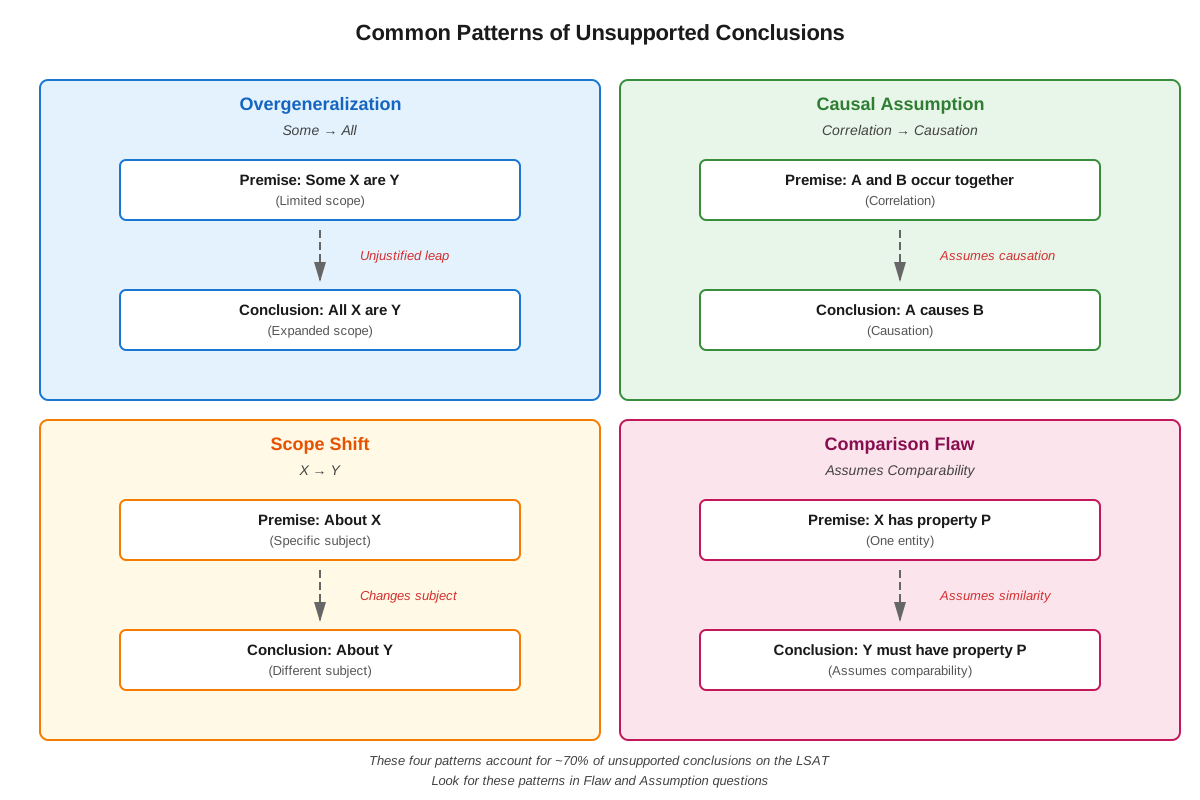
Scope Shifts represent one of the most common forms of unsupported conclusions on the LSAT. These occur when a conclusion discusses a different group, time period, or concept than the premises address. For example:
- Premises discuss "some members" while conclusion claims "all members"
- Premises address past events while conclusion predicts future outcomes
- Premises concern one population while conclusion generalizes to another
Concept Introduction happens when a conclusion contains terms or ideas absent from the premises. If premises discuss "economic growth" but the conclusion claims "increased happiness," the argument has introduced a new concept requiring an unstated assumption connecting the two ideas.
Causal Reasoning Gaps emerge when arguments conclude causal relationships from correlational or temporal data. Observing that two events occur together or in sequence does not establish that one causes the other—yet arguments frequently make this logical leap.
Comparative Reasoning Failures occur when conclusions make comparative claims (better, worse, more, less) without premises that establish the relevant comparison. An argument might present data about one option while concluding it's superior to alternatives never discussed in the premises.
The Anatomy of Logical Gaps
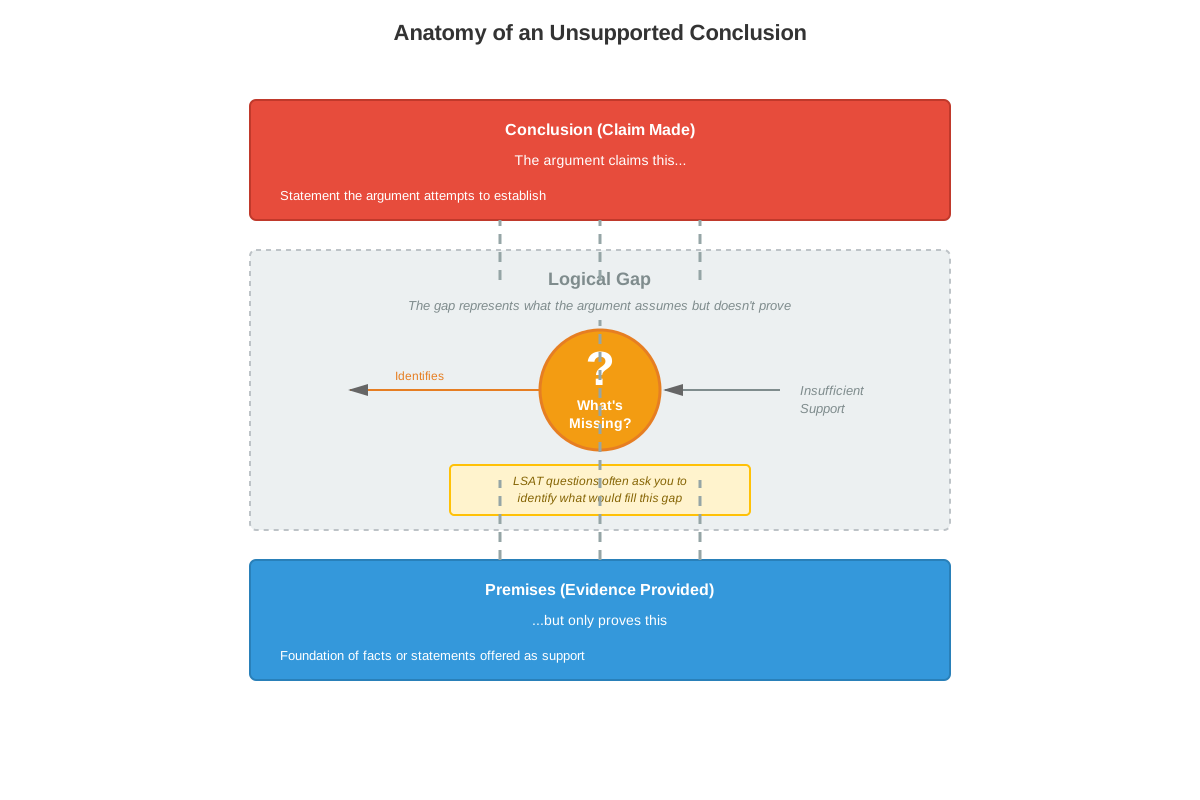
Understanding the structure of logical gaps helps identify unsupported conclusions systematically. Every gap represents missing information—an unstated assumption the argument requires to be valid. The gap exists in the logical space between the last premise and the conclusion.
Consider this structure:
Premise 1: [Evidence about X]
Premise 2: [Evidence about Y]
[LOGICAL GAP - Unstated assumption needed]
Conclusion: [Claim about Z]
The gap becomes visible when asking: "What must be true for these premises to actually prove this conclusion?" Whatever answer emerges represents the missing support.
Degrees of Support
Not all unsupported conclusions are equally unsupported. The LSAT tests understanding of support gradations:
| Support Level | Description | Example |
|---|---|---|
| No support | Premises completely irrelevant to conclusion | Premises about weather; conclusion about economics |
| Minimal support | Premises tangentially related but insufficient | One example used to prove universal claim |
| Partial support | Premises support some aspects but not others | Evidence for correlation used to prove causation |
| Strong support | Premises nearly sufficient; minor gaps remain | Comprehensive evidence with small scope issue |
Identifying Support Gaps in Practice
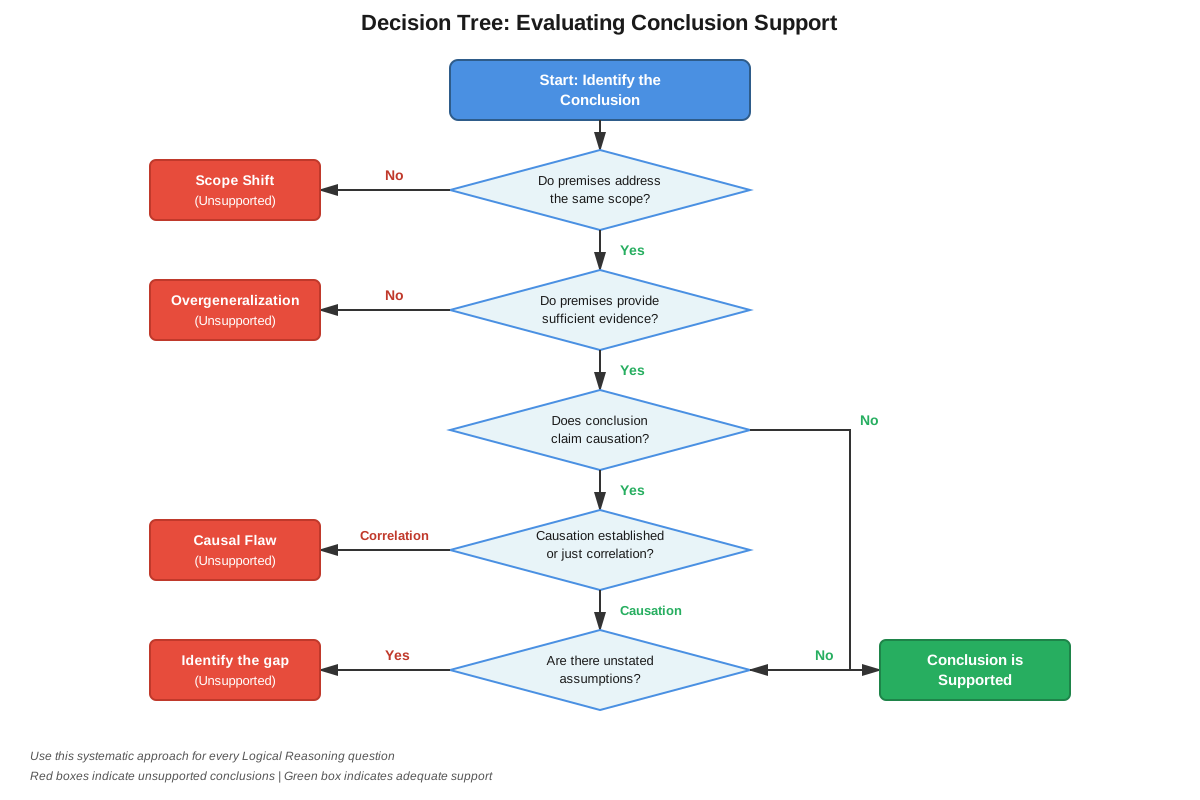
A systematic approach to recognizing unsupported conclusions involves:
- Isolate the conclusion: Identify exactly what the argument claims
- List the premises: Determine what evidence the argument provides
- Compare scope and terms: Check whether conclusion terms appear in premises
- Test sufficiency: Ask whether the premises, if true, would prove the conclusion
- Identify the gap: Articulate what's missing or what assumption is required
Common Patterns of Unsupported Conclusions
Overgeneralization: Drawing broad conclusions from limited evidence. An argument might survey 50 people and conclude about "most people" or observe a trend for three years and predict it will continue indefinitely.
Unwarranted Assumptions: Treating debatable claims as established facts. Arguments might assume that correlation implies causation, that past patterns will continue, or that what's true for parts is true for the whole.
Ignoring Alternatives: Concluding one explanation is correct without ruling out other possibilities. An argument might observe an effect and conclude a specific cause without considering alternative explanations.
Prescriptive from Descriptive: Drawing "ought" conclusions from "is" premises. Describing how things are doesn't establish how they should be without additional normative premises.
The Role of Context
The LSAT presents arguments in isolation, but recognizing unsupported conclusions requires understanding what counts as adequate support in logical reasoning contexts. Unlike everyday conversation where shared assumptions go unstated, LSAT arguments must explicitly provide all necessary support. If information isn't stated in the premises, it cannot be assumed—even if it seems obvious or reasonable.
Concept Relationships
The skill of recognizing unsupported conclusions serves as the foundation for multiple advanced Logical Reasoning competencies. This topic directly enables assumption identification because every unsupported conclusion reveals a gap that assumptions must fill. When a conclusion lacks support, the missing link between premises and conclusion represents the argument's assumption.
The relationship flows as follows:
Recognizing Unsupported Conclusions → Identifies Logical Gaps → Reveals Required Assumptions → Enables Flaw Identification → Supports Strengthen/Weaken Analysis
This skill also connects intimately with argument structure analysis. Before determining whether a conclusion is supported, one must accurately identify which statement is the conclusion and which are premises. The structural analysis provides the framework; support evaluation provides the critical assessment.
Furthermore, recognizing unsupported conclusions relates to conditional reasoning because many support failures involve improper conditional inferences. An argument might affirm the consequent or deny the antecedent, creating an unsupported conclusion through faulty conditional logic.
The concept also underpins causal reasoning analysis, as many unsupported conclusions involve unjustified causal claims. Recognizing when causal conclusions lack support requires understanding both general support principles and specific causal reasoning requirements.
High-Yield Facts
⭐ An unsupported conclusion can have true premises and a true conclusion—the issue is whether the premises prove the conclusion, not whether statements are factually accurate.
⭐ Scope shifts between premises and conclusions represent the most frequently tested form of unsupported conclusions on the LSAT.
⭐ If a conclusion introduces a new term not mentioned in the premises, the argument requires an unstated assumption connecting that term to the premise concepts.
⭐ Correlation does not establish causation—arguments concluding causal relationships from correlational evidence contain unsupported conclusions unless they rule out alternative explanations.
⭐ Comparative conclusions require comparative premises—if premises don't establish a comparison, the conclusion is unsupported.
- Arguments can provide some support for a conclusion while still being logically flawed due to insufficient support.
- The strength of support needed varies by conclusion type: universal claims require stronger support than particular claims.
- Temporal scope shifts (past evidence supporting future conclusions) create unsupported conclusions unless continuity is established.
- Prescriptive conclusions (what should be done) require normative premises, not just descriptive facts.
- An argument's conclusion can be narrower than its premises without being unsupported, but not broader.
- Analogical reasoning creates unsupported conclusions when relevant differences between compared cases aren't addressed.
Quick check — test yourself on Recognizing unsupported conclusions so far.
Try Flashcards →Common Misconceptions
Misconception: If premises are true and the conclusion is true, the conclusion is supported.
Correction: Support concerns the logical relationship between premises and conclusion, not the truth value of individual statements. True premises can fail to support a true conclusion if no logical connection exists.
Misconception: An unsupported conclusion means the conclusion is false or probably false.
Correction: An unsupported conclusion might be true; the problem is that the argument hasn't proven it. The conclusion's truth value is separate from whether the argument successfully supports it.
Misconception: If an argument provides any relevant evidence, the conclusion is supported.
Correction: Support requires sufficiency, not just relevance. Premises can be relevant but insufficient—providing some support while leaving the conclusion ultimately unsupported.
Misconception: Common sense or general knowledge can fill gaps in LSAT arguments.
Correction: LSAT arguments must be evaluated based solely on stated information. Outside knowledge cannot be imported to support conclusions, even when such knowledge seems obvious.
Misconception: Longer arguments with more premises necessarily provide better support than shorter arguments.
Correction: Quantity of premises doesn't guarantee quality of support. Multiple irrelevant premises provide no more support than one irrelevant premise, while a single highly relevant premise might provide strong support.
Misconception: If an argument's reasoning pattern is common in everyday life, it must be logically sound.
Correction: Many common reasoning patterns are logically flawed. The LSAT tests ability to identify these flaws regardless of how frequently people use such reasoning in practice.
Misconception: Recognizing an unsupported conclusion means finding the conclusion completely ridiculous or implausible.
Correction: Many unsupported conclusions are plausible or even likely true—the issue is that the specific argument presented doesn't adequately prove them.
Worked Examples
Example 1: Scope Shift Analysis
Argument: "A recent study of 200 college students found that those who exercised at least three times per week reported higher life satisfaction than those who exercised less frequently. Therefore, regular exercise causes increased life satisfaction in adults."
Analysis Process:
Step 1 - Identify the conclusion: "Regular exercise causes increased life satisfaction in adults."
Step 2 - Identify the premises: A study of 200 college students found a correlation between exercise frequency and reported life satisfaction.
Step 3 - Compare scope and terms:
- Premises: college students, correlation, "at least three times per week"
- Conclusion: adults (broader population), causation, "regular exercise" (undefined frequency)
Step 4 - Identify support gaps:
- Population scope shift: College students → all adults (unsupported generalization)
- Causal reasoning gap: Correlation → causation (alternative explanations not ruled out)
- Term shift: "Three times per week" → "regular exercise" (definition unclear)
Step 5 - Articulate why conclusion is unsupported: The conclusion is unsupported because (1) evidence about college students doesn't necessarily apply to all adults, (2) correlation doesn't establish causation—perhaps life satisfaction causes exercise, or a third factor causes both, and (3) the conclusion uses vaguer language than the premises establish.
Connection to Learning Objectives: This example demonstrates how to identify unsupported conclusions by systematically comparing premise and conclusion scope, explaining the reasoning pattern (scope shift plus causal reasoning gap), and applying the analysis to solve the problem.
Example 2: Concept Introduction
Argument: "The city's new traffic management system has reduced average commute times by 15% during peak hours. The system uses artificial intelligence to optimize traffic light timing based on real-time traffic flow. City officials should implement this system in all major metropolitan areas."
Analysis Process:
Step 1 - Identify the conclusion: "City officials should implement this system in all major metropolitan areas."
Step 2 - Identify the premises:
- The system reduced commute times by 15% in one city
- The system uses AI for traffic light optimization
Step 3 - Compare scope and terms:
- Premises discuss: one city, commute time reduction, technical mechanism
- Conclusion discusses: all major metropolitan areas, what "should" be done
Step 4 - Identify support gaps:
- Generalization gap: One city → all major metropolitan areas
- Prescriptive gap: Descriptive success → normative recommendation
- Concept introduction: Cost, feasibility, and other implementation factors not addressed
- Unstated assumptions: Other cities are similar enough; benefits outweigh costs; no better alternatives exist
Step 5 - Articulate why conclusion is unsupported: The premises establish that the system worked in one city but don't address whether it would work elsewhere, whether it's cost-effective, whether implementation is feasible, or whether alternative solutions might be superior. The prescriptive conclusion requires normative premises about what goals should be pursued and how to weigh competing considerations—none of which the argument provides.
Connection to Learning Objectives: This example shows how conclusions can introduce entirely new concepts (cost-effectiveness, feasibility, comparative value) not mentioned in premises, creating multiple support gaps. It demonstrates the reasoning pattern of moving from descriptive to prescriptive claims without adequate justification.
Exam Strategy
Approaching Questions Systematically
When encountering LSAT questions testing recognizing unsupported conclusions, follow this strategic approach:
- Read the question stem first to know what you're looking for (flaw, assumption, strengthen, etc.)
- Identify the conclusion immediately using indicator words or structural position
- Actively read premises while asking "Does this prove the conclusion?"
- Note scope shifts between premises and conclusion before looking at answer choices
- Predict the gap before evaluating answers
Trigger Words and Phrases
Watch for these high-yield indicators of unsupported conclusions:
Causal language: "causes," "leads to," "results in," "produces," "brings about"—often signals causal reasoning gaps
Universal quantifiers: "all," "every," "always," "never," "none"—often indicates overgeneralization
Comparative terms: "better," "worse," "more effective," "superior"—signals need for comparative premises
Prescriptive language: "should," "ought to," "must," "needs to"—indicates prescriptive conclusions requiring normative support
Predictive language: "will," "is going to," "is likely to"—suggests temporal scope shift from past/present evidence
Generalization markers: "in general," "typically," "most," "usually"—may indicate overgeneralization from limited data
Process of Elimination Tips
When evaluating answer choices:
For Flaw questions: Eliminate answers that describe reasoning patterns not present in the argument. The correct answer must accurately describe both what the argument does and why it's problematic.
For Assumption questions: Eliminate answers that, if false, wouldn't damage the argument. The correct answer must be necessary for the conclusion to follow from the premises.
For Strengthen/Weaken questions: Eliminate answers that address issues irrelevant to the argument's gap. The correct answer must target the specific connection between the argument's premises and conclusion.
Exam Tip: If you can't immediately spot the gap, ask yourself: "What would I need to know to be certain the conclusion is true, given these premises?" The answer reveals the unsupported element.
Time Allocation
Spend approximately:
- 15-20 seconds: Reading and understanding the argument
- 10-15 seconds: Identifying the gap/unsupported element
- 30-40 seconds: Evaluating answer choices
- 5-10 seconds: Confirming your selection
Don't spend excessive time trying to understand every nuance of a complex argument. Focus on the structural relationship between premises and conclusion—that's what the LSAT tests.
Memory Techniques
The SCOPE Acronym
Use SCOPE to remember key elements to check when evaluating support:
- Subject: Does the conclusion discuss the same subject as the premises?
- Concepts: Are all conclusion terms present in the premises?
- Overview: Is the conclusion's breadth justified by the premises?
- Population: Does the conclusion generalize beyond the premise population?
- Evidence type: Does the conclusion type (causal, prescriptive, etc.) match the evidence provided?
The "Bridge" Visualization
Visualize arguments as bridges:
- Premises = the starting point (one side of a river)
- Conclusion = the destination (other side of the river)
- Support = the bridge connecting them
An unsupported conclusion is like a bridge with missing planks—you can see both sides but can't actually get from premises to conclusion. The gap represents the missing planks (unstated assumptions).
The Three C's of Causal Gaps
Remember Correlation ≠ Causation requires checking three C's:
- Could the reverse be true? (Reverse causation)
- Could something else explain both? (Common cause)
- Coincidence? (No causal relationship at all)
Quantifier Mismatch Mnemonic
"Some to All Falls" reminds you that moving from "some" in premises to "all" in conclusions represents a logical fall (failure).
Summary
Recognizing unsupported conclusions is a critical LSAT skill requiring systematic analysis of the logical relationship between an argument's premises and conclusion. An unsupported conclusion exists when premises fail to provide adequate justification for the claim made, whether due to scope shifts, concept introduction, insufficient evidence, or logical gaps. The most common patterns include overgeneralization from limited data, causal claims based on correlational evidence, comparative conclusions without comparative premises, and prescriptive recommendations based solely on descriptive facts. Success requires identifying the conclusion, analyzing premise scope and content, comparing premise and conclusion terms, and recognizing the specific gap between what's proven and what's claimed. This foundational skill underlies most Logical Reasoning question types and appears in 60-70% of questions through various manifestations. Mastery involves both recognizing when conclusions lack support and articulating precisely why the support is inadequate.
Key Takeaways
- Unsupported conclusions involve logical gaps between premises and conclusions, not the truth or falsity of individual statements
- Scope shifts—where conclusions discuss different populations, time periods, or concepts than premises—represent the most frequently tested support failure
- New terms or concepts in conclusions that don't appear in premises signal unsupported conclusions requiring unstated assumptions
- Correlation never establishes causation without ruling out alternative explanations like reverse causation or common causes
- Systematic analysis using the SCOPE framework (Subject, Concepts, Overview, Population, Evidence type) helps identify support gaps efficiently
- The LSAT tests whether arguments prove their conclusions based solely on stated premises, without importing outside knowledge or common sense
- Recognizing unsupported conclusions enables success on Flaw, Assumption, Strengthen, and Weaken questions—the majority of Logical Reasoning items
Related Topics
Necessary Assumptions: Once you recognize that a conclusion is unsupported, identifying necessary assumptions involves determining what must be true to bridge the gap between premises and conclusion. Mastering unsupported conclusion recognition makes assumption questions significantly more manageable.
Sufficient Assumptions: These questions ask what information, if added, would make an unsupported conclusion fully supported. Understanding support gaps is prerequisite to identifying what would fill those gaps.
Flaw Questions: Many flaws involve unsupported conclusions—overgeneralization, causal reasoning errors, and scope shifts. This topic provides the foundation for identifying and articulating these reasoning errors.
Strengthen and Weaken Questions: These questions test ability to identify what would increase or decrease support for conclusions. Recognizing existing support gaps reveals what information would be relevant to strengthening or weakening arguments.
Argument Evaluation: Advanced questions ask what information would be most useful in evaluating an argument. Understanding where conclusions lack support reveals what additional information would be most valuable.
Practice CTA
Now that you understand how to recognize unsupported conclusions, it's time to apply this knowledge to actual LSAT questions. The practice questions and flashcards will help solidify these concepts and develop the quick recognition skills essential for test day success. Remember: recognizing unsupported conclusions is a skill that improves dramatically with deliberate practice. Each practice question you analyze strengthens your ability to spot logical gaps quickly and accurately—a capability that will serve you throughout the Logical Reasoning sections and beyond. Approach the practice materials actively, always asking yourself "What's the gap?" before looking at answer choices. Your investment in mastering this foundational skill will pay dividends across multiple question types and significantly impact your overall LSAT score.
Sign up free to keep reading
Create a free AnvayaPrep account to finish this LSAT guide on Recognizing unsupported conclusions — plus flashcards and practice questions.