Overview
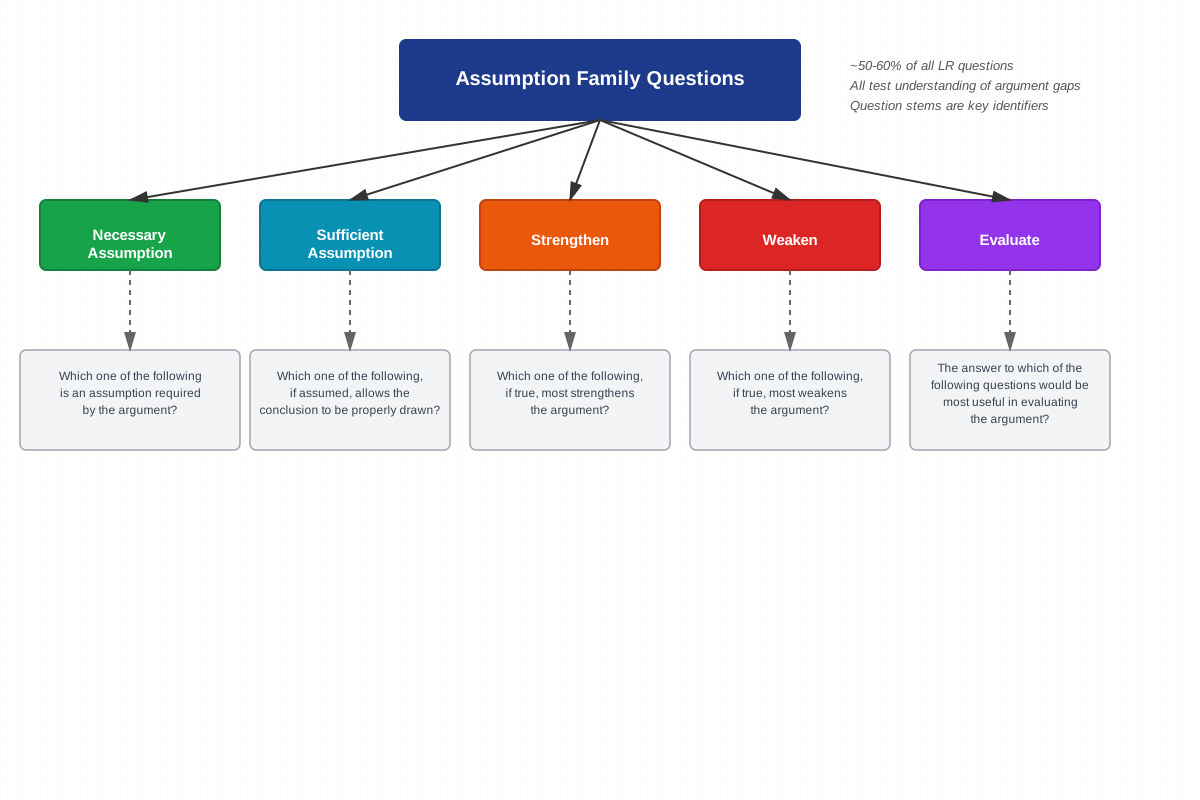
Assumption family questions represent one of the most critical and frequently tested question types on the LSAT Logical Reasoning section. These questions assess a test-taker's ability to identify unstated premises that must be true for an argument to hold together logically. The assumption family encompasses several related question types—including Necessary Assumption, Sufficient Assumption, Strengthen, Weaken, and Evaluate questions—all of which require understanding the gap between an argument's evidence and its conclusion.
Mastering LSAT assumption family questions is essential because they constitute approximately 50-60% of all Logical Reasoning questions on any given test. These questions test the fundamental skill of critical reasoning: recognizing what an argument takes for granted but doesn't explicitly state. When an LSAT argument moves from premises to conclusion, there's almost always an inferential leap—something the author assumes without proving. Your ability to spot these gaps and understand how they function determines success on a substantial portion of the exam.
Within the broader logical reasoning framework, assumption family questions build directly on argument structure analysis. While basic argument identification teaches you to separate premises from conclusions, assumption questions require you to analyze the quality and completeness of that reasoning. These questions connect to formal logic, conditional reasoning, and causal reasoning patterns, making them a cornerstone skill that supports performance across multiple question types. Understanding assumptions also enhances performance on Reading Comprehension passages, where identifying unstated premises helps decode complex arguments.
Learning Objectives
- [ ] Identify how Assumption family questions appears in LSAT questions
- [ ] Explain the reasoning pattern behind Assumption family questions
- [ ] Apply Assumption family questions to solve LSAT-style problems accurately
- [ ] Distinguish between necessary and sufficient assumptions in argument analysis
- [ ] Recognize the five major question types within the assumption family and their unique characteristics
- [ ] Employ the negation test to verify necessary assumptions
- [ ] Predict assumptions before reviewing answer choices to improve accuracy and speed
Prerequisites
- Argument structure identification: Understanding how to identify premises, conclusions, and intermediate conclusions is essential because assumption questions require you to analyze the relationship between these components.
- Conditional reasoning basics: Familiarity with "if-then" statements and their contrapositives helps recognize logical gaps in arguments that rely on conditional relationships.
- Causal reasoning fundamentals: Many assumption family questions involve causal claims, so understanding how cause-and-effect arguments work enables you to spot unstated causal assumptions.
- Basic formal logic: Knowledge of logical validity and soundness provides the foundation for understanding what makes an assumption necessary or sufficient for an argument.
Why This Topic Matters
In real-world applications, the ability to identify assumptions underlies critical thinking in law, business, medicine, and everyday decision-making. Lawyers must recognize unstated premises in opposing counsel's arguments to effectively challenge them. Business analysts must identify assumptions in financial projections to assess risk. The skill of assumption analysis translates directly to the type of analytical reasoning required in law school case analysis and legal writing.
On the LSAT specifically, assumption family questions appear with remarkable consistency and frequency. Across both Logical Reasoning sections (which together comprise approximately 50% of your total LSAT score), you can expect to encounter 12-16 assumption family questions per test. The breakdown typically includes:
- Necessary Assumption questions: 4-6 questions per test
- Strengthen questions: 4-5 questions per test
- Weaken questions: 3-4 questions per test
- Sufficient Assumption questions: 1-2 questions per test
- Evaluate questions: 1-2 questions per test
These questions commonly appear in passages discussing scientific studies, policy recommendations, business decisions, historical explanations, and causal claims. The LSAT frequently tests your ability to identify assumptions in arguments about correlation versus causation, sampling methodology, analogical reasoning, and conditional predictions. Because these questions are both frequent and challenging, they represent one of the highest-yield areas for focused study and practice.
Core Concepts
The Assumption Family Framework
The assumption family consists of five primary question types that all revolve around the same fundamental concept: the gap between an argument's stated premises and its conclusion. Each question type approaches this gap from a different angle, but all require you to understand what the argument takes for granted.
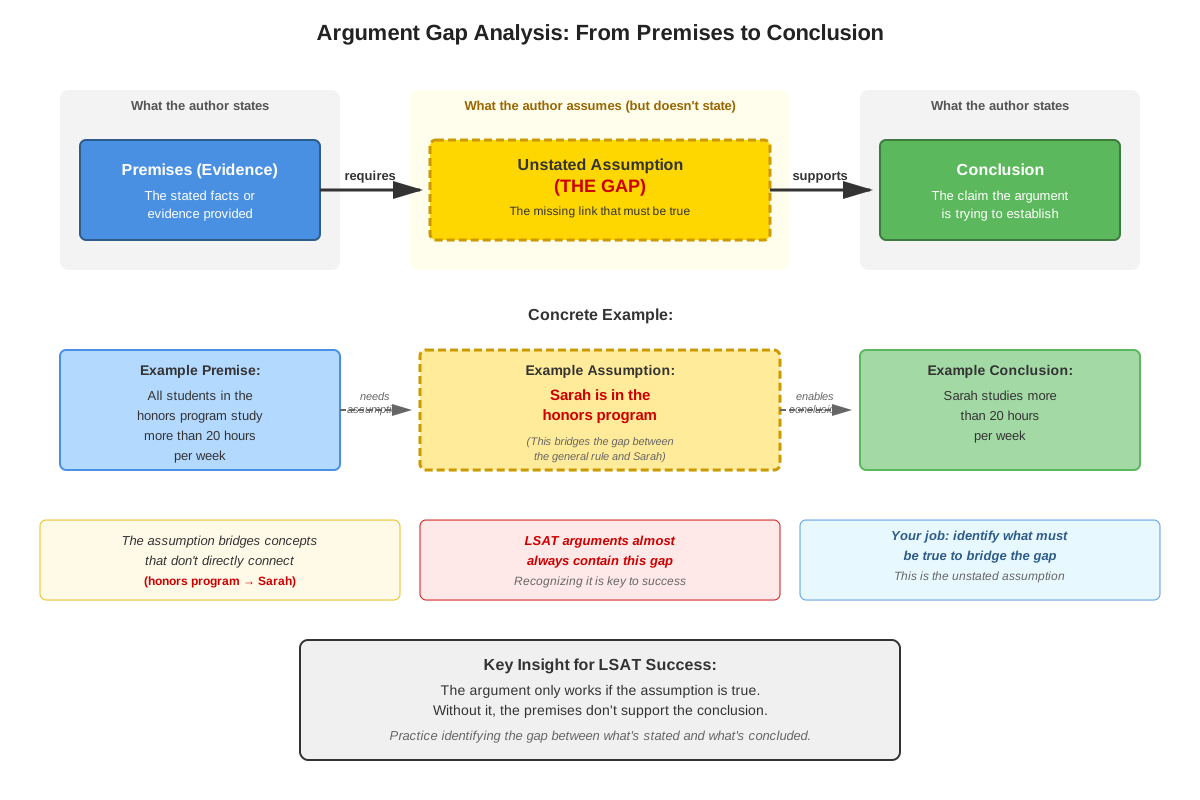
An assumption is an unstated premise that the argument requires to be true (or at least plausible) for its reasoning to work. Every LSAT argument with a gap contains assumptions—pieces of information the author believes but doesn't explicitly state. Your task varies by question type: sometimes you identify what must be assumed, sometimes you strengthen or weaken the argument by affecting its assumptions, and sometimes you evaluate what information would help determine the argument's validity.
Necessary Assumption Questions
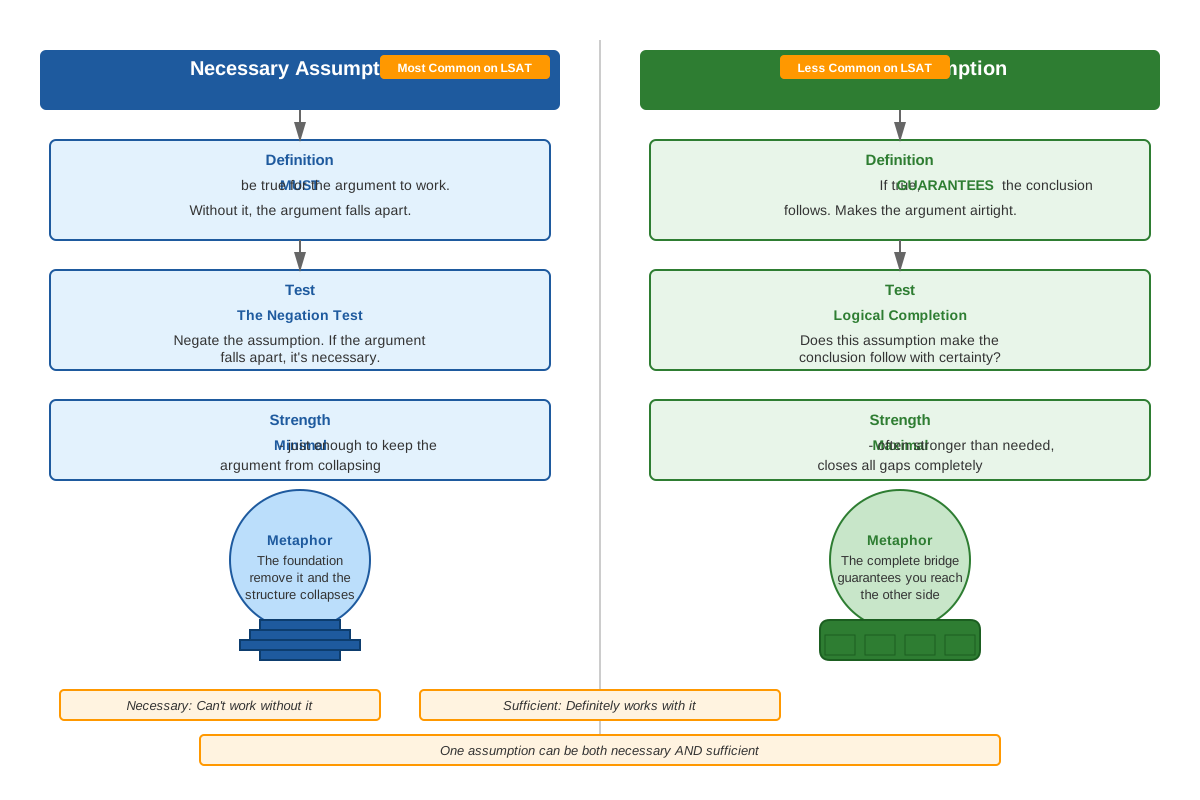
Necessary assumption questions ask you to identify a statement that the argument absolutely requires to be true. If a necessary assumption is false, the argument completely falls apart. These questions typically use language like:
- "Which one of the following is an assumption required by the argument?"
- "The argument depends on assuming which one of the following?"
- "The argument presupposes which one of the following?"
The key characteristic of necessary assumptions is that they are required but not necessarily sufficient to make the argument work. Think of them as the minimum conditions needed for the argument to have any chance of being valid.
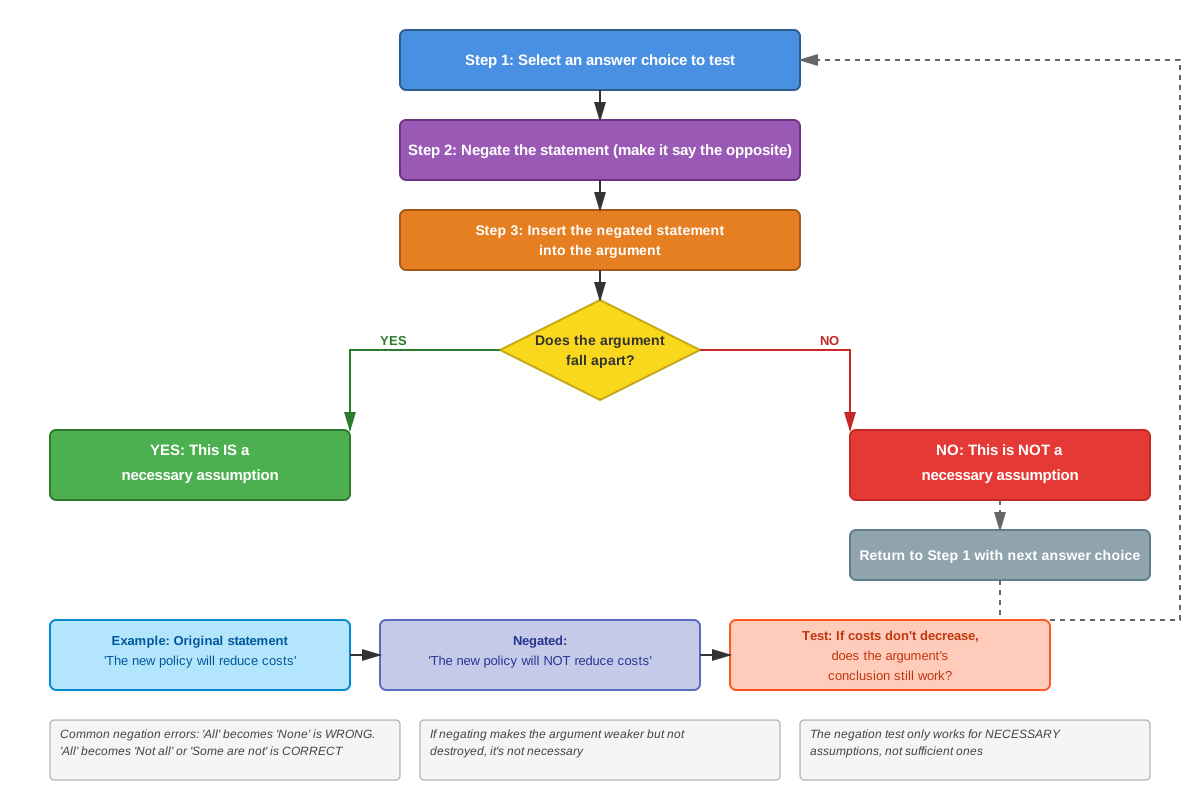
The Negation Test is the most reliable technique for verifying necessary assumptions. To apply it:
- Negate the answer choice (make it false or opposite)
- If negating the statement destroys the argument, it's a necessary assumption
- If the argument can still work when the statement is negated, it's not necessary
For example, if an argument concludes that "increasing police patrols will reduce crime" based on evidence that "cities with more police have less crime," a necessary assumption might be: "The correlation between police presence and lower crime rates is not entirely due to reverse causation (low crime areas choosing to reduce police presence)." If you negate this—if the correlation IS entirely due to reverse causation—the argument collapses.
Sufficient Assumption Questions
Sufficient assumption questions ask you to identify a statement that, if true, would guarantee the conclusion follows logically from the premises. These assumptions are sufficient but not necessary—they're more than enough to make the argument work, but the argument might work without them too.
These questions use distinctive language:
- "Which one of the following, if assumed, allows the conclusion to be properly drawn?"
- "The conclusion follows logically if which one of the following is assumed?"
- "The conclusion can be properly inferred if which one of the following is assumed?"
Sufficient assumptions often involve formal logic and conditional reasoning. They typically bridge the gap between premises and conclusion by providing a connecting principle or rule. For instance:
- Premise: All lawyers passed the bar exam
- Conclusion: Sarah is qualified to practice law
- Sufficient Assumption: Everyone who passed the bar exam is qualified to practice law
This assumption guarantees the conclusion, though other assumptions might also work.
Strengthen Questions
Strengthen questions ask you to identify information that makes the argument's conclusion more likely to be true. Unlike sufficient assumptions, strengthen answers don't need to guarantee the conclusion—they just need to provide additional support.
Common question stems include:
- "Which one of the following, if true, most strengthens the argument?"
- "Which one of the following, if true, provides the most support for the conclusion?"
- "Which one of the following, if true, most helps to justify the reasoning above?"
Strengthen questions often work by:
- Confirming an assumption the argument makes
- Providing additional evidence for the conclusion
- Ruling out alternative explanations
- Addressing potential objections
- Establishing the reliability of evidence cited
Weaken Questions
Weaken questions ask you to identify information that undermines the argument or makes its conclusion less likely to be true. These are essentially the opposite of strengthen questions.
Typical question stems:
- "Which one of the following, if true, most weakens the argument?"
- "Which one of the following, if true, most calls into question the argument's conclusion?"
- "Which one of the following, if true, most undermines the reasoning above?"
Weaken answers commonly work by:
- Showing an assumption is false or questionable
- Providing evidence against the conclusion
- Offering alternative explanations for the evidence
- Demonstrating the evidence is unreliable or unrepresentative
- Revealing relevant information the argument ignored
Evaluate Questions
Evaluate questions ask you to identify what additional information would be most useful in assessing the argument's strength. These questions test whether you understand what the argument's conclusion depends upon.
Question stems include:
- "The answer to which one of the following questions would be most useful in evaluating the argument?"
- "Which one of the following would be most important to know in evaluating the argument?"
The correct answer to an evaluate question typically identifies an assumption such that:
- If answered one way, it strengthens the argument
- If answered the opposite way, it weakens the argument
This creates a "swing factor"—information that could significantly impact the argument's validity depending on how the question is answered.
Identifying Argument Gaps
The core skill underlying all assumption family questions is gap identification—recognizing the logical space between premises and conclusion. Common gap types include:
| Gap Type | Description | Example |
|---|---|---|
| Causal Gap | Assumes correlation implies causation | "Sales increased after the ad campaign, so the campaign caused increased sales" (ignores other factors) |
| Representativeness Gap | Assumes a sample represents the whole | "Survey of college students shows X, therefore all adults believe X" (college students may not represent all adults) |
| Comparison Gap | Assumes compared items are relevantly similar | "Policy worked in Country A, so it will work in Country B" (countries may differ in relevant ways) |
| Temporal Gap | Assumes past/present conditions will continue | "Trend has continued for 5 years, so it will continue" (conditions may change) |
| Scope Gap | Conclusion is broader/narrower than evidence | "Some experts agree, therefore the claim is true" (some ≠ sufficient consensus) |
| Term Shift | Uses different terms in premise and conclusion | "Product is popular, therefore it's high-quality" (popular ≠ high-quality) |
Concept Relationships
The assumption family questions form an interconnected web of related skills. At the foundation lies argument structure analysis → which enables gap identification → which is the core skill for necessary assumption questions.
Necessary assumptions then connect directly to the other family members: Strengthen questions work by confirming or supporting assumptions, while Weaken questions work by undermining or contradicting assumptions. Sufficient assumption questions take gap identification further by requiring you to find a statement that completely bridges the gap. Evaluate questions test whether you can identify which assumptions are most critical to the argument's success.
All assumption family questions connect to conditional reasoning because many arguments contain implicit conditional statements. They also relate to causal reasoning since causal arguments always contain assumptions about alternative explanations, mechanism, and correlation-causation relationships.
The relationship to formal logic is particularly strong for sufficient assumption questions, which often require recognizing that the correct answer provides a logical rule that makes the conclusion necessarily follow. Meanwhile, necessary assumptions, strengthen, and weaken questions connect more to informal logic and real-world reasoning patterns.
Understanding assumption family questions also enhances performance on Flaw questions (which often identify problematic assumptions), Principle questions (which may ask for principles that justify assumptions), and Parallel Reasoning questions (which require recognizing similar assumption patterns across different arguments).
High-Yield Facts
⭐ Necessary assumptions must pass the negation test: If negating a statement destroys the argument, it's a necessary assumption; if the argument survives negation, it's not necessary.
⭐ Sufficient assumptions guarantee the conclusion: They provide more than enough support, often using formal logical connections, but aren't required for the argument to work.
⭐ Assumption family questions constitute 50-60% of all Logical Reasoning questions, making them the highest-yield topic for LSAT preparation.
⭐ The correct answer to strengthen/weaken questions doesn't need to prove/disprove the conclusion: It only needs to make the conclusion more or less likely to be true.
⭐ Most LSAT arguments contain causal reasoning gaps: Watch for assumptions about alternative explanations, reverse causation, and correlation-causation confusion.
- Necessary assumptions are always relevant to the argument but may seem "obvious" or "minimal"—they're the least the argument needs, not the most helpful addition.
- Strengthen and weaken questions require you to accept the answer choice as true and then assess its impact on the argument.
- Evaluate questions have answers that work both ways: one answer to the question strengthens the argument, the opposite answer weakens it.
- Wrong answers in assumption questions often include statements that are true, relevant, or helpful but not actually assumed or required by the argument.
- Sufficient assumption wrong answers often provide partial bridges that don't fully guarantee the conclusion or introduce new terms not in the conclusion.
- The argument's conclusion scope must match the assumption's scope—if the conclusion is about "most," the assumption can't be about "all."
- Representativeness assumptions appear frequently: arguments using surveys, studies, or samples assume the sample represents the broader population.
- Temporal assumptions are common: arguments about future predictions assume current conditions will continue or past patterns will repeat.
Quick check — test yourself on Assumption family questions so far.
Try Flashcards →Common Misconceptions
Misconception: Necessary assumptions must be obviously true or important-sounding statements. → Correction: Necessary assumptions are often subtle, minimal statements that seem almost too basic. They're the least the argument needs to work, not the most impressive addition. A necessary assumption might be as simple as "the survey respondents answered honestly" or "the terms used mean the same thing in premise and conclusion."
Misconception: If an answer choice strengthens an argument, it must be a necessary assumption. → Correction: Many statements can strengthen an argument without being necessary for it. Necessary assumptions are specifically required—the argument cannot work without them. Use the negation test: strengthening statements often still leave the argument intact when negated, while necessary assumptions destroy the argument when negated.
Misconception: Sufficient assumptions need to be realistic or plausible. → Correction: Sufficient assumptions only need to guarantee the conclusion logically; they can be extreme, unrealistic, or even absurd. An answer like "All politicians are dishonest" might be a sufficient assumption even though it's clearly false in reality. The LSAT asks what would make the conclusion follow, not what's actually true.
Misconception: Weaken questions require finding information that proves the conclusion false. → Correction: Weaken answers only need to make the conclusion less likely or cast doubt on the reasoning. The conclusion might still be true even with the weakening information. You're undermining the argument's support, not disproving the conclusion entirely.
Misconception: The correct answer to assumption questions must be directly stated or strongly implied in the passage. → Correction: Assumptions are by definition unstated. The correct answer identifies something the argument depends on but never explicitly mentions. If it were stated in the passage, it wouldn't be an assumption—it would be a premise.
Worked Examples
Example 1: Necessary Assumption Question
Argument: "The city's new recycling program has been highly successful. Since the program began six months ago, the amount of waste sent to landfills has decreased by 30%. Therefore, the recycling program has significantly reduced the city's environmental impact."
Question: Which one of the following is an assumption required by the argument?
Answer Choices:
(A) The recycling program is more cost-effective than the previous waste management system.
(B) The decrease in landfill waste is not primarily due to residents generating less waste overall.
(C) Other cities have implemented similar recycling programs with comparable results.
(D) The environmental impact of recycling materials is less than the impact of landfilling them.
(E) The recycling program will continue to reduce landfill waste at the same rate.
Analysis:
First, identify the argument structure:
- Premise: Landfill waste decreased 30% since the recycling program began
- Conclusion: The recycling program significantly reduced environmental impact
Now identify the gaps:
- Gap between "less landfill waste" and "recycling program caused it" (causal gap)
- Gap between "less landfill waste" and "reduced environmental impact" (assumes landfill reduction = environmental benefit)
Apply the negation test to each answer:
(A) Negated: "The recycling program is NOT more cost-effective than the previous system."
- Does this destroy the argument? No—the argument is about environmental impact, not cost-effectiveness. The program could still reduce environmental impact even if it costs more.
- Not necessary.
(B) Negated: "The decrease in landfill waste IS primarily due to residents generating less waste overall."
- Does this destroy the argument? Yes! If people are just generating less waste (maybe due to economic recession, population decrease, or behavior change unrelated to recycling), then the recycling program didn't cause the reduction. The argument attributes the decrease to the recycling program, so this assumption is required.
- Strong candidate.
(C) Negated: "Other cities have NOT implemented similar programs with comparable results."
- Does this destroy the argument? No—the argument is only about this city's program. What happened in other cities is irrelevant to whether this program reduced this city's environmental impact.
- Not necessary.
(D) Negated: "The environmental impact of recycling materials is NOT less than the impact of landfilling them."
- Does this destroy the argument? Yes! If recycling actually has equal or greater environmental impact than landfilling (considering energy use, transportation, processing), then reducing landfill waste through recycling wouldn't reduce environmental impact—it might even increase it.
- Strong candidate.
(E) Negated: "The recycling program will NOT continue to reduce landfill waste at the same rate."
- Does this destroy the argument? No—the argument is about what has happened (past tense: "has reduced"), not future predictions. The program could have reduced impact even if the rate won't continue.
- Not necessary.
Decision between (B) and (D): Both seem necessary, but (D) is more fundamental. Even if the recycling program caused the waste reduction (making B true), the conclusion about environmental impact specifically requires that recycling is environmentally better than landfilling. Without (D), the entire conclusion fails.
Correct Answer: (D)
This example demonstrates how necessary assumptions often address the connection between evidence and conclusion, and how the negation test reliably identifies them.
Example 2: Weaken Question
Argument: "Medical researchers have concluded that drinking coffee reduces the risk of developing Type 2 diabetes. Their study followed 50,000 adults for ten years and found that those who drank three or more cups of coffee daily were 25% less likely to develop diabetes than those who drank no coffee. This demonstrates that coffee consumption provides significant protection against diabetes."
Question: Which one of the following, if true, most weakens the argument?
Answer Choices:
(A) Some participants who drank coffee also engaged in regular exercise, which independently reduces diabetes risk.
(B) The study did not examine whether tea consumption has similar effects on diabetes risk.
(C) People who regularly drink coffee are significantly more likely to be health-conscious individuals who maintain lower body weight and exercise regularly, factors that independently reduce diabetes risk.
(D) The protective effect of coffee was observed across different age groups and ethnic backgrounds.
(E) Decaffeinated coffee showed a smaller but still statistically significant protective effect.
Analysis:
The argument's reasoning:
- Evidence: Coffee drinkers had 25% lower diabetes rates in a 10-year study
- Conclusion: Coffee consumption protects against diabetes
- Assumption: The correlation is causal—coffee itself reduces risk, not some other factor associated with coffee drinking
To weaken this, we need to undermine the causal claim or suggest alternative explanations.
(A): "Some participants who drank coffee also exercised."
- This introduces a potential confounding variable but says only "some" participants. This doesn't strongly undermine the correlation because it doesn't explain the overall pattern. Many coffee drinkers might not exercise, yet still showed reduced risk.
- Weak weakener.
(B): "The study didn't examine tea consumption."
- This is irrelevant to whether coffee protects against diabetes. What wasn't studied doesn't weaken what was found.
- Not a weakener.
(C): "Coffee drinkers are significantly more likely to be health-conscious people who maintain lower weight and exercise regularly."
- This provides a strong alternative explanation: the reduced diabetes risk might be due to the overall healthy lifestyle of coffee drinkers, not the coffee itself. This is a classic confounding variable that undermines the causal interpretation. If health-conscious behavior explains both the coffee drinking and the lower diabetes rates, coffee might not be protective at all.
- Strong weakener.
(D): "The effect was observed across different groups."
- This actually strengthens the argument by showing the correlation is robust and consistent, making it more likely to be real rather than a statistical artifact.
- Strengthens, doesn't weaken.
(E): "Decaf coffee also showed protective effects."
- This actually supports the argument by suggesting coffee itself (not just caffeine) has protective properties. It rules out one alternative explanation.
- Strengthens, doesn't weaken.
Correct Answer: (C)
This example illustrates how weaken questions often work by introducing alternative explanations or confounding variables that undermine causal claims. The correct answer doesn't prove the conclusion false—coffee might still be protective—but it significantly weakens the argument by suggesting the evidence could be explained differently.
Exam Strategy
Approaching Assumption Family Questions
Step 1: Identify the question type immediately. The question stem tells you exactly what task to perform. Look for key phrases:
- "assumption required/depends on" = Necessary Assumption
- "if assumed, allows the conclusion to be properly drawn" = Sufficient Assumption
- "if true, strengthens/supports" = Strengthen
- "if true, weakens/undermines" = Weaken
- "most useful/important to know in evaluating" = Evaluate
Step 2: Analyze the argument structure before looking at answers. Identify:
- The conclusion (what is the author trying to prove?)
- The premises (what evidence is provided?)
- The gap (what's missing between evidence and conclusion?)
Step 3: Predict the assumption or type of answer. Before reading answer choices, articulate what the argument takes for granted. This prevents you from being seduced by attractive wrong answers.
Step 4: Use process of elimination strategically:
- Eliminate answers that are irrelevant to the argument's reasoning
- Eliminate answers that go in the wrong direction (strengthen when you need weaken)
- Eliminate answers with scope mismatches (conclusion about "some," answer about "all")
Trigger Words and Phrases
Watch for these high-frequency indicators of assumptions:
Causal language: "causes," "leads to," "results in," "because of," "due to" → Likely assumes no alternative explanations, no reverse causation
Comparative language: "more than," "better than," "superior to" → Likely assumes the comparison is valid and relevant factors are similar
Predictive language: "will," "is going to," "in the future" → Likely assumes current conditions will continue
Representativeness language: "study shows," "survey found," "sample indicates" → Likely assumes the sample represents the broader population
Conditional language: "if...then," "only if," "unless" → Look for formal logic gaps in conditional chains
Evaluative language: "should," "ought to," "best" → Likely assumes certain values or criteria for judgment
Time Management
- Necessary Assumption questions: 1:15-1:30 per question. These require careful analysis and often the negation test.
- Sufficient Assumption questions: 1:30-1:45 per question. These often involve formal logic and require precise analysis.
- Strengthen/Weaken questions: 1:00-1:15 per question. These are often more intuitive once you identify the gap.
- Evaluate questions: 1:15-1:30 per question. These require understanding what the argument depends on.
If you're stuck after eliminating to two choices, use your verification technique (negation test for necessary assumptions, "does this guarantee the conclusion?" for sufficient assumptions, "does this make the conclusion more/less likely?" for strengthen/weaken).
Common Wrong Answer Patterns
- True but irrelevant: The statement might be factually correct but doesn't address the argument's reasoning gap
- Reverses the logic: Confuses necessary and sufficient conditions or gets causation backwards
- Scope mismatch: Uses "all" when the conclusion says "some," or vice versa
- Opposite effect: Weakens when you need to strengthen, or vice versa
- New information: Introduces concepts not present in the argument's conclusion
- Premise booster: Restates or supports a premise rather than connecting premise to conclusion
Memory Techniques
SCAN for Assumption Types:
- Scope gaps (conclusion broader/narrower than evidence)
- Causal gaps (correlation assumed to be causation)
- Analogy gaps (compared things assumed similar)
- Necessary condition gaps (missing logical links)
The SWAN Method for Question Types:
- Sufficient = Seals the deal (guarantees conclusion)
- Weaken = Wounds the argument
- Assumption (Necessary) = Absolutely required
- Necessary = Negation test works
For Negation Test: Remember "NOT IT = NO GO"
- NOT the assumption
- IT (the argument)
- NO GO (falls apart)
If making the assumption false means the argument can't work, you've found a necessary assumption.
Visualize the Bridge: Picture the argument as two cliffs—the premise cliff and the conclusion cliff. The assumption is the bridge connecting them. For necessary assumptions, it's the minimum bridge needed (might be rickety but gets you across). For sufficient assumptions, it's a superhighway (more than enough, guarantees safe passage).
The "So What?" Test: After reading the premises, ask "So what? Why does that prove the conclusion?" Whatever answer you give is likely the assumption. If you can't answer "so what?" without adding information, that information is what's assumed.
Summary
Assumption family questions represent the cornerstone of LSAT Logical Reasoning, comprising over half of all LR questions. These questions test your ability to identify, analyze, and manipulate the unstated premises that arguments depend upon. The family includes five related question types: Necessary Assumption questions ask what the argument requires to be true; Sufficient Assumption questions ask what would guarantee the conclusion; Strengthen questions ask what makes the conclusion more likely; Weaken questions ask what undermines the argument; and Evaluate questions ask what information would help assess the argument's validity. All five types require the same core skill—identifying the gap between an argument's stated evidence and its conclusion. Success depends on recognizing common gap patterns (causal, representativeness, comparison, temporal, scope, and term shift), applying verification techniques like the negation test, and systematically eliminating wrong answers that are irrelevant, reverse the logic, or mismatch the scope. Master these questions by always analyzing argument structure before reviewing answer choices, predicting the assumption type, and understanding that assumptions are by definition unstated—they're what the argument takes for granted but never explicitly says.
Key Takeaways
- Assumption family questions constitute 50-60% of Logical Reasoning questions, making them the highest-yield study area for LSAT preparation
- The negation test is the gold standard for verifying necessary assumptions: if negating a statement destroys the argument, it's necessary; if the argument survives, it's not
- All assumption family questions require identifying the gap between premises and conclusion—the logical space where unstated premises live
- Sufficient assumptions guarantee the conclusion (often using formal logic), while necessary assumptions are merely required for the argument to work
- Strengthen and weaken answers only need to make the conclusion more or less likely—they don't need to prove or disprove it completely
- Common gap types include causal gaps, representativeness gaps, comparison gaps, temporal gaps, scope gaps, and term shifts—recognizing these patterns accelerates analysis
- Always analyze the argument structure and predict the assumption before reading answer choices—this prevents being misled by attractive wrong answers
Related Topics
Flaw Questions: Understanding assumptions enables you to identify when arguments make problematic assumptions. Flaw questions often describe assumption errors, so mastering assumption identification directly improves flaw question performance.
Principle Questions: These questions ask you to identify general rules that justify specific arguments. The principles often articulate the assumptions underlying the reasoning, making assumption analysis essential.
Parallel Reasoning Questions: These require recognizing similar logical structures across different arguments. Understanding assumption patterns helps you identify when two arguments make analogous inferential leaps.
Conditional Reasoning: Many sufficient assumption questions involve formal conditional logic. Deepening your understanding of conditional statements and their contrapositives enhances performance on assumption questions with "if-then" structures.
Causal Reasoning: Since many LSAT arguments involve causal claims, understanding causal reasoning patterns (correlation vs. causation, alternative explanations, reverse causation) is essential for identifying assumptions in causal arguments.
Practice CTA
Now that you've mastered the conceptual framework of assumption family questions, it's time to put your knowledge into practice. Attempt the practice questions to apply these strategies to real LSAT-style problems. Focus on identifying question types immediately, analyzing argument structure before reviewing answers, and using the negation test for necessary assumptions. Review the flashcards to reinforce high-yield facts and common gap patterns. Remember: assumption questions are skills-based—improvement comes through deliberate practice with immediate feedback. Each question you analyze strengthens your pattern recognition and speeds your processing. You've built the foundation; now construct mastery through application.
Sign up free to keep reading
Create a free AnvayaPrep account to finish this LSAT guide on Assumption family questions — plus flashcards and practice questions.