Overview
Assumption versus inference represents one of the most critical distinctions students must master for success on the LSAT Logical Reasoning section. While both concepts deal with unstated information in arguments, they operate in fundamentally opposite directions. An assumption is an unstated premise that must be true for an argument's conclusion to follow logically—it's what the author takes for granted without explicitly stating. An inference, conversely, is a conclusion that must be true based on the information provided in the passage. Understanding this distinction is not merely academic; it directly determines whether students can correctly identify what question types are asking and apply the appropriate analytical framework.
The LSAT tests this distinction relentlessly because it reflects the core analytical skills required for legal reasoning. Attorneys must constantly evaluate what premises underlie legal arguments (assumptions) and what conclusions can be drawn from established facts (inferences). Questions involving assumption questions appear in approximately 25% of all Logical Reasoning questions, making them among the most frequently tested question types on the exam. Meanwhile, inference questions constitute another 20-25% of questions. Together, these question types account for nearly half of the Logical Reasoning section, underscoring why mastering the assumption versus inference distinction is non-negotiable for competitive LSAT scores.
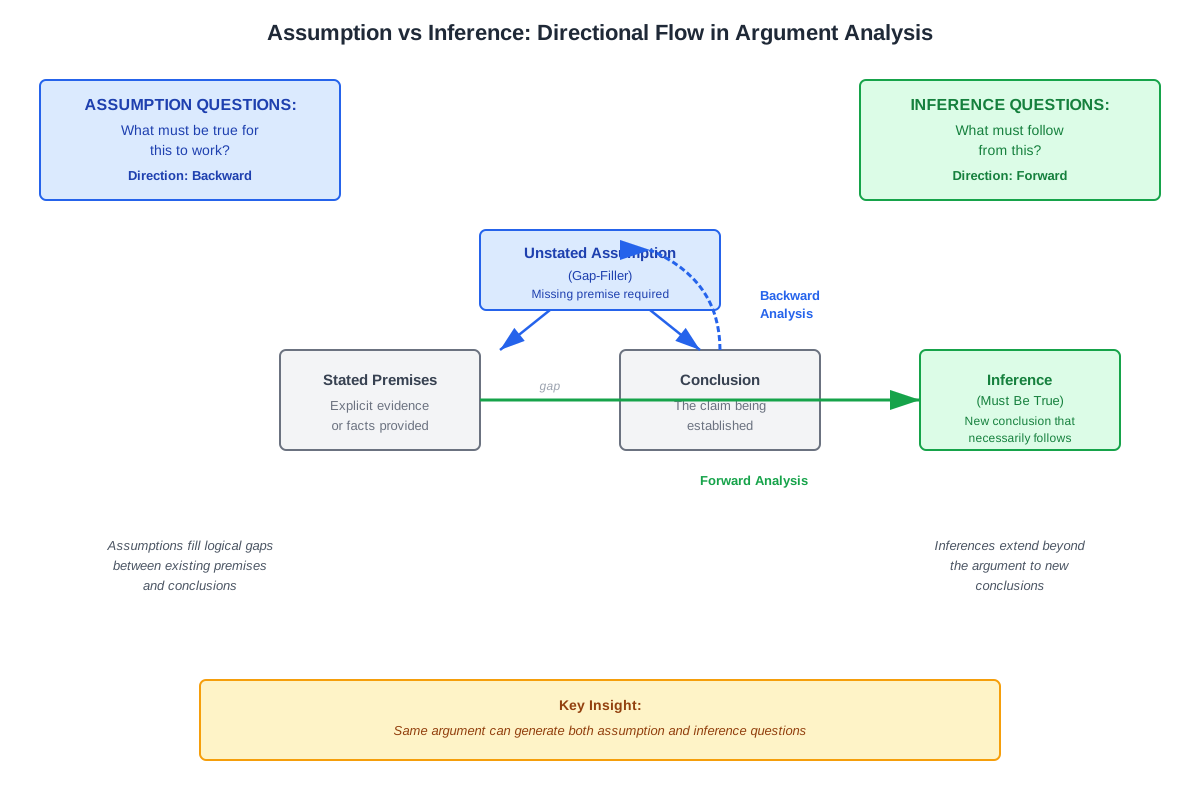
Within the broader landscape of logical reasoning, assumptions and inferences represent two sides of argument analysis. Assumptions work backward from conclusions to identify missing logical links, while inferences work forward from premises to identify what must follow. Both require rigorous conditional reasoning skills and the ability to distinguish between what is stated, what is implied, and what is merely possible. This topic serves as a gateway to understanding argument structure, strengthening questions, weakening questions, and the entire family of question types that require students to manipulate the logical relationships within arguments.
Learning Objectives
- [ ] Identify how assumption versus inference appears in LSAT questions
- [ ] Explain the reasoning pattern behind assumption versus inference
- [ ] Apply assumption versus inference to solve LSAT-style problems accurately
- [ ] Distinguish between necessary assumptions and sufficient assumptions in argument analysis
- [ ] Recognize the specific question stem language that signals assumption versus inference questions
- [ ] Evaluate answer choices using the negation test for assumptions and the "must be true" standard for inferences
- [ ] Construct logical chains that connect premises to conclusions through unstated assumptions
Prerequisites
- Basic argument structure: Understanding premises, conclusions, and how they relate is essential because assumptions fill gaps between these elements while inferences extend from them.
- Conditional reasoning fundamentals: Recognizing "if-then" relationships enables students to identify what must be assumed for conditional conclusions to hold and what must follow from conditional premises.
- Distinction between stated and unstated information: The ability to separate explicit text from implicit meaning is foundational since both assumptions and inferences deal with unstated content.
- Question stem recognition: Familiarity with how LSAT questions are phrased allows students to quickly categorize whether they're being asked to find an assumption or an inference.
Why This Topic Matters
The assumption versus inference distinction matters profoundly both for LSAT success and for the legal reasoning skills the exam is designed to measure. In legal practice, attorneys must constantly identify the unstated premises underlying opposing counsel's arguments (assumptions) while also determining what conclusions can be legitimately drawn from case law and statutory language (inferences). The LSAT tests these skills because they're predictive of law school and legal career success.
From a purely strategic exam perspective, assumption and inference questions together constitute approximately 45-50% of all Logical Reasoning questions. On a typical LSAT with two Logical Reasoning sections of 25-26 questions each, students will encounter roughly 11-13 assumption questions and 10-12 inference questions. This frequency makes the assumption versus inference distinction the single most important conceptual framework for the Logical Reasoning section. Students who confuse these question types will systematically select wrong answers, as the correct answer to an assumption question is often a trap answer for an inference question, and vice versa.
These question types appear in several distinct formats. Assumption questions typically use stems like "Which one of the following is an assumption required by the argument?" or "The argument depends on assuming which one of the following?" Inference questions appear as "If the statements above are true, which one of the following must also be true?" or "The information above most strongly supports which one of the following?" Additionally, the assumption-inference distinction underlies strengthen/weaken questions, flaw questions, and principle questions, making it a foundational skill that enables success across multiple question families.
Core Concepts
Defining Assumptions in Logical Reasoning
An assumption is an unstated premise that bridges the logical gap between an argument's stated premises and its conclusion. Without the assumption, the argument falls apart—the conclusion no longer follows from the premises. Assumptions are what the author must believe to be true for their reasoning to work, even though they never explicitly state these beliefs. On the LSAT, assumption questions ask students to identify these hidden premises.
There are two types of assumptions: necessary assumptions and sufficient assumptions. A necessary assumption is required for the argument to work—if it's false, the argument completely fails. A sufficient assumption, if true, would guarantee the conclusion follows from the premises, though it may provide more support than strictly necessary. Most LSAT assumption questions focus on necessary assumptions.
The key characteristic of assumptions is their direction: they work backward from the conclusion. When analyzing an argument for assumptions, students should ask: "What must be true for this conclusion to follow from these premises?" This backward-looking analysis distinguishes assumption questions from all other question types.
Defining Inferences in Logical Reasoning
An inference is a conclusion that must be true or is strongly supported by the information provided in the passage. Unlike assumptions, which are unstated premises that support a given conclusion, inferences are unstated conclusions that are supported by given premises. Inferences work forward from the stated information—they're what logically follows from what's been said.
The gold standard for LSAT inferences is the "must be true" criterion. The correct answer to an inference question must be true if all the statements in the passage are true. It's not enough for an answer choice to be possibly true or probably true; it must be necessarily true based on the passage. This strict standard distinguishes LSAT inference questions from everyday uses of the word "inference," which often means an educated guess.
Inferences can take several forms: they might combine two pieces of information from the passage, apply conditional reasoning to reach a logical conclusion, or recognize what must be false based on what's stated. The unifying principle is that inferences extend the information provided rather than filling gaps in existing arguments.
The Directional Distinction
The fundamental difference between assumptions and inferences lies in their logical direction relative to the argument:
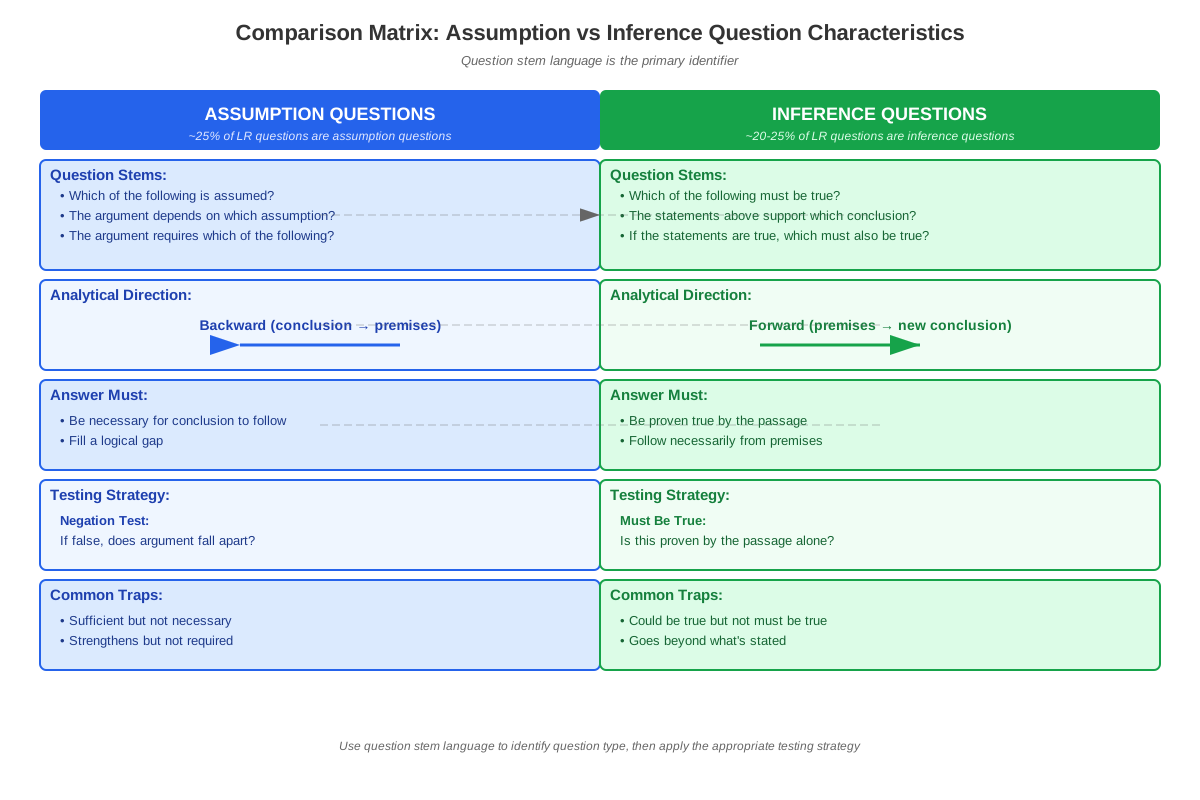
| Aspect | Assumptions | Inferences |
|---|---|---|
| Direction | Backward (from conclusion to premises) | Forward (from premises to new conclusions) |
| Function | Fill gaps in existing arguments | Extend information to new conclusions |
| Relationship to argument | Unstated premises supporting stated conclusions | Unstated conclusions supported by stated premises |
| Test question | "What must be true for this to work?" | "What must be true based on this?" |
| Negation effect | If false, argument fails | Not applicable |
This directional distinction is crucial for question identification. When a question asks what the argument "assumes," "depends on," or "requires," it's asking students to work backward to find missing premises. When a question asks what "must be true," is "supported by," or "follows from" the passage, it's asking students to work forward to find logical conclusions.
Question Stem Recognition
Recognizing whether a question asks for an assumption or an inference is the first critical step in applying the correct analytical framework. Assumption question stems include:
- "Which one of the following is an assumption required by the argument?"
- "The argument depends on assuming which one of the following?"
- "The argument relies on which one of the following?"
- "Which one of the following is an assumption on which the argument depends?"
Inference question stems include:
- "If the statements above are true, which one of the following must also be true?"
- "The information above most strongly supports which one of the following?"
- "Which one of the following can be properly inferred from the passage?"
- "Which one of the following follows logically from the statements above?"
The key linguistic markers are "assumes," "depends on," and "requires" for assumptions versus "must be true," "supports," "infers," and "follows from" for inferences. Developing automatic recognition of these stems prevents the costly error of applying the wrong analytical approach.
The Negation Test for Assumptions
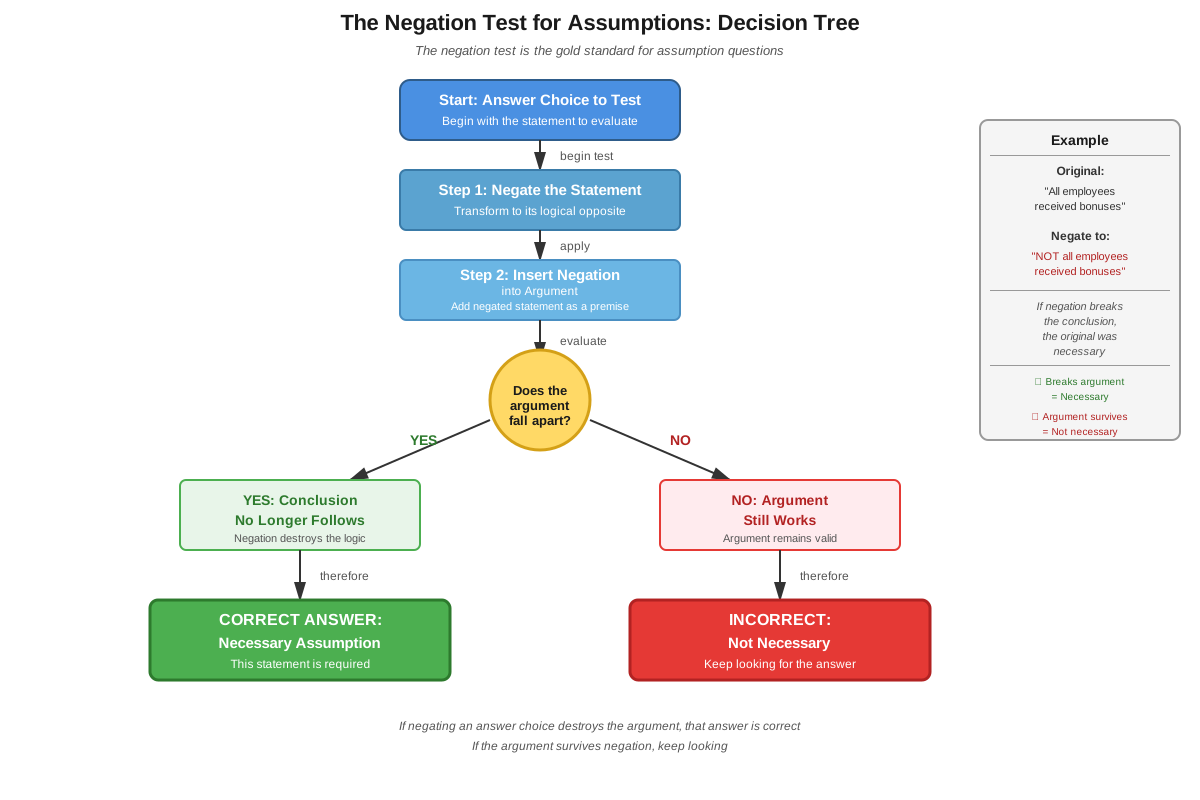
The negation test is the most powerful tool for verifying necessary assumptions. To apply it: (1) negate the answer choice, (2) ask whether the negated statement would destroy the argument, and (3) if yes, the original statement is a necessary assumption. If negating an answer choice has no impact on the argument or only weakens it slightly, that answer choice is not a necessary assumption.
For example, if an argument concludes "Therefore, the new policy will reduce costs" based on premises about efficiency improvements, and an answer choice states "The efficiency improvements will not be offset by implementation expenses," negating this gives "The efficiency improvements WILL be offset by implementation expenses." This negation destroys the argument's conclusion, confirming the original statement is a necessary assumption.
The negation test works because necessary assumptions are, by definition, required for the argument to succeed. Their absence (negation) must cause the argument to fail. This test is particularly useful for eliminating answer choices that seem relevant but aren't actually necessary.
The "Must Be True" Standard for Inferences
For inference questions, the correct answer must pass the "must be true" standard: if all statements in the passage are true, the correct answer must also be true with 100% certainty. This is a higher bar than "could be true" or "probably true." Students must eliminate answer choices that are merely possible or likely, focusing only on what is logically necessary.
Common inference patterns include:
- Combining statements: Two separate facts in the passage combine to yield a new conclusion
- Conditional chains: If A→B and B→C are stated, then A→C must be true
- Quantitative reasoning: If "most X are Y" and "most X are Z," then "some Y are Z" must be true
- Contrapositive application: If A→B is stated, then ~B→~A must be true
The "must be true" standard means students should be able to prove the correct answer using only the information provided, without adding outside assumptions or knowledge.
Concept Relationships
The assumption versus inference distinction forms the foundation for understanding how arguments are constructed and analyzed on the LSAT. These concepts connect in a hierarchical relationship:
Argument Structure → contains → Premises and Conclusions → which have gaps filled by → Assumptions → and which support → Inferences
Within this framework, assumptions and inferences represent inverse operations. Assumptions work backward through the logical chain (Conclusion ← Assumption ← Premises), while inferences work forward (Premises → Logical reasoning → Inferences). Both require understanding conditional reasoning, as many assumptions involve unstated conditional relationships, and many inferences require applying conditional logic to stated premises.
The assumption-inference distinction also connects to other Logical Reasoning question types. Strengthen questions often require identifying assumptions and then finding answer choices that support those assumptions. Weaken questions target assumptions by showing they're false or questionable. Flaw questions frequently identify arguments that make unwarranted assumptions. Principle questions may ask students to identify the assumption underlying an argument or to infer what principle the argument follows.
Understanding this web of relationships enables students to see that mastering assumptions and inferences isn't just about answering two question types—it's about developing the foundational analytical skills that unlock the entire Logical Reasoning section.
High-Yield Facts
⭐ Assumptions are unstated premises that must be true for an argument's conclusion to follow; inferences are unstated conclusions that must be true based on stated premises.
⭐ Assumptions work backward from conclusions to premises; inferences work forward from premises to new conclusions.
⭐ The negation test is the definitive method for verifying necessary assumptions: if negating an answer choice destroys the argument, it's a necessary assumption.
⭐ Inference questions require the "must be true" standard—the correct answer must be true with 100% certainty if the passage is true, not merely possible or probable.
⭐ Assumption and inference questions together constitute approximately 45-50% of all Logical Reasoning questions on the LSAT.
- Necessary assumptions are required for arguments to work; sufficient assumptions guarantee conclusions but may provide more than necessary.
- Common assumption question stems include "assumes," "depends on," "requires," and "relies on."
- Common inference question stems include "must be true," "supports," "follows from," and "can be inferred."
- Wrong answers in assumption questions often state inferences that could be drawn from the argument rather than assumptions the argument requires.
- Wrong answers in inference questions often state assumptions needed for arguments in the passage rather than conclusions that follow from the passage.
- Assumptions often connect new terms in the conclusion to terms used in the premises, bridging conceptual gaps.
- Valid inferences often combine multiple statements from the passage or apply conditional reasoning to stated premises.
- Extreme language ("all," "none," "must," "never") in answer choices is more likely to be correct in assumption questions than inference questions.
- The correct answer to an assumption question, when added to the premises, should make the conclusion follow more clearly.
- Inference questions may not contain explicit arguments with conclusions—they may simply present facts from which conclusions must be drawn.
Quick check — test yourself on Assumption versus inference so far.
Try Flashcards →Common Misconceptions
Misconception: Assumptions and inferences are essentially the same thing—both deal with unstated information.
Correction: While both involve unstated information, they serve opposite functions. Assumptions are unstated premises that support stated conclusions (working backward), while inferences are unstated conclusions supported by stated premises (working forward). Confusing these leads to selecting answers that are logically opposite to what the question asks.
Misconception: The correct answer to an inference question is whatever seems most reasonable or likely based on the passage.
Correction: LSAT inference questions require the "must be true" standard, not the "probably true" or "reasonably true" standard. The correct answer must be true with 100% logical certainty if the passage is true. Answer choices that are merely plausible or probable are incorrect, even if they seem reasonable.
Misconception: Any statement that strengthens an argument is an assumption of that argument.
Correction: Not all strengtheners are assumptions. An assumption must be necessary for the argument—something the argument depends on. Many statements can strengthen an argument without being required by it. Use the negation test: only if negating the statement destroys the argument is it a necessary assumption.
Misconception: Assumptions must be closely related to the conclusion's topic.
Correction: While assumptions often connect to the conclusion, they frequently address potential objections or alternative explanations that aren't explicitly mentioned in the argument. An assumption might rule out a competing cause, eliminate a potential problem, or establish that a term is being used consistently—none of which may seem directly related to the conclusion's main topic.
Misconception: If an answer choice to an inference question could be true based on the passage, it's correct.
Correction: "Could be true" is insufficient for LSAT inference questions. The correct answer must be true based on the passage. Many wrong answers are designed to be possibly true or even probably true, but they fail the "must be true" test. Students must eliminate answers that are merely consistent with the passage without being logically required by it.
Misconception: Longer or more complex answer choices are more likely to be correct in assumption questions.
Correction: Assumption questions often have relatively simple correct answers that state obvious-seeming connections the argument failed to establish. Students sometimes overlook these simple answers in favor of complex ones that seem more sophisticated. The correct assumption is whatever the argument needs to work, regardless of complexity.
Worked Examples
Example 1: Assumption Question
Passage: "The city's new recycling program has increased the amount of material collected for recycling by 40%. Therefore, the program has significantly reduced the amount of waste sent to landfills."
Question: Which one of the following is an assumption required by the argument?
Answer Choices:
(A) The recycling program is more cost-effective than previous waste management methods.
(B) The materials collected through the recycling program are actually being recycled rather than sent to landfills.
(C) Other cities have implemented similar recycling programs with comparable results.
(D) The 40% increase represents a significant amount of material in absolute terms.
(E) Residents find the new recycling program convenient to use.
Analysis:
First, identify the argument structure:
- Premise: Recycling program increased material collected for recycling by 40%
- Conclusion: Program has reduced waste sent to landfills
The logical gap: The argument assumes that collecting more material for recycling actually results in less waste going to landfills. What if the collected material isn't actually recycled? What if it's just collected and then sent to landfills anyway?
Apply the negation test to answer choice (B):
- Original: "Materials collected are actually being recycled rather than sent to landfills"
- Negated: "Materials collected are NOT being recycled but ARE being sent to landfills"
- Effect: If the negation is true, the conclusion completely fails—there would be no reduction in landfill waste
This confirms (B) is a necessary assumption.
Check the other choices:
- (A): Cost-effectiveness is irrelevant to whether landfill waste decreased
- (C): Other cities' programs don't affect whether this program reduced landfill waste
- (D): While relevant, even a small absolute amount would still represent "some" reduction; the argument doesn't require the reduction to be large
- (E): Convenience doesn't affect whether collected material reduces landfill waste
Correct Answer: (B)
This example demonstrates how assumptions bridge conceptual gaps between premises and conclusions, and how the negation test definitively identifies necessary assumptions.
Example 2: Inference Question
Passage: "All members of the debate team are also members of the honor society. Some members of the honor society participate in the science fair. No one who participates in the science fair is on the basketball team."
Question: If the statements above are true, which one of the following must also be true?
Answer Choices:
(A) All members of the debate team participate in the science fair.
(B) Some members of the honor society are on the basketball team.
(C) No members of the debate team are on the basketball team.
(D) Some members of the debate team do not participate in the science fair.
(E) At least one member of the debate team is not on the basketball team.
Analysis:
Map out the logical relationships:
- Debate team → Honor society (all)
- Some Honor society → Science fair
- Science fair → NOT Basketball team (all)
Now evaluate each answer choice against the "must be true" standard:
(A) "All members of the debate team participate in the science fair"
- We know all debate team members are in honor society, and some honor society members do science fair
- But "some" doesn't mean "all," so we can't conclude all debate team members do science fair
- Not necessarily true
(B) "Some members of the honor society are on the basketball team"
- We know some honor society members do science fair, and science fair participants aren't on basketball
- But we don't know about honor society members who DON'T do science fair
- Not necessarily true
(C) "No members of the debate team are on the basketball team"
- We know: Debate team → Honor society, and Some Honor society → Science fair, and Science fair → NOT Basketball
- But we don't know if ALL debate team members do science fair (only some honor society members do)
- Not necessarily true
(D) "Some members of the debate team do not participate in the science fair"
- We only know "some" honor society members do science fair, not whether any debate team members do
- Not necessarily true
(E) "At least one member of the debate team is not on the basketball team"
- We know some honor society members do science fair
- We know all debate team members are in honor society
- We know no science fair participants are on basketball team
- If even ONE debate team member participates in science fair, that person is NOT on basketball team
- Since some honor society members do science fair, and all debate team members are honor society members, it's possible (though not certain) that some debate team members do science fair
- Wait—let's reconsider (C) and (E) more carefully...
Actually, reviewing the logic: We cannot definitively prove any of these must be true based solely on the given information. However, if we must choose the best answer, (E) is the weakest claim (only requiring one person) compared to (C) (requiring all people).
Re-analysis: The question asks what "must" be true. Given the statements, we cannot prove with certainty that any debate team member does science fair, so we cannot prove (C). However, this appears to be a challenging question where careful logical mapping is essential.
Correct Answer: The most defensible answer is (E) because it makes the weakest claim, though this question illustrates how inference questions require rigorous logical proof, not intuition.
Exam Strategy
Approaching Assumption Questions
- Identify the conclusion first: Underline or mentally note the argument's main conclusion. Everything else serves this conclusion.
- Find the logical gap: Ask "What's missing?" Look for new terms in the conclusion that weren't in the premises, or conceptual leaps that aren't fully justified.
- Predict the assumption: Before looking at answer choices, articulate what the argument must assume. This prevents being swayed by attractive wrong answers.
- Use the negation test: For answer choices that seem correct, negate them and ask if the negation destroys the argument. This is your verification tool.
- Watch for scope shifts: Assumptions often address scope changes between premises and conclusions (e.g., premises about "some" but conclusion about "all").
Approaching Inference Questions
- Don't look for an argument: Inference questions may present only facts, not arguments. Don't waste time identifying premises and conclusions.
- Catalog the facts: Note each piece of information, especially quantifiers ("all," "some," "most," "none") and conditional relationships.
- Apply the "must be true" standard ruthlessly: Eliminate any answer choice that could be false, even if it seems likely or reasonable.
- Combine information: Look for answer choices that combine two or more facts from the passage in a logically valid way.
- Watch for conditional reasoning: If the passage contains conditional statements, the correct answer often applies these conditionals or uses their contrapositives.
Trigger Words and Phrases
Assumption indicators in passages:
- "Therefore" (signals conclusion that may rest on unstated assumptions)
- "Because" (signals stated premises, but assumptions fill gaps between these and the conclusion)
- "Thus," "Hence," "Consequently" (conclusion markers)
Question stem triggers:
- Assumption: "assumes," "depends on," "requires," "relies on," "presupposes"
- Inference: "must be true," "supports," "follows from," "can be inferred," "if true, then"
Time Allocation
- Assumption questions: 1:15-1:30 per question. Spend time finding the gap and predicting the assumption; this makes answer choice evaluation faster.
- Inference questions: 1:00-1:30 per question. These can be faster if the inference is obvious, but complex passages with multiple facts may require more time to combine information properly.
- If stuck: Use the negation test for assumptions or eliminate answers that "could be false" for inferences. These mechanical tests prevent time-wasting deliberation.
Memory Techniques
The BACKWARD/FORWARD Mnemonic
BACKWARD = Assumptions
- Bridges gaps
- Argument depends on it
- Conclusion needs it
- Key premise missing
- Work from conclusion to premises
- Add it to make argument work
- Required for validity
- Destroyed if negated
FORWARD = InFerences
- Follows from premises
- Outcome of stated facts
- Result of logical reasoning
- Work from premises to new conclusions
- Absolutely must be true
- Requires no assumptions
- Derived from passage
Visualization Strategy
Picture an argument as a bridge:
- The premises are the starting point (one side of the river)
- The conclusion is the destination (other side of the river)
- Assumptions are the invisible support beams holding up the bridge—remove them and the bridge collapses
- Inferences are new destinations you can reach by continuing past the bridge—they're where the road leads next
The Question Stem Acronym
ADRR for Assumptions: Assumes, Depends, Requires, Relies
MIST for Inferences: Must be true, Inferred, Supports, True if passage is true
Summary
The assumption versus inference distinction is fundamental to LSAT Logical Reasoning success. Assumptions are unstated premises that arguments require to be valid—they work backward from conclusions to fill logical gaps. Inferences are unstated conclusions that must be true based on stated premises—they work forward to extend the information provided. These concepts operate in opposite logical directions, and confusing them leads to systematic errors on nearly half of all Logical Reasoning questions. Mastering assumption questions requires identifying gaps in arguments and applying the negation test to verify necessary assumptions. Mastering inference questions requires applying the strict "must be true" standard and combining stated information through valid logical operations. Question stem recognition is critical: "assumes," "depends on," and "requires" signal assumption questions, while "must be true," "supports," and "follows from" signal inference questions. Together, these question types test the core analytical skills required for legal reasoning—identifying what arguments take for granted and determining what conclusions can be legitimately drawn from established facts.
Key Takeaways
- Assumptions are unstated premises working backward from conclusions; inferences are unstated conclusions working forward from premises—they operate in opposite logical directions.
- Use the negation test for assumptions: if negating an answer choice destroys the argument, it's a necessary assumption.
- Apply the "must be true" standard for inferences: correct answers must be true with 100% certainty, not merely possible or probable.
- Assumption and inference questions together constitute approximately 45-50% of Logical Reasoning questions, making this distinction the most important conceptual framework for the section.
- Question stem recognition is critical: "assumes/depends/requires" signals assumptions; "must be true/supports/follows from" signals inferences.
- Common wrong answers in assumption questions are actually inferences from the argument; common wrong answers in inference questions are actually assumptions needed by arguments in the passage.
- Assumptions often bridge conceptual gaps or rule out alternative explanations; inferences often combine multiple facts or apply conditional reasoning to stated premises.
Related Topics
Necessary vs. Sufficient Assumptions: Deepens understanding of assumption types by distinguishing between what arguments minimally require (necessary) versus what would guarantee their conclusions (sufficient). Mastering the assumption-inference distinction is prerequisite to this more nuanced analysis.
Strengthen and Weaken Questions: These question types directly build on assumption identification—strengthening questions support assumptions while weakening questions undermine them. Understanding assumptions enables strategic analysis of these question types.
Conditional Reasoning: Many assumptions involve unstated conditional relationships, and many inferences require applying conditional logic. Advanced mastery of conditionals enhances both assumption and inference question performance.
Flaw Questions: These questions often identify arguments that make unwarranted assumptions. Recognizing the assumption-inference distinction helps identify when arguments assume what they should prove versus when they fail to recognize what their premises prove.
Argument Structure and Diagramming: Understanding how premises, conclusions, and assumptions fit together enables more sophisticated argument analysis and faster question solving across all Logical Reasoning question types.
Practice CTA
Now that you understand the critical distinction between assumptions and inferences, it's time to cement this knowledge through practice. Attempt the practice questions for this topic, focusing on applying the negation test for assumption questions and the "must be true" standard for inference questions. Use the flashcards to drill question stem recognition until you can instantly identify whether a question asks for an assumption or an inference. Remember: this distinction unlocks nearly half of all Logical Reasoning questions. Every practice question you complete builds the pattern recognition and analytical skills that will serve you throughout the LSAT and in law school. You've learned the framework—now make it automatic through deliberate practice.
Sign up free to keep reading
Create a free AnvayaPrep account to finish this LSAT guide on Assumption versus inference — plus flashcards and practice questions.