Overview
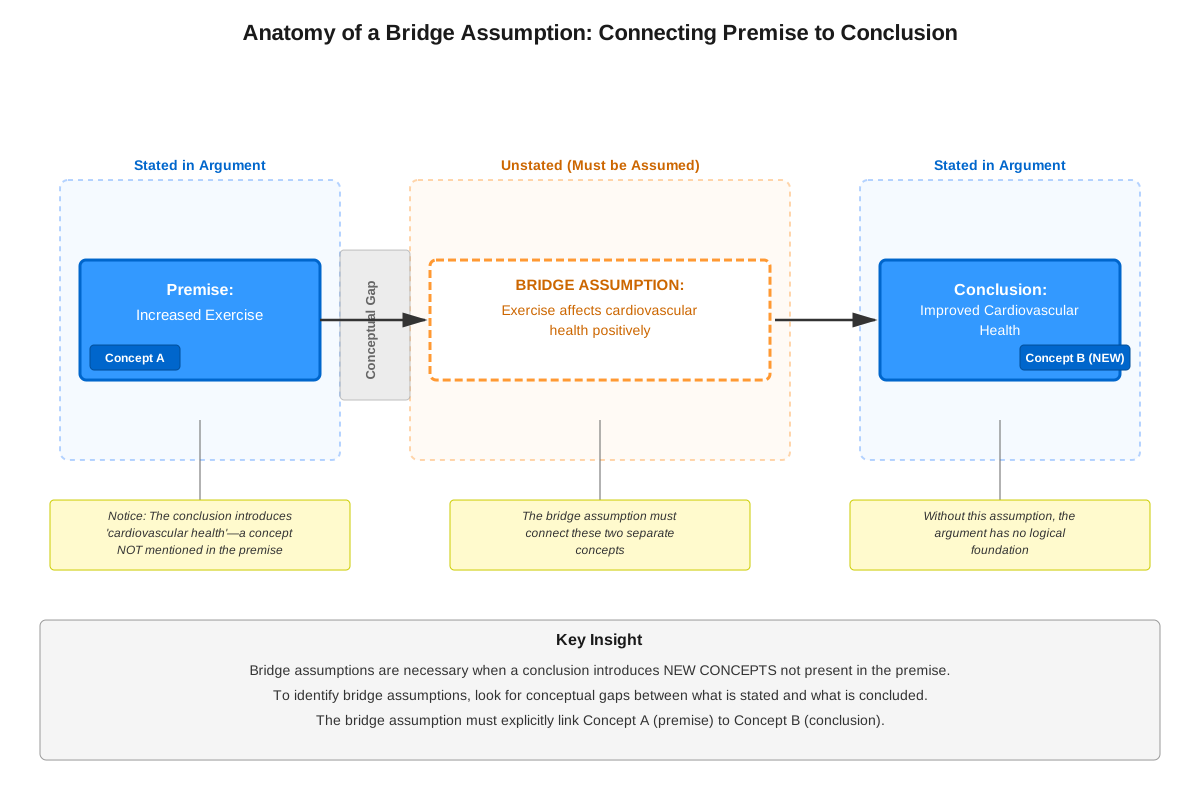
Bridge assumptions represent one of the most critical and frequently tested concepts in LSAT Logical Reasoning. These assumptions function as the invisible connective tissue between an argument's evidence and its conclusion, linking two distinct concepts that appear disconnected in the explicit reasoning. When an LSAT argument moves from discussing "increased exercise" in the premises to "improved cardiovascular health" in the conclusion, a bridge assumption must connect these two separate ideas—specifically, that increased exercise actually affects cardiovascular health in a positive way.
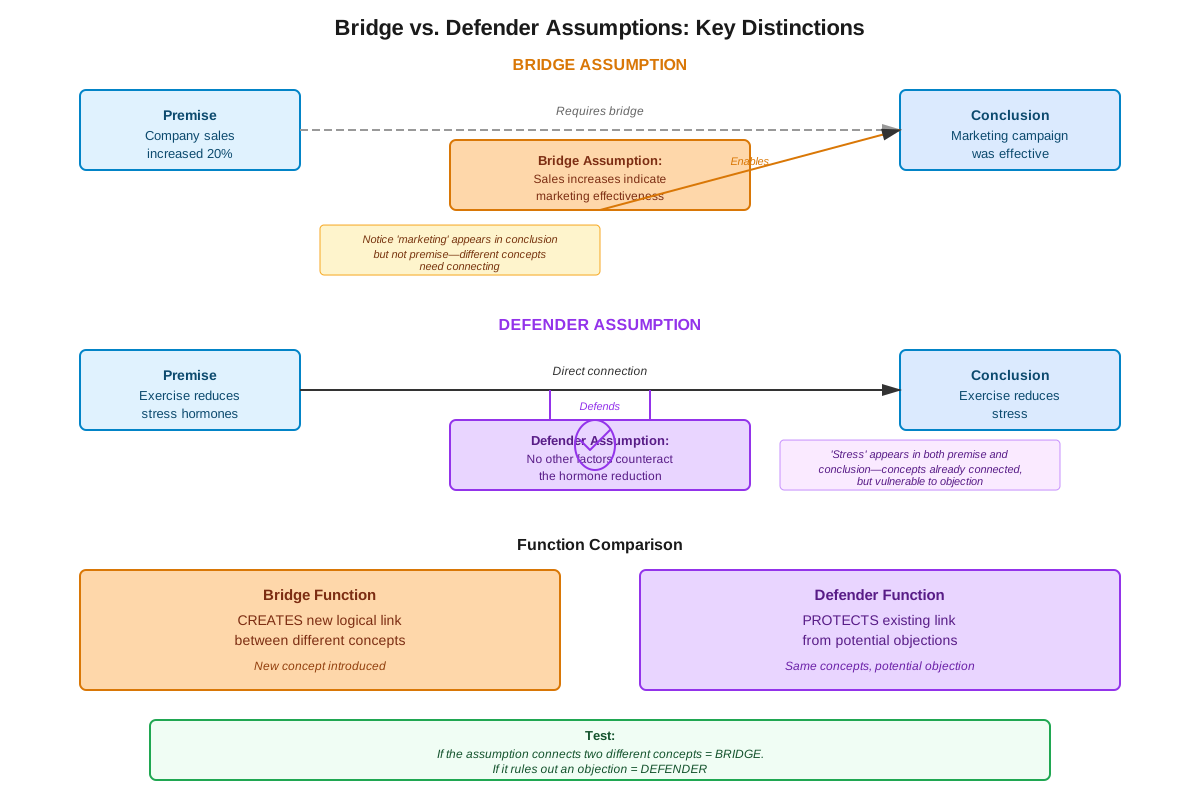
Understanding bridge assumptions is essential for success on the LSAT because they appear in multiple question types, including Necessary Assumption questions, Sufficient Assumption questions, Strengthen questions, and Flaw questions. The test makers deliberately construct arguments with conceptual gaps, and recognizing these gaps—then identifying what must be true to bridge them—separates high scorers from average performers. Bridge assumptions differ from other types of assumptions (such as defender assumptions that protect against objections) because they actively forge new logical connections rather than merely defending existing ones.
Within the broader landscape of LSAT bridge assumptions and assumption questions, mastering this topic provides the foundation for understanding argument structure, identifying logical gaps, and predicting correct answers before reviewing answer choices. This skill translates directly to improved performance across all Logical Reasoning question types, as recognizing what an argument takes for granted is fundamental to evaluating its logical soundness. Students who develop expertise in identifying bridge assumptions typically see score improvements of 3-5 points in the Logical Reasoning sections alone.
Learning Objectives
- [ ] Identify how Bridge assumptions appears in LSAT questions
- [ ] Explain the reasoning pattern behind Bridge assumptions
- [ ] Apply Bridge assumptions to solve LSAT-style problems accurately
- [ ] Distinguish bridge assumptions from defender assumptions in complex arguments
- [ ] Predict bridge assumptions before reviewing answer choices
- [ ] Recognize the "new concept" pattern that signals a bridge assumption gap
- [ ] Evaluate answer choices by testing whether they successfully connect premise concepts to conclusion concepts
Prerequisites
- Basic argument structure: Understanding premises, conclusions, and how to identify each component is essential because bridge assumptions specifically connect these elements
- Conditional reasoning fundamentals: Recognizing sufficient and necessary conditions helps identify when bridge assumptions create logical links between conditional statements
- Argument analysis skills: The ability to separate what an argument explicitly states from what it assumes is foundational to recognizing any type of assumption, including bridges
- Question stem recognition: Distinguishing between different Logical Reasoning question types ensures proper application of bridge assumption identification strategies
Why This Topic Matters
Bridge assumptions appear in approximately 25-30% of all Logical Reasoning questions on the LSAT, making them one of the highest-yield topics for score improvement. They are the primary focus of Necessary Assumption questions (which typically comprise 4-6 questions per test) and Sufficient Assumption questions (2-4 questions per test), while also appearing regularly in Strengthen, Weaken, and Flaw questions. The ability to quickly identify bridge assumptions can save 30-45 seconds per question, providing crucial time for more challenging items.
In real-world applications, bridge assumption recognition translates to critical thinking skills valued in legal practice. Attorneys must identify unstated connections in opposing counsel's arguments, recognize gaps in witness testimony, and construct airtight logical chains in their own advocacy. Law school professors frequently test this skill through the Socratic method, expecting students to articulate the implicit assumptions underlying legal reasoning in case law and statutory interpretation.
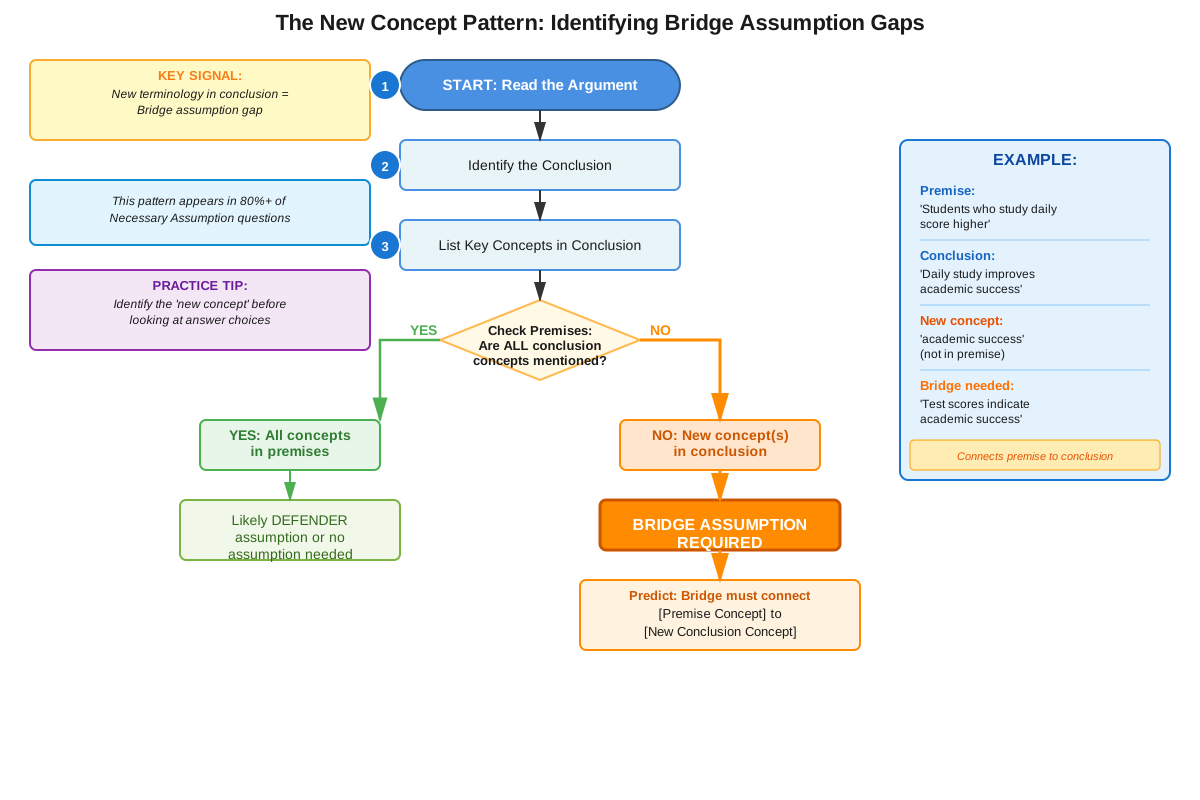
On the LSAT, bridge assumptions most commonly appear when arguments introduce new terminology in the conclusion that wasn't present in the premises, shift between different categories or groups, or move from discussing one time period to making claims about another. Test makers deliberately construct these gaps to assess whether students can identify what must be true for the argument to hold together logically. Recognizing the pattern—"the premises discuss X, but the conclusion is about Y"—is the first step toward mastering this high-yield topic.
Core Concepts
What Are Bridge Assumptions?
A bridge assumption is an unstated premise that connects two different concepts, terms, or ideas in an argument—specifically linking something discussed in the evidence to something claimed in the conclusion. These assumptions are called "bridges" because they span the logical gap between distinct elements, much like a physical bridge connects two separate landmasses. Without the bridge assumption, the argument's reasoning would contain a fatal disconnect, making the conclusion unsupported by the stated premises.
The defining characteristic of bridge assumptions is the presence of concept shift: the argument's premises discuss one set of terms or ideas, while the conclusion introduces or emphasizes different terms or ideas. For example, if premises discuss "employee satisfaction surveys" but the conclusion claims "the company will increase productivity," a bridge assumption must connect satisfaction to productivity. The argument assumes these concepts relate in a specific way, even though this relationship is never explicitly stated.
The Anatomy of Bridge Assumption Arguments
Bridge assumption arguments follow a predictable structure that, once recognized, makes them significantly easier to analyze:
- Premises introduce Concept A: The evidence discusses a specific term, category, group, or idea
- Conclusion shifts to Concept B: The conclusion makes a claim about a different term, category, group, or idea
- Unstated bridge: The argument implicitly assumes Concept A and Concept B are connected in a way that makes the reasoning valid
Consider this example:
Premise: Studies show that people who read fiction regularly score higher on empathy tests.
Conclusion: Therefore, schools should require more fiction reading to improve students' interpersonal skills.
The premise discusses "empathy test scores" (Concept A), while the conclusion claims benefits for "interpersonal skills" (Concept B). The bridge assumption connects these: that empathy test scores reflect or predict actual interpersonal skills. Without this connection, the evidence about test scores wouldn't support the conclusion about real-world skills.
Identifying the "New Concept" Pattern
The most reliable trigger for recognizing bridge assumptions is the appearance of new or shifted terminology in the conclusion. When reading an LSAT argument, track the specific nouns, adjectives, and key concepts in the premises, then compare them to the conclusion's language. Any significant difference signals a potential bridge assumption.
Common patterns include:
- Category shifts: Premises about "mammals" leading to conclusions about "dogs"
- Temporal shifts: Evidence from "the past" supporting claims about "the future"
- Scope shifts: Data about "some members" leading to conclusions about "the entire group"
- Measurement shifts: Premises about "quantity" supporting conclusions about "quality"
- Causal shifts: Evidence of "correlation" leading to conclusions about "causation"
Bridge Assumptions vs. Defender Assumptions
Understanding the distinction between bridge and defender assumptions is crucial for LSAT success:
| Feature | Bridge Assumptions | Defender Assumptions |
|---|---|---|
| Function | Connect two different concepts | Protect against potential objections |
| Structure | Link Concept A to Concept B | Assume no undermining factors exist |
| Language pattern | "A relates to B in this way" | "No alternative explanation exists" |
| Question type frequency | Very common in Necessary/Sufficient Assumption | More common in Strengthen/Weaken |
| Identification trigger | New terminology in conclusion | Potential objections to existing reasoning |
For example, in an argument concluding that "the new policy will reduce crime," a bridge assumption might connect "the policy's specific mechanisms" to "crime reduction," while a defender assumption might be that "no other factors will increase crime enough to offset the policy's effects."
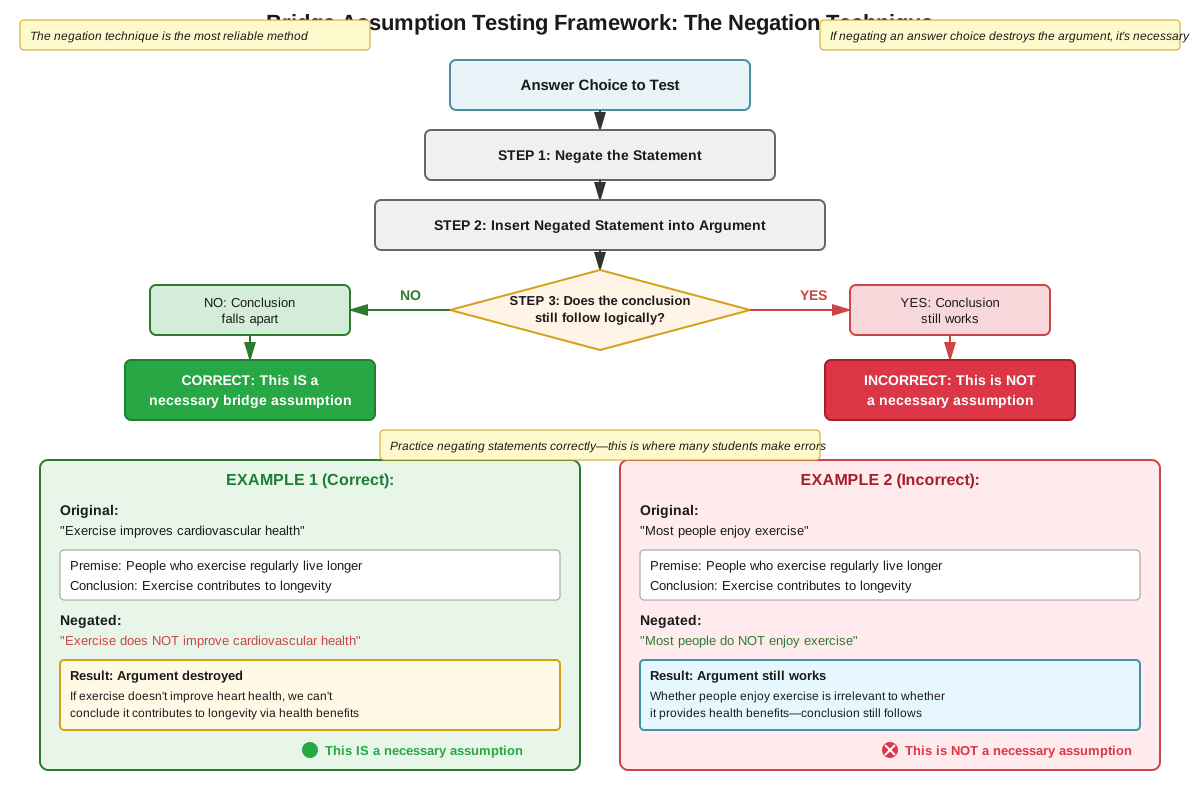
The Negation Technique for Bridge Assumptions
The negation test is particularly powerful for confirming bridge assumptions in Necessary Assumption questions. To apply it:
- Identify the potential bridge assumption
- Negate it (make it false)
- Check whether the negation destroys the argument
If negating the statement makes the argument fall apart, it's a necessary assumption. For bridge assumptions, negation typically reveals the logical gap by showing that the premise concept and conclusion concept have no meaningful connection.
Example:
Argument: "Sales of electric vehicles increased 40% last year. Therefore, carbon emissions from transportation will decrease."
Bridge assumption: "Electric vehicles produce fewer carbon emissions than the vehicles they replace."
Negation: "Electric vehicles do NOT produce fewer carbon emissions than the vehicles they replace."
The negation destroys the argument because if electric vehicles don't reduce emissions, increased sales wouldn't lead to decreased emissions. This confirms the bridge assumption is necessary.
Sufficient vs. Necessary Bridge Assumptions
Bridge assumptions appear in both Necessary Assumption and Sufficient Assumption questions, but with different characteristics:
Necessary bridge assumptions provide the minimum connection required for the argument to work. They state what must be true for the reasoning to be valid, but they don't guarantee the conclusion is correct. These are typically more modest claims that simply establish a relationship exists between the concepts.
Sufficient bridge assumptions provide enough information to guarantee the conclusion follows from the premises. They are typically stronger, more comprehensive statements that fully close the logical gap. In Sufficient Assumption questions, the correct answer will make the argument's reasoning airtight and logically valid.
For the same argument, these might look different:
- Necessary: "Increased exercise has some positive effect on cardiovascular health"
- Sufficient: "Increased exercise always improves cardiovascular health significantly"
Concept Relationships
Bridge assumptions serve as the foundational concept for understanding all assumption-based questions in LSAT Logical Reasoning. The relationship flows as follows:
Argument Structure → identifies → Premises and Conclusions → reveals → Conceptual Gaps → requires → Bridge Assumptions → which can be → Necessary or Sufficient → and must be distinguished from → Defender Assumptions
Within the topic itself, recognizing the "new concept" pattern enables identification of bridge assumptions, which then allows application of the negation technique to confirm necessary assumptions. This confirmation process connects back to fundamental conditional reasoning skills, as many bridge assumptions can be expressed as conditional statements (if A, then B).
Bridge assumptions also relate directly to Strengthen and Weaken questions: answer choices that strengthen arguments often provide partial bridge assumptions or evidence supporting the bridge, while weakening answers attack the validity of the assumed bridge connection. Understanding Flaw questions requires recognizing when arguments fail to establish necessary bridges between concepts.
The progression for mastery follows this path: Basic Argument Analysis → Recognizing Conceptual Shifts → Identifying Bridge Assumptions → Applying Negation Tests → Distinguishing Assumption Types → Predicting Correct Answers → Efficient Answer Choice Elimination
High-Yield Facts
⭐ Bridge assumptions connect two different concepts that appear in an argument—one in the premises and a different one in the conclusion
⭐ The most reliable indicator of a bridge assumption is new or shifted terminology appearing in the conclusion that wasn't present in the premises
⭐ Necessary bridge assumptions can be confirmed using the negation test: if negating the assumption destroys the argument, it's necessary
⭐ Bridge assumptions differ from defender assumptions because they actively connect concepts rather than protecting against objections
⭐ Sufficient bridge assumptions are stronger and more comprehensive than necessary bridge assumptions, fully guaranteeing the conclusion
- Bridge assumptions appear in approximately 25-30% of all Logical Reasoning questions across different question types
- Common concept shifts include category changes, temporal shifts, scope modifications, and measurement alterations
- The correct answer in Necessary Assumption questions often uses language that directly links the premise concept to the conclusion concept
- Incorrect answer choices in bridge assumption questions frequently discuss only one concept (premise or conclusion) without connecting both
- Bridge assumptions can be expressed as conditional statements: "If [premise concept], then [conclusion concept]"
- Multiple bridge assumptions may exist in complex arguments with several conceptual shifts
- Recognizing bridge assumptions before reviewing answer choices typically saves 20-30 seconds per question
- The LSAT rarely makes bridge assumptions obvious; they require active identification of conceptual gaps
- Bridge assumptions are more common in arguments about causation, predictions, and recommendations than in pure descriptive arguments
- Prephrasing the bridge assumption before reading answer choices significantly improves accuracy rates
Quick check — test yourself on Bridge assumptions so far.
Try Flashcards →Common Misconceptions
Misconception: Bridge assumptions must use the exact same words as the premises and conclusion.
Correction: Bridge assumptions connect the concepts discussed in premises and conclusions, which may be expressed using synonyms, related terms, or paraphrased language. The connection is conceptual, not purely linguistic.
Misconception: Every argument contains a bridge assumption.
Correction: Bridge assumptions only exist when there's a conceptual shift between premises and conclusion. Arguments where the conclusion directly follows from premises using the same concepts may have defender assumptions but not bridge assumptions.
Misconception: The longest or most complex answer choice is usually the correct bridge assumption.
Correction: Correct bridge assumptions are often stated simply and directly. The LSAT frequently includes verbose, complex wrong answers as distractors, while the correct answer efficiently connects the two concepts.
Misconception: Bridge assumptions must be realistic or true in the real world.
Correction: The LSAT tests logical connections within the argument's reasoning, not real-world truth. A bridge assumption is correct if it logically connects the concepts, regardless of whether it's factually accurate outside the argument's context.
Misconception: Identifying one concept shift means you've found the only bridge assumption.
Correction: Complex arguments may contain multiple conceptual shifts requiring several bridge assumptions. Always analyze the complete logical chain from premises to conclusion.
Misconception: Bridge assumptions only appear in Necessary Assumption questions.
Correction: While most common in Necessary and Sufficient Assumption questions, bridge assumptions are also tested in Strengthen, Weaken, Flaw, and Evaluate questions. The same skill—recognizing conceptual gaps—applies across question types.
Misconception: The negation test works by simply adding "not" to the assumption.
Correction: Proper negation requires understanding logical opposites. For "all," the negation is "not all" (or "some are not"), not "none." For "some," the negation is "none," not "not some."
Worked Examples
Example 1: Necessary Bridge Assumption
Argument:
"A recent survey found that 78% of employees at TechCorp reported feeling 'very satisfied' with their work environment. Therefore, TechCorp should experience lower turnover rates than its competitors in the coming year."
Step 1: Identify the premise concept(s)
The premises discuss "employee satisfaction" specifically measured through survey responses about work environment.
Step 2: Identify the conclusion concept(s)
The conclusion makes a claim about "turnover rates" and specifically predicts they'll be "lower than competitors."
Step 3: Recognize the conceptual shift
The argument shifts from discussing satisfaction (Concept A) to predicting turnover rates (Concept B). These are related but distinct concepts—the argument never explicitly states they're connected.
Step 4: Prephrase the bridge assumption
To connect satisfaction to turnover, the argument must assume: "Employee satisfaction levels affect turnover rates" or more specifically, "Higher satisfaction leads to lower turnover."
Step 5: Apply the negation test
Negation: "Employee satisfaction levels do NOT affect turnover rates."
If satisfaction doesn't affect turnover, then the evidence about high satisfaction wouldn't support the conclusion about low turnover. The argument falls apart, confirming this is a necessary assumption.
Step 6: Evaluate answer choices (hypothetical options)
- (A) "TechCorp's competitors have lower employee satisfaction" - This discusses competitors but doesn't bridge satisfaction to turnover
- (B) "Employee satisfaction influences employee retention decisions" - ✓ This bridges the concepts: satisfaction → retention (inverse of turnover)
- (C) "The survey accurately measured employee opinions" - This is a defender assumption about the survey's validity, not a bridge
- (D) "TechCorp will maintain current satisfaction levels" - This discusses future satisfaction but doesn't connect satisfaction to turnover
Answer: (B) successfully bridges the conceptual gap by connecting satisfaction to retention/turnover decisions.
Example 2: Sufficient Bridge Assumption
Argument:
"Every member of the city council voted in favor of the new zoning ordinance. Thus, the ordinance will definitely be implemented next month."
Step 1: Identify the premise concept(s)
The premise establishes that "all council members voted in favor" of the ordinance.
Step 2: Identify the conclusion concept(s)
The conclusion claims the ordinance "will definitely be implemented" with certainty and a specific timeframe.
Step 3: Recognize the conceptual shift
The argument shifts from "council approval" (Concept A) to "actual implementation" (Concept B). Approval and implementation are distinct—many things could prevent implementation despite approval.
Step 4: Prephrase the bridge assumption
For a SUFFICIENT assumption (note the "definitely" in the conclusion), we need a guarantee: "If all council members vote in favor, the ordinance will be implemented next month" or "Council approval is the only requirement for implementation within this timeframe."
Step 5: Evaluate answer choices (hypothetical options)
- (A) "The council has authority to pass zoning ordinances" - Necessary but not sufficient; doesn't guarantee implementation
- (B) "Most ordinances approved by the council are eventually implemented" - Too weak; "most" and "eventually" don't guarantee "definitely" and "next month"
- (C) "Any ordinance approved unanimously by the council is automatically implemented the following month" - ✓ This is sufficient; it guarantees the conclusion
- (D) "The ordinance addresses important community needs" - Irrelevant to the logical connection between approval and implementation
Answer: (C) provides a sufficient bridge by establishing that unanimous approval (which occurred) automatically leads to implementation next month (the conclusion). This makes the argument logically valid.
Key difference from Example 1: Sufficient assumptions are stronger and more comprehensive. They don't just establish that a connection exists (necessary) but guarantee the conclusion follows with certainty (sufficient).
Exam Strategy
Pre-Reading Strategy
Before reading the argument, quickly scan the question stem to determine whether it's asking for a necessary assumption ("required," "depends on," "assumes") or sufficient assumption ("allows the conclusion to be properly drawn," "enables the conclusion to follow logically"). This determines whether to look for a minimal connection or a guarantee.
Active Reading Approach
While reading the argument:
- Underline or mentally note key nouns and concepts in the premises
- Circle or highlight the conclusion indicator and conclusion
- Immediately compare premise concepts to conclusion concepts
- Flag any new terminology or conceptual shifts in the conclusion
Exam Tip: The moment you notice different terminology in the conclusion, you've likely identified a bridge assumption question. This recognition should happen within 10-15 seconds of reading.
Trigger Words and Phrases
Watch for these high-frequency indicators of bridge assumptions:
In conclusions:
- "Therefore, [new concept] will..."
- "Thus, this means [different concept]..."
- "Consequently, we can expect [shifted concept]..."
- "This shows that [new category/group]..."
Conceptual shift patterns:
- Premises: "studies show," "research indicates," "data reveals" → Conclusion: "we should," "this will," "people will"
- Premises: specific examples → Conclusion: general principle
- Premises: past/present → Conclusion: future
- Premises: correlation → Conclusion: causation
Answer Choice Elimination
Eliminate answers that:
- Discuss only the premise concept without mentioning the conclusion concept
- Discuss only the conclusion concept without connecting back to premises
- Introduce entirely new concepts not present in either premises or conclusion
- Are defender assumptions that protect against objections rather than bridging concepts
- Are too extreme for Necessary Assumption questions (watch for "always," "never," "only")
Prioritize answers that:
- Explicitly mention both the premise concept and conclusion concept
- Use connecting language like "affects," "influences," "leads to," "indicates," "reflects"
- Match your prephrased assumption in meaning, even if wording differs
- Pass the negation test (for Necessary Assumption questions)
Time Allocation
- Reading and analysis: 20-30 seconds
- Prephrasing the bridge: 10-15 seconds
- Evaluating answer choices: 30-45 seconds
- Total target time: 60-90 seconds per question
Prephrasing the bridge assumption before reading answers typically saves 15-20 seconds by allowing immediate recognition of correct answers and faster elimination of wrong choices.
Advanced Technique: The "Connect the Dots" Method
Visualize the argument structure as:
[Premise Concept A] ----?----> [Conclusion Concept B]
The question mark represents the missing bridge. Your job is to articulate what must go in that space. Write it down in 3-5 words if time permits, or clearly formulate it mentally. This prephrase becomes your prediction, and the correct answer will match this prediction conceptually.
Memory Techniques
The BRIDGE Acronym
Both concepts must appear (in the correct answer)
Recognize new terminology in the conclusion
Identify the conceptual shift
Distinguish from defender assumptions
Gap between premise and conclusion
Eliminate answers discussing only one concept
Visualization Strategy
Picture the argument as two islands (premise concept and conclusion concept) separated by water (the logical gap). The bridge assumption is the structure that allows you to walk from the premise island to the conclusion island. If the bridge is missing or broken (assumption is false), you can't make the journey (conclusion doesn't follow).
The "New Word Alert" Technique
Train yourself to have an automatic mental alarm when reading conclusions: "NEW WORD ALERT!" Any significant terminology in the conclusion that wasn't in the premises should trigger immediate recognition that a bridge assumption is needed. Practice this with every argument until it becomes automatic.
Negation Shortcut Mnemonic
"FLIP IT, KILL IT"
- FLIP IT: Negate the assumption (flip it to its opposite)
- KILL IT: Check if the negation kills (destroys) the argument
If the negation kills the argument, the assumption is necessary.
The Two-Column Method
When practicing, create a mental or physical two-column chart:
| Premises Discuss | Conclusion Claims |
|---|---|
| [Concept A] | [Concept B] |
The bridge assumption must connect the left column to the right column. This visual organization makes conceptual shifts immediately obvious.
Summary
Bridge assumptions represent the logical connections between distinct concepts in LSAT arguments, specifically linking ideas discussed in premises to different ideas claimed in conclusions. These assumptions are identified by recognizing conceptual shifts—when the conclusion introduces new terminology, categories, timeframes, or scopes not present in the premises. Mastering bridge assumptions requires three core skills: identifying the "new concept" pattern that signals a logical gap, prephrasing the connection needed to bridge that gap, and distinguishing bridge assumptions from defender assumptions that protect against objections rather than connecting concepts. The negation test confirms necessary bridge assumptions by demonstrating that negating the assumption destroys the argument's reasoning. Bridge assumptions appear across multiple question types but are most prominent in Necessary and Sufficient Assumption questions, where they constitute the primary focus of 25-30% of Logical Reasoning questions. Success requires active reading to track conceptual shifts, systematic prephrasing before reviewing answer choices, and efficient elimination of answers that fail to connect both premise and conclusion concepts.
Key Takeaways
- Bridge assumptions connect two different concepts: one from the premises and a different one from the conclusion, spanning the logical gap between them
- New terminology in conclusions is the primary trigger: whenever the conclusion discusses concepts not explicitly mentioned in the premises, a bridge assumption is required
- Prephrase before reading answer choices: articulating the needed connection in your own words dramatically improves accuracy and speed
- The negation test confirms necessary assumptions: if negating an assumption destroys the argument, it's necessary; if the argument survives, it's not
- Bridge assumptions differ from defender assumptions: bridges actively connect concepts while defenders protect against potential objections
- Both concepts must appear in correct answers: eliminate any choice that discusses only the premise concept or only the conclusion concept without linking them
- Sufficient bridge assumptions are stronger than necessary ones: sufficient assumptions guarantee the conclusion while necessary assumptions provide only the minimum required connection
Related Topics
Defender Assumptions: After mastering bridge assumptions, study how defender assumptions protect arguments from objections and alternative explanations. Understanding both types enables complete analysis of assumption-based questions.
Sufficient Assumption Questions: Build on bridge assumption skills by learning how to identify assumptions that guarantee conclusions follow logically, requiring stronger and more comprehensive connections.
Strengthen and Weaken Questions: Apply bridge assumption recognition to questions asking what would support or undermine arguments, as correct answers often provide or attack the assumed bridges.
Flaw Questions: Use bridge assumption expertise to identify when arguments fail to establish necessary connections between concepts, a common logical flaw tested on the LSAT.
Conditional Reasoning in Arguments: Many bridge assumptions can be expressed as conditional statements, so deepening conditional reasoning skills enhances bridge assumption identification.
Practice CTA
Now that you understand the mechanics and patterns of bridge assumptions, it's time to cement this knowledge through active practice. Attempt the practice questions designed for this topic, focusing on identifying conceptual shifts before reading answer choices. Create flashcards for the common patterns and trigger words you've learned. Remember: bridge assumptions appear in roughly one-quarter of all Logical Reasoning questions, making this one of the highest-yield topics for score improvement. Every question you practice strengthens your pattern recognition and speeds your analysis. The difference between a good LSAT score and a great one often comes down to mastering exactly this type of high-frequency, high-impact concept. You've built the foundation—now apply it with confidence!
Sign up free to keep reading
Create a free AnvayaPrep account to finish this LSAT guide on Bridge assumptions — plus flashcards and practice questions.