Overview
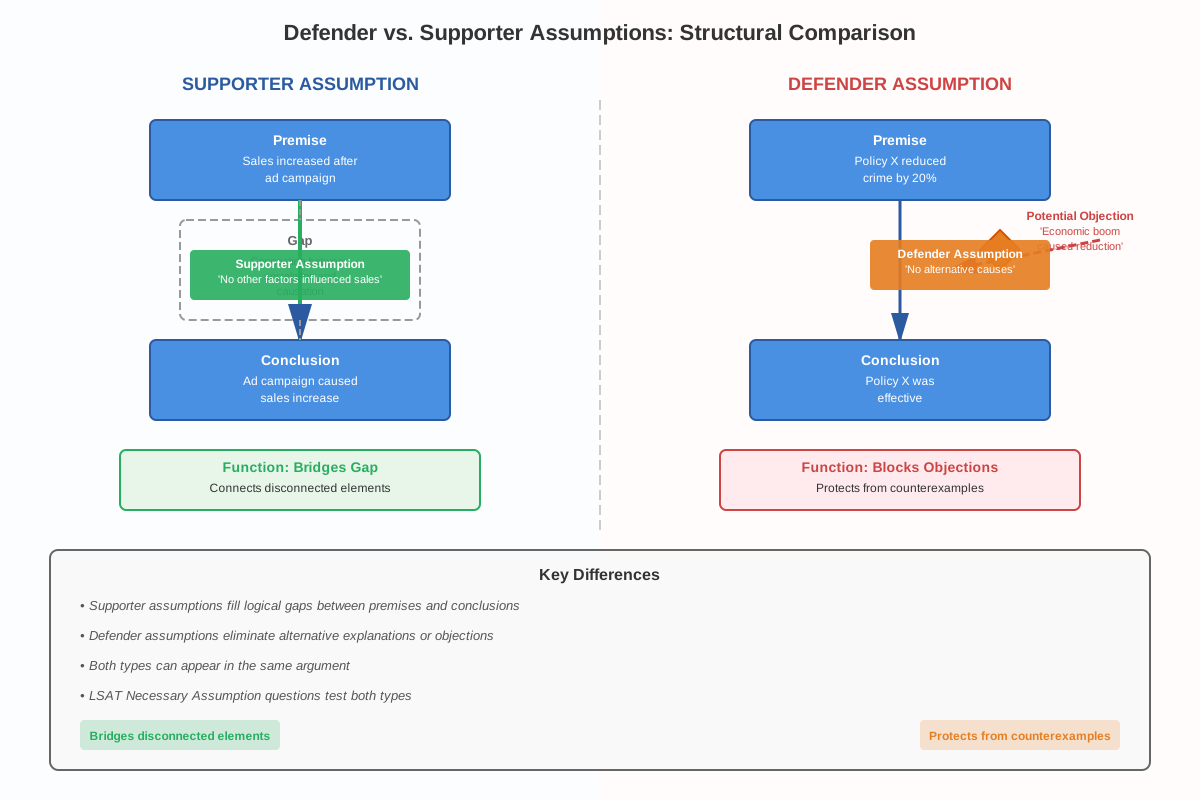
Defender assumptions represent a critical category within LSAT assumption questions that test a student's ability to identify unstated premises that protect an argument from potential objections or counterexamples. Unlike supporter assumptions that bridge gaps between premises and conclusions, defender assumptions function as shields—they rule out alternative explanations, eliminate potential weaknesses, or prevent objections that could undermine the argument's validity. Understanding this distinction is essential for success on the LSAT, as approximately 25-30% of assumption questions involve defender-type reasoning patterns.
In logical reasoning, arguments often contain vulnerabilities that the author implicitly assumes away. For instance, an argument might conclude that a new policy caused crime rates to drop, but this reasoning is only valid if we assume no other factors (economic changes, demographic shifts, weather patterns) were responsible for the decline. The defender assumption protects the argument by ruling out these alternative causes. Mastering defender assumptions requires developing a critical eye for what could go wrong with an argument and recognizing what must be true to prevent those problems.
The relationship between defender assumptions and other LSAT logical reasoning concepts is foundational. While supporter assumptions connect disconnected elements in an argument (bridging gaps between evidence and conclusion), defender assumptions address potential attacks on the argument's reasoning. Both types appear in Necessary Assumption questions, Sufficient Assumption questions, and Strengthen questions, though defender assumptions are particularly prevalent in Necessary Assumption questions where students must identify what the argument depends upon to avoid collapse. Understanding defender assumptions also enhances performance on Weaken questions, as the correct answer often exploits the very vulnerability that a defender assumption would have protected against.
Learning Objectives
- [ ] Identify how Defender assumptions appears in LSAT questions
- [ ] Explain the reasoning pattern behind Defender assumptions
- [ ] Apply Defender assumptions to solve LSAT-style problems accurately
- [ ] Distinguish between defender assumptions and supporter assumptions in argument analysis
- [ ] Recognize common vulnerability patterns that defender assumptions address
- [ ] Evaluate answer choices by testing whether they eliminate potential objections to arguments
- [ ] Predict defender assumptions before reviewing answer choices to improve accuracy and speed
Prerequisites
- Basic argument structure: Understanding premises, conclusions, and how they relate is essential because defender assumptions protect the connection between these elements
- Causation vs. correlation: Recognizing the difference matters because many defender assumptions rule out alternative causal explanations
- Necessary vs. sufficient conditions: This logical distinction is crucial because defender assumptions are typically necessary (required) for the argument to hold
- Argument evaluation skills: The ability to identify argument weaknesses enables recognition of what assumptions defend against those weaknesses
- Common logical fallacies: Familiarity with reasoning errors helps identify what defender assumptions must rule out
Why This Topic Matters
Defender assumptions appear with remarkable frequency on the LSAT, making them one of the highest-yield topics in logical reasoning preparation. Research on recent LSAT administrations indicates that 8-12 questions per test involve defender assumption reasoning, distributed across Necessary Assumption questions (where they appear in 40-50% of questions), Strengthen questions (30-40%), and even some Sufficient Assumption questions. This frequency translates to approximately 15-20% of all logical reasoning points on any given LSAT, making mastery of this concept essential for achieving a competitive score.
In real-world applications, defender assumption reasoning mirrors the critical thinking required in legal practice. Attorneys must anticipate objections to their arguments, identify potential counterarguments, and ensure their reasoning accounts for alternative explanations. When a prosecutor argues that forensic evidence proves guilt, they implicitly assume the evidence wasn't contaminated, planted, or misinterpreted—all defender assumptions that opposing counsel might challenge. Similarly, when judges evaluate legal arguments, they assess whether the reasoning holds up against potential objections, essentially testing whether necessary defender assumptions are satisfied.
On the LSAT, defender assumptions most commonly appear in passages involving causal reasoning, comparative arguments, and proposals or predictions. Question stems that signal defender assumptions include "Which one of the following is an assumption required by the argument?" (Necessary Assumption), "Which one of the following, if true, most strengthens the argument?" (Strengthen), and occasionally "The argument depends on assuming which one of the following?" The correct answer typically eliminates an alternative explanation, rules out a potential objection, or confirms that a vulnerability doesn't actually undermine the argument.
Core Concepts
What Are Defender Assumptions?
Defender assumptions are unstated premises that protect an argument from potential objections, alternative explanations, or counterexamples that would otherwise weaken or invalidate the reasoning. These assumptions function defensively rather than constructively—they don't build the argument's positive case but instead shield it from attack. Every argument with a defender assumption contains an implicit vulnerability, and the assumption serves to rule out that vulnerability as a legitimate concern.
The defining characteristic of defender assumptions is their protective function. Consider this argument: "Sales increased after we launched our advertising campaign, so the campaign was effective." This reasoning assumes that no other factor caused the sales increase—a classic defender assumption. Without this assumption, alternative explanations (seasonal trends, competitor closures, economic improvements) could undermine the causal claim. The assumption defends against these alternatives by implicitly ruling them out.
The Reasoning Pattern Behind Defender Assumptions
The typical structure of arguments requiring defender assumptions follows this pattern:
- Evidence is presented (often observational or correlational data)
- A conclusion is drawn (frequently causal, comparative, or predictive)
- An implicit vulnerability exists (alternative explanations, counterexamples, or objections)
- The defender assumption rules out the vulnerability (making the argument valid)
Understanding this pattern enables students to anticipate defender assumptions systematically. When analyzing an argument, ask: "What could go wrong with this reasoning? What alternative explanation might someone offer? What objection could undermine this conclusion?" The defender assumption will address precisely these concerns.
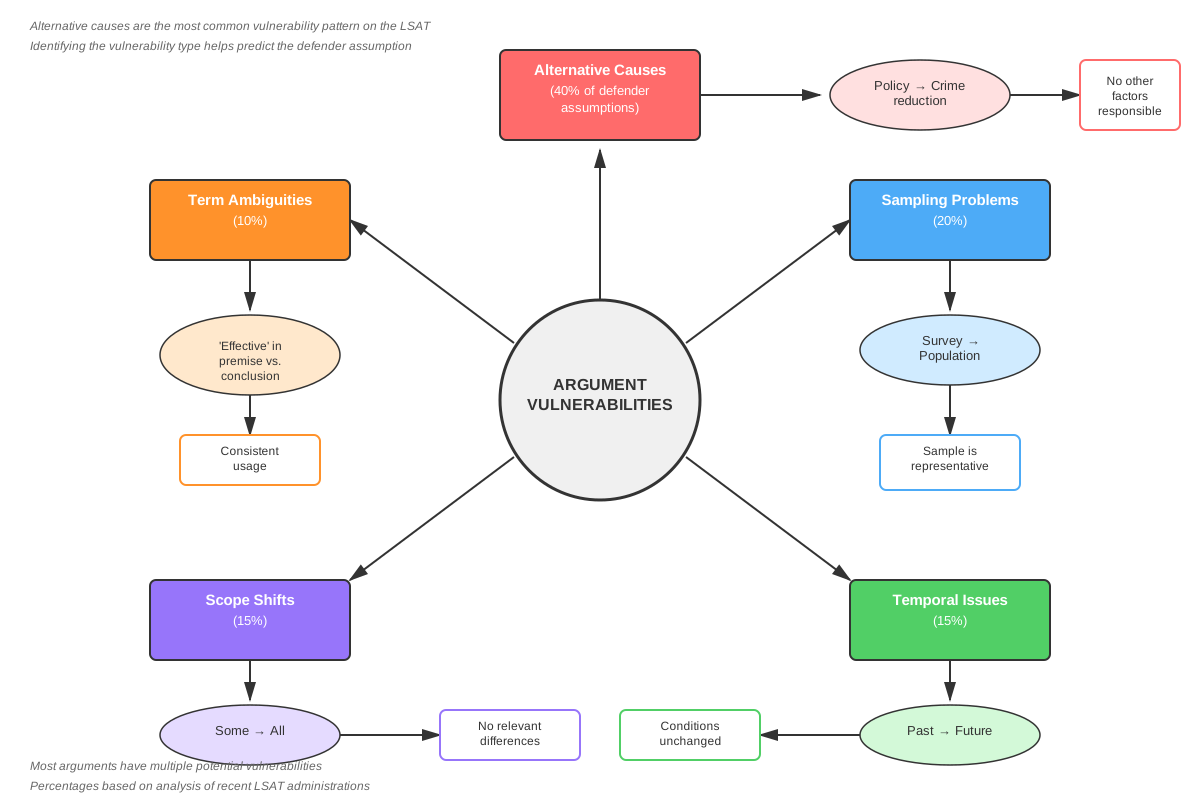
Common Types of Defender Assumptions
| Type | Function | Example Context |
|---|---|---|
| Alternative Cause Eliminators | Rule out other potential causes in causal arguments | "X caused Y" assumes no other factor caused Y |
| Comparison Validators | Ensure compared groups are relevantly similar | "Group A outperformed Group B" assumes groups were comparable |
| Representativeness Guarantors | Confirm samples or examples are representative | "Survey shows X" assumes respondents represent the population |
| Implementation Feasibility Protectors | Rule out practical obstacles to proposals | "Plan X will work" assumes no insurmountable obstacles exist |
| Consistency Maintainers | Ensure no contradictory information undermines the argument | "Theory X explains Y" assumes no contradictory evidence exists |
Alternative Cause Eliminators
The most frequently tested defender assumption type involves causal reasoning. When an argument claims X caused Y based on correlation or temporal sequence, it implicitly assumes no alternative factor caused Y. This assumption defends against the objection: "But couldn't something else have caused the effect?"
For example: "After the city installed speed cameras, traffic accidents decreased by 30%. Therefore, the speed cameras reduced accidents." This argument assumes that no other factor (improved road conditions, reduced traffic volume, better weather, increased police presence) caused the accident reduction. The defender assumption protects the causal claim by ruling out these alternatives.
Comparison Validators
Arguments making comparative claims often assume that the compared entities are similar in relevant respects. Without this assumption, differences between the compared groups could explain the observed difference, undermining the argument's conclusion.
Consider: "Students who took the prep course scored higher on the LSAT than those who didn't. The prep course must be effective." This reasoning assumes that students who took the course weren't already higher-performing students (self-selection bias), didn't have other advantages (more study time, better resources), and were otherwise comparable to the control group. These defender assumptions protect against the objection that pre-existing differences, rather than the course itself, explain the score difference.
Representativeness Guarantors
When arguments generalize from samples, examples, or specific cases to broader populations or principles, they assume the sample is representative. This defender assumption rules out the objection that the sample is biased, atypical, or otherwise unrepresentative.
Example: "A survey of 1,000 residents found that 70% support the new policy. Therefore, the policy has broad public support." This assumes the survey respondents represent the broader population—that the sample wasn't biased toward policy supporters, that non-respondents don't differ systematically from respondents, and that the surveyed population reflects the relevant demographic.
The Negation Test for Defender Assumptions
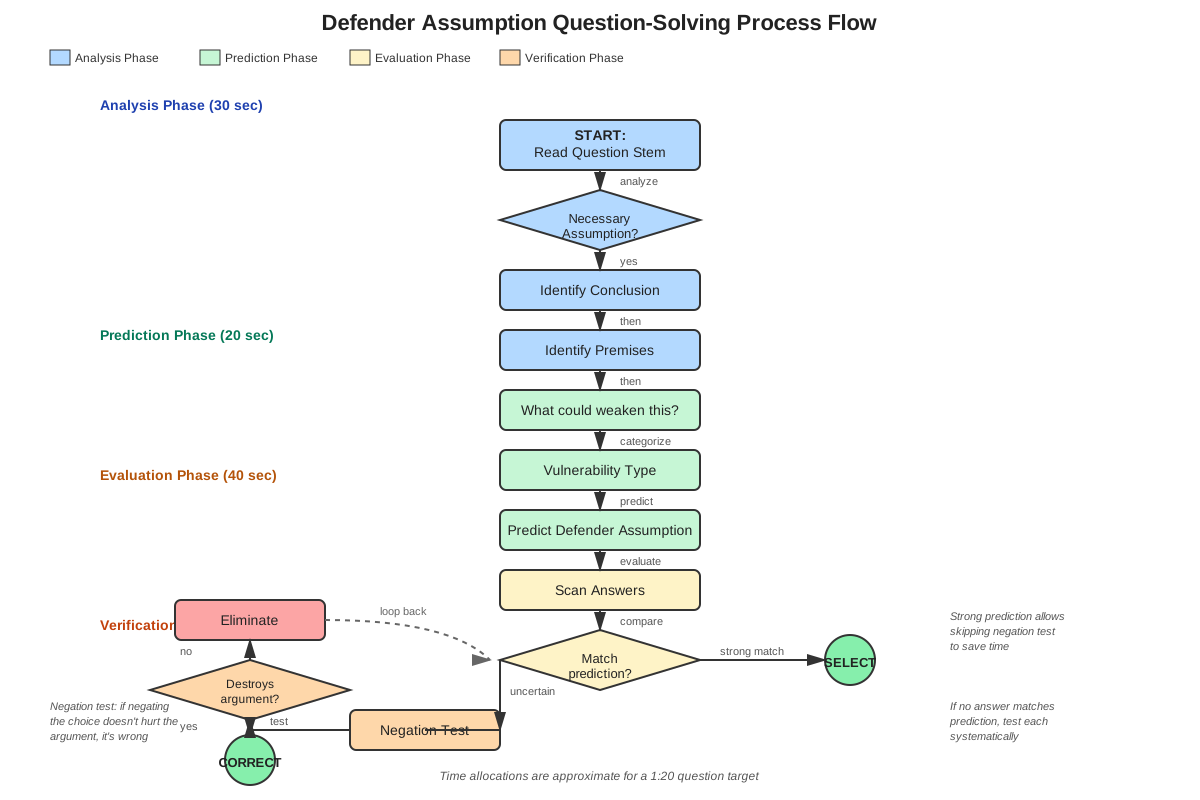
The negation test is the most reliable method for confirming defender assumptions in Necessary Assumption questions. If negating an answer choice destroys the argument, that choice states a necessary assumption. For defender assumptions, negation typically introduces the very vulnerability the assumption was protecting against.
Process:
- Identify the answer choice to test
- Negate it (make it false or opposite)
- Determine whether the negated version undermines the argument
- If the argument collapses, the original statement is a necessary assumption
Example: Argument: "Crime decreased after the new police chief was appointed, so her policies are working."
Potential defender assumption: "No other factor caused the crime decrease."
Negation: "Another factor caused the crime decrease."
Result: The negated version destroys the causal claim, confirming this is a necessary defender assumption.
Concept Relationships
Defender assumptions connect intimately with several logical reasoning concepts, forming a network of related skills. Understanding these relationships enhances both comprehension and application.
Defender assumptions → Necessary Assumption questions: Defender assumptions are the most common type of necessary assumption tested on the LSAT. When a question asks what the argument "requires" or "depends on," the correct answer frequently identifies a defender assumption that rules out a potential objection.
Causal reasoning → Defender assumptions: Arguments establishing causal relationships almost always require defender assumptions to eliminate alternative causes. Mastering causal reasoning patterns directly improves ability to identify defender assumptions.
Weaken questions ← Defender assumptions: The relationship is inverse here—correct answers to Weaken questions often exploit the absence of defender assumptions. If an argument fails to rule out an alternative explanation, that alternative becomes a way to weaken the argument. Understanding defender assumptions thus illuminates what makes arguments vulnerable.
Strengthen questions → Defender assumptions: Strengthen questions often present answer choices that supply defender assumptions, explicitly ruling out vulnerabilities the argument left unaddressed. The correct answer might eliminate an alternative cause, confirm representativeness, or validate a comparison.
Supporter assumptions vs. Defender assumptions: These two assumption types work differently. Supporter assumptions bridge gaps between premises and conclusions (connecting disconnected concepts), while defender assumptions protect against objections (ruling out alternatives). Many arguments require both types, and distinguishing them improves analytical precision.
Sufficient Assumption questions ← Defender assumptions: While less common, some Sufficient Assumption questions involve defender-type reasoning, particularly when the correct answer must rule out all potential objections to guarantee the conclusion.
High-Yield Facts
⭐ Defender assumptions protect arguments from potential objections, alternative explanations, or counterexamples rather than building positive connections between premises and conclusions.
⭐ In causal arguments, defender assumptions typically rule out alternative causes—this is the single most common defender assumption pattern on the LSAT.
⭐ The negation test reliably identifies defender assumptions: if negating a statement destroys the argument, that statement is a necessary defender assumption.
⭐ Comparative arguments require defender assumptions that the compared groups are similar in relevant respects; differences between groups represent vulnerabilities.
⭐ Arguments generalizing from samples assume representativeness—that the sample accurately reflects the broader population or principle.
- Defender assumptions appear in 40-50% of Necessary Assumption questions, making them the dominant assumption type tested.
- When an argument moves from correlation to causation, it always requires a defender assumption ruling out alternative causes.
- Proposals and predictions require defender assumptions that no insurmountable obstacles will prevent implementation or that conditions will remain stable.
- Temporal sequence alone (X happened before Y) never establishes causation without a defender assumption ruling out coincidence and alternative causes.
- Arguments citing expert opinion or authority implicitly assume the expert is credible, unbiased, and speaking within their area of expertise—all defender assumptions.
- Statistical arguments assume data collection methods were sound, samples were unbiased, and no confounding variables distorted results.
- When arguments rely on analogies, they assume the compared situations are relevantly similar—a defender assumption protecting against disanalogy objections.
Quick check — test yourself on Defender assumptions so far.
Try Flashcards →Common Misconceptions
Misconception: All assumptions connect premises to conclusions by bridging conceptual gaps.
Correction: While supporter assumptions bridge gaps, defender assumptions work differently—they protect arguments from objections by ruling out vulnerabilities. Defender assumptions don't build connections; they eliminate threats to existing reasoning.
Misconception: If an answer choice strengthens an argument, it must be a necessary assumption.
Correction: Many statements strengthen arguments without being necessary. A necessary defender assumption, when negated, must destroy the argument. Something can strengthen without being required. Use the negation test to distinguish necessary assumptions from mere strengtheners.
Misconception: Causal arguments only need to show correlation or temporal sequence to be valid.
Correction: Correlation and temporal sequence are never sufficient for causal claims without defender assumptions ruling out alternative causes, coincidence, and reverse causation. The LSAT consistently tests whether students recognize this gap.
Misconception: Defender assumptions must be explicitly stated in answer choices using words like "no other factor" or "nothing else."
Correction: Defender assumptions can be stated in various ways. An answer might positively assert something that, if false, would introduce a vulnerability. For example, "The survey methodology was sound" defends against methodological objections without using "no" or "nothing."
Misconception: The longest or most complex answer choice is usually the defender assumption.
Correction: Defender assumptions are often stated simply and directly. Test writers sometimes include complex, wordy answer choices as distractors. Focus on logical function, not length or complexity.
Misconception: If an argument seems obviously flawed, it must not have any valid defender assumptions.
Correction: Even weak arguments have necessary assumptions—statements that, if false, would make the argument even worse. The question asks what the argument requires, not whether the argument is strong overall.
Misconception: Defender assumptions only appear in Necessary Assumption questions.
Correction: While most common in Necessary Assumption questions, defender assumption reasoning appears in Strengthen questions (where supplying the assumption strengthens the argument), Weaken questions (where denying the assumption weakens it), and occasionally Sufficient Assumption questions.
Worked Examples
Example 1: Alternative Cause Elimination
Argument: "The Brookdale School District implemented a new mathematics curriculum in 2020. Student math scores on standardized tests increased by 15% in 2021. Therefore, the new curriculum improved student mathematical ability."
Question: Which one of the following is an assumption required by the argument?
Analysis Process:
- Identify the conclusion: The new curriculum improved student mathematical ability.
- Identify the evidence: Math scores increased after curriculum implementation.
- Recognize the reasoning pattern: This is causal reasoning based on temporal sequence (post hoc reasoning).
- Identify the vulnerability: Alternative factors could have caused the score increase—better teachers, more study time, easier tests, demographic changes, maturation effects, or external tutoring.
- Predict the defender assumption: The argument must assume no other factor caused the improvement.
- Evaluate answer choices (hypothetical):
- (A) "The new curriculum was more expensive than the previous one." → Irrelevant to whether it caused improvement.
- (B) "No significant factor other than the curriculum change affected student math performance during this period." → This rules out alternative causes—strong candidate.
- (C) "Students enjoyed the new curriculum more than the old one." → Could strengthen but isn't necessary; students could dislike it and still improve.
- (D) "The standardized tests accurately measure mathematical ability." → Addresses test validity but doesn't rule out alternative causes of score changes.
- (E) "Other school districts should adopt similar curricula." → This is a recommendation, not an assumption of the argument.
- Apply the negation test to choice (B): "A significant factor other than the curriculum change affected student math performance during this period." If true, this destroys the causal claim that the curriculum caused the improvement. The negation ruins the argument, confirming (B) is a necessary defender assumption.
Answer: (B)
Connection to learning objectives: This example demonstrates how defender assumptions appear in LSAT questions (causal reasoning context), explains the reasoning pattern (ruling out alternative causes), and applies the concept to solve the problem accurately using systematic analysis and the negation test.
Example 2: Comparison Validation
Argument: "A recent study compared two groups of patients with chronic back pain. Group A received physical therapy, while Group B received only pain medication. After six months, Group A reported significantly less pain than Group B. This demonstrates that physical therapy is more effective than medication for treating chronic back pain."
Question: The argument depends on assuming which one of the following?
Analysis Process:
- Identify the conclusion: Physical therapy is more effective than medication for chronic back pain.
- Identify the evidence: Group A (physical therapy) reported less pain than Group B (medication only) after six months.
- Recognize the reasoning pattern: Comparative argument based on experimental or observational study.
- Identify vulnerabilities:
- Were the groups comparable at the start?
- Did Group A have less severe pain initially?
- Were patients randomly assigned or self-selected?
- Did Group A receive additional treatments?
- Were pain reports measured consistently?
- Did Group B patients comply with medication regimens?
- Predict defender assumptions: The argument must assume the groups were relevantly similar and that no confounding factors explain the difference.
- Evaluate answer choices (hypothetical):
- (A) "Physical therapy is less expensive than long-term medication." → Irrelevant to effectiveness comparison.
- (B) "The patients in Group A did not have significantly less severe pain than those in Group B at the beginning of the study." → This rules out a pre-existing difference that would invalidate the comparison—strong candidate.
- (C) "All patients in both groups completed the full six-month study period." → Could be relevant but isn't as fundamental as ensuring initial comparability.
- (D) "Physical therapy requires more patient effort than taking medication." → Irrelevant to the effectiveness comparison.
- (E) "Some patients in Group B experienced side effects from medication." → This might explain the result but isn't necessary for the argument's logic.
- Apply the negation test to choice (B): "The patients in Group A had significantly less severe pain than those in Group B at the beginning of the study." If true, the better outcome for Group A could simply reflect their less severe starting condition, not the treatment's effectiveness. The negation destroys the argument's comparative logic, confirming (B) is necessary.
Answer: (B)
Connection to learning objectives: This example illustrates defender assumptions in comparative contexts, explains how they validate comparisons by ensuring relevant similarity, and demonstrates systematic application to LSAT-style problems. The analysis shows how defender assumptions protect against the objection that pre-existing differences, rather than the treatment, explain the observed outcome.
Exam Strategy
Approaching Defender Assumption Questions
When encountering assumption questions on the LSAT, follow this systematic approach to identify defender assumptions efficiently:
Step 1: Read actively for argument structure
Identify the conclusion first (often signaled by "therefore," "thus," "so," or "consequently"), then locate the premises supporting it. Understanding what the argument claims and why is essential before identifying what it assumes.
Step 2: Identify the reasoning pattern
Determine whether the argument involves causal reasoning, comparison, generalization from samples, prediction, or analogy. Each pattern has characteristic vulnerabilities that defender assumptions address.
Step 3: Spot the vulnerability
Ask: "What could go wrong with this reasoning? What objection might someone raise? What alternative explanation could undermine this conclusion?" The vulnerability points directly to the defender assumption needed.
Step 4: Predict the defender assumption
Before reviewing answer choices, articulate what the argument must assume to avoid the vulnerability you identified. This prediction dramatically improves accuracy and speed.
Step 5: Evaluate answer choices strategically
Eliminate choices that are irrelevant, too extreme, or address different aspects of the argument. Focus on choices that rule out the vulnerability you identified.
Step 6: Apply the negation test
For remaining contenders, negate each choice and determine whether the negation destroys the argument. The choice whose negation ruins the argument is the necessary defender assumption.
Trigger Words and Phrases
Certain words and phrases signal that an argument likely requires defender assumptions:
Causal language: "caused," "resulted in," "led to," "produced," "brought about," "responsible for," "because of"
→ Expect defender assumptions ruling out alternative causes
Comparative language: "more effective than," "better than," "superior to," "outperformed," "exceeded"
→ Expect defender assumptions ensuring relevant similarity between compared entities
Generalization language: "shows that," "demonstrates," "proves," "indicates," "suggests that [general principle]"
→ Expect defender assumptions about representativeness or absence of counterexamples
Predictive language: "will result in," "is likely to," "should lead to," "can be expected to"
→ Expect defender assumptions that conditions will remain stable and no obstacles will interfere
Temporal sequence: "after," "following," "subsequently," "since then"
→ Especially when combined with causal claims, expect defender assumptions ruling out coincidence and alternative causes
Process of Elimination Tips
Eliminate answer choices that:
- Address irrelevant aspects of the argument (wrong scope)
- Make the argument stronger but aren't necessary (fail the negation test)
- Are too extreme or absolute when the argument requires only modest assumptions
- Introduce new concepts not connected to the argument's reasoning
- State the conclusion or premises rather than an unstated assumption
- Would be true regardless of whether the argument is sound
Prioritize answer choices that:
- Directly address the vulnerability you identified
- Rule out alternative explanations or objections
- Use language matching the argument's reasoning pattern
- When negated, clearly undermine or destroy the argument
- Connect the evidence to the conclusion by eliminating potential problems
Time Allocation Advice
For assumption questions involving defender assumptions:
- Initial read and analysis: 30-45 seconds (understand argument structure and identify vulnerability)
- Prediction: 10-15 seconds (articulate what the argument must assume)
- Answer choice evaluation: 45-60 seconds (eliminate wrong answers and test remaining choices)
- Total time: 90-120 seconds per question
If struggling to identify the defender assumption after 90 seconds, use the negation test systematically on remaining answer choices rather than re-reading the argument repeatedly. The negation test is more reliable than intuition when time is limited.
Exam Tip: On difficult assumption questions, the correct defender assumption often addresses the most obvious objection to the argument. If you think "But what about [alternative explanation]?" while reading, the correct answer likely rules out that very concern.
Memory Techniques
The DEFEND Acronym
Remember the six most common types of defender assumptions with DEFEND:
- Different causes ruled out (alternative cause elimination)
- Equivalence assumed (comparison validation)
- Feasibility confirmed (implementation obstacles eliminated)
- Examples representative (sample representativeness)
- No contradictions exist (consistency maintained)
- Data reliable (methodology sound)
The Shield Visualization
Visualize defender assumptions as shields protecting an argument from incoming attacks. Each potential objection is an arrow flying toward the argument; the defender assumption is the shield that blocks it. When analyzing arguments, imagine what "arrows" (objections) could strike the argument, then identify what "shield" (defender assumption) must be in place to block them.
The "What Could Go Wrong?" Question
Develop the habit of automatically asking "What could go wrong with this reasoning?" after reading any argument. This question triggers defender assumption thinking and becomes automatic with practice. The answer to this question points directly to what the argument must assume to avoid that problem.
The Negation Test Mnemonic: "RUIN"
Remember the negation test process with RUIN:
- Reverse the answer choice (negate it)
- Understand what the negation means
- Inspect whether the argument still works
- Necessary if the argument is ruined
If the negation RUINs the argument, the original statement is a necessary assumption.
Pattern Recognition Shortcuts
Create mental shortcuts for common patterns:
"X happened, then Y happened, so X caused Y" → Always needs defender assumption ruling out alternative causes
"Group A did better than Group B" → Always needs defender assumption that groups were comparable
"Survey shows X" → Always needs defender assumption about representativeness
"Plan will work" → Always needs defender assumption about feasibility and stable conditions
Summary
Defender assumptions represent a critical category of unstated premises that protect arguments from potential objections, alternative explanations, and counterexamples. Unlike supporter assumptions that build positive connections between premises and conclusions, defender assumptions function as shields, ruling out vulnerabilities that could undermine an argument's validity. The most common defender assumption pattern involves causal reasoning, where arguments must assume no alternative factor caused the observed effect. Other frequent patterns include comparison validation (ensuring compared groups are relevantly similar), representativeness guarantees (confirming samples reflect broader populations), and feasibility protections (ruling out obstacles to proposals). The negation test provides the most reliable method for identifying necessary defender assumptions: if negating a statement destroys the argument, that statement is a necessary assumption. Mastering defender assumptions requires developing a critical eye for argument vulnerabilities and systematically asking "What could go wrong with this reasoning?" This skill appears in 40-50% of Necessary Assumption questions and significantly impacts performance on Strengthen and Weaken questions as well, making it one of the highest-yield topics in LSAT preparation.
Key Takeaways
- Defender assumptions protect arguments from objections by ruling out alternative explanations, counterexamples, and vulnerabilities rather than building positive connections
- Causal arguments almost always require defender assumptions eliminating alternative causes—this is the single most tested pattern on the LSAT
- The negation test reliably identifies necessary defender assumptions: negate the statement and check if the argument collapses
- Comparative arguments require defender assumptions that compared groups are relevantly similar; pre-existing differences represent critical vulnerabilities
- Predict the defender assumption before reviewing answer choices by asking "What could go wrong with this reasoning?" to improve accuracy and speed
- Defender assumptions appear across multiple question types (Necessary Assumption, Strengthen, Weaken) and represent 15-20% of all logical reasoning points
- Systematic analysis beats intuition: identify the reasoning pattern, spot the vulnerability, predict the assumption, then evaluate choices using the negation test
Related Topics
Supporter Assumptions: While defender assumptions protect arguments from objections, supporter assumptions bridge conceptual gaps between premises and conclusions. Mastering both types enables complete analysis of assumption questions and understanding when arguments require defensive versus constructive unstated premises.
Causal Reasoning: Since most defender assumptions involve ruling out alternative causes, deepening understanding of causal reasoning patterns, post hoc fallacies, and correlation versus causation strengthens ability to identify defender assumptions quickly and accurately.
Strengthen and Weaken Questions: These question types have inverse relationships with defender assumptions. Strengthen questions often provide defender assumptions explicitly, while Weaken questions exploit their absence. Mastering defender assumptions dramatically improves performance on both question types.
Necessary vs. Sufficient Assumptions: Understanding the logical distinction between what an argument requires (necessary) versus what would guarantee its conclusion (sufficient) clarifies why defender assumptions are typically necessary conditions and how to evaluate them using the negation test.
Flaw Questions: Recognizing argument flaws involves identifying missing defender assumptions. When an argument fails to rule out alternative explanations or address potential objections, that failure constitutes a flaw. Mastering defender assumptions thus enhances flaw identification skills.
Practice CTA
Now that you understand defender assumptions—how they protect arguments from objections, the reasoning patterns they follow, and strategies for identifying them systematically—it's time to apply this knowledge. Attempt the practice questions to test your ability to spot defender assumptions in various contexts, distinguish them from supporter assumptions, and use the negation test effectively. Work through the flashcards to reinforce the key patterns and common vulnerability types. Remember: defender assumption mastery comes from active practice, not passive review. Each practice question you analyze strengthens your pattern recognition and builds the automatic thinking processes that lead to LSAT success. You've learned the framework—now make it instinctive through deliberate practice.
Sign up free to keep reading
Create a free AnvayaPrep account to finish this LSAT guide on Defender assumptions — plus flashcards and practice questions.