Overview
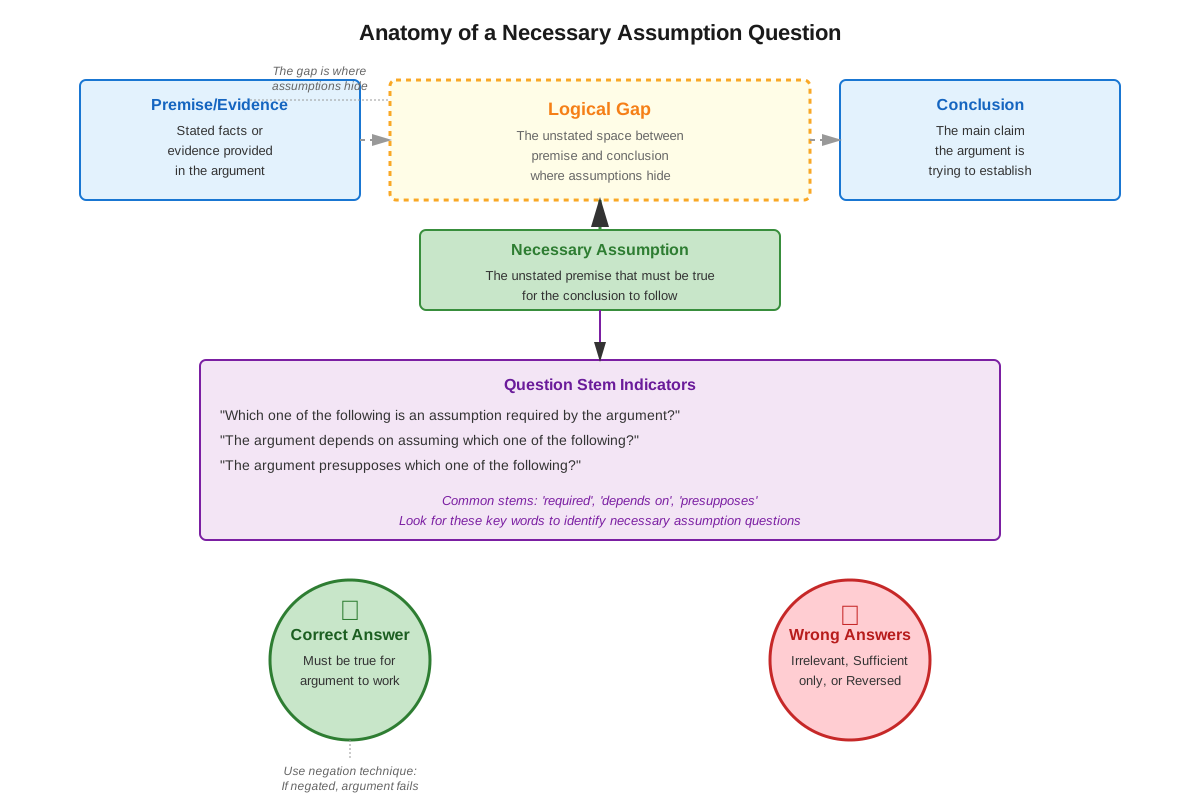
Necessary assumption stems are among the most frequently tested question types in the LSAT Logical Reasoning section, appearing in approximately 4-6 questions per test. These questions ask test-takers to identify an unstated premise that must be true for an argument's conclusion to follow logically from its evidence. Unlike sufficient assumptions (which guarantee the conclusion), necessary assumptions represent the minimum required support—if removed, the argument collapses entirely. Mastering necessary assumption identification is critical because these questions directly test the core skill the LSAT measures: the ability to analyze the logical structure of arguments and identify gaps between evidence and conclusions.
The challenge of assumption questions lies in recognizing what the argument takes for granted but never explicitly states. Every LSAT argument contains some logical gap—a leap from premises to conclusion that requires additional support. Necessary assumption questions specifically target these gaps, asking test-takers to identify which unstated premise the argument depends upon. The correct answer will always be something the author must believe to be true, even if unconsciously, for the argument to work. Understanding how to recognize and evaluate these assumptions is foundational to success across all Logical Reasoning question types.
Within the broader landscape of LSAT Logical Reasoning, necessary assumption questions connect intimately with strengthen, weaken, and flaw questions. All these question types require identifying the argument's vulnerable points—the places where the reasoning could break down. Necessary assumptions represent the "load-bearing walls" of arguments: remove them, and the entire logical structure fails. This makes them essential not only for answering assumption questions directly but also for understanding how arguments can be attacked or defended in other question types.
Learning Objectives
- [ ] Identify how necessary assumption stems appears in LSAT questions
- [ ] Explain the reasoning pattern behind necessary assumption stems
- [ ] Apply necessary assumption stems to solve LSAT-style problems accurately
- [ ] Distinguish necessary assumptions from sufficient assumptions in under 30 seconds
- [ ] Use the negation technique to verify necessary assumptions with 95%+ accuracy
- [ ] Recognize the five most common types of logical gaps that create necessary assumptions
- [ ] Eliminate wrong answer choices that are irrelevant, sufficient but not necessary, or reverse the logic
Prerequisites
- Basic argument structure: Understanding premises, conclusions, and inference patterns is essential because necessary assumptions fill gaps between these elements
- Conditional reasoning fundamentals: Recognizing "if-then" relationships helps identify when assumptions connect conditional statements
- Conclusion identification skills: Locating the main claim is required because necessary assumptions specifically support the conclusion
- Evidence evaluation: Distinguishing between stated evidence and unstated assumptions requires recognizing what the argument explicitly provides
Why This Topic Matters
Necessary assumption questions test the fundamental skill that underlies legal reasoning: identifying what must be true for an argument to hold together. In legal practice, attorneys constantly evaluate whether arguments rest on sound foundations or depend on questionable unstated premises. The ability to spot these hidden assumptions is crucial for constructing persuasive arguments and dismantling opposing ones. This skill extends beyond law to any field requiring critical analysis—business strategy, policy analysis, scientific reasoning, and everyday decision-making all benefit from the ability to identify unstated premises.
On the LSAT itself, necessary assumption questions appear with remarkable consistency. Test-takers can expect 4-6 necessary assumption questions per test, distributed across both Logical Reasoning sections. These questions carry the same weight as any other Logical Reasoning question (approximately 1 point each), but their frequency makes them high-yield study targets. More importantly, the skills developed through mastering necessary assumptions transfer directly to other question types: strengthen questions often present necessary assumptions as correct answers, weaken questions target them for attack, and flaw questions identify arguments that fail because necessary assumptions are questionable.
Common manifestations in LSAT passages include arguments about causation (assuming no alternative causes), arguments making recommendations (assuming the recommendation is feasible), arguments about comparisons (assuming the compared items are relevantly similar), and arguments using evidence from one context to draw conclusions about another (assuming the contexts are analogous). Recognizing these patterns allows test-takers to anticipate the types of assumptions likely to appear in answer choices.
Core Concepts
Defining Necessary Assumptions
A necessary assumption is an unstated premise that must be true for an argument's conclusion to be properly drawn from its evidence. The defining characteristic of necessary assumptions is that their negation destroys the argument—if a necessary assumption is false, the conclusion cannot logically follow from the premises. This distinguishes necessary assumptions from sufficient assumptions, which guarantee the conclusion but may provide more support than minimally required.
Consider this simple argument: "Sarah scored in the 99th percentile on the LSAT, so she will be admitted to a top law school." The necessary assumption here is that Sarah will apply to top law schools. If she doesn't apply, she cannot be admitted, regardless of her score. This assumption is necessary but not sufficient—applying doesn't guarantee admission, but not applying guarantees rejection.
Recognizing Necessary Assumption Question Stems
LSAT necessary assumption stems follow predictable patterns that signal the question type. The most common phrasings include:
- "Which one of the following is an assumption required by the argument?"
- "The argument depends on assuming which one of the following?"
- "The argument relies on which one of the following assumptions?"
- "Which one of the following is an assumption on which the argument depends?"
- "The conclusion follows logically if which one of the following is assumed?"
The key linguistic markers are words like "required," "depends," "relies," and "necessary." These contrast with sufficient assumption stems, which use language like "allows the conclusion to be properly drawn" or "enables the conclusion to be properly inferred." Recognizing these stem variations instantly helps test-takers activate the appropriate analytical framework.
The Negation Technique
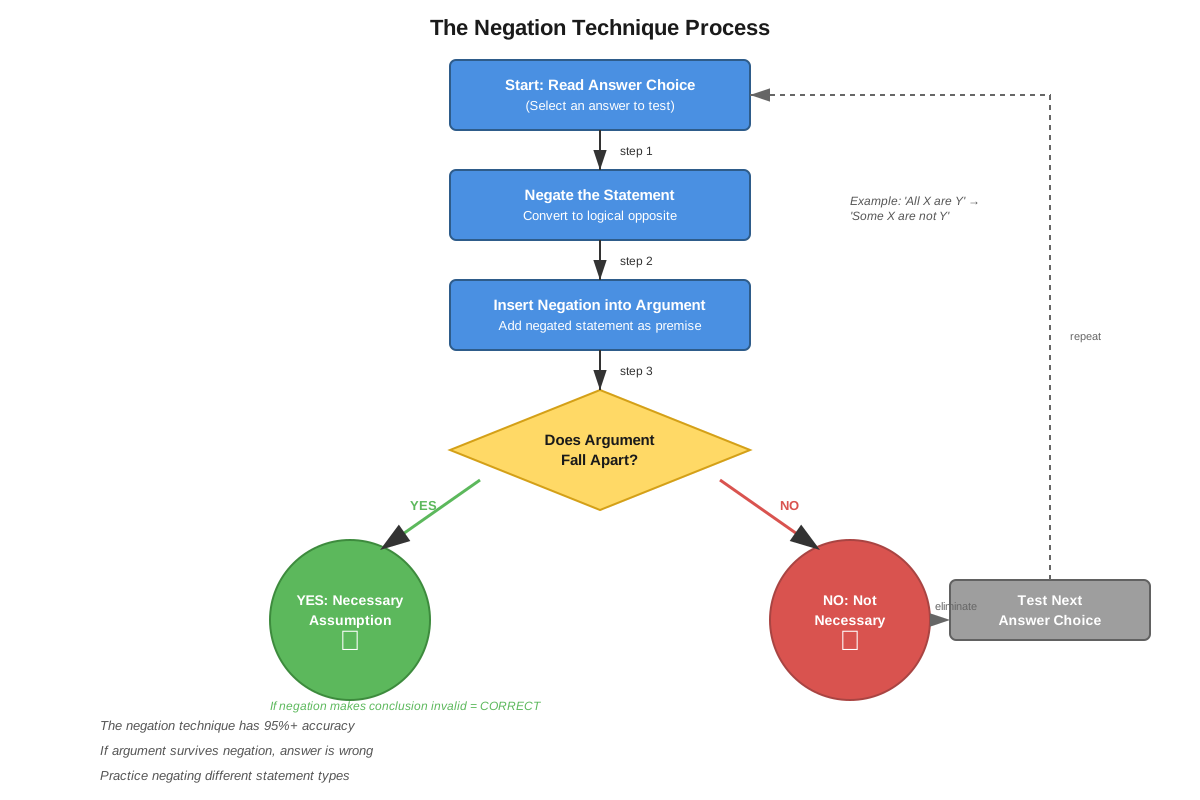
The most powerful tool for verifying necessary assumptions is the negation technique. This method involves negating the answer choice and asking whether the negated version destroys the argument. If negating an answer choice makes the argument fall apart, that choice states a necessary assumption. If the argument still works (or is unaffected) when the choice is negated, it's not necessary.
The negation technique works because of the logical definition of necessity: something is necessary if and only if its absence prevents the outcome. For LSAT purposes, this means:
- Take the answer choice
- Negate it (make it false, not just opposite)
- Ask: "Does this negation destroy the argument's reasoning?"
- If yes → necessary assumption; if no → eliminate
Important nuance: negating doesn't mean finding the extreme opposite. For "Some X are Y," the negation is "No X are Y" (not "All X are not Y"). For "Most X are Y," the negation is "Most X are not Y" or "Half or fewer X are Y."
Common Logical Gaps Creating Necessary Assumptions
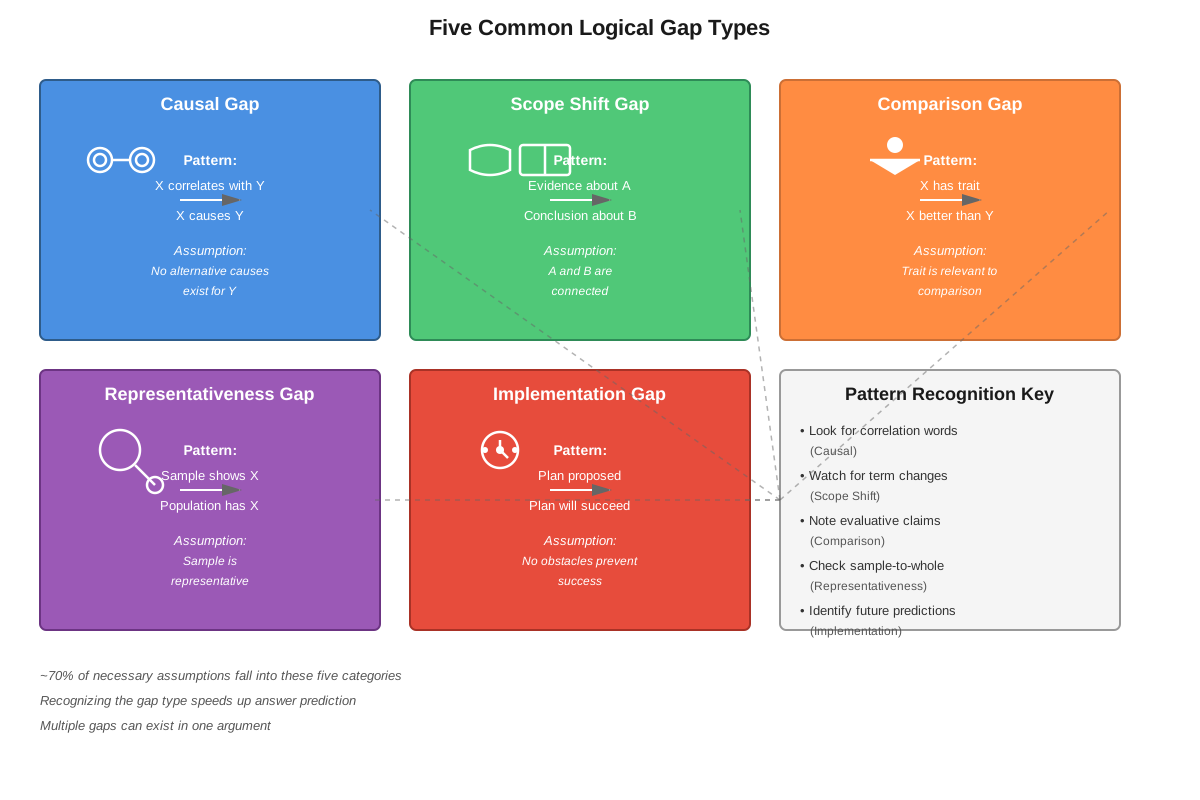
LSAT arguments exhibit recurring patterns of logical gaps that create necessary assumptions:
| Gap Type | Description | Example Assumption |
|---|---|---|
| Causal reasoning | Concludes X causes Y from correlation | No alternative causes exist |
| Representativeness | Applies sample data to broader population | Sample is representative |
| Comparison | Argues A is better/worse than B | A and B are comparable in relevant ways |
| Feasibility | Recommends a course of action | The action is possible to implement |
| Term shift | Uses different terms in premises vs. conclusion | The terms refer to the same thing |
| Temporal | Assumes past/present conditions continue | Relevant conditions haven't changed |
Term Shifts and Concept Matching
One of the most common sources of necessary assumptions is the term shift—when an argument uses one concept in the premises and a related but different concept in the conclusion. The argument must assume these concepts are connected in the relevant way.
Example: "This medication reduced symptoms in clinical trials. Therefore, patients should take this medication." The premises discuss "reducing symptoms" while the conclusion recommends action. The necessary assumption bridges this gap: that reducing symptoms is a sufficient reason to recommend the medication (i.e., the benefits outweigh risks, costs are reasonable, etc.).
Recognizing term shifts requires careful attention to the precise language used in premises versus conclusions. Even subtle shifts—from "popular" to "high quality," from "economically beneficial" to "should be implemented," from "correlated with" to "causes"—create logical gaps requiring assumptions.
Scope Limitations
Arguments often make claims about a specific scope while relying on evidence from a different scope. Necessary assumptions must bridge these scope gaps. Common scope issues include:
- Temporal scope: Evidence from the past applied to the future (assumes conditions remain similar)
- Geographic scope: Evidence from one location applied to another (assumes relevant similarity)
- Population scope: Evidence about one group applied to another (assumes groups are comparable)
- Contextual scope: Evidence from one situation applied to another (assumes contexts are analogous)
Distinguishing Necessary from Sufficient Assumptions
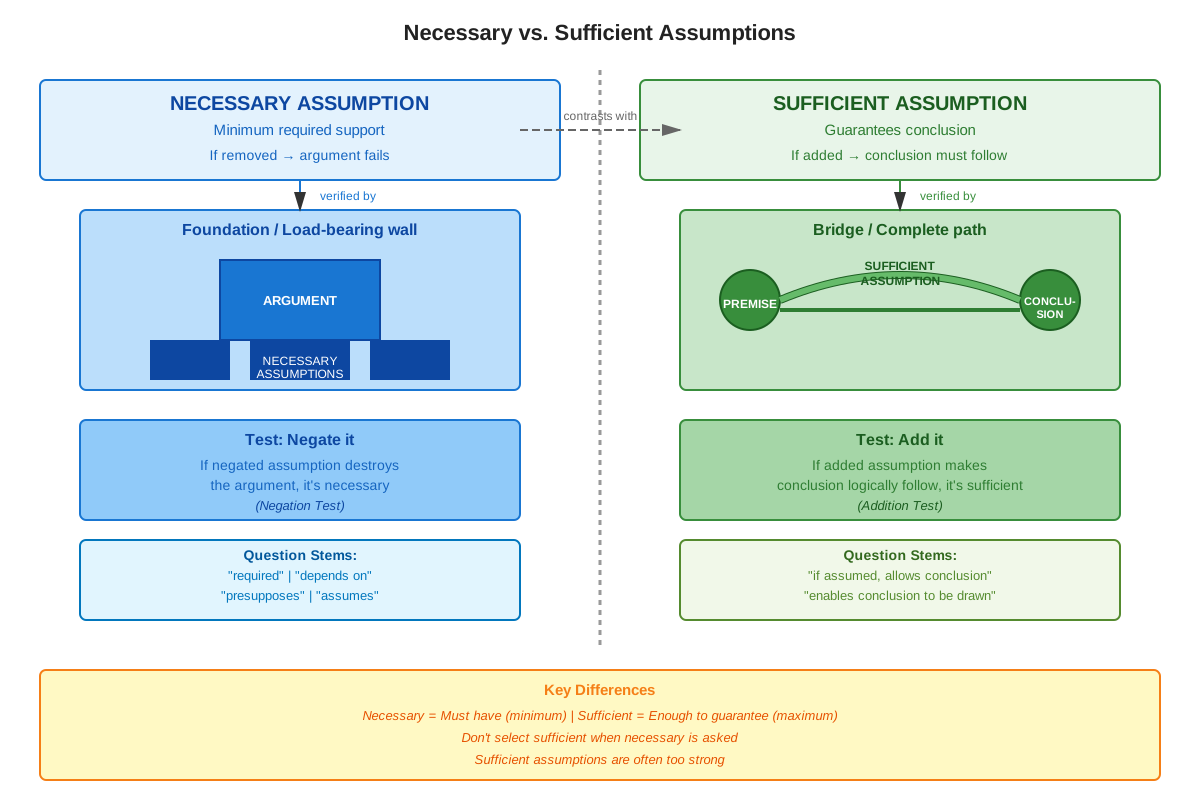
Understanding the necessary/sufficient distinction is crucial for avoiding trap answers:
Necessary assumptions are minimally required—they must be true, but alone may not guarantee the conclusion. They represent the "floor" of what the argument needs.
Sufficient assumptions guarantee the conclusion—they provide enough support that the conclusion must follow. They represent the "ceiling" of complete logical support.
On necessary assumption questions, sufficient assumptions are often wrong answers because they provide more than required. The correct answer will be the minimum needed, not the maximum possible.
Concept Relationships
The concepts within necessary assumption questions form an interconnected analytical framework. Necessary assumption stems signal the question type → which activates the search for logical gaps in the argument → which are identified through careful analysis of term shifts and scope limitations → which generate predictions about what the assumption must address → which are verified using the negation technique.
This topic connects backward to prerequisite knowledge of argument structure: identifying premises and conclusions is the first step before analyzing what assumptions connect them. It connects forward to strengthen/weaken questions: necessary assumptions, when stated, strengthen arguments; when shown to be false, they weaken arguments. Flaw questions often identify problematic necessary assumptions—assumptions that are questionable or unlikely to be true.
The relationship map flows as follows:
Argument Structure Analysis → Identify Conclusion and Evidence → Spot Logical Gaps (term shifts, scope issues, causal leaps) → Predict Assumption Type → Evaluate Answer Choices → Verify with Negation Technique → Select Necessary Assumption
High-Yield Facts
⭐ Necessary assumptions must be true for the conclusion to follow; if negated, they destroy the argument
⭐ The negation technique is the most reliable verification method: negate the answer choice and check if the argument falls apart
⭐ Common stem language includes "required," "depends on," "relies on," and "assumption on which the argument depends"
⭐ Term shifts between premises and conclusion create logical gaps requiring assumptions to bridge them
⭐ Necessary assumptions are minimally sufficient—they provide just enough support, not more than needed
- Causal arguments assume no alternative explanations exist for the observed effect
- Comparison arguments assume the compared items are similar in relevant respects
- Recommendation arguments assume the recommended action is feasible and desirable
- Arguments using samples assume the sample is representative of the population
- Arguments applying past evidence to future situations assume relevant conditions remain constant
- Sufficient assumptions are often wrong answers on necessary assumption questions because they provide more support than minimally required
- Irrelevant answer choices may be true but don't affect whether the conclusion follows from the premises
- Necessary assumptions are always unstated—if explicitly stated in the stimulus, they're premises, not assumptions
- The correct answer will make the argument work better but won't necessarily make it perfect
- Extreme language in answer choices often signals wrong answers unless the argument itself uses extreme language
Quick check — test yourself on Necessary assumption stems so far.
Try Flashcards →Common Misconceptions
Misconception: Necessary assumptions must make the argument completely valid and airtight. → Correction: Necessary assumptions only need to be minimally required for the argument to work as presented. The argument may still have other weaknesses even with the necessary assumption in place. The assumption fills one logical gap but doesn't necessarily make the argument perfect.
Misconception: If an answer choice strengthens the argument, it must be a necessary assumption. → Correction: Many statements strengthen arguments without being necessary. A necessary assumption is specifically something the argument requires—its negation must destroy the argument. Use the negation technique to distinguish necessary assumptions from mere strengtheners.
Misconception: The negation of a statement is always its extreme opposite. → Correction: Negation means making the statement false, not finding its polar opposite. For "Some doctors recommend this treatment," the negation is "No doctors recommend this treatment," not "All doctors oppose this treatment." For "Most voters support the policy," the negation is "Most voters don't support it" or "Half or fewer support it."
Misconception: Necessary assumptions must be explicitly related to every premise in the argument. → Correction: Necessary assumptions specifically connect the evidence to the conclusion. They bridge the logical gap between what's stated and what's concluded. They don't need to relate to every piece of evidence—only to the reasoning structure that leads to the conclusion.
Misconception: If an answer choice seems obviously true or like common sense, it can't be the necessary assumption. → Correction: Necessary assumptions are often unstated precisely because they seem obvious to the argument's author. The LSAT tests whether you can identify these taken-for-granted premises. Don't eliminate answer choices because they seem too simple or obvious—verify them with the negation technique instead.
Worked Examples
Example 1: Causal Reasoning Gap
Stimulus: "Since the new traffic light was installed at the intersection of Main and Oak Streets, the number of accidents there has decreased by 40%. Therefore, the traffic light has made the intersection safer."
Question: Which one of the following is an assumption on which the argument depends?
Analysis:
Step 1 - Identify the conclusion: The traffic light has made the intersection safer.
Step 2 - Identify the evidence: Accidents decreased by 40% after the light was installed.
Step 3 - Spot the logical gap: This is a classic causal reasoning gap. The argument observes a correlation (light installed → accidents decreased) and concludes causation (light caused the decrease). What's missing? The argument assumes no other factors caused the decrease.
Step 4 - Predict the assumption: The argument must assume that something else didn't cause the accident reduction. It needs to rule out alternative explanations.
Step 5 - Evaluate answer choices:
(A) "The intersection of Main and Oak Streets had more accidents than other intersections before the light was installed." → Not necessary. The argument is about whether the light caused the decrease, not about how this intersection compared to others. Negation: Even if this intersection had fewer accidents than others, the light could still have caused the decrease here.
(B) "No other significant changes that would affect safety occurred at the intersection during the same period." → This looks necessary. Let's negate it: "Other significant changes that would affect safety DID occur at the intersection during the same period." If true, this destroys the argument—we couldn't conclude the light caused the decrease because other factors might be responsible.
(C) "Traffic lights are generally effective at reducing accidents at intersections." → Not necessary. The argument is about this specific light at this specific intersection. Negation: Even if traffic lights generally aren't effective, this particular one could still have caused this particular decrease.
(D) "The 40% decrease in accidents represents a statistically significant change." → Not necessary for the basic logical structure. The argument takes the 40% decrease as given. Whether it's statistically significant doesn't affect whether the light caused it.
(E) "The traffic light will continue to reduce accidents in the future." → Not necessary. The conclusion is about whether the light has made (past tense) the intersection safer, not about future effects.
Answer: (B)
Connection to learning objectives: This example demonstrates identifying the necessary assumption stem ("assumption on which the argument depends"), explaining the causal reasoning pattern, and applying the negation technique to verify the correct answer.
Example 2: Term Shift Gap
Stimulus: "The Riverside Museum's new exhibit has attracted more visitors than any previous exhibit. The museum director concluded that the new exhibit is the most successful exhibit in the museum's history."
Question: The director's conclusion depends on assuming which one of the following?
Analysis:
Step 1 - Identify the conclusion: The new exhibit is the most successful exhibit in the museum's history.
Step 2 - Identify the evidence: The new exhibit attracted more visitors than any previous exhibit.
Step 3 - Spot the logical gap: This is a term shift. The evidence is about "visitors" (quantity), but the conclusion is about "success" (quality/value). The argument assumes these concepts are connected—that visitor numbers determine success.
Step 4 - Predict the assumption: The argument must assume that success is measured by (or at least correlates with) visitor numbers. It needs to connect the quantitative measure (visitors) to the qualitative judgment (success).
Step 5 - Evaluate answer choices:
(A) "The new exhibit cost no more to create than previous exhibits." → Not necessary. Even if it cost more, it could still be most successful if success is measured by visitors. Negation: Even if it cost much more, the conclusion about success could still follow if success means attracting visitors.
(B) "Visitor numbers are a reliable indicator of an exhibit's success." → This looks necessary. Let's negate it: "Visitor numbers are NOT a reliable indicator of an exhibit's success." If true, this destroys the argument—we couldn't conclude the exhibit is most successful just because it had the most visitors.
(C) "The museum has been tracking visitor numbers for all its exhibits." → Not necessary. The argument already states this exhibit had more visitors than any previous exhibit, implying comparison was possible. This is already given in the evidence.
(D) "Visitors to the new exhibit were more satisfied than visitors to previous exhibits." → Not necessary. The argument doesn't mention satisfaction—only visitor numbers. This would be relevant if the argument defined success in terms of satisfaction, but it doesn't.
(E) "The new exhibit will continue to attract high visitor numbers." → Not necessary. The conclusion is about whether it IS (present tense) the most successful, based on what has already happened, not about future performance.
Answer: (B)
Connection to learning objectives: This example illustrates identifying term shifts as a reasoning pattern, recognizing how necessary assumptions bridge conceptual gaps, and applying the negation technique to distinguish necessary from unnecessary answer choices.
Exam Strategy
When approaching necessary assumption questions on the LSAT, follow this systematic process:
Step 1 - Recognize the question type immediately (5 seconds): Scan for trigger words like "required," "depends," "relies," or "assumption on which the argument depends." This activates the necessary assumption framework.
Step 2 - Identify the conclusion precisely (10 seconds): Underline or mentally note the exact conclusion. Necessary assumptions specifically support the conclusion, so knowing exactly what's being concluded is essential.
Step 3 - Identify the evidence (10 seconds): Note what premises the argument provides. Understanding what IS stated helps identify what ISN'T stated but is needed.
Step 4 - Spot the logical gap (15 seconds): Ask yourself: "What's the leap from evidence to conclusion?" Look for term shifts, scope changes, causal reasoning, comparisons, or feasibility issues. This is where the assumption will live.
Step 5 - Predict the assumption (10 seconds): Before looking at answer choices, articulate what the argument must assume. Even a rough prediction helps avoid trap answers.
Step 6 - Evaluate answer choices with negation (60-90 seconds): For each answer choice, negate it and ask whether the negation destroys the argument. Eliminate choices whose negation leaves the argument intact.
Exam Tip: If you're stuck between two answer choices, the negation technique is decisive. The choice whose negation more severely damages the argument is the necessary assumption.
Trigger phrases to watch for in answer choices:
- Defender assumptions: "No alternative explanation exists," "No other factor contributed," "Nothing else caused"—these defend against alternative explanations
- Connector assumptions: "X is related to Y," "X indicates Y," "X is a measure of Y"—these bridge term shifts
- Feasibility assumptions: "It is possible to," "X can be done," "No obstacles prevent"—these support recommendations
- Scope assumptions: "The same is true of," "X applies to Y," "Conditions remain similar"—these justify scope extensions
Process of elimination tips:
- Eliminate answer choices that are irrelevant—they might be true but don't affect whether the conclusion follows
- Eliminate answer choices that are sufficient but not necessary—they guarantee the conclusion but provide more than minimally required
- Eliminate answer choices that reverse the logic—they state the opposite of what the argument needs
- Eliminate answer choices that address premises rather than the conclusion—necessary assumptions connect evidence to conclusion
- Eliminate answer choices that are too extreme unless the argument itself uses extreme language
Time allocation: Spend approximately 1:30-2:00 minutes per necessary assumption question. These questions reward careful analysis more than speed. If you're consistently taking longer than 2 minutes, focus on faster conclusion identification and gap recognition.
Memory Techniques
NEGATION mnemonic for the verification technique:
- Note the answer choice
- Eliminate the statement (make it false)
- Gauge the argument's survival
- Argument destroyed? → Necessary
- Test remains standing? → Not necessary
- If uncertain, try another choice
- Only one will collapse the argument
- Necessary assumption found!
GAPS acronym for common logical gaps:
- Generalization (sample to population)
- Alternative causes (causal reasoning)
- Possibility/feasibility (recommendations)
- Scope shifts (term changes, context changes)
Visualization strategy: Picture the argument as a bridge from premises (one side) to conclusion (other side). The necessary assumption is a support beam—remove it, and the bridge collapses. This mental image reinforces that necessary assumptions are structural requirements, not decorative additions.
The "Must Be True" test: Rephrase the question as "What must the author believe for this argument to work?" This helps distinguish necessary assumptions from strengtheners or background information.
Comparison table to memorize:
| Necessary Assumption | Sufficient Assumption |
|---|---|
| Minimally required | Guarantees conclusion |
| If false → argument fails | If true → conclusion must follow |
| "Depends on" | "Allows to be properly drawn" |
| Floor of support | Ceiling of support |
| Often seems obvious | Often seems strong |
Summary
Necessary assumption questions test the ability to identify unstated premises that arguments require to function logically. These questions appear 4-6 times per LSAT and are identifiable through stems containing words like "required," "depends," or "relies." The core skill involves recognizing logical gaps—places where the argument leaps from evidence to conclusion without explicit support. Common gaps include causal reasoning (assuming no alternative causes), term shifts (assuming different concepts are connected), scope changes (assuming contexts are comparable), and feasibility issues (assuming recommendations are possible). The negation technique provides the most reliable verification method: negate the answer choice and determine whether the negation destroys the argument. If it does, the choice states a necessary assumption; if the argument survives, eliminate that choice. Mastering necessary assumptions requires distinguishing them from sufficient assumptions (which provide more support than minimally required) and from mere strengtheners (which help but aren't required). Success on these questions translates directly to improved performance on strengthen, weaken, and flaw questions, making necessary assumption mastery a high-yield investment of study time.
Key Takeaways
- Necessary assumptions are unstated premises that must be true for an argument's conclusion to follow from its evidence—their negation destroys the argument
- Recognize necessary assumption questions through stem language: "required," "depends on," "relies on," or "assumption on which the argument depends"
- The negation technique is the gold standard for verification: negate the answer choice and check if the argument collapses
- Common logical gaps include causal reasoning, term shifts, scope changes, and feasibility issues—learn to spot these patterns quickly
- Necessary assumptions provide minimal support (the floor), while sufficient assumptions guarantee conclusions (the ceiling)—don't choose answers that provide more than necessary
- Use systematic analysis: identify conclusion → identify evidence → spot the gap → predict the assumption → verify with negation
- These questions appear 4-6 times per test and connect directly to strengthen, weaken, and flaw questions, making them essential for overall Logical Reasoning success
Related Topics
Sufficient Assumption Questions: These questions ask for premises that, if true, would guarantee the conclusion. Mastering necessary assumptions provides the foundation for understanding sufficient assumptions, as the distinction between minimal requirement and complete guarantee is crucial for both question types.
Strengthen Questions: Many strengthen questions present necessary assumptions as correct answers. Understanding what arguments require helps identify which additional premises would most effectively support them.
Weaken Questions: These questions often attack necessary assumptions by showing them to be false or questionable. Recognizing necessary assumptions helps predict how arguments can be undermined.
Flaw Questions: Many flaws involve problematic necessary assumptions—assumptions that are questionable, unlikely, or unjustified. Identifying necessary assumptions is the first step toward recognizing when arguments depend on shaky foundations.
Conditional Reasoning: Advanced necessary assumption questions often involve conditional statements. Understanding how necessary and sufficient conditions work in formal logic deepens mastery of assumption questions.
Practice CTA
Now that you understand the mechanics of necessary assumption questions, it's time to apply these concepts to actual LSAT problems. The practice questions and flashcards will reinforce your ability to recognize question stems, identify logical gaps, and verify assumptions using the negation technique. Remember: necessary assumption questions reward systematic analysis more than intuition. Trust the process, use the negation technique consistently, and you'll see your accuracy improve dramatically. Each practice question is an opportunity to strengthen the neural pathways that make gap recognition and assumption identification automatic. You've built the foundation—now build the skill through deliberate practice!
Sign up free to keep reading
Create a free AnvayaPrep account to finish this LSAT guide on Necessary assumption stems — plus flashcards and practice questions.