Overview
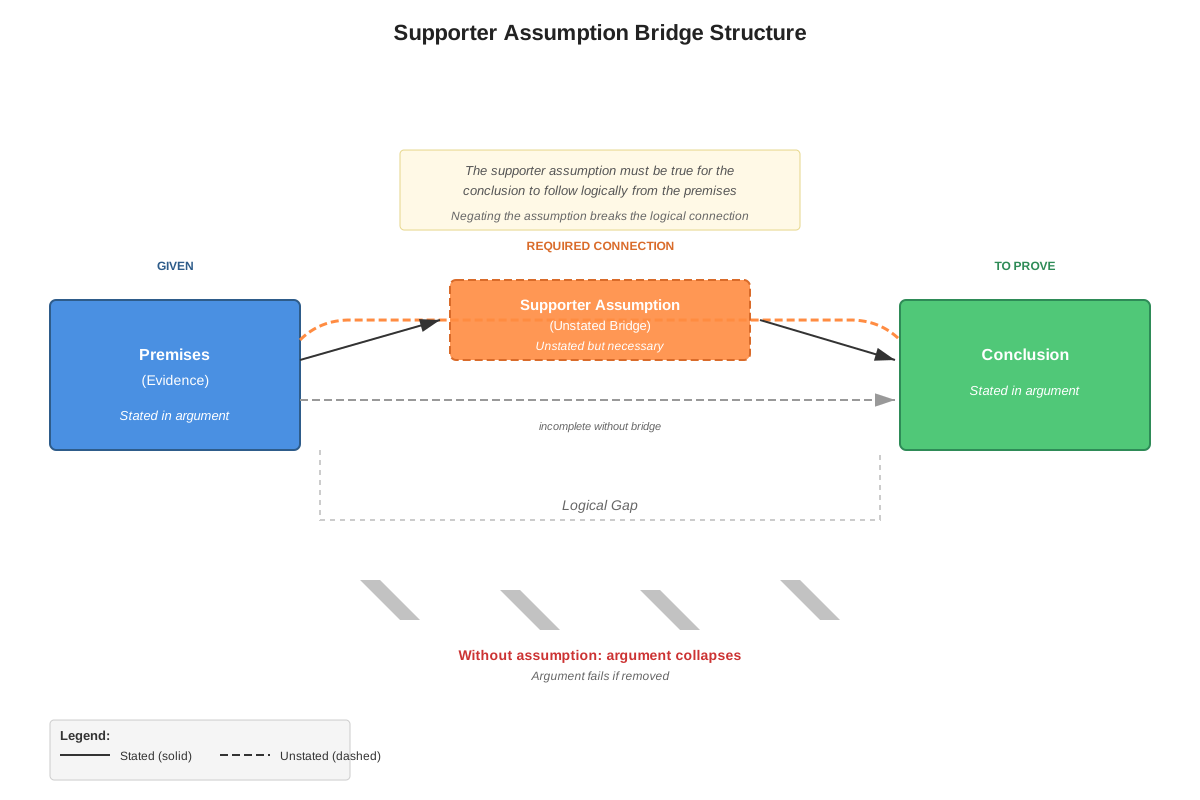
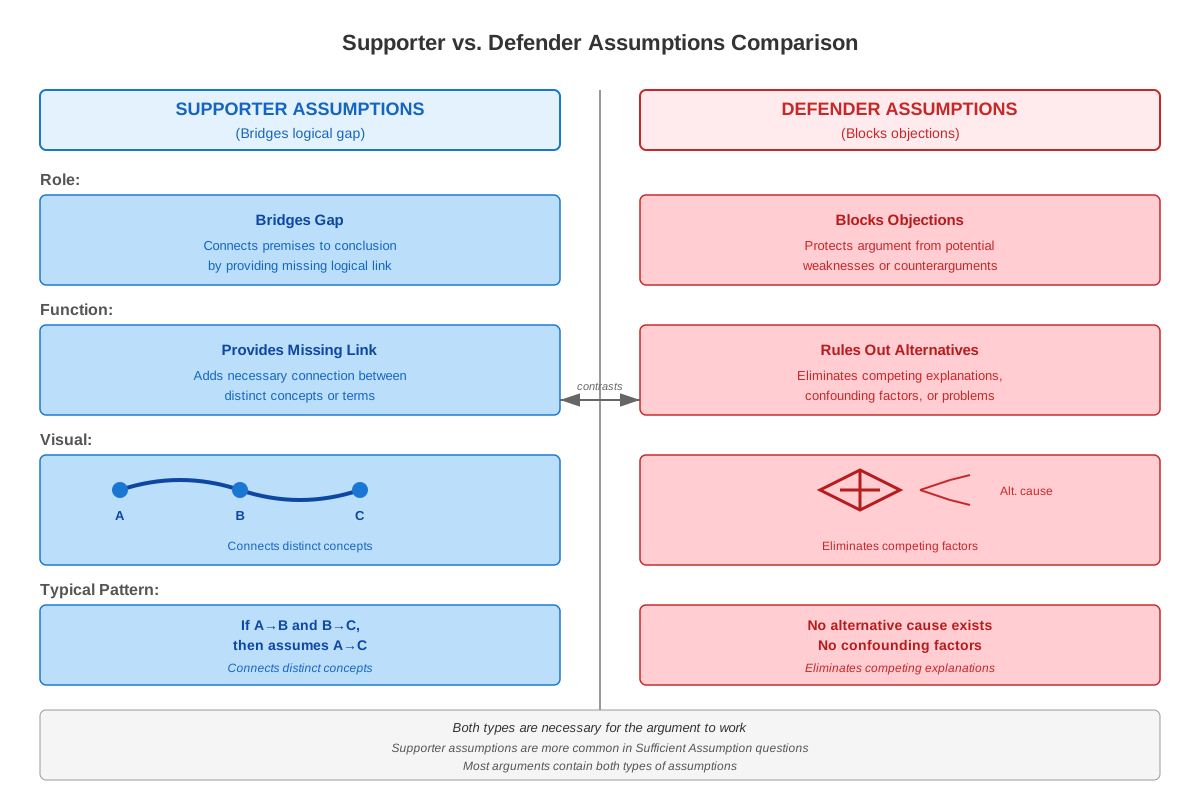
Supporter assumptions represent one of the two fundamental categories of assumptions tested in LSAT Logical Reasoning sections. These assumptions function as essential bridges that connect an argument's evidence to its conclusion, filling logical gaps that the author has left unstated. Unlike defender assumptions (which protect arguments from potential objections), supporter assumptions actively strengthen the logical connection by providing missing pieces of reasoning that must be true for the argument to hold together.
Understanding supporter assumptions is critical for LSAT success because they appear frequently across multiple question types, including Necessary Assumption questions, Sufficient Assumption questions, and Strengthen questions. The LSAT tests whether students can identify what an argument takes for granted—the unstated premises that must exist for the reasoning to be valid. Mastering this skill requires recognizing the gap between what evidence is presented and what conclusion is drawn, then identifying precisely what missing link would complete that logical chain.
Within the broader landscape of assumption questions, supporter assumptions form the foundation for understanding how arguments are constructed and what makes them vulnerable to criticism. This topic connects directly to argument structure analysis, conditional reasoning, and the ability to evaluate logical sufficiency. Students who excel at identifying supporter assumptions develop a sophisticated understanding of how premises relate to conclusions, which enhances performance not only on assumption questions but also on Strengthen, Weaken, and Flaw questions throughout the Logical Reasoning sections.
Learning Objectives
- [ ] Identify how Supporter assumptions appears in LSAT questions
- [ ] Explain the reasoning pattern behind Supporter assumptions
- [ ] Apply Supporter assumptions to solve LSAT-style problems accurately
- [ ] Distinguish between supporter assumptions and defender assumptions in argument analysis
- [ ] Recognize the specific gap between premises and conclusion that a supporter assumption fills
- [ ] Evaluate answer choices using the negation technique to test necessity
- [ ] Predict supporter assumptions before reviewing answer choices to improve accuracy and speed
Prerequisites
- Basic argument structure: Understanding premises, conclusions, and how to identify each component is essential because supporter assumptions connect these elements
- Conditional reasoning fundamentals: Recognizing sufficient and necessary conditions helps identify what must be true for conclusions to follow from premises
- Argument analysis skills: The ability to separate what is stated from what is assumed allows students to locate the gaps that supporter assumptions fill
- Question stem recognition: Distinguishing between different Logical Reasoning question types ensures appropriate strategy application
Why This Topic Matters
Supporter assumptions represent approximately 15-20% of all Logical Reasoning questions on the LSAT, making them one of the highest-yield topics for score improvement. These questions appear primarily as Necessary Assumption questions (which ask what the argument requires) and Sufficient Assumption questions (which ask what would guarantee the conclusion). Additionally, understanding supporter assumptions enhances performance on Strengthen questions, since the correct answer often explicitly states an assumption the argument depends upon.
In real-world contexts, identifying supporter assumptions is fundamental to critical thinking and persuasive communication. Legal reasoning—the core skill the LSAT measures—constantly requires recognizing unstated premises in arguments, whether analyzing case law, constructing legal arguments, or identifying weaknesses in opposing counsel's reasoning. Attorneys must identify what assumptions underlie judicial opinions, statutory interpretations, and factual claims to build effective legal strategies.
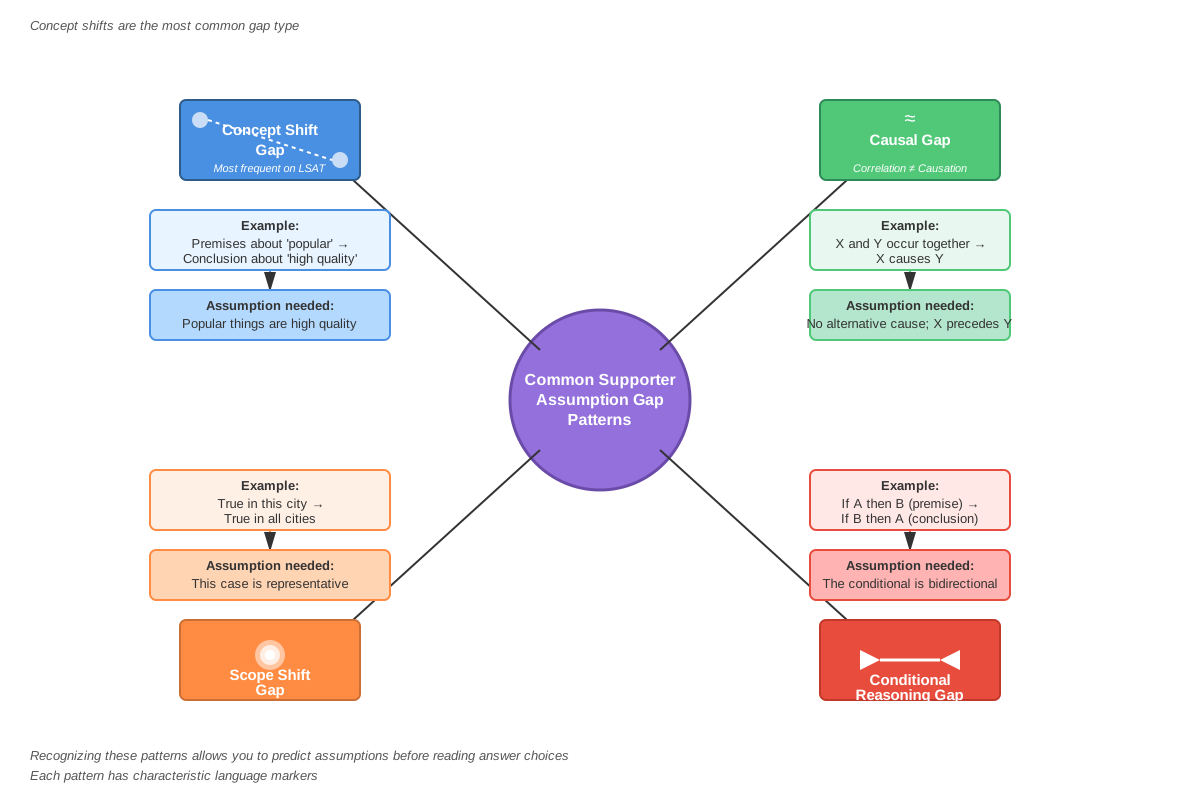
On the LSAT, supporter assumptions most commonly appear in arguments that make logical leaps between evidence and conclusion. Typical patterns include: arguments that shift terminology between premise and conclusion, arguments that move from correlation to causation, arguments that generalize from limited samples, arguments that assume representativeness of data, and arguments that rely on plans or predictions working as intended. Recognizing these patterns allows students to anticipate the type of assumption needed before examining answer choices, dramatically improving both accuracy and speed.
Core Concepts
What Are Supporter Assumptions?
Supporter assumptions are unstated premises that must be true for an argument's conclusion to follow logically from its stated evidence. These assumptions "support" the argument by bridging gaps in reasoning—they provide the missing logical links that connect what the author says (premises) to what the author concludes. Every LSAT argument with a supporter assumption contains a logical gap: the conclusion goes beyond what the premises strictly establish, and the assumption fills that gap.
The defining characteristic of supporter assumptions is their necessity: if the assumption is false, the argument falls apart. This necessity distinguishes assumptions from mere strengtheners. While many statements might make an argument stronger, only assumptions are required for the argument to work at all. The negation test exploits this property: negating a true assumption should destroy the argument's logical force.
The Anatomy of Arguments with Supporter Assumptions
LSAT arguments requiring supporter assumptions follow a predictable structure:
- Premise(s): Evidence or facts the argument presents as given
- Logical Gap: An unstated connection or missing piece of reasoning
- Conclusion: A claim that goes beyond what the premises alone establish
- Supporter Assumption: The unstated premise that bridges the gap
Consider this structure in action:
Premise: "Sales of electric vehicles increased 40% last year."
Conclusion: "Therefore, consumer concern about climate change is growing."
The logical gap here is obvious: the premise discusses vehicle sales, while the conclusion addresses consumer motivations. The supporter assumption must connect these concepts: "The increase in electric vehicle sales was driven primarily by climate change concerns rather than other factors (cost, performance, convenience, etc.)."
Types of Supporter Assumptions
Concept Shift Assumptions
The most common supporter assumptions address concept shifts—situations where the conclusion introduces terms, ideas, or categories not present in the premises. The assumption must establish that the premise-concept relates to the conclusion-concept in the way the argument requires.
Pattern: Premise discusses X → Conclusion discusses Y → Assumption: X relates to Y in the relevant way
Example:
- Premise: "The new policy reduced workplace accidents by 30%"
- Conclusion: "The new policy improved worker safety"
- Assumption: "Reducing accidents constitutes improving safety" (connects the concepts)
Representativeness Assumptions
Arguments that generalize from samples to populations, or from past to future, require representativeness assumptions—unstated premises that the sample/past case is relevantly similar to the broader group/future situation.
Pattern: Evidence about specific case(s) → Conclusion about broader category → Assumption: The specific case(s) are representative
Example:
- Premise: "In three pilot cities, the program reduced homelessness"
- Conclusion: "The program will reduce homelessness nationally"
- Assumption: "The pilot cities are representative of national conditions" or "No relevant differences exist between pilot cities and other locations"
Causal Assumptions
When arguments conclude that X causes Y based on correlation or temporal sequence, they assume away alternative explanations. The causal assumption states that the observed relationship reflects genuine causation rather than coincidence, reverse causation, or common cause.
Pattern: X and Y are correlated → X causes Y → Assumption: The correlation reflects causation (not other relationships)
Example:
- Premise: "Countries with higher chocolate consumption have more Nobel laureates"
- Conclusion: "Chocolate consumption increases cognitive ability leading to Nobel prizes"
- Assumption: "The correlation isn't due to a third factor (wealth, education systems) that causes both"
Plan/Prediction Assumptions
Arguments about future plans or predictions assume that conditions will remain stable, that no obstacles will interfere, and that the plan will be implemented as intended. These feasibility assumptions are essential for any argument projecting current evidence into future outcomes.
Pattern: Current evidence + Plan → Predicted outcome → Assumption: Conditions allow the plan to work as intended
Example:
- Premise: "The new software reduced processing time in testing"
- Conclusion: "Implementing this software will improve our efficiency"
- Assumption: "The testing environment reflects actual conditions" and "No implementation obstacles will prevent the software from working similarly"
Identifying the Gap: The Core Skill
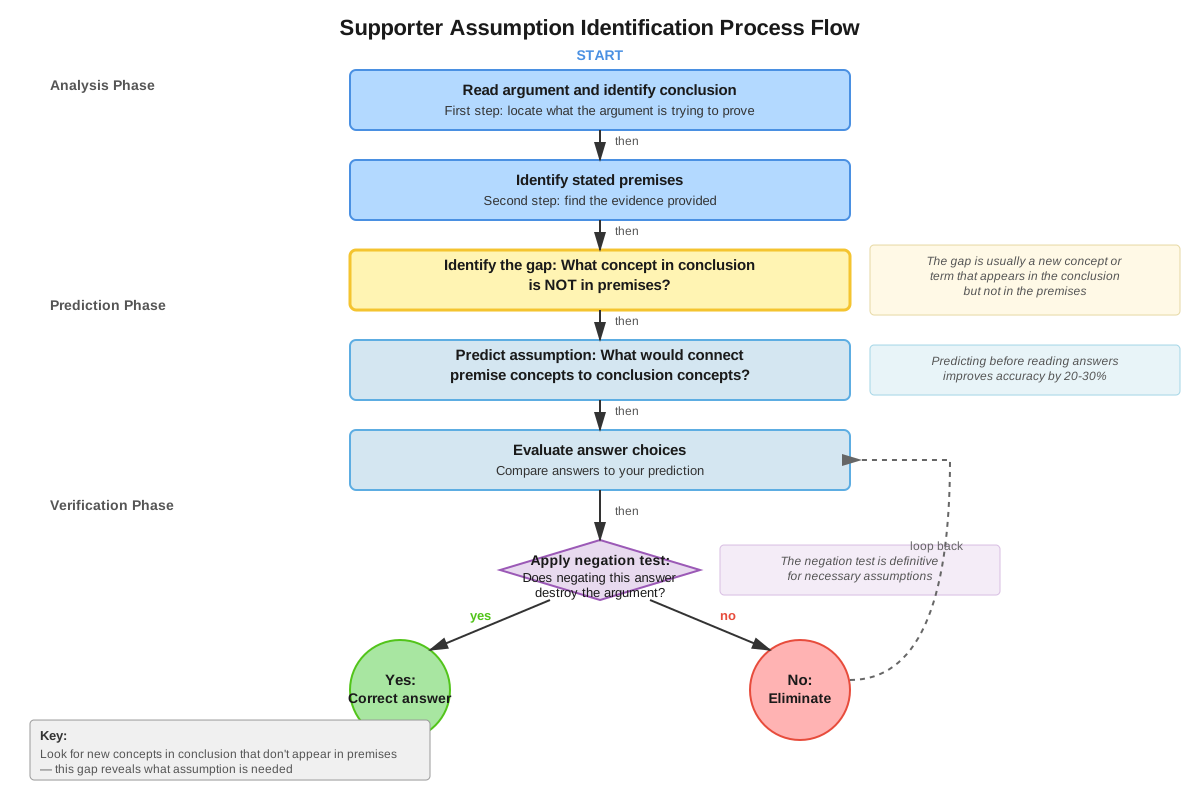
The key to finding supporter assumptions is gap identification—systematically comparing premises to conclusion to locate what's missing. Use this process:
- Identify the conclusion: What is the argument trying to prove?
- Identify the premises: What evidence supports this conclusion?
- Compare terms and concepts: What appears in the conclusion but not in the premises?
- Identify the logical leap: What must be true to get from the evidence to the conclusion?
- Articulate the gap: State in your own words what's missing
This process transforms assumption questions from guessing games into systematic analysis. Students who practice gap identification can often predict the correct answer before reading the choices, dramatically improving accuracy.
The Negation Test
The negation test is the gold standard for verifying supporter assumptions. Because assumptions are necessary for arguments, negating a true assumption should severely weaken or destroy the argument. To apply the negation test:
- Take the statement you're testing
- Negate it (make it false, not just opposite)
- Ask: "Does this negation destroy the argument?"
- If yes, it's a necessary assumption; if no, it's not
Important: Negation means "make false," not "make opposite." The negation of "All X are Y" is "Not all X are Y" (some aren't), not "No X are Y" (none are).
Concept Relationships
Supporter assumptions form the foundation of a hierarchy of Logical Reasoning concepts. At the base level, argument structure analysis enables students to identify premises and conclusions—the essential first step before locating assumptions. Supporter assumptions then build on this foundation by addressing the logical gaps between premises and conclusions.
The relationship flows as follows:
Argument Structure → Gap Identification → Supporter Assumptions → Assumption Question Types
Within supporter assumptions themselves, the various types (concept shift, representativeness, causal, plan/prediction) represent different manifestations of the same underlying principle: conclusions require unstated premises to follow from stated evidence. These types aren't mutually exclusive—complex arguments may contain multiple gaps requiring multiple assumptions.
Supporter assumptions connect directly to defender assumptions (the other major assumption category) through contrast: while supporter assumptions actively bridge gaps, defender assumptions protect arguments from potential objections. Together, these categories encompass all assumption questions on the LSAT.
The mastery of supporter assumptions enables progression to more advanced topics: Sufficient Assumption questions (which ask for assumptions that guarantee conclusions), Strengthen questions (which often present assumptions explicitly), and Flaw questions (which identify failures to establish necessary assumptions). Understanding what assumptions arguments require illuminates what makes arguments vulnerable to criticism.
High-Yield Facts
⭐ Supporter assumptions are necessary premises that must be true for an argument's conclusion to follow from its stated evidence
⭐ The most common supporter assumption pattern involves concept shifts—when the conclusion introduces terms not present in the premises
⭐ The negation test definitively identifies necessary assumptions: negating a true assumption should destroy the argument
⭐ Supporter assumptions fill logical gaps; they don't merely strengthen arguments but are required for arguments to work
⭐ Necessary Assumption questions explicitly test supporter assumptions, typically using stems like "assumes," "depends on," or "requires"
- Representativeness assumptions are required whenever arguments generalize from samples to populations or from past to future
- Causal arguments assume away alternative explanations for observed correlations or temporal sequences
- Plan and prediction arguments assume feasibility—that conditions will allow the plan to work as intended
- Correct assumption answers often seem obvious or underwhelming because they state what the argument takes for granted
- Incorrect answers on assumption questions often strengthen the argument without being necessary, or address issues irrelevant to the specific gap
- The gap between premises and conclusion determines what assumption is needed; different gaps require different assumptions
- Supporter assumptions can be tested by asking: "Could the premises be true, this statement false, and the conclusion still follow?"
- Arguments may contain multiple assumptions, but LSAT questions typically focus on the most significant gap
- Conditional reasoning often appears in supporter assumptions, particularly in Sufficient Assumption questions
- Time pressure makes pre-phrasing assumptions (predicting the answer before reading choices) especially valuable for efficiency
Quick check — test yourself on Supporter assumptions so far.
Try Flashcards →Common Misconceptions
Misconception: Any statement that strengthens an argument is an assumption the argument makes.
Correction: Assumptions must be necessary, not merely helpful. Many statements strengthen arguments without being required. The negation test distinguishes true assumptions (whose negation destroys the argument) from mere strengtheners (whose negation only weakens it).
Misconception: The correct answer to an assumption question should provide strong, obvious support for the conclusion.
Correction: Assumptions often seem minimal or underwhelming because they state what the argument already takes for granted. The correct answer fills the specific gap in reasoning, which may be a subtle connection rather than dramatic support.
Misconception: Negating a statement means stating its opposite.
Correction: Logical negation means making a statement false, not necessarily opposite. "All X are Y" negates to "Not all X are Y" (at least one X is not Y), not to "No X are Y" (the opposite extreme). Proper negation is essential for the negation test.
Misconception: Supporter assumptions and defender assumptions are interchangeable terms for the same concept.
Correction: These are distinct assumption types. Supporter assumptions actively bridge gaps between premises and conclusions, while defender assumptions protect arguments from potential objections or alternative explanations. Different question types target different assumption categories.
Misconception: If an answer choice is true in the real world, it must be the correct assumption.
Correction: Assumption questions test logical relationships within the argument, not real-world truth. The correct answer must be what the specific argument requires, regardless of whether it's actually true. Focus on the argument's internal logic, not external facts.
Misconception: Complex or technical-sounding answer choices are more likely to be correct assumptions.
Correction: The LSAT often uses complexity as a distractor. Correct assumptions directly address the specific gap between premises and conclusion, which usually requires straightforward language. Overly complex answers often introduce irrelevant considerations.
Worked Examples
Example 1: Concept Shift Assumption
Argument: "The city's new traffic cameras have generated $2 million in revenue from traffic fines this year. Therefore, the traffic camera program has been successful."
Question: Which of the following is an assumption required by the argument?
Step 1 - Identify the conclusion: "The traffic camera program has been successful."
Step 2 - Identify the premises: "The cameras generated $2 million in revenue from fines."
Step 3 - Identify the gap: The premise discusses revenue generation, while the conclusion discusses program success. These are different concepts. The argument assumes that revenue generation constitutes or indicates success.
Step 4 - Predict the assumption: "Generating revenue is a valid measure of the program's success" or "Financial performance indicates program success."
Step 5 - Evaluate answer choices (hypothetical):
(A) The traffic cameras reduced accidents at intersections where they were installed.
- This would strengthen the argument by providing an alternative success measure, but it's not necessary. The argument could work even if cameras didn't reduce accidents, as long as revenue indicates success. Not necessary.
(B) Revenue generation is an appropriate criterion for evaluating the success of the traffic camera program.
- This directly addresses the gap between revenue (premise) and success (conclusion). Apply the negation test: "Revenue generation is NOT an appropriate criterion for evaluating success." If true, the argument falls apart—revenue wouldn't indicate success. This is the assumption.
(C) Other cities have implemented similar traffic camera programs.
- This is irrelevant to whether revenue indicates success for this city's program. Not necessary.
(D) The $2 million in revenue exceeded the program's operating costs.
- While this might strengthen the argument, it's not necessary. The argument could work even if the program lost money, as long as revenue generation itself indicates success. Not necessary.
(E) Traffic violations decreased after the cameras were installed.
- Like choice (A), this provides alternative evidence but isn't necessary for the revenue-to-success reasoning. Not necessary.
Answer: (B) - This assumption bridges the concept shift from revenue to success.
Example 2: Representativeness Assumption
Argument: "A study of 500 college students found that those who took notes by hand performed better on conceptual questions than those who used laptops. Therefore, professionals should take notes by hand during meetings to improve their comprehension of complex material."
Question: The argument depends on assuming which of the following?
Step 1 - Identify the conclusion: "Professionals should take notes by hand during meetings to improve comprehension."
Step 2 - Identify the premises: "College students who took notes by hand performed better on conceptual questions than laptop users."
Step 3 - Identify the gap: The premise concerns college students in a study context, while the conclusion concerns professionals in meeting contexts. The argument assumes the study results apply to this different population and situation.
Step 4 - Predict the assumption: "The relationship between note-taking method and comprehension observed in college students applies similarly to professionals" or "No relevant differences exist between the study context and professional meetings that would affect the results."
Step 5 - Apply the negation test to the predicted assumption: "The relationship observed in college students does NOT apply to professionals." If true, the argument collapses—we'd have no reason to think professionals would benefit. This confirms we've identified the assumption.
Key Learning Point: Representativeness assumptions are essential whenever arguments generalize from one group or context to another. The LSAT frequently tests whether students recognize that evidence about one population may not apply to another without assuming relevant similarity.
Exam Strategy
Approaching Supporter Assumption Questions
Step 1: Identify the question type. Supporter assumption questions use stems like:
- "The argument assumes which of the following?"
- "The argument depends on assuming that..."
- "Which of the following is an assumption required by the argument?"
- "The conclusion follows logically if which of the following is assumed?"
Step 2: Analyze the argument structure. Before reading answer choices, invest 15-20 seconds identifying:
- The conclusion (what the argument is trying to prove)
- The premises (what evidence supports the conclusion)
- The gap (what's missing between premises and conclusion)
Step 3: Predict the assumption. Articulate in your own words what must be true to bridge the gap. This pre-phrasing dramatically improves accuracy by giving you a target before encountering distractors.
Step 4: Evaluate answer choices systematically. For each choice, ask:
- Does this address the gap I identified?
- Is this necessary, or merely helpful?
- When negated, does this destroy the argument?
Trigger Words and Phrases
Watch for these indicators of logical gaps requiring supporter assumptions:
- Concept shifts: When conclusions use different terminology than premises ("sales increased" → "popularity grew")
- Causal language: "Therefore," "thus," "consequently," "as a result" (especially when correlation is presented as evidence)
- Generalizations: "All," "most," "typically," "generally" (especially when based on limited evidence)
- Plans and predictions: "Will," "should," "would," "is likely to" (indicating assumptions about future conditions)
- Comparative claims: "Better," "more effective," "superior" (requiring assumptions about comparison validity)
Process of Elimination Tips
Eliminate answers that:
- Address issues not mentioned in the argument (scope errors)
- Strengthen the argument without being necessary (the negation test reveals these)
- Reverse the argument's logic or contradict premises
- Are too extreme (using "all," "only," "never") when the argument requires only modest assumptions
- Defend against objections rather than bridge gaps (these are defender assumptions, not supporter assumptions)
Keep answers that:
- Connect concepts that shift between premises and conclusion
- Address the specific gap you identified
- Seem obvious or underwhelming (assumptions often do)
- Fail the negation test (negating them destroys the argument)
Time Allocation
For Necessary Assumption questions testing supporter assumptions:
- 30 seconds: Read and analyze the argument, identify the gap
- 15 seconds: Predict the assumption
- 45 seconds: Evaluate answer choices
- Total: 90 seconds (slightly above the 85-second average per question, justified by the complexity)
If you cannot identify the gap within 30 seconds, proceed to answer choices but apply the negation test rigorously to each option. This takes longer but ensures accuracy when pre-phrasing proves difficult.
Memory Techniques
The GAPS Acronym for Identifying Supporter Assumptions
Generalization - Does the conclusion generalize beyond the evidence?
Alternatives - Does the argument assume away alternative explanations?
Plan feasibility - Does the argument assume a plan will work as intended?
Shift in concepts - Does the conclusion introduce terms not in the premises?
When analyzing arguments, mentally run through GAPS to quickly identify what type of assumption is needed.
The Bridge Visualization
Visualize arguments as bridges: premises are one side of a river, conclusions are the other side, and assumptions are the bridge spans connecting them. The gap is the water between—the assumption must be strong enough to cross it. This mental image helps students remember that assumptions must be sufficient to connect premises to conclusions, not merely strengthen the connection.
The Negation Destruction Test
Remember: "Negate to Devastate." If negating a statement devastates (destroys) the argument, it's a necessary assumption. This rhyme helps students remember to apply the negation test and what result they're looking for.
Concept Shift Detection: "New Words, New Worlds"
When new terminology appears in the conclusion that wasn't in the premises, remember "New Words, New Worlds"—the argument has shifted to a new conceptual world, and the assumption must build a bridge between these worlds. This phrase triggers awareness of concept shift assumptions.
Summary
Supporter assumptions are unstated premises that must be true for LSAT arguments to succeed logically. These assumptions bridge gaps between stated evidence and conclusions, providing the missing logical links that arguments require but don't explicitly state. The most common patterns involve concept shifts (where conclusions introduce new terms), representativeness issues (where arguments generalize from limited evidence), causal reasoning (where correlation is treated as causation), and plan feasibility (where future predictions assume stable conditions). Mastering supporter assumptions requires systematic gap identification: comparing premises to conclusions to locate what's missing, then predicting what assumption would fill that gap. The negation test provides definitive verification—negating a true assumption should destroy the argument's logical force. On the LSAT, supporter assumptions appear primarily in Necessary Assumption questions but also underlie Sufficient Assumption and Strengthen questions. Success requires recognizing that assumptions often seem obvious or minimal because they state what arguments already take for granted, distinguishing necessary assumptions from mere strengtheners, and applying the negation test rigorously to verify answer choices.
Key Takeaways
- Supporter assumptions are necessary premises that bridge logical gaps between an argument's stated evidence and its conclusion
- The most frequent pattern involves concept shifts—conclusions introducing terms or ideas not present in premises
- Gap identification is the core skill: systematically compare premises to conclusions to locate what's missing
- The negation test definitively verifies assumptions: negating a true assumption should destroy the argument
- Pre-phrasing assumptions before reading answer choices dramatically improves accuracy and efficiency
- Correct assumptions often seem obvious or underwhelming because they state what arguments already take for granted
- Distinguish necessary assumptions (required for the argument) from strengtheners (helpful but not required) using the negation test
Related Topics
Defender Assumptions: The complementary category of assumptions that protect arguments from potential objections rather than actively bridging gaps. Mastering supporter assumptions provides the foundation for understanding how defender assumptions function differently.
Sufficient Assumption Questions: A question type that asks for assumptions strong enough to guarantee conclusions. Understanding supporter assumptions (which are necessary) enables progression to sufficient assumptions (which are both necessary and guarantee validity).
Strengthen Questions: Questions asking what would make arguments more convincing. Many strengthen question answers explicitly state assumptions that arguments depend upon, making supporter assumption mastery directly applicable.
Weaken Questions: Questions asking what would undermine arguments. Understanding what assumptions arguments require illuminates what would damage them if those assumptions proved false.
Flaw Questions: Questions identifying reasoning errors. Many flaws involve failing to establish necessary assumptions, making supporter assumption recognition essential for flaw identification.
Practice CTA
Now that you understand the mechanics of supporter assumptions, the gap identification process, and the negation test, you're ready to apply these skills to practice questions. The concepts covered here appear in approximately 15-20% of all Logical Reasoning questions, making this one of the highest-yield topics for score improvement. Attempt the practice questions for this topic, focusing on identifying gaps before reading answer choices and applying the negation test to verify your selections. Use the flashcards to reinforce the key patterns and processes until gap identification becomes automatic. Remember: every minute invested in mastering supporter assumptions pays dividends across multiple question types throughout the LSAT. Your ability to identify what arguments take for granted is fundamental to logical reasoning success—both on test day and in legal practice beyond.
Sign up free to keep reading
Create a free AnvayaPrep account to finish this LSAT guide on Supporter assumptions — plus flashcards and practice questions.