Overview
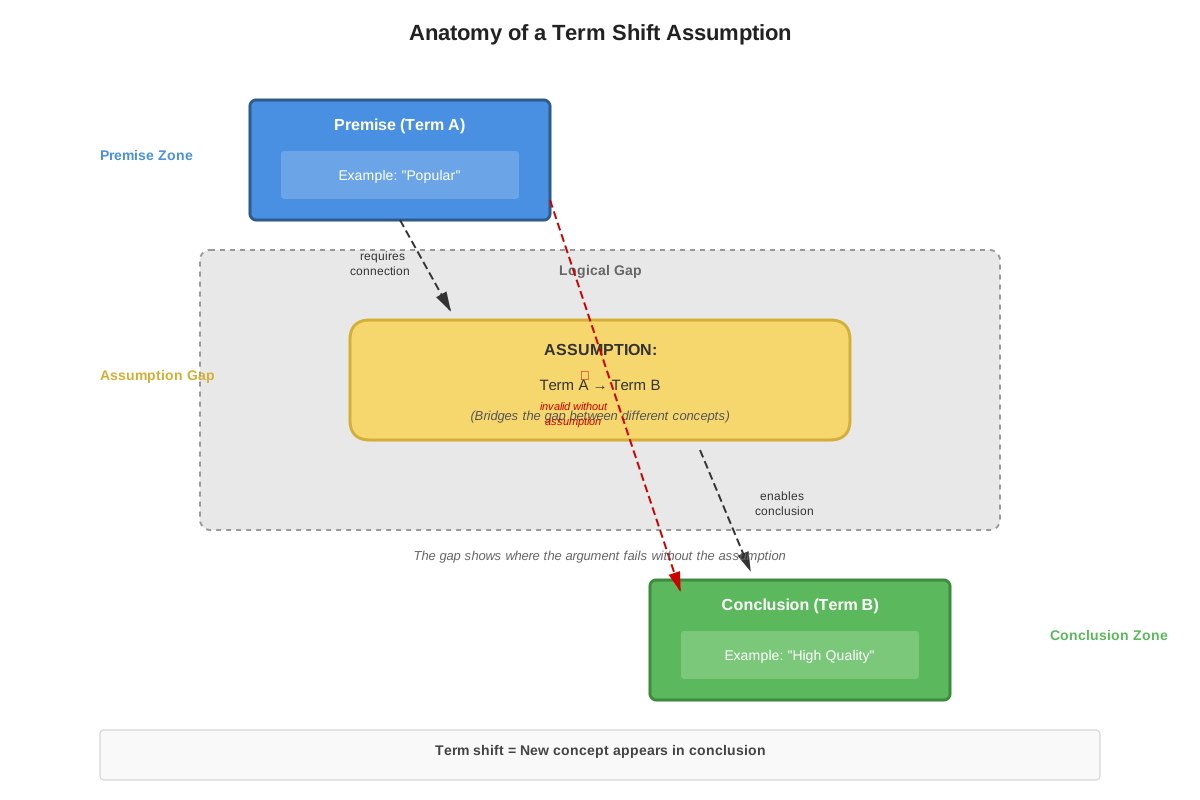
Term shift assumptions represent one of the most frequently tested patterns in LSAT logical reasoning sections. These assumptions occur when an argument moves from one concept or term in its premises to a different but related concept or term in its conclusion. The argument implicitly assumes that these two terms are connected in a way that makes the logical leap valid. For example, an argument might present evidence about what is "popular" and conclude something about what is "high quality," assuming without stating that popularity indicates quality.
Understanding term shift assumptions is crucial for success on LSAT term shift assumptions questions because they appear across multiple question types, including Necessary Assumption, Sufficient Assumption, Strengthen, Weaken, and Flaw questions. The LSAT tests whether students can identify the unstated connection between shifted terms and recognize when an argument depends on linking two distinct concepts. Mastering this skill directly impacts performance on approximately 20-30% of all Logical Reasoning questions.
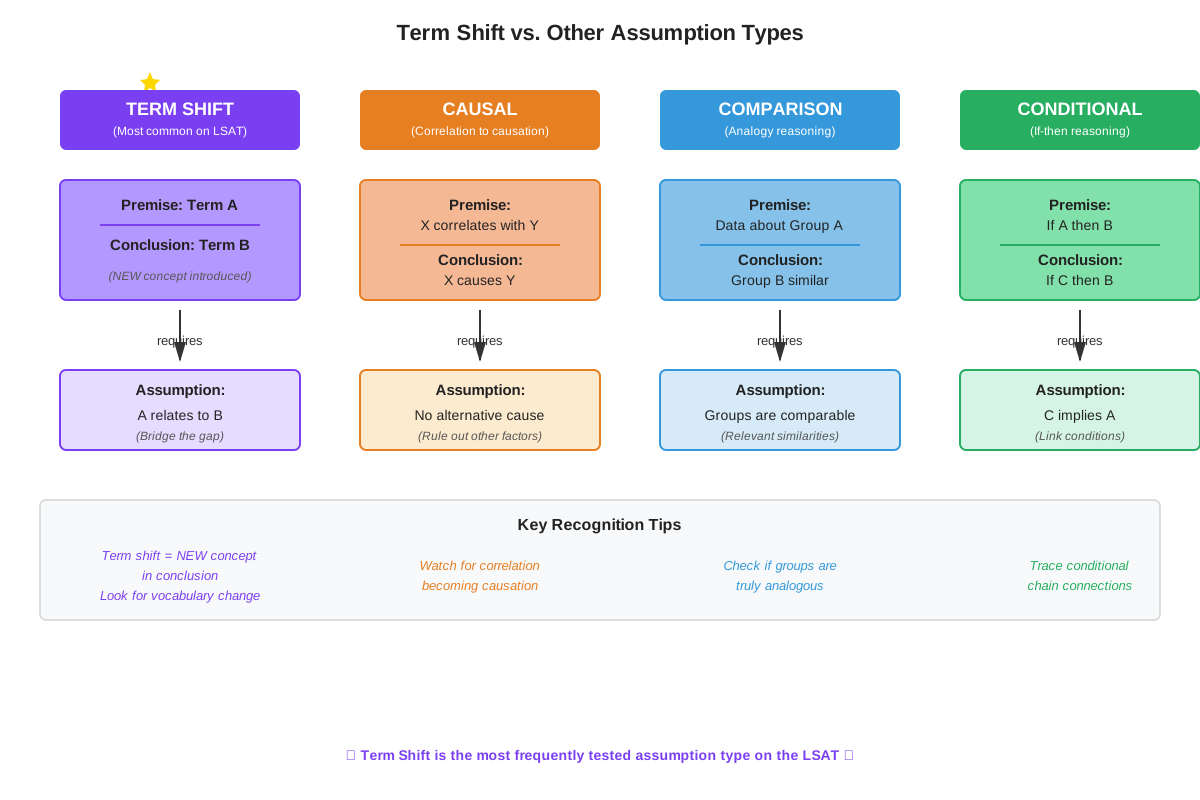
Within the broader landscape of assumption questions, term shift assumptions represent a specific pattern distinct from other assumption types like causal assumptions or comparison assumptions. While all assumptions involve unstated premises necessary for an argument's validity, term shift assumptions specifically involve the introduction of new terminology or concepts in the conclusion that weren't present in the premises. Recognizing this pattern allows test-takers to quickly identify the logical gap and predict correct answers before reviewing answer choices, significantly improving both accuracy and speed.
Learning Objectives
- [ ] Identify how Term shift assumptions appears in LSAT questions
- [ ] Explain the reasoning pattern behind Term shift assumptions
- [ ] Apply Term shift assumptions to solve LSAT-style problems accurately
- [ ] Distinguish term shift assumptions from other assumption types (causal, comparison, conditional)
- [ ] Predict the content of correct answer choices by identifying the specific terms being shifted
- [ ] Evaluate answer choices by testing whether they successfully bridge the gap between shifted terms
- [ ] Recognize subtle variations of term shifts, including shifts between related concepts, scope changes, and degree modifications
Prerequisites
- Basic argument structure: Understanding premises and conclusions is essential because term shifts occur between these components; students must identify where evidence ends and claims begin
- Conditional reasoning fundamentals: Many term shift assumptions involve conditional relationships; recognizing sufficient and necessary conditions helps identify when terms are being equated or connected
- Assumption question basics: Familiarity with what makes a statement an assumption (unstated but necessary) provides the foundation for recognizing the specific pattern of term shifts
- Logical indicators and keywords: Recognizing conclusion indicators ("therefore," "thus," "consequently") helps pinpoint where new terms are introduced
Why This Topic Matters
Term shift assumptions reflect real-world reasoning patterns that appear constantly in legal arguments, policy debates, and everyday decision-making. Lawyers must recognize when opposing counsel makes unwarranted connections between concepts—for instance, arguing that because an action is legal, it must be ethical. The ability to identify these logical gaps is fundamental to legal analysis and advocacy.
On the LSAT, term shift assumptions appear in approximately 4-6 questions per Logical Reasoning section, making them one of the highest-yield patterns to master. They appear most frequently in Necessary Assumption questions (where students must identify what the argument requires) and Flaw questions (where students must describe the logical error). They also appear regularly in Sufficient Assumption questions (where students must find what would make the argument valid), Strengthen questions, and Weaken questions.
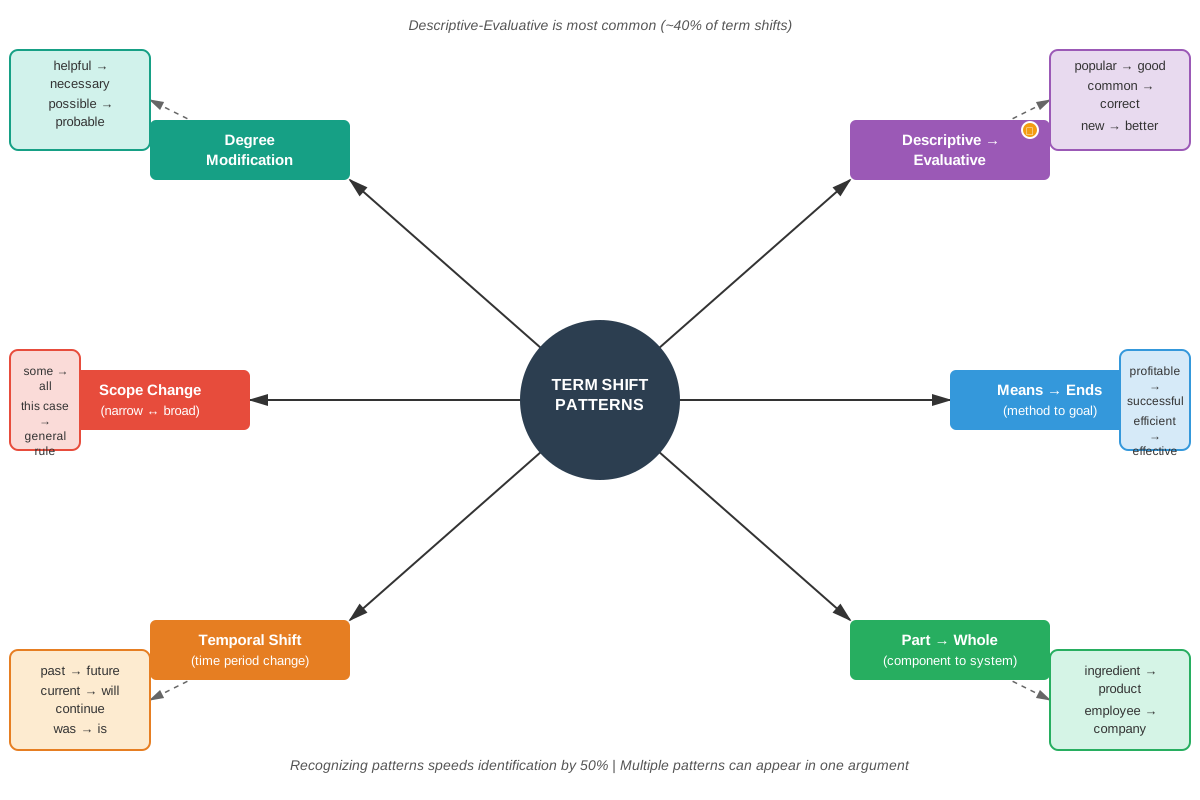
The LSAT presents term shifts in various forms: sometimes the shift is obvious (moving from "economically beneficial" to "morally right"), while other times it's subtle (moving from "most experts agree" to "the consensus view"). The exam also tests whether students can recognize shifts in scope (from "some" to "all"), degree (from "helpful" to "essential"), or temporal frame (from "historically true" to "currently true"). Questions may ask students to identify the assumption directly, describe the flaw in reasoning, or select an answer that bridges the gap between terms.
Core Concepts
Definition of Term Shift Assumptions
A term shift assumption occurs when an argument introduces a new term, concept, or idea in its conclusion that was not present in its premises, creating a logical gap that must be bridged by an unstated assumption. The argument implicitly assumes a connection, equivalence, or relationship between the term in the premises and the different term in the conclusion. This assumption is necessary for the argument to be valid but is not explicitly stated.
The key characteristic distinguishing term shifts from other logical patterns is the presence of mismatched vocabulary between premises and conclusion. While the premises discuss Concept A, the conclusion makes a claim about Concept B. The argument treats these concepts as if they're connected, but that connection remains unstated.
The Anatomy of a Term Shift
Every term shift assumption follows a predictable structure:
- Premise Term(s): The evidence discusses one or more specific concepts, using particular terminology
- Conclusion Term(s): The conclusion introduces different terminology or concepts
- The Gap: The logical space between these terms that requires an assumption
- The Assumption: The unstated claim that connects the premise term(s) to the conclusion term(s)
Consider this simple example:
- Premise: "This restaurant is extremely popular with local residents."
- Conclusion: "Therefore, this restaurant serves high-quality food."
- Premise Term: "popular"
- Conclusion Term: "high-quality"
- The Gap: No stated connection between popularity and quality
- The Assumption: "Popular restaurants serve high-quality food" or "Popularity indicates quality"
Types of Term Shifts
| Type | Description | Example |
|---|---|---|
| Concept Shift | Moving between entirely different concepts | Evidence about cost → Conclusion about value |
| Scope Shift | Changing the breadth of a claim | Evidence about "some" → Conclusion about "all" |
| Degree Shift | Changing the intensity or extent | Evidence about "helpful" → Conclusion about "necessary" |
| Temporal Shift | Changing time frames | Evidence about past → Conclusion about future |
| Category Shift | Moving between related but distinct categories | Evidence about legality → Conclusion about morality |
Recognizing Term Shifts in Arguments
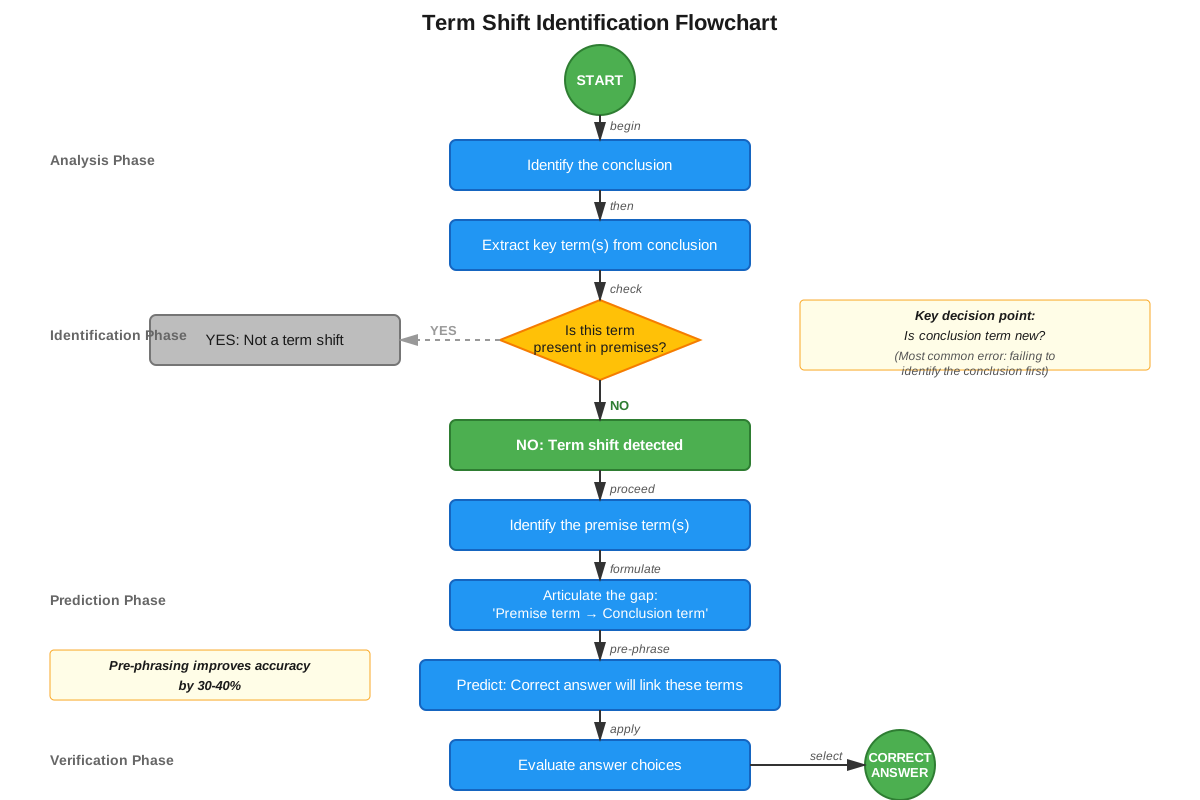
To identify term shift assumptions systematically:
- Isolate the conclusion: Identify exactly what the argument is trying to prove
- Extract conclusion keywords: Note the specific terms, concepts, or ideas in the conclusion
- Review the premises: Identify what evidence is actually provided
- Extract premise keywords: Note the specific terms used in the evidence
- Compare vocabularies: Look for mismatches between premise and conclusion terminology
- Identify the gap: Articulate what unstated connection would link these terms
- Predict the assumption: Formulate how the correct answer will bridge this gap
The Negation Test for Term Shift Assumptions
In Necessary Assumption questions, the negation test confirms whether an assumption is required. If negating a statement causes the argument to fall apart, that statement is a necessary assumption. For term shift assumptions:
- Original assumption: "Popularity indicates quality"
- Negated: "Popularity does NOT indicate quality"
- Result: If popularity doesn't indicate quality, then the evidence about popularity cannot support the conclusion about quality—the argument collapses
This test is particularly powerful for term shift assumptions because the connection between terms is the argument's foundation. Severing that connection destroys the argument's validity.
Common Term Shift Patterns on the LSAT
The LSAT repeatedly tests certain term shift patterns:
Normative Shifts: Moving from descriptive facts to prescriptive claims
- Evidence: "This policy would increase efficiency"
- Conclusion: "We should implement this policy"
- Assumption: Efficiency increases are desirable/we should pursue efficiency
Epistemic Shifts: Moving from what is known/believed to what is true
- Evidence: "Most scientists believe X"
- Conclusion: "X is true"
- Assumption: Scientific consensus indicates truth
Practical Shifts: Moving from capability to actuality
- Evidence: "The company could reduce costs"
- Conclusion: "The company will reduce costs"
- Assumption: The company will do what it's capable of doing
Evaluative Shifts: Moving from one value judgment to another
- Evidence: "This artwork is innovative"
- Conclusion: "This artwork is valuable"
- Assumption: Innovation confers value
Distinguishing Term Shifts from Other Assumptions
Not every assumption involves a term shift. Other common assumption patterns include:
- Causal assumptions: Assuming one thing causes another (no term shift, but assuming a relationship type)
- Comparison assumptions: Assuming two things are comparable (may involve term shifts if comparing different attributes)
- Conditional assumptions: Assuming if-then relationships (may or may not involve term shifts)
- Representativeness assumptions: Assuming a sample represents a population (usually no term shift)
The distinguishing feature of term shift assumptions is the vocabulary mismatch—the conclusion literally uses different words to describe different concepts than the premises used.
Concept Relationships
Term shift assumptions connect to broader logical reasoning concepts through multiple pathways:
Argument Structure → Term Shift Identification: Understanding basic argument structure (premises supporting conclusions) enables recognition of term shifts because students must first identify what the premises say versus what the conclusion claims. Only after distinguishing these components can the vocabulary mismatch become apparent.
Term Shift Recognition → Assumption Prediction: Once a term shift is identified, the specific nature of the shift (which terms are involved) directly determines what the assumption must say. The assumption must bridge the exact gap between the specific premise term and the specific conclusion term.
Assumption Prediction → Answer Choice Evaluation: Predicting the assumption before reviewing answer choices creates a clear standard for evaluation. Correct answers will match the predicted bridge; incorrect answers will fail to connect the specific terms involved.
Term Shifts ↔ Other Assumption Types: Term shifts often combine with other assumption patterns. An argument might shift terms AND assume causation, or shift terms AND make a comparison. Recognizing when multiple assumption types are present prevents incomplete analysis.
Negation Test ↔ Term Shift Validation: The negation test provides a verification mechanism for term shift assumptions. If negating the proposed connection between terms causes argument collapse, the term shift assumption has been correctly identified.
Within the broader Assumption Questions unit, term shift assumptions represent one specific pattern among several. Mastering term shifts provides a foundation for recognizing other patterns because it trains students to carefully compare premise and conclusion content—a skill applicable to all assumption types.
High-Yield Facts
⭐ Term shift assumptions occur when an argument's conclusion introduces terminology or concepts not present in its premises, requiring an unstated assumption to bridge the gap.
⭐ The correct answer to a term shift assumption question will explicitly connect the premise term to the conclusion term, making the previously implicit connection explicit.
⭐ Approximately 20-30% of Logical Reasoning questions involve term shift assumptions, making this one of the highest-yield patterns to master.
⭐ To identify term shifts, compare the specific vocabulary in the conclusion to the specific vocabulary in the premises—mismatches indicate potential term shifts.
⭐ The negation test confirms necessary assumptions: if negating the connection between shifted terms causes the argument to fail, that connection is a necessary assumption.
- Term shifts can be subtle, involving related concepts (like "beneficial" and "desirable") rather than obviously different concepts
- Scope shifts (some → all, many → most) are a specific type of term shift involving quantifier changes
- Degree shifts (helpful → essential, possible → probable) involve changes in intensity or certainty level
- Multiple term shifts can occur in a single argument, requiring assumptions that connect several different concept pairs
- Wrong answers in term shift questions often connect the wrong terms, reverse the direction of connection, or address concepts not present in the argument
- Sufficient assumption questions involving term shifts require answers that guarantee the connection, while necessary assumption questions require answers that state the minimum connection needed
- Flaw questions involving term shifts ask students to describe the error: "fails to establish that [premise term] indicates [conclusion term]"
Quick check — test yourself on Term shift assumptions so far.
Try Flashcards →Common Misconceptions
Misconception: Any argument with an assumption involves a term shift.
Correction: Term shifts are one specific type of assumption pattern. Arguments can have assumptions without term shifts—for example, causal assumptions where the same terms appear in premises and conclusion, but the causal relationship is assumed rather than established.
Misconception: The premise and conclusion terms must be completely unrelated for a term shift to exist.
Correction: Term shifts often involve related or similar concepts. The shift from "popular" to "high-quality" involves related concepts, but they're not identical. Even subtle shifts between near-synonyms can create logical gaps requiring assumptions.
Misconception: If an answer choice mentions both the premise term and conclusion term, it must be correct.
Correction: The answer must connect these terms in the right direction and manner. An answer might mention both terms but reverse the relationship, make the connection too weak, or add irrelevant conditions.
Misconception: Term shift assumptions only appear in Necessary Assumption questions.
Correction: Term shifts appear across multiple question types including Sufficient Assumption, Flaw, Strengthen, Weaken, and even some Inference questions. The same underlying pattern manifests differently depending on what the question asks.
Misconception: Identifying the term shift is sufficient to answer the question correctly.
Correction: Identification is the first step, but students must also understand what type of connection the assumption must establish and evaluate whether answer choices successfully bridge the specific gap. Different questions require different approaches even when the same term shift is present.
Misconception: The assumption must use the exact same words as the premise and conclusion.
Correction: Correct answers often paraphrase or use related terminology. An assumption connecting "popular" to "high-quality" might say "widely patronized establishments maintain superior standards"—different words expressing the same connection.
Misconception: Longer, more complex answer choices are more likely to be correct in term shift questions.
Correction: Correct answers are often simple and direct, stating the connection clearly. Complex answers frequently introduce irrelevant information or conditions not required by the argument.
Worked Examples
Example 1: Necessary Assumption Question
Argument: "The new traffic management system has significantly reduced average commute times in the city. Therefore, the system has improved residents' quality of life."
Question: Which of the following is an assumption required by the argument?
Step 1 - Identify the conclusion: "The system has improved residents' quality of life"
Step 2 - Identify conclusion terms: "improved quality of life"
Step 3 - Identify premise evidence: "reduced average commute times"
Step 4 - Identify premise terms: "reduced commute times"
Step 5 - Compare vocabularies: The premises discuss commute times; the conclusion discusses quality of life. These are different concepts.
Step 6 - Identify the gap: No stated connection between commute times and quality of life
Step 7 - Predict the assumption: The argument must assume that reduced commute times improve quality of life, or that commute time reduction is a factor in quality of life improvement.
Step 8 - Evaluate answer choices:
(A) "Most residents use the traffic management system regularly"
- Analysis: This doesn't connect commute times to quality of life; it addresses usage patterns. Eliminate.
(B) "Reduced commute times contribute to improved quality of life"
- Analysis: This directly connects the premise term (commute times) to the conclusion term (quality of life). This bridges the gap. Strong contender.
(C) "The traffic management system was expensive to implement"
- Analysis: Cost is irrelevant to the connection between commute times and quality of life. Eliminate.
(D) "Quality of life improvements are the most important goal for city planning"
- Analysis: This discusses the importance of quality of life but doesn't connect it to commute times. Eliminate.
(E) "No other factors have negatively affected quality of life during this period"
- Analysis: This addresses alternative explanations but doesn't establish the basic connection between commute times and quality of life. Eliminate.
Step 9 - Apply negation test to (B): "Reduced commute times do NOT contribute to improved quality of life." If this were true, the evidence about reduced commute times couldn't support the conclusion about quality of life improvement. The argument collapses. This confirms (B) is necessary.
Answer: (B)
Connection to learning objectives: This example demonstrates identifying term shifts (commute times → quality of life), explaining the reasoning pattern (evidence about one concept supporting a conclusion about a different concept), and applying the pattern to solve the problem accurately.
Example 2: Flaw Question
Argument: "Studies show that employees who take regular breaks throughout the workday report higher job satisfaction. Companies should therefore implement mandatory break policies to increase productivity."
Question: The reasoning in the argument is flawed because it:
Step 1 - Identify the structure:
- Premise: Regular breaks → higher job satisfaction
- Conclusion: Mandatory breaks should be implemented → increase productivity
Step 2 - Identify term shifts:
- First shift: "job satisfaction" (premise) → "productivity" (conclusion)
- Second shift: "employees who take breaks" (premise) → "mandatory break policies" (conclusion)
Step 3 - Identify the primary flaw: The argument assumes that job satisfaction leads to or indicates productivity, but this connection is never established. The evidence is about satisfaction; the conclusion is about productivity.
Step 4 - Predict the answer: The correct answer will describe the flaw as failing to establish a connection between job satisfaction and productivity.
Step 5 - Evaluate answer choices:
(A) "assumes that what is true of employees who voluntarily take breaks will be true of all employees under a mandatory policy"
- Analysis: This identifies a real issue (voluntary vs. mandatory) but doesn't address the main term shift from satisfaction to productivity. Secondary issue.
(B) "fails to establish that increased job satisfaction leads to increased productivity"
- Analysis: This directly identifies the term shift flaw—the argument moves from satisfaction to productivity without establishing the connection. Strong match.
(C) "overlooks the possibility that breaks might reduce the total time available for work"
- Analysis: This raises a practical concern but doesn't describe the logical flaw in the reasoning structure. Eliminate.
(D) "relies on studies that may not be representative of all workplaces"
- Analysis: This questions the evidence quality but doesn't address the term shift. Eliminate.
(E) "confuses a correlation between breaks and satisfaction with a causal relationship"
- Analysis: This describes a causal reasoning flaw, not the term shift from satisfaction to productivity. Eliminate.
Answer: (B)
Connection to learning objectives: This example shows how term shift assumptions appear in Flaw questions, where students must describe the reasoning error rather than identify what the argument assumes. The same underlying pattern (shifting from one term to another without justification) manifests as a describable flaw.
Exam Strategy
Systematic Approach to Term Shift Questions
Phase 1 - Recognition (5-10 seconds):
- Read the conclusion first to identify what the argument is trying to prove
- Scan for vocabulary mismatches between conclusion and premises
- Flag potential term shifts immediately
Phase 2 - Analysis (10-15 seconds):
- Circle or mentally note the specific premise term(s)
- Circle or mentally note the specific conclusion term(s)
- Articulate the gap: "The argument moves from [X] to [Y]"
- Predict: "The assumption must connect [X] to [Y]"
Phase 3 - Answer Choice Evaluation (20-30 seconds):
- Eliminate choices that don't mention both terms
- Eliminate choices that reverse the connection
- Eliminate choices that introduce new, irrelevant terms
- Select the choice that bridges the specific gap identified
Trigger Words and Phrases
Watch for these indicators of term shifts:
Conclusion indicators introducing new concepts:
- "Therefore, it is beneficial/valuable/important..."
- "Thus, we should/must/ought to..."
- "Consequently, this will improve/enhance/increase..."
Evaluative language shifts:
- Evidence: "effective" → Conclusion: "desirable"
- Evidence: "popular" → Conclusion: "superior"
- Evidence: "innovative" → Conclusion: "valuable"
Normative language (should, ought, must) in conclusions often signals shifts from descriptive premises to prescriptive conclusions.
Quantifier changes:
- "Some experts" (premise) → "The consensus" (conclusion)
- "Can reduce" (premise) → "Will eliminate" (conclusion)
Process of Elimination Strategies
For Necessary Assumption questions:
- Eliminate answers that introduce concepts not in the original argument
- Eliminate answers that are too strong (the assumption need only be sufficient to bridge the gap, not make an extreme claim)
- Apply the negation test to remaining contenders
- Select the answer whose negation destroys the argument
For Sufficient Assumption questions:
- Identify the exact gap between premise and conclusion terms
- Eliminate answers that don't guarantee the connection
- Select the answer that, if true, would make the conclusion follow logically with certainty
For Flaw questions:
- Identify the term shift first
- Eliminate answers describing other flaw types (causal, sampling, etc.)
- Select the answer that describes the failure to establish a connection between the specific terms involved
Time Allocation
- Simple term shifts (obvious vocabulary mismatch): 45-60 seconds total
- Complex term shifts (multiple shifts or subtle shifts): 60-90 seconds total
- If stuck: Move on after 90 seconds; term shift questions are predictable enough that returning with fresh eyes often yields immediate clarity
Exam Tip: Pre-phrasing the assumption before reading answer choices dramatically improves accuracy. Students who predict "the answer must connect X to Y" rarely fall for trap answers that connect the wrong terms or reverse the relationship.
Memory Techniques
The SHIFT Acronym
Spot the conclusion term
Highlight the premise term
Identify the gap between them
Formulate the connecting assumption
Test by negation (for necessary assumptions)
Visualization Strategy
Picture the argument as a bridge:
- Left bank: Premise term (where the evidence is)
- Right bank: Conclusion term (where the argument wants to go)
- Missing bridge: The assumption that connects them
- Your task: Identify what bridge is needed or describe why the current bridge is faulty
The "Different Words, Different Concepts" Rule
Create a mental alert: whenever the conclusion uses different vocabulary than the premises, immediately think "TERM SHIFT." Train yourself to notice vocabulary mismatches automatically.
The Connection Formula
Memorize this template for predicting assumptions:
"[Premise term] indicates/leads to/is a factor in [Conclusion term]"
This formula works for the majority of term shift assumptions and helps generate accurate predictions quickly.
Mnemonic for Common Shifts
PEND - Remember common shift types:
- Prescriptive (is → should)
- Evaluative (one value → different value)
- Normative (fact → obligation)
- Degree (some → all, possible → certain)
Summary
Term shift assumptions represent a fundamental pattern in LSAT Logical Reasoning where arguments introduce new terminology or concepts in their conclusions that weren't present in their premises. These assumptions bridge the logical gap between mismatched terms, connecting the evidence provided to the claim being made. Mastering term shift recognition requires systematic comparison of premise and conclusion vocabulary, identification of the specific gap created by the mismatch, and prediction of what connection must be assumed. The pattern appears across multiple question types—Necessary Assumption, Sufficient Assumption, Flaw, Strengthen, and Weaken—making it one of the highest-yield concepts to master for LSAT success. Students who can quickly identify term shifts, articulate the required connection, and evaluate whether answer choices successfully bridge the gap will significantly improve both accuracy and speed on Logical Reasoning sections. The key is recognizing that different words often signal different concepts, and arguments that jump from one concept to another without explicit justification depend on unstated assumptions connecting those concepts.
Key Takeaways
- Term shift assumptions occur when conclusions introduce vocabulary or concepts not present in premises, creating logical gaps that require unstated assumptions
- Identify term shifts by systematically comparing premise terminology to conclusion terminology—vocabulary mismatches signal potential term shifts
- The correct answer in term shift questions will explicitly connect the premise term to the conclusion term in the appropriate direction and manner
- Term shifts appear in 20-30% of Logical Reasoning questions across multiple question types, making this pattern essential for LSAT success
- Use the negation test to confirm necessary assumptions: if negating the connection between terms destroys the argument, that connection is necessary
- Predict the assumption before reviewing answer choices by articulating exactly what connection would bridge the identified gap
- Watch for common shift patterns: descriptive to prescriptive, capability to actuality, belief to truth, and one evaluative term to another
Related Topics
Causal Assumptions: After mastering term shifts, students should study causal assumptions, where arguments assume one thing causes another. Many arguments combine term shifts with causal reasoning, requiring assumptions that both connect different terms and establish causal relationships.
Sufficient vs. Necessary Assumptions: Understanding the distinction between what's sufficient to make an argument work versus what's necessary for it to work builds on term shift recognition. The same term shift might require different assumption strengths depending on question type.
Flaw Question Types: Term shifts represent one category of logical flaws. Studying other flaw types (causal flaws, sampling flaws, conditional reasoning flaws) provides comprehensive coverage of how arguments can go wrong.
Strengthen and Weaken Questions: These question types often test term shift understanding indirectly. Answers that strengthen arguments involving term shifts will support the connection between terms; answers that weaken will undermine that connection.
Formal Logic and Conditional Reasoning: Advanced students should explore how term shifts interact with conditional statements, particularly when arguments shift from one conditional relationship to another or assume connections between sufficient/necessary conditions.
Practice CTA
Now that you understand term shift assumptions, it's time to apply this knowledge to actual LSAT questions. The practice questions and flashcards will reinforce your ability to spot term shifts quickly, predict assumptions accurately, and eliminate wrong answers efficiently. Remember: term shift recognition is a skill that improves dramatically with deliberate practice. Each question you analyze strengthens your pattern recognition and speeds up your processing time. Approach the practice materials systematically, using the SHIFT acronym and the strategies outlined above. Your investment in mastering this high-yield pattern will pay dividends across multiple question types and significantly boost your Logical Reasoning score. You've got this!
Sign up free to keep reading
Create a free AnvayaPrep account to finish this LSAT guide on Term shift assumptions — plus flashcards and practice questions.