Overview
Begging the question is one of the most frequently tested logical fallacies on the LSAT, appearing regularly in flaw questions within the Logical Reasoning section. This fallacy occurs when an argument's conclusion is assumed within its premises, creating circular reasoning that fails to provide independent support for the claim being made. Rather than offering genuine evidence, the argument simply restates its conclusion in different words, making it logically invalid despite potentially appearing persuasive on the surface.
Understanding how to identify LSAT begging the question patterns is essential for success on the exam because this flaw appears in approximately 10-15% of all flaw questions, making it one of the highest-yield logical fallacies to master. The LSAT tests this concept in sophisticated ways, often disguising the circular reasoning through complex language, multiple premises, or by separating the circular elements across different parts of the argument. Students who can quickly recognize when an argument assumes what it purports to prove gain a significant advantage in both accuracy and timing.
Within the broader landscape of logical reasoning concepts, begging the question represents a fundamental failure in argument structure—specifically, a failure to provide independent justification. This connects directly to other flaw types such as unwarranted assumptions, gaps in reasoning, and failures to establish causation. Mastering this topic strengthens overall argument analysis skills and provides a foundation for understanding how premises should properly support conclusions without presupposing them.
Learning Objectives
- [ ] Identify how Begging the question appears in LSAT questions
- [ ] Explain the reasoning pattern behind Begging the question
- [ ] Apply Begging the question to solve LSAT-style problems accurately
- [ ] Distinguish begging the question from other circular reasoning patterns and related flaws
- [ ] Recognize disguised forms of circular reasoning where the conclusion is rephrased or distributed across multiple premises
- [ ] Evaluate answer choices to select descriptions that accurately characterize circular reasoning flaws
- [ ] Predict when begging the question is likely to appear based on argument structure and question stem language
Prerequisites
- Basic argument structure: Understanding premises, conclusions, and how arguments are constructed is essential because identifying circular reasoning requires recognizing when a conclusion appears within the supporting evidence.
- Flaw question format: Familiarity with how flaw questions are presented and what they ask enables efficient identification of the specific logical error being tested.
- Conditional reasoning fundamentals: Basic understanding of logical relationships helps distinguish between valid logical connections and circular assumptions.
- Common logical fallacies overview: General awareness of other fallacy types provides context for understanding what makes begging the question distinct from other reasoning errors.
Why This Topic Matters
In real-world contexts, circular reasoning undermines the persuasiveness of arguments across legal briefs, policy debates, scientific reasoning, and everyday decision-making. Attorneys must avoid circular arguments when presenting cases, and judges must identify when reasoning fails to provide independent justification. The ability to detect when someone assumes what they're trying to prove is fundamental to critical thinking in professional and academic contexts.
On the LSAT specifically, begging the question appears in approximately 3-5 questions per test, making it one of the most frequently tested logical flaws. These questions typically appear as:
- Flaw questions asking what error the argument commits (most common)
- Parallel flaw questions requiring identification of structurally similar circular reasoning
- Principle questions where the principle involves avoiding circular reasoning
- Strengthen/Weaken questions where recognizing circular reasoning helps eliminate trap answers
The LSAT tests this concept because law school and legal practice demand the ability to construct and evaluate arguments that provide genuine evidentiary support rather than mere restatement. Questions involving begging the question often appear in the middle-to-difficult range of question difficulty, and they frequently serve as points of differentiation between mid-range and high-scoring test-takers. The test makers deliberately craft these arguments to sound plausible, using sophisticated vocabulary and complex sentence structures to obscure the circular nature of the reasoning.
Core Concepts
Definition and Structure of Begging the Question
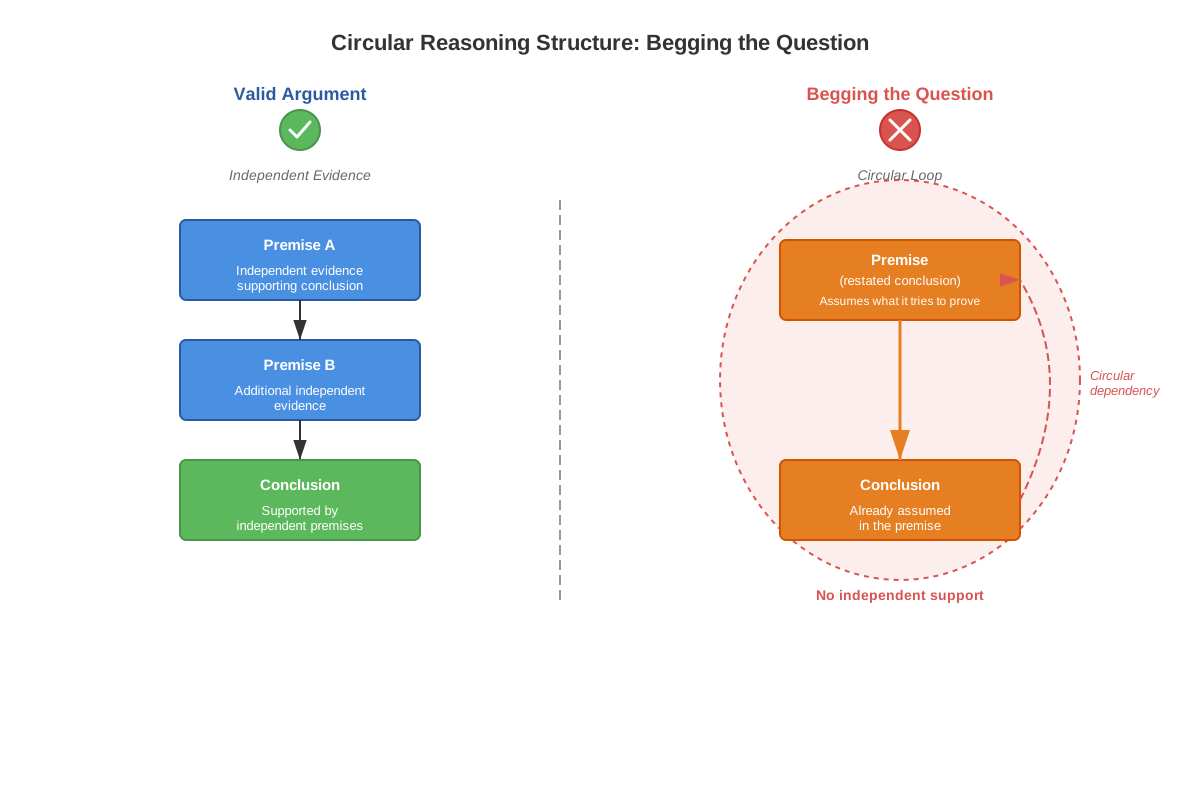
Begging the question (also known as circular reasoning or petitio principii) occurs when an argument's conclusion is assumed, either explicitly or implicitly, within one or more of its premises. The argument fails because it does not provide independent evidence for its conclusion—instead, it presupposes the truth of what it claims to be proving. The Latin term "petitio principii" literally means "assuming the initial point," which captures the essence of this fallacy.
The basic structure follows this pattern:
- Premise contains or assumes the conclusion (often in disguised form)
- Conclusion restates what was already assumed in the premise
- No independent evidence bridges the gap between premise and conclusion
For example: "The death penalty is morally wrong because it is unethical to execute criminals." This argument begs the question because "morally wrong" and "unethical" express essentially the same concept—the premise assumes what the conclusion tries to prove.
Forms of Circular Reasoning on the LSAT
The LSAT presents begging the question in several sophisticated forms:
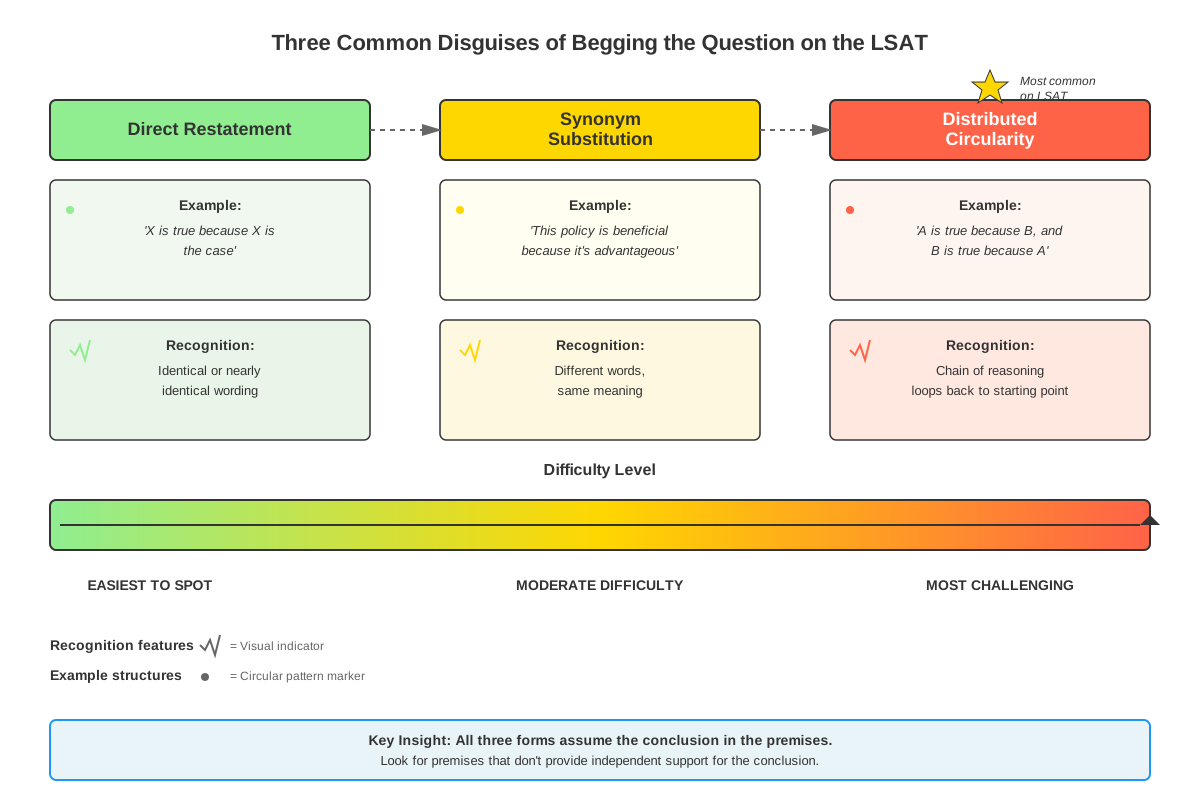
Direct Restatement: The simplest form where the premise directly restates the conclusion using synonymous or nearly synonymous language. Example: "This policy will succeed because it will achieve its goals." The premise (achieving goals) is simply another way of stating the conclusion (success).
Definitional Circularity: The argument uses a definition that already contains the conclusion. Example: "All natural remedies are safe because anything found in nature poses no health risks." The definition of "natural" already assumes "safe," making the reasoning circular.
Distributed Circularity: The circular reasoning is spread across multiple premises, making it harder to detect. Example: "A is true because B is true. B is true because C is true. C is true because A is true." Each individual step might seem reasonable, but the overall chain assumes what it tries to prove.
Implicit Assumption Circularity: The conclusion appears as an unstated assumption necessary for the premises to support the conclusion. Example: "The witness must be lying because her testimony contradicts the truth." This assumes we already know "the truth," which is precisely what the testimony is meant to establish.
Distinguishing Begging the Question from Valid Reasoning
Understanding what begging the question is NOT helps sharpen recognition:
| Valid Reasoning | Begging the Question |
|---|---|
| Premises provide independent evidence | Premises restate or assume the conclusion |
| Conclusion follows from distinct facts | Conclusion was already presupposed |
| Can be challenged by questioning premises | Cannot be challenged because it's circular |
| Moves from evidence to claim | Moves from claim to same claim |
Valid arguments may use terms that appear in both premises and conclusions, but they don't assume the conclusion itself. For example: "All mammals are warm-blooded. Whales are mammals. Therefore, whales are warm-blooded." This is valid categorical reasoning, not circular, because the premises provide independent classification criteria.
Recognition Patterns in LSAT Arguments
Several textual patterns signal potential circular reasoning:
Synonym substitution: Watch for premises that use different words to express the same concept as the conclusion. Words like "effective/successful," "moral/ethical," "beneficial/advantageous," or "reliable/trustworthy" often signal this pattern.
Evaluative terms without criteria: When arguments use evaluative language (good, bad, right, wrong, best, worst) without providing independent standards for evaluation, they often beg the question. Example: "This is the best solution because it's superior to alternatives."
Self-referential justification: Arguments that justify a claim by referring back to the claim itself or its inherent properties. Example: "This law is just because it embodies justice."
Question-begging epithets: Using loaded descriptive terms that assume the conclusion. Example: "This corrupt practice should be eliminated because corruption must be stopped." The term "corrupt" already assumes what needs to be proven.
How LSAT Answer Choices Describe This Flaw
The LSAT uses specific language patterns to describe begging the question in answer choices:
- "presupposes what it sets out to prove"
- "takes for granted the very claim it purports to establish"
- "assumes the truth of its conclusion in stating its premises"
- "argues in a circle"
- "treats a claim that requires support as though it were self-evident"
- "fails to provide independent grounds for its conclusion"
- "the conclusion is merely a restatement of a premise"
Recognizing these standard phrasings helps quickly identify correct answers in flaw questions. However, the LSAT also uses variations and more complex descriptions, so understanding the underlying concept remains essential.
Concept Relationships
Begging the question connects to several other logical reasoning concepts in important ways:
Relationship to Sufficient Assumptions: While sufficient assumption questions ask what would make an argument valid, begging the question represents a flaw where the "assumption" is actually the conclusion itself. Understanding sufficient assumptions helps recognize when an argument inappropriately assumes its conclusion rather than properly bridging a logical gap.
Connection to Necessary Assumptions: Arguments that beg the question often disguise the circular reasoning as a necessary assumption. The key distinction is that legitimate necessary assumptions provide independent support, while circular reasoning merely restates the conclusion. This relationship flows as: Necessary Assumption (legitimate) → provides independent support → differs from → Begging the Question → assumes conclusion itself.
Relationship to Causal Reasoning Flaws: Some circular arguments involve causal claims where the effect is used to prove the cause, which is then used to prove the effect. This creates a specific type of circular reasoning common in LSAT questions: Causal Claim → requires independent evidence → when lacking → may result in → Circular Causal Reasoning.
Connection to Conditional Logic: Valid conditional reasoning (if A then B; A; therefore B) can superficially resemble circular reasoning but differs fundamentally. Understanding valid conditional structures helps distinguish them from circular patterns: Valid Conditional → uses independent trigger → differs from → Circular Reasoning → assumes conclusion as trigger.
Integration with Argument Evaluation: Recognizing begging the question is part of the broader skill of argument evaluation, which includes identifying gaps, assessing evidence quality, and determining whether premises genuinely support conclusions. The skill hierarchy flows: Basic Argument Structure → Premise-Conclusion Identification → Gap Analysis → Flaw Recognition (including Begging the Question) → Complete Argument Evaluation.
High-Yield Facts
⭐ Begging the question occurs when an argument assumes its conclusion within its premises, providing no independent support for the claim.
⭐ The most common LSAT presentation involves using synonymous or nearly synonymous terms in the premise and conclusion.
⭐ Answer choices describing this flaw typically use phrases like "presupposes what it sets out to prove" or "takes for granted the very claim it purports to establish."
⭐ Circular reasoning can be distributed across multiple premises, making it harder to detect but still fundamentally flawed.
⭐ Arguments using evaluative terms (good, bad, effective, just) without independent criteria often beg the question.
- The flaw appears in approximately 10-15% of all flaw questions on the LSAT, making it one of the highest-yield fallacies to master.
- Begging the question differs from valid reasoning in that valid arguments provide independent evidence rather than restating conclusions.
- Question-begging epithets (loaded descriptive terms) often signal circular reasoning by assuming what needs to be proven.
- The LSAT frequently disguises circular reasoning through complex sentence structures and sophisticated vocabulary.
- Recognizing when a definition already contains the conclusion helps identify definitional circularity.
- Self-referential justifications (justifying a claim by referring to the claim itself) always beg the question.
- Parallel flaw questions involving begging the question require identifying the same circular structure in a different context.
- Time-efficient recognition involves scanning for synonym pairs between premises and conclusions.
Quick check — test yourself on Begging the question so far.
Try Flashcards →Common Misconceptions
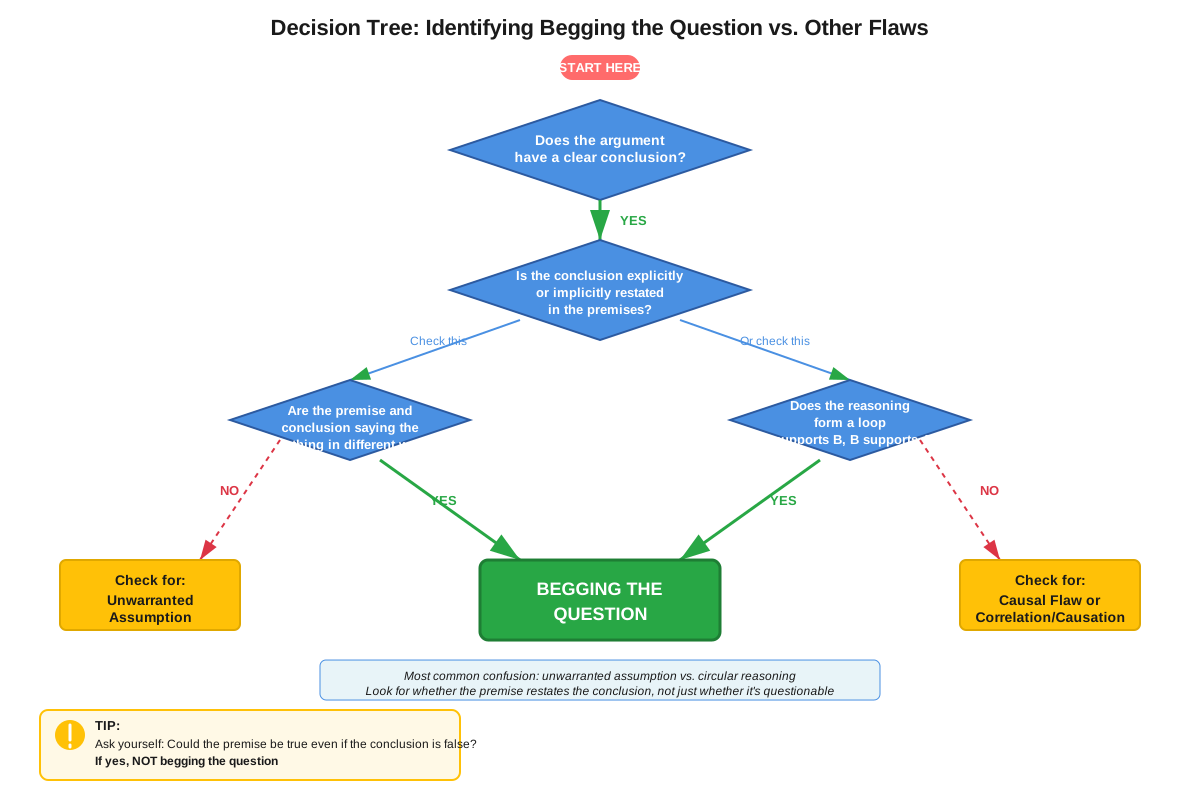
Misconception: Any argument that mentions the same concept in both premises and conclusion begs the question. → Correction: Valid arguments regularly reference the same concepts throughout; begging the question specifically occurs when the conclusion itself (not just related concepts) is assumed in the premises. For example, "All dogs are mammals; Fido is a dog; therefore Fido is a mammal" mentions "mammal" in both premise and conclusion but doesn't beg the question because the premises provide independent classification.
Misconception: Begging the question is the same as raising a question or prompting inquiry. → Correction: In common usage, "begs the question" often incorrectly means "raises the question," but in logic and on the LSAT, it specifically refers to circular reasoning. The LSAT uses only the technical logical meaning, never the colloquial one.
Misconception: If an argument's premises are true, it cannot beg the question. → Correction: Begging the question is a structural flaw independent of the truth of premises or conclusion. An argument can have true premises and a true conclusion while still begging the question if the reasoning is circular. The flaw concerns the logical relationship between premises and conclusion, not their truth values.
Misconception: Circular reasoning is acceptable if the circle is large enough or involves many steps. → Correction: The number of steps in circular reasoning doesn't make it valid. Whether direct ("A because A") or distributed across multiple premises ("A because B because C because A"), circular reasoning fails to provide independent justification regardless of complexity.
Misconception: Begging the question only occurs with identical words in premises and conclusion. → Correction: The LSAT frequently tests circular reasoning using synonyms, paraphrases, or conceptually equivalent expressions. "Effective" and "successful," "moral" and "ethical," or "reliable" and "trustworthy" can signal circular reasoning even though the exact words differ.
Misconception: If an argument has multiple premises, it cannot beg the question because it has substantial support. → Correction: The quantity of premises doesn't prevent circular reasoning. An argument with five premises can still beg the question if any of those premises assumes the conclusion, regardless of how much other information is provided.
Misconception: Begging the question is the same as making an unsupported assertion. → Correction: While both are flaws, they differ fundamentally. An unsupported assertion provides no evidence at all, while begging the question provides "evidence" that circularly assumes the conclusion. The latter appears to offer support but fails to do so independently.
Worked Examples
Example 1: Direct Circular Reasoning
Argument: "The new education policy will improve student outcomes because it will make students perform better academically. Therefore, the policy should be implemented."
Analysis Process:
Step 1: Identify the conclusion. The conclusion is that "the policy should be implemented."
Step 2: Identify the stated reason/premise. The premise is that "it will improve student outcomes because it will make students perform better academically."
Step 3: Examine the relationship between premise and conclusion. "Improve student outcomes" and "perform better academically" are essentially synonymous expressions. The premise doesn't provide independent evidence for why the policy will work—it simply restates that it will work using different words.
Step 4: Recognize the circular pattern. The argument structure is: "Policy should be implemented because it will succeed" where "succeed" is defined as the same thing the conclusion claims. This is classic begging the question.
Step 5: Predict answer choice language. Look for descriptions like "presupposes what it aims to establish" or "takes for granted the very outcome it seeks to demonstrate."
Connection to Learning Objectives: This example demonstrates how to identify begging the question in its most straightforward form (Objective 1) and illustrates the basic reasoning pattern of synonym substitution (Objective 2).
Example 2: Distributed Circular Reasoning
Argument: "We know that the defendant is guilty because the witness testimony is reliable. The witness testimony is reliable because it comes from a credible source. We know the source is credible because guilty defendants are always identified by credible sources."
Analysis Process:
Step 1: Map the chain of reasoning.
- Conclusion: Defendant is guilty
- Support 1: Witness testimony is reliable
- Support 2: Testimony comes from credible source
- Support 3: Credible sources identify guilty defendants
Step 2: Identify the circular loop. The final premise (Support 3) assumes that we already know the defendant is guilty ("guilty defendants are always identified by credible sources"). This creates a circle: guilty → credible source → reliable testimony → guilty.
Step 3: Recognize the distributed nature. The circularity isn't immediately obvious because it's spread across multiple steps. Each individual step might seem reasonable in isolation, but the chain ultimately assumes its conclusion.
Step 4: Distinguish from valid reasoning. A valid version would provide independent evidence for the witness's credibility (e.g., "The witness has no motive to lie and has been consistently accurate in the past") rather than assuming the conclusion about guilt.
Step 5: Apply to LSAT strategy. In flaw questions with complex, multi-step arguments, trace the logical chain carefully to identify whether it loops back to assume its conclusion.
Connection to Learning Objectives: This example shows how begging the question appears in more sophisticated LSAT questions (Objective 1), explains the distributed circular reasoning pattern (Objective 2), and demonstrates the analytical process needed to solve such problems accurately (Objective 3).
Example 3: Question-Begging Epithet
Argument: "This unfair law should be repealed because unjust legislation has no place in a democratic society."
Analysis Process:
Step 1: Identify evaluative terms. "Unfair" and "unjust" are evaluative terms that require independent justification.
Step 2: Examine whether independent criteria are provided. The argument provides no independent explanation of why the law is unfair or unjust—it simply asserts these characterizations.
Step 3: Recognize the question-begging epithet. By calling the law "unfair" in the premise and "unjust" in the supporting reason, the argument assumes what it needs to prove: that the law is indeed unfair/unjust.
Step 4: Identify what's missing. A valid argument would provide specific reasons why the law is unfair (e.g., "This law disproportionately burdens low-income citizens" or "This law violates constitutional protections").
Step 5: Connect to answer choices. Look for descriptions indicating the argument "uses loaded language that assumes what needs to be proven" or "takes for granted the evaluative claim it purports to establish."
Connection to Learning Objectives: This example illustrates a subtle form of circular reasoning common on the LSAT (Objective 1), explains the question-begging epithet pattern (Objective 2), and shows how to apply recognition skills to solve problems (Objective 3).
Exam Strategy
Systematic Approach to Begging the Question Questions
When approaching flaw questions that might involve circular reasoning, follow this efficient process:
- Read the conclusion first: Identify exactly what the argument is trying to prove. Write it down or clearly mark it.
- Scan premises for synonym pairs: Quickly check whether any premise uses synonymous language to the conclusion. This catches 60-70% of begging the question instances.
- Check for evaluative terms without criteria: If the conclusion makes an evaluative claim (good, bad, effective, just), verify whether the premises provide independent standards or merely restate the evaluation.
- Trace multi-step reasoning: For complex arguments, map the logical chain to identify whether it loops back to assume the conclusion.
- Predict before reading answers: Formulate your own description of the flaw before examining answer choices to avoid being misled by attractive wrong answers.
Trigger Words and Phrases
Watch for these high-probability indicators of circular reasoning:
In the argument:
- Synonym pairs (effective/successful, moral/ethical, beneficial/advantageous)
- Self-referential language ("by its very nature," "inherently," "by definition")
- Evaluative terms without supporting criteria
- Phrases like "obviously," "clearly," or "certainly" that assert rather than prove
In answer choices (correct answers):
- "presupposes what it sets out to prove"
- "takes for granted"
- "assumes the truth of its conclusion"
- "argues in a circle"
- "treats as established what requires support"
- "fails to provide independent justification"
In answer choices (common traps):
- Descriptions of other flaws (correlation/causation, sampling errors, appeals to authority)
- Overly specific descriptions that don't match the argument's structure
- Descriptions that sound circular but actually describe different flaws
Process of Elimination Tips
Eliminate answers that:
- Describe flaws not present in the argument (e.g., if there's no statistical reasoning, eliminate answers about sampling)
- Use "circular reasoning" language but describe a different structural problem
- Are too narrow or specific when the actual flaw is circular reasoning
- Describe the argument as failing to consider alternatives (this is usually a different flaw)
Keep answers that:
- Use standard circular reasoning language
- Accurately describe the relationship between the specific premise and conclusion
- Identify that the conclusion is assumed rather than proven
- Match your pre-formulated prediction of the flaw
Time Allocation
For questions involving begging the question:
- Initial read: 30-40 seconds to understand the argument
- Flaw identification: 15-20 seconds to recognize circular reasoning
- Answer evaluation: 30-40 seconds to select the correct description
- Total target time: 75-100 seconds
If you identify circular reasoning quickly (within 20 seconds of reading), you can often select the correct answer in under 60 seconds total, banking time for more difficult questions.
Memory Techniques
Primary Mnemonic: CIRCLE
Use CIRCLE to remember the key features of begging the question:
- Conclusion assumed in premise
- Independent evidence lacking
- Restatement using synonyms
- Circular logical structure
- Loaded language (question-begging epithets)
- Evaluative terms without criteria
Visualization Strategy
Picture a snake eating its own tail (ouroboros symbol). This ancient image perfectly captures circular reasoning—the argument "consumes itself" by assuming what it tries to prove. When you see potential circular reasoning, visualize this image to confirm the logical structure loops back on itself.
Acronym for Answer Choice Recognition
PAST helps remember common answer choice phrasings:
- Presupposes what it proves
- Assumes its conclusion
- Self-referential reasoning
- Takes for granted what requires support
Synonym Recognition Trick
Create a mental "synonym alert list" of common pairs that signal circular reasoning:
- Effective ↔ Successful
- Moral ↔ Ethical
- Beneficial ↔ Advantageous
- Reliable ↔ Trustworthy
- Fair ↔ Just
- Valid ↔ Sound
When you see these pairs across premise and conclusion, immediately suspect circular reasoning.
The "Because Why?" Test
When reading an argument, ask "Because why?" after each premise. If the answer is essentially "because the conclusion is true," you've found circular reasoning. This simple test quickly identifies when premises fail to provide independent support.
Summary
Begging the question represents a fundamental logical flaw where an argument assumes its conclusion within its premises, failing to provide independent justification for its claims. On the LSAT, this fallacy appears frequently in flaw questions, typically disguised through synonym substitution, question-begging epithets, evaluative terms without criteria, or distributed circular reasoning across multiple premises. Successful identification requires recognizing when premises merely restate the conclusion rather than offering genuine evidence, understanding that valid arguments may reference the same concepts without being circular, and distinguishing this flaw from other reasoning errors. The LSAT tests this concept using specific answer choice language including "presupposes what it sets out to prove" and "takes for granted the very claim it purports to establish." Mastery involves quickly scanning for synonym pairs between premises and conclusions, checking whether evaluative claims receive independent support, and tracing multi-step reasoning to identify circular loops. This high-yield topic appears in 10-15% of flaw questions and serves as a critical differentiator between mid-range and high-scoring test-takers.
Key Takeaways
- Begging the question occurs when an argument's conclusion is assumed within its premises, providing no independent support—this is the single most important concept to master.
- The most common LSAT presentation uses synonymous terms in premises and conclusions; scanning for synonym pairs enables quick identification in 60-70% of cases.
- Answer choices use predictable language patterns including "presupposes what it sets out to prove" and "takes for granted"; memorizing these phrases accelerates answer selection.
- Circular reasoning differs fundamentally from valid reasoning that references the same concepts—the key distinction is whether the conclusion itself (not just related ideas) is assumed.
- Question-begging epithets and evaluative terms without independent criteria are high-probability indicators of circular reasoning on the LSAT.
- Distributed circular reasoning across multiple premises requires careful tracing of the logical chain to identify the loop back to the conclusion.
- This flaw appears in approximately 10-15% of flaw questions, making it one of the highest-yield logical fallacies for LSAT preparation.
Related Topics
Necessary vs. Sufficient Assumptions: Understanding the distinction between assumptions that must be true for an argument to work (necessary) and those that would guarantee the conclusion (sufficient) helps clarify when circular reasoning inappropriately treats the conclusion as an assumption. Mastering begging the question provides foundation for recognizing when assumptions are legitimate versus circular.
Causal Reasoning Flaws: Many circular arguments involve causal claims where the effect is used to establish the cause. Understanding causal reasoning flaws more broadly enables recognition of circular causal patterns as a specific subtype.
Conditional Logic and Valid Argument Forms: Studying valid conditional reasoning structures (modus ponens, modus tollens) helps distinguish legitimate logical connections from circular reasoning that superficially resembles valid forms.
Parallel Flaw Questions: Once begging the question is mastered in standard flaw questions, parallel flaw questions require applying the same recognition skills to identify structurally similar circular reasoning in different contexts.
Strengthen and Weaken Questions: Understanding circular reasoning helps eliminate trap answers in strengthen/weaken questions, as circular arguments cannot be genuinely strengthened or weakened by additional evidence.
Practice CTA
Now that you understand the concept, structure, and recognition patterns of begging the question, it's time to cement your mastery through active practice. Attempt the practice questions designed specifically for this topic, focusing on applying the systematic approach and trigger word recognition strategies outlined above. Use the flashcards to reinforce key definitions and answer choice phrasings until recognition becomes automatic. Remember that begging the question appears in 10-15% of flaw questions—mastering this single topic can directly improve your score on 3-5 questions per test. Your investment in understanding circular reasoning will pay dividends not only on the LSAT but throughout law school and legal practice, where constructing and evaluating arguments with genuine evidentiary support is essential to success.
Sign up free to keep reading
Create a free AnvayaPrep account to finish this LSAT guide on Begging the question — plus flashcards and practice questions.