Overview
Causal flaw is one of the most frequently tested error patterns in LSAT Logical Reasoning sections, appearing in approximately 15-20% of all flaw questions. This reasoning error occurs when an argument incorrectly establishes or assumes a cause-and-effect relationship between two events or phenomena. The LSAT tests this concept because identifying faulty causal reasoning is fundamental to critical thinking in legal contexts, where attorneys must distinguish between genuine causation and mere correlation, coincidence, or alternative explanations.
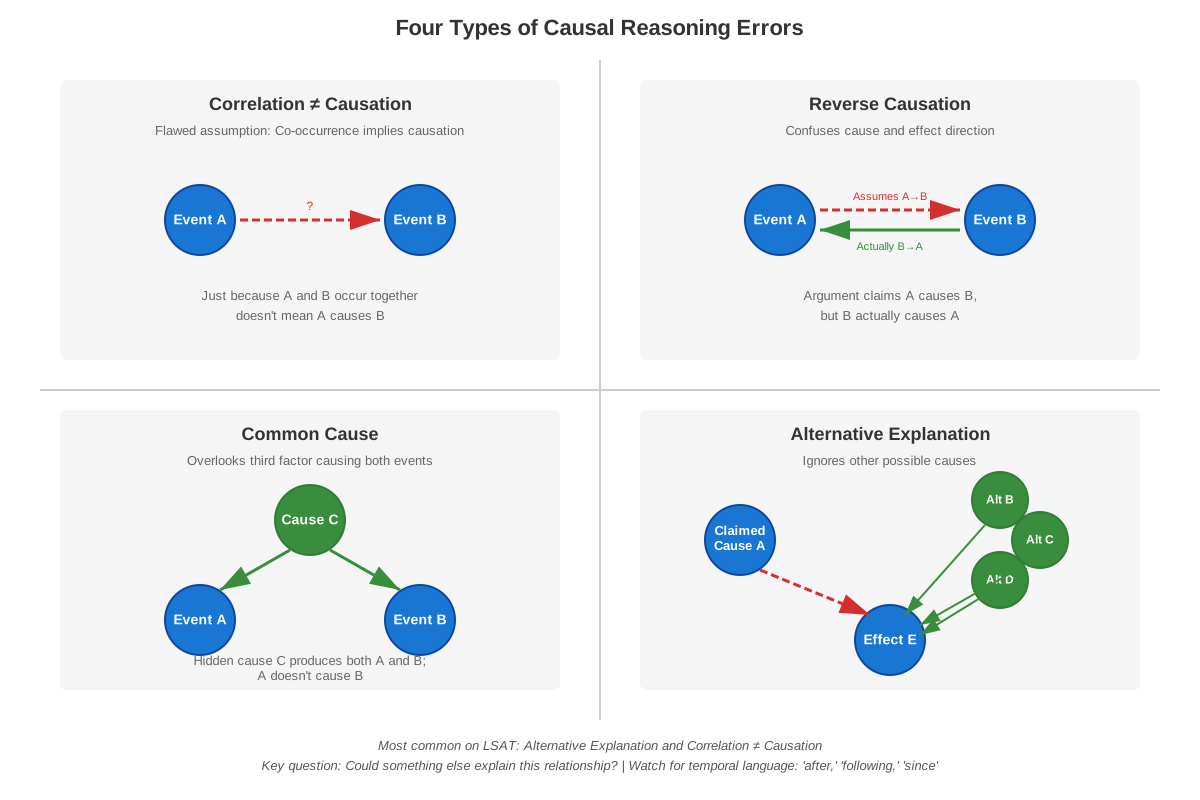
Understanding LSAT causal flaw patterns requires recognizing that just because two things occur together or in sequence does not mean one caused the other. Arguments commit causal flaws when they overlook alternative explanations, confuse correlation with causation, reverse the actual causal direction, or fail to consider that both observed phenomena might result from a common underlying cause. These errors appear across various question types, including Flaw, Weaken, Strengthen, and Assumption questions, making mastery of causal reasoning essential for achieving a competitive LSAT score.
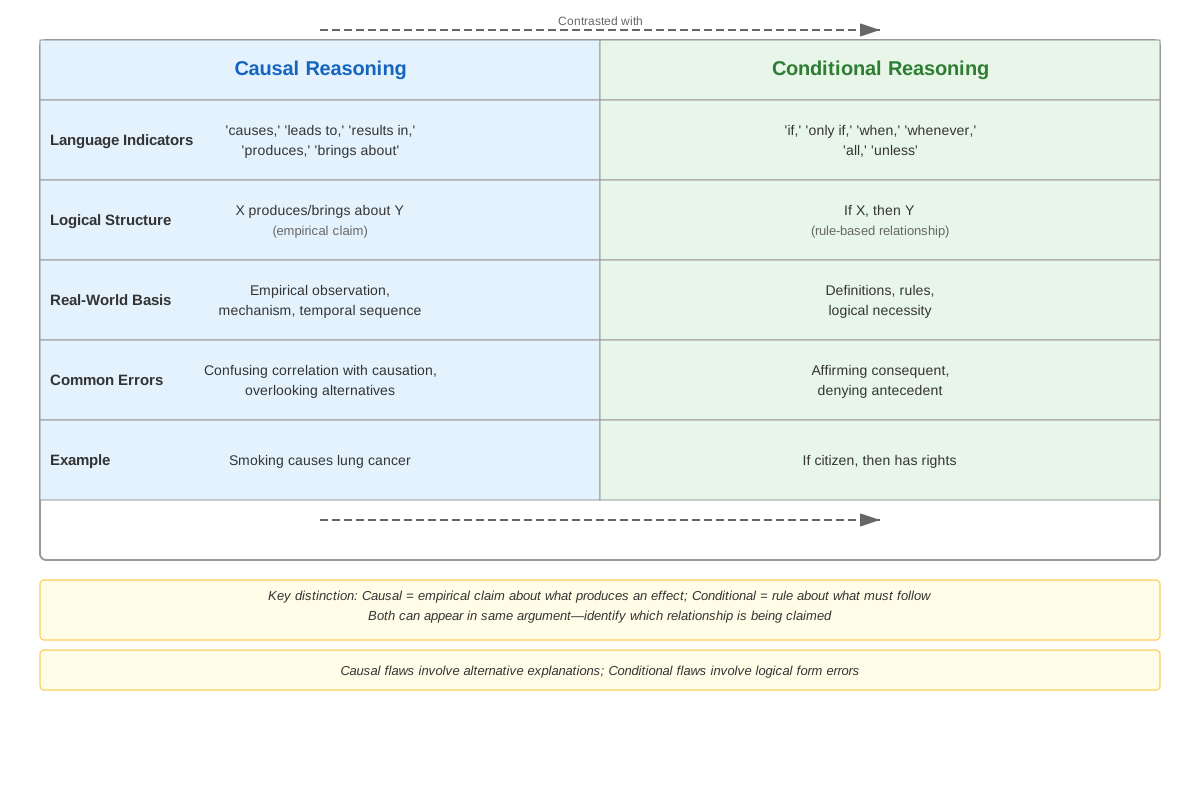
The causal flaw connects to broader Logical Reasoning concepts including sufficient and necessary conditions, conditional reasoning, and argument structure analysis. While conditional logic deals with "if-then" relationships that are definitional or rule-based, causal reasoning addresses empirical claims about what produces or brings about certain effects in the real world. Recognizing this distinction helps test-takers avoid conflating these different types of relationships and enables more precise identification of logical vulnerabilities in LSAT arguments.
Learning Objectives
- [ ] Identify how Causal flaw appears in LSAT questions
- [ ] Explain the reasoning pattern behind Causal flaw
- [ ] Apply Causal flaw to solve LSAT-style problems accurately
- [ ] Distinguish between correlation and causation in argument structures
- [ ] Recognize the four primary types of causal reasoning errors
- [ ] Predict alternative explanations that weaken causal claims
- [ ] Evaluate answer choices that correctly describe causal flaws
Prerequisites
- Basic argument structure: Understanding premises, conclusions, and how claims support one another is essential because causal flaws occur in the logical connection between evidence and conclusion
- Correlation vs. causation distinction: Familiarity with the difference between events occurring together versus one producing the other provides the foundation for recognizing causal errors
- Conditional reasoning fundamentals: Knowledge of sufficient and necessary conditions helps distinguish rule-based relationships from empirical causal claims
- Flaw question format: Understanding how the LSAT asks test-takers to identify reasoning errors ensures proper approach to causal flaw questions
Why This Topic Matters
Causal reasoning appears throughout legal practice, from establishing liability in tort cases to demonstrating discriminatory intent in civil rights litigation. Attorneys must constantly evaluate whether evidence genuinely supports causal claims or whether alternative explanations undermine a party's theory of causation. The LSAT tests this skill because law schools seek students who can think critically about cause-and-effect relationships rather than accepting superficial connections.
On the LSAT, causal flaws appear in approximately 3-5 questions per test, distributed across multiple question types. Flaw questions most directly test causal reasoning by asking test-takers to identify the error in an argument's reasoning. However, causal relationships also appear in Weaken questions (where correct answers provide alternative explanations), Strengthen questions (where correct answers rule out alternatives), Assumption questions (where correct answers state unstated causal premises), and occasionally in Parallel Flaw questions.
Common manifestations include arguments about policy effectiveness (claiming a policy caused an observed change), scientific or medical claims (asserting one factor produces a health outcome), historical explanations (attributing events to specific causes), and business or economic reasoning (connecting management decisions to company performance). The LSAT frequently presents scenarios where temporal sequence, statistical correlation, or anecdotal evidence is mistakenly treated as proof of causation.
Core Concepts
The Basic Structure of Causal Arguments
A causal argument claims that one phenomenon (the cause) produces, brings about, or is responsible for another phenomenon (the effect). In LSAT arguments, causal claims typically appear in conclusions, with premises offering evidence such as correlation, temporal sequence, or observed patterns. The fundamental structure follows this pattern: "Evidence shows X and Y occur together or in sequence; therefore, X causes Y."
Causal indicator language signals these relationships. Watch for phrases like "caused by," "results in," "leads to," "produces," "brings about," "is responsible for," "explains why," "the reason for," and "due to." These phrases explicitly state causal relationships. However, causal claims can also be implicit, requiring careful reading to identify the underlying causal assumption.
The Four Primary Types of Causal Flaws
Type 1: Correlation Mistaken for Causation
This most common causal flaw occurs when an argument observes that two phenomena occur together (correlation) and concludes that one causes the other without ruling out alternative explanations. The argument treats statistical association or co-occurrence as sufficient evidence for a causal relationship.
Example: "Countries with higher chocolate consumption have more Nobel Prize winners per capita. Therefore, eating chocolate improves cognitive function and leads to greater scientific achievement."
The flaw: The correlation between chocolate consumption and Nobel Prizes does not establish that chocolate causes scientific achievement. Alternative explanations include wealth (richer countries afford both chocolate and better education), cultural factors, or reverse causation.
Type 2: Reverse Causation
This flaw occurs when an argument identifies the correct two variables but reverses the causal direction, claiming A causes B when actually B causes A (or when causation runs in both directions). The argument observes correlation but misidentifies which phenomenon is the cause and which is the effect.
Example: "Studies show that people who exercise regularly report higher energy levels. Therefore, having high energy causes people to exercise more frequently."
The flaw: While the correlation is real, the argument reverses the likely causal direction. Exercise probably causes increased energy rather than existing energy causing exercise, though both directions might operate simultaneously.
Type 3: Common Cause (Third Factor)
This flaw occurs when an argument claims A causes B, but both A and B are actually effects of an unmentioned third factor C. The argument fails to consider that the correlation between A and B results from both being caused by something else entirely.
Example: "Children who sleep with nightlights are more likely to develop myopia. Therefore, nightlight use causes nearsightedness."
The flaw: Both nightlight use and myopia might result from a common cause—parental myopia. Nearsighted parents are more likely to use nightlights (because they have difficulty seeing in the dark) and more likely to have nearsighted children (genetic transmission).
Type 4: Temporal Sequence Mistaken for Causation (Post Hoc Fallacy)
This flaw, formally called "post hoc ergo propter hoc" (after this, therefore because of this), occurs when an argument claims that because B followed A in time, A must have caused B. Temporal sequence is necessary for causation but not sufficient to establish it.
Example: "The new mayor took office in January, and by March, unemployment had decreased by 2%. The mayor's policies are clearly responsible for the improved employment situation."
The flaw: The timing alone does not prove causation. The unemployment decrease might result from seasonal factors, national economic trends, policies enacted by the previous administration, or other factors unrelated to the new mayor's actions.
Necessary vs. Sufficient Evidence for Causation
Understanding what evidence actually establishes causation helps identify when arguments fall short. Strong causal arguments typically include:
| Evidence Type | What It Shows | Limitation |
|---|---|---|
| Correlation | A and B occur together | Does not show direction or rule out alternatives |
| Temporal sequence | A precedes B | Does not rule out coincidence or common cause |
| Mechanism | How A produces B | Strengthens claim but may be speculative |
| Controlled experiment | A's presence/absence affects B | Strongest evidence; rarely present in LSAT arguments |
| Alternative elimination | Other explanations ruled out | Necessary for strong causal claims |
LSAT arguments with causal flaws typically rely only on correlation or temporal sequence without eliminating alternatives, establishing mechanism, or providing experimental evidence.
Recognizing Vulnerable Causal Arguments
Certain argument structures signal high vulnerability to causal flaws:
- Single observation arguments: Claims based on one instance or anecdote without systematic evidence
- Correlation-only arguments: Evidence limited to statistical association without mechanism or alternative elimination
- Before-and-after comparisons: Temporal sequence without controlling for other changing factors
- Analogical causal claims: Assuming that because A causes B in one context, similar relationships hold elsewhere
- Complex system arguments: Causal claims about phenomena with multiple potential contributing factors
The Role of Alternative Explanations
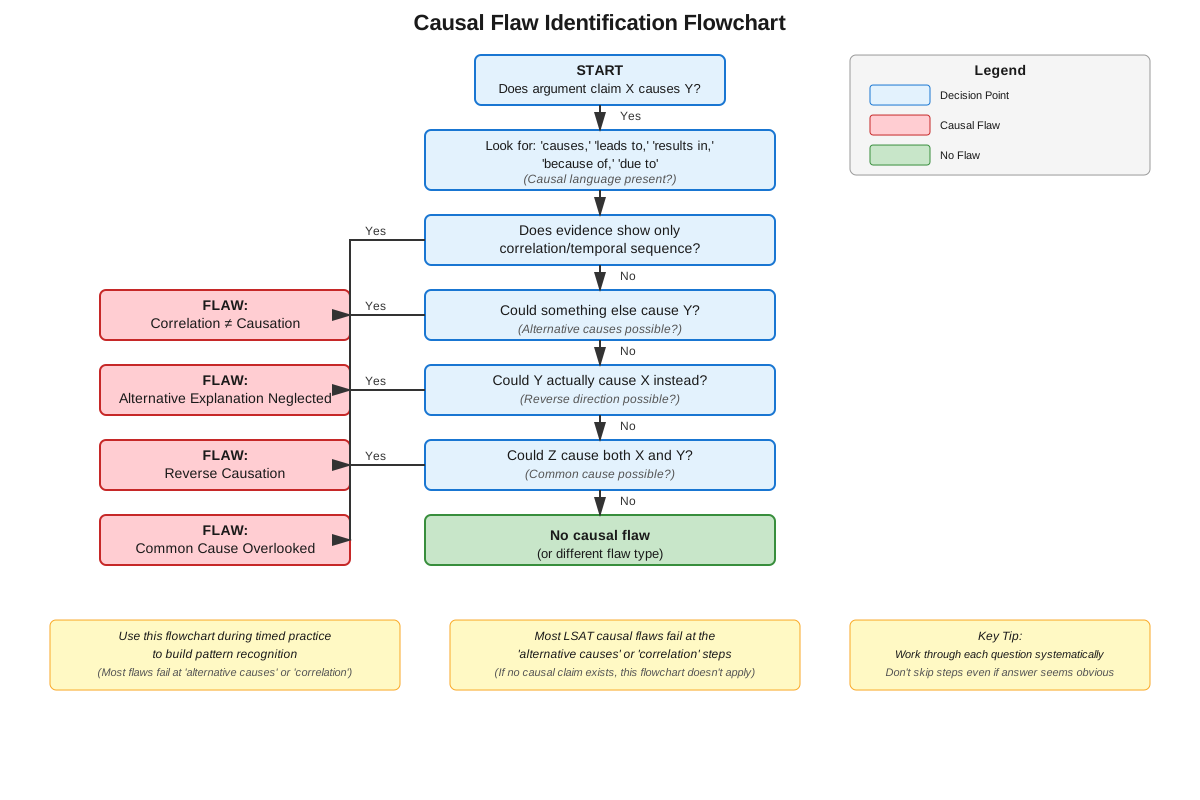
The key to identifying causal flaws lies in generating alternative explanations for the observed correlation or pattern. Strong causal arguments must address and eliminate plausible alternatives. Weak arguments ignore alternatives entirely. When evaluating LSAT causal arguments, systematically consider:
- Could the causal direction be reversed?
- Could a third factor cause both observed phenomena?
- Could the correlation be coincidental?
- Could other factors occurring simultaneously explain the effect?
- Could the effect have multiple causes, not just the one mentioned?
Concept Relationships
The causal flaw concept connects internally through a hierarchy of reasoning errors. At the foundation lies the basic correlation-causation confusion, which branches into more specific error types: reverse causation (wrong direction), common cause (missing third factor), and post hoc reasoning (temporal sequence alone). All four types share the common vulnerability of insufficient evidence to establish genuine causation.
Causal flaws connect to prerequisite knowledge of argument structure because identifying the flaw requires first recognizing where the causal claim appears (typically in the conclusion) and what evidence supports it (the premises). The relationship to conditional reasoning is contrastive—while conditional statements express definitional or rule-based relationships ("if A, then B"), causal statements make empirical claims about what produces effects in the world. Confusing these two relationship types leads to additional reasoning errors.
The concept map flows as follows: Basic argument structure → Identify causal claim → Evaluate evidence type → Generate alternative explanations → Recognize specific flaw type → Select answer describing the flaw. This sequence represents the analytical process for solving causal flaw questions.
Causal flaws also connect forward to Weaken questions (where alternatives weaken causal claims), Strengthen questions (where eliminating alternatives strengthens them), and Assumption questions (where unstated premises assert no alternatives exist). Mastering causal flaws thus enables success across multiple Logical Reasoning question types.
High-Yield Facts
- ⭐ Correlation does not establish causation—the most fundamental principle underlying all causal flaw questions
- ⭐ Temporal sequence (A before B) is necessary but not sufficient for causation—timing alone never proves a causal relationship
- ⭐ The four main causal flaw types are: correlation/causation confusion, reverse causation, common cause, and post hoc reasoning
- ⭐ Alternative explanations are the key to identifying causal flaws—if plausible alternatives exist, the causal claim is vulnerable
- ⭐ Causal flaw answer choices often use phrases like "fails to consider," "overlooks the possibility," or "takes for granted"
- Causal arguments appear in approximately 15-20% of Logical Reasoning questions across multiple question types
- Strong causal claims require eliminating alternative explanations, not just showing correlation
- Reverse causation is particularly common in arguments about behavior and outcomes
- Common cause flaws often involve genetic, environmental, or socioeconomic third factors
- The absence of a stated mechanism does not itself constitute a flaw, but it makes the argument more vulnerable
- Controlled experiments provide the strongest causal evidence but rarely appear in LSAT arguments
- Multiple factors can contribute to an effect; claiming a single cause when multiple exist is a causal oversimplification
- Causal claims about complex systems (economies, societies, ecosystems) are especially vulnerable to alternative explanations
- Answer choices describing causal flaws must match both the flaw type and the specific content of the argument
Quick check — test yourself on Causal flaw so far.
Try Flashcards →Common Misconceptions
Misconception: Any argument showing correlation commits a causal flaw.
Correction: Correlation is evidence for causation; the flaw occurs when the argument treats correlation as sufficient proof without addressing alternatives. Some LSAT arguments appropriately use correlation as supporting evidence while acknowledging limitations.
Misconception: Temporal sequence never indicates causation.
Correction: Temporal sequence is necessary for causation (causes must precede effects). The flaw occurs when arguments treat temporal sequence as sufficient evidence without ruling out coincidence or other explanations. Timing is relevant evidence, just not conclusive on its own.
Misconception: All causal arguments on the LSAT are flawed.
Correction: Causal arguments appear in various question types, and some are logically sound or can be strengthened. In Strengthen questions, for example, the stimulus may present a causal claim that the correct answer supports by eliminating alternatives.
Misconception: Reverse causation means the argument has the cause and effect completely backward.
Correction: Reverse causation means the argument identifies the correct two variables but reverses the primary causal direction. Sometimes causation operates in both directions (bidirectional causation), but the argument emphasizes the wrong direction.
Misconception: Identifying a causal flaw requires scientific or technical knowledge.
Correction: LSAT causal flaw questions test logical reasoning, not content knowledge. The flaw lies in the logical structure—the failure to eliminate alternatives—not in scientific facts. All necessary information appears in the stimulus.
Misconception: The correct answer must use the exact phrase "correlation and causation."
Correction: Answer choices describe causal flaws in various ways, including "fails to establish," "overlooks the possibility that," "takes for granted," "presumes without justification," and "treats as the sole cause." Recognizing these varied phrasings is essential.
Misconception: If an argument mentions multiple factors, it cannot commit a causal flaw.
Correction: Arguments can commit causal flaws even when acknowledging some complexity. The flaw might involve claiming one factor is primary without justification, ignoring the most important alternative, or failing to consider how factors interact.
Worked Examples
Example 1: Identifying a Common Cause Flaw
Stimulus: "A recent study found that employees who take regular vacation days report higher job satisfaction than those who take fewer vacation days. This demonstrates that taking vacations causes increased job satisfaction. Companies should therefore encourage employees to use their vacation time to improve workplace morale."
Question: The reasoning in the argument is flawed in that it:
Analysis:
Step 1: Identify the conclusion—"taking vacations causes increased job satisfaction"
Step 2: Identify the evidence—correlation between vacation days taken and reported job satisfaction
Step 3: Recognize this is a causal claim based on correlation
Step 4: Generate alternative explanations:
- Reverse causation: Maybe satisfied employees feel comfortable taking vacations, while dissatisfied employees fear taking time off
- Common cause: Perhaps employees with better work-life balance both take more vacations AND have higher satisfaction, with both resulting from supportive management or lower stress positions
- Other factors: Job type, salary, or workplace culture might affect both vacation-taking and satisfaction
Step 5: Identify the flaw type—this is most likely a common cause flaw, though reverse causation is also plausible
Correct answer would state: "fails to consider that both taking regular vacations and experiencing job satisfaction might result from other factors, such as having a supportive work environment"
Connection to learning objectives: This example demonstrates how to identify causal flaws (Objective 1), explains the reasoning pattern of assuming causation from correlation (Objective 2), and shows the analytical process for solving such problems (Objective 3).
Example 2: Reverse Causation in a Policy Argument
Stimulus: "Since the city implemented its new traffic monitoring system three years ago, the number of traffic accidents at monitored intersections has decreased by 30%. Meanwhile, intersections without monitoring equipment have seen only a 10% decrease in accidents. Clearly, the monitoring system has caused the reduction in accidents at equipped intersections, and the city should expand the program to all intersections."
Question: Which of the following, if true, most weakens the argument?
Analysis:
Step 1: Identify the causal claim—monitoring system caused the 30% accident reduction
Step 2: Identify the evidence—correlation between monitoring presence and larger accident reduction
Step 3: Note the comparison group (unmonitored intersections) strengthens the argument somewhat but doesn't eliminate all alternatives
Step 4: Generate alternative explanations:
- Reverse causation: Perhaps the city installed monitors at intersections that were already improving due to other factors
- Selection bias: The city might have chosen to monitor intersections where other improvements were made (new signals, road redesign)
- Common cause: Both monitoring installation and accident reduction might result from increased attention to those intersections
- Temporal factors: Other citywide changes in the past three years might affect monitored intersections differently
Step 5: Predict answer types that would weaken by providing alternatives
Strong weakening answer: "The city installed monitoring equipment only at intersections where it had also recently redesigned traffic flow patterns and improved lighting."
This answer provides an alternative explanation (road redesign and lighting) that could account for the accident reduction, undermining the claim that monitoring caused the improvement.
Connection to learning objectives: This example shows how causal flaws appear in Weaken questions (Objective 1), demonstrates the reasoning pattern of inferring causation from comparative correlation (Objective 2), and illustrates how to apply causal reasoning to eliminate wrong answers and select correct ones (Objective 3).
Exam Strategy
Recognizing Causal Claims in Stimuli
Develop a systematic approach to identifying causal arguments:
- Scan for causal indicator words: "causes," "results in," "leads to," "produces," "explains," "responsible for," "due to," "because of"
- Look for correlation evidence: Statistics, studies, surveys, or observations showing two things occurring together
- Check for temporal language: "after," "following," "since," "when," "subsequently"—these often signal post hoc reasoning
- Identify the conclusion: Causal claims typically appear in conclusions, with correlational evidence in premises
Exam Tip: If you see a study, survey, or statistical correlation in the premises and a conclusion about what "causes" or "explains" something, immediately consider causal flaw possibilities.
Approaching Different Question Types
For Flaw Questions:
- After identifying the causal claim, immediately generate 2-3 alternative explanations
- Predict answer language: "fails to consider," "overlooks the possibility," "presumes without warrant"
- Eliminate answers describing flaws not present in the argument
- The correct answer must describe both the flaw type AND match the argument's specific content
For Weaken Questions:
- Correct answers typically provide alternative explanations for the observed correlation
- Look for answers introducing third factors, suggesting reverse causation, or showing the correlation is coincidental
- Eliminate answers that are irrelevant to the causal mechanism or that actually strengthen the claim
For Strengthen Questions:
- Correct answers typically eliminate alternative explanations
- Look for answers ruling out reverse causation, common causes, or coincidence
- Answers providing mechanistic explanations (how A causes B) also strengthen causal claims
For Assumption Questions:
- Correct answers often state that no alternative explanation exists
- Use the negation test: if negating the answer destroys the argument, it's a necessary assumption
- Causal assumptions typically assert "no third factor," "not reverse causation," or "not coincidental"
Time Management
Allocate approximately:
- 20-30 seconds: Reading and identifying the causal claim
- 15-20 seconds: Generating alternative explanations
- 30-40 seconds: Evaluating answer choices
- Total: 65-90 seconds for straightforward causal flaw questions
More complex questions involving multiple causal claims or intricate scenarios may require up to 2 minutes. If generating alternatives takes longer than 20 seconds, move to the answer choices and use them to guide your thinking.
Process of Elimination Tips
Eliminate answers that:
- Describe flaws not present in the argument (e.g., claiming circular reasoning when the flaw is causal)
- Are too vague or generic to describe the specific causal error
- Confuse sufficient and necessary conditions (conditional logic) with causal relationships
- Criticize the argument for lacking evidence that isn't required (e.g., "fails to provide a complete mechanism")
- Describe the argument's evidence rather than its reasoning flaw
Favor answers that:
- Use precise language matching the argument's content
- Identify specific alternative explanations the argument overlooks
- Correctly name the relationship between the variables discussed
- Match the flaw type you identified during your initial analysis
Memory Techniques
The RACE Acronym for Causal Flaws
Reverse causation - Could the effect actually cause what's claimed as the cause?
Alternative explanations - What other factors might explain the correlation?
Common cause - Could a third factor cause both observed phenomena?
Evidence insufficient - Is the evidence (correlation, timing) enough to prove causation?
Visualization Strategy
Picture a triangle when considering common cause flaws:
        Third Factor (C)
           /    \
          /      \
         /        \
        A -------- B
    (observed)  (observed)
The argument claims A causes B (horizontal arrow) but overlooks that C causes both (diagonal arrows).
The "Just Because" Test
When you identify a causal claim, mentally insert "just because" before the evidence:
"Just because vacation days and job satisfaction correlate, does that mean vacations cause satisfaction?"
This phrasing naturally prompts consideration of alternatives and helps identify the logical gap.
Temporal Sequence Reminder
"After ≠ Because" - Memorize this simple equation. Temporal sequence (after) does not equal causation (because). This directly addresses post hoc reasoning.
The Three Questions Method
For any causal claim, ask:
- Could it be backward? (reverse causation)
- Could something else explain both? (common cause)
- Could it be coincidence? (no causation)
If the answer to any question is "yes" and the argument doesn't address it, you've found the flaw.
Summary
Causal flaws represent one of the highest-yield topics in LSAT Logical Reasoning, appearing across multiple question types and testing the fundamental critical thinking skill of distinguishing genuine causation from mere correlation. The core principle is that correlation, temporal sequence, and even comparative evidence do not establish causation without eliminating alternative explanations. The four primary causal flaw types—correlation mistaken for causation, reverse causation, common cause, and post hoc reasoning—all share this fundamental vulnerability. Success on causal reasoning questions requires a systematic approach: identify the causal claim, recognize the evidence type, generate alternative explanations, match the flaw to one of the four types, and select answers that precisely describe the oversight. Strong causal arguments must eliminate alternatives through controlled comparison, mechanistic explanation, or explicit consideration of competing hypotheses. The LSAT rewards test-takers who can quickly recognize causal claims, generate plausible alternatives, and navigate answer choices using precise logical analysis rather than intuition.
Key Takeaways
- Correlation never proves causation—this is the foundational principle for all causal reasoning questions
- The four main causal flaw types are correlation/causation confusion, reverse causation, common cause, and post hoc reasoning
- Alternative explanations are the key—if you can generate a plausible alternative, the argument likely commits a causal flaw
- Causal flaws appear across question types—Flaw, Weaken, Strengthen, and Assumption questions all test causal reasoning
- Temporal sequence is necessary but not sufficient—causes must precede effects, but timing alone doesn't prove causation
- Use the RACE acronym to systematically evaluate causal arguments: Reverse, Alternatives, Common cause, Evidence insufficient
- Answer choices must match both flaw type and content—generic descriptions or wrong flaw types are incorrect even if they sound sophisticated
Related Topics
Necessary and Sufficient Assumptions: Understanding what unstated premises causal arguments require connects directly to causal flaws, as these assumptions often assert that no alternative explanations exist. Mastering causal flaws provides the foundation for identifying these assumptions.
Strengthen and Weaken Questions: These question types frequently test causal reasoning by asking what would support or undermine causal claims. The skills developed in identifying causal flaws transfer directly to predicting what strengthens or weakens causal arguments.
Method of Reasoning Questions: Some questions ask how an argument proceeds or what role evidence plays. Recognizing causal reasoning patterns helps identify when arguments "infer causation from correlation" or "use temporal sequence as evidence."
Parallel Flaw Questions: Occasionally, the LSAT asks test-takers to identify arguments with parallel reasoning structures. Causal flaws appear in these questions, requiring recognition of the abstract pattern across different content.
Practice CTA
Now that you understand the core principles of causal flaws, it's time to apply this knowledge to actual LSAT questions. The practice questions and flashcards will reinforce your ability to quickly identify causal claims, generate alternatives, and select correct answers under timed conditions. Remember that recognizing causal flaws is a skill that improves dramatically with deliberate practice—each question you analyze strengthens your pattern recognition and speeds your analytical process. Approach the practice materials systematically, reviewing both correct and incorrect answers to understand why each choice succeeds or fails. Your investment in mastering causal reasoning will pay dividends across multiple question types and significantly boost your Logical Reasoning score.
Sign up free to keep reading
Create a free AnvayaPrep account to finish this LSAT guide on Causal flaw — plus flashcards and practice questions.