Overview
Conditional negation is one of the most frequently tested logical flaws on the LSAT, appearing regularly in Flaw Questions within the Logical Reasoning section. This error occurs when an argument incorrectly assumes that negating the sufficient condition of a conditional statement automatically negates the necessary condition, or vice versa. Understanding this flaw is absolutely critical because it represents a fundamental misunderstanding of how conditional logic operates—a misunderstanding that test-makers exploit repeatedly across multiple question types.
The LSAT tests conditional negation both directly and indirectly. Directly, you'll encounter arguments that explicitly commit this error, and you must identify it as the flaw. Indirectly, recognizing valid versus invalid conditional reasoning helps you eliminate wrong answers in Strengthen, Weaken, Assumption, and Inference questions. Mastering lsat conditional negation provides a significant competitive advantage because many test-takers struggle to distinguish between valid contrapositive reasoning and invalid negation patterns.
Within the broader landscape of Logical Reasoning, conditional negation sits at the intersection of formal logic and argument analysis. It builds upon basic conditional statement understanding while connecting to other common flaws like confusing sufficient and necessary conditions, reversing conditional relationships, and making unwarranted assumptions. The ability to spot conditional negation errors quickly and confidently separates high scorers from average performers, making this a genuinely high-yield topic that deserves focused attention and deliberate practice.
Learning Objectives
- [ ] Identify how Conditional negation appears in LSAT questions
- [ ] Explain the reasoning pattern behind Conditional negation
- [ ] Apply Conditional negation to solve LSAT-style problems accurately
- [ ] Distinguish between valid contrapositive reasoning and invalid conditional negation
- [ ] Recognize the multiple linguistic forms that signal conditional negation errors
- [ ] Predict when an argument is likely to commit a conditional negation flaw based on its structure
- [ ] Articulate why conditional negation represents invalid reasoning using formal logical notation
Prerequisites
- Basic conditional statement structure (if-then relationships): Understanding the difference between sufficient and necessary conditions is foundational to recognizing when these relationships are improperly negated.
- Contrapositive formation: Knowing how to validly transform a conditional statement by negating and reversing both terms allows you to distinguish correct from incorrect logical moves.
- Logical operators and their meanings: Familiarity with terms like "only if," "unless," "whenever," and "requires" helps identify conditional relationships embedded in natural language.
- Argument structure analysis: The ability to separate premises from conclusions enables you to pinpoint exactly where the logical error occurs in flawed reasoning.
Why This Topic Matters
Conditional negation appears in approximately 10-15% of all Flaw Questions on the LSAT, making it one of the top five most common logical errors tested. Beyond dedicated Flaw Questions, understanding this error pattern enhances performance on Necessary Assumption questions (where the correct answer often fixes a conditional negation error), Parallel Flaw questions (where matching the conditional structure is essential), and even some Strengthen/Weaken questions (where answer choices exploit conditional relationships).
In real-world contexts, conditional negation errors pervade everyday reasoning and public discourse. Politicians frequently argue that because a policy didn't achieve its intended goal (negating the necessary condition), the policy wasn't implemented properly (negating the sufficient condition). Business leaders sometimes reason that because a strategy succeeded (affirming the necessary condition), they must have followed best practices (affirming the sufficient condition). Legal reasoning, which the LSAT is designed to test, constantly requires distinguishing between what must be true, what might be true, and what cannot be true based on conditional relationships.
On the exam, conditional negation typically appears in arguments about causation, rules and their applications, predictions based on conditions, and policy recommendations. The LSAT presents these flaws in increasingly sophisticated linguistic packaging, requiring students to see through surface-level vocabulary to the underlying logical structure. Test-makers particularly favor conditional negation in harder questions (those appearing later in sections) because many students can identify obvious conditional statements but struggle when the relationships are expressed through complex sentence structures or embedded within longer arguments.
Core Concepts
The Structure of Conditional Statements
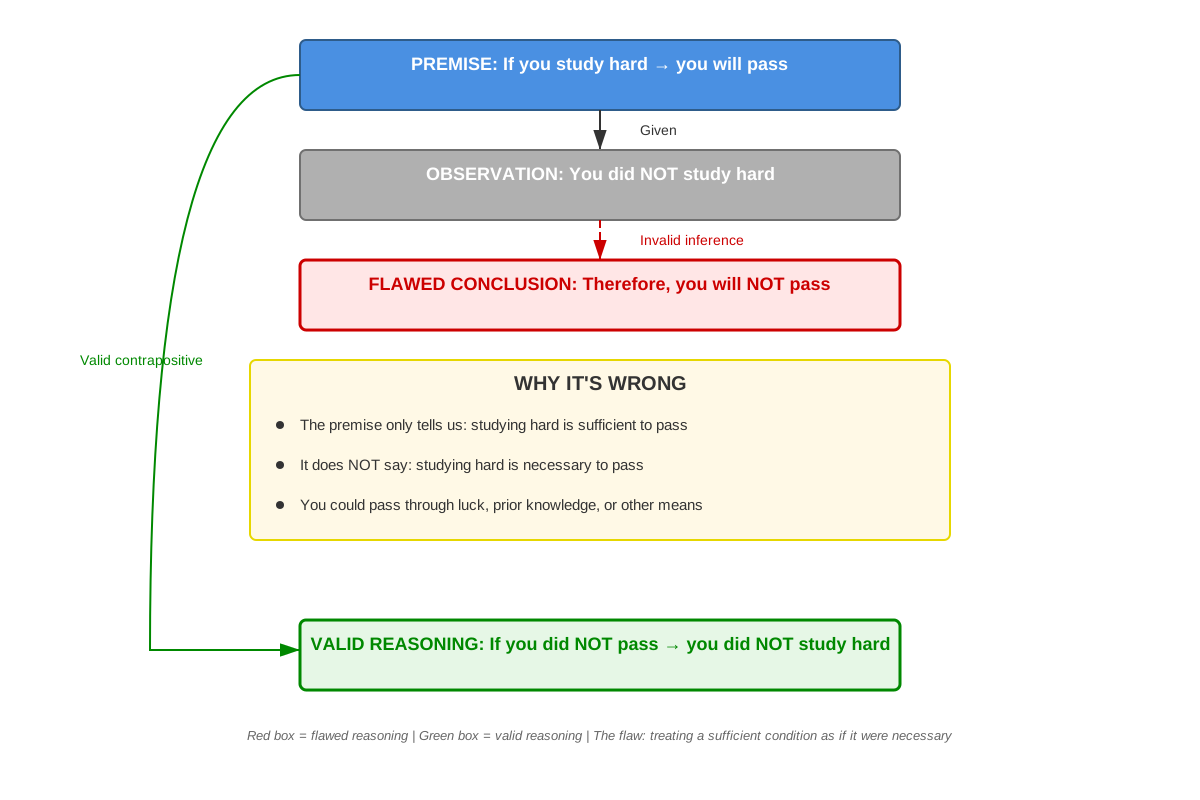
A conditional statement establishes a relationship between two conditions: a sufficient condition (the "if" part) and a necessary condition (the "then" part). The formal structure is: If A, then B, which can be symbolized as A → B. The sufficient condition (A) is enough to guarantee the necessary condition (B), but B can occur without A. This asymmetrical relationship is crucial to understanding why negation doesn't work the way many people intuitively assume.
Consider the statement: "If it is raining, then the ground is wet." Rain is sufficient for wet ground, but wet ground doesn't require rain (sprinklers, flooding, or morning dew could also cause it). The ground being wet is necessary for us to conclude it's raining in this logical framework, but rain isn't necessary for wet ground.
Valid Transformations: The Contrapositive
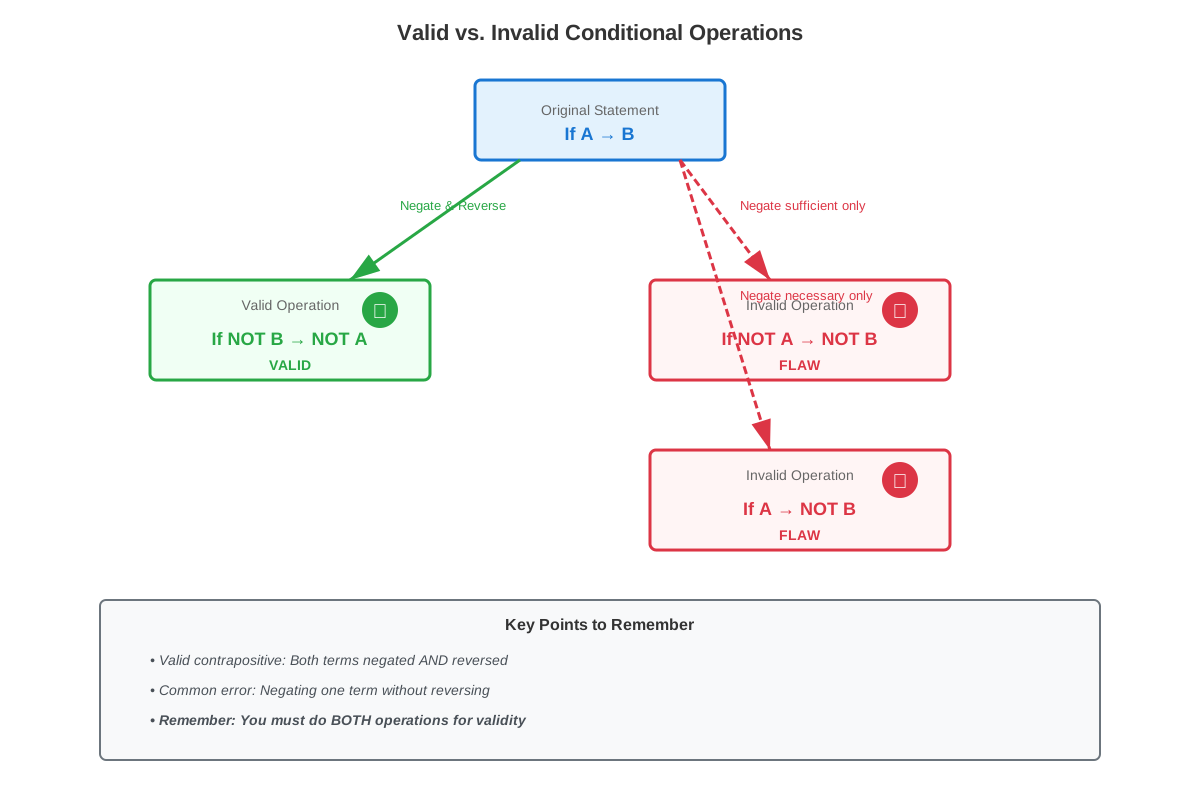
The only valid transformation of a conditional statement is the contrapositive, which negates both conditions AND reverses their order. If the original statement is A → B, the contrapositive is NOT B → NOT A (symbolized as ~B → ~A). This transformation is logically equivalent to the original statement—they always have the same truth value.
Using our rain example: "If it is raining, then the ground is wet" has the contrapositive "If the ground is NOT wet, then it is NOT raining." This is perfectly valid reasoning. If you observe dry ground, you can definitively conclude it isn't raining (assuming the original conditional is true).
Invalid Transformations: Conditional Negation
Conditional negation occurs when an argument negates one part of a conditional statement without properly applying contrapositive logic. There are two primary forms:
Form 1: Negating the Sufficient Condition
- Original: If A, then B (A → B)
- Invalid inference: If NOT A, then NOT B (~A → ~B)
- This is also called "denying the antecedent"
Example: "If it is raining, then the ground is wet. It is not raining. Therefore, the ground is not wet." This is invalid because other factors could make the ground wet even without rain.
Form 2: Negating the Necessary Condition
- Original: If A, then B (A → B)
- Invalid inference: If NOT B, then NOT A (~B → ~A)
- Wait—this looks like the contrapositive! But the error occurs when someone negates B without also reversing the relationship.
The more common manifestation on the LSAT involves affirming rather than negating, but the logical error is structurally similar. The key insight is that negating one condition doesn't tell you anything definitive about the other condition unless you also reverse the relationship (creating the contrapositive).
The Conditional Negation Flaw in Arguments
In LSAT arguments, conditional negation typically appears when:
- The premise establishes a conditional relationship (A → B)
- The premise or evidence indicates that A did not occur (~A)
- The conclusion invalidly infers that B did not occur (~B)
Or alternatively:
- The premise establishes a conditional relationship (A → B)
- The premise or evidence indicates that B did not occur (~B)
- The conclusion invalidly infers that A did not occur (~A)—but WITHOUT properly recognizing this as contrapositive reasoning
The flaw lies in treating the absence of the sufficient condition as if it guarantees the absence of the necessary condition, or in failing to recognize that multiple sufficient conditions might lead to the same necessary condition.
Linguistic Variations
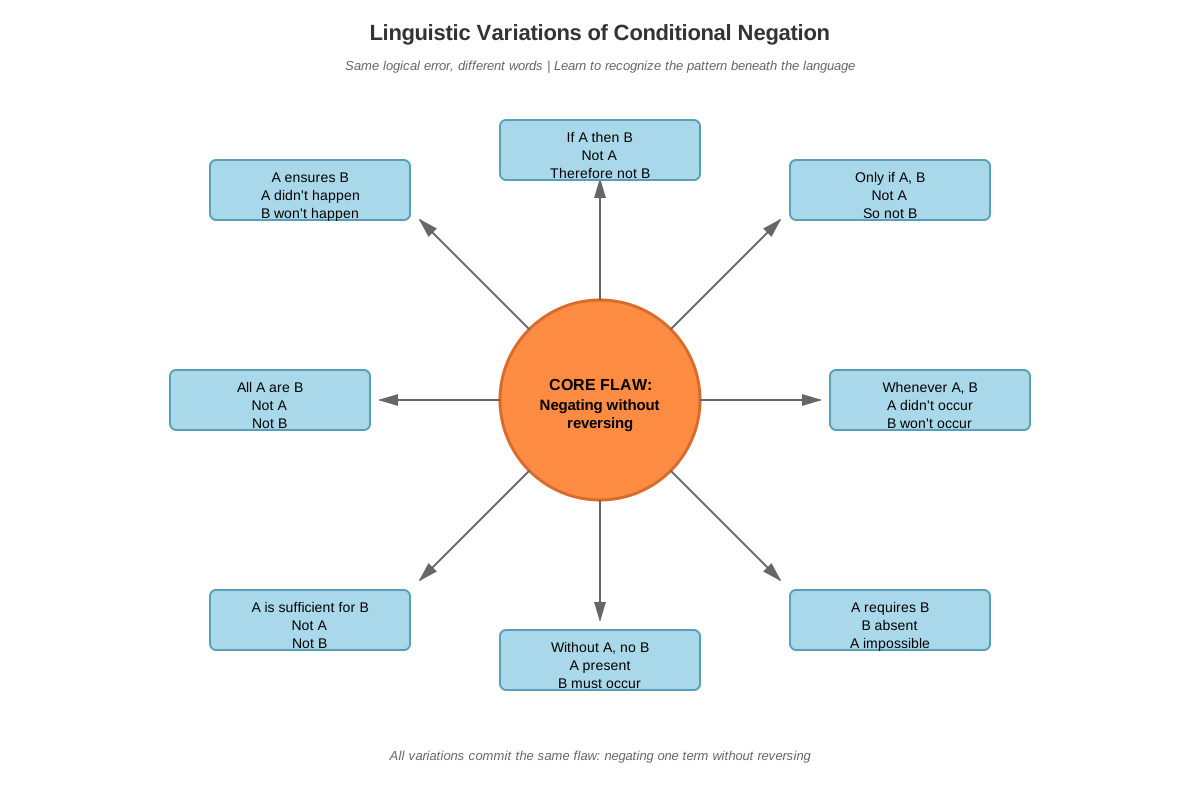
The LSAT rarely presents conditional statements in simple "if-then" format. Instead, test-makers use various linguistic constructions that express conditional relationships:
| Linguistic Form | Logical Structure | Example |
|---|---|---|
| "Only if B, A" | A → B | "You can graduate only if you pass the exam" (Graduate → Pass) |
| "A requires B" | A → B | "Admission requires a high score" (Admission → High Score) |
| "Without B, not A" | A → B | "Without oxygen, there is no fire" (Fire → Oxygen) |
| "All A are B" | A → B | "All lawyers passed the bar" (Lawyer → Passed Bar) |
| "A unless B" | ~B → A | "The plant dies unless watered" (~Watered → Dies) |
Conditional negation errors can occur with any of these linguistic forms, requiring students to first translate the natural language into logical structure, then identify whether the negation is valid or invalid.
Why Conditional Negation Is Invalid
The fundamental reason conditional negation fails is that conditional statements are one-directional. A → B tells you what happens when A is true, but it makes no claims about what happens when A is false. When A is false, B might be true or false—the original conditional simply doesn't address this scenario.
Think of it this way: A conditional statement gives you one pathway to a result, but it doesn't claim to be the only pathway. Negating that one pathway doesn't eliminate all possible pathways to the result. This is why "If it's raining, the ground is wet" doesn't mean "If it's not raining, the ground isn't wet"—there are other pathways to wet ground.
Concept Relationships
Conditional negation connects to several other logical reasoning concepts in a hierarchical and complementary way:
Foundation: Basic conditional logic (A → B structure) → Builds to → Valid transformations (contrapositive: ~B → ~A) → Contrasts with → Invalid transformations (conditional negation: ~A → ~B)
Parallel concepts: Conditional negation is one of several conditional reasoning errors, including:
- Reversing the conditional (confusing A → B with B → A)
- Confusing sufficient and necessary conditions
- Affirming the consequent (B is true, therefore A must be true)
Application context: Understanding conditional negation enables recognition of:
- Causal reasoning flaws (cause didn't occur, so effect didn't occur)
- Rule application errors (condition wasn't met, so rule doesn't apply)
- Prediction failures (expected condition absent, so predicted outcome won't happen)
Diagnostic utility: Conditional negation often appears alongside other flaws in complex arguments. An argument might commit conditional negation AND make an unwarranted assumption, but the conditional negation is the primary structural flaw. Recognizing the conditional negation helps eliminate answer choices that describe secondary or non-existent problems.
The relationship to contrapositive reasoning is particularly important: students must internalize that contrapositive formation (negate AND reverse) is valid, while simple negation (negate WITHOUT reversing) is invalid. This distinction appears in approximately 20% of all Logical Reasoning questions in some form.
High-Yield Facts
⭐ Conditional negation occurs when an argument negates one part of a conditional statement without properly reversing the relationship (as required for valid contrapositive reasoning).
⭐ The pattern "If A then B; not A; therefore not B" is ALWAYS invalid—this is the classic conditional negation error.
⭐ The only valid transformation of a conditional statement is the contrapositive: negate BOTH terms AND reverse their order.
⭐ Conditional negation is one of the top five most common flaws tested on the LSAT, appearing in 10-15% of Flaw Questions.
⭐ The LSAT disguises conditional statements using varied language ("only if," "requires," "unless," "all," "without"), but the underlying logical structure remains the same.
- Negating the sufficient condition tells you nothing definitive about the necessary condition—other sufficient conditions might exist.
- Conditional statements are one-directional; they specify one pathway to a result but don't claim it's the exclusive pathway.
- In Flaw Question answer choices, conditional negation might be described as "takes the absence of a condition to be sufficient to conclude that an effect will not occur" or "treats one possible cause as though it were a necessary cause."
- Arguments about rules, policies, and predictions are particularly prone to conditional negation errors on the LSAT.
- Recognizing conditional negation helps eliminate wrong answers in Assumption questions—the correct answer often provides an alternative sufficient condition or clarifies the conditional relationship.
- The contrapositive and the original conditional statement are logically equivalent and always have the same truth value.
- Conditional negation is sometimes called "denying the antecedent" in formal logic terminology.
- On harder LSAT questions, conditional negation may be embedded within complex sentence structures requiring careful diagramming to identify.
Quick check — test yourself on Conditional negation so far.
Try Flashcards →Common Misconceptions
Misconception: If a conditional statement is true, then negating both parts creates another true statement.
Correction: Simply negating both parts (A → B becomes ~A → ~B) is invalid. You must ALSO reverse the order to create the valid contrapositive (~B → ~A). The statement "If not A, then not B" is not logically related to "If A, then B."
Misconception: The contrapositive and conditional negation are the same thing.
Correction: The contrapositive is valid (negate AND reverse), while conditional negation is invalid (negate WITHOUT reversing). These are opposite in terms of logical validity. The contrapositive of A → B is ~B → ~A (valid). Conditional negation would be ~A → ~B (invalid).
Misconception: If the sufficient condition doesn't occur, the necessary condition probably won't occur either.
Correction: The absence of one sufficient condition tells you nothing about whether the necessary condition will occur. There may be multiple sufficient conditions, any one of which could bring about the necessary condition. Probability or likelihood is irrelevant to the logical structure.
Misconception: Conditional negation only appears in arguments with explicit "if-then" language.
Correction: Conditional relationships appear in many linguistic forms ("requires," "only if," "unless," "all," "without," etc.). Conditional negation can occur with any of these forms. The LSAT specifically tests whether you can recognize conditional structures regardless of surface-level wording.
Misconception: In real-world reasoning, conditional negation makes intuitive sense, so it must be acceptable on the LSAT.
Correction: The LSAT tests formal logical validity, not intuitive plausibility. Many conditional negation errors seem reasonable in everyday contexts but are logically invalid. The test specifically exploits the gap between intuitive reasoning and formal logic. Your task is to identify the logical flaw, not to evaluate whether the conclusion seems plausible.
Misconception: If an argument commits conditional negation, the conclusion must be false.
Correction: A logical flaw means the conclusion doesn't follow from the premises—it's not properly supported. However, the conclusion could still happen to be true for other reasons. The flaw is in the reasoning process, not necessarily in the truth value of the conclusion itself.
Worked Examples
Example 1: Classic Conditional Negation in a Policy Argument
Argument: "The city council implemented a new traffic policy stating that if traffic cameras are installed at an intersection, then accidents at that intersection will decrease. However, the council decided not to install traffic cameras at the intersection of Main and Elm. Therefore, accidents at Main and Elm will not decrease."
Analysis:
Step 1: Identify the conditional statement in the premises.
- "If traffic cameras are installed, then accidents will decrease"
- Structure: Cameras → Decrease in accidents
Step 2: Identify what the premises tell us happened.
- Cameras were NOT installed at Main and Elm
- This negates the sufficient condition: ~Cameras
Step 3: Identify the conclusion.
- Accidents will NOT decrease at Main and Elm
- This negates the necessary condition: ~Decrease in accidents
Step 4: Evaluate the logical connection.
- The argument structure is: Cameras → Decrease; ~Cameras; therefore ~Decrease
- This is the classic conditional negation pattern (~A → ~B)
- This is INVALID reasoning
Step 5: Explain why it's invalid.
The original conditional tells us that cameras are sufficient to cause a decrease in accidents, but it doesn't tell us that cameras are necessary for a decrease. Other factors might also reduce accidents: increased police presence, better signage, road redesign, or changes in traffic patterns. The absence of cameras doesn't guarantee that accidents won't decrease through these alternative means.
Correct answer choice might read: "The argument treats one possible cause of a decrease in accidents as though it were the only possible cause" or "The argument invalidly infers from the claim that a certain condition is sufficient for a result that the absence of that condition ensures the result will not occur."
Example 2: Conditional Negation in Causal Reasoning
Argument: "Research has shown that if children are exposed to classical music during early development, they will demonstrate enhanced spatial reasoning abilities. Marcus was not exposed to classical music during his early development. Consequently, Marcus will not demonstrate enhanced spatial reasoning abilities."
Analysis:
Step 1: Translate to logical structure.
- Original conditional: Classical music exposure → Enhanced spatial reasoning
- Symbolically: M → S
Step 2: Identify the evidence.
- Marcus was not exposed to classical music: ~M
Step 3: Identify the conclusion.
- Marcus will not have enhanced spatial reasoning: ~S
Step 4: Recognize the pattern.
- M → S; ~M; therefore ~S
- This is conditional negation (denying the antecedent)
Step 5: Articulate the flaw.
The research establishes that classical music exposure is sufficient for enhanced spatial reasoning, but it doesn't establish that it's necessary. Many other factors might contribute to enhanced spatial reasoning: puzzle-solving activities, sports participation, visual arts training, mathematical education, or genetic predisposition. Marcus might develop enhanced spatial reasoning through any of these alternative pathways, even without classical music exposure.
Step 6: Consider the contrapositive (valid reasoning).
The valid contrapositive would be: "If Marcus does NOT demonstrate enhanced spatial reasoning (~S), then Marcus was NOT exposed to classical music (~M)." This is logically sound but is NOT what the argument concludes.
This example demonstrates: How conditional negation appears in causal reasoning contexts, which are extremely common on the LSAT. The argument confuses a sufficient condition (classical music) with a necessary condition, treating it as if it were the only pathway to the result.
Exam Strategy
Identification Triggers
When reading LSAT arguments, watch for these warning signs that conditional negation might be present:
Structural triggers:
- Premise establishes a conditional relationship (any form: if-then, requires, only if, unless, all, etc.)
- Evidence states that the sufficient condition did NOT occur
- Conclusion claims the necessary condition will NOT occur
Language triggers:
- "Therefore, it won't happen"
- "Consequently, the result will not occur"
- "Thus, we can conclude it is not the case"
- "So the effect will be absent"
Systematic Approach
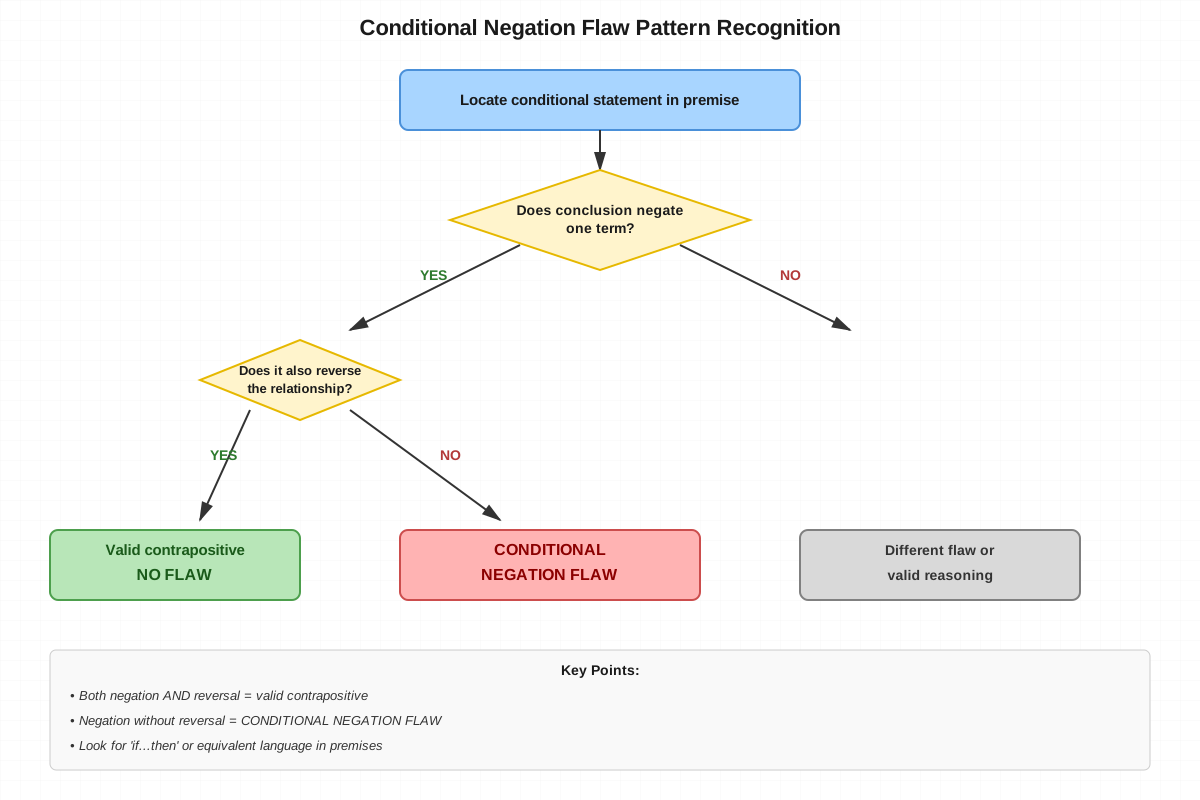
- Diagram the conditional relationship (30 seconds): Convert the natural language into symbolic form (A → B) to clarify the logical structure.
- Identify what's negated (15 seconds): Determine whether the argument negates the sufficient condition, the necessary condition, or both.
- Check for reversal (15 seconds): Did the argument reverse the relationship when negating? If not, it's likely conditional negation.
- Predict the flaw description (20 seconds): Before looking at answer choices, articulate the flaw in your own words: "The argument assumes that because one sufficient condition is absent, the necessary condition won't occur."
- Eliminate and confirm (40 seconds): Eliminate answer choices that describe different flaws, then confirm your selection matches the conditional negation pattern.
Answer Choice Recognition
Conditional negation in Flaw Question answer choices is typically described as:
- "treats a condition sufficient for bringing about a result as though it were necessary for doing so"
- "takes the absence of something that would ensure a particular outcome as evidence that that outcome will not occur"
- "confuses a condition that would guarantee a result with a condition required for that result"
- "mistakes a sufficient condition for a necessary condition"
Elimination strategy: Wrong answers in conditional negation questions often describe:
- Sampling errors or generalization problems (not relevant to conditional logic)
- Circular reasoning (the argument has a structural flaw, not a circularity problem)
- Ad hominem attacks (no personal attack is present)
- False dichotomies (the issue is conditional logic, not limited options)
Time Management
Conditional negation questions should take approximately 1:15-1:30 minutes once you've mastered the pattern. The diagramming step is crucial and worth the 30 seconds—it prevents errors and speeds up answer choice evaluation. If you find yourself spending more than 2 minutes, you likely haven't clearly identified the conditional structure. Return to Step 1 and re-diagram before proceeding.
Exam Tip: On test day, if you immediately recognize the conditional negation pattern, you can often predict the correct answer before reading the choices. This confidence allows you to move quickly and bank time for harder questions.
Memory Techniques
The "One Path" Mnemonic
Remember: "One path shown ≠ Only path known"
A conditional statement shows you ONE pathway to a result (if A, then B), but it doesn't claim this is the ONLY pathway. Blocking one path doesn't block all paths. This simple phrase captures why conditional negation is invalid.
The Contrapositive Checklist: "NERD"
To form a valid contrapositive, remember NERD:
- Negate the necessary condition
- Exchange the positions (reverse)
- Reverse the arrow direction
- Double-check you negated both terms
If you only do the "N" without the "ER," you've committed conditional negation.
Visual Analogy: The Highway System
Think of a conditional statement as a highway: "If you take Highway A, you'll reach City B." This tells you Highway A is a route to City B, but it doesn't mean Highway A is the ONLY route. If Highway A is closed (~A), you can't conclude City B is unreachable (~B)—there might be Highway C, Highway D, or a train route. This analogy helps internalize why negating the sufficient condition doesn't negate the necessary condition.
The "Flip and Negate" Rule
For valid contrapositive reasoning, remember: "Flip and Negate BOTH"
If you flip (reverse) without negating, you get the converse (invalid).
If you negate without flipping, you get conditional negation (invalid).
You must do BOTH operations to maintain logical validity.
Summary
Conditional negation represents a fundamental misunderstanding of how conditional logic operates and is one of the most frequently tested flaws on the LSAT Logical Reasoning section. This error occurs when an argument negates one part of a conditional statement without properly applying contrapositive logic—specifically, when it assumes that negating the sufficient condition necessarily negates the necessary condition, or when it negates without also reversing the relationship. The only valid transformation of a conditional statement (A → B) is the contrapositive (~B → ~A), which requires negating BOTH terms AND reversing their order. Conditional negation fails because conditional statements are one-directional: they establish one pathway to a result but don't claim it's the exclusive pathway. Mastering this concept requires recognizing conditional relationships in varied linguistic forms, distinguishing valid from invalid transformations, and quickly identifying the flaw pattern in LSAT arguments. Success depends on systematic diagramming, understanding the logical structure beneath surface-level language, and remembering that the absence of one sufficient condition tells you nothing definitive about whether the necessary condition will occur.
Key Takeaways
- Conditional negation is the invalid inference that negating one part of a conditional statement (without reversing) negates the other part—this is one of the top five most tested flaws on the LSAT.
- The pattern "If A then B; not A; therefore not B" is ALWAYS logically invalid, even if it seems intuitively reasonable in everyday contexts.
- The only valid transformation of a conditional is the contrapositive: negate BOTH terms AND reverse their order (~B → ~A from A → B).
- Conditional statements show one pathway to a result but don't claim it's the only pathway—other sufficient conditions may exist.
- The LSAT disguises conditional relationships using varied language ("requires," "only if," "unless," "all"), requiring translation to logical structure before evaluating validity.
- In Flaw Questions, conditional negation is typically described as treating a sufficient condition as though it were necessary, or taking the absence of a sufficient condition as evidence the result won't occur.
- Systematic diagramming (30 seconds) prevents errors and accelerates answer choice evaluation, making it a worthwhile time investment on test day.
Related Topics
Sufficient vs. Necessary Conditions: Understanding the distinction between conditions that guarantee a result (sufficient) and conditions required for a result (necessary) is foundational to recognizing when arguments confuse these concepts. Mastering conditional negation naturally leads to deeper exploration of this distinction.
Contrapositive Formation and Application: Since valid contrapositive reasoning is the correct alternative to conditional negation, studying how to form and apply contrapositives strengthens your ability to distinguish valid from invalid conditional inferences across all Logical Reasoning question types.
Causal Reasoning Flaws: Many conditional negation errors appear in causal contexts, where arguments treat causes as necessary rather than merely sufficient. Understanding conditional negation provides tools for analyzing more complex causal reasoning patterns.
Formal Logic and Conditional Chains: Advanced LSAT questions combine multiple conditional statements into chains (A → B → C). Recognizing conditional negation errors becomes more challenging but also more valuable in these complex scenarios.
Parallel Flaw Questions: Once you can identify conditional negation, you can match this flaw pattern across different content areas—a crucial skill for Parallel Flaw questions, which test whether you understand the abstract logical structure independent of subject matter.
Practice CTA
Now that you understand the conditional negation flaw pattern, it's time to cement this knowledge through active practice. Work through the practice questions and flashcards designed specifically for this topic, focusing on recognizing the pattern quickly and accurately. Each practice problem you solve strengthens your ability to spot this flaw on test day, building the automaticity that separates top scorers from average performers. Remember: understanding the concept is the first step, but fluency comes from deliberate practice. You've invested the time to learn this high-yield topic—now maximize that investment by applying it to LSAT-style problems. Your future self on test day will thank you for the preparation you're doing right now.
Sign up free to keep reading
Create a free AnvayaPrep account to finish this LSAT guide on Conditional negation — plus flashcards and practice questions.