Overview
Confusing sufficient and necessary conditions represents one of the most frequently tested logical flaws on the LSAT Logical Reasoning section. This error occurs when an argument mistakenly treats a sufficient condition as if it were necessary, or vice versa. Understanding this distinction is absolutely critical for success on flaw questions, as well as for strengthening, weakening, and assumption questions throughout the exam. The LSAT tests this concept repeatedly because it reflects a fundamental error in conditional reasoning that appears in legal analysis, policy debates, and everyday arguments.
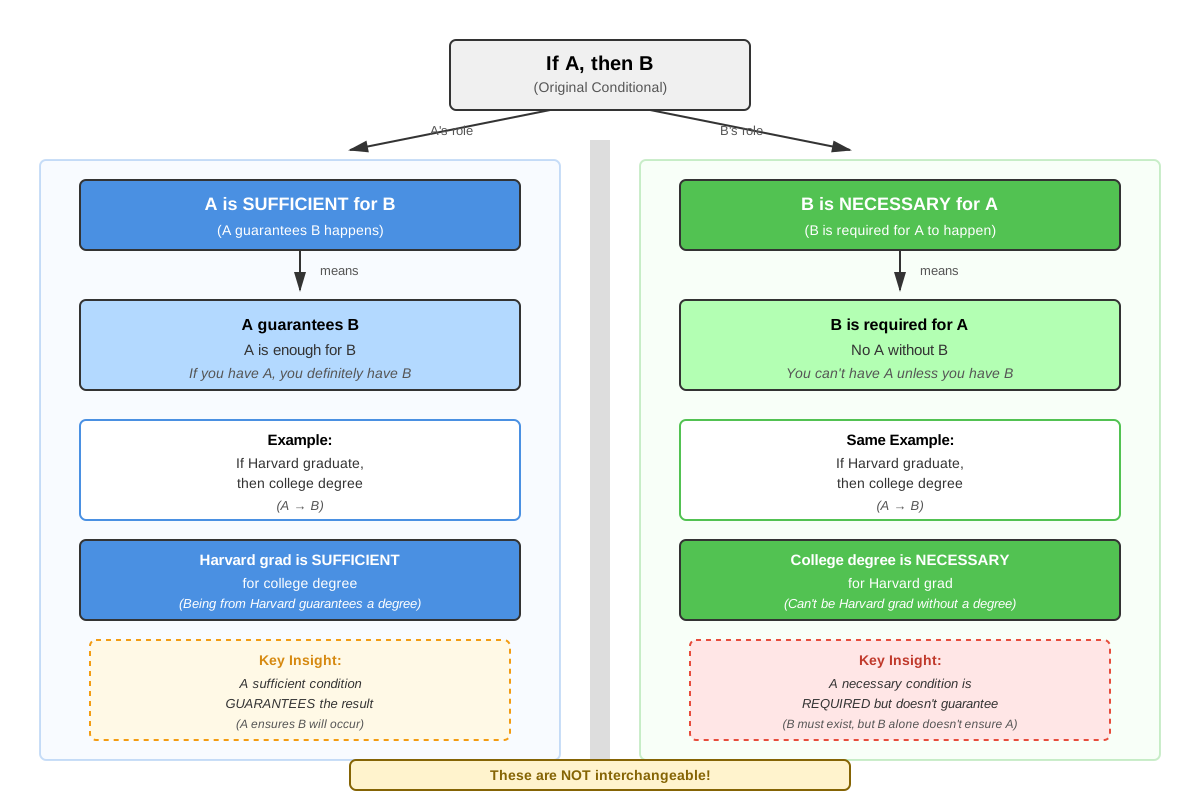
The confusion between sufficient and necessary conditions stems from a misunderstanding of the directional nature of conditional relationships. When someone says "If A, then B," they establish that A is sufficient for B (A guarantees B) and that B is necessary for A (you cannot have A without B). However, this does NOT mean that B is sufficient for A, nor does it mean that A is necessary for B. Arguments that make this reversal commit the flaw of confusing sufficient and necessary conditions, creating invalid reasoning that the LSAT expects test-takers to identify and critique.
This topic sits at the heart of logical reasoning on the LSAT. Mastering the distinction between sufficient and necessary conditions provides the foundation for understanding formal logic, conditional chains, contrapositive reasoning, and numerous argument patterns. Students who thoroughly understand this concept gain a significant advantage across multiple question types, as conditional reasoning appears in approximately 25-30% of all Logical Reasoning questions in some form.
Learning Objectives
- [ ] Identify how confusing sufficient and necessary appears in LSAT questions
- [ ] Explain the reasoning pattern behind confusing sufficient and necessary
- [ ] Apply confusing sufficient and necessary to solve LSAT-style problems accurately
- [ ] Distinguish between valid and invalid conditional inferences in complex arguments
- [ ] Recognize the formal logical structure underlying sufficient/necessary confusion
- [ ] Predict answer choice patterns for flaw questions involving conditional reasoning errors
- [ ] Construct contrapositives correctly to avoid sufficient/necessary confusion
Prerequisites
- Basic conditional logic notation: Understanding "if...then" statements is essential because sufficient/necessary confusion involves misinterpreting these relationships
- Contrapositive formation: Knowing how to correctly form contrapositives helps identify when arguments incorrectly reverse or negate conditionals
- Argument structure identification: Recognizing premises and conclusions allows students to pinpoint where the logical error occurs
- Flaw question format: Familiarity with how the LSAT asks about flawed reasoning helps students recognize what they're looking for
Why This Topic Matters
In legal reasoning and policy analysis—the core competencies the LSAT measures—distinguishing between sufficient and necessary conditions is crucial. Lawyers must understand that meeting one requirement for a contract doesn't mean meeting all requirements, or that satisfying a necessary condition doesn't automatically satisfy all conditions. This logical precision prevents costly errors in legal interpretation and argumentation.
On the LSAT itself, confusing sufficient and necessary appears with remarkable frequency. Research on released LSAT exams shows that this flaw appears in approximately 3-5 questions per test, making it one of the top five most common logical flaws tested. It appears most frequently in:
- Flaw questions (primary appearance): "The reasoning is flawed in that it..."
- Necessary assumption questions: Where the assumption must fix the sufficient/necessary confusion
- Parallel flaw questions: Where students must match the logical structure of the error
- Strengthen/Weaken questions: Where answer choices exploit the gap created by the confusion
The LSAT presents this flaw in various contexts: scientific reasoning, policy recommendations, causal arguments, and conditional predictions. Test-makers deliberately embed the error within complex language to obscure the underlying logical structure, making pattern recognition essential for efficient problem-solving.
Core Concepts
Understanding Sufficient Conditions
A sufficient condition is something that, if present, guarantees a particular outcome. When we say "A is sufficient for B," we mean that whenever A occurs, B must also occur. The presence of A is enough—sufficient—to ensure B happens. In conditional notation: A → B (read as "if A, then B").
For example: "If you score 180 on the LSAT, then you will be admitted to at least one law school." Scoring 180 is sufficient for admission somewhere because that score guarantees admission. However, scoring 180 is NOT necessary for admission—you can be admitted with lower scores.
Key characteristics of sufficient conditions:
- They guarantee the result
- They appear in the "if" clause of conditional statements
- Multiple different sufficient conditions can lead to the same result
- The absence of a sufficient condition tells us nothing definite
Understanding Necessary Conditions
A necessary condition is something that must be present for a particular outcome to occur. When we say "B is necessary for A," we mean that A cannot happen without B. However, B alone doesn't guarantee A will happen. In the conditional A → B, B is necessary for A.
For example: "To attend law school, you must have a bachelor's degree." Having a bachelor's degree is necessary for law school attendance, but it's not sufficient—you also need acceptable LSAT scores, applications, and admission. The degree is required but doesn't guarantee admission.
Key characteristics of necessary conditions:
- They are required for the result
- They appear in the "then" clause of conditional statements
- Their absence prevents the outcome (via contrapositive)
- Their presence alone doesn't guarantee the outcome
The Logical Structure of the Confusion
The flaw of confusing sufficient and necessary occurs when an argument commits one of these errors:
- Treating a sufficient condition as necessary: Assuming that because A is sufficient for B, A must be necessary for B
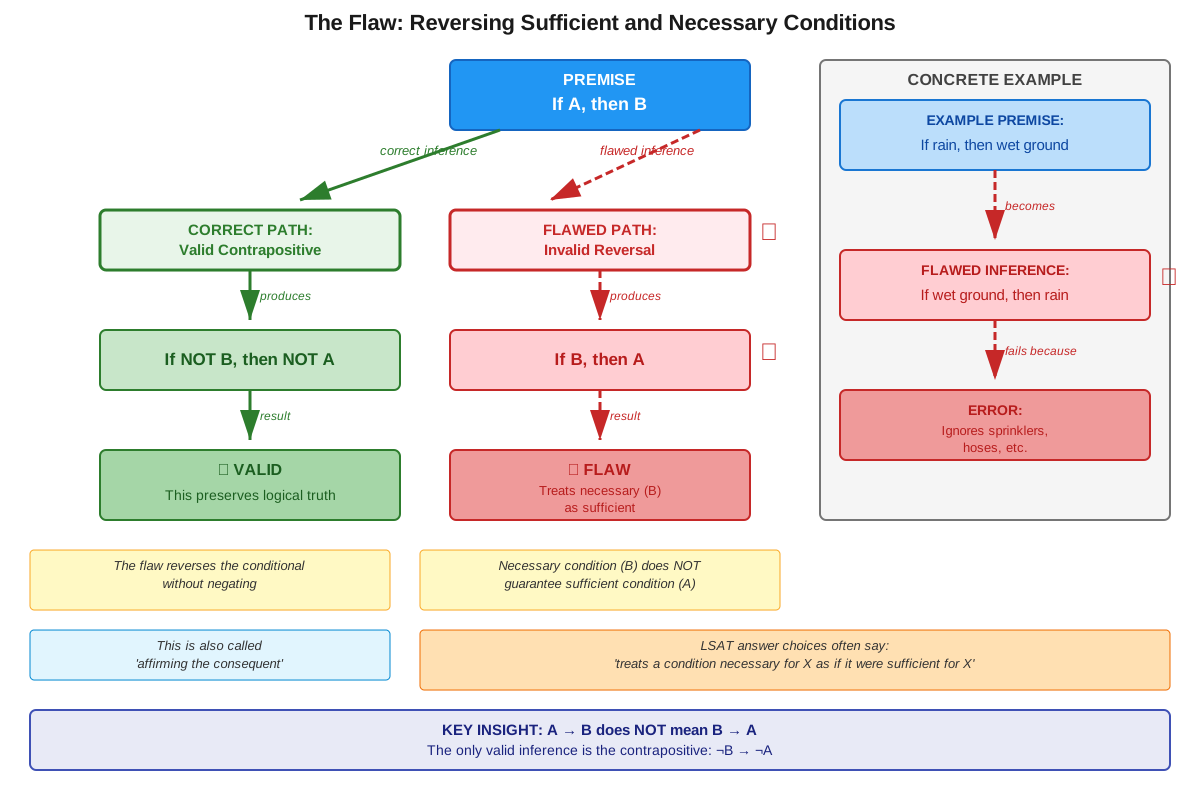
- Treating a necessary condition as sufficient: Assuming that because B is necessary for A, B must be sufficient for A
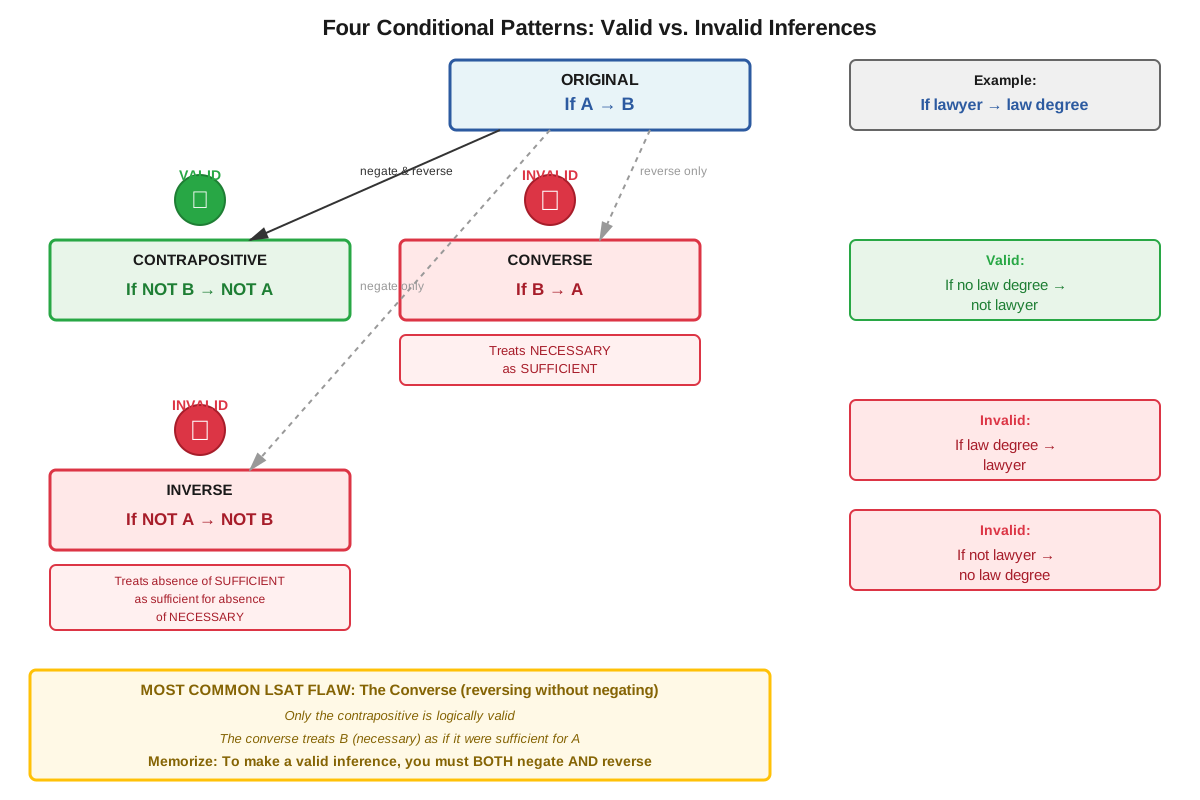
| Valid Conditional | A → B (If A, then B) |
|---|---|
| What this means | A is sufficient for B; B is necessary for A |
| Valid inference | Contrapositive: ~B → ~A (If not B, then not A) |
| INVALID inference | Converse: B → A (If B, then A) |
| INVALID inference | Inverse: ~A → ~B (If not A, then not B) |
Common Manifestations in LSAT Arguments
Pattern 1: Mistaking Sufficient for Necessary
Argument structure:
- Premise: If you have X, then you will achieve Y
- Conclusion: Therefore, to achieve Y, you must have X
Example: "Studies show that people who exercise daily have lower stress levels. Therefore, daily exercise is necessary to reduce stress."
The flaw: Daily exercise is presented as sufficient for lower stress (if you exercise daily, you'll have lower stress), but the conclusion treats it as necessary (you must exercise daily to have lower stress). Other methods might also reduce stress.
Pattern 2: Mistaking Necessary for Sufficient
Argument structure:
- Premise: To achieve Y, you must have X
- Conclusion: Therefore, if you have X, you will achieve Y
Example: "To become a licensed attorney, one must pass the bar exam. Sarah passed the bar exam, so she will become a licensed attorney."
The flaw: Passing the bar is necessary for licensure, but the argument treats it as sufficient. Sarah might lack other requirements (character and fitness approval, law degree, etc.).
Recognizing the Flaw in Complex Language
The LSAT rarely presents this flaw in simple, transparent language. Instead, test-makers embed the error within sophisticated vocabulary and complex sentence structures. Common linguistic disguises include:
- Causal language: "X causes Y" often implies X is sufficient for Y, but arguments may treat it as necessary
- Requirement language: "X requires Y" means Y is necessary for X, but arguments may treat Y as sufficient
- Guarantee language: "X guarantees Y" means X is sufficient for Y, but arguments may treat X as necessary
- Conditional indicators: "only if," "unless," "without," and "except" create necessary conditions that may be mistaken for sufficient ones
The Contrapositive Connection
Understanding contrapositives helps identify sufficient/necessary confusion. The contrapositive of A → B is ~B → ~A (if not B, then not A). This is the ONLY valid reversal of a conditional statement. When an argument reverses a conditional without negating both terms (creating B → A instead of ~B → ~A), it confuses sufficient and necessary conditions.
Concept Relationships
The confusion between sufficient and necessary conditions connects directly to several other logical reasoning concepts:
Conditional Logic Foundation → Sufficient/Necessary Distinction → Flaw Identification
The ability to parse conditional statements provides the foundation for recognizing when arguments misuse these relationships. Once identified, this flaw appears across multiple question types.
Sufficient/Necessary Confusion ↔ Contrapositive Errors: These concepts are intimately related. Arguments that fail to form proper contrapositives often confuse sufficient and necessary conditions by creating invalid converses or inverses.
Sufficient/Necessary Confusion → Necessary Assumption Questions: Many necessary assumption questions require assumptions that bridge the gap created by treating a sufficient condition as necessary or vice versa.
Sufficient/Necessary Confusion → Formal Logic Questions: In questions involving complex conditional chains, each link must maintain proper sufficient/necessary relationships. One reversal breaks the entire chain.
The relationship to prerequisite knowledge: Basic conditional logic (if-then statements) establishes the vocabulary and notation, while understanding argument structure allows students to identify where in the reasoning the confusion occurs. Together, these enable precise diagnosis of the flaw.
Quick check — test yourself on Confusing sufficient and necessary so far.
Try Flashcards →High-Yield Facts
⭐ A sufficient condition guarantees an outcome but is not required for it; a necessary condition is required but doesn't guarantee the outcome
⭐ The only valid reversal of a conditional is the contrapositive (reversing AND negating both terms)
⭐ In A → B, A is sufficient for B and B is necessary for A—never the reverse
⭐ Treating a necessary condition as sufficient is the most common form of this flaw on the LSAT
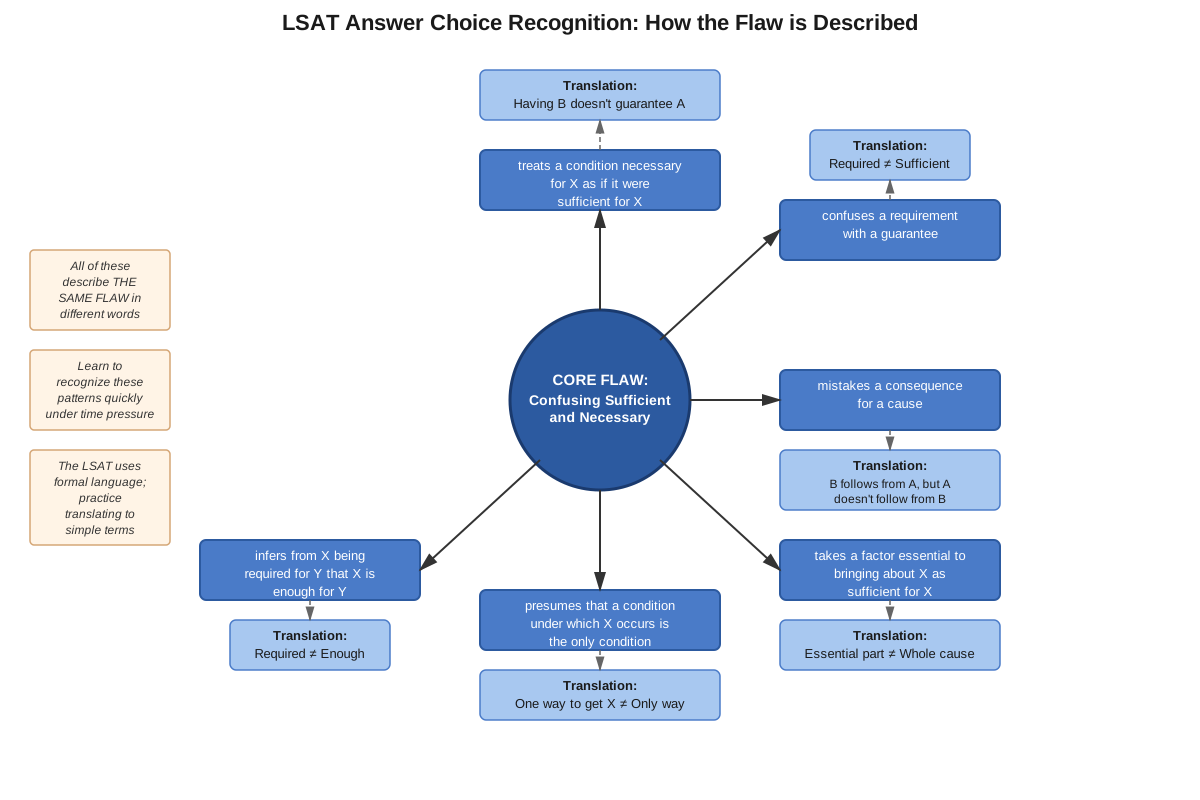
⭐ Answer choices describing this flaw often use phrases like "treats a condition that is necessary as though it were sufficient" or "confuses a sufficient condition with a necessary condition"
- The converse (B → A) and inverse (~A → ~B) are both invalid inferences from A → B
- Multiple sufficient conditions can exist for the same necessary condition
- A condition can be both sufficient and necessary (A ↔ B), but this must be explicitly stated
- "Only if" introduces a necessary condition, not a sufficient one (A only if B means A → B)
- The absence of a necessary condition guarantees the absence of the outcome (via contrapositive)
- Causal relationships often involve sufficient conditions that arguments mistakenly treat as necessary
- Requirement language ("must," "requires") indicates necessary conditions that may be mistaken for sufficient ones
Common Misconceptions
Misconception: If A is sufficient for B, then A is also necessary for B.
Correction: Sufficient and necessary are distinct logical relationships. A can be sufficient for B while being completely unnecessary—other conditions might also produce B. The conditional A → B tells us only that A guarantees B, not that A is required for B.
Misconception: The converse of a conditional statement (reversing without negating) is logically valid.
Correction: The converse (B → A from A → B) is invalid. Only the contrapositive (~B → ~A) is valid. Treating the converse as valid is precisely the error of confusing sufficient and necessary conditions.
Misconception: If something is necessary, it must be important or significant.
Correction: In logic, "necessary" has a technical meaning—required for an outcome—regardless of importance. Oxygen is necessary for human life, but so is having at least one cell. Both are necessary despite different levels of significance.
Misconception: An argument that confuses sufficient and necessary is always completely wrong in its conclusion.
Correction: The conclusion might happen to be true, but the reasoning is flawed. The flaw is in the logical connection between premises and conclusion, not necessarily in the truth of the conclusion itself.
Misconception: Necessary conditions are rare or unusual requirements.
Correction: Necessary conditions are simply requirements, common or rare. Breathing is necessary for running a marathon, and so is registering for the race—both are necessary conditions despite different levels of difficulty.
Misconception: If multiple conditions are each sufficient for an outcome, then all of them together are necessary.
Correction: Multiple sufficient conditions create alternatives, not requirements. If A, B, or C each suffice for outcome X, then you need only one of them, not all. None individually is necessary unless it's the only sufficient condition.
Worked Examples
Example 1: Classic Sufficient/Necessary Confusion
Argument: "Research has demonstrated that regular meditation reduces anxiety in most practitioners. Therefore, anyone seeking to reduce their anxiety must practice regular meditation."
Analysis:
Step 1: Identify the conditional relationship in the premise.
- Premise: If someone practices regular meditation → they will (likely) reduce anxiety
- This establishes meditation as sufficient for anxiety reduction
Step 2: Identify what the conclusion claims.
- Conclusion: If someone seeks to reduce anxiety → they must practice meditation
- This treats meditation as necessary for anxiety reduction
Step 3: Recognize the flaw.
The argument takes a sufficient condition (meditation) and treats it as necessary. The premise tells us meditation is one way to reduce anxiety (sufficient), but the conclusion claims it's the only way or a required way (necessary). Other methods—therapy, medication, lifestyle changes—might also reduce anxiety.
Step 4: Predict the answer choice.
Look for language like: "treats a condition sufficient for bringing about a result as though it were necessary for that result" or "mistakes a sufficient condition for a necessary one."
Connection to learning objectives: This example demonstrates the core pattern of sufficient/necessary confusion and shows how to identify it systematically in LSAT arguments.
Example 2: Necessary Condition Treated as Sufficient
Argument: "To qualify for the advanced seminar, students must have completed the introductory course. Jennifer has completed the introductory course, so she will qualify for the advanced seminar."
Analysis:
Step 1: Identify the conditional relationship.
- Premise: If qualify for advanced seminar → must have completed introductory course
- This can be written as: Qualify → Completed Intro
- The introductory course is necessary for qualification
Step 2: Examine the conclusion's logic.
- Conclusion: Jennifer completed intro → Jennifer will qualify
- This reverses the conditional: Completed Intro → Qualify
- This treats the necessary condition (completing intro) as sufficient
Step 3: Identify what's missing.
The introductory course might be necessary but not sufficient. Other requirements might exist: minimum grade, instructor approval, prerequisite skills, enrollment capacity, etc. Meeting one necessary condition doesn't guarantee meeting all requirements.
Step 4: Recognize the formal error.
The argument commits the fallacy of affirming the consequent—it takes the "then" clause of the conditional and treats it as an "if" clause. This is the classic form of treating a necessary condition as sufficient.
Real LSAT application: This pattern appears frequently in arguments about qualifications, requirements, and eligibility. Watch for arguments that conclude someone will achieve an outcome simply because they've met one stated requirement.
Exam Strategy
Identification Triggers
When reading LSAT arguments, watch for these linguistic signals that often accompany sufficient/necessary confusion:
Sufficient condition indicators (in premises):
- "If," "when," "whenever," "all," "any," "each," "every"
- "Guarantees," "ensures," "causes"
Necessary condition indicators (in premises):
- "Only if," "must," "requires," "necessary," "prerequisite"
- "Without," "unless," "except," "until"
Flaw signal phrases (in conclusions):
- "Therefore, one must..."
- "Thus, it is necessary to..."
- "So, the only way to..."
- "Hence, X will definitely occur..."
Systematic Approach for Flaw Questions
- Diagram the conditional relationship in the premise using arrow notation
- Identify which term is sufficient and which is necessary
- Examine the conclusion to see if it reverses this relationship
- Check for the gap: Does the conclusion claim necessity when only sufficiency was established, or vice versa?
- Predict the answer: Look for language about confusing/treating/mistaking sufficient and necessary conditions
Process of Elimination Tips
Eliminate answer choices that:
- Describe the conditional relationship correctly (these describe valid reasoning, not the flaw)
- Mention completely different flaws (circular reasoning, ad hominem, etc.) when you've identified sufficient/necessary confusion
- Reverse the error (saying the argument treats necessary as sufficient when it actually treats sufficient as necessary)
Keep answer choices that:
- Use the exact language "sufficient" and "necessary"
- Describe treating one type of condition as the other type
- Mention "confuses," "mistakes," "takes to be," or "treats as though"
Time Management
This flaw typically takes 45-60 seconds to identify once you recognize the pattern. Spend:
- 20 seconds reading and diagramming the argument
- 15 seconds identifying the flaw
- 20 seconds scanning answer choices for the match
If you cannot quickly diagram the conditional, skip and return—forcing the analysis wastes time. With practice, recognition becomes nearly automatic.
Memory Techniques
The "Guarantee vs. Requirement" Mnemonic
SUFFICIENT = GUARANTEE
- Sufficient
- Guarantees
- Both have the letter 'u'
- Think: "Sufficient is enough—it's a guarantee"
NECESSARY = REQUIREMENT
- Necessary
- Requirement
- Both end in 'y' sound
- Think: "Necessary means you need it—it's required"
The Arrow Direction Visualization
Visualize the arrow as a one-way street:
A → B
(Sufficient) → (Necessary)
The arrow flows FROM sufficient TO necessary. You cannot legally drive backward on a one-way street, just as you cannot reverse the conditional without negating both terms.
The "ONLY Reverses" Rule
ONLY the contrapositive is valid—and it requires reversing AND negating:
- Only
- Negate
- Logically
- Yield valid reversal
This reminds you that you must negate both terms when reversing.
The "SCAN" Approach for Flaw Questions
- Spot the conditional language
- Chart the relationship (diagram it)
- Analyze the conclusion's claim
- Note the reversal (if present)
Summary
Confusing sufficient and necessary conditions represents a fundamental logical error that appears frequently throughout the LSAT Logical Reasoning section. This flaw occurs when arguments mistakenly treat a sufficient condition (one that guarantees an outcome) as if it were necessary (required for the outcome), or vice versa. The most common pattern involves treating a necessary condition as sufficient—concluding that because something is required for an outcome, its presence guarantees that outcome. Mastering this concept requires understanding that in any conditional relationship A → B, A is sufficient for B and B is necessary for A, and that the only valid reversal is the contrapositive (~B → ~A). The LSAT tests this concept across multiple question types, particularly in flaw questions where test-takers must identify the logical error, and in assumption questions where the correct answer bridges the gap created by the confusion. Success requires recognizing conditional language, accurately diagramming relationships, and systematically checking whether conclusions reverse the sufficient/necessary relationship established in the premises.
Key Takeaways
- Sufficient conditions guarantee outcomes but aren't required; necessary conditions are required but don't guarantee outcomes
- The flaw appears when arguments reverse the direction of conditional relationships without proper negation
- In A → B, A is sufficient for B and B is necessary for A—memorize this relationship
- Only the contrapositive (~B → ~A) is a valid reversal; the converse (B → A) commits the sufficient/necessary confusion
- This flaw appears in 3-5 questions per LSAT, making it one of the highest-yield patterns to master
- Watch for conclusions using "must," "necessary," "only way," or "will definitely" after premises establish sufficient conditions
- Diagramming conditional relationships with arrows prevents confusion and enables quick flaw identification
Related Topics
Formal Logic and Conditional Chains: Building on sufficient/necessary distinctions, this topic explores complex conditional sequences where multiple relationships link together. Mastering sufficient/necessary confusion is essential before tackling multi-step conditional reasoning.
Contrapositive Formation and Application: This topic deepens understanding of the only valid way to reverse conditionals. Students who master sufficient/necessary confusion are prepared to use contrapositives strategically in Must Be True and Inference questions.
Necessary Assumption Questions: Many necessary assumptions fix the gap created by sufficient/necessary confusion. Understanding this flaw enables students to predict what assumptions arguments require.
Parallel Flaw Questions: These questions require matching the logical structure of flawed reasoning. Recognizing sufficient/necessary confusion in abstract form prepares students for these challenging questions.
Causal Reasoning Flaws: Causal arguments often involve sufficient conditions (causes) that are mistakenly treated as necessary. This topic extends sufficient/necessary analysis to causal contexts.
Practice CTA
Now that you understand the distinction between sufficient and necessary conditions and can identify when arguments confuse them, it's time to reinforce this knowledge through active practice. Attempt the practice questions designed for this topic, focusing on quickly recognizing the conditional relationships and identifying where arguments reverse them. Use the flashcards to drill the key distinctions until recognizing this flaw becomes automatic. Remember: this is one of the highest-yield patterns on the LSAT—every minute spent mastering it directly translates to points on test day. The difference between understanding this concept intellectually and recognizing it instantly under timed conditions comes only through deliberate practice. You've built the foundation; now make it instinctive.
Sign up free to keep reading
Create a free AnvayaPrep account to finish this LSAT guide on Confusing sufficient and necessary — plus flashcards and practice questions.