Overview
The lack of baseline flaw represents one of the most frequently tested reasoning errors in LSAT Logical Reasoning sections. This flaw occurs when an argument presents data, statistics, or observations about a current state of affairs but fails to provide comparative information from a previous time period or control condition. Without this baseline comparison, the argument cannot validly conclude that a change has occurred, that a trend exists, or that a particular factor caused an observed outcome.
Understanding this flaw is essential for LSAT success because it appears across multiple question types, including flaw questions, assumption questions, strengthen/weaken questions, and method of reasoning questions. The LSAT frequently tests whether students can recognize when an argument jumps to conclusions about change, improvement, or causation without establishing what the situation was like before the alleged change occurred. This reasoning pattern exploits a common cognitive bias: people naturally assume that current observations represent meaningful changes without questioning whether baseline data supports such conclusions.
Within the broader landscape of Logical Reasoning concepts, the lack of baseline flaw connects intimately with causal reasoning errors, statistical reasoning flaws, and comparison errors. It shares conceptual territory with other common LSAT flaws such as confusing correlation with causation and making unwarranted comparisons. Mastering this topic strengthens overall analytical skills and provides a framework for evaluating arguments that rely on temporal comparisons, before-and-after claims, and assertions about trends or patterns over time.
Learning Objectives
- [ ] Identify how Lack of baseline flaw appears in LSAT questions
- [ ] Explain the reasoning pattern behind Lack of baseline flaw
- [ ] Apply Lack of baseline flaw to solve LSAT-style problems accurately
- [ ] Distinguish lack of baseline flaw from related reasoning errors such as causal confusion and sampling flaws
- [ ] Predict answer choice language that correctly describes this flaw in various question formats
- [ ] Construct valid baseline comparisons that would repair flawed arguments
Prerequisites
- Basic argument structure recognition: Understanding premises and conclusions is necessary to identify where baseline information should appear but doesn't
- Causal reasoning fundamentals: Recognizing causal claims helps identify when baseline data would be needed to support such claims
- Statistical reasoning basics: Familiarity with how data and numbers function in arguments enables recognition of incomplete statistical comparisons
- Temporal reasoning: Understanding how arguments make claims about change over time is essential for spotting missing baseline comparisons
Why This Topic Matters
The lack of baseline flaw appears with remarkable frequency on the LSAT, showing up in approximately 10-15% of Logical Reasoning questions across various question types. This high frequency makes it one of the most valuable flaw patterns to master for test day success. Questions featuring this flaw typically appear at medium to medium-high difficulty levels, making them crucial for students aiming to break into the 160+ score range.
In real-world contexts, the lack of baseline flaw underlies many misleading arguments in advertising, politics, and media reporting. Companies claim their products "improve" outcomes without showing what those outcomes were before product use. Politicians tout "record" achievements without providing historical context. News reports highlight current statistics without comparative data that would reveal whether situations are actually changing. Developing sensitivity to this flaw enhances critical thinking skills applicable far beyond the LSAT.
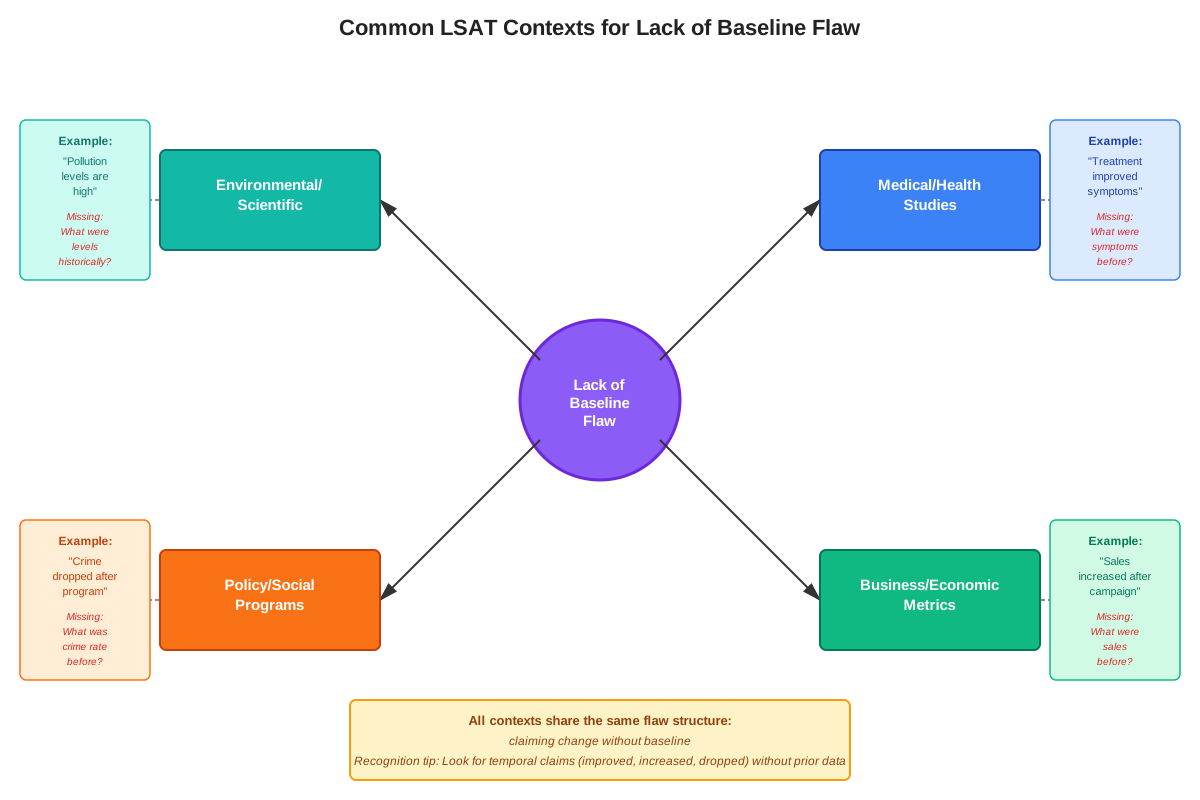
On the exam, this flaw commonly appears in arguments about: medical treatments or interventions claiming effectiveness without pre-treatment data; business or policy changes asserting improvement without prior performance metrics; social trends or patterns concluded from current observations alone; scientific studies claiming to identify causes without control group comparisons; and educational or training programs claiming success without baseline measurements. The LSAT tests this concept because it represents a fundamental principle of sound reasoning: to claim something has changed, improved, or worsened, one must know what it was like before.
Core Concepts
The Fundamental Structure of the Flaw
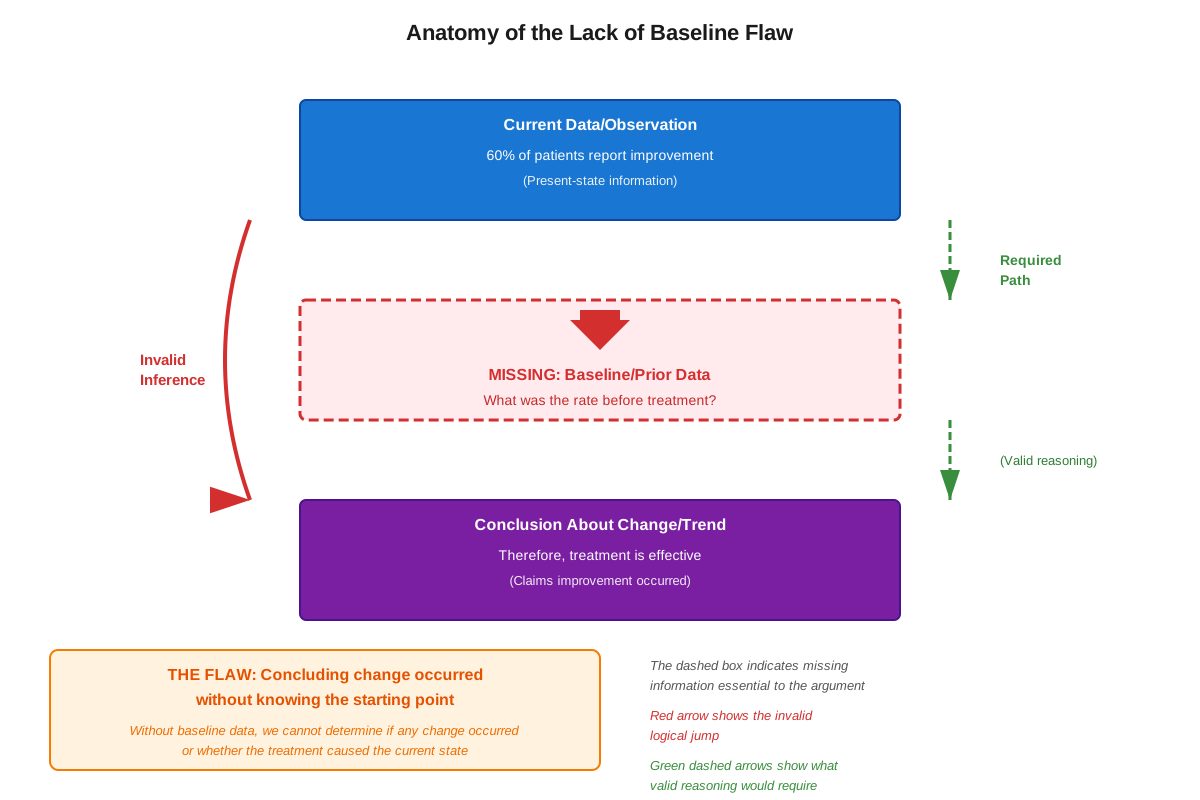
The lack of baseline flaw (also called the "no baseline comparison" error) occurs when an argument presents current data or observations and draws a conclusion about change, improvement, causation, or trends without providing comparative information from a prior state or control condition. The logical structure follows this pattern:
- Premise: Current observation or data point X exists
- Conclusion: Therefore, X represents a change/improvement/problem/trend
- Missing element: No information about what the situation was like before or in comparison conditions
This flaw violates a fundamental principle of comparative reasoning: to establish that something has changed, one must know both the current state AND the previous state. Without baseline data, the argument commits a logical leap from "is" to "was different before."
Key Characteristics and Recognition Patterns
Several distinctive features help identify this flaw in LSAT passages:
Temporal language without temporal comparison: Arguments use words like "increase," "decrease," "improve," "worsen," "trend," "growing," or "declining" while providing data from only one time period. The conclusion asserts change, but the premises describe only the present state.
Causal claims from single observations: The argument attributes an outcome to a specific cause based on current observations alone, without showing that the outcome was different before the alleged cause was present.
Effectiveness claims without pre-intervention data: Arguments conclude that a treatment, policy, or intervention "works" or "is effective" based solely on post-intervention observations, without establishing what outcomes looked like before the intervention.
Comparative conclusions from absolute data: The argument presents absolute numbers or percentages and concludes something is "high," "low," "excessive," or "insufficient" without reference points for comparison.
The Logical Gap Explained
The reasoning error stems from a fundamental confusion between describing a state and describing a change in state. Consider this distinction:
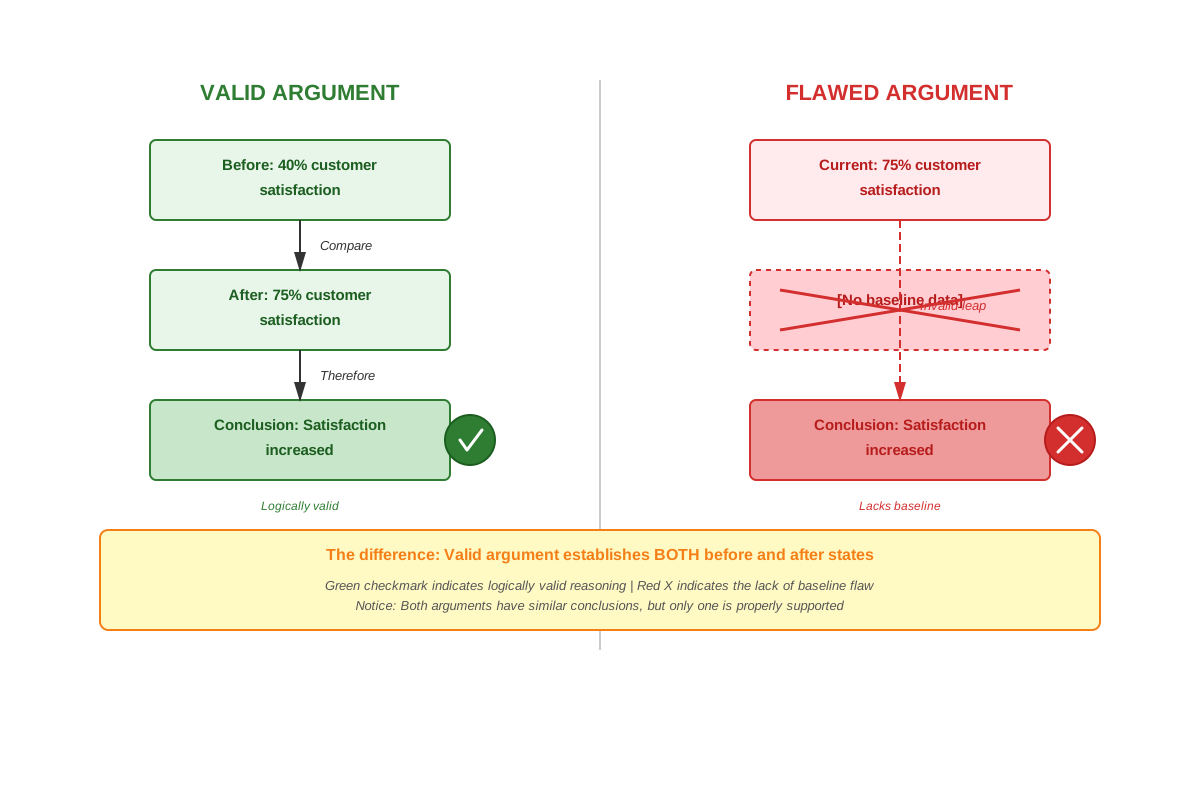
| Valid Reasoning | Flawed Reasoning |
|---|---|
| Premise: 40% of students failed last year | Premise: 40% of students failed this year |
| Premise: 60% of students failed this year | Conclusion: Student failure rates have increased |
| Conclusion: Failure rates increased by 20% | Missing: Any data about previous years |
| Evidence: Baseline comparison provided | Gap: No baseline for comparison |
The flawed reasoning treats a single data point as if it were inherently meaningful for claims about change. However, without knowing the baseline, we cannot determine whether 40% represents an increase, decrease, or stable pattern. Perhaps failure rates have always been around 40%. Perhaps they were previously 70% and have actually improved. The current observation alone cannot answer these questions.
Variations in How the Flaw Appears
The LSAT presents this flaw in several distinct variations:
Before-and-after claims: Arguments assert that a change occurred between two time periods but provide data from only one period. Example: "After implementing the new policy, 30% of employees reported satisfaction. Therefore, the policy improved satisfaction." (Missing: satisfaction rates before the policy)
Trend identification: Arguments identify a pattern or trend based on a single observation or short time series without longer-term baseline data. Example: "Crime rates this year are 15% higher than last year. This represents a dangerous upward trend." (Missing: data from multiple previous years to establish whether this is truly a trend or normal variation)
Effectiveness evaluation: Arguments conclude that an intervention caused an outcome without showing that the outcome was different before the intervention. Example: "Patients who received the treatment showed 70% improvement. The treatment is therefore effective." (Missing: improvement rates without treatment, or in a control group)
Comparative superiority: Arguments claim something is "better" or "worse" than alternatives without providing data about those alternatives. Example: "Our students score an average of 85%. Our program is superior." (Missing: scores from other programs or previous cohorts)
The Role of Control Groups and Comparison Conditions
A closely related concept involves control groups or comparison conditions. While technically distinct from temporal baseline comparisons, the underlying logical principle is identical: to attribute an outcome to a specific cause, one must show that the outcome differs from what occurs without that cause present.
Arguments lacking control group comparisons commit essentially the same error as those lacking temporal baselines—they fail to provide the comparative information necessary to support their conclusions. The LSAT often tests whether students recognize that both types of comparison (temporal and conditional) serve the same logical function: establishing a reference point against which to evaluate claims about change or causation.
Why This Flaw Is Persuasive
Understanding why this flaw appears convincing helps in recognizing it. The human mind naturally interprets current observations as meaningful without consciously considering baseline comparisons. When told "30% of users experienced side effects," people instinctively react to this number without asking "compared to what?" This cognitive tendency makes arguments with missing baselines feel complete even though they're logically incomplete.
Additionally, the flaw often appears in contexts where the conclusion seems plausible or matches prior expectations. If an argument claims a new teaching method "improved" test scores and provides data showing high current scores, readers may accept the improvement claim because it aligns with their assumption that new methods should improve outcomes. The LSAT exploits this tendency by presenting arguments where the conclusion seems reasonable, testing whether students can recognize the logical gap despite the conclusion's intuitive appeal.
Concept Relationships
The lack of baseline flaw connects to several other Logical Reasoning concepts in important ways:
Causal reasoning errors → The lack of baseline flaw often appears in causal arguments. When an argument claims X caused Y without baseline data, it commits both a causal reasoning error (failing to rule out alternative explanations) and a lack of baseline flaw (failing to show Y was different before X). These flaws frequently co-occur because establishing causation requires showing that the effect was absent or different before the cause was present.
Statistical reasoning → Baseline comparisons are a specific application of proper statistical reasoning. Arguments that misuse statistics often lack appropriate comparison groups or reference points. Understanding statistical reasoning principles helps recognize when baseline data would be necessary to interpret numbers meaningfully.
Necessary vs. sufficient assumptions → In assumption questions, the missing baseline often represents a necessary assumption. The argument assumes (without stating) that the baseline was different from the current state. Recognizing this helps identify correct answer choices in assumption questions.
Strengthen/Weaken questions → Information providing baseline comparisons typically strengthens arguments lacking them, while information showing similar baselines weakens conclusions about change. This relationship makes baseline reasoning relevant across multiple question types.
Comparison errors → The lack of baseline flaw is a specific type of comparison error—specifically, a missing comparison. It relates to other comparison flaws like comparing non-comparable groups or shifting comparison standards.
The conceptual flow: Argument makes claim about change/causation → Requires comparative evidence → Lacks baseline/control comparison → Commits logical flaw → Can be identified and exploited in various question types
High-Yield Facts
⭐ The lack of baseline flaw occurs when an argument concludes that something has changed, improved, or worsened without providing data about the previous state or comparison condition
⭐ This flaw appears in approximately 10-15% of Logical Reasoning questions, making it one of the most frequently tested reasoning errors
⭐ Key trigger words include: "increase," "decrease," "improve," "worsen," "trend," "growing," "change," "effective," and "better/worse"
⭐ The flaw can appear in multiple question types: flaw questions, assumption questions, strengthen/weaken questions, and method of reasoning questions
⭐ To claim something has changed, an argument must provide both current data AND baseline data—one data point alone cannot establish change
- Arguments lacking baselines often provide absolute numbers or percentages that seem meaningful but are actually uninterpretable without comparison
- The flaw is particularly common in arguments about medical treatments, policy effectiveness, business performance, and social trends
- Control group comparisons serve the same logical function as temporal baseline comparisons—both provide necessary reference points
- Answer choices describing this flaw often use language like "fails to establish," "takes for granted," "overlooks the possibility," or "presumes without justification"
- The flaw remains present even if the conclusion happens to be true—the issue is logical structure, not factual accuracy
- Baseline comparisons can be temporal (before vs. after) or conditional (with vs. without the factor in question)
- Arguments may provide baseline data for one variable while lacking it for another—careful reading is essential to identify which comparison is missing
Quick check — test yourself on Lack of baseline flaw so far.
Try Flashcards →Common Misconceptions
Misconception: If an argument provides any numbers or data, it has sufficient evidence for its conclusion → Correction: Numbers alone are meaningless without appropriate comparison points. An argument stating "40% of patients improved" provides data but no baseline for evaluating whether this represents good, bad, or typical improvement rates.
Misconception: The lack of baseline flaw only appears in arguments explicitly about "change" or "trends" → Correction: This flaw appears whenever an argument makes any comparative claim, including assertions about effectiveness, superiority, problems, or causation. An argument claiming a treatment "works" commits this flaw if it lacks baseline data, even without explicitly claiming the treatment "changed" outcomes.
Misconception: If the conclusion seems obviously true or reasonable, the argument doesn't commit a logical flaw → Correction: Logical flaws concern the relationship between premises and conclusion, not whether the conclusion happens to be true. An argument can reach a true conclusion through flawed reasoning. The LSAT tests logical structure, not factual accuracy.
Misconception: Providing data from two consecutive time periods automatically establishes a meaningful trend → Correction: Two data points can show a difference but cannot establish a trend without longer-term baseline data. What appears to be a trend might be normal variation. True trend identification requires multiple data points over extended periods.
Misconception: The lack of baseline flaw is the same as correlation/causation confusion → Correction: While related, these are distinct flaws. Correlation/causation confusion involves mistaking coincidence for causation. Lack of baseline involves failing to provide comparative data necessary to support any causal or change-based claim. An argument can commit one flaw without the other, though they often co-occur.
Misconception: If an argument acknowledges uncertainty or uses qualified language ("may," "might," "suggests"), it avoids the baseline flaw → Correction: Hedging language doesn't repair logical gaps. Even qualified conclusions about change or causation require baseline support. An argument claiming something "may have increased" still needs baseline data to justify even this tentative conclusion.
Worked Examples
Example 1: Medical Treatment Effectiveness
Argument: "A study of patients with chronic back pain found that 65% of those who received acupuncture treatment reported significant pain reduction after six weeks. This demonstrates that acupuncture is an effective treatment for chronic back pain."
Analysis:
Step 1: Identify the conclusion
The conclusion is that acupuncture is "effective" for chronic back pain—a claim about the treatment causing positive outcomes.
Step 2: Identify the evidence
The premise provides only post-treatment data: 65% of patients who received acupuncture reported pain reduction after six weeks.
Step 3: Identify the logical gap
The argument lacks baseline comparison data. To establish effectiveness, we need to know:
- What percentage of these patients experienced pain reduction before treatment?
- What percentage of chronic back pain patients experience spontaneous improvement without any treatment?
- What percentage of patients receiving alternative treatments or placebo experience similar improvement?
Step 4: Explain why this is a lack of baseline flaw
The argument presents current/post-treatment data (65% improvement) and concludes the treatment is effective without showing that outcomes are different from baseline conditions. Perhaps 70% of chronic back pain patients naturally improve over six weeks without any treatment—in which case, acupuncture would actually be associated with worse outcomes than no treatment. Without baseline or control group data, the 65% figure is uninterpretable.
Step 5: Connect to learning objectives
This example demonstrates how the flaw appears in effectiveness claims (Learning Objective 1), illustrates the reasoning pattern of drawing change/causation conclusions from single-state data (Learning Objective 2), and shows how recognizing the missing baseline enables accurate flaw identification (Learning Objective 3).
Example 2: Business Performance Evaluation
Argument: "After implementing a new customer service training program, our company received customer satisfaction ratings averaging 4.2 out of 5 stars. The training program has clearly improved our customer service quality."
Analysis:
Step 1: Identify the conclusion
The conclusion claims the training program "improved" customer service quality—an explicit claim about positive change.
Step 2: Identify the evidence
The premise provides only post-implementation data: 4.2 out of 5 stars average satisfaction rating after the training program.
Step 3: Identify the logical gap
The argument lacks pre-implementation baseline data. To support an improvement claim, we need:
- What were customer satisfaction ratings before the training program?
- Have satisfaction ratings changed at all, or were they always around 4.2?
- Are there other factors (new products, different customer demographics, seasonal variations) that might explain current ratings?
Step 4: Explain why this is a lack of baseline flaw
The argument uses the temporal trigger word "improved" but provides data from only one time period (after implementation). The 4.2 rating might represent improvement (if previous ratings were 3.5), no change (if ratings were always 4.2), or even decline (if previous ratings were 4.7). Without baseline data, the improvement claim is unsupported.
Step 5: Identify how this would appear in different question types
- Flaw question: Correct answer might state "takes for granted that customer satisfaction ratings were lower before the training program"
- Assumption question: Correct answer might state "customer satisfaction ratings were lower before implementing the training program"
- Weaken question: Correct answer might state "customer satisfaction ratings averaged 4.5 out of 5 stars before the training program was implemented"
- Strengthen question: Correct answer might state "before the training program, customer satisfaction ratings averaged only 3.1 out of 5 stars"
This example shows how the same underlying flaw manifests across multiple question types, demonstrating the importance of recognizing the reasoning pattern rather than memorizing question-specific approaches.
Exam Strategy
Recognition Triggers
When reading LSAT arguments, immediately flag these linguistic patterns as potential lack of baseline flaws:
Change verbs: increase, decrease, improve, worsen, decline, grow, rise, fall, change, shift, develop, emerge
Comparative adjectives: better, worse, higher, lower, more, less, superior, inferior
Effectiveness language: effective, successful, works, causes, produces, results in, leads to
Trend language: trend, pattern, tendency, increasingly, progressively, consistently
Temporal markers without temporal comparison: after, following, since, now, currently, recently (when followed by conclusions about change)
Exam Tip: When you see any of these triggers, immediately ask yourself: "Does this argument provide data from before AND after, or with AND without? If not, lack of baseline flaw is likely present."
Question-Type Specific Approaches
For Flaw Questions:
Correct answers describing lack of baseline flaw typically use phrases like:
- "fails to establish that [outcome] was different before [intervention]"
- "takes for granted that [current state] represents a change from [previous state]"
- "overlooks the possibility that [outcome] would have occurred without [cause]"
- "presumes without justification that [baseline] was different"
For Assumption Questions:
The missing baseline becomes a necessary assumption. Correct answers often state:
- "[Outcome] was different/lower/higher before [intervention]"
- "[Current observation] represents a change from previous conditions"
- "Without [alleged cause], [outcome] would not have occurred"
For Strengthen Questions:
Information providing favorable baseline comparisons strengthens the argument:
- Data showing the baseline was worse/different in the direction supporting the conclusion
- Control group data showing different outcomes without the intervention
- Historical data establishing that current observations represent genuine change
For Weaken Questions:
Information showing similar or unfavorable baselines weakens the argument:
- Data showing the baseline was similar to current observations
- Control group data showing similar outcomes without the intervention
- Historical data showing current observations are typical, not exceptional
Process of Elimination Strategy
When evaluating answer choices:
- First pass: Eliminate answers that describe flaws not present in the argument (e.g., ad hominem attacks, circular reasoning, equivocation if these don't appear)
- Second pass: For remaining answers, check whether they accurately describe the relationship between premises and conclusion
- Baseline check: If you identified a potential lack of baseline flaw, look for answer choices mentioning:
- Missing comparisons
- Unestablished prior states
- Assumptions about baselines
- Failure to rule out that current observations are typical/normal
- Precision check: Ensure the answer choice correctly identifies WHAT baseline is missing (temporal, control group, comparison condition)
Time Management
Lack of baseline flaws are typically medium difficulty to identify but quick to confirm once recognized. Allocate:
- 15-20 seconds: Initial argument reading and conclusion identification
- 10-15 seconds: Recognizing the lack of baseline flaw
- 30-40 seconds: Evaluating answer choices
- Total: 55-75 seconds for questions featuring this flaw
If you identify the flaw quickly, you can often eliminate 3-4 answer choices rapidly, leaving only 1-2 serious contenders for detailed evaluation.
Memory Techniques
The "Before and After" Mnemonic
Remember: B.A.D. reasoning lacks Baseline And Data
- Before: Was there data from before?
- After: Is there only data from after?
- Deficient: If yes to both above, the reasoning is deficient
The Comparison Checklist
When evaluating arguments about change or causation, mentally run through:
- Temporal: Before vs. After?
- Control: With vs. Without?
- Baseline: Reference point established?
If any answer is "no," a baseline flaw likely exists. Remember: TCB = "Take Care with Baselines"
Visualization Strategy
Picture a graph with two bars:
- Bar 1: Current state (usually provided in the argument)
- Bar 2: Baseline state (usually missing in flawed arguments)
If you can only visualize one bar, the argument lacks baseline comparison. This mental image helps quickly identify the flaw during timed conditions.
The "Compared to What?" Question
Train yourself to automatically ask "Compared to what?" whenever you encounter:
- Numbers, percentages, or statistics
- Claims about effectiveness or causation
- Assertions about change or trends
- Comparative language (better, worse, more, less)
This simple question immediately reveals whether baseline information is present or absent.
Summary
The lack of baseline flaw represents a fundamental error in comparative reasoning that appears frequently across LSAT Logical Reasoning questions. This flaw occurs when arguments present current observations or data and draw conclusions about change, improvement, causation, or trends without providing necessary comparative information from previous states or control conditions. To validly conclude that something has changed, an argument must establish both what the current state is AND what the previous state was—a single data point cannot support claims about change. The flaw appears in multiple question types including flaw, assumption, strengthen, and weaken questions, making it one of the highest-yield patterns to master. Recognition depends on identifying trigger language (change verbs, comparative adjectives, effectiveness claims) and immediately questioning whether baseline comparison data is provided. Understanding this flaw enhances both LSAT performance and general critical thinking skills, as it represents a reasoning error common in real-world arguments across medicine, business, policy, and media contexts.
Key Takeaways
- The lack of baseline flaw occurs when arguments conclude something has changed without providing data about the prior state or comparison condition
- This is one of the most frequently tested flaws on the LSAT, appearing in 10-15% of Logical Reasoning questions across multiple question types
- Key recognition triggers include change verbs (increase, improve, worsen), effectiveness claims, and comparative language without comparative data
- A single data point, no matter how precise, cannot establish change—baseline comparison is logically necessary for such conclusions
- The flaw appears in both temporal comparisons (before vs. after) and conditional comparisons (with vs. without, treatment vs. control)
- Always ask "Compared to what?" when evaluating arguments with numbers, statistics, or claims about change
- Recognizing this flaw enables quick elimination of incorrect answer choices and confident selection of correct answers across question types
Related Topics
Causal Reasoning Flaws: Understanding how arguments establish (or fail to establish) causal relationships builds directly on baseline reasoning, as causation claims require showing that effects differ with and without the alleged cause.
Statistical Reasoning: Proper interpretation of statistics and data requires understanding when comparative information is necessary, making baseline reasoning a specific application of broader statistical reasoning principles.
Necessary vs. Sufficient Assumptions: The missing baseline often represents a necessary assumption in arguments, connecting this topic to the broader framework of assumption identification and evaluation.
Strengthen and Weaken Questions: Mastering baseline reasoning enables quick identification of answer choices that strengthen arguments (by providing favorable baselines) or weaken them (by showing similar baselines).
Comparison Errors: The lack of baseline flaw is one type of comparison error; studying related comparison flaws (inappropriate comparisons, shifting standards) provides a comprehensive understanding of comparative reasoning on the LSAT.
Practice CTA
Now that you understand the lack of baseline flaw, you're ready to apply this knowledge to actual LSAT questions. The practice questions and flashcards will help solidify your recognition of this flaw pattern and build the speed necessary for test-day success. Remember: this flaw appears in approximately 1-2 questions per Logical Reasoning section, making it one of the most valuable patterns to master. Each practice question you complete strengthens your ability to spot this flaw instantly and confidently eliminate incorrect answer choices. Your investment in mastering this concept will pay dividends across multiple question types throughout the exam. Start practicing now to transform this knowledge into automatic recognition and consistent points on test day!
Sign up free to keep reading
Create a free AnvayaPrep account to finish this LSAT guide on Lack of baseline flaw — plus flashcards and practice questions.