Overview
Survey flaw is one of the most frequently tested reasoning errors in LSAT Logical Reasoning sections, appearing in approximately 10-15% of all flaw questions. This critical topic examines how arguments improperly draw conclusions from survey data, polling results, or sample populations. Understanding survey flaws requires recognizing when an argument makes unjustified leaps from limited data to broad generalizations, or when the methodology of data collection itself undermines the conclusion.
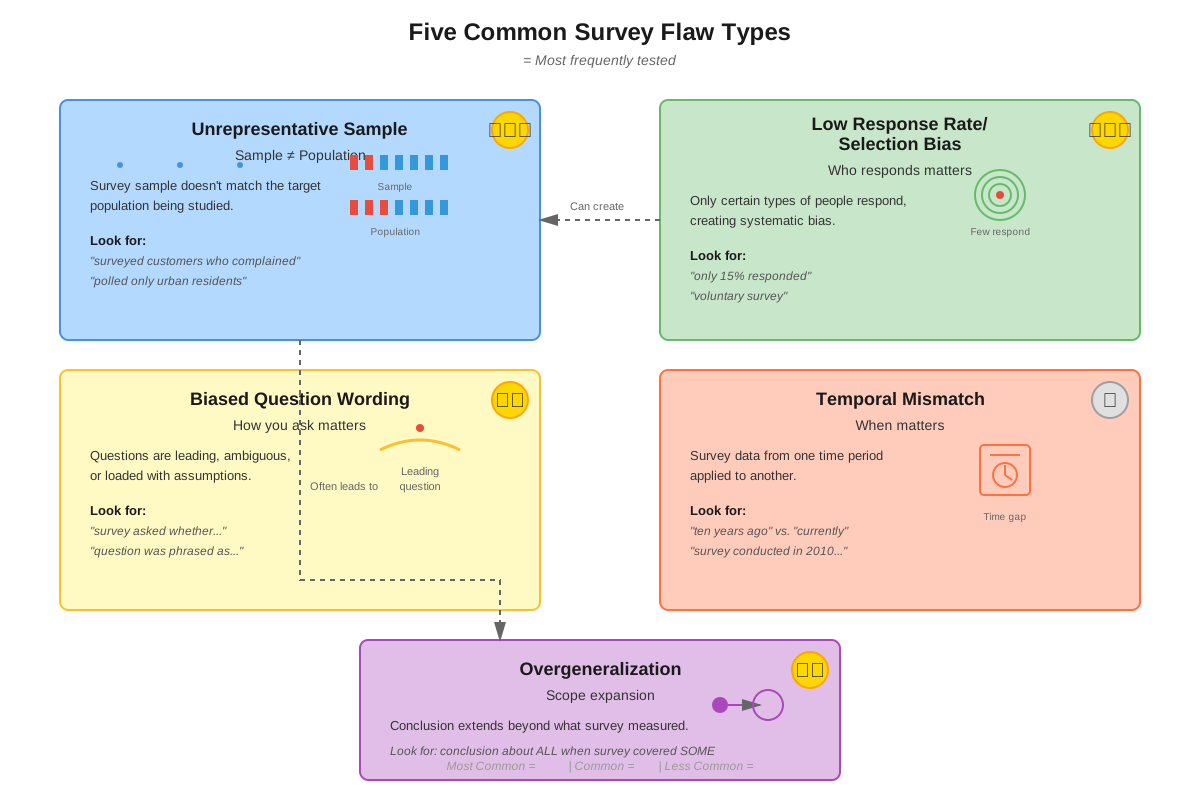
The LSAT tests survey flaws because they represent a fundamental category of reasoning errors that appear throughout legal practice, policy analysis, and everyday decision-making. Attorneys must regularly evaluate statistical evidence, expert testimony based on research studies, and demographic data—all of which rely on sound survey methodology. When an argument commits a lsat survey flaw, it typically fails in one of several predictable ways: the sample is unrepresentative, the response rate creates bias, the questions are leading or ambiguous, or the conclusion overgeneralizes from the data collected.
Within the broader landscape of Logical Reasoning, survey flaws connect to several other important concepts including sampling errors, representativeness issues, and causal reasoning problems. While survey flaws have their own distinct patterns, they share characteristics with other statistical reasoning errors and generalization flaws. Mastering this topic provides a foundation for understanding how evidence supports (or fails to support) conclusions, a skill that underlies success across all Logical Reasoning question types, including Strengthen, Weaken, Assumption, and Evaluate questions.
Learning Objectives
- [ ] Identify how Survey flaw appears in LSAT questions
- [ ] Explain the reasoning pattern behind Survey flaw
- [ ] Apply Survey flaw to solve LSAT-style problems accurately
- [ ] Distinguish between different types of survey flaws (unrepresentative samples, biased questions, low response rates, etc.)
- [ ] Predict how survey methodology affects the validity of conclusions drawn from data
- [ ] Evaluate whether a given survey design supports or undermines an argument's conclusion
Prerequisites
- Basic argument structure: Understanding premises and conclusions is essential because survey flaws involve identifying gaps between survey data (premises) and the conclusions drawn from that data.
- Concept of generalization: Recognizing when arguments extend findings from a specific group to a broader population helps identify when survey samples are inappropriately applied.
- Flaw question format: Familiarity with how the LSAT asks students to identify reasoning errors ensures efficient navigation of survey flaw questions.
- Causation vs. correlation: Many survey flaws involve confusing these concepts, so distinguishing them prevents misidentifying the specific error.
Why This Topic Matters
Survey flaws represent a critical intersection between formal logic and practical reasoning. In legal contexts, attorneys regularly encounter survey evidence in trademark disputes (consumer confusion surveys), employment discrimination cases (workplace climate surveys), and product liability litigation (consumer safety studies). The ability to identify methodological weaknesses in survey-based arguments directly translates to evaluating the strength of evidence in legal proceedings.
On the LSAT, survey flaws appear with remarkable consistency. Approximately 2-3 questions per test involve survey methodology errors, making this a high-yield topic for score improvement. These questions appear primarily in Flaw question types but also surface in Weaken, Strengthen, and Assumption questions where survey data serves as evidence. The LSAT favors certain survey flaw patterns: unrepresentative samples (most common), biased question wording, low response rates creating selection bias, and inappropriate generalizations from survey results.
Survey flaw questions typically present arguments that cite poll results, research studies, customer feedback, or demographic data to support a conclusion. The test-maker expects students to recognize when the survey methodology undermines the conclusion's validity. This topic matters because it tests critical thinking about empirical evidence—a skill that distinguishes strong legal reasoning from superficial analysis.
Core Concepts
What Constitutes a Survey Flaw
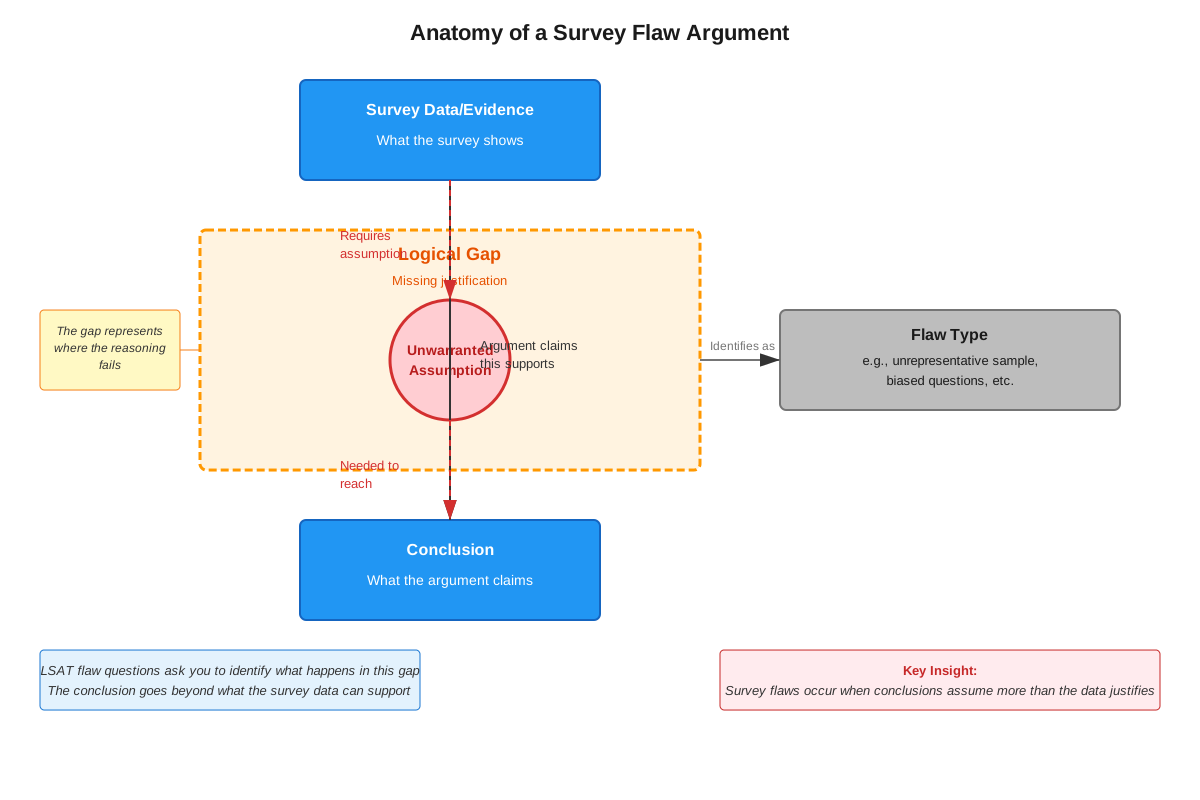
A survey flaw occurs when an argument draws a conclusion based on survey, poll, or sample data that is methodologically flawed in ways that undermine the conclusion's validity. The flaw lies not in the conclusion itself being false, but in the survey evidence failing to adequately support that conclusion. Survey flaws represent a specific category of evidence-based reasoning errors where the method of data collection or the interpretation of results contains a critical weakness.
The fundamental pattern involves three elements: (1) an argument cites survey or sample data, (2) the argument draws a conclusion about a broader population or makes a general claim, and (3) a methodological problem with the survey makes the inference from data to conclusion unjustified. Recognizing this pattern allows test-takers to quickly identify when survey methodology should be scrutinized.
Unrepresentative Samples
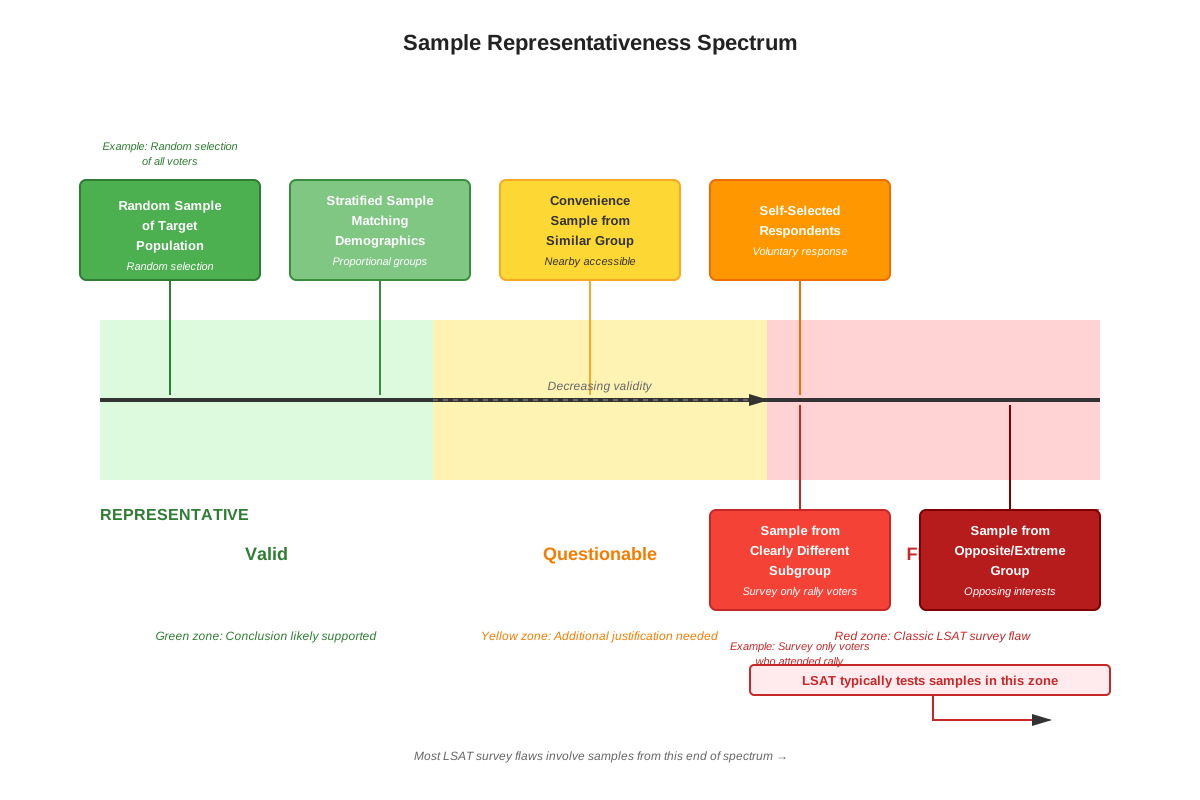
The most frequently tested survey flaw involves unrepresentative samples—situations where the surveyed group differs systematically from the population about which conclusions are drawn. This flaw violates the fundamental principle that valid generalizations require samples that accurately reflect the target population's relevant characteristics.
Common manifestations include:
- Self-selection bias: Only people with strong opinions or particular characteristics choose to respond (e.g., a restaurant survey completed only by customers who visit the restaurant's website)
- Convenience sampling: Surveying only easily accessible groups that may differ from the broader population (e.g., polling only college students about retirement policy preferences)
- Demographic mismatch: The sample differs from the target population in age, income, education, geographic location, or other relevant factors
- Temporal mismatch: Surveying at times when only certain types of people are available (e.g., weekday afternoon phone surveys missing working professionals)
The key to identifying unrepresentative sample flaws is asking: "Could the people surveyed differ in relevant ways from the people the conclusion is about?"
Biased or Ambiguous Questions
Survey flaws frequently involve problems with how questions are worded or structured. Biased questions lead respondents toward particular answers through loaded language, false premises, or limited options. Ambiguous questions allow multiple interpretations, making responses unreliable indicators of what the survey claims to measure.
Examples of question bias include:
- Leading questions: "Don't you agree that the wasteful government spending should be reduced?" (presupposes spending is wasteful)
- Loaded language: Using emotionally charged terms that influence responses
- False dichotomies: Offering only two options when more exist
- Double-barreled questions: Asking about two issues simultaneously, making responses unclear
The LSAT tests whether students recognize that survey conclusions are only as valid as the questions that generated the data. When question wording could systematically skew responses, any conclusion based on those responses is undermined.
Low Response Rates and Non-Response Bias
Non-response bias occurs when people who respond to surveys differ systematically from those who don't respond, and the argument fails to account for this difference. This flaw is particularly common when response rates are low, creating the possibility that respondents represent a skewed subset of the surveyed population.
Critical considerations include:
- The lower the response rate, the greater the potential for bias
- People with extreme views often respond at higher rates than those with moderate views
- Respondents may differ from non-respondents in motivation, available time, literacy, or interest in the topic
- Voluntary surveys are especially vulnerable to this flaw
The LSAT frequently presents arguments that cite survey results without mentioning response rates or that acknowledge low response rates but fail to recognize the resulting bias. Test-takers must recognize that conclusions about "all members" or "most members" of a group are undermined when only a small, potentially unrepresentative fraction responded.
Inappropriate Generalization from Survey Results
Even when survey methodology is sound, arguments can commit flaws by overgeneralizing from survey results. This occurs when conclusions extend beyond what the data actually supports, either by claiming more certainty than warranted or by applying findings to contexts or populations not covered by the survey.
Common overgeneralization patterns:
- Temporal overgeneralization: Assuming current survey results will hold true in the future or applied to past situations
- Geographic overgeneralization: Extending findings from one location to other areas with different characteristics
- Categorical overgeneralization: Applying results about one group to a broader category (e.g., surveying luxury car buyers and concluding about all car buyers)
- Certainty overgeneralization: Treating survey results as definitive proof rather than evidence suggesting a conclusion
Confusing Correlation with Causation in Survey Data
While technically a distinct flaw type, survey arguments frequently combine sampling issues with causal reasoning errors. When surveys reveal correlations between variables, arguments may incorrectly infer causation without ruling out alternative explanations such as reverse causation, common causes, or coincidence.
For example, a survey finding that people who drink coffee report higher stress levels might be used to conclude that coffee causes stress, ignoring that stressed people might drink more coffee (reverse causation) or that demanding jobs might cause both stress and increased coffee consumption (common cause).
Comparison Table: Survey Flaw Types
| Flaw Type | Key Characteristic | Red Flag Phrases | Example |
|---|---|---|---|
| Unrepresentative Sample | Sample differs from target population | "surveyed customers who...", "poll of members who..." | Surveying gym members about exercise habits and concluding about the general population |
| Biased Questions | Question wording influences responses | "leading question", "loaded language" | "Do you support the dangerous policy of..." |
| Low Response Rate | Non-respondents may differ from respondents | "only X% responded", "voluntary survey" | 5% response rate to mailed survey used to conclude about all recipients |
| Overgeneralization | Conclusion extends beyond data | "will always", "proves that", "in all cases" | Survey of current preferences used to predict future behavior |
| Ambiguous Questions | Multiple interpretations possible | "unclear", "could mean different things" | "Are you satisfied?" without specifying with what |
Concept Relationships
Survey flaw concepts form an interconnected web where multiple flaws often appear simultaneously in a single argument. Unrepresentative samples serve as the foundation—if the sample doesn't match the population, all subsequent analysis is compromised. This connects directly to low response rates, which create unrepresentative samples through self-selection. Both of these connect to inappropriate generalization, as the gap between sample and population determines what generalizations are justified.
Biased or ambiguous questions operate at a different level, affecting data quality rather than sample composition. However, they interact with other flaws: even a perfectly representative sample yields unreliable conclusions if questions are biased. Similarly, causal reasoning errors often compound survey flaws—an unrepresentative sample that shows correlation provides even weaker support for causal claims.
The relationship map flows as follows:
Survey Design → Question Quality → Response Collection → Sample Composition → Data Interpretation → Conclusion Validity
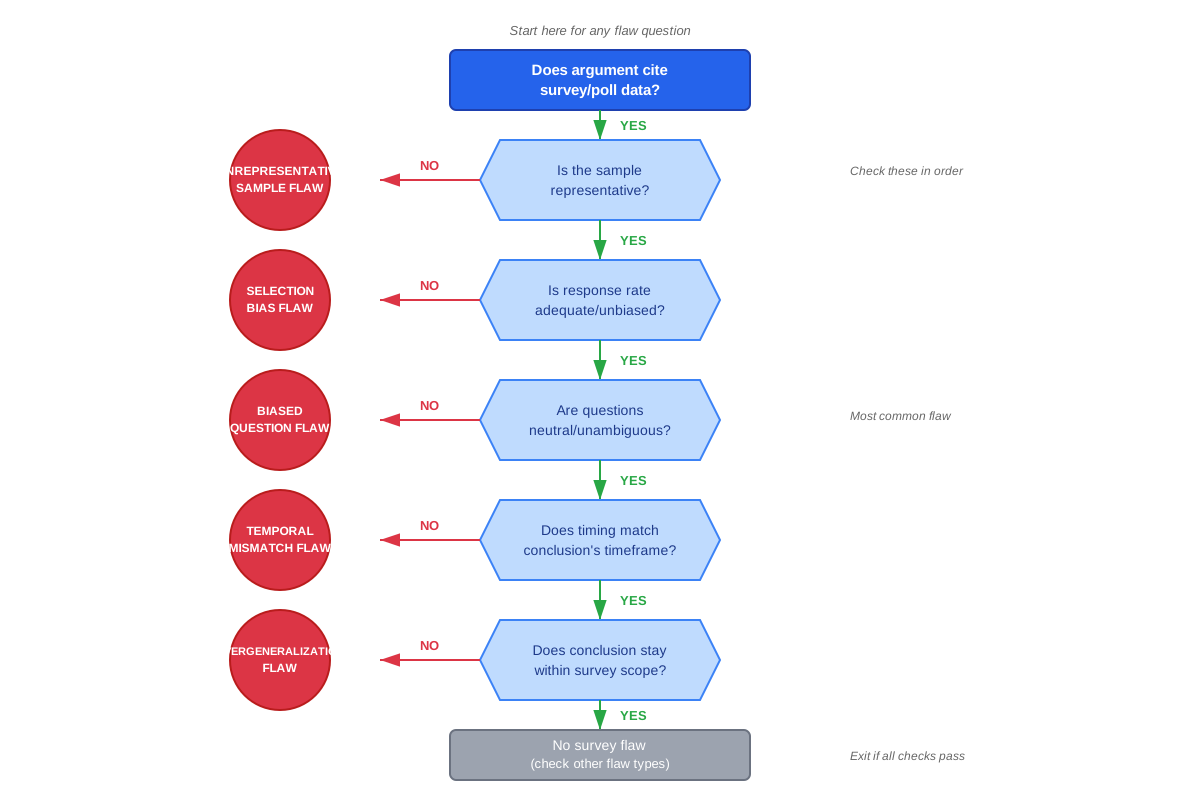
Each stage introduces potential flaws. The LSAT tests whether students can identify which stage contains the critical weakness undermining an argument's conclusion. Understanding these relationships helps predict what the correct answer will address: if the sample is clearly representative and questions are neutral, look for overgeneralization; if response rates are low, focus on non-response bias.
These concepts also connect to broader Logical Reasoning principles. Survey flaws represent specific instances of evidence evaluation, a skill tested across question types. They relate to necessary assumptions (arguments assume survey methodology is sound), strengthening/weakening (fixing or exploiting methodological flaws), and reasoning patterns (recognizing standard argument structures involving empirical data).
Quick check — test yourself on Survey flaw so far.
Try Flashcards →High-Yield Facts
⭐ Unrepresentative samples are the most frequently tested survey flaw on the LSAT, appearing in approximately 60% of survey-related questions.
⭐ Self-selection bias occurs when only people with particular characteristics choose to participate, making the sample unrepresentative of the broader population.
⭐ Low response rates create the potential for non-response bias, as respondents may differ systematically from non-respondents in ways relevant to the conclusion.
⭐ Survey questions that use loaded language or false premises produce biased results that cannot reliably support conclusions about actual opinions or behaviors.
⭐ Generalizing from a sample to a different population requires that the sample be representative of that population in relevant respects.
- Temporal factors matter: surveying people at specific times may exclude groups with different schedules or availability.
- Geographic location affects representativeness: samples from one region may not reflect other areas with different demographics or cultures.
- Voluntary surveys are inherently vulnerable to self-selection bias because participation correlates with interest or strong opinions.
- Ambiguous survey questions allow multiple interpretations, making responses unreliable indicators of what the survey claims to measure.
- Even large samples can be unrepresentative if the selection method systematically excludes or overrepresents certain groups.
- Correlation found in survey data does not establish causation without ruling out alternative explanations like reverse causation or common causes.
- Survey conclusions about future behavior or preferences are weakened when based solely on current responses without evidence of stability over time.
- Comparing survey results across different populations requires that the surveys use identical methodology and question wording.
Common Misconceptions
Misconception: Large sample sizes automatically make surveys representative and reliable.
Correction: Sample size matters less than sample composition. A massive sample that systematically excludes certain groups or overrepresents others remains unrepresentative. The LSAT frequently tests this by presenting arguments citing large numbers of respondents while ignoring selection bias.
Misconception: If a survey finds a correlation between two variables, the argument commits a causation flaw.
Correction: Not all survey arguments make causal claims. Many simply report correlations or describe survey results. The flaw only exists if the argument incorrectly infers causation from correlation. Focus on what the conclusion actually claims.
Misconception: Any survey with less than 100% response rate is automatically flawed.
Correction: Low response rates create potential for bias, but the severity depends on whether non-respondents likely differ from respondents in relevant ways. A 40% response rate might be acceptable if there's no reason to think non-respondents differ systematically. The flaw is the failure to consider this possibility, not the response rate itself.
Misconception: Survey flaws only appear in Flaw questions.
Correction: While most common in Flaw questions, survey methodology issues appear in Weaken questions (exploiting methodological weaknesses), Strengthen questions (addressing methodological concerns), Assumption questions (assuming methodology is sound), and Evaluate questions (asking what information would determine validity).
Misconception: If the survey question is neutral and unbiased, the survey cannot be flawed.
Correction: Question quality is only one dimension of survey validity. A perfectly worded question asked to an unrepresentative sample, or with a very low response rate, still produces unreliable results. Multiple independent factors affect survey validity.
Misconception: Survey flaws are always explicitly about "surveys" or "polls."
Correction: The LSAT uses varied language including "study," "research," "sample," "questionnaire," "data collection," and "investigation." Any argument drawing conclusions from a subset of a population potentially involves survey methodology issues.
Worked Examples
Example 1: Unrepresentative Sample
Argument: "A recent survey of Riverside City residents found that 78% support the proposed downtown development project. The survey was conducted by calling numbers from the phone directory and asking residents their opinion. Therefore, the majority of Riverside City residents support the project."
Question: The reasoning in the argument is flawed because it:
Analysis:
Step 1: Identify the conclusion: "The majority of Riverside City residents support the project."
Step 2: Identify the evidence: A survey showing 78% support among those surveyed.
Step 3: Look for the gap between evidence and conclusion. The conclusion is about "Riverside City residents" generally, but the evidence comes from a specific subset—those reached by calling numbers from the phone directory.
Step 4: Identify the methodological problem. The phone directory method creates an unrepresentative sample because:
- It excludes residents with unlisted numbers
- It excludes residents who only use cell phones (not typically in directories)
- It excludes residents without phones
- It only reaches people who answer calls from unknown numbers
- It may oversample people who are home during calling hours
Step 5: Articulate the flaw. The argument treats the surveyed group as representative of all Riverside City residents when the survey method systematically excludes certain types of residents who may have different opinions about the development project.
Correct Answer Pattern: "fails to consider that the method of conducting the survey may have resulted in a sample that is unrepresentative of Riverside City residents generally"
Connection to Learning Objectives: This example demonstrates how to identify survey flaws in LSAT questions (Objective 1), explains the reasoning pattern of unrepresentative sampling (Objective 2), and shows the application process for solving such problems (Objective 3).
Example 2: Multiple Compounding Flaws
Argument: "Concerned about employee morale, Techcorp sent an anonymous survey to all 500 employees asking whether they were satisfied with company leadership. Only 50 employees responded, and 40 of them expressed dissatisfaction. The company concluded that employee morale is low and that most employees are dissatisfied with leadership."
Question: Which of the following most accurately describes a flaw in the company's reasoning?
Analysis:
Step 1: Identify the conclusion: "Employee morale is low and most employees are dissatisfied with leadership."
Step 2: Identify the evidence: 40 out of 50 survey respondents (80%) expressed dissatisfaction.
Step 3: Identify potential flaws. This argument contains multiple issues:
- Low response rate: Only 10% (50/500) of employees responded
- Non-response bias: The 450 non-respondents may differ systematically from respondents
- Self-selection: Employees with strong negative feelings may be more motivated to respond
- Overgeneralization: Concluding about "most employees" based on a small, potentially unrepresentative subset
Step 4: Determine the primary flaw. While multiple problems exist, the most serious is the combination of low response rate and self-selection bias. The argument assumes that the 10% who responded represent the views of all 500 employees, ignoring that dissatisfied employees are likely overrepresented among respondents.
Step 5: Predict the correct answer. It should address how the respondents may not represent all employees, particularly noting that those with complaints are more likely to respond to such surveys.
Correct Answer Pattern: "overlooks the possibility that employees who are dissatisfied with leadership were more likely to respond to the survey than those who are satisfied"
Alternative Correct Pattern: "treats a sample that may be unrepresentative as though it represents the views of all employees"
Connection to Learning Objectives: This example shows how multiple survey flaws can compound (Objective 4), demonstrates predicting how methodology affects conclusion validity (Objective 5), and illustrates evaluating whether survey design supports the conclusion (Objective 6).
Exam Strategy
Identification Triggers
Watch for these phrases that signal potential survey flaw questions:
- "A survey/poll/study found that..."
- "Researchers surveyed/interviewed/sampled..."
- "Data collected from..."
- "Respondents indicated/reported..."
- "A questionnaire sent to..."
- "Of those surveyed/polled..."
When these phrases appear, immediately shift to survey methodology analysis mode. Ask yourself the four critical questions:
- Who was surveyed? (sample composition)
- How were they selected? (sampling method)
- What were they asked? (question quality)
- Who responded? (response rate and bias)
Systematic Approach
Use this step-by-step process for survey flaw questions:
- Identify the conclusion precisely: What claim is being made? About whom? How broad?
- Identify the survey evidence: What data supports the conclusion? What was measured?
- Map the gap: Does the conclusion extend beyond the surveyed population? Does it claim more certainty than warranted?
- Check sample representativeness: Could the surveyed group differ from the conclusion's target population in relevant ways?
- Check methodology: Are there issues with question wording, response rates, or data collection?
- Predict the flaw: Before looking at answers, articulate the methodological weakness in your own words.
Process of Elimination
When evaluating answer choices:
Eliminate answers that:
- Describe flaws unrelated to survey methodology (e.g., ad hominem attacks, circular reasoning)
- Accurately describe the argument's reasoning without identifying a flaw
- Address issues irrelevant to the gap between evidence and conclusion
- Describe flaws the argument doesn't commit (e.g., claiming a causation error when the conclusion doesn't make causal claims)
Favor answers that:
- Use language like "unrepresentative," "biased sample," "self-selection," "non-response"
- Identify specific ways the surveyed group could differ from the target population
- Point out that the conclusion extends beyond what the data supports
- Note that question wording or methodology could skew results
Time Management
Survey flaw questions typically require 60-90 seconds. Allocate time as follows:
- 15-20 seconds: Read and identify argument structure
- 15-20 seconds: Analyze survey methodology and identify the flaw
- 10-15 seconds: Predict the correct answer
- 20-30 seconds: Evaluate answer choices and select
If you cannot identify the flaw within 30 seconds, use the trigger word strategy: scan answers for survey methodology terms and evaluate those first.
Exam Tip: The LSAT rarely tests obscure or technical survey methodology. Focus on the most common flaws: unrepresentative samples, self-selection bias, low response rates, and overgeneralization. These account for approximately 85% of survey flaw questions.
Memory Techniques
The SAMPLE Acronym
Use SAMPLE to remember the key dimensions of survey validity:
- Selection method: How were participants chosen?
- Ambiguity: Are questions clear and unbiased?
- Match: Does the sample match the target population?
- Participation rate: What percentage responded?
- Language: Is question wording neutral or loaded?
- Extension: Does the conclusion overgeneralize?
The Four Questions Visualization
Picture a survey as a bridge connecting data to conclusion. The bridge has four support pillars, and the LSAT tests whether any pillar is weak:
- Who pillar: Sample composition
- How pillar: Selection method
- What pillar: Question quality
- Response pillar: Who actually participated
If any pillar is weak, the bridge (argument) cannot reliably support the conclusion.
The Representative Test
Create a mental checklist: "Could the people surveyed differ from the people the conclusion is about in terms of..."
- Age?
- Income?
- Education?
- Geographic location?
- Interest in the topic?
- Availability/schedule?
- Motivation to respond?
If the answer to any question is "yes," you've likely identified an unrepresentative sample flaw.
Summary
Survey flaws represent a high-yield LSAT topic testing whether arguments properly draw conclusions from empirical data. The core principle is that conclusions about populations require representative samples collected through sound methodology. The most frequently tested flaw involves unrepresentative samples where the surveyed group differs systematically from the population about which conclusions are drawn. This occurs through self-selection bias, convenience sampling, demographic mismatches, or low response rates creating non-response bias. Additional survey flaws include biased or ambiguous question wording that skews responses, and inappropriate generalizations that extend conclusions beyond what survey data supports. Success on survey flaw questions requires systematically analyzing who was surveyed, how they were selected, what they were asked, and who responded, then identifying gaps between the survey evidence and the conclusion. The LSAT expects students to recognize that even large samples can be unrepresentative, that low response rates create bias potential, and that survey methodology must match the scope and nature of the conclusion being drawn.
Key Takeaways
- Unrepresentative samples are the most common survey flaw: Always check whether the surveyed group could differ from the target population in relevant ways.
- Self-selection and low response rates create bias: People who choose to respond often differ systematically from those who don't, undermining conclusions about the entire group.
- Sample size matters less than sample composition: A large unrepresentative sample provides weaker evidence than a smaller representative one.
- Question wording affects validity: Loaded language, false premises, or ambiguous phrasing compromise survey results regardless of sample quality.
- Survey conclusions must match survey scope: Generalizing beyond the surveyed population, time period, or context represents inappropriate extension of evidence.
- Multiple flaws often compound: Arguments may combine unrepresentative samples with biased questions or overgeneralization, but identify the primary methodological weakness.
- Use systematic analysis: Apply the SAMPLE framework or four-pillar approach to efficiently identify survey methodology problems under time pressure.
Related Topics
Causal Reasoning Flaws: Survey data often appears in causal arguments. Understanding how correlation differs from causation and recognizing when survey evidence fails to establish causal relationships builds on survey flaw mastery.
Sampling and Generalization: This broader topic encompasses survey flaws but extends to any argument drawing general conclusions from specific instances, including anecdotal evidence and case studies.
Statistical Reasoning: Advanced understanding of how arguments use numerical data, percentages, and probability connects to survey methodology and helps evaluate quantitative evidence across question types.
Strengthen and Weaken Questions with Survey Evidence: Once survey flaws are mastered, applying this knowledge to identify what would fix methodological problems (strengthen) or expose additional weaknesses (weaken) represents the next level of skill development.
Necessary Assumptions in Empirical Arguments: Survey-based arguments depend on assumptions about methodology being sound. Identifying these unstated assumptions connects survey flaw recognition to assumption question strategies.
Practice CTA
Now that you understand survey flaws comprehensively, apply this knowledge to practice questions and flashcards. Focus on identifying the specific type of survey flaw in each question, predicting the correct answer before reviewing choices, and timing yourself to build efficiency. Survey flaw mastery comes through recognizing patterns across multiple examples, so commit to working through at least 10-15 practice questions on this topic. Each question you analyze strengthens your ability to spot methodological weaknesses instantly on test day. Remember: survey flaws appear frequently enough that mastering this topic can directly improve your score by 2-3 points. Your investment in understanding these concepts will pay dividends across multiple questions on every LSAT you encounter.
Sign up free to keep reading
Create a free AnvayaPrep account to finish this LSAT guide on Survey flaw — plus flashcards and practice questions.