Overview
Abstract argument structure is a critical analytical skill tested extensively on the LSAT Logical Reasoning section, particularly in Parallel Reasoning questions. This concept requires test-takers to identify and match the underlying logical framework of an argument while ignoring the specific content or subject matter. Rather than focusing on what an argument discusses—whether it's about economics, biology, or politics—students must recognize how the argument operates: the relationship between premises and conclusion, the type of reasoning employed, and the logical moves the author makes.
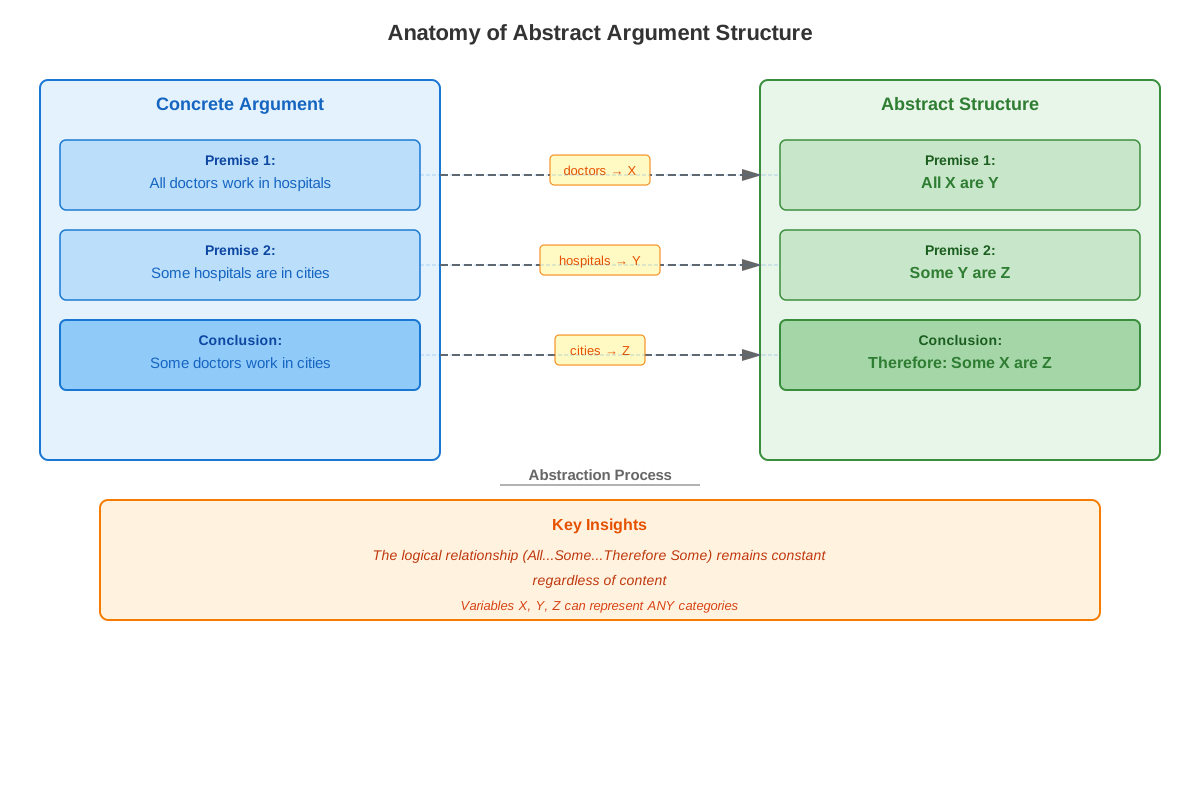
Mastering abstract argument structure transforms how students approach the LSAT. Instead of getting distracted by unfamiliar vocabulary or complex subject matter, students learn to see through the surface content to the skeletal logical framework beneath. This skill is particularly valuable because the LSAT deliberately uses diverse and sometimes obscure topics to test pure reasoning ability rather than background knowledge. When a student can reduce an argument about medieval architecture to its abstract form—"All X are Y, some Y are Z, therefore some X are Z"—they gain the power to match it with a structurally identical argument about molecular biology, regardless of their familiarity with either field.
Within the broader logical reasoning curriculum, abstract argument structure serves as a bridge between basic argument analysis and advanced question types. It builds upon foundational skills like identifying conclusions and premises, while enabling success on parallel reasoning questions, parallel flaw questions, and even strengthening the ability to analyze Method of Reasoning questions. This topic represents a shift from understanding what arguments say to understanding how they work—a metacognitive leap that separates high scorers from average performers.
Learning Objectives
- [ ] Identify how Abstract argument structure appears in LSAT questions
- [ ] Explain the reasoning pattern behind Abstract argument structure
- [ ] Apply Abstract argument structure to solve LSAT-style problems accurately
- [ ] Translate concrete arguments into abstract logical notation within 30 seconds
- [ ] Distinguish between structurally similar arguments with different logical forms
- [ ] Recognize common structural patterns that appear repeatedly across LSAT questions
- [ ] Evaluate answer choices by systematically comparing structural elements rather than content
Prerequisites
- Basic argument structure identification: Understanding what constitutes a premise and conclusion is essential because abstract structure analysis requires first recognizing the components before abstracting them.
- Conditional reasoning fundamentals: Familiarity with if-then statements and their contrapositives helps recognize structural patterns involving necessary and sufficient conditions.
- Quantifier logic: Knowledge of terms like "all," "some," "most," and "none" is necessary because these quantifiers form the backbone of many abstract structures.
- Conclusion identification skills: The ability to quickly locate an argument's main point allows students to anchor their structural analysis around the conclusion.
Why This Topic Matters
Abstract argument structure represents one of the most reliable pathways to LSAT success because it eliminates the variable of content comprehension. Students who master this skill can answer questions correctly even when they don't fully understand the subject matter being discussed. This is particularly valuable under timed conditions when reading comprehension might be compromised by stress or fatigue.
On the LSAT, abstract argument structure appears most prominently in Parallel Reasoning questions, which typically constitute 2-3 questions per Logical Reasoning section, meaning 4-6 questions per test. These questions explicitly ask test-takers to identify arguments with matching structures. However, the skill extends far beyond these explicit applications. Parallel Flaw questions (another 2-3 per section) require the same structural matching ability while also identifying logical errors. Method of Reasoning questions benefit from structural analysis, as do some Strengthen/Weaken questions where recognizing analogous reasoning patterns helps predict what would support or undermine an argument.
The LSAT frequently presents abstract argument structure challenges through several common formats: arguments using analogical reasoning where the structure involves comparing two situations, arguments employing conditional chains where multiple if-then statements link together, arguments using quantified statements about categories and their relationships, and arguments involving causal reasoning where the structure shows how one phenomenon allegedly produces another. Test-makers deliberately vary the content across answer choices while maintaining or altering the structure, making structural analysis the only reliable method for eliminating wrong answers.
Core Concepts
Defining Abstract Argument Structure
Abstract argument structure refers to the logical skeleton of an argument—the formal relationship between premises and conclusion stripped of all specific content. When analyzing lsat abstract argument structure, students must learn to see arguments as patterns of reasoning rather than statements about particular topics. For example, the argument "All dogs are mammals; Fido is a dog; therefore, Fido is a mammal" has the same abstract structure as "All senators are politicians; Jones is a senator; therefore, Jones is a politician." Both follow the pattern: All X are Y; Z is an X; therefore, Z is a Y.
This abstraction process involves three key steps: (1) identifying the logical components (premises, conclusion, intermediate conclusions), (2) recognizing the type of reasoning employed (deductive, inductive, analogical, causal), and (3) mapping the relationships between components using variables or general terms. The goal is to create a template that captures how the argument works without reference to what it's about.
Types of Structural Elements
Arguments contain several structural elements that must be identified and matched in parallel reasoning questions:
Quantifiers determine the scope of claims. "All," "every," and "any" indicate universal statements; "some," "many," and "most" indicate partial statements; "no" and "none" indicate universal negatives. The specific quantifier used dramatically affects argument structure. An argument moving from "all X are Y" to "all Y are Z" differs fundamentally from one moving from "some X are Y" to "some Y are Z."
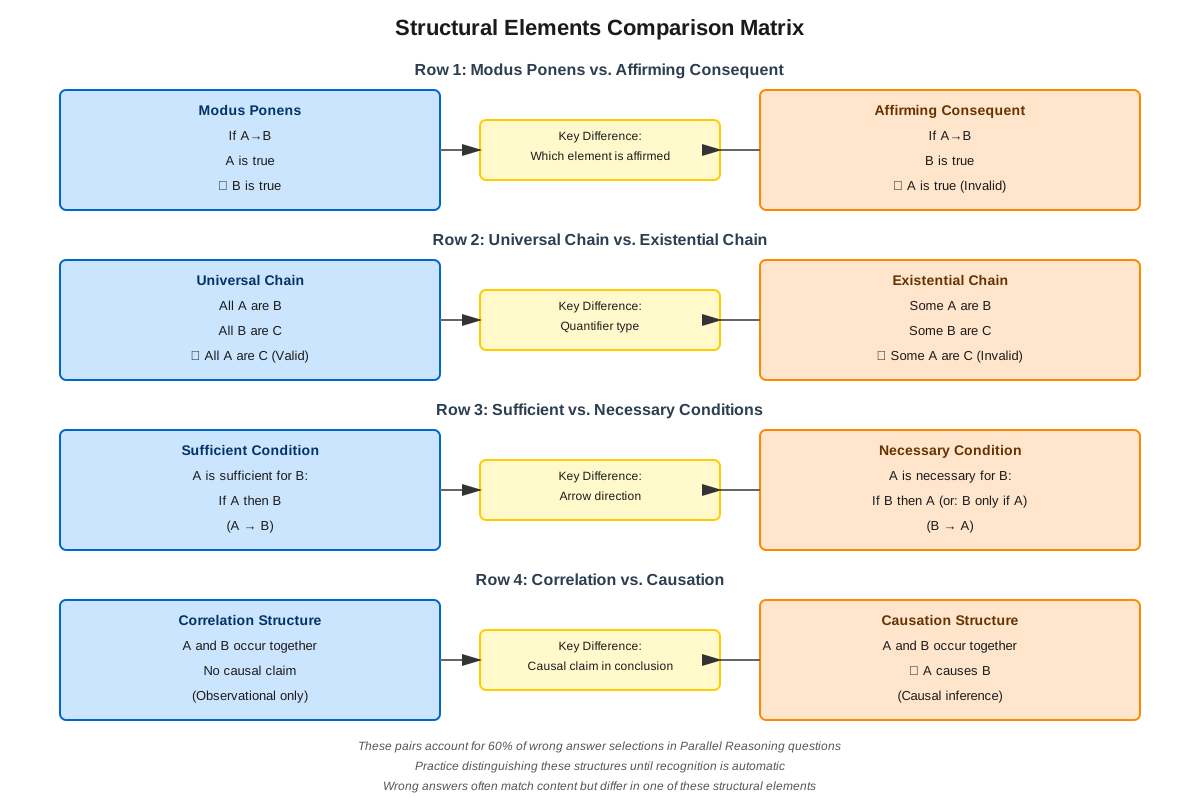
Conditional relationships establish if-then connections between ideas. These can be explicit ("If it rains, the game is cancelled") or implicit ("Winning requires practice"). Conditional structures include simple conditionals, chains of conditionals, and contrapositive reasoning. The direction of the conditional arrow is crucial to structure.
Causal claims assert that one thing produces or brings about another. Causal structures differ from mere correlations or conditional statements. An argument claiming "X causes Y" has a different structure than one claiming "X and Y occur together" or "If X, then Y."
Analogical reasoning compares two situations and draws conclusions based on their similarity. The structure involves: Situation A has properties 1, 2, 3 and outcome X; Situation B has properties 1, 2, 3; therefore, Situation B will have outcome X.
Common Structural Patterns on the LSAT
Certain argument structures appear repeatedly on the LSAT, making pattern recognition a high-yield study strategy:
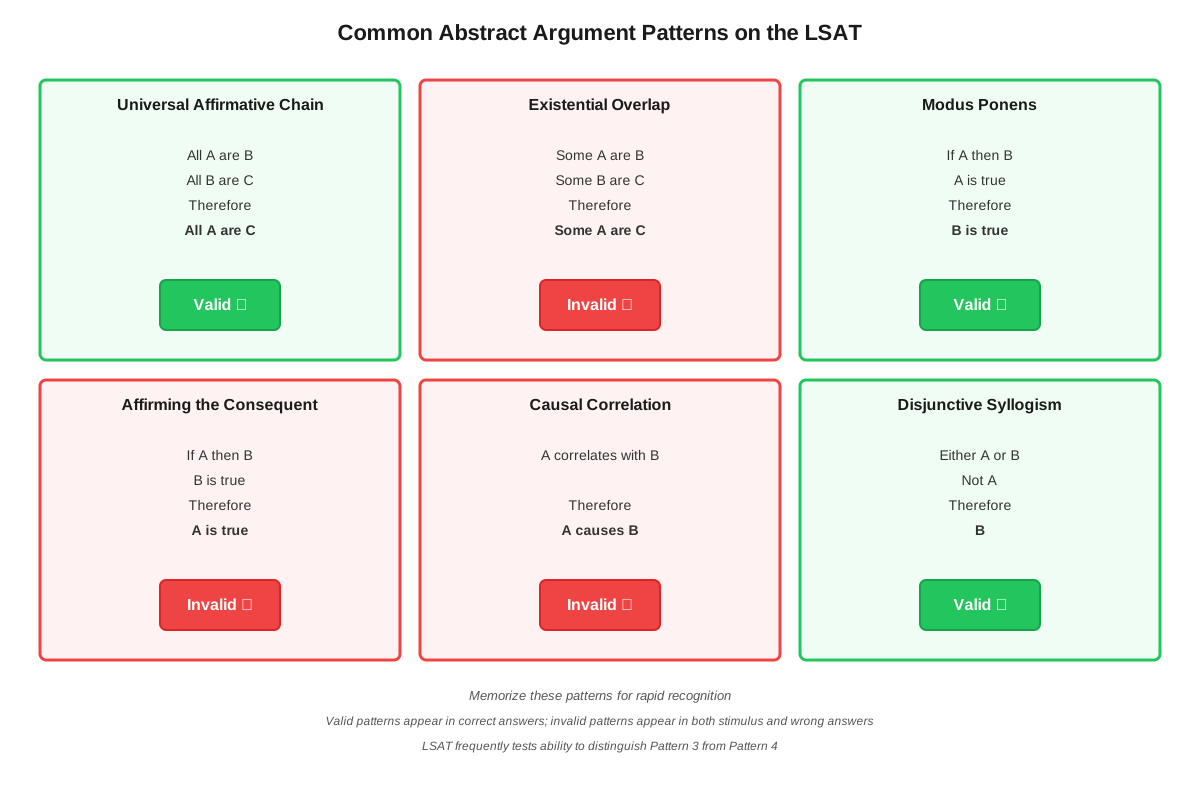
| Pattern Name | Structure | Example |
|---|---|---|
| Categorical Syllogism | All X are Y; All Y are Z; Therefore, all X are Z | All lawyers are professionals; All professionals need licenses; Therefore, all lawyers need licenses |
| Existential Inference | All X are Y; Some things are X; Therefore, some things are Y | All roses are flowers; Some plants are roses; Therefore, some plants are flowers |
| Contrapositive | If X, then Y; Not Y; Therefore, not X | If it rains, the ground is wet; The ground isn't wet; Therefore, it didn't rain |
| Causal Reversal | X correlates with Y; Therefore, Y causes X | Crime increased after police hiring increased; Therefore, police hiring causes crime |
| Analogical | A and B are similar in respects 1, 2, 3; A has property P; Therefore, B has property P | Rats and humans share 90% DNA; Drug X harms rats; Therefore, drug X will harm humans |
The Abstraction Process
Converting concrete arguments into abstract structures requires systematic methodology. First, identify the conclusion by asking "What is the author trying to prove?" Mark this clearly, as it anchors the entire structure. Second, identify each premise by asking "What evidence supports this conclusion?" Number the premises to track multiple supporting statements.
Third, determine the logical relationship between premises and conclusion. Ask: Is this deductive (conclusion must follow) or inductive (conclusion probably follows)? Does it use categories and quantifiers? Does it establish causation? Does it draw an analogy? Fourth, replace specific terms with variables. Use X, Y, Z for categories or objects; use P, Q, R for properties or conditions. Maintain consistent variable assignment—if "dogs" becomes X in the premise, it must remain X throughout.
Fifth, write out the abstract structure using your variables and logical connectors. Use notation like "All X are Y" or "If P, then Q" or "X causes Y." Finally, verify your abstraction by checking whether the original argument and your abstract version have identical logical moves. If the original makes two premises and one conclusion, your abstract version should too.
Structural Flaws and Their Patterns
Many LSAT questions test the ability to recognize not just argument structure but flawed argument structure. Common structural flaws include:
Affirming the consequent: If P, then Q; Q; therefore, P. (If it rains, the ground is wet; The ground is wet; Therefore, it rained—ignoring other causes of wetness)
Denying the antecedent: If P, then Q; Not P; therefore, not Q. (If you study, you'll pass; You didn't study; Therefore, you won't pass—ignoring other ways to pass)
Illicit categorical inference: All X are Y; All Z are Y; Therefore, all X are Z. (All dogs are animals; All cats are animals; Therefore, all dogs are cats)
Causal confusion: Confusing correlation with causation, reversing cause and effect, or ignoring alternative explanations for observed phenomena.
Recognizing these flawed patterns in abstract form allows students to identify them regardless of content, making Parallel Flaw questions significantly more manageable.
Concept Relationships
Abstract argument structure serves as the foundation for parallel reasoning, which in turn connects to parallel flaw questions. The relationship flows: Basic argument analysis → Abstract argument structure → Parallel reasoning → Parallel flaw recognition. Each skill builds upon the previous one, with abstraction serving as the critical bridge between understanding individual arguments and comparing multiple arguments.
Within abstract argument structure itself, the concepts interconnect hierarchically. Identifying structural elements (quantifiers, conditionals, causal claims) enables pattern recognition (categorical syllogisms, contrapositive reasoning), which facilitates the abstraction process (converting concrete to abstract), which ultimately allows structural matching (comparing argument skeletons). This progression moves from component identification to holistic comparison.
The relationship to prerequisite knowledge is direct: Premise/conclusion identification provides the raw material that abstract argument structure organizes and systematizes. Conditional reasoning represents one specific type of structure that appears within the broader category of abstract structures. Quantifier logic provides the vocabulary for expressing many abstract structures precisely.
Abstract argument structure also connects forward to advanced topics. Method of Reasoning questions often require structural analysis to describe how an argument proceeds. Principle questions sometimes involve matching abstract structures across different contexts. Even Strengthen/Weaken questions benefit from structural thinking when evaluating whether new information affects the logical framework of an argument.
High-Yield Facts
⭐ Parallel Reasoning questions require matching argument structure, not content or conclusion truth value—the correct answer must have identical logical moves even if it discusses completely different subject matter.
⭐ Quantifiers must match exactly in parallel arguments—an argument using "all" cannot parallel one using "some" or "most," as these create fundamentally different logical relationships.
⭐ The number of premises must match between parallel arguments—if the original has two premises, the correct answer must have two premises, not one or three.
⭐ Conditional statements must maintain the same direction—if the original argues "If P, then Q," the parallel must also move from sufficient condition to necessary condition, not the reverse.
⭐ Flawed arguments must be matched with identically flawed arguments—in Parallel Flaw questions, both the structure and the specific type of logical error must match.
- Abstract structure focuses on form, not content—two arguments about entirely different topics can share identical structure.
- The conclusion's position in the argument (beginning, middle, or end) should match in parallel arguments, though this is less critical than logical structure.
- Intermediate conclusions (sub-conclusions that serve as premises for the main conclusion) must be matched in parallel arguments.
- Causal arguments have distinct structures from conditional arguments—"X causes Y" differs from "If X, then Y" in important ways.
- Analogical reasoning has a recognizable structure: similarity in known respects → similarity in unknown respect.
- Arguments using necessary vs. sufficient conditions create different structures that must be distinguished.
- The strength of the inference (deductive certainty vs. inductive probability) should match in parallel arguments.
- Negative quantifiers ("no," "none") create different structures than positive quantifiers ("all," "some").
- Structural matching requires checking every element—one matching component doesn't make arguments parallel.
- Time pressure makes structural analysis more efficient than content analysis for parallel questions.
Quick check — test yourself on Abstract argument structure so far.
Try Flashcards →Common Misconceptions
Misconception: Parallel arguments must reach similar or related conclusions about similar topics.
Correction: Parallel arguments must have identical logical structures but can discuss completely unrelated topics and reach conclusions about entirely different subject matter. An argument about economics can parallel one about biology if their logical frameworks match.
Misconception: If two arguments both use conditional reasoning, they automatically have parallel structures.
Correction: The mere presence of conditional reasoning doesn't create parallel structure. The specific conditional relationships must match—the direction of implications, the number of conditionals, and how they connect must all align. "If P, then Q; therefore Q" differs structurally from "If P, then Q; not Q; therefore not P."
Misconception: Abstract argument structure only matters for Parallel Reasoning questions.
Correction: While most explicit in Parallel Reasoning questions, structural analysis enhances performance across question types including Parallel Flaw, Method of Reasoning, Principle questions, and even some Strengthen/Weaken questions where recognizing analogous reasoning patterns helps evaluate answer choices.
Misconception: The correct answer in Parallel Reasoning questions will use similar vocabulary or discuss related concepts.
Correction: The LSAT deliberately uses diverse vocabulary and unrelated topics across answer choices to test pure structural reasoning. Similar vocabulary often appears in wrong answers as a distractor. Students must ignore content similarity and focus exclusively on logical structure.
Misconception: Matching the conclusion type (recommendation, prediction, explanation) is sufficient for parallel structure.
Correction: While conclusion type can be a useful initial filter, true parallel structure requires matching the entire logical framework—how premises relate to each other and to the conclusion, not just what kind of conclusion is drawn.
Misconception: Abstract structures can be identified by reading quickly and getting the "gist" of the argument.
Correction: Accurate structural analysis requires careful, systematic examination of each logical component. Speed comes from practice and pattern recognition, not from skimming. Rushing through structural analysis leads to errors that cost more time than careful initial analysis.
Misconception: All arguments using "all" and "some" have the same structure.
Correction: The specific arrangement and relationship of quantified statements matters enormously. "All X are Y; some Y are Z" creates a different structure than "All X are Y; some X are Z" or "Some X are Y; all Y are Z." The position and connection of quantifiers determines structure.
Worked Examples
Example 1: Basic Parallel Reasoning
Original Argument: "All professional athletes train regularly. Maria trains regularly. Therefore, Maria is a professional athlete."
Step 1 - Identify Components:
- Premise 1: All professional athletes train regularly
- Premise 2: Maria trains regularly
- Conclusion: Maria is a professional athlete
Step 2 - Determine Reasoning Type: This is categorical/deductive reasoning using quantifiers. Notice it attempts to draw a conclusion about category membership.
Step 3 - Abstract the Structure:
- All X are Y
- Z is Y
- Therefore, Z is X
Step 4 - Identify the Flaw: This commits the fallacy of affirming the consequent in categorical form. Just because all X are Y doesn't mean all Y are X. Many things besides professional athletes train regularly.
Step 5 - Evaluate Answer Choices:
(A) "All roses are flowers. This plant is a flower. Therefore, this plant is a rose."
- Structure: All X are Y; Z is Y; Therefore, Z is X
- This matches perfectly—same flawed structure, different content
(B) "All roses are flowers. This plant is a rose. Therefore, this plant is a flower."
- Structure: All X are Y; Z is X; Therefore, Z is Y
- This is valid categorical reasoning—doesn't match the flaw
(C) "Some roses are red. This flower is red. Therefore, this flower is a rose."
- Structure: Some X are Y; Z is Y; Therefore, Z is X
- Uses "some" instead of "all"—different quantifier means different structure
(D) "All roses need water. All flowers need water. Therefore, all roses are flowers."
- Structure: All X are Y; All Z are Y; Therefore, all X are Z
- Two universal premises instead of one universal and one particular—different structure
Answer: (A) matches the abstract structure exactly, including the logical flaw.
Connection to Learning Objectives: This example demonstrates identifying abstract structure in LSAT questions, explaining the reasoning pattern (flawed categorical inference), and applying the concept to eliminate wrong answers systematically.
Example 2: Complex Conditional Structure
Original Argument: "If the company expands internationally, it will need additional capital. If it needs additional capital, it will have to issue new stock. The company is expanding internationally. Therefore, it will have to issue new stock."
Step 1 - Identify Components:
- Premise 1: If expand internationally → need capital
- Premise 2: If need capital → issue stock
- Premise 3: Expanding internationally (affirming the sufficient condition)
- Conclusion: Will issue stock
Step 2 - Determine Reasoning Type: This is conditional chain reasoning with modus ponens (affirming the sufficient condition to derive the necessary condition).
Step 3 - Abstract the Structure:
- If P, then Q
- If Q, then R
- P (is true)
- Therefore, R
Step 4 - Recognize the Pattern: This is valid conditional chain reasoning. The argument establishes a chain (P→Q→R) and affirms the first element (P), validly concluding the final element (R).
Step 5 - Evaluate Answer Choices:
(A) "If it rains, the game is cancelled. If the game is cancelled, fans get refunds. It rained. Therefore, fans get refunds."
- Structure: If P, then Q; If Q, then R; P; Therefore, R
- Perfect match—same conditional chain with affirmation of sufficient condition
(B) "If it rains, the game is cancelled. The game was cancelled. Therefore, it rained."
- Structure: If P, then Q; Q; Therefore, P
- Only one conditional, and it affirms the consequent—different structure and flawed
(C) "If it rains, the game is cancelled. If the game is cancelled, fans get refunds. Fans got refunds. Therefore, it rained."
- Structure: If P, then Q; If Q, then R; R; Therefore, P
- Has the chain but affirms the final consequent and works backward—this is invalid reasoning, unlike the original
(D) "If it rains, the game is cancelled. It didn't rain. Therefore, the game wasn't cancelled."
- Structure: If P, then Q; Not P; Therefore, not Q
- This denies the antecedent—different structure and flawed
Answer: (A) matches the conditional chain structure and the valid reasoning pattern.
Connection to Learning Objectives: This example shows how to translate complex conditional arguments into abstract notation, distinguish between structurally similar arguments with different logical forms (comparing valid chains to invalid affirmation of consequent), and apply systematic structural analysis under time pressure.
Exam Strategy
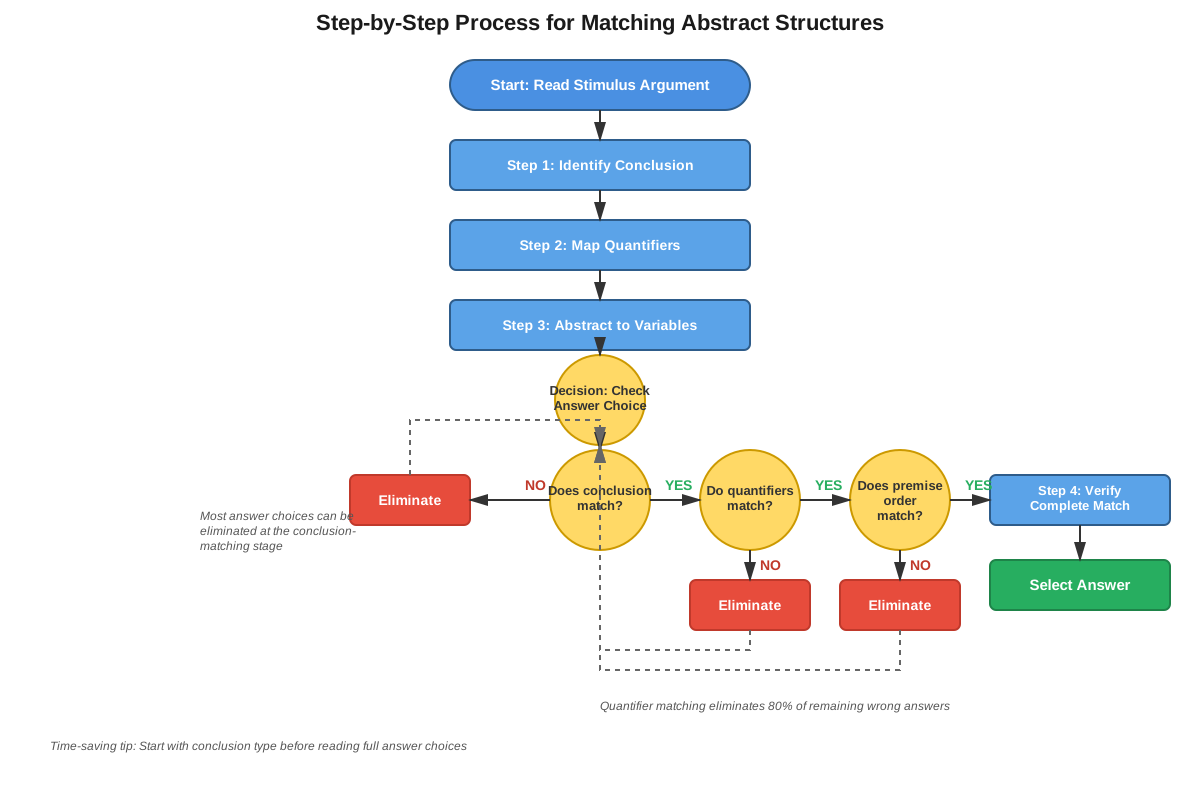
When approaching logical reasoning questions involving abstract argument structure, employ a systematic four-phase strategy:
Phase 1: Rapid Structure Identification (15-20 seconds)
Read the original argument while actively identifying its skeleton. Ask: How many premises? What type of reasoning (categorical, conditional, causal, analogical)? What quantifiers appear? Is this valid or flawed reasoning? Don't get distracted by complex content—focus on logical moves. Mark or mentally note the conclusion first, as it anchors your structural analysis.
Phase 2: Abstract Notation (10-15 seconds)
Quickly write or mentally formulate the abstract structure using variables. For simple arguments, this might be "All X are Y; Z is X; therefore Z is Y." For complex arguments, use arrows for conditionals (P→Q) or causal notation (X causes Y). This notation serves as your template for evaluating answer choices.
Phase 3: Systematic Answer Evaluation (60-90 seconds)
Evaluate each answer choice against your abstract template. Use aggressive elimination: as soon as you identify one structural mismatch, eliminate that choice and move on. Check in order: (1) number of premises, (2) types of quantifiers or conditionals, (3) direction of reasoning, (4) validity/flaw matching. Don't waste time fully analyzing an answer choice after you've found a disqualifying mismatch.
Phase 4: Verification (10-15 seconds)
Before selecting your answer, quickly verify that every structural element matches. Check: Do the quantifiers align? Does the conditional direction match? Is the number of logical steps identical? Does any flaw in the original appear in the answer?
Exam Tip: Trigger words signal structural elements. "All," "every," "any" indicate universal claims. "Some," "several," "many" indicate particular claims. "If," "when," "whenever" signal conditionals. "Because," "since," "due to" often indicate causal claims. "Similarly," "likewise," "analogously" suggest analogical reasoning.
Time Allocation: Parallel Reasoning questions typically require 90-120 seconds. Spend more time on initial structure identification (30-35 seconds total for phases 1-2) to save time on answer evaluation. Students who rush the abstraction phase often waste time reconsidering answer choices because they lack a clear template.
Process of Elimination Tips Specific to Abstract Structure:
- Eliminate any answer with a different number of premises immediately
- Eliminate answers that change quantifiers (all→some, some→most, etc.)
- Eliminate answers that reverse conditional direction (sufficient→necessary becomes necessary→sufficient)
- In Parallel Flaw questions, eliminate valid arguments immediately—they cannot parallel flawed reasoning
- Eliminate answers that reach conclusions about different logical categories than the original (if original concludes about category membership, eliminate answers concluding about causation)
Common Trap Patterns: The LSAT frequently includes wrong answers that match the original argument's content domain (if original discusses business, wrong answer discusses economics), use similar vocabulary, or reach similar-sounding conclusions. These content-based similarities are deliberate distractors. Train yourself to ignore content and focus exclusively on structure.
Memory Techniques
The SQUID Mnemonic for structural analysis:
- Structure: Identify the overall framework (categorical, conditional, causal, analogical)
- Quantifiers: Note all quantifiers and their scope (all, some, most, none)
- Understanding: Determine if reasoning is valid or flawed
- Inference: Identify how the conclusion follows from premises
- Direction: Check the direction of logical flow (especially for conditionals)
The "X-Ray Vision" Visualization: Imagine looking at arguments through X-ray glasses that make the content transparent while highlighting the logical skeleton in bright colors. Premises glow blue, conclusions glow red, and the connecting logical relationships appear as colored arrows or lines. This mental image helps students focus on structure rather than content.
The MATCH Acronym for parallel reasoning evaluation:
- Moves: Same number of logical moves/steps
- Arrows: Same direction of conditionals or causal claims
- Type: Same reasoning type (deductive, inductive, analogical)
- Count: Same number of premises and conclusions
- How: Same method of connecting premises to conclusion
Quantifier Quick Reference (memorize this pattern):
- ALL = Universal positive (every member of category)
- SOME = Existential positive (at least one member)
- MOST = Majority (more than half)
- NONE = Universal negative (no members)
Remember: Moving from stronger to weaker quantifiers (all→most→some) or vice versa changes structure.
The "Skeleton Key" Technique: For each common structural pattern, create a memorable concrete example that you can use as a reference point. For instance, for "All X are Y; Z is X; therefore Z is Y," always think of "All dogs are mammals; Fido is a dog; therefore Fido is a mammal." When you encounter this structure with unfamiliar content, translate it to your familiar "skeleton key" example to verify the match.
Summary
Abstract argument structure represents the logical framework of an argument independent of its specific content—the skeleton that remains when subject matter is stripped away. Mastering this concept enables LSAT success by allowing students to match arguments based on how they reason rather than what they discuss. The core skill involves identifying structural elements (quantifiers, conditionals, causal claims, analogies), translating concrete arguments into abstract notation using variables, recognizing common patterns (categorical syllogisms, conditional chains, causal reasoning), and systematically comparing structures across multiple arguments. Success requires distinguishing between content similarity and structural identity—arguments about completely different topics can share identical logical frameworks, while arguments about similar topics may employ fundamentally different reasoning patterns. The abstraction process follows a systematic methodology: identify conclusion and premises, determine reasoning type, replace specific terms with variables, map logical relationships, and verify the abstract structure captures all logical moves. This skill appears most explicitly in Parallel Reasoning and Parallel Flaw questions but enhances performance across Logical Reasoning question types by developing metacognitive awareness of how arguments function at a fundamental level.
Key Takeaways
- Abstract argument structure focuses on logical form, not content—two arguments with identical structures can discuss completely unrelated topics, while similar topics don't guarantee structural similarity
- Systematic abstraction using variables (X, Y, Z for categories; P, Q, R for conditions) creates a template for matching arguments and eliminates the distraction of unfamiliar or complex subject matter
- Quantifiers must match exactly in parallel arguments—"all," "some," "most," and "none" create fundamentally different logical relationships that cannot be substituted
- Common structural patterns appear repeatedly on the LSAT—recognizing categorical syllogisms, conditional chains, causal arguments, and analogical reasoning accelerates analysis
- The number and type of premises must match between parallel arguments, along with the method of connecting premises to conclusion and the validity or flaw in the reasoning
- Trigger words signal structural elements: "all/every" for universal claims, "if/when" for conditionals, "because/causes" for causal reasoning, "similarly" for analogies
- Effective exam strategy prioritizes structure identification over content comprehension—spending 30-35 seconds on careful abstraction saves time during answer evaluation and increases accuracy
Related Topics
Parallel Flaw Questions: Building directly on abstract argument structure, these questions require matching both the logical framework and the specific type of reasoning error. Mastering abstract structure is prerequisite to efficiently identifying parallel flaws.
Formal Logic and Conditional Reasoning: A deeper dive into conditional statements, contrapositives, and conditional chains provides the foundation for analyzing one of the most common structural patterns on the LSAT.
Method of Reasoning Questions: These questions ask students to describe how an argument proceeds, which requires recognizing abstract structural patterns and articulating them in plain language.
Categorical Logic and Quantifiers: Advanced study of how quantified statements interact, including Venn diagram representations and rules for valid categorical inferences, strengthens the ability to analyze arguments using "all," "some," "most," and "none."
Argument Diagramming: Visual representation techniques for mapping argument structure, including premise-conclusion relationships, intermediate conclusions, and complex argument chains, complement abstract structural analysis.
Practice CTA
Now that you understand abstract argument structure, it's time to put this knowledge into practice. The concepts you've learned—identifying structural elements, translating arguments into abstract notation, and matching logical frameworks—become automatic only through repeated application. Attempt the practice questions to test your ability to recognize structures under time pressure, and use the flashcards to reinforce pattern recognition for common structural types. Remember: every Parallel Reasoning question you practice strengthens not just your ability to answer that question type, but your overall logical reasoning skills across the entire LSAT. The investment you make in mastering abstract structure pays dividends throughout the Logical Reasoning section. You've built the foundation—now build the skill through deliberate practice.
Sign up free to keep reading
Create a free AnvayaPrep account to finish this LSAT guide on Abstract argument structure — plus flashcards and practice questions.