Overview
Argument form matching is a critical skill tested in the Logical Reasoning section of the LSAT, particularly in questions categorized as parallel reasoning questions. These questions require test-takers to identify arguments that share the same underlying logical structure, even when the content differs dramatically. Rather than focusing on whether an argument is valid or what conclusion follows, argument form matching asks students to recognize the abstract pattern of reasoning—the skeleton that remains when all specific content is stripped away.
This topic is essential for the LSAT because it tests pure logical reasoning ability in its most distilled form. Parallel reasoning questions typically appear 2-4 times per LSAT exam, making them a high-yield area of study. Success on these questions demonstrates mastery of formal logic, the ability to abstract from content to structure, and the capacity to recognize patterns—all skills that law schools value highly. These questions are often considered among the most challenging in the Logical Reasoning section because they require students to hold multiple complex structures in mind simultaneously while comparing them systematically.
Within the broader landscape of logical reasoning, argument form matching represents the intersection of several fundamental skills: recognizing argument structure, identifying premises and conclusions, understanding conditional logic, and distinguishing between different types of reasoning (deductive, inductive, analogical). Mastering this topic strengthens performance across all Logical Reasoning question types because it develops the foundational ability to see through surface content to underlying logical relationships. Students who excel at argument form matching typically perform better on assumption questions, strengthen/weaken questions, and flaw questions because they can quickly identify how arguments are constructed.
Learning Objectives
- [ ] Identify how Argument form matching appears in LSAT questions
- [ ] Explain the reasoning pattern behind Argument form matching
- [ ] Apply Argument form matching to solve LSAT-style problems accurately
- [ ] Distinguish between structural similarity and content similarity in arguments
- [ ] Systematically eliminate answer choices that deviate from the original argument's form
- [ ] Recognize common argument structures that frequently appear in parallel reasoning questions
- [ ] Match quantifiers, conditional relationships, and logical operators across arguments
Prerequisites
- Basic argument structure: Understanding premises, conclusions, and how they connect is essential because argument form matching requires identifying these components in multiple arguments simultaneously
- Conditional logic fundamentals: Knowledge of if-then statements and their contrapositives is necessary because many parallel reasoning questions involve conditional relationships that must be matched precisely
- Deductive vs. inductive reasoning: Distinguishing between these reasoning types is crucial because the correct answer must match not only the structure but also the type of reasoning employed
- Logical operators: Familiarity with "and," "or," "not," "all," "some," and "none" is required because these operators define the logical relationships that must be preserved in parallel arguments
Why This Topic Matters
Argument form matching develops the ability to think abstractly about logical relationships, a skill that extends far beyond the LSAT. In legal practice, attorneys must recognize when precedents apply to new cases based on structural similarities rather than surface-level content matches. This same skill applies to identifying patterns in contracts, statutes, and judicial reasoning. The ability to abstract from specific content to general form is fundamental to legal analysis.
On the LSAT, parallel reasoning questions appear with reliable frequency—typically 2-4 questions per exam across both Logical Reasoning sections. These questions are worth the same point value as any other question, but they often require more time due to their complexity. According to LSAT preparation data, parallel reasoning questions have an average difficulty rating of 3-4 out of 5, with some reaching the highest difficulty levels. They appear most commonly in the middle to later portions of Logical Reasoning sections, where harder questions tend to cluster.
These questions appear in several distinct formats. The most common is "parallel reasoning" questions, which ask: "Which one of the following arguments is most similar in its reasoning to the argument above?" A less common variant is "parallel flaw" questions, which ask students to match not just the structure but also the specific logical error in the original argument. Both types require the same fundamental skill of lsat argument form matching, though parallel flaw questions add an additional layer of complexity by requiring identification of the flaw before matching it.
Core Concepts
Understanding Argument Form
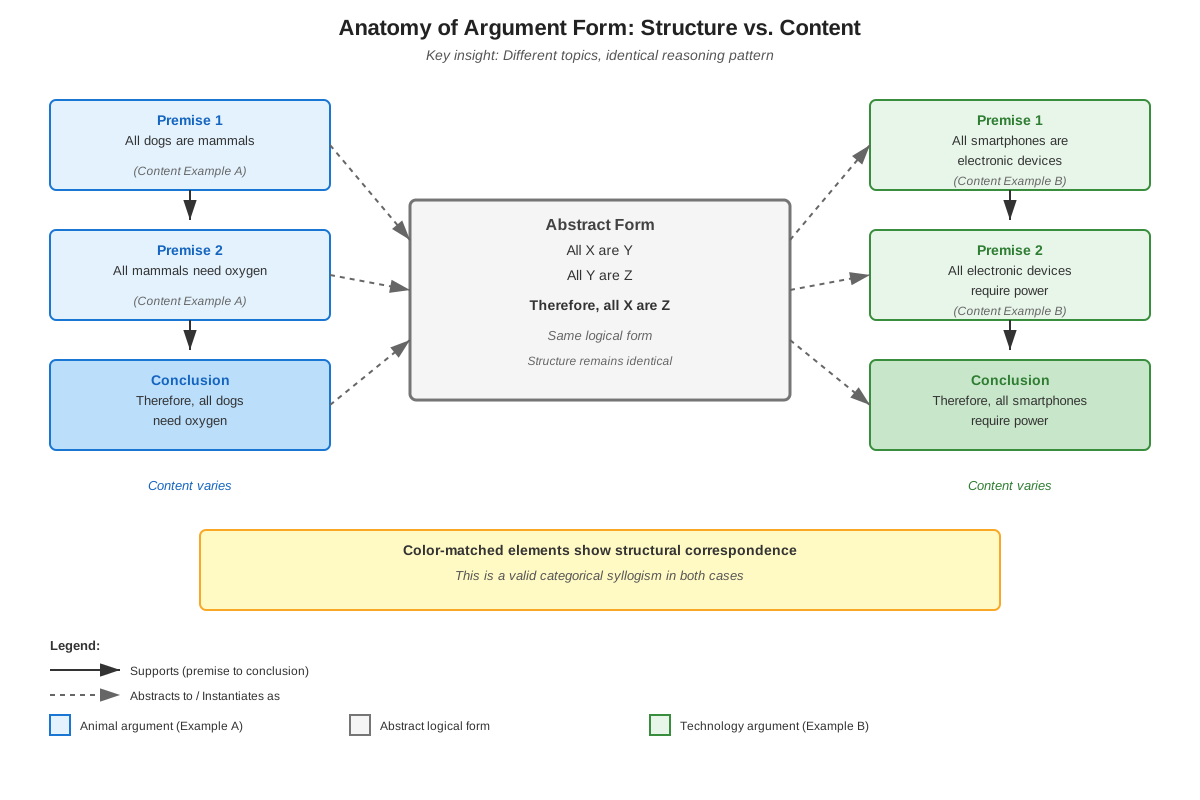
Argument form refers to the abstract logical structure of an argument, independent of its specific content. When examining argument form, the goal is to identify the pattern of reasoning that would remain true regardless of what specific subjects, objects, or actions are being discussed. For example, the arguments "All dogs are mammals; Fido is a dog; therefore, Fido is a mammal" and "All senators are politicians; Smith is a senator; therefore, Smith is a politician" share the same form: All X are Y; Z is X; therefore, Z is Y.
The key to mastering argument form matching is developing the ability to translate concrete arguments into abstract representations. This process involves several steps:
- Identify the conclusion of the argument
- Identify each premise that supports the conclusion
- Determine the logical relationships between premises and conclusion
- Note any quantifiers (all, some, none, most)
- Identify any conditional relationships (if-then statements)
- Recognize the type of reasoning (deductive, inductive, analogical)
Common Argument Structures on the LSAT
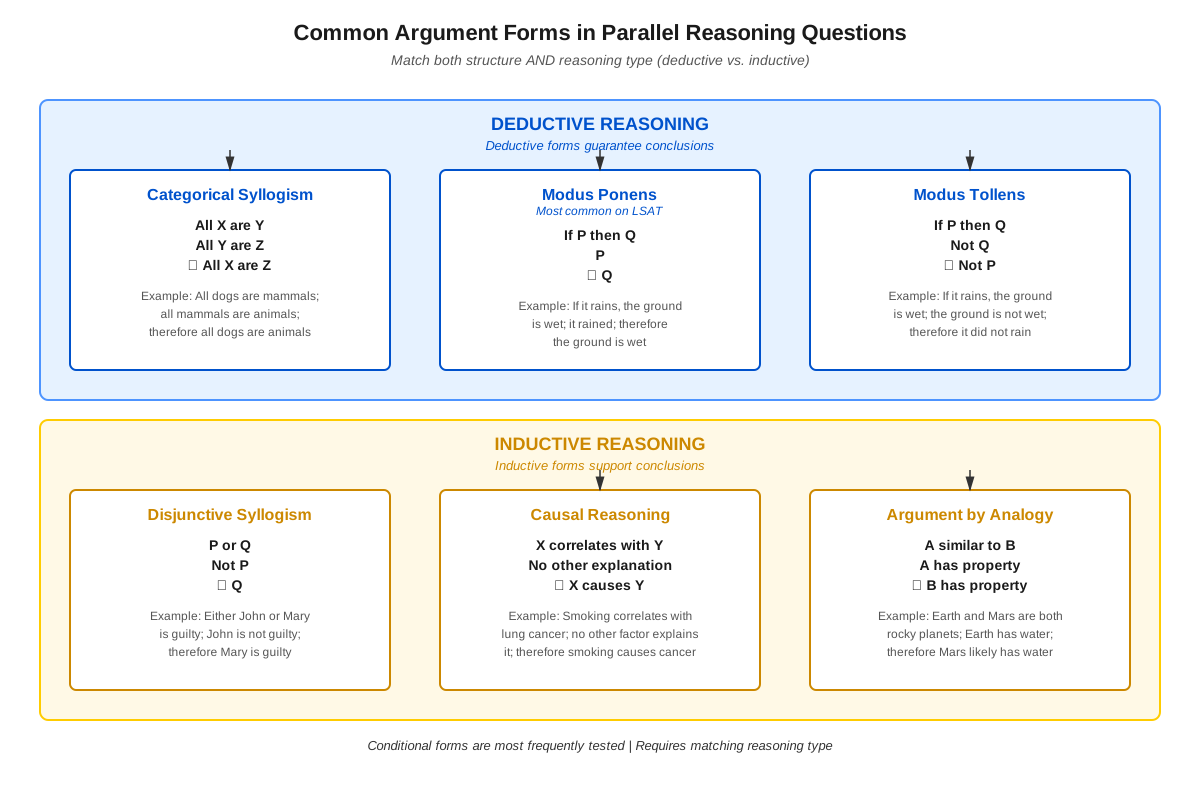
Several argument structures appear repeatedly in parallel reasoning questions. Recognizing these patterns accelerates the matching process:
Categorical Syllogisms: These arguments involve categories and membership. The structure typically follows: All/Some/No members of Category A are members of Category B; X is/is not a member of Category A; therefore, X is/is not a member of Category B.
Conditional Chains: These arguments link multiple conditional statements. For example: If A, then B; If B, then C; A is true; therefore, C is true. The parallel argument must preserve the chain structure and the direction of reasoning.
Analogical Reasoning: These arguments claim that because two things are similar in some respects, they will be similar in another respect. The structure is: X has properties 1, 2, and 3; Y has properties 1 and 2; therefore, Y probably has property 3.
Causal Arguments: These arguments establish or assume causal relationships. The structure might be: When A occurs, B occurs; A occurred; therefore, A caused B. Or alternatively: B occurred; A is known to cause B; therefore, A probably occurred.
Elimination Arguments: These arguments eliminate alternatives to reach a conclusion. The structure is: Either A, B, or C is true; A is not true; B is not true; therefore, C must be true.
Quantifiers and Their Matching
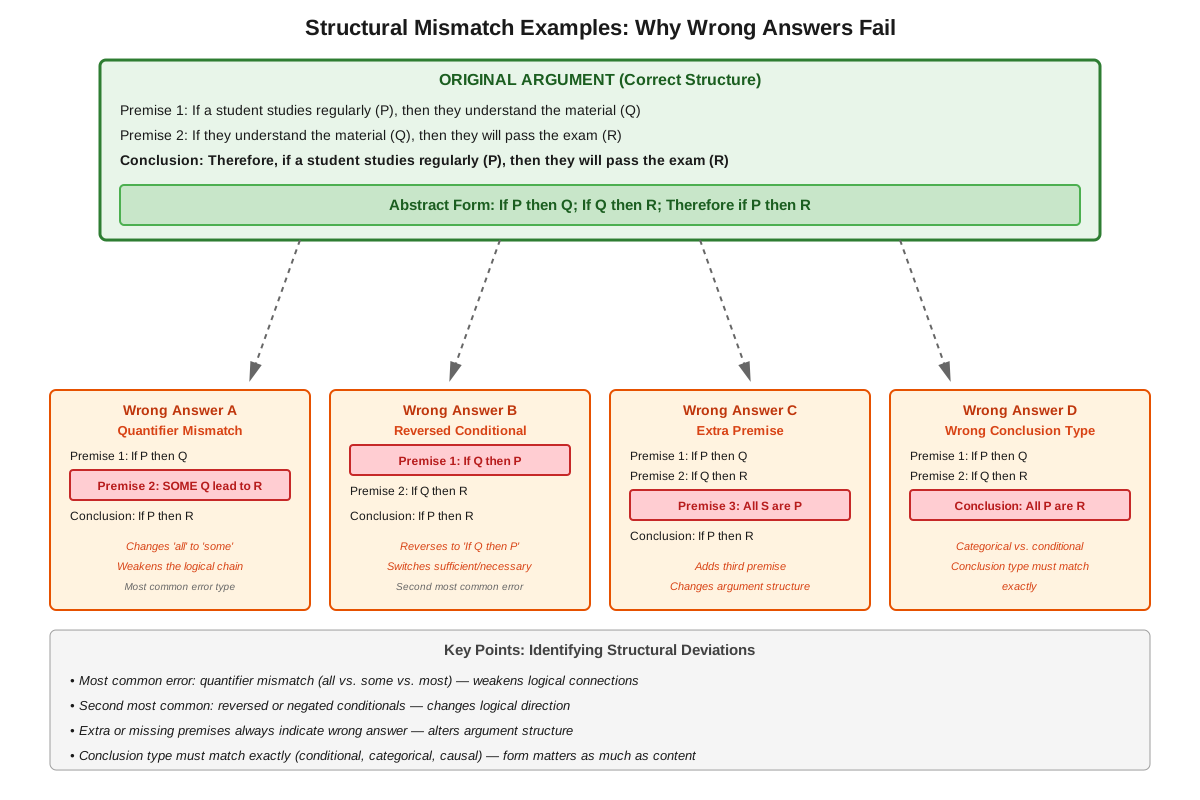
Quantifiers are words that specify the scope of a claim: all, some, most, none, few, many. In argument form matching, quantifiers must be preserved precisely. An argument that uses "all" cannot be matched with an argument that uses "some," even if the rest of the structure appears similar.
| Original Quantifier | Must Match With | Cannot Match With |
|---|---|---|
| All X are Y | All A are B | Some A are B, Most A are B |
| Some X are Y | Some A are B | All A are B, No A are B |
| Most X are Y | Most A are B | All A are B, Some A are B |
| No X are Y | No A are B | Some A are B, All A are B |
Conditional Logic in Parallel Arguments
Conditional statements create if-then relationships that must be matched exactly in parallel reasoning questions. The original argument's conditional structure—including the direction of the conditional, any negations, and whether the argument affirms the antecedent, denies the consequent, or commits a conditional reasoning error—must all be preserved.
For example, if the original argument states: "If it rains, the game will be cancelled; it rained; therefore, the game was cancelled," the parallel argument must also affirm the antecedent of a conditional statement. An argument that denies the consequent ("the game was not cancelled; therefore, it did not rain") would not be parallel, even though it represents valid conditional reasoning.
Reasoning Type Consistency
The type of reasoning employed in the original argument must match the type in the correct answer. Deductive reasoning moves from general principles to specific conclusions with certainty. Inductive reasoning moves from specific observations to general conclusions with probability. Analogical reasoning draws comparisons between similar situations.
If the original argument uses deductive reasoning to reach a certain conclusion, the parallel argument must also use deductive reasoning to reach a certain conclusion. An argument that reaches a probable or tentative conclusion would not match, even if other structural elements align.
The Role of Intermediate Conclusions
Some complex arguments contain intermediate conclusions—statements that serve as conclusions for some premises while also serving as premises for the final conclusion. When matching argument form, these intermediate steps must be preserved. If the original argument has two stages of reasoning, the parallel argument must also have two stages with the same logical relationships.
Concept Relationships
The concepts within argument form matching build upon each other in a hierarchical structure. Understanding argument form (the foundation) enables recognition of common argument structures (the framework), which in turn allows for precise matching of quantifiers and conditional logic (the details). This progression moves from general to specific:
Argument Form → Common Structures → Quantifier Matching → Conditional Logic → Reasoning Type
Argument form matching connects directly to prerequisite knowledge of basic argument structure. The ability to identify premises and conclusions (prerequisite) is necessary before one can abstract those elements into a form (current topic). Similarly, understanding conditional logic (prerequisite) enables the matching of conditional relationships across arguments (current topic).
The relationship to parallel flaw questions represents an extension of argument form matching. Once students can match valid argument forms, they can apply the same process to matching flawed argument forms, adding only the additional step of identifying the specific type of flaw present.
Within the broader Logical Reasoning curriculum, argument form matching strengthens performance on assumption questions (by clarifying how premises connect to conclusions), strengthen/weaken questions (by revealing the structure that must be supported or undermined), and method of reasoning questions (by developing the ability to describe abstract logical relationships).
High-Yield Facts
⭐ Parallel reasoning questions require matching the logical structure, not the content or subject matter of the argument
⭐ Quantifiers (all, some, most, none) must match exactly between the original argument and the correct answer
⭐ The type of reasoning (deductive, inductive, analogical) must be preserved in the parallel argument
⭐ Conditional logic relationships must match in both direction and structure, including any negations
⭐ The number of premises in the original argument should match the number of premises in the correct answer
- Parallel reasoning questions typically appear 2-4 times per LSAT exam
- The conclusion's certainty level (definite vs. probable) must match between arguments
- Intermediate conclusions in the original argument must be matched in the parallel argument
- The correct answer will preserve the same logical relationships between all elements, not just some
- Causal relationships in the original argument must be matched with causal relationships in the answer
- Arguments using elimination reasoning must match the number of alternatives eliminated
- The scope of the conclusion must match (specific vs. general)
Quick check — test yourself on Argument form matching so far.
Try Flashcards →Common Misconceptions
Misconception: If two arguments reach similar conclusions or discuss related topics, they must have parallel reasoning.
Correction: Parallel reasoning requires matching the logical structure, not the content. Two arguments about completely different subjects can have parallel reasoning, while two arguments about the same subject can have entirely different logical structures.
Misconception: An argument that is valid or sound must be the correct parallel to another valid argument.
Correction: Validity alone does not determine parallel structure. Two valid arguments can have completely different forms. The correct answer must match the specific structure of the original argument, whether that argument is valid or flawed.
Misconception: If most elements of an argument match, close enough is good enough for parallel reasoning.
Correction: Parallel reasoning requires exact structural matching. If the original uses "all" and an answer choice uses "most," that answer is incorrect regardless of how many other elements match. Every structural component must align.
Misconception: The correct answer will use similar vocabulary or terminology to the original argument.
Correction: The LSAT deliberately uses different content domains to test pure logical reasoning. The correct answer will often discuss a completely unrelated topic using entirely different vocabulary while maintaining identical logical structure.
Misconception: Longer answer choices are more likely to be correct because they provide more detail.
Correction: Length is irrelevant to structural matching. The correct answer might be the shortest or longest option. Focus on logical structure, not the amount of text or detail provided.
Misconception: If an argument commits a logical flaw, any answer that commits any flaw will be parallel.
Correction: In parallel flaw questions, the specific type of flaw must match exactly. An argument that commits an ad hominem fallacy is not parallel to an argument that commits a false dichotomy, even though both are flawed.
Worked Examples
Example 1: Categorical Syllogism
Original Argument: "All professional athletes train regularly. Maria trains regularly. Therefore, Maria is a professional athlete."
Analysis Process:
Step 1: Identify the conclusion: "Maria is a professional athlete"
Step 2: Identify the premises:
- Premise 1: "All professional athletes train regularly"
- Premise 2: "Maria trains regularly"
Step 3: Determine the logical structure:
- All X are Y
- Z is Y
- Therefore, Z is X
Step 4: Identify the reasoning type: This is deductive reasoning, but it commits a logical flaw (affirming the consequent). The argument assumes that because Maria has a characteristic of professional athletes, she must be one, but the premise only tells us that all professional athletes train regularly, not that all people who train regularly are professional athletes.
Step 5: Abstract the form: The argument incorrectly reverses a categorical relationship.
Evaluating Answer Choices:
Choice A: "All roses are flowers. This plant is a flower. Therefore, this plant is a rose."
- Structure: All X are Y; Z is Y; therefore, Z is X
- This matches perfectly! It commits the same flaw of reversing the categorical relationship.
Choice B: "All roses are flowers. This plant is a rose. Therefore, this plant is a flower."
- Structure: All X are Y; Z is X; therefore, Z is Y
- This does not match. This is valid reasoning (affirming the antecedent), while the original commits a flaw.
Choice C: "Most roses are red. This flower is red. Therefore, this flower is probably a rose."
- Structure: Most X are Y; Z is Y; therefore, Z is probably X
- This does not match. The quantifier changed from "all" to "most," and the conclusion's certainty level changed from definite to probable.
Correct Answer: Choice A matches the argument form exactly.
Example 2: Conditional Chain with Elimination
Original Argument: "If the company expands, it will need to hire more staff. If it hires more staff, costs will increase. The company cannot afford increased costs. Therefore, the company will not expand."
Analysis Process:
Step 1: Identify the conclusion: "The company will not expand"
Step 2: Identify the premises:
- Premise 1: "If the company expands → it will need to hire more staff"
- Premise 2: "If it hires more staff → costs will increase"
- Premise 3: "The company cannot afford increased costs" (costs will not increase)
Step 3: Determine the logical structure:
- If A → B
- If B → C
- Not C
- Therefore, not A
Step 4: Identify the reasoning type: This is valid deductive reasoning using the contrapositive through a conditional chain (denying the consequent).
Step 5: Abstract the form: Conditional chain with denial of the final consequent, working backward to deny the initial antecedent.
Evaluating Answer Choices:
Choice A: "If it rains, the streets will be wet. If the streets are wet, driving will be dangerous. Driving is dangerous. Therefore, it rained."
- Structure: If A → B; If B → C; C; therefore, A
- This does not match. This affirms the consequent (a flaw), while the original denies the consequent (valid reasoning).
Choice B: "If the medication works, symptoms will decrease. If symptoms decrease, the patient will feel better. The patient does not feel better. Therefore, the medication did not work."
- Structure: If A → B; If B → C; Not C; therefore, not A
- This matches perfectly! It uses the same conditional chain structure and denies the final consequent to reach a valid conclusion about the initial antecedent.
Correct Answer: Choice B matches the argument form exactly, preserving both the conditional chain structure and the valid reasoning pattern.
Exam Strategy
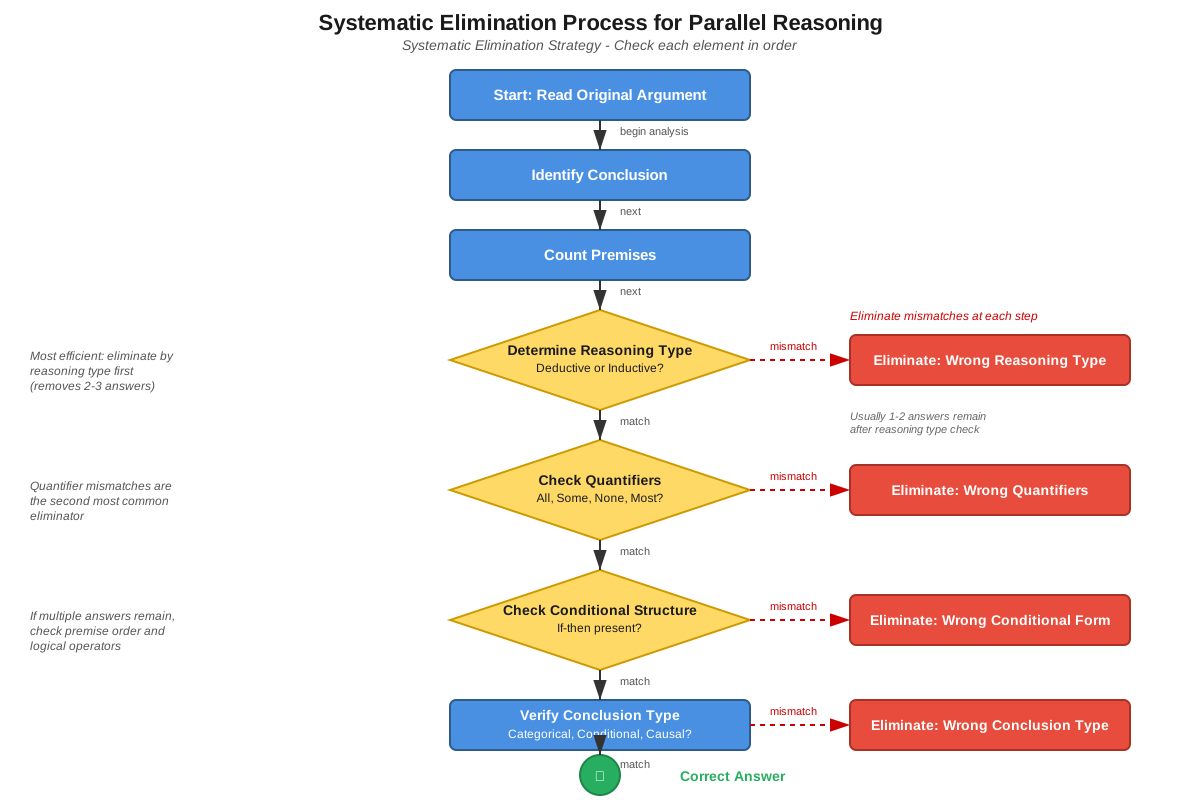
When approaching parallel reasoning questions on the LSAT, employ a systematic process to maximize accuracy while managing time effectively:
Step 1: Analyze the Original Argument First (30-45 seconds)
Before reading any answer choices, invest time understanding the original argument's structure. Identify the conclusion, premises, quantifiers, conditional relationships, and reasoning type. Consider creating a quick symbolic representation (A→B, All X are Y) to clarify the structure.
Step 2: Note Key Structural Features (15 seconds)
Identify the most distinctive structural elements that will serve as efficient elimination criteria:
- Number of premises
- Quantifiers used (all, some, most, none)
- Conditional relationships and their direction
- Type of reasoning (deductive/inductive)
- Certainty level of conclusion (definite/probable)
- Presence of intermediate conclusions
Step 3: Use Process of Elimination Aggressively (60-90 seconds)
Read answer choices strategically, eliminating based on the most obvious structural mismatches first:
Trigger Words to Watch: "All," "some," "most," "none," "if," "only if," "unless," "probably," "certainly," "must be," "could be"
Eliminate answer choices that:
- Use different quantifiers than the original
- Have a different number of premises
- Reach conclusions with different certainty levels
- Use different types of reasoning
- Lack conditional relationships present in the original
- Add conditional relationships not in the original
Step 4: Compare Remaining Choices Carefully (30-45 seconds)
For the 1-2 remaining answer choices, map each element of the original argument to elements in the answer choice. Verify that every logical relationship is preserved.
Time Allocation Advice: Parallel reasoning questions typically require 90-120 seconds—longer than average LSAT questions. This investment is worthwhile because these questions reward systematic analysis. If pressed for time, focus on eliminating based on quantifiers and reasoning type first, as these are the quickest structural elements to verify.
Common Trap Patterns:
- Answer choices that discuss similar content but have different structures
- Answer choices that are valid arguments but don't match the original's structure
- Answer choices that match most but not all structural elements
- Answer choices that reverse the direction of conditional relationships
Memory Techniques
MATCH Acronym for Systematic Analysis:
- Match the reasoning type (deductive, inductive, analogical)
- Assess quantifiers (all, some, most, none must be identical)
- Trace conditional logic (if-then relationships and their direction)
- Count premises (same number and same relationships)
- Heed conclusion certainty (definite vs. probable must match)
Visualization Strategy: Picture the argument as a physical structure—a building with a foundation (premises), support beams (logical relationships), and a roof (conclusion). The parallel argument must have the same architectural blueprint, even if built with different materials (content).
The "Skeleton Method": When reading the original argument, mentally strip away all content words and replace them with variables or generic placeholders. "All dogs are mammals" becomes "All X are Y." This skeleton is what must be matched in the correct answer.
Quantifier Matching Rhyme:
"All must match with all, some must match with some,
Most must match with most, or the answer's wrong, not right, not done."
Conditional Direction Reminder: "Forward flows forward, backward flows back; switch the direction, and the structure's off track." This reminds students that if the original argument affirms the antecedent (If A then B; A; therefore B), the parallel must also affirm the antecedent, not deny the consequent.
Summary
Argument form matching is the foundational skill for parallel reasoning questions on the LSAT, requiring test-takers to identify arguments that share identical logical structures despite having different content. Success depends on the ability to abstract from specific subject matter to recognize underlying patterns of reasoning, including the precise matching of quantifiers, conditional relationships, reasoning types, and conclusion certainty levels. The systematic approach involves analyzing the original argument's structure first, identifying its most distinctive features, and then using aggressive process of elimination to find the answer choice that preserves every structural element. This skill tests pure logical reasoning ability and appears 2-4 times per LSAT exam, making it a high-yield area for focused study. Mastery requires practice in translating concrete arguments into abstract forms and recognizing that surface-level content similarity is irrelevant—only structural identity matters.
Key Takeaways
- Argument form matching requires identifying identical logical structures, not similar content or conclusions
- Quantifiers (all, some, most, none) must match exactly between the original argument and correct answer
- The type of reasoning (deductive, inductive, analogical) and conclusion certainty level must be preserved
- Conditional logic relationships must match in direction, structure, and any negations present
- Systematic analysis of the original argument before reading answer choices improves accuracy and efficiency
- Process of elimination based on structural mismatches is the most efficient strategy for these time-intensive questions
- Every element of the logical structure must align—partial matching is insufficient for correct answers
Related Topics
Parallel Flaw Questions: Building directly on argument form matching, these questions require identifying not just the structure but also the specific logical error that must be matched. Mastering basic parallel reasoning enables progression to this more complex variant.
Formal Logic and Conditional Reasoning: Deeper study of conditional logic, including complex conditional chains, contrapositives, and sufficient/necessary conditions, strengthens the ability to match conditional structures in parallel reasoning questions.
Argument Structure Analysis: Advanced study of how complex arguments are constructed, including intermediate conclusions, subsidiary arguments, and multi-layered reasoning, enhances the ability to match sophisticated argument forms.
Method of Reasoning Questions: These questions ask test-takers to describe how an argument proceeds, requiring similar skills in abstracting from content to structure. Success in parallel reasoning transfers directly to these questions.
Categorical Logic and Syllogisms: Formal study of categorical relationships (all, some, none) and valid syllogistic forms provides the theoretical foundation for recognizing and matching these common structures in parallel reasoning questions.
Practice CTA
Now that you understand the principles and strategies of argument form matching, it's time to apply these skills to actual LSAT-style questions. The practice questions and flashcards have been specifically designed to reinforce the concepts covered in this guide, progressing from straightforward structural matching to more complex parallel reasoning scenarios. Consistent practice with immediate feedback is the most effective way to internalize these patterns and build the speed necessary for test day success. Challenge yourself to apply the MATCH acronym and systematic elimination strategy to each practice question—you'll be surprised how quickly these techniques become second nature!
Sign up free to keep reading
Create a free AnvayaPrep account to finish this LSAT guide on Argument form matching — plus flashcards and practice questions.