Overview
Argument skeleton matching is a critical skill within the LSAT's Logical Reasoning section, specifically appearing in Parallel Reasoning questions. These questions require test-takers to identify arguments that share the same underlying logical structure, even when the subject matter differs completely. Rather than focusing on content, students must extract the abstract reasoning pattern—the "skeleton"—from one argument and match it to another argument with an identical structure. This skill tests the ability to see beyond surface-level details and recognize the fundamental architecture of logical reasoning.
Mastering lsat argument skeleton matching is essential because these questions appear consistently on every LSAT administration, typically comprising 2-4 questions per test. These questions are among the most time-consuming in the Logical Reasoning section, yet they offer high point value when approached systematically. The ability to quickly identify and match argument structures directly impacts overall LSAT performance and is a skill that distinguishes high scorers from average performers.
Within the broader landscape of logical reasoning, argument skeleton matching represents an advanced application of fundamental skills. It builds upon the ability to identify premises and conclusions, recognize conditional reasoning, understand quantifiers, and detect logical fallacies. This topic connects directly to formal logic, argument structure analysis, and pattern recognition—skills that permeate the entire LSAT. Success with parallel reasoning questions demonstrates mastery of logical form over content, a hallmark of sophisticated legal reasoning that law schools value highly.
Learning Objectives
- [ ] Identify how Argument skeleton matching appears in LSAT questions
- [ ] Explain the reasoning pattern behind Argument skeleton matching
- [ ] Apply Argument skeleton matching to solve LSAT-style problems accurately
- [ ] Systematically extract the logical skeleton from complex arguments within 60 seconds
- [ ] Distinguish between structural similarity and superficial content similarity
- [ ] Recognize common argument structures that frequently appear in parallel reasoning questions
- [ ] Eliminate answer choices efficiently by identifying structural mismatches
Prerequisites
- Basic argument structure: Understanding premises, conclusions, and intermediate conclusions is essential because skeleton matching requires identifying these components before abstracting their relationships.
- Conditional reasoning: Familiarity with if-then statements and their contrapositives is necessary because many parallel reasoning questions involve conditional logic structures.
- Quantifier logic: Knowledge of universal ("all," "every") and existential ("some," "most") quantifiers is required because these determine the scope and strength of logical relationships.
- Logical indicators: Recognition of conclusion indicators (therefore, thus, so) and premise indicators (because, since, given that) enables rapid identification of argument components.
- Common logical fallacies: Understanding flawed reasoning patterns helps identify when parallel reasoning questions ask for matching flawed arguments.
Why This Topic Matters
Parallel reasoning questions test a fundamental lawyering skill: the ability to apply precedent by recognizing when two situations share the same logical structure despite different factual contexts. In legal practice, attorneys constantly argue that Case A should be decided like Case B because they share the same underlying legal reasoning, regardless of whether one involves contract law and the other tort law. This abstract pattern recognition is precisely what law schools seek in applicants.
On the LSAT, parallel reasoning questions appear in two primary forms: Parallel Reasoning questions (asking for structurally identical valid arguments) and Parallel Flaw questions (asking for structurally identical flawed arguments). Together, these question types constitute approximately 10-15% of all Logical Reasoning questions, appearing 2-4 times per test section. Given that most LSATs contain two Logical Reasoning sections, test-takers can expect to encounter 4-8 parallel reasoning questions per exam administration.
These questions commonly appear with stimulus arguments involving causal reasoning, conditional logic chains, analogical reasoning, statistical arguments, and categorical syllogisms. The LSAT frequently uses everyday scenarios (consumer behavior, scientific studies, political decisions) in the stimulus, then shifts to completely different contexts (historical events, business decisions, personal choices) in the answer choices. This deliberate content mismatch forces test-takers to focus on structure rather than subject matter—exactly the skill being tested.
Core Concepts
The Argument Skeleton
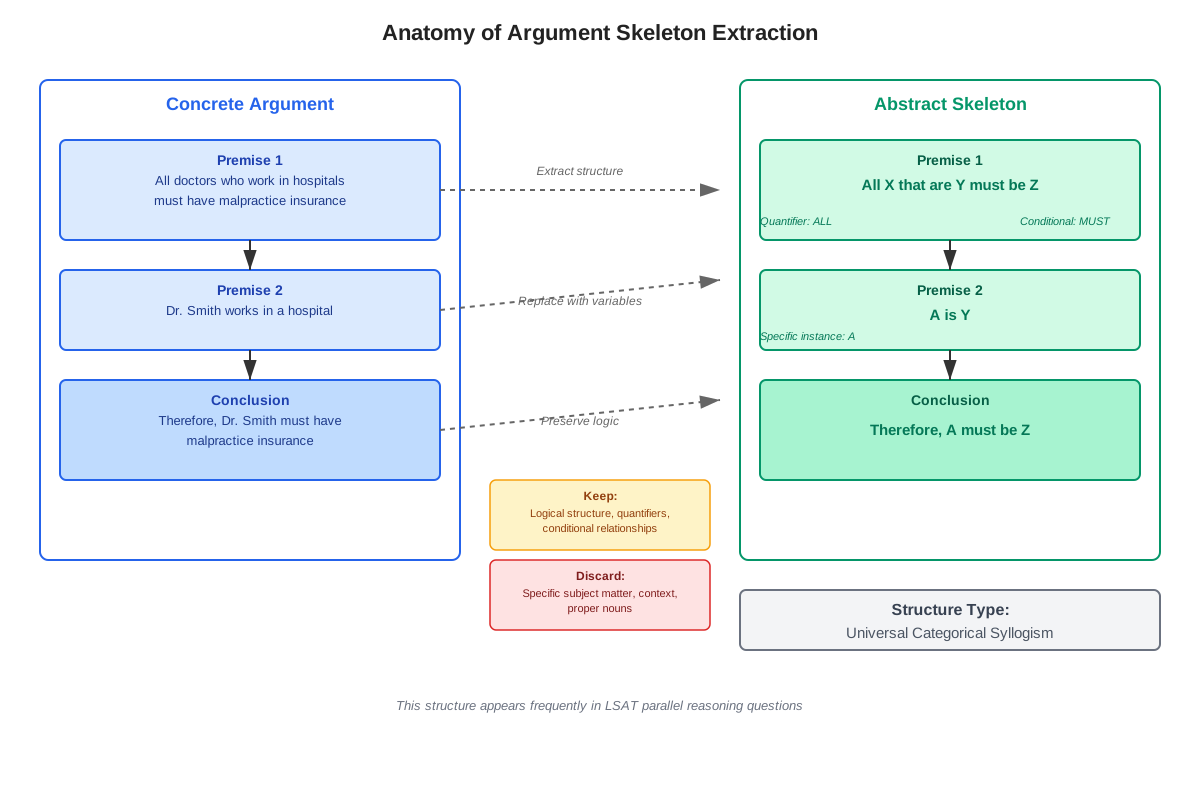
The argument skeleton is the abstract logical structure of an argument, stripped of all specific content. It represents the formal relationship between premises and conclusions, including the type of reasoning employed, the logical connectors used, and the strength of claims made. Think of it as the blueprint or framework that remains when all concrete details are removed.
To extract an argument skeleton, follow this systematic process:
- Identify the conclusion: Locate what the argument is trying to prove
- Identify all premises: Find every piece of evidence or reasoning offered
- Map the logical relationships: Determine how premises connect to the conclusion
- Abstract the content: Replace specific terms with variables or generic placeholders
- Note the reasoning type: Identify whether the argument uses causal, conditional, analogical, or other reasoning patterns
For example, consider this argument: "All dogs are mammals. Rover is a dog. Therefore, Rover is a mammal." The skeleton is: "All X are Y. Z is an X. Therefore, Z is a Y." This represents a valid categorical syllogism structure that could apply to any content.
Structural Elements to Match
When matching argument skeletons, several critical elements must align perfectly:
| Structural Element | What to Match | Example |
|---|---|---|
| Number of premises | Exact count of supporting statements | Two premises vs. three premises |
| Conclusion type | Definitive vs. probable vs. conditional | "X will happen" vs. "X probably happens" |
| Quantifiers | All, most, some, none | "All X are Y" vs. "Most X are Y" |
| Logical connectors | And, or, if-then, unless | "If X then Y" vs. "X or Y" |
| Reasoning type | Causal, conditional, analogical, etc. | Cause-effect vs. comparison |
| Validity status | Valid vs. flawed reasoning | Sound logic vs. logical fallacy |
Common Argument Structures
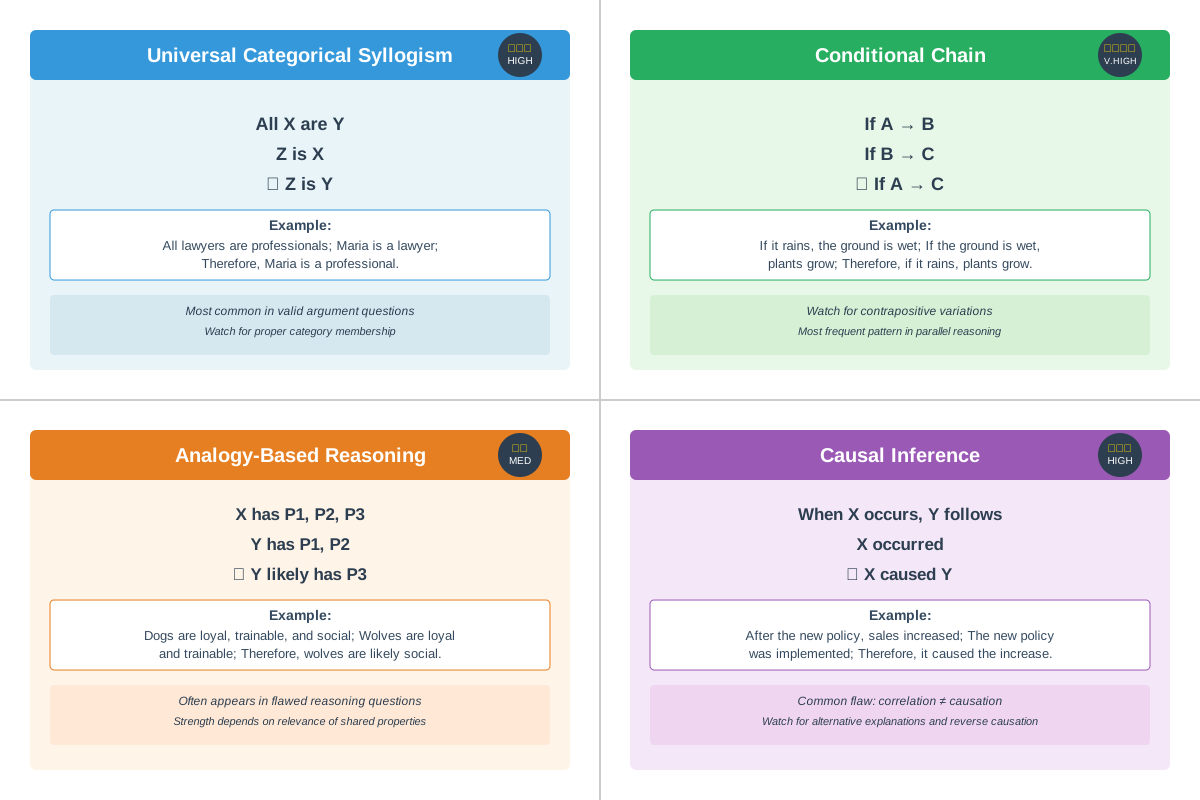
Certain argument patterns appear repeatedly in LSAT parallel reasoning questions:
Conditional Chain Structure: "If A, then B. If B, then C. A is true. Therefore, C is true." This structure involves multiple conditional statements linked together, with the conclusion following from affirming the initial condition.
Causal Reasoning Structure: "X occurred. Then Y occurred. No other explanation for Y is apparent. Therefore, X caused Y." This pattern establishes causation through temporal sequence and elimination of alternatives.
Analogical Structure: "Situation A has properties 1, 2, and 3, and also has property Z. Situation B has properties 1, 2, and 3. Therefore, Situation B probably has property Z." This reasoning draws parallels between similar cases.
Categorical Syllogism: "All X are Y. All Y are Z. Therefore, all X are Z." This classical logical form uses categorical relationships to reach a conclusion.
Disjunctive Reasoning: "Either X or Y must be true. X is not true. Therefore, Y must be true." This structure eliminates alternatives to reach a conclusion.
Matching Flawed Arguments
Parallel Flaw questions require matching not just the structure but also the specific logical error. Common flawed structures include:
Affirming the Consequent: "If A, then B. B is true. Therefore, A is true." This fallacy incorrectly reverses conditional logic.
Denying the Antecedent: "If A, then B. A is not true. Therefore, B is not true." This fallacy incorrectly assumes the conditional works in reverse.
False Dichotomy: "Either extreme X or extreme Y. Not X. Therefore, Y." This fallacy ignores middle ground or additional options.
Hasty Generalization: "Some X have property Y. Therefore, all X have property Y." This fallacy overgeneralizes from limited evidence.
Circular Reasoning: "X is true because Y is true. Y is true because X is true." This fallacy uses the conclusion as its own premise.
The Abstraction Process
Successful skeleton matching requires systematic abstraction. Replace specific content with generic placeholders while preserving logical relationships:
- Replace specific subjects with variables: "doctors" → "Group A" or "X"
- Replace specific actions with generic verbs: "prescribe medication" → "perform action Y"
- Replace specific objects with placeholders: "antibiotics" → "item Z"
- Preserve quantifiers exactly: "all," "most," "some" must match precisely
- Maintain logical operators: "if-then," "and," "or," "unless" must be identical
- Keep the same number of logical steps and intermediate conclusions
This abstraction reveals whether two arguments share the same logical DNA, regardless of their surface-level differences.
Concept Relationships
The concepts within argument skeleton matching form an interconnected system. The argument skeleton serves as the foundation—it is the target pattern that must be identified and matched. This skeleton is composed of structural elements (quantifiers, connectors, premise-conclusion relationships) that must align perfectly between the stimulus and correct answer. The abstraction process is the method by which test-takers extract the skeleton from content-rich arguments, enabling comparison.
Common argument structures represent frequently tested patterns that test-takers should recognize quickly, serving as templates against which to compare new arguments. When dealing with flawed arguments, all the same structural matching principles apply, but with the additional requirement that the specific logical error must also match.
The relationship flows as follows: Stimulus argument → Abstraction process → Argument skeleton → Structural element comparison → Common structure recognition → Answer choice evaluation. Each step depends on the previous one, and weakness in any area compromises the entire matching process.
This topic connects to prerequisite knowledge by applying basic argument structure (identifying premises and conclusions) as the first step in skeleton extraction. Conditional reasoning and quantifier logic become specific structural elements that must match. Logical indicators facilitate rapid identification of argument components during the abstraction process. Common logical fallacies become the specific flaws that must match in Parallel Flaw questions.
Argument skeleton matching also connects forward to other LSAT topics. The pattern recognition skills developed here enhance performance on Method of Reasoning questions, which ask how an argument proceeds. The structural analysis strengthens Flaw question performance by improving recognition of reasoning errors. The abstraction skills transfer to Sufficient Assumption and Necessary Assumption questions, which require understanding argument structure to identify missing logical links.
High-Yield Facts
⭐ Parallel Reasoning questions require matching both the logical structure AND the validity status (valid argument must match valid argument; flawed must match flawed).
⭐ The number of premises in the stimulus must exactly match the number of premises in the correct answer choice.
⭐ Quantifiers must match precisely: "all" cannot match "most," and "some" cannot match "many."
⭐ Conditional logic direction must be identical: "If A then B" is structurally different from "If B then A."
⭐ The strength of the conclusion must match: definitive conclusions ("will happen") differ from probabilistic conclusions ("probably happens").
- Parallel Flaw questions are typically more time-consuming than regular Parallel Reasoning questions because they require identifying both structure and flaw type.
- Content similarity between stimulus and answer choice is often a trap—the LSAT deliberately uses different subject matter to test structural thinking.
- The correct answer will match the stimulus in every structural detail, while wrong answers typically differ in one or two key elements.
- Intermediate conclusions in the stimulus must also appear as intermediate conclusions in the correct answer.
- The logical relationship between premises (whether they work independently or build upon each other) must be preserved.
- Diagramming conditional logic in both stimulus and answer choices dramatically increases accuracy on parallel reasoning questions involving if-then statements.
- Wrong answer choices often match the stimulus in reasoning type (e.g., both causal) but differ in structure (e.g., different number of premises or different conclusion strength).
- Parallel Reasoning questions typically appear later in Logical Reasoning sections, as they are considered more difficult and time-intensive.
- The abstraction process becomes faster with practice—experienced test-takers can extract skeletons in 30-45 seconds.
- Recognizing common argument structures (categorical syllogisms, conditional chains, causal arguments) allows for faster pattern matching.
Quick check — test yourself on Argument skeleton matching so far.
Try Flashcards →Common Misconceptions
Misconception: Arguments with similar content or subject matter are more likely to be structurally parallel.
Correction: The LSAT deliberately uses different content in parallel arguments to test structural thinking. An argument about medicine can be structurally identical to one about architecture. Focus on logical form, not topic similarity.
Misconception: If two arguments reach the same type of conclusion (both recommend an action, both make a prediction), they are structurally parallel.
Correction: Conclusion type is only one structural element. Two arguments can both recommend actions but use completely different reasoning structures to reach those recommendations. All structural elements must match.
Misconception: In Parallel Flaw questions, any answer choice with a logical flaw will work.
Correction: The specific type of flaw must match exactly. An argument that commits the fallacy of affirming the consequent must be matched with another argument that commits the same fallacy, not just any flawed reasoning.
Misconception: Longer answer choices are more likely to be correct because they provide more detail.
Correction: Length is irrelevant to structural matching. The LSAT often includes verbose wrong answers and concise correct answers. Focus on structural elements, not word count.
Misconception: The correct answer will use similar logical indicator words (if the stimulus uses "therefore," the answer will too).
Correction: While indicator words can be helpful, they are not required to match. An argument can indicate its conclusion with "therefore," "thus," "so," or "consequently" and still be structurally identical to one using different indicators.
Misconception: If the stimulus argument is valid, any valid argument in the answer choices could be correct.
Correction: Validity is necessary but not sufficient. The correct answer must be valid AND structurally identical in all other respects (number of premises, quantifiers, logical connectors, reasoning type).
Misconception: Parallel Reasoning questions are too time-consuming and should be skipped.
Correction: While these questions do require more time, they are highly learnable and offer full point value. With systematic approach and practice, most test-takers can complete them in 90-120 seconds with high accuracy.
Worked Examples
Example 1: Valid Parallel Reasoning
Stimulus: "Every member of the city council voted for the new budget. Chen is a member of the city council. Therefore, Chen voted for the new budget."
Step 1 - Identify the conclusion: "Chen voted for the new budget" (signaled by "therefore")
Step 2 - Identify the premises:
- Premise 1: "Every member of the city council voted for the new budget"
- Premise 2: "Chen is a member of the city council"
Step 3 - Map the logical structure: This is a categorical syllogism with universal quantifier
- All members of Group X have Property Y
- Individual Z is a member of Group X
- Therefore, Individual Z has Property Y
Step 4 - Note key structural features:
- Two premises
- Universal quantifier ("every")
- Definitive conclusion (not probable or conditional)
- Valid reasoning (proper categorical syllogism)
Step 5 - Abstract the skeleton: "All X are Y. Z is an X. Therefore, Z is Y."
Evaluating Answer Choices:
(A) "Most students who study regularly pass the exam. Maria studies regularly. Therefore, Maria will probably pass the exam."
- Structural mismatch: Uses "most" instead of "all" (quantifier mismatch)
- Structural mismatch: Conclusion is probabilistic ("probably") not definitive
- Eliminate
(B) "All employees must attend the training. Rodriguez is an employee. Therefore, Rodriguez must attend the training."
- Structural match: "All X are Y. Z is an X. Therefore, Z is Y."
- Quantifier match: "All" matches "every"
- Conclusion strength match: Definitive conclusion
- Valid reasoning: Proper categorical syllogism
- Keep as strong contender
(C) "Every doctor has a medical degree. Every person with a medical degree studied biology. Therefore, every doctor studied biology."
- Structural mismatch: Three categorical statements instead of two premises plus conclusion
- Structural mismatch: Conclusion is about all members of the group, not one individual
- Eliminate
(D) "All the books on the shelf are mysteries. This book is on the shelf. Therefore, this book might be a mystery."
- Structural mismatch: Conclusion is tentative ("might be") not definitive
- Eliminate
Correct Answer: (B) - Perfect structural match in all elements.
Example 2: Parallel Flaw
Stimulus: "If the company implements the new policy, employee satisfaction will increase. Employee satisfaction has increased. Therefore, the company must have implemented the new policy."
Step 1 - Identify the conclusion: "The company must have implemented the new policy"
Step 2 - Identify the premises:
- Premise 1: "If the company implements the new policy, employee satisfaction will increase" (conditional statement)
- Premise 2: "Employee satisfaction has increased" (affirms the consequent)
Step 3 - Identify the flaw: This commits the fallacy of affirming the consequent
- Structure: If A, then B. B is true. Therefore, A is true.
- Flaw: The conditional doesn't work in reverse; B could be true for other reasons
Step 4 - Abstract the skeleton: "If X, then Y. Y occurred. Therefore, X occurred."
Step 5 - Note that we need to match both structure AND flaw type
Evaluating Answer Choices:
(A) "If it rains, the streets will be wet. The streets are wet. Therefore, it must have rained."
- Structural match: "If X, then Y. Y is true. Therefore, X is true."
- Flaw match: Affirms the consequent (streets could be wet from other causes)
- Keep as strong contender
(B) "If the plant gets water, it will grow. The plant did not get water. Therefore, it will not grow."
- Structural mismatch: This denies the antecedent, not affirms the consequent
- Flaw mismatch: Different logical error
- Eliminate
(C) "If students study, they pass. These students passed. Therefore, they probably studied."
- Conclusion strength mismatch: "Probably" is weaker than the definitive conclusion in stimulus
- Eliminate (even though the flaw type is similar, the conclusion strength must match)
(D) "If the alarm sounds, there is danger. There is danger. Therefore, the alarm will sound."
- Structural mismatch: Conclusion is predictive future tense, not past tense like stimulus
- Eliminate
Correct Answer: (A) - Matches both the structure and the specific logical flaw.
Exam Strategy
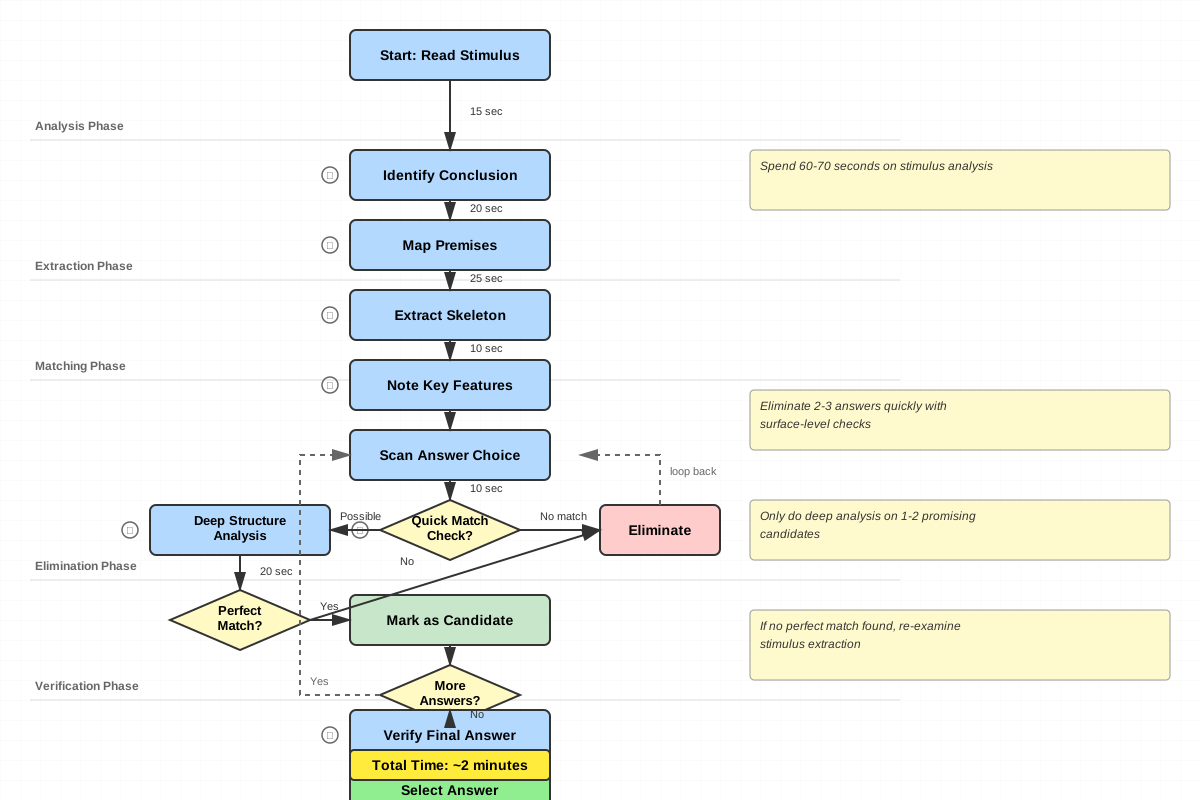
Initial Approach: When encountering a Parallel Reasoning question, immediately note whether it asks for parallel reasoning or parallel flaw. This determines whether to match valid or flawed structure. Read the question stem carefully—phrases like "most similar in reasoning" indicate standard parallel reasoning, while "flawed reasoning most similar" indicates parallel flaw.
Trigger Words and Phrases:
- "Which one of the following is most similar in its reasoning to the argument above?"
- "The pattern of reasoning in which one of the following is most similar to that in the argument above?"
- "The flawed reasoning in which one of the following most closely resembles the flawed reasoning above?"
- "Which one of the following arguments is most similar in its logical structure to the argument above?"
Systematic Process:
- Read the stimulus actively (30-45 seconds): Identify conclusion, premises, and logical structure while reading
- Abstract immediately (15-20 seconds): Create a mental or written skeleton before looking at answers
- Predict structural features (10 seconds): Note what must match (number of premises, quantifiers, reasoning type)
- Evaluate answer choices systematically (45-60 seconds): Check each structural element in order
Process of Elimination Tips:
- Eliminate on quantifier mismatches first: This is the fastest way to eliminate wrong answers. If stimulus uses "all," eliminate any answer using "most" or "some."
- Check premise count second: If stimulus has two premises, eliminate any answer with three or more distinct premises.
- Verify conclusion strength third: Definitive conclusions must match definitive conclusions; probabilistic must match probabilistic.
- Confirm reasoning type last: Ensure causal matches causal, conditional matches conditional, etc.
Time Allocation: Budget 90-120 seconds for Parallel Reasoning questions, slightly more (120-150 seconds) for Parallel Flaw questions. These questions are time-intensive but highly accurate when approached systematically. If a question is taking longer than 2 minutes, make your best guess and move on—spending 3+ minutes on one question damages overall section performance.
Advanced Techniques:
Exam Tip: For conditional logic parallel reasoning questions, diagram both the stimulus and answer choices using standard conditional notation. This makes structural comparison immediate and eliminates the possibility of missing reversed logic.
Exam Tip: When stuck between two answer choices, create a detailed structural checklist and compare each element systematically. The correct answer will match in ALL respects; wrong answers will differ in at least one structural element.
Common Traps to Avoid:
- Don't be seduced by content similarity—different topics can share identical structure
- Don't assume longer answers are more likely correct—length is irrelevant to structure
- Don't rush the abstraction phase—15 seconds spent creating a clear skeleton saves 30+ seconds in answer evaluation
- Don't forget to verify that valid arguments match valid arguments and flawed match flawed
Memory Techniques
SQUARC Mnemonic for structural elements to match:
- Strength of conclusion (definitive vs. probable)
- Quantifiers (all, most, some, none)
- Units (number of premises)
- Arrangement (how premises relate to each other)
- Reasoning type (causal, conditional, analogical)
- Connectors (if-then, and, or, unless)
The "Skeleton Key" Visualization: Imagine the argument as a building. The skeleton is the steel framework—it remains the same whether the building is covered in brick, glass, or wood (content). When matching arguments, visualize stripping away the exterior to see if the frameworks are identical.
"All Must Fall" Rule: For categorical syllogisms, remember that "All X are Y" creates a definitive relationship. If the stimulus uses "all" or "every," the correct answer must too—no exceptions. Think: "All must fall together" (all the structural elements must align).
Conditional Chain Acronym - IFTTT: "If This, Then That, Then The other Thing" helps remember that conditional chains must match in both number of links and direction of logic flow.
Flaw Family Grouping: Memorize flawed reasoning patterns in families:
- Conditional Confusion Family: Affirming consequent, denying antecedent
- Generalization Family: Hasty generalization, composition/division
- Causal Family: Correlation-causation, reversed causation, ignoring alternative causes
- Relevance Family: Ad hominem, appeal to authority, red herring
When you identify a flaw in the stimulus, immediately recall its family to predict what the correct answer must contain.
Summary
Argument skeleton matching is the process of identifying and comparing the abstract logical structure of arguments, independent of their specific content. This skill is tested through Parallel Reasoning and Parallel Flaw questions on the LSAT, which require test-takers to find arguments with identical logical architecture despite different subject matter. Success requires systematic extraction of the argument skeleton through a five-step process: identifying the conclusion, identifying premises, mapping logical relationships, abstracting content into variables, and noting the reasoning type. Critical structural elements that must match include the number of premises, quantifiers, logical connectors, conclusion strength, reasoning type, and validity status. Common argument structures appear repeatedly, including conditional chains, causal reasoning, analogical arguments, categorical syllogisms, and disjunctive reasoning. For Parallel Flaw questions, both the structure and the specific logical error must match exactly. The key to mastery is developing the ability to see beyond surface-level content to the underlying logical form, then systematically comparing structural elements between stimulus and answer choices. With practice, this process becomes rapid and reliable, transforming these challenging questions into high-yield scoring opportunities.
Key Takeaways
- Argument skeleton matching requires identifying logical structure independent of content—focus on form, not subject matter
- All structural elements must match exactly: quantifiers, premise count, conclusion strength, logical connectors, and reasoning type
- The systematic abstraction process (identify conclusion → identify premises → map relationships → abstract content → note reasoning type) is essential for accuracy
- Quantifier mismatches are the fastest elimination tool—"all" cannot match "most," and "some" cannot match "many"
- Parallel Flaw questions require matching both structure and the specific type of logical error—any flaw won't work, only the identical flaw
- Common argument structures (conditional chains, categorical syllogisms, causal reasoning) appear repeatedly and should be recognized quickly
- Time investment in these questions pays off—they are highly learnable and offer full point value when approached systematically
Related Topics
Method of Reasoning Questions: These questions ask how an argument proceeds or what role a statement plays. Mastering argument skeleton matching enhances performance on Method of Reasoning questions because both require understanding argument structure. The structural analysis skills developed here transfer directly to identifying reasoning methods.
Flaw Questions: Understanding common flawed argument structures from Parallel Flaw questions strengthens the ability to identify logical errors in standard Flaw questions. The pattern recognition developed through skeleton matching accelerates flaw identification.
Sufficient and Necessary Assumption Questions: These questions require understanding argument structure to identify missing logical links. The ability to abstract argument skeletons and see structural gaps directly supports assumption question performance.
Formal Logic and Conditional Reasoning: Advanced study of formal logic notation and complex conditional relationships builds upon the conditional reasoning patterns encountered in parallel reasoning questions, enabling faster and more accurate analysis.
Strengthen and Weaken Questions: Understanding argument structure through skeleton matching improves the ability to identify which answer choices affect the logical relationship between premises and conclusion, enhancing performance on these common question types.
Practice CTA
Now that you understand the principles and strategies of argument skeleton matching, it's time to apply these skills to actual LSAT-style questions. The practice questions and flashcards have been specifically designed to reinforce the concepts covered in this guide, progressing from straightforward structural matching to complex parallel flaw scenarios. Each practice question offers an opportunity to implement the systematic approach you've learned: abstract the skeleton, identify structural elements, and match with precision. Remember, argument skeleton matching is a highly learnable skill—your accuracy and speed will improve dramatically with focused practice. Approach each practice question as an opportunity to refine your technique, and review your work to understand not just which answer was correct, but why the structural match was perfect. You're building a skill that will serve you throughout the LSAT and in legal reasoning beyond. Start practicing now to transform this challenging question type into a reliable source of points on test day!
Sign up free to keep reading
Create a free AnvayaPrep account to finish this LSAT guide on Argument skeleton matching — plus flashcards and practice questions.