Overview
Matching conclusion strength is a critical skill within the parallel reasoning question type on the LSAT Logical Reasoning section. This concept requires test-takers to identify arguments that share not only similar logical structures but also equivalent levels of certainty in their conclusions. While many students focus solely on matching the pattern of reasoning, the LSAT frequently tests whether candidates can distinguish between conclusions that are definitive versus those that are qualified, probable, or conditional.
Understanding conclusion strength is essential because the LSAT consistently includes wrong answer choices that mirror the argument's structure but fail to match the degree of certainty expressed in the original conclusion. For instance, an argument concluding "X will definitely occur" differs fundamentally from one concluding "X probably will occur," even if both follow identical reasoning patterns. This subtle distinction separates high-scoring test-takers from those who struggle with parallel reasoning questions.
This topic integrates seamlessly with broader Logical Reasoning concepts, including argument structure analysis, conditional reasoning, and the distinction between necessary and sufficient conditions. Mastering LSAT matching conclusion strength enhances performance not only on parallel reasoning questions but also on flaw identification, assumption questions, and strengthen/weaken questions where recognizing the scope and certainty of claims proves crucial. The ability to calibrate conclusion strength represents a sophisticated analytical skill that the LSAT rewards consistently across multiple question types.
Learning Objectives
By the end of this study guide, students should be able to:
- [ ] Identify how matching conclusion strength appears in LSAT questions
- [ ] Explain the reasoning pattern behind matching conclusion strength
- [ ] Apply matching conclusion strength to solve LSAT-style problems accurately
- [ ] Distinguish between categorical, qualified, conditional, and probabilistic conclusions
- [ ] Recognize common trap answers that match structure but not conclusion strength
- [ ] Evaluate whether two arguments share equivalent degrees of certainty in their conclusions
Prerequisites
Students should have foundational knowledge in the following areas:
- Basic argument structure: Understanding premises, conclusions, and how they connect is essential because matching conclusion strength requires first identifying what the conclusion claims before assessing its strength
- Conditional reasoning fundamentals: Recognizing "if-then" relationships helps distinguish conditional conclusions from categorical ones
- Parallel reasoning basics: Familiarity with matching argument patterns provides the foundation upon which conclusion strength matching builds
- Indicator words: Knowledge of conclusion indicators ("therefore," "thus," "must be") and qualifier words ("probably," "likely," "might") enables precise identification of conclusion strength
Why This Topic Matters
In real-world contexts, distinguishing between levels of certainty in conclusions is fundamental to critical thinking, legal reasoning, and professional decision-making. Attorneys must recognize whether precedents establish definitive rules or merely suggest probable outcomes. Policy analysts differentiate between recommendations that "should" be implemented versus those that "must" be implemented. This skill translates directly to evaluating arguments in academic, professional, and civic contexts.
On the LSAT, parallel reasoning questions appear in approximately 2-3 questions per Logical Reasoning section, making them a regular feature of the exam. Among these questions, conclusion strength mismatches represent one of the most common trap answer patterns, appearing in roughly 60-70% of parallel reasoning questions. The LSAT test-makers deliberately craft wrong answers that perfectly match the argument's structure but subtly shift the conclusion from definitive to probable, or vice versa.
This topic appears in several distinct ways on the exam. Most commonly, students encounter parallel reasoning questions asking them to identify which answer choice "most closely parallels the reasoning" in the stimulus. Additionally, parallel flaw questions require matching both the logical error and the conclusion strength. Less frequently, method of reasoning questions may ask students to describe how an argument reaches its conclusion, requiring attention to whether that conclusion is presented as certain, probable, or conditional.
Core Concepts
Understanding Conclusion Strength Categories
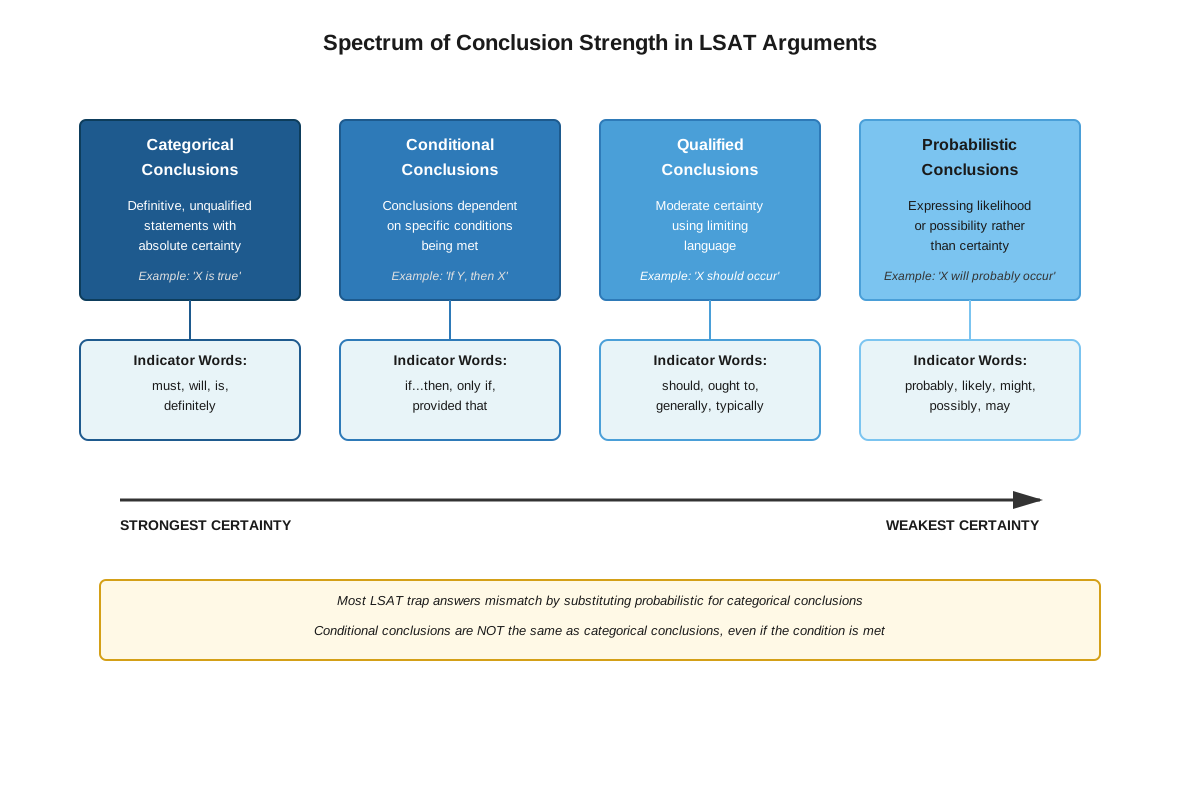
Conclusion strength refers to the degree of certainty or confidence with which an argument's conclusion is stated. On the LSAT, conclusions fall into several distinct categories that must be matched precisely in parallel reasoning questions.
Categorical conclusions assert claims with complete certainty, using language like "is," "must be," "will," "cannot," or "definitely." For example: "Therefore, the policy will fail" or "The defendant must be guilty." These conclusions admit no possibility of exception or uncertainty.
Qualified conclusions express claims with moderate certainty, employing words such as "probably," "likely," "unlikely," "tends to," or "generally." For instance: "Therefore, the policy will probably fail" or "The defendant is likely guilty." These conclusions acknowledge the possibility of alternative outcomes while still asserting a preferred prediction.
Conditional conclusions present claims that depend on specific circumstances being met, typically using "if-then" structures: "If the policy is implemented, then it will fail" or "The defendant would be guilty if the evidence is authentic." These conclusions make no assertion about whether the condition is actually satisfied.
Possibility conclusions indicate that something could occur or might be true, using language like "may," "might," "could," or "possibly": "Therefore, the policy might fail" or "The defendant could be guilty." These represent the weakest form of conclusion, asserting only that an outcome falls within the realm of possibility.
Identifying Conclusion Strength Indicators
The LSAT uses specific linguistic markers to signal conclusion strength. Recognizing these trigger words enables rapid and accurate assessment of how strongly an argument commits to its conclusion.
Certainty indicators include: must, will, cannot, definitely, certainly, clearly, undoubtedly, necessarily, always, never, is, are. When these words appear in conclusions, the argument makes an absolute claim.
Probability indicators include: probably, likely, unlikely, tends to, generally, usually, typically, most, often, rarely, seldom. These signal that the conclusion acknowledges uncertainty while still making a prediction.
Possibility indicators include: may, might, could, possibly, perhaps, can, potentially. These represent the weakest commitment to the conclusion's truth.
Conditional indicators include: if, then, only if, unless, provided that, assuming that, would, should (in conditional contexts). These signal that the conclusion's truth depends on specified conditions.
The Relationship Between Premise Strength and Conclusion Strength
A critical principle in logical reasoning is that conclusion strength must be proportional to premise strength. Strong premises (those asserting facts with certainty) can support strong conclusions, while weak premises (those expressing probabilities or possibilities) can only support correspondingly weak conclusions.
Consider this valid relationship: "All politicians who accept corporate donations vote against campaign finance reform. Senator X accepts corporate donations. Therefore, Senator X will vote against campaign finance reform." The categorical premises ("all" and the definitive statement about Senator X) support a categorical conclusion.
Now consider an invalid strength relationship: "Most politicians who accept corporate donations vote against campaign finance reform. Senator X accepts corporate donations. Therefore, Senator X will definitely vote against campaign finance reform." Here, the qualified premise ("most") cannot support the categorical conclusion ("will definitely"). The conclusion should instead read "Senator X will probably vote against campaign finance reform."
Matching Strength in Parallel Reasoning Questions
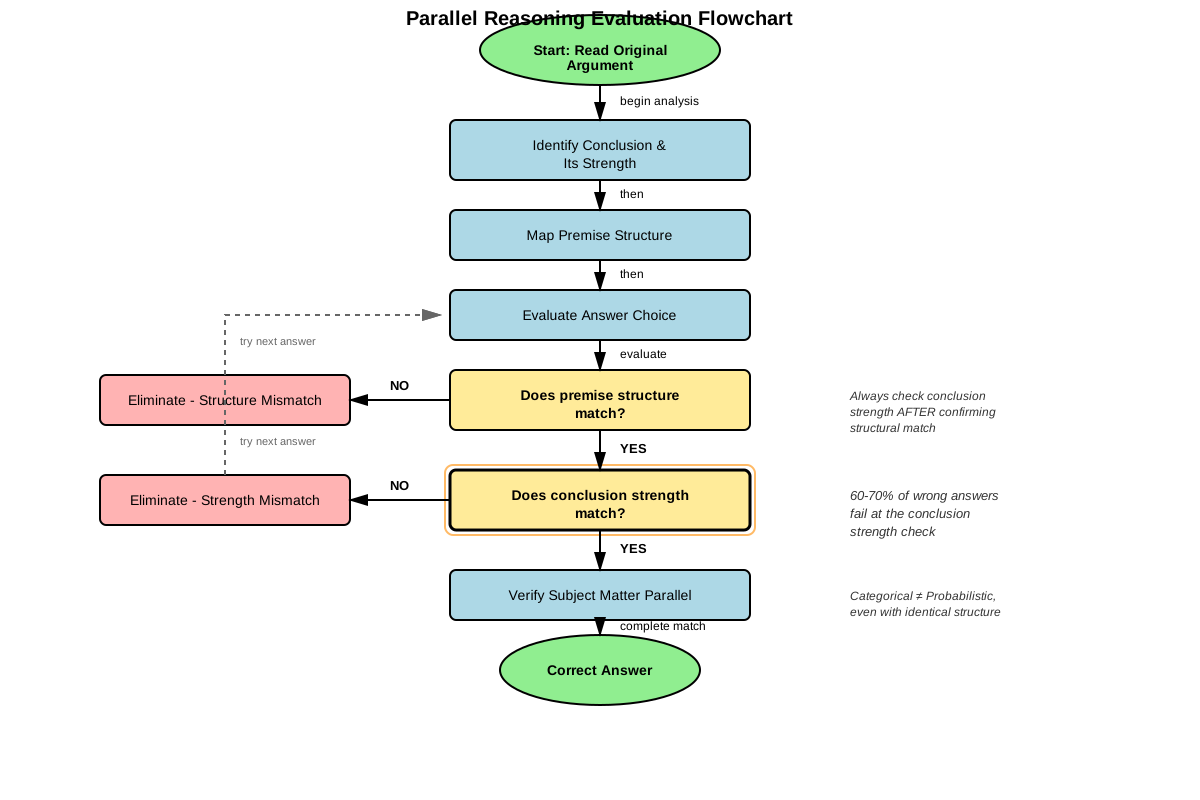
When approaching LSAT matching conclusion strength questions, students must execute a two-step process. First, identify the conclusion strength in the original argument. Second, eliminate any answer choice whose conclusion exhibits a different strength level, regardless of how well it matches the argument's structure.
| Original Conclusion Strength | Must Match With | Cannot Match With |
|---|---|---|
| Categorical ("will happen") | Categorical ("must occur") | Qualified ("probably will"), Conditional ("would happen if"), Possibility ("might happen") |
| Qualified ("probably will") | Qualified ("likely will") | Categorical ("will"), Possibility ("could"), Conditional ("would if") |
| Conditional ("if X, then Y") | Conditional ("if A, then B") | Categorical ("Y occurs"), Qualified ("Y probably occurs") |
| Possibility ("might happen") | Possibility ("could occur") | Categorical ("will"), Qualified ("probably will") |
Common Strength Mismatches in Wrong Answers
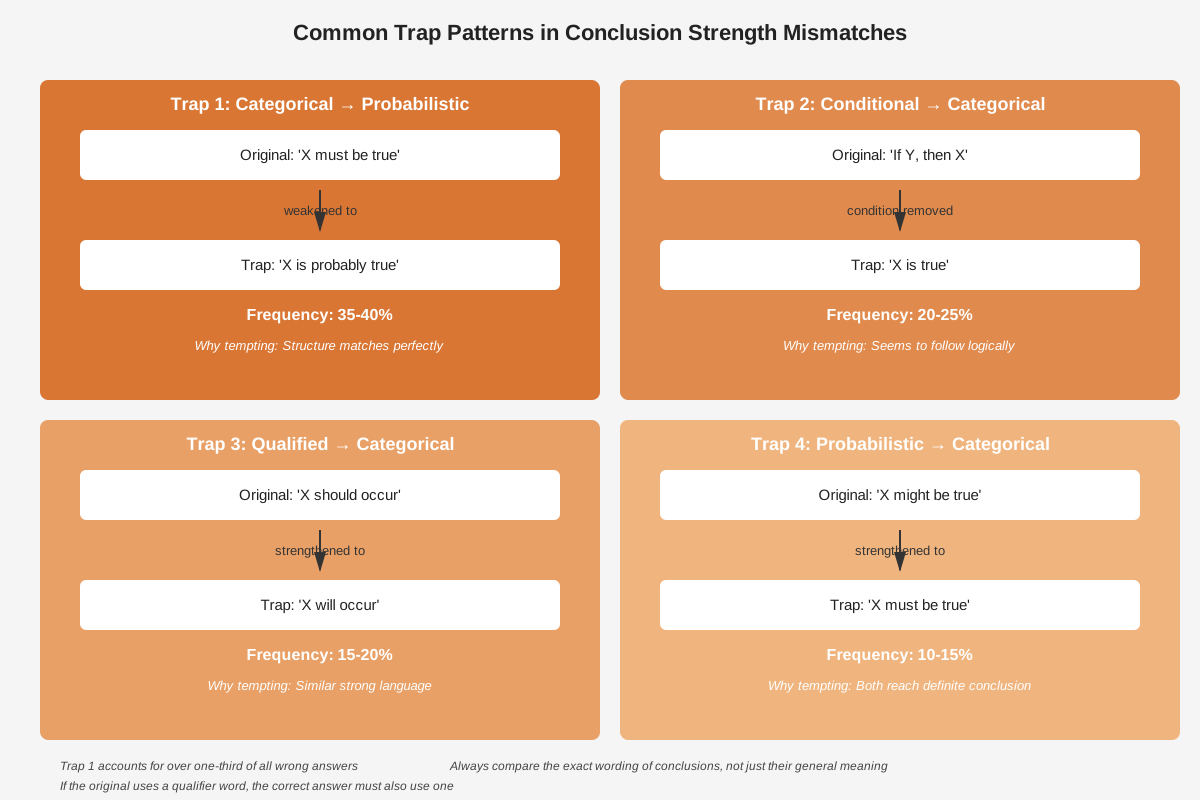
The LSAT systematically exploits predictable errors in matching conclusion strength. Understanding these patterns enables efficient elimination of wrong answers.
Categorical-to-qualified shifts represent the most common trap. The original argument concludes "X will occur," but the answer choice concludes "X probably will occur." Despite matching structure perfectly, this answer is incorrect because it weakens the conclusion's certainty.
Qualified-to-categorical shifts work in reverse. The original concludes "X probably will occur," but the answer concludes "X will occur." This strengthens the conclusion beyond what the original argument claims.
Conditional-to-categorical shifts occur when the original presents a conditional conclusion ("If A, then B") but the answer choice asserts a categorical claim ("B occurs"). This error involves treating a hypothetical relationship as an actual fact.
Implicit versus explicit strength creates subtle traps. Some conclusions don't use explicit strength indicators but imply certainty through context. For example, "The company's profits increased" is categorical even without the word "definitely," while "The company's profits may have increased" is a possibility claim.
Concept Relationships
The concepts within matching conclusion strength form an interconnected hierarchy. At the foundation lies conclusion identification—students must first locate and isolate the conclusion before assessing its strength. This leads directly to strength categorization, where the conclusion is classified as categorical, qualified, conditional, or possibility-based. Once categorized, students apply strength matching principles to evaluate answer choices, eliminating those with mismatched certainty levels. Throughout this process, indicator word recognition serves as the practical tool enabling rapid and accurate strength assessment.
These concepts connect to prerequisite knowledge in several ways. Basic argument structure provides the framework for identifying conclusions. Conditional reasoning expertise enables recognition of conditional conclusions and understanding why they differ from categorical claims. Parallel reasoning fundamentals establish the broader context in which conclusion strength operates as one essential matching criterion alongside structural parallelism.
The relationship map flows as follows:
Argument Structure Analysis → Conclusion Identification → Indicator Word Recognition → Strength Categorization → Strength Matching → Answer Choice Elimination → Correct Answer Selection
Additionally, this topic connects forward to advanced Logical Reasoning skills. Mastering conclusion strength enhances performance on assumption questions (where recognizing the gap between qualified premises and categorical conclusions reveals necessary assumptions), strengthen/weaken questions (where understanding conclusion strength helps identify relevant evidence), and flaw questions (where overstated conclusions represent a common logical error).
High-Yield Facts
⭐ Parallel reasoning questions require matching both argument structure AND conclusion strength—matching structure alone is insufficient.
⭐ Categorical conclusions use words like "must," "will," "cannot," "is," and "definitely," asserting claims with complete certainty.
⭐ Qualified conclusions use words like "probably," "likely," "tends to," and "generally," acknowledging uncertainty while making predictions.
⭐ The most common wrong answer trap in parallel reasoning questions is matching structure while shifting conclusion strength from categorical to qualified or vice versa.
⭐ Conditional conclusions ("if X, then Y") differ fundamentally from categorical conclusions ("Y occurs") and cannot be matched with each other.
- Possibility conclusions ("might," "could," "may") represent the weakest form of conclusion and can only match with other possibility conclusions.
- Strong premises (categorical facts) can support strong conclusions, but weak premises (probabilities) cannot support categorical conclusions without committing a logical flaw.
- Implicit conclusion strength matters—a conclusion can be categorical even without explicit certainty indicators if the context makes the claim definitive.
- Answer choices in parallel reasoning questions often match 90% of the original argument's structure but fail on conclusion strength alone.
- Recognizing conclusion strength indicators should take no more than 5-10 seconds per argument with practice.
- Some arguments contain multiple conclusions with different strength levels—always match the strength of the main conclusion.
- Negations preserve strength: "will not occur" (categorical) differs from "probably will not occur" (qualified) just as their positive counterparts do.
Quick check — test yourself on Matching conclusion strength so far.
Try Flashcards →Common Misconceptions
Misconception: If an answer choice matches the argument's structure perfectly, it must be correct regardless of conclusion strength.
Correction: Structure matching is necessary but not sufficient. The LSAT deliberately creates wrong answers with perfect structural parallelism but mismatched conclusion strength. Both elements must align for an answer to be correct.
Misconception: Words like "should" always indicate qualified conclusions.
Correction: "Should" can indicate either a qualified conclusion ("probably ought to") or a conditional conclusion ("if X, then Y should occur") depending on context. Always examine the full sentence structure to determine the intended strength.
Misconception: Conditional conclusions and categorical conclusions can match if they discuss the same topic.
Correction: These represent fundamentally different logical structures. A conditional conclusion makes no claim about what actually occurs, only about what would occur if conditions are met. A categorical conclusion asserts that something does or will occur. These cannot match in parallel reasoning questions.
Misconception: Stronger conclusions are always better or more logical than weaker ones.
Correction: Conclusion strength must be proportional to premise strength. An argument with probabilistic premises that reaches a probabilistic conclusion is more logical than one with identical premises that reaches a categorical conclusion. The LSAT tests whether conclusions are appropriately supported, not whether they're maximally strong.
Misconception: If the original argument's conclusion lacks explicit strength indicators, any conclusion strength in the answer choices is acceptable.
Correction: Conclusions without explicit indicators still possess implicit strength based on context and verb forms. "The policy increased efficiency" (categorical) differs from "The policy may have increased efficiency" (possibility) even though the first lacks words like "definitely." Always determine the implicit strength level.
Misconception: Matching conclusion strength only matters in parallel reasoning questions.
Correction: While most critical for parallel reasoning, conclusion strength awareness enhances performance across question types. Flaw questions often involve overstated conclusions, assumption questions require bridging gaps between premise and conclusion strength, and strengthen/weaken questions depend on understanding what level of support the conclusion requires.
Worked Examples
Example 1: Categorical to Qualified Mismatch
Original Argument: "Every student who completed the advanced seminar passed the certification exam. Maria completed the advanced seminar. Therefore, Maria passed the certification exam."
Analysis: First, identify the conclusion: "Maria passed the certification exam." Next, assess its strength. The conclusion uses the past tense "passed" without any qualifiers, making it categorical. The premises support this strength—"every student" is a universal claim, and Maria definitively "completed" the seminar.
Answer Choice A: "Every employee who attended the training session received a promotion. James attended the training session. Therefore, James probably received a promotion."
Evaluation: This answer matches the structure perfectly: universal premise + specific instance + conclusion about that instance. However, the conclusion "probably received" is qualified, while the original conclusion "passed" is categorical. This is a strength mismatch. Eliminate.
Answer Choice B: "Every employee who attended the training session received a promotion. James attended the training session. Therefore, James received a promotion."
Evaluation: This answer matches both structure and conclusion strength. The conclusion "received" is categorical, matching "passed" in the original. The universal premise "every employee" parallels "every student," and the specific instance "James attended" parallels "Maria completed." This is correct.
Learning Objective Connection: This example demonstrates how to identify conclusion strength (categorical) and apply matching principles to eliminate answers with mismatched strength (qualified) while selecting answers with appropriate strength (categorical).
Example 2: Conditional Versus Categorical Distinction
Original Argument: "If the company implements the new software system, productivity will increase by 20%. The company is considering implementing the system. Therefore, productivity might increase by 20%."
Analysis: The conclusion is "productivity might increase by 20%." The word "might" signals a possibility conclusion. Note that the first premise is conditional ("if...then"), but the conclusion is not conditional—it's a possibility claim about what could happen given that implementation is being considered.
Answer Choice A: "If the city builds the new highway, traffic congestion will decrease by 30%. The city is planning to build the highway. Therefore, traffic congestion will decrease by 30%."
Evaluation: This answer has similar structure, but the conclusion "will decrease" is categorical, not a possibility claim. The original says "might increase" (possibility), while this says "will decrease" (certainty). Eliminate due to strength mismatch.
Answer Choice B: "If the city builds the new highway, traffic congestion will decrease by 30%. The city is planning to build the highway. Therefore, traffic congestion might decrease by 30%."
Evaluation: This matches both structure and conclusion strength. The conditional premise parallels the original, the consideration/planning premise parallels the original, and most importantly, the possibility conclusion "might decrease" matches the strength of "might increase." This is correct.
Answer Choice C: "If the city builds the new highway, then traffic congestion might decrease by 30%."
Evaluation: This is a single conditional statement, not an argument with multiple premises and a conclusion. Additionally, it places the possibility qualifier within the conditional ("might decrease") rather than having a possibility conclusion about the conditional. Eliminate due to structural and strength differences.
Learning Objective Connection: This example illustrates the critical distinction between conditional conclusions and possibility conclusions, showing how to recognize possibility indicators ("might") and match them appropriately while avoiding categorical conclusions ("will") that represent different strength levels.
Exam Strategy
When approaching parallel reasoning questions involving conclusion strength, implement this systematic process:
Step 1: Identify and isolate the conclusion (10-15 seconds). Use conclusion indicators and argument structure to locate the main claim. Underline or mentally note it.
Step 2: Categorize the conclusion strength (5-10 seconds). Scan for strength indicators: certainty words (categorical), probability words (qualified), conditional structures (conditional), or possibility words (possibility). If no explicit indicators appear, determine implicit strength from context and verb forms.
Step 3: Scan answer choices for conclusion strength (20-30 seconds). Read only the conclusion of each answer choice initially. Immediately eliminate any choice whose conclusion strength differs from the original. This typically eliminates 2-3 answer choices quickly.
Step 4: Verify structural parallelism (20-30 seconds). Among remaining choices with matched conclusion strength, check whether the argument structure (number and type of premises, reasoning pattern) matches the original.
Step 5: Confirm the correct answer (10-15 seconds). Verify that your selected answer matches both structure and conclusion strength, then move forward confidently.
Exam Tip: Conclusion strength mismatches are easier to spot than structural differences. Always check strength first to eliminate wrong answers quickly, saving time for more complex structural analysis.
Trigger phrases to watch for in question stems include: "most closely parallels the reasoning," "exhibits a pattern of reasoning most similar to," "uses a method of reasoning that is most similar to." These all require matching both structure and conclusion strength.
Process-of-elimination strategy: In parallel reasoning questions, wrong answers typically fail on one of three dimensions: (1) conclusion strength mismatch (most common), (2) structural difference in premises, or (3) different reasoning pattern. Check these in order of frequency to maximize efficiency.
Time allocation: Spend no more than 90 seconds total on parallel reasoning questions. If you've eliminated choices based on conclusion strength but struggle with structural matching among remaining options, make your best guess and move on. These questions can be time-consuming, and spending 2+ minutes rarely improves accuracy significantly.
Memory Techniques
CCQP Acronym for Conclusion Strength Hierarchy: Remember conclusion strength levels from strongest to weakest as Categorical, Conditional, Qualified, Possibility. Note that conditional sits between categorical and qualified because it makes definitive claims about hypothetical relationships.
The Certainty Spectrum Visualization: Picture a horizontal line with "DEFINITELY WILL" on the far left, "PROBABLY WILL" in the center-left, "MIGHT" in the center-right, and "IF-THEN" as a separate branch above the line. When reading conclusions, mentally place them on this spectrum to categorize their strength quickly.
"Must Match Must" Mnemonic: If the original conclusion uses "must," the correct answer's conclusion must use "must" or an equivalent certainty word. This rhyming reminder helps recall that categorical conclusions require categorical matches.
The Qualifier Check: Before selecting an answer in parallel reasoning questions, perform the "Qualifier Check"—scan both conclusions for qualifier words (probably, might, if, must, will). If the qualifiers differ in strength, the answer is wrong. This simple check catches the majority of wrong answers.
Strength Indicator Flashcard Method: Create mental flashcards grouping strength indicators:
- Categorical Set: must, will, is, cannot, definitely, certainly
- Qualified Set: probably, likely, tends to, generally, usually
- Possibility Set: might, may, could, possibly, perhaps
- Conditional Set: if, then, would, unless, provided that
Rapid recognition of these sets enables instant strength categorization.
Summary
Matching conclusion strength is an essential skill for LSAT parallel reasoning questions, requiring test-takers to identify not only structural parallelism but also equivalent levels of certainty in conclusions. Conclusions fall into four main categories—categorical (definite claims), qualified (probable claims), conditional (hypothetical claims), and possibility (potential claims)—each marked by specific linguistic indicators. The LSAT systematically tests this skill by creating wrong answers that perfectly match argument structure while subtly shifting conclusion strength, making strength mismatches the most common trap in parallel reasoning questions. Success requires a two-step process: first, categorize the original conclusion's strength using indicator words and context; second, eliminate answer choices with mismatched strength before evaluating structural parallelism. This skill connects to broader logical reasoning competencies, including recognizing appropriate relationships between premise and conclusion strength, understanding conditional logic, and identifying logical flaws involving overstated conclusions. Mastering conclusion strength matching not only improves parallel reasoning performance but enhances overall logical reasoning skills across multiple question types.
Key Takeaways
- Matching conclusion strength is mandatory in parallel reasoning questions—structural parallelism alone is insufficient for correct answers
- Four main conclusion strength categories exist: categorical (definite), qualified (probable), conditional (hypothetical), and possibility (potential), each requiring exact matches
- Strength indicator words provide rapid categorization: "must/will" signals categorical, "probably/likely" signals qualified, "if/then" signals conditional, "might/may" signals possibility
- The most common LSAT trap is matching structure while shifting conclusion strength, particularly from categorical to qualified or vice versa
- Check conclusion strength before structural details to eliminate wrong answers efficiently and save time
- Premise strength must support conclusion strength—categorical conclusions require categorical premises, while qualified premises can only support qualified conclusions
- Implicit strength matters—conclusions without explicit indicators still possess definite strength levels based on context and verb forms
Related Topics
Parallel Flaw Questions: Building on conclusion strength matching, parallel flaw questions require matching both the logical error and the conclusion strength of flawed arguments. Mastering conclusion strength provides the foundation for identifying when flaws involve overstated or understated conclusions.
Sufficient Assumption Questions: These questions often involve bridging gaps between qualified premises and categorical conclusions, requiring understanding of how conclusion strength affects what assumptions are necessary to make arguments valid.
Strengthen and Weaken Questions: Recognizing conclusion strength helps identify what type of evidence would appropriately strengthen or weaken an argument—categorical conclusions require different support than qualified ones.
Method of Reasoning Questions: These questions ask students to describe how arguments reach their conclusions, sometimes requiring explicit recognition of whether conclusions are presented as certain, probable, or conditional.
Formal Logic and Conditional Reasoning: Advanced study of conditional statements and their contrapositive forms deepens understanding of conditional conclusions and how they differ from categorical claims.
Practice CTA
Now that you understand the principles of matching conclusion strength, it's time to apply these concepts to actual LSAT questions. The practice questions and flashcards for this topic will challenge you to rapidly identify conclusion strength, distinguish between subtle strength variations, and eliminate wrong answers efficiently. Remember that this skill improves dramatically with deliberate practice—each question you analyze strengthens your ability to spot strength indicators and avoid common traps. Approach the practice materials with confidence, knowing that mastering conclusion strength matching will significantly boost your performance on parallel reasoning questions and enhance your overall logical reasoning skills. You've built the foundation; now it's time to reinforce it through application!
Sign up free to keep reading
Create a free AnvayaPrep account to finish this LSAT guide on Matching conclusion strength — plus flashcards and practice questions.