Overview
Complete the argument question stems represent a distinctive and frequently tested question type within the LSAT's Logical Reasoning sections. These questions present an incomplete argument and ask test-takers to identify the conclusion that logically follows from the premises provided. Unlike other question types that ask you to evaluate, strengthen, or weaken existing complete arguments, complete the argument questions require you to actively construct the logical endpoint of a reasoning chain. This demands both recognition of argumentative structure and the ability to trace logical implications forward from given premises.
Mastering this question type is essential for LSAT success because it tests fundamental skills that underpin all logical reasoning: the ability to identify premises, understand their logical relationships, and determine what conclusions they support. Complete the argument questions typically appear 2-4 times per Logical Reasoning section, making them a high-yield topic that can significantly impact your score. These questions assess whether you can distinguish between what an argument actually establishes versus what it merely suggests, a critical skill for legal reasoning.
Within the broader landscape of question stem recognition, complete the argument stems occupy a unique position. While most LSAT question types ask you to analyze completed arguments, these questions require synthesis rather than analysis. They bridge the gap between understanding argument structure (premises, conclusions, assumptions) and applying formal logic patterns (conditional reasoning, causal reasoning). Success with complete the argument questions demonstrates mastery of both recognizing logical patterns and predicting their necessary outcomes—skills that directly translate to evaluating legal arguments in law school and practice.
Learning Objectives
- [ ] Identify how Complete the argument question stems appears in LSAT questions
- [ ] Explain the reasoning pattern behind Complete the argument question stems
- [ ] Apply Complete the argument question stems to solve LSAT-style problems accurately
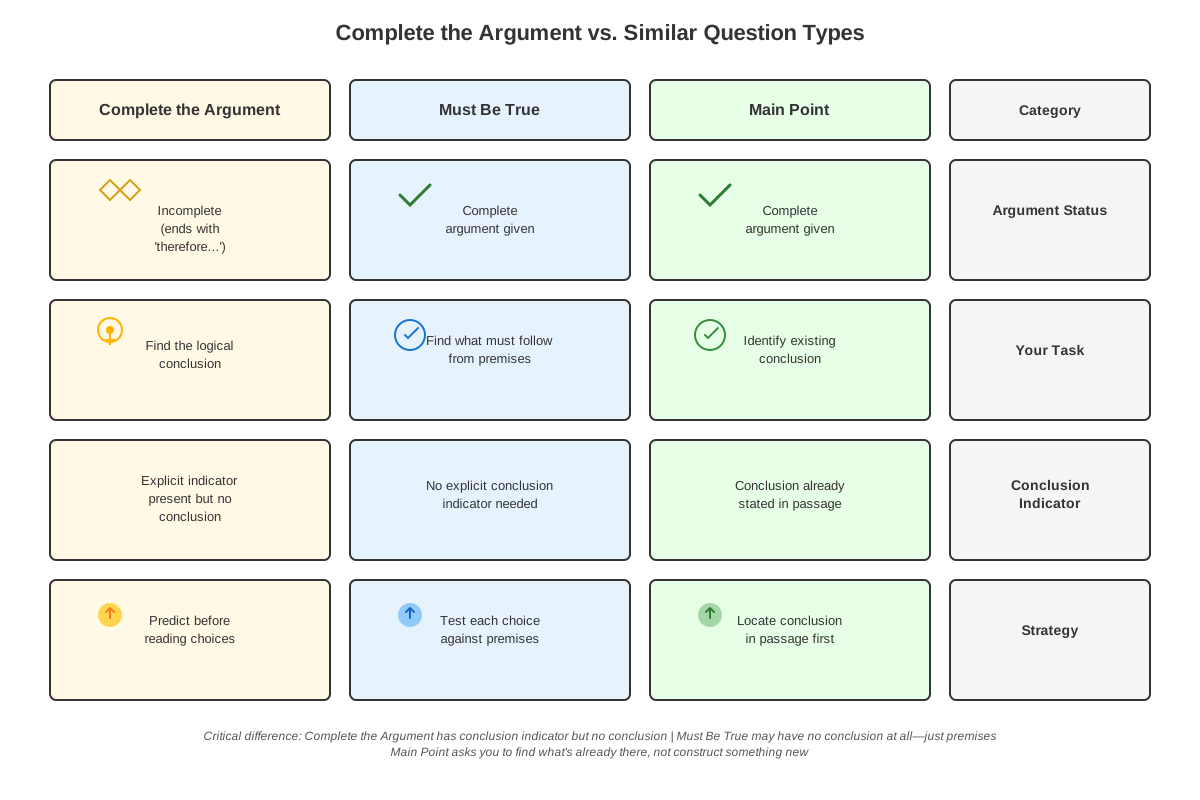
- [ ] Distinguish complete the argument questions from similar question types (Must Be True, Main Point)
- [ ] Recognize the common logical structures that precede incomplete conclusions
- [ ] Evaluate answer choices by testing logical necessity versus mere plausibility
- [ ] Identify trap answers that introduce new information or reverse logical relationships
Prerequisites
- Basic argument structure: Understanding of premises, conclusions, and inference indicators is essential because complete the argument questions require identifying where premises end and the conclusion should begin
- Conditional reasoning fundamentals: Knowledge of if-then statements and their contrapositives helps predict logical outcomes from conditional premises
- Causal reasoning patterns: Familiarity with cause-and-effect relationships enables recognition of when arguments are building toward causal conclusions
- Question stem identification: Ability to quickly categorize question types ensures proper strategic approach and prevents confusion with similar question formats
Why This Topic Matters
Complete the argument questions test a lawyer's core competency: the ability to construct sound conclusions from established facts. In legal practice, attorneys must constantly determine what conclusions the evidence supports, what claims can legitimately be made, and where logical reasoning leads. This question type directly simulates the reasoning process lawyers use when building cases, drafting arguments, or advising clients on what their circumstances legally establish.
On the LSAT, complete the argument questions appear with notable frequency—typically 4-8 times across both Logical Reasoning sections in any given test administration. This represents approximately 8-15% of all Logical Reasoning questions, making them a high-impact topic for score improvement. The LSAT tests these questions at medium difficulty, meaning they effectively differentiate between mid-range and high-scoring test-takers. Students who master this question type gain a reliable source of points that many competitors struggle with.
These questions commonly appear in several recognizable formats: arguments about scientific studies that need conclusions about what the research demonstrates, policy discussions requiring conclusions about what should be done, causal chains needing final effects identified, and conditional reasoning sequences requiring the ultimate logical outcome. The incomplete nature of these arguments means test-takers cannot rely on evaluating an author's stated conclusion—they must actively construct it themselves, making these questions particularly challenging for students who primarily practice reactive analysis rather than proactive synthesis.
Core Concepts
Recognizing Complete the Argument Question Stems
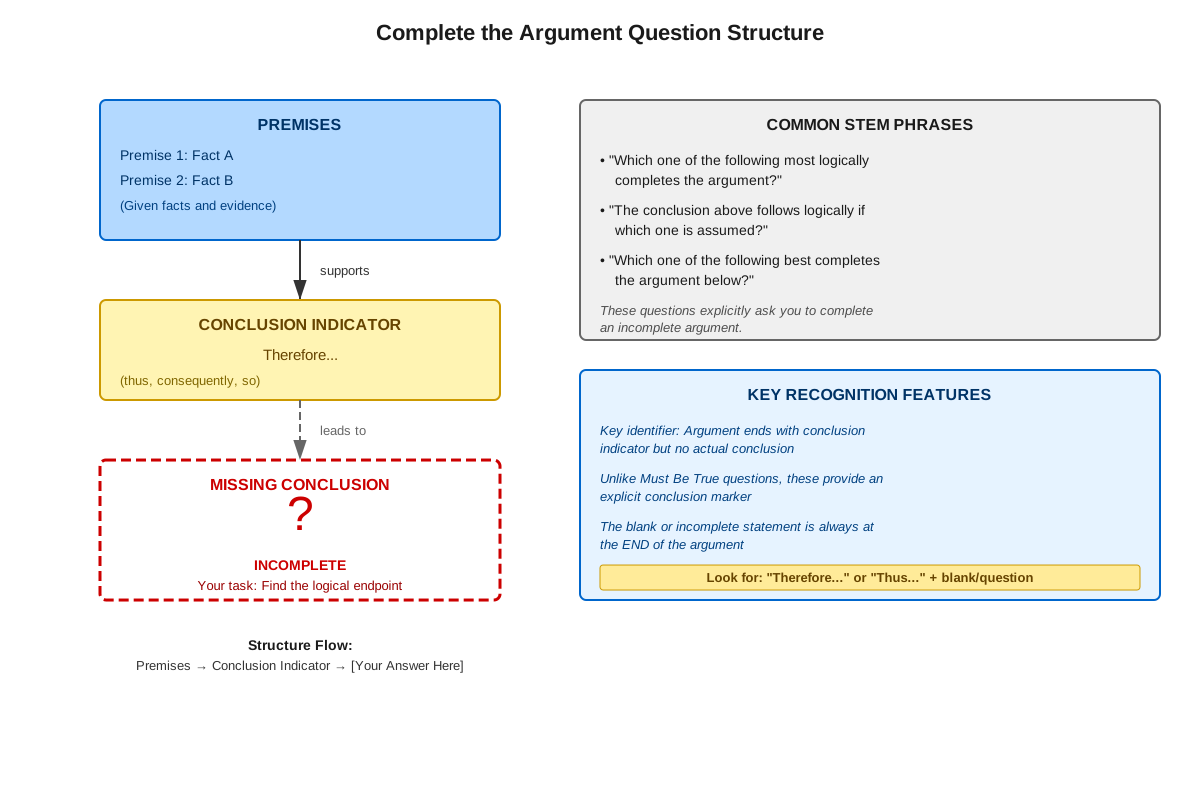
LSAT complete the argument question stems follow predictable linguistic patterns that signal their unique task. The most common formulations include:
- "Which one of the following most logically completes the argument?"
- "Which one of the following best completes the passage?"
- "The conclusion of the argument is most strongly supported if which one of the following completes the passage?"
- "Which one of the following, if true, most logically completes the argument below?"
The key identifying feature is the explicit instruction to "complete" something, combined with the argument itself containing a clear gap—usually indicated by a blank line, ellipsis, or the word "therefore" followed by incomplete text. This structural incompleteness distinguishes these questions from Must Be True questions (which ask what follows from a complete argument) and Main Point questions (which ask you to identify an already-stated conclusion).
The Logical Structure of Incomplete Arguments
Complete the argument questions present premises that establish a logical foundation, then stop before stating the conclusion those premises support. Understanding this structure requires recognizing three components:
- Setup premises: Background information or context that frames the argument
- Key premises: The logical drivers that will determine what conclusion is warranted
- Conclusion gap: The missing endpoint that must follow logically from the premises
The argument's incompleteness is always strategic—the LSAC designs these passages so that the premises point toward one specific, logically necessary conclusion. Your task is identifying which answer choice represents that necessary conclusion rather than merely a possible or plausible one.
Types of Reasoning Patterns in Complete the Argument Questions
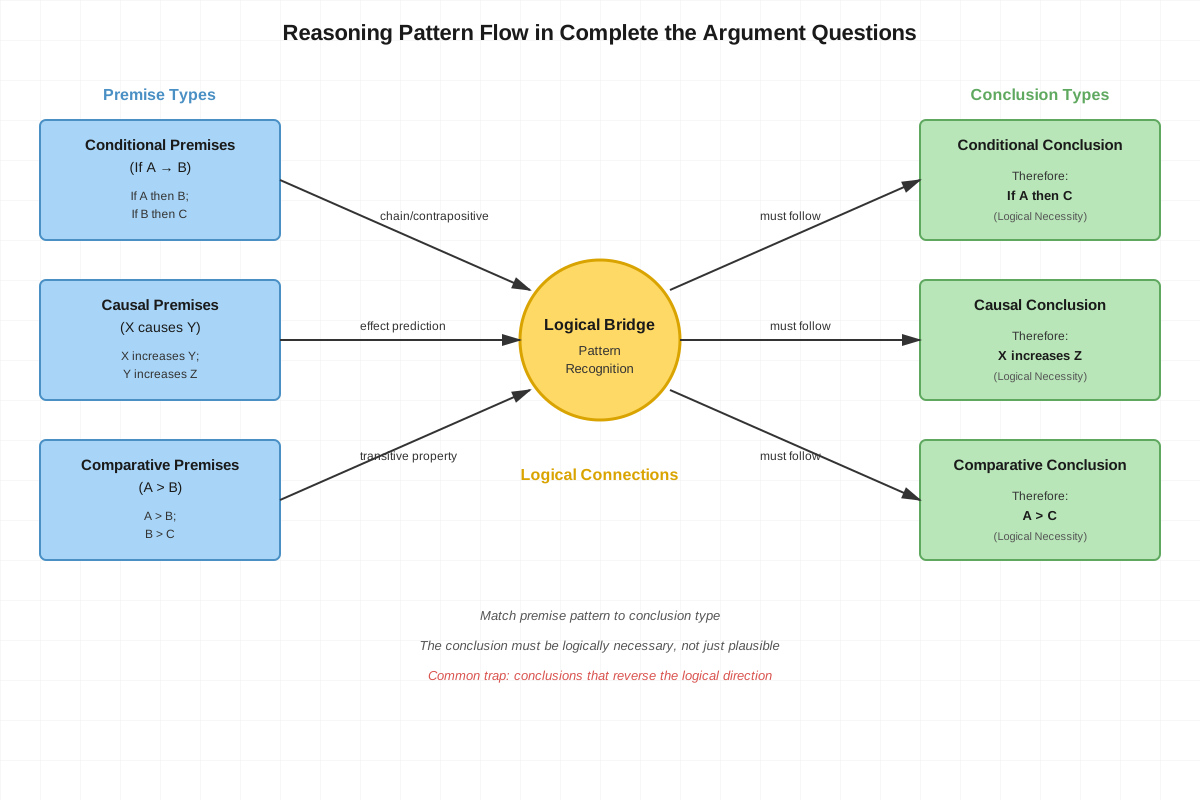
Different logical structures require different completion strategies:
| Reasoning Pattern | Premise Structure | Required Conclusion Type |
|---|---|---|
| Conditional Chain | If A→B, If B→C | Must conclude C follows from A |
| Causal Sequence | X causes Y, Y causes Z | Must conclude X ultimately causes Z |
| Comparison | Group 1 has property P, Group 2 lacks P | Must conclude difference in outcomes |
| Elimination | Options A, B, C exist; A and B impossible | Must conclude C is the case |
| Principle Application | General rule stated, specific case described | Must conclude rule applies to case |
Recognizing which pattern the premises follow allows you to predict the logical form the conclusion must take, even before reading the answer choices.
The Logical Necessity Standard
The correct answer to a complete the argument question must be logically necessary given the premises—not merely consistent with them or plausible. This represents a higher standard than many students initially apply. An answer is logically necessary when:
- It is the only conclusion the premises fully support
- Denying it would contradict or waste the premises provided
- It uses only concepts and relationships established in the premises
- It represents the natural endpoint of the reasoning chain
Wrong answers often feel plausible because they relate to the topic or could be true in the real world, but they fail the necessity test because they either go beyond what the premises establish, introduce new concepts, or represent only one of several possible conclusions.
The Role of Scope and Degree
Complete the argument questions heavily test scope (what the argument is about) and degree (how strong the claims are). The correct conclusion must match the premises in both dimensions:
- If premises discuss "some" members of a group, the conclusion cannot claim "all" or "most"
- If premises establish correlation, the conclusion cannot claim causation
- If premises discuss one time period, the conclusion cannot extend to other periods without justification
- If premises compare two things, the conclusion must maintain that comparative framework
Many trap answers violate scope or degree by making claims that are too broad, too narrow, too strong, or too weak relative to what the premises establish.
Answer Choice Evaluation Strategy
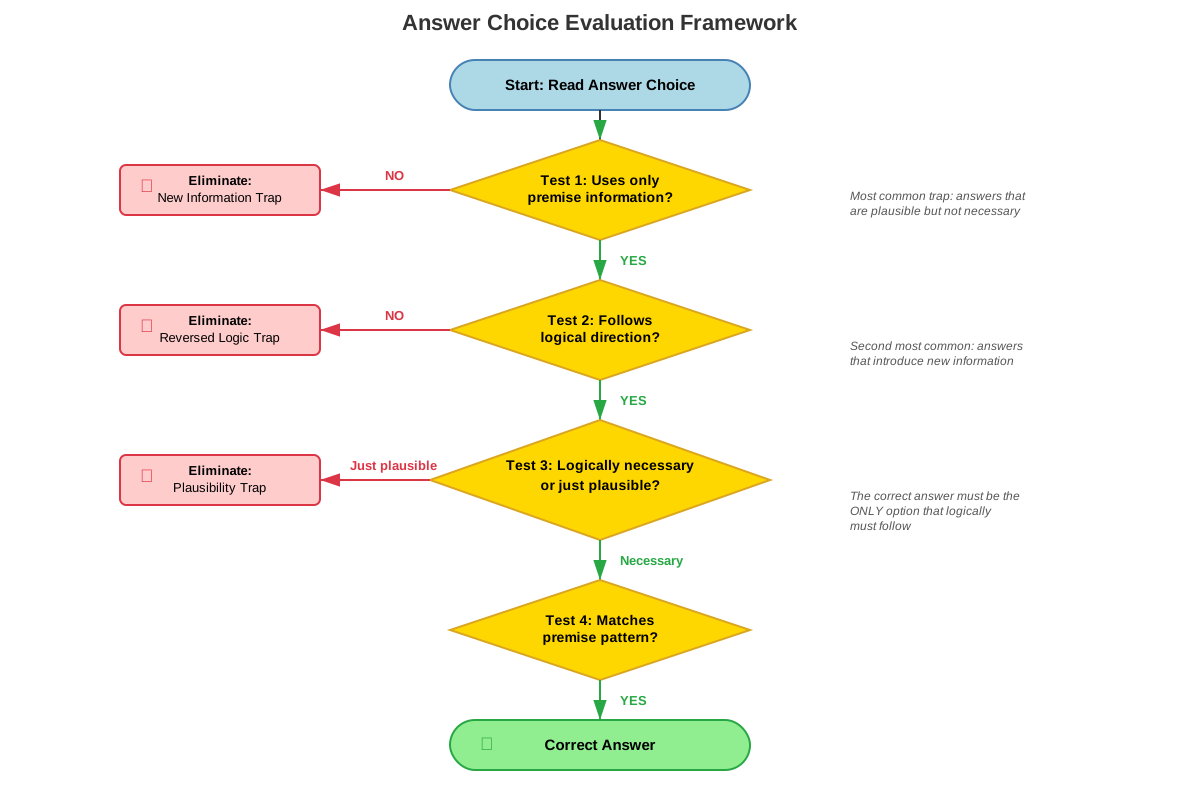
Evaluating answer choices for complete the argument questions requires a specific methodology:
- Pre-phrase: Before reading choices, articulate what the conclusion should say based on the premises
- Scope check: Eliminate choices that introduce new concepts not mentioned in the premises
- Necessity test: For remaining choices, ask "Do the premises make this conclusion necessary?"
- Comparison: If multiple choices seem possible, identify which one the premises most directly and completely support
The pre-phrasing step is particularly crucial because it prevents you from being seduced by sophisticated-sounding wrong answers that don't actually follow from the premises.
Concept Relationships
The concepts within complete the argument questions form an interconnected system. Question stem recognition serves as the entry point, allowing you to identify that you're dealing with a completion task rather than an evaluation task. This recognition triggers the appropriate logical structure analysis, where you identify what type of reasoning pattern the premises follow. The reasoning pattern then determines what logical necessity standard applies—what form the conclusion must take and what scope and degree it must maintain.
These internal relationships connect to broader Logical Reasoning skills. Complete the argument questions draw heavily on conditional reasoning when premises establish if-then relationships, requiring you to trace chains of implications forward. They connect to causal reasoning when premises describe cause-and-effect relationships that need final outcomes identified. The scope and degree analysis used in these questions directly parallels the skills needed for Strengthen/Weaken questions, where answer choices often fail by mismatching the argument's scope.
The relationship map flows as follows: Question Stem Recognition → Identify Reasoning Pattern → Determine Logical Necessity Requirements → Pre-phrase Expected Conclusion → Evaluate Answer Choices Against Necessity Standard → Select Most Logically Complete Option. Each step depends on the previous one, making this a sequential rather than parallel process.
High-Yield Facts
⭐ Complete the argument question stems explicitly ask you to "complete" or "finish" an incomplete passage, distinguishing them from Must Be True questions
⭐ The correct answer must be logically necessary given the premises, not merely plausible or consistent with them
⭐ These questions appear 4-8 times per LSAT (both LR sections combined), representing 8-15% of Logical Reasoning questions
⭐ The incomplete argument always provides sufficient premises to determine exactly one logically necessary conclusion
⭐ Wrong answers typically introduce new information not mentioned in the premises or violate scope/degree constraints
- Complete the argument questions test synthesis skills rather than analytical skills, requiring forward reasoning rather than evaluation
- The conclusion gap is strategically placed where the logical chain reaches its natural endpoint
- Pre-phrasing the conclusion before reading answer choices significantly improves accuracy and speed
- Conditional reasoning chains (If A→B, If B→C, therefore If A→C) are among the most common premise structures
- The correct answer will use only concepts, relationships, and scope established in the premises—no new elements
- Comparative arguments require conclusions that maintain the comparison rather than making absolute claims
- Causal chains require conclusions about ultimate effects, not intermediate steps
- Elimination-based premises require conclusions identifying what remains after other options are ruled out
- The strength of the conclusion (must, likely, might, could) must match the strength of the premises
- Time pressure makes these questions particularly challenging because they require active construction rather than passive recognition
Quick check — test yourself on Complete the argument question stems so far.
Try Flashcards →Common Misconceptions
Misconception: Complete the argument questions are the same as Must Be True questions since both ask what follows from the premises. → Correction: While both involve inference, Must Be True questions present complete arguments and ask what else must be true, while complete the argument questions present incomplete arguments and ask specifically for the missing conclusion. The task is synthesis versus additional inference.
Misconception: The correct answer is whichever choice sounds most sophisticated or uses the most advanced vocabulary. → Correction: The LSAC often uses complex language in wrong answers to make them appear authoritative. The correct answer is determined solely by logical necessity from the premises, regardless of how it's phrased. Simple, direct conclusions are often correct.
Misconception: If an answer choice could be true based on the premises, it's a good answer. → Correction: "Could be true" is insufficient; the correct answer must be what the premises logically establish or require. Many wrong answers are consistent with the premises without being necessitated by them.
Misconception: You should read all answer choices before selecting one to ensure you find the best option. → Correction: While you should verify your selection, pre-phrasing the conclusion before reading choices and selecting the first one that matches your pre-phrase is often more efficient and accurate than comparing all five choices without a clear target.
Misconception: Complete the argument questions test reading comprehension—understanding what the passage says. → Correction: These questions test logical reasoning—understanding what the premises logically require. You might fully comprehend every sentence but still select the wrong answer if you don't trace the logical implications correctly.
Misconception: The conclusion should introduce new information to make the argument more interesting or complete. → Correction: The conclusion must be derived entirely from information already present in the premises. Introducing new concepts, even if they seem relevant to the topic, violates the logical necessity requirement.
Misconception: Longer, more detailed answer choices are more likely to be correct because they're more thorough. → Correction: Length is irrelevant to correctness. Wrong answers are often longer because they include additional claims that go beyond what the premises establish. The correct answer might be the shortest option.
Worked Examples
Example 1: Conditional Reasoning Chain
Argument:
"All successful entrepreneurs are risk-takers. Maria is not a risk-taker. Therefore, _____________."
Step 1 - Identify the reasoning pattern: This is a conditional reasoning structure. The first premise establishes: If successful entrepreneur → risk-taker. The second premise tells us Maria is NOT a risk-taker.
Step 2 - Apply logical rules: When we know someone lacks the necessary condition (risk-taker), we can conclude they lack the sufficient condition (successful entrepreneur). This is the contrapositive: If NOT risk-taker → NOT successful entrepreneur.
Step 3 - Pre-phrase the conclusion: Maria is not a successful entrepreneur.
Step 4 - Evaluate hypothetical answer choices:
- (A) "Maria will never take any risks in her life" - WRONG: Too broad in scope; the premises only establish she's not a risk-taker in the relevant sense, not that she'll never take any risk ever
- (B) "Maria is not a successful entrepreneur" - CORRECT: This is the logically necessary conclusion from the contrapositive
- (C) "Maria might become a successful entrepreneur if she becomes a risk-taker" - WRONG: Introduces a hypothetical future scenario not established by the premises
- (D) "Most people who are not risk-takers are not successful entrepreneurs" - WRONG: Changes scope from the individual (Maria) to a general claim about "most people"
- (E) "Risk-taking is the most important quality for entrepreneurial success" - WRONG: Makes a comparative claim about importance not established in the premises
Connection to learning objectives: This example demonstrates identifying the question type (completion task), explaining the reasoning pattern (conditional logic with contrapositive), and applying it to select the correct answer.
Example 2: Causal Reasoning with Scope Limitation
Argument:
"Studies show that children who read regularly perform better academically than children who do not read regularly. The Riverside School District recently implemented a daily reading program in all elementary schools. Therefore, _____________."
Step 1 - Identify the reasoning pattern: This establishes a correlation/causal relationship between regular reading and academic performance, then describes an intervention (implementing a reading program).
Step 2 - Analyze scope and degree: The premises establish a correlation for "children" generally and describe an action taken in "elementary schools" in "Riverside School District." The conclusion must maintain these scope limitations.
Step 3 - Pre-phrase the conclusion: The conclusion should predict improved academic performance, but only for elementary students in Riverside, and should maintain appropriate causal language (likely to improve, expected to improve) rather than claiming certainty.
Step 4 - Evaluate hypothetical answer choices:
- (A) "academic performance in Riverside elementary schools will definitely improve" - WRONG: Too strong ("definitely"); the premises establish correlation, not guaranteed causation
- (B) "elementary students in Riverside are likely to show improved academic performance" - CORRECT: Matches scope (elementary, Riverside), maintains appropriate degree (likely, not certain), and follows logically from the causal relationship established
- (C) "all students in Riverside School District will become better readers" - WRONG: Scope violation (premises discuss elementary schools, not "all students"); also shifts focus to reading ability rather than academic performance
- (D) "reading programs are the most effective way to improve academic performance" - WRONG: Makes a comparative claim not established in the premises
- (E) "children who do not read regularly will fall further behind academically" - WRONG: Discusses a different group (non-readers) rather than following through on the intervention described
Connection to learning objectives: This example shows how to recognize scope limitations in premises, explain how causal reasoning patterns work in complete the argument questions, and apply scope-matching to eliminate wrong answers and identify the correct completion.
Exam Strategy
When approaching complete the argument questions on the LSAT, implement this systematic process:
Recognition Phase: Immediately identify the question type by scanning for "complete" or "finish" language in the stem. Note whether the passage contains a blank line, ellipsis, or incomplete final sentence. This recognition triggers your completion strategy rather than your evaluation strategy.
Analysis Phase: Read the argument carefully, identifying where the premises end and the gap begins. Map the logical structure: Is this conditional reasoning? Causal reasoning? Comparison? Elimination? Understanding the pattern tells you what form the conclusion must take.
Pre-phrasing Phase: Before looking at answer choices, articulate in your own words what the conclusion should say. This doesn't need to be perfectly worded—focus on capturing the logical content and scope. Write down key scope limitations (time period, group discussed, degree of certainty).
Exam Tip: Students who pre-phrase before reading choices answer these questions 15-20% more accurately than those who immediately read all five options. The pre-phrase serves as a filter against attractive wrong answers.
Trigger words to watch for in the argument:
- "Therefore" followed by a blank or incomplete statement
- "Thus" or "Hence" indicating a conclusion is coming
- "It follows that" signaling logical consequence
- "This means that" or "This shows that" introducing implications
Trigger words in answer choices that often signal wrong answers:
- "Always," "never," "must," "cannot" (when premises don't support absolute claims)
- "Most," "many," "some" (when they mismatch the scope of the premises)
- New concepts or terms not mentioned in the premises
- Comparative language ("more than," "most important") when premises don't establish comparisons
Process of elimination strategy:
- First pass: Eliminate choices that introduce new information or violate obvious scope constraints
- Second pass: For remaining choices, test each against the necessity standard—do the premises make this conclusion required?
- Final selection: Choose the answer that most directly and completely follows from the premises without adding or assuming anything extra
Time allocation: Spend 1:00-1:15 on these questions. They require more active thinking than simple Must Be True questions but less complex evaluation than Strengthen/Weaken questions. If you're stuck between two choices, select the one with narrower scope and more conservative claims—it's more likely to be fully supported by the premises.
Memory Techniques
COMPLETE mnemonic for evaluating answer choices:
- Check for new Concepts not in premises
- Observe the scope (time, group, degree)
- Match the reasoning pattern (conditional, causal, etc.)
- Pre-phrase before reading choices
- Logical necessity, not mere plausibility
- Eliminate scope violations first
- Test remaining choices against premises
- Exact conclusion the premises require
Visualization strategy: Picture the argument as a bridge with the premises as support pillars and the conclusion as the final span. The premises determine exactly where the bridge must end—you can't build it to a different location just because that would be interesting. The correct answer is the only place the bridge can logically reach given the support structure.
Scope matching acronym - STUD:
- Subject: Who or what is the argument about?
- Time: What time period do the premises cover?
- Uncertainty: How certain are the premises (must, likely, might)?
- Degree: How many or how much (all, most, some)?
The conclusion must match the premises on all four dimensions.
Pattern recognition shortcut: When you see conditional language (if/then, all, every, only), immediately think "contrapositive completion." When you see causal language (causes, leads to, results in), think "ultimate effect completion." This instant pattern recognition saves valuable seconds.
Summary
Complete the argument question stems represent a high-yield LSAT question type that tests your ability to synthesize logical conclusions from given premises rather than merely analyzing existing arguments. These questions appear 4-8 times per test and are identifiable by explicit instructions to "complete" an incomplete passage. Success requires recognizing the logical structure of the premises (conditional chains, causal sequences, comparisons, or elimination patterns), understanding what conclusion those premises logically necessitate, and distinguishing between answers that are merely plausible versus logically required. The correct answer must match the premises in scope (subject, time period, groups discussed) and degree (strength of claims), while using only concepts established in the passage. Pre-phrasing the conclusion before reading answer choices dramatically improves accuracy by providing a clear target and preventing seduction by sophisticated-sounding wrong answers. These questions test the core legal reasoning skill of determining what conclusions the evidence supports—making them both practically important and strategically valuable for LSAT success.
Key Takeaways
- Complete the argument questions ask you to identify the logically necessary conclusion from incomplete arguments, requiring synthesis rather than evaluation skills
- These questions appear 4-8 times per LSAT and are recognizable by "complete" or "finish" language in the question stem
- The correct answer must be logically necessary given the premises—not merely consistent, plausible, or possible
- Pre-phrasing the conclusion before reading answer choices significantly improves accuracy and efficiency
- Wrong answers typically introduce new information, violate scope constraints, or mismatch the degree of certainty established in the premises
- Recognizing the reasoning pattern (conditional, causal, comparison, elimination) tells you what form the conclusion must take
- Scope matching is critical: the conclusion must match premises in subject, time period, strength of claims, and quantifiers (all/most/some)
Related Topics
Must Be True Questions: After mastering complete the argument questions, study Must Be True questions, which also require identifying what logically follows from premises but work with complete arguments rather than incomplete ones. The inference skills developed here transfer directly.
Main Point Questions: These questions ask you to identify the conclusion in a complete argument, developing your ability to distinguish premises from conclusions—a skill that helps you recognize where the gap occurs in complete the argument questions.
Conditional Reasoning: Deep mastery of conditional logic (sufficient/necessary conditions, contrapositives, chains) is essential because many complete the argument questions use conditional structures. This topic provides the logical machinery for solving conditional completion questions.
Argument Structure: Understanding how arguments are constructed—the relationship between premises, intermediate conclusions, and main conclusions—provides the foundation for recognizing what's missing in incomplete arguments.
Strengthen and Weaken Questions: The scope-matching skills developed for complete the argument questions directly apply to evaluating whether answer choices in Strengthen/Weaken questions actually address the argument's scope.
Practice CTA
Now that you understand the structure, strategy, and common patterns of complete the argument questions, it's time to apply this knowledge. Work through the practice questions for this topic, focusing on pre-phrasing conclusions before reading answer choices and explicitly identifying the reasoning pattern in each argument. Use the flashcards to reinforce recognition of question stem variations and common trap answer patterns. Remember: these questions reward systematic thinking and careful scope analysis. Each practice question you complete strengthens your ability to synthesize logical conclusions—a skill that will serve you throughout the LSAT and in legal reasoning generally. You're building the foundation for consistent high performance on a question type that many test-takers find challenging but that you can master through deliberate practice.
Sign up free to keep reading
Create a free AnvayaPrep account to finish this LSAT guide on Complete the argument question stems — plus flashcards and practice questions.