Overview
Most strongly supported question stems represent a critical category within LSAT logical reasoning that tests a student's ability to draw valid inferences from given information. Unlike assumption or strengthen/weaken questions that require identifying missing logical components, most strongly supported questions ask test-takers to identify what conclusion can be properly drawn from the stimulus. These questions assess the fundamental skill of recognizing what logically follows from a set of premises—a core competency that underlies success across all LSAT sections.
Understanding lsat most strongly supported question stems is essential because they appear with significant frequency on every LSAT administration, typically comprising 10-15% of all Logical Reasoning questions. These questions bridge the gap between pure reading comprehension and complex logical manipulation, requiring students to stay strictly within the bounds of what the passage explicitly states or necessarily implies. Mastery of this question type directly translates to improved performance on inference questions in Reading Comprehension and helps develop the disciplined reasoning required for Logic Games.
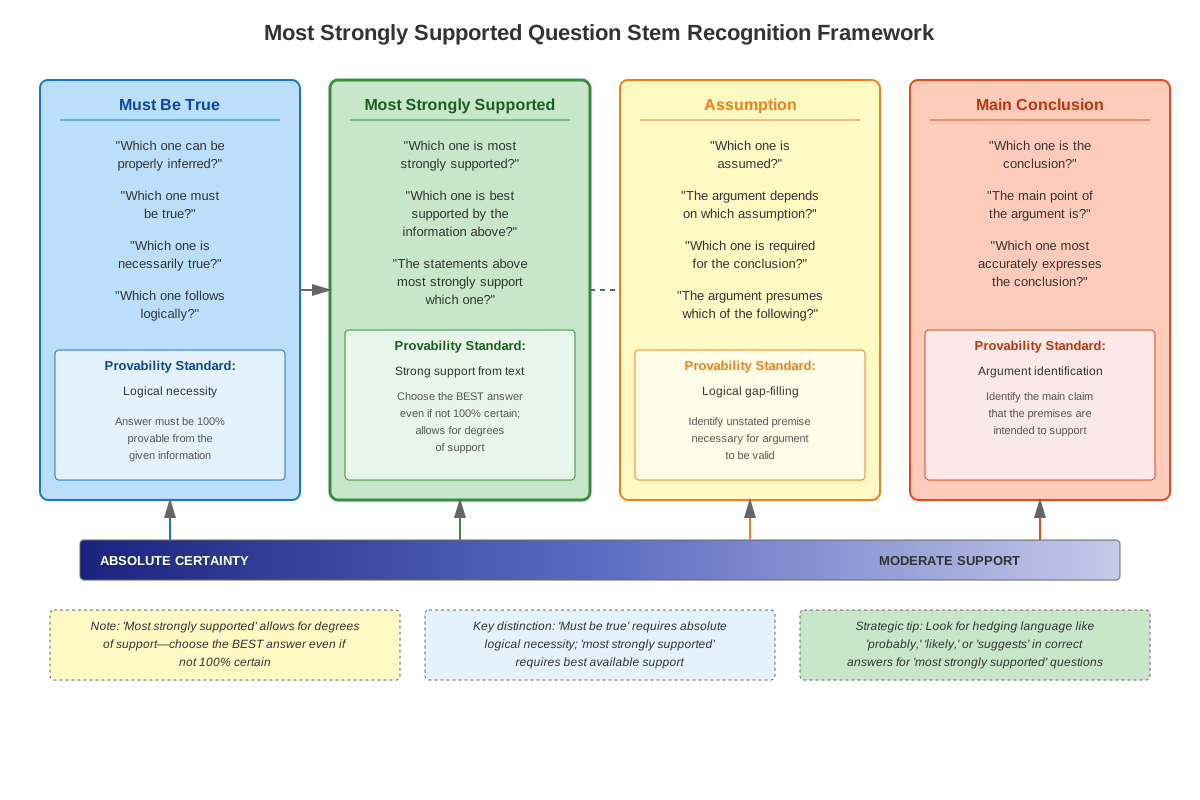
Within the broader framework of question stem recognition, most strongly supported questions occupy a unique position. They require conservative, text-bound reasoning rather than the creative gap-filling needed for assumption questions or the evaluative judgment required for strengthen/weaken questions. Success depends on recognizing the specific language that signals this question type and applying the appropriate strategic approach—one that prioritizes provability over plausibility and demands that every element of the correct answer be grounded in the stimulus.
Learning Objectives
- [ ] Identify how Most strongly supported question stems appears in LSAT questions
- [ ] Explain the reasoning pattern behind Most strongly supported question stems
- [ ] Apply Most strongly supported question stems to solve LSAT-style problems accurately
- [ ] Distinguish most strongly supported questions from other inference-based question types
- [ ] Evaluate answer choices using the "provability standard" appropriate for this question type
- [ ] Recognize common trap answer patterns specific to most strongly supported questions
Prerequisites
- Basic logical reasoning structure: Understanding of premises, conclusions, and argument structure is necessary because most strongly supported questions require identifying what follows from given premises
- Conditional reasoning fundamentals: Knowledge of if-then statements and their valid inferences helps recognize what can be properly concluded from conditional premises
- Reading comprehension skills: Ability to parse complex sentences and identify explicit versus implicit information ensures accurate understanding of the stimulus before attempting to draw inferences
- Question stem recognition basics: Familiarity with how LSAT questions are structured allows for quick identification of question type and appropriate strategy deployment
Why This Topic Matters
Most strongly supported questions test one of the most practical reasoning skills applicable beyond the LSAT: the ability to distinguish between what evidence actually proves versus what it merely suggests. In legal practice, this skill manifests when attorneys must determine what conclusions can be legitimately drawn from case law, statutes, or evidence. In everyday decision-making, it prevents overreach in reasoning and helps maintain intellectual honesty about what information truly supports.
On the LSAT itself, most strongly supported questions appear in approximately 3-5 questions per Logical Reasoning section, making them one of the more common question types. They typically appear with moderate difficulty ratings, though some can be quite challenging when the stimulus contains dense factual information or multiple conditional statements. The LSAC uses these questions to assess whether test-takers can engage in disciplined inference-drawing without importing outside assumptions or making logical leaps.
These questions commonly appear in several formats: straightforward factual passages requiring combination of stated information, passages with conditional statements requiring valid deductions, comparative statements requiring recognition of relative relationships, and causal or correlational data requiring careful interpretation. The stimulus length varies considerably, from compact three-sentence passages to dense paragraph-length presentations of data or scenarios. Regardless of format, the core task remains constant: identify what the passage proves or most strongly supports, not what seems plausible or likely.
Core Concepts
Defining Most Strongly Supported Questions
Most strongly supported question stems are prompts that ask test-takers to identify which answer choice is best proven or most justified by the information in the stimulus. The key distinguishing feature is that these questions move from premises to conclusion—the stimulus provides facts or claims, and the correct answer states something that logically follows. Common phrasings include "Which one of the following is most strongly supported by the information above?", "The statements above, if true, most strongly support which one of the following?", and "Which one of the following can be properly inferred from the passage?"
The critical word "supported" indicates a directional relationship: the stimulus supports the answer choice, not the other way around. This distinguishes these questions from strengthen questions (where the answer choice supports the stimulus's conclusion) or assumption questions (where the answer choice fills a gap in the stimulus's reasoning). The modifier "most strongly" acknowledges that multiple answers might have some degree of support, but only one will be most directly and completely justified by the passage.
The Provability Standard
The correct answer to a most strongly supported question must meet what can be called the provability standard: every element of the answer must be justified by explicit statements or valid inferences from the stimulus. This standard is more stringent than "could be true" but less absolute than "must be true." The answer should be the one that requires the fewest additional assumptions and stays closest to the text.
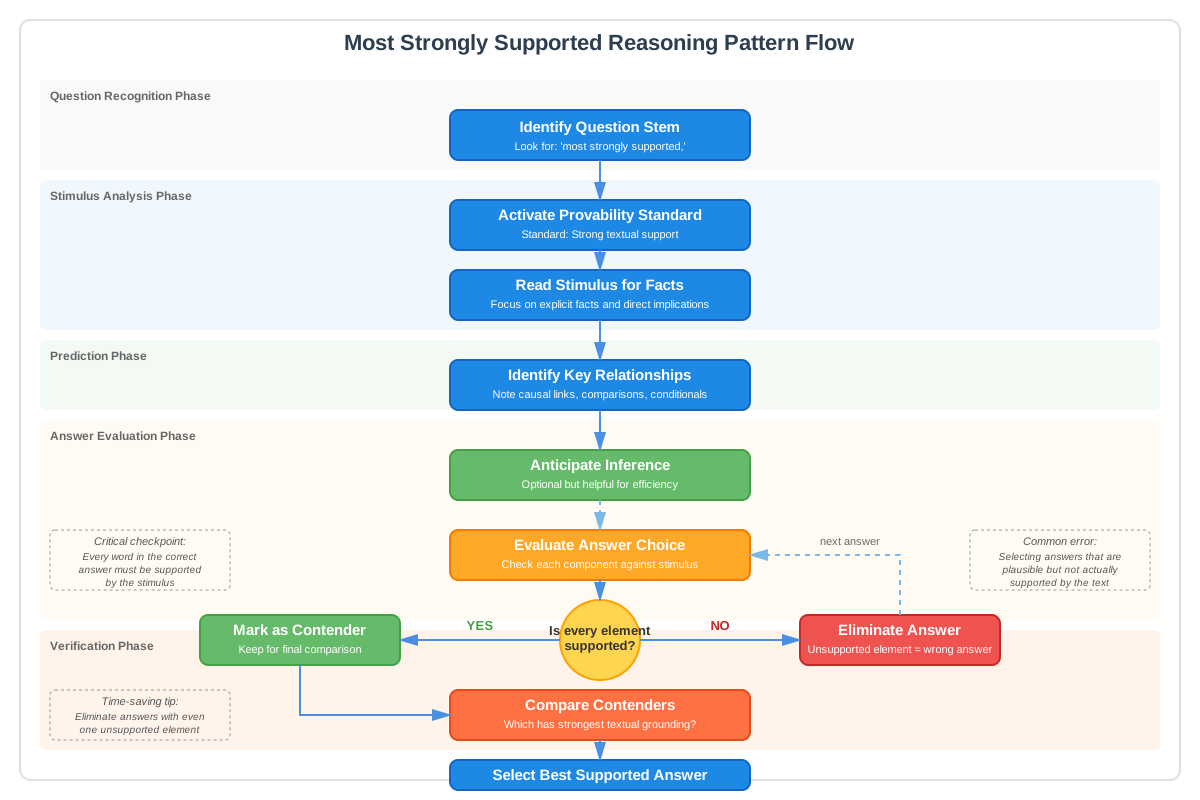
Test-takers should apply a verification process: for each answer choice, identify which specific sentence or combination of sentences in the stimulus supports each claim in the answer. If any part of an answer choice lacks textual support, it fails the provability standard. The correct answer will typically combine, paraphrase, or draw a direct logical consequence from stimulus information without adding new factual claims.
Common Stimulus Patterns
Most strongly supported questions draw from several recurring stimulus patterns:
Factual combination passages present multiple discrete facts that must be synthesized. For example, a stimulus might state "All members of the committee are lawyers" and "Sarah is on the committee," supporting the inference "Sarah is a lawyer." The reasoning pattern involves recognizing how separate pieces of information connect.
Conditional statement passages provide if-then relationships from which valid inferences can be drawn. These require applying rules of conditional logic: affirming the sufficient condition allows you to affirm the necessary condition, and denying the necessary condition allows you to deny the sufficient condition. Invalid inferences (affirming the necessary or denying the sufficient) appear frequently in wrong answers.
Comparative and quantitative passages present relationships between quantities, frequencies, or degrees. These support inferences about relative magnitudes but rarely support absolute claims. A stimulus stating "More people prefer Brand A than Brand B" supports "Brand A is more popular than Brand B" but not "Brand A is popular" (which would require knowing absolute numbers).
Causal and correlational passages describe relationships between phenomena. These support careful inferences about what has been observed but typically do not support broad causal claims unless explicitly stated. A stimulus noting "Sales increased after the advertising campaign" supports "The increase coincided with the campaign" but not necessarily "The campaign caused the increase."
Strategic Approach Framework
| Step | Action | Purpose |
|---|---|---|
| 1 | Read stimulus carefully | Identify all explicit claims and relationships |
| 2 | Identify question stem type | Confirm this is a "most strongly supported" question |
| 3 | Anticipate possible inferences | Consider what logically follows before viewing answers |
| 4 | Evaluate each answer | Test each against the provability standard |
| 5 | Verify the best answer | Ensure every element has textual support |
The anticipation step (Step 3) is particularly valuable for straightforward passages where the inference is clear. However, for complex stimuli with multiple possible inferences, moving directly to answer evaluation may be more efficient.
Wrong Answer Patterns
Understanding common wrong answer types accelerates elimination:
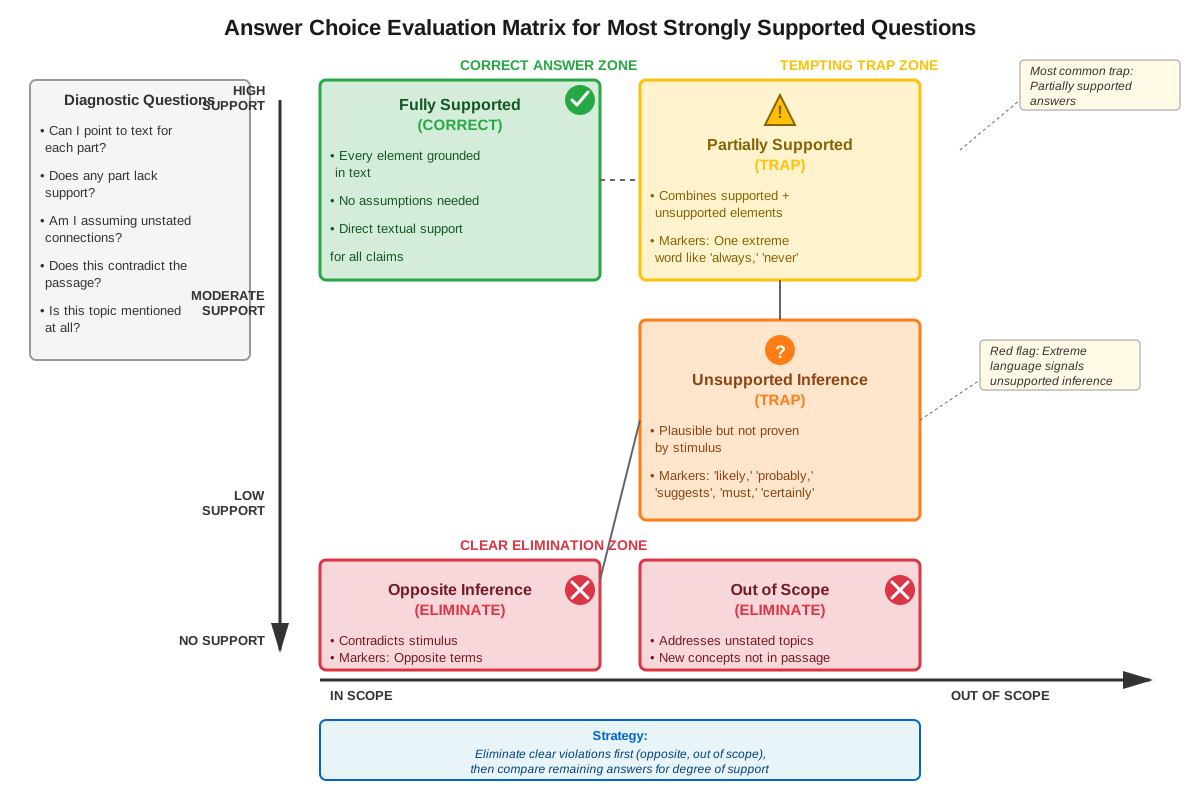
Out of scope answers introduce topics, terms, or concepts not mentioned in the stimulus. These are often tempting because they seem related to the general subject matter, but they fail because they lack any textual basis.
Reversal answers flip a relationship stated in the stimulus, such as concluding "A causes B" when the stimulus only supports "B causes A." These exploit careless reading.
Extreme answers make absolute claims (using words like "always," "never," "only," "all") when the stimulus supports only moderate or qualified statements. Most strongly supported questions rarely have correct answers with extreme language unless the stimulus itself uses such language.
Possible but unsupported answers could be true in the real world but aren't justified by the stimulus. These are perhaps the most dangerous wrong answers because they seem reasonable, but they require importing outside knowledge or making assumptions beyond the text.
Partial match answers correctly reflect some stimulus information but add unsupported claims. Test-takers who verify only part of an answer choice fall for these.
Concept Relationships
The concepts within most strongly supported questions form an interconnected system. Question stem recognition serves as the entry point, determining that the appropriate strategy is inference-drawing rather than assumption-identification or argument evaluation. This recognition activates the provability standard, which governs how strictly answer choices must be verified against the stimulus.
The provability standard directly connects to understanding stimulus patterns because different patterns support different types of inferences. Factual combination passages support synthetic conclusions, conditional passages support logical deductions, and comparative passages support relative claims. Recognizing the pattern helps predict what type of inference will be supportable.
Wrong answer patterns represent the inverse of the provability standard—they catalog the ways answers fail to meet that standard. Understanding these patterns creates a two-pronged approach: positive verification (does the answer have support?) and negative elimination (does the answer exhibit a known flaw?).
The relationship map flows as follows:
Question Stem Recognition → identifies question type → activates Provability Standard → guides evaluation of Answer Choices → informed by Stimulus Pattern Recognition → accelerated by Wrong Answer Pattern Recognition → leads to Correct Answer Selection
This topic connects to prerequisite knowledge of conditional reasoning because many most strongly supported questions require applying conditional logic rules. It relates to broader logical reasoning skills by exemplifying conservative, text-bound reasoning—a mindset that also benefits assumption and principle questions by preventing overreach. Mastery of most strongly supported questions builds the foundation for must-be-true questions in Logic Games and inference questions in Reading Comprehension.
High-Yield Facts
⭐ Most strongly supported questions ask what the stimulus proves or justifies, not what proves or justifies the stimulus's conclusion
⭐ The correct answer must be supported by explicit statements or valid logical inferences from the stimulus without requiring additional assumptions
⭐ Common question stem phrasings include "most strongly supported," "properly inferred," "most reasonable to conclude," and "if the statements above are true"
⭐ Wrong answers frequently introduce out-of-scope information, make extreme claims unsupported by the stimulus, or reverse relationships stated in the passage
⭐ The provability standard requires that every element of the correct answer be grounded in the stimulus—partial support is insufficient
- Most strongly supported questions typically comprise 10-15% of Logical Reasoning questions on any given LSAT
- These questions differ from "must be true" questions primarily in degree—most strongly supported allows for slightly less certainty than logical necessity
- Conditional reasoning passages in most strongly supported questions reward knowledge of valid inference forms (modus ponens and modus tollens)
- Comparative statements in stimuli support only relative claims, not absolute judgments about individual items
- Causal language in answer choices requires explicit causal language in the stimulus—correlation alone does not support causation claims
- Quantitative information in stimuli supports mathematical inferences but rarely supports qualitative judgments without additional context
- The correct answer often paraphrases or combines stimulus information rather than quoting it directly
- Time-efficient test-takers verify only the most promising answer choices rather than thoroughly testing all five options
Quick check — test yourself on Most strongly supported question stems so far.
Try Flashcards →Common Misconceptions
Misconception: Most strongly supported questions and assumption questions are essentially the same because both involve finding what completes an argument.
Correction: These question types move in opposite logical directions. Most strongly supported questions ask what follows from the stimulus (premises → conclusion), while assumption questions ask what missing premise the stimulus's conclusion depends on (finding the gap between stated premises and conclusion). The stimulus in a most strongly supported question provides complete information; the stimulus in an assumption question has a logical gap.
Misconception: The correct answer to a most strongly supported question must be something that must be true with absolute certainty.
Correction: While the correct answer should be strongly justified, "most strongly supported" allows for a slightly lower standard than "must be true." The correct answer is the one with the most support relative to other options, even if it's not logically necessary. However, it must still be more than merely possible or plausible—it needs substantial grounding in the stimulus.
Misconception: If an answer choice seems reasonable or likely based on common sense, it's probably correct.
Correction: Most strongly supported questions test reasoning from the stimulus alone, not real-world knowledge or common sense. An answer that seems obviously true in reality but lacks textual support is wrong. Test-takers must discipline themselves to ignore outside knowledge and evaluate answers solely based on stimulus content.
Misconception: Longer, more detailed answer choices are more likely to be correct because they show more sophisticated reasoning.
Correction: Length has no correlation with correctness. In fact, longer answers often include additional unsupported claims that make them wrong. The correct answer might be quite simple and direct, while longer answers may add complexity that goes beyond what the stimulus supports.
Misconception: If part of an answer choice is supported by the stimulus, the entire answer is acceptable.
Correction: Every element of the correct answer must be supported. Partial match answers are a common trap—they begin with accurate information but then add unsupported claims. Test-takers must verify each component of an answer choice, not just recognize familiar elements.
Misconception: Most strongly supported questions always have stimuli that present arguments with conclusions.
Correction: Many most strongly supported stimuli are purely factual passages without argumentative structure—they simply present information from which inferences can be drawn. Unlike strengthen/weaken or flaw questions that require an argument, most strongly supported questions can work with any informational passage.
Worked Examples
Example 1: Factual Combination
Stimulus: "The city's new recycling program accepts only plastics labeled with recycling codes 1 and 2. Plastic bottles are typically labeled with code 1, while plastic containers for dairy products usually carry code 2. Plastic bags generally have code 4, and plastic utensils typically have code 6."
Question Stem: "If the statements above are true, which one of the following is most strongly supported?"
Answer Choices:
(A) Most plastic products are not accepted by the city's recycling program.
(B) Plastic bags cannot be recycled through the city's new program.
(C) The city's program accepts more types of plastic than most recycling programs.
(D) Plastic bottles and dairy containers are accepted by the city's program.
(E) Plastic utensils should be labeled with code 1 or 2.
Analysis:
Working through the provability standard:
(A) Claims "most plastic products" are not accepted. The stimulus mentions only four types of plastic products and their typical codes. We cannot determine what proportion of all plastic products these represent, so we cannot support a claim about "most." Eliminate—out of scope/unsupported quantitative claim.
(B) States plastic bags cannot be recycled through the program. The stimulus says bags "generally have code 4" and the program accepts only codes 1 and 2. This seems supported, but the word "generally" creates a problem—some bags might have codes 1 or 2. The answer's absolute claim "cannot" is too strong. Eliminate—too extreme given qualified stimulus language.
(C) Makes a comparison to "most recycling programs." The stimulus provides no information about other recycling programs. Eliminate—out of scope.
(D) States plastic bottles and dairy containers are accepted. The stimulus says bottles are "typically labeled with code 1" and dairy containers "usually carry code 2," and the program accepts codes 1 and 2. This combines stimulus information validly. The answer appropriately uses qualified language (implicit in "are accepted" rather than "all are accepted") that matches the stimulus's "typically" and "usually." This is most strongly supported.
(E) Makes a prescriptive claim ("should be labeled") that goes beyond the descriptive information in the stimulus. Eliminate—unsupported normative claim.
Correct Answer: (D)
This example demonstrates factual combination—taking separate pieces of information and synthesizing them. The correct answer stays within the bounds of what's stated, using appropriate qualification that matches the stimulus's hedged language.
Example 2: Conditional Reasoning
Stimulus: "All participants in the advanced seminar must have completed the introductory course. No one who has completed the introductory course is unfamiliar with the basic terminology. Therefore, everyone in the advanced seminar is familiar with the basic terminology."
Question Stem: "Which one of the following is most strongly supported by the information above?"
Answer Choices:
(A) Anyone familiar with the basic terminology has completed the introductory course.
(B) Some people who have completed the introductory course are not in the advanced seminar.
(C) If someone is unfamiliar with the basic terminology, that person is not in the advanced seminar.
(D) Most people who are familiar with the basic terminology are in the advanced seminar.
(E) The introductory course is sufficient preparation for the advanced seminar.
Analysis:
First, identify the conditional relationships:
- Advanced seminar → completed introductory course
- Completed introductory course → familiar with terminology
- Chain: Advanced seminar → completed introductory course → familiar with terminology
(A) Reverses the second conditional (familiar with terminology → completed introductory course). This is an invalid inference—affirming the necessary condition. Eliminate—conditional logic error.
(B) Claims some introductory course completers are not in the advanced seminar. The stimulus tells us all advanced seminar participants completed the introductory course, but it doesn't tell us that all introductory course completers are in the advanced seminar. This could be true, but the stimulus doesn't provide information about the full set of introductory course completers. Eliminate—possible but not supported.
(C) States: unfamiliar with terminology → not in advanced seminar. This is the contrapositive of our chain. If someone is unfamiliar with terminology, they haven't completed the introductory course (contrapositive of the second conditional), and if they haven't completed the introductory course, they're not in the advanced seminar (contrapositive of the first conditional). This is validly inferred and strongly supported.
(D) Makes a quantitative claim ("most") that has no support in the stimulus. Eliminate—unsupported quantitative claim.
(E) Makes a claim about sufficiency for preparation that goes beyond the logical relationships stated. The stimulus tells us the introductory course is required (necessary) but says nothing about whether it's sufficient. Eliminate—out of scope.
Correct Answer: (C)
This example demonstrates conditional reasoning in most strongly supported questions. The correct answer applies valid contrapositive reasoning, while wrong answers commit common conditional logic errors or introduce unsupported claims.
Exam Strategy
When approaching most strongly supported questions on the LSAT, begin by carefully reading the question stem to confirm the question type. Trigger phrases to watch for include "most strongly supported," "most reasonably concluded," "properly inferred," "most likely to be true," and "if the statements above are true." These phrases signal that you should be looking for what follows from the stimulus, not what the stimulus assumes or what would strengthen it.
After confirming the question type, read the stimulus with particular attention to:
- Conditional statements (if-then relationships) that allow valid deductions
- Quantitative or comparative language (more, less, most, some, all) that constrains what can be inferred
- Qualified versus absolute statements (typically, usually, always, never) that determine how strong your inference can be
- Relationships between concepts that might be combined or synthesized
Exam Tip: Before looking at answer choices, pause for 5-10 seconds to consider what might be inferable. For straightforward stimuli, this anticipation often leads directly to the correct answer. For complex stimuli, this pause helps you organize the information mentally.
When evaluating answer choices, use a two-pass strategy:
First pass: Quickly scan all five answers, eliminating obvious wrong answers:
- Answers introducing new topics not mentioned in the stimulus
- Answers with extreme language unsupported by the stimulus
- Answers that clearly reverse or distort stimulus relationships
Second pass: For remaining contenders, apply rigorous verification:
- Identify the specific sentence(s) in the stimulus supporting each element of the answer
- Check that no part of the answer requires additional assumptions
- Verify that the answer's strength matches the stimulus's strength (qualified stimulus → qualified answer)
Process of elimination tips specific to most strongly supported questions:
- The "point to it" test: For each claim in an answer choice, you should be able to point to specific words in the stimulus that support it. If you can't, eliminate.
- The "add nothing" test: The correct answer should require adding no new factual information beyond what the stimulus provides. If you find yourself thinking "that would be true if..." or "that's probably true because...", you're adding assumptions—eliminate.
- The "strength match" test: Compare the certainty level of the answer to the stimulus. Absolute answers require absolute stimulus support; qualified answers match qualified stimuli.
Time allocation: Most strongly supported questions typically warrant 1:15-1:30 minutes. Straightforward factual combination questions may take only 1:00 minute, while complex conditional reasoning questions might justify 1:45 minutes. If you find yourself spending more than 2:00 minutes, make your best guess and move on—these questions rarely reward extended deliberation because the correct answer should be provable, not debatable.
Common timing traps: Avoid getting stuck trying to prove why wrong answers are wrong. Once you've identified that an answer lacks support, move on. Also avoid re-reading the stimulus multiple times for difficult questions—if the answer isn't clear after two careful readings, work through answer elimination rather than seeking perfect comprehension.
Memory Techniques
Mnemonic for the question type: "SUPPORT"
- Stimulus provides the facts
- Use only what's given
- Prove each element
- Paraphrase is common
- Out-of-scope answers are wrong
- Reverse direction from assumptions
- Text-bound reasoning required
Visualization strategy: Picture the stimulus as a foundation of concrete blocks (facts) and the answer choices as structures built on top. The correct answer sits firmly on the foundation with every part touching the blocks below. Wrong answers either float in the air (unsupported), extend beyond the foundation (out of scope), or rest partially on the foundation with parts hanging off (partially supported).
Acronym for wrong answer elimination: "ROPES"
- Reversals (flipping stimulus relationships)
- Out of scope (introducing new concepts)
- Possible but unsupported (could be true but isn't proven)
- Extreme (absolute claims from qualified premises)
- Synthesis errors (incorrectly combining information)
Memory aid for conditional reasoning: Remember "CANT" for contrapositive application:
- Contrapositive is valid
- Affirming necessary is invalid
- Negating sufficient is invalid
- Trace the chain for complex conditionals
Phrase to remember: "The stimulus supports the answer, not the answer supports the stimulus." This directional reminder distinguishes most strongly supported questions from strengthen questions and helps maintain the correct logical orientation.
Summary
Most strongly supported question stems represent a fundamental LSAT question type that tests the ability to draw valid inferences from given information. These questions require identifying which answer choice is best justified by the stimulus, applying a provability standard that demands textual support for every element of the correct answer. Success depends on recognizing the question type through characteristic phrasings like "most strongly supported" or "properly inferred," understanding that the logical direction flows from stimulus to answer, and rigorously verifying that answer choices stay within the bounds of what the passage states or necessarily implies. Common stimulus patterns include factual combinations, conditional statements, comparative relationships, and causal or correlational data, each supporting different types of inferences. Wrong answers typically fail by introducing out-of-scope information, making extreme claims, reversing relationships, or presenting plausible but unsupported statements. Mastery requires disciplined text-bound reasoning, systematic answer verification, and recognition of common trap patterns—skills that transfer across all LSAT sections and legal reasoning more broadly.
Key Takeaways
- Most strongly supported questions ask what the stimulus proves or justifies, requiring inference from premises to conclusion rather than identifying missing assumptions
- The provability standard demands that every element of the correct answer be grounded in explicit statements or valid logical inferences from the stimulus
- Question stem recognition is critical—phrases like "most strongly supported," "properly inferred," and "most reasonably concluded" signal this question type
- Wrong answers commonly introduce out-of-scope information, make extreme claims unsupported by qualified premises, reverse stimulus relationships, or present possible but unproven statements
- Effective strategy involves careful stimulus reading, anticipation of possible inferences, systematic answer verification using the "point to it" test, and efficient elimination of obvious wrong answers
- Conditional reasoning passages require applying valid inference forms (modus ponens, modus tollens, contrapositive) while avoiding common errors like affirming the necessary condition
- Success requires disciplined text-bound reasoning that resists importing outside knowledge or making assumptions beyond what the stimulus explicitly provides
Related Topics
Must Be True Questions: A closely related question type that requires absolute logical necessity rather than strong support; mastering most strongly supported questions provides the foundation for the more stringent must-be-true standard.
Assumption Questions: The logical inverse of most strongly supported questions—while most strongly supported asks what follows from the stimulus, assumption questions ask what missing premise the stimulus depends on; understanding both clarifies the directional nature of logical reasoning.
Inference Questions in Reading Comprehension: Apply the same provability standard and text-bound reasoning developed for most strongly supported questions to longer passages; success with logical reasoning inference questions directly transfers to reading comprehension.
Conditional Reasoning: Many most strongly supported questions involve conditional statements; deepening understanding of sufficient and necessary conditions, contrapositives, and valid inference forms enhances performance on these questions.
Strengthen and Weaken Questions: Understanding that these questions reverse the logical direction (answer supports stimulus rather than stimulus supports answer) clarifies the distinction and prevents strategic confusion.
Practice CTA
Now that you've mastered the core concepts of most strongly supported question stems, it's time to put your knowledge into practice. Work through the practice questions to apply the provability standard, test your ability to recognize wrong answer patterns, and build the disciplined reasoning skills that distinguish top LSAT performers. Remember: these questions reward careful, text-bound thinking—every correct answer is provable, not just plausible. Approach each practice question systematically, verify your reasoning, and learn from both correct and incorrect answers. Consistent practice with these questions will build the inference-drawing skills that serve you throughout the LSAT and in legal reasoning beyond. You've got this!
Sign up free to keep reading
Create a free AnvayaPrep account to finish this LSAT guide on Most strongly supported question stems — plus flashcards and practice questions.