Overview
Principle question stems represent one of the most strategically important question types in LSAT Logical Reasoning sections. These questions ask test-takers to identify, apply, or evaluate broad rules or generalizations that govern specific situations presented in stimulus passages. Unlike other question types that focus on the internal logic of a single argument, principle questions require students to move between abstract rules and concrete applications, testing both analytical reasoning and pattern recognition skills.
Mastering principle questions is essential for LSAT success because they appear with high frequency—typically 3-5 questions per Logical Reasoning section—and they bridge multiple reasoning skills. These questions test your ability to recognize when a general rule applies to a specific case, when a specific case illustrates a broader principle, or when competing principles conflict. The cognitive flexibility required for principle questions directly translates to the kind of legal reasoning attorneys perform daily when applying statutory law to individual cases or extracting legal precedents from specific court decisions.
Within the broader landscape of question stem recognition, principle questions occupy a unique position. They share characteristics with both assumption questions (requiring identification of unstated connections) and inference questions (demanding logical derivation), yet they maintain distinct features that require specialized strategies. Understanding how to quickly identify principle question stems and deploy appropriate solving techniques can significantly improve both accuracy and timing efficiency across the entire Logical Reasoning section.
Learning Objectives
- [ ] Identify how Principle question stems appears in LSAT questions
- [ ] Explain the reasoning pattern behind Principle question stems
- [ ] Apply Principle question stems to solve LSAT-style problems accurately
- [ ] Distinguish between "Principle-Identify" and "Principle-Apply" question variations
- [ ] Recognize the relationship between abstract principles and concrete applications
- [ ] Evaluate answer choices by testing principle-to-case alignment in both directions
- [ ] Develop systematic approaches for eliminating incorrect principle formulations
Prerequisites
- Basic argument structure recognition: Understanding premises, conclusions, and reasoning patterns is essential because principle questions require identifying how general rules connect to specific arguments
- Conditional reasoning fundamentals: Principle questions frequently involve if-then relationships, making fluency with sufficient and necessary conditions critical for accurate analysis
- Question stem classification skills: The ability to quickly categorize question types enables efficient strategy selection and prevents confusion between principle questions and similar question types
- Abstract reasoning capability: Moving between specific examples and general rules requires comfort with abstraction, a foundational skill for all higher-level LSAT reasoning
Why This Topic Matters
Principle questions test a fundamental skill required in legal practice: the ability to connect abstract rules to concrete situations. Attorneys constantly navigate between statutory language (general principles) and client circumstances (specific applications), making this question type highly predictive of law school success. The LSAT tests this skill because it directly mirrors case law analysis, where lawyers must determine which precedents apply to new situations.
On the LSAT, principle questions appear in approximately 15-20% of all Logical Reasoning questions, making them one of the most frequent question types after assumption and strengthen/weaken questions. Each Logical Reasoning section typically contains 3-5 principle questions, distributed across both "identify the principle" and "apply the principle" variations. Given that Logical Reasoning comprises approximately 50% of the total LSAT score, mastering principle questions can directly impact 7-10% of your overall performance.
These questions commonly appear in several formats: identifying which principle justifies a given argument, selecting which situation illustrates a stated principle, determining which principle resolves an apparent conflict, or finding which principle both parties in a dialogue would accept. The versatility of principle question formats means that recognition skills must be sharp—misidentifying a principle question as a different type can lead to applying the wrong strategy and selecting incorrect answers. Additionally, principle questions often feature complex conditional logic and require careful attention to scope, making them excellent discriminators between high and mid-range scorers.
Core Concepts
Understanding Principle Questions
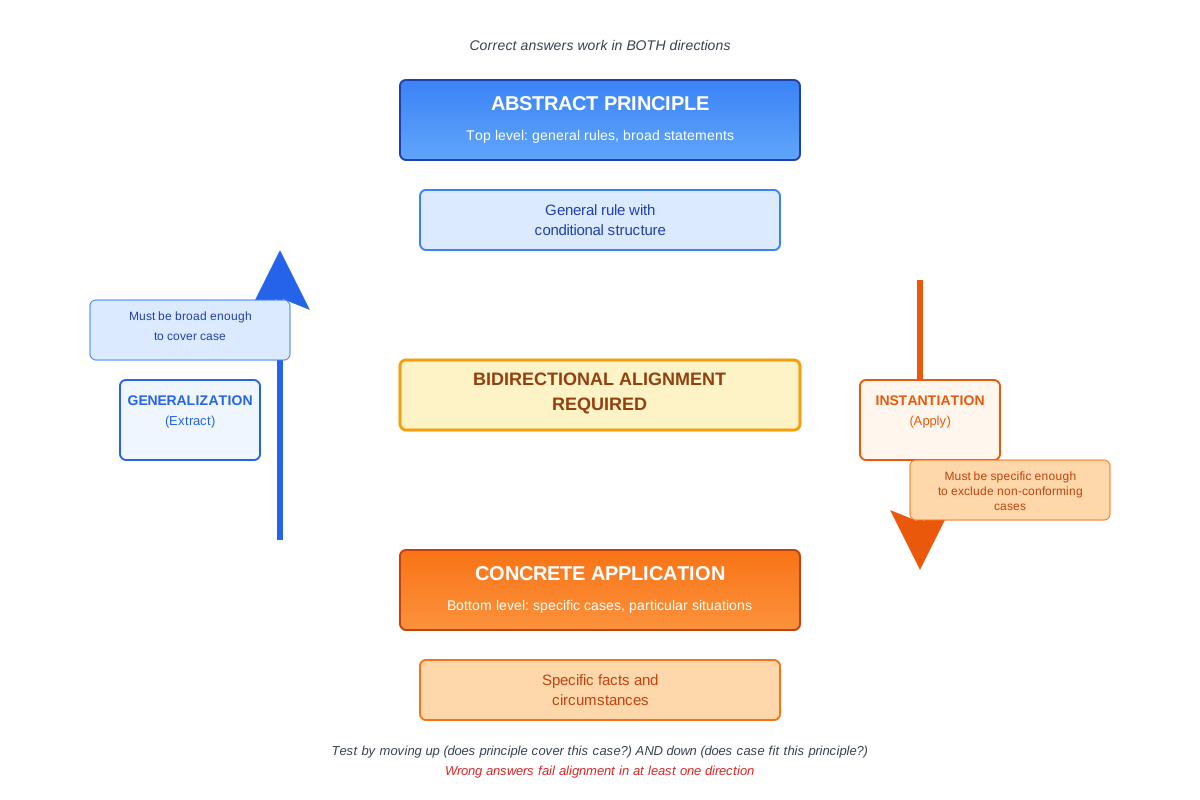
Principle question stems are question types in LSAT Logical Reasoning that involve identifying, applying, or evaluating general rules, standards, or propositions that govern reasoning in specific situations. A principle in LSAT terminology is a broad, abstract rule that can apply to multiple situations, while an application is a specific instance or scenario that falls under that rule. The relationship between principles and applications is bidirectional: sometimes you'll identify principles from applications, and other times you'll apply principles to new situations.
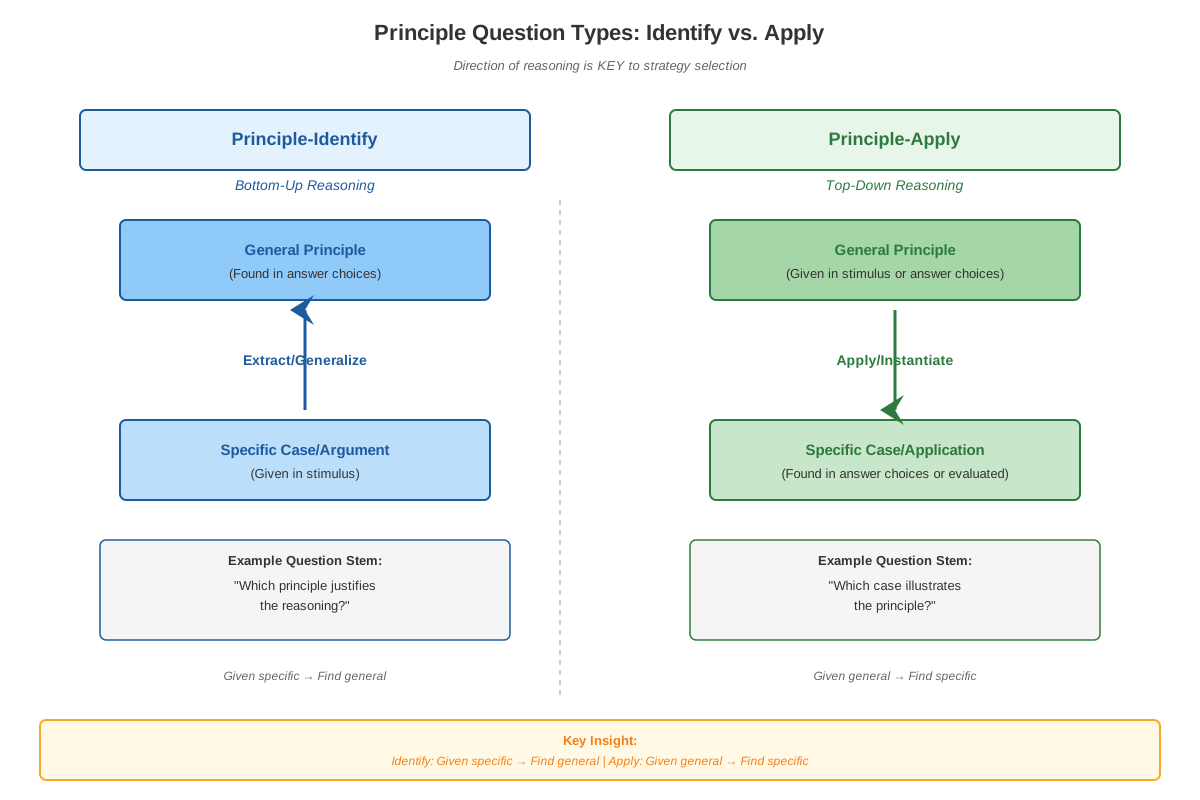
The fundamental reasoning pattern involves abstraction and instantiation. Abstraction means extracting general rules from specific examples—moving from concrete details to broader propositions. Instantiation means applying general rules to specific cases—moving from abstract principles to concrete situations. Both directions require recognizing which features of a situation are legally or logically relevant and which are merely circumstantial details.
Two Primary Principle Question Types
| Question Type | Direction of Reasoning | Common Stem Language | Primary Task |
|---|---|---|---|
| Principle-Identify | Specific → General | "Which principle justifies...", "Which principle underlies...", "The reasoning above conforms to which principle..." | Extract the abstract rule that governs the specific argument |
| Principle-Apply | General → Specific | "Which situation illustrates...", "The principle above, if valid, most helps to justify...", "Which action conforms to the principle..." | Find the concrete case that matches the abstract rule |
Principle-Identify questions present a specific argument or situation in the stimulus and ask which answer choice states the general principle that justifies, underlies, or is illustrated by that argument. The stimulus contains concrete details, and your task is to abstract away irrelevant specifics while preserving the logical structure. For example, if the stimulus argues "The museum should not accept the donation because it comes with restrictions on how the art can be displayed," the underlying principle might be "Institutions should reject gifts that compromise their operational autonomy."
Principle-Apply questions present a general principle in the stimulus and ask which answer choice provides a situation that exemplifies, conforms to, or is justified by that principle. The stimulus states an abstract rule, and your task is to find the concrete application that matches all relevant conditions. For example, if the stimulus states "One should not criticize others for behavior one engages in oneself," the correct answer would describe a specific situation where someone hypocritically criticizes behavior they themselves practice.
Principle Question Stem Recognition
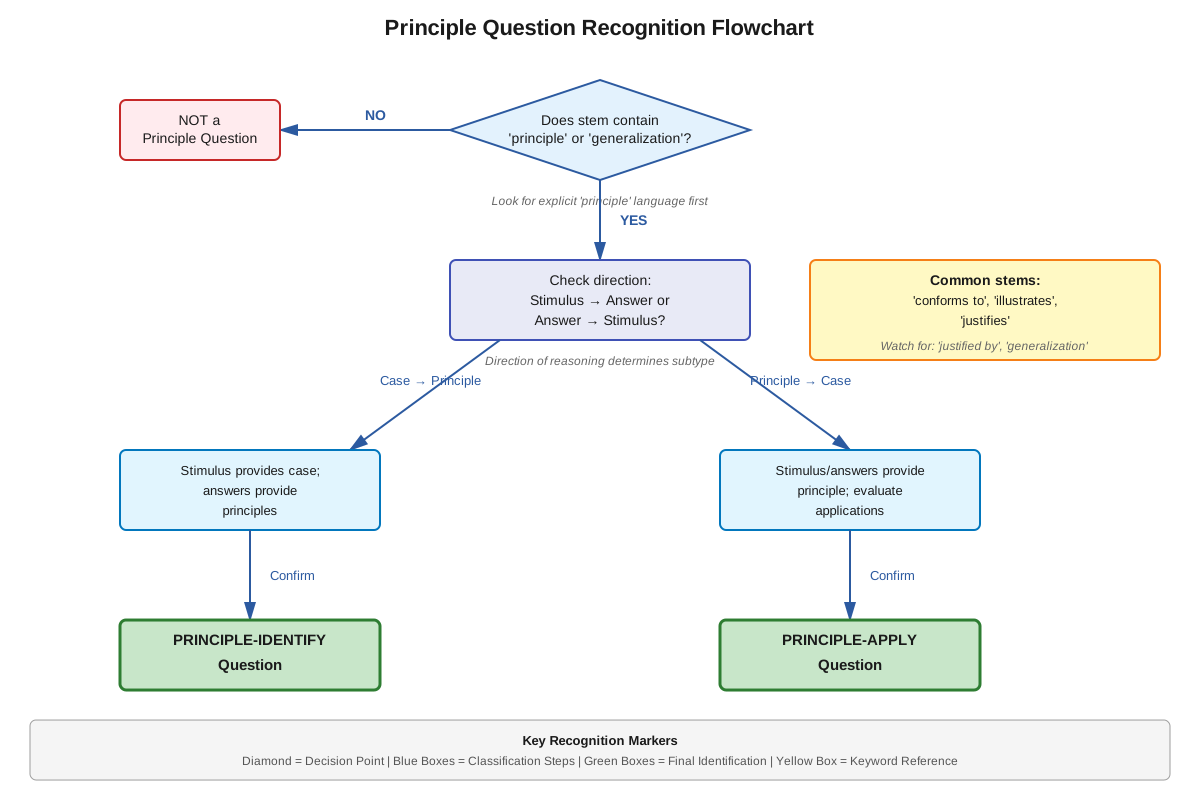
Recognizing lsat principle question stems quickly and accurately is crucial for deploying the correct strategy. These stems contain distinctive language patterns that signal principle questions:
Definitive Principle Indicators:
- "Which one of the following principles..."
- "The reasoning above conforms to which principle..."
- "Which principle, if valid, most helps to justify..."
- "The situation described above most closely conforms to which principle..."
- "Which principle underlies the argument..."
- "The ethicist's reasoning most closely conforms to which principle..."
Key Recognition Features:
- The word "principle" explicitly appears in most (but not all) principle question stems
- Stems often use words like "conforms to," "illustrates," "underlies," "justifies," or "exemplifies"
- The question asks about general rules, standards, propositions, or policies
- There's an explicit or implicit relationship between abstract rules and concrete applications
Structural Components of Principle Questions
Every principle question involves three essential components:
- The General Rule: An abstract proposition that applies broadly across multiple situations, typically containing conditional logic or normative standards (what should/ought to be done)
- The Specific Application: A concrete situation with particular details, actors, and circumstances that either illustrates the principle or requires the principle for justification
- The Matching Criteria: The logical features that must align between principle and application, including:
- Relevant conditions (what circumstances trigger the rule)
- Relevant actions (what behavior the rule governs)
- Relevant outcomes (what results the rule produces or prevents)
- Scope limitations (what the rule does and doesn't cover)
Conditional Logic in Principle Questions
Many principle questions involve conditional reasoning, where principles take the form "If [condition], then [consequence]" or "All [category] should [action]." Understanding how to match conditional structures between principles and applications is critical:
- Sufficient conditions in principles must be satisfied by the application's circumstances
- Necessary conditions in principles must be present in the application's outcome
- Contrapositive relationships may be tested, requiring recognition that if a principle states "If A, then B," situations showing "not B, therefore not A" also conform
For example, a principle stating "If an action harms others without their consent, it is morally wrong" requires applications where: (1) an action occurs, (2) harm results, (3) consent is absent, and (4) moral wrongness is concluded. An answer choice missing any element fails to match the principle.
Scope Matching in Principle Questions
Scope refers to the breadth of situations a principle covers. Correct answers must match the scope of the principle—neither too broad nor too narrow:
- Overly broad answers include situations or conditions not present in the stimulus
- Overly narrow answers add unnecessary restrictions not required by the stimulus
- Scope-matched answers cover exactly the relevant domain without over- or under-inclusion
For instance, if a stimulus argues that "this restaurant should refund customers when meals are served cold," a principle about "businesses should compensate customers for defective products" might be too broad (meals aren't products in the same sense), while "restaurants should refund customers when entrees are served below 140°F" would be too narrow (adding an unnecessary temperature specification).
Concept Relationships
The concepts within principle questions form an interconnected reasoning chain: Question Stem Recognition → enables → Question Type Classification (Identify vs. Apply) → determines → Reasoning Direction (abstraction vs. instantiation) → guides → Scope Analysis → combined with → Conditional Logic Mapping → produces → Answer Evaluation Strategy.
Principle questions connect to prerequisite topics through multiple pathways. Conditional reasoning provides the logical framework for many principle formulations, as principles often express if-then relationships. Argument structure recognition enables identification of which elements in a stimulus are premises, conclusions, or background information—crucial for determining what the principle must justify or explain. Question stem recognition skills allow rapid classification, preventing confusion between principle questions and superficially similar types like assumption or inference questions.
Principle questions also relate to other Logical Reasoning question types. They share characteristics with assumption questions (both involve unstated connections between ideas) but differ in that principle questions make the connection explicit and general rather than leaving it implicit. They resemble parallel reasoning questions (both require matching logical structures) but focus on abstract-concrete relationships rather than structural isomorphism. They connect to strengthen/weaken questions when principles are used to support or undermine arguments, but principle questions specifically ask about the rule itself rather than evidence for or against a conclusion.
The bidirectional nature of principle reasoning creates an internal relationship: mastering Principle-Identify questions strengthens Principle-Apply skills because both require recognizing the essential features that connect general rules to specific cases. This symmetry means that practice with one type reinforces competency with the other.
High-Yield Facts
⭐ Principle question stems almost always contain the word "principle," "conforms to," "illustrates," "underlies," or "justifies"—these are high-reliability recognition markers.
⭐ The two main principle question types move in opposite directions: Identify questions go from specific to general (abstraction), while Apply questions go from general to specific (instantiation).
⭐ Correct principle answers must match the scope of the stimulus exactly—neither broader nor narrower than what the argument requires.
⭐ Conditional logic appears in approximately 60-70% of principle questions, making fluency with if-then reasoning essential for this question type.
⭐ Irrelevant details in the stimulus are deliberate distractors—correct principles abstract away specific names, places, and circumstances while preserving logical structure.
- Principle questions typically appear 3-5 times per Logical Reasoning section, making them one of the most frequent question types.
- Wrong answers in Principle-Identify questions often reverse the logic, confuse sufficient and necessary conditions, or introduce elements not present in the stimulus.
- Wrong answers in Principle-Apply questions frequently match some but not all conditions of the principle, creating partial but incomplete alignment.
- Normative language (should, ought, must, required) frequently appears in principle formulations because principles often express standards or obligations.
- Multiple principles may be true of a situation, but the correct answer is the one most directly relevant to the specific reasoning in the stimulus.
- Principle questions reward careful reading of quantifiers (all, some, most, none) because scope errors are a primary wrong answer trap.
- The stimulus in Principle-Apply questions is typically shorter than in Principle-Identify questions because stating a general rule requires fewer words than describing a specific situation.
- Principle questions often test ethical, legal, or policy reasoning, reflecting the types of normative arguments common in law.
- Answer choices in principle questions are typically longer and more complex than in other question types because they must express complete general rules or detailed scenarios.
- Time management is crucial for principle questions—they often require more careful analysis than assumption or inference questions, so allocate 90-120 seconds per question.
Quick check — test yourself on Principle question stems so far.
Try Flashcards →Common Misconceptions
Misconception: All principle questions explicitly use the word "principle" in the question stem.
Correction: While most principle questions do use "principle," some use equivalent language like "general proposition," "policy," "standard," or "rule." Focus on the reasoning pattern (abstract-concrete relationship) rather than relying solely on keyword presence.
Misconception: The correct principle must mention the same specific details (names, objects, places) as the stimulus.
Correction: Correct principles abstract away irrelevant specifics. If the stimulus discusses "a museum rejecting a painting donation," the principle should refer to "institutions rejecting gifts" or similar general categories, not specifically museums or paintings.
Misconception: In Principle-Apply questions, any answer that doesn't violate the principle is correct.
Correction: The correct answer must affirmatively illustrate or conform to the principle, not merely avoid violating it. The principle's conditions must be satisfied, and its prescribed action or outcome must occur.
Misconception: Longer, more detailed answer choices are more likely to be correct because they're more comprehensive.
Correction: Length is not a reliable indicator. Wrong answers are often longer because they include unnecessary conditions or irrelevant details. The correct answer matches the logical structure regardless of length.
Misconception: Principle questions are just assumption questions with different wording.
Correction: While both involve connections between ideas, assumption questions ask for unstated premises necessary for an argument to work, while principle questions ask for explicit general rules that justify or illustrate reasoning. Assumptions are implicit and specific to one argument; principles are explicit and apply broadly.
Misconception: If a principle seems reasonable or true in the real world, it's more likely to be correct.
Correction: Real-world plausibility is irrelevant. The correct answer must match the logical structure of the stimulus, even if the principle seems unusual or counterintuitive. Evaluate logical alignment, not real-world truth.
Misconception: In Principle-Identify questions, the correct answer must use similar language to the stimulus.
Correction: Correct principles often rephrase the stimulus using different vocabulary while preserving logical structure. Don't be distracted by surface-level language similarity; focus on whether the logical relationship matches.
Worked Examples
Example 1: Principle-Identify Question
Stimulus: "The city council should not approve the new highway project. While the highway would reduce commute times, it would require demolishing a historic neighborhood that has significant cultural value to the community. Economic efficiency should not take precedence over cultural preservation when a community's heritage is at stake."
Question Stem: "Which one of the following principles most helps to justify the reasoning above?"
Answer Choices:
(A) Projects that provide economic benefits should be approved unless they cause environmental damage.
(B) Cultural preservation should take priority over economic considerations when community heritage would be lost.
(C) Historic neighborhoods should never be demolished regardless of potential benefits.
(D) City councils should consider both economic and cultural factors when making decisions.
(E) Communities should preserve their heritage whenever possible.
Step-by-Step Solution:
- Identify the question type: The stem asks "which principle justifies the reasoning," indicating a Principle-Identify question. We need to abstract from the specific argument to a general rule.
- Analyze the argument structure:
- Conclusion: City council should not approve the highway
- Premise 1: Highway would reduce commute times (economic benefit)
- Premise 2: Highway requires demolishing historic neighborhood (cultural cost)
- Principle stated: Economic efficiency should not take precedence over cultural preservation when heritage is at stake
- Extract the logical structure: The argument prioritizes cultural preservation over economic benefit when heritage is threatened. The principle must capture this priority relationship and the condition that triggers it.
- Evaluate each answer:
- (A) Focuses on environmental damage, not cultural preservation—scope mismatch. Eliminate.
- (B) States cultural preservation should take priority over economic considerations when heritage would be lost—this matches the argument's structure exactly. Strong candidate.
- (C) Uses absolute language ("never") that's stronger than the argument, which only prioritizes culture when heritage is at stake, not in all circumstances. Too extreme.
- (D) Too weak—merely considering both factors doesn't justify rejecting the project. The argument makes a priority claim, not just a consideration claim. Eliminate.
- (E) "Whenever possible" is vague and doesn't capture the priority relationship over economic factors. Too weak.
- Select the answer: (B) correctly abstracts the argument's reasoning pattern while matching its scope and logical structure.
Connection to Learning Objectives: This example demonstrates identifying principle question stems through the "justify the reasoning" language, explaining the reasoning pattern of prioritizing one value over another under specific conditions, and applying systematic evaluation to select the correct principle formulation.
Example 2: Principle-Apply Question
Stimulus: "A professional has an obligation to refuse work that would require violating their professional ethical standards, even if refusing the work results in financial loss."
Question Stem: "The principle above, if valid, most helps to justify which one of the following judgments?"
Answer Choices:
(A) A journalist should decline to write an article praising a company that advertises in her newspaper, even though her editor requested the article.
(B) An accountant should refuse to falsify financial records for a client, even though losing the client would significantly reduce the accountant's income.
(C) A lawyer should not accept a case if she believes the client is guilty, even if the case would be financially lucrative.
(D) A doctor should recommend the most effective treatment for a patient, even if a less effective treatment would be more profitable.
(E) An engineer should report safety violations at her company, even if reporting them might result in her termination.
Step-by-Step Solution:
- Identify the question type: The stem asks which judgment the principle "helps to justify," indicating a Principle-Apply question. We need to find a specific situation that matches the general rule.
- Break down the principle's components:
- Subject: A professional
- Obligation: Must refuse work
- Condition: Work would require violating professional ethical standards
- Consequence accepted: Financial loss
- Logical structure: If work requires ethical violation, then refuse work despite financial cost
- Identify matching criteria: The correct answer must include:
- A professional acting in their professional capacity
- Work that would require violating professional ethics
- Refusal of that work
- Financial consequence of refusal
- Evaluate each answer:
- (A) Writing a praising article might be ethically questionable, but it's not clearly a violation of journalistic ethical standards (journalists can write positive articles). The ethical violation is unclear. Weak match.
- (B) Falsifying financial records clearly violates accounting ethical standards. Refusing to do so despite losing income (financial loss) matches all components perfectly. Strong candidate.
- (C) Believing a client is guilty doesn't mean representing them violates legal ethics—lawyers are ethically permitted (even obligated) to defend guilty clients. This misunderstands legal ethics. Eliminate.
- (D) Recommending the most effective treatment is ethically required, but this describes doing the right thing, not refusing work that would violate ethics. The structure doesn't match. Eliminate.
- (E) Reporting violations is ethically praiseworthy, but this describes taking action, not refusing work. The principle specifically addresses refusing work, not taking positive action. Structure mismatch.
- Select the answer: (B) matches all components of the principle: professional (accountant), work requiring ethical violation (falsifying records), refusal of that work, and financial consequence (losing client/income).
Connection to Learning Objectives: This example demonstrates recognizing Principle-Apply question stems through "helps to justify which judgment" language, explaining how to match conditional components between principle and application, and applying systematic evaluation by checking each required element.
Exam Strategy
Immediate Recognition Strategy
When you encounter a question stem, scan for these trigger words that signal principle questions:
- "principle" (most reliable indicator)
- "conforms to"
- "illustrates"
- "underlies"
- "justifies"
- "general proposition"
- "policy"
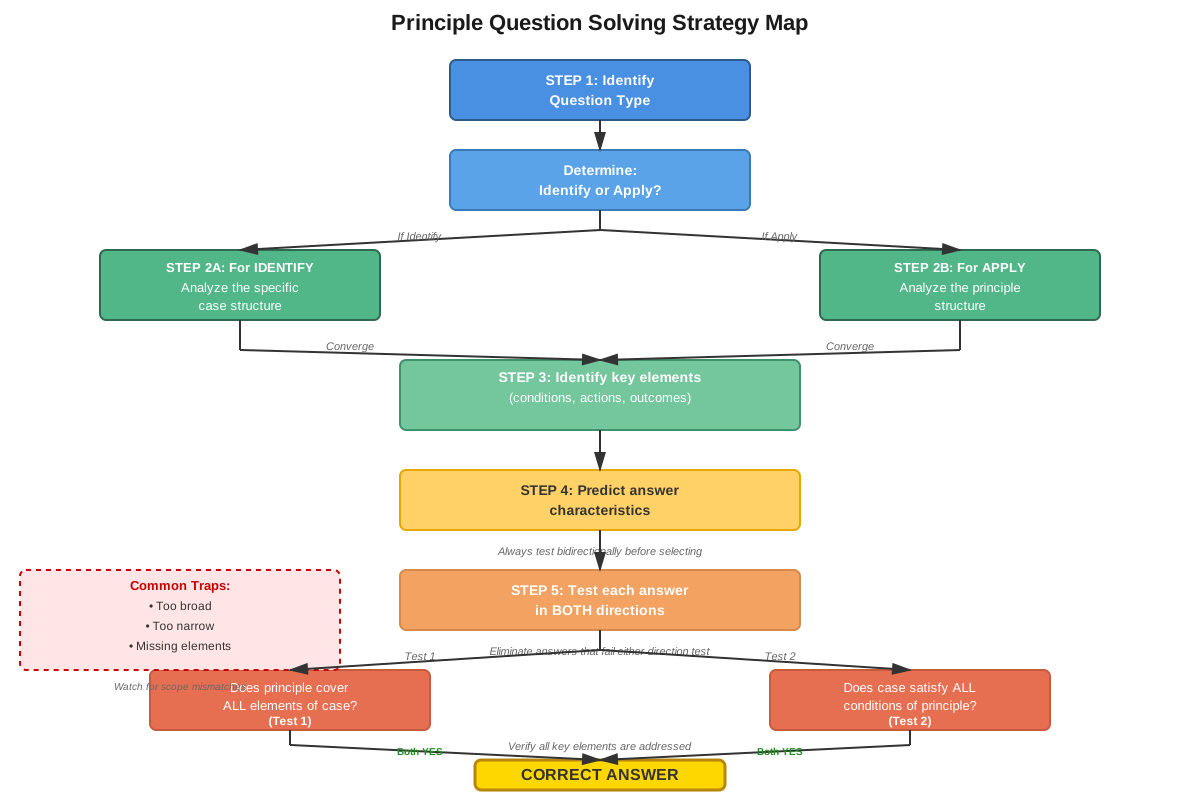
Exam Tip: If you see "principle" in the question stem, immediately classify the question and determine whether it's Identify (specific stimulus → general answer) or Apply (general stimulus → specific answer). This classification determines your entire approach.
Approach for Principle-Identify Questions
- Read the stimulus carefully, noting the conclusion and reasoning structure
- Identify the logical gap or connection the principle must bridge
- Abstract away specific details: Replace concrete terms with general categories (e.g., "museum" → "institution," "painting" → "gift")
- Predict the principle structure before reading answers
- Eliminate answers that:
- Are too broad (cover situations not in the stimulus)
- Are too narrow (add unnecessary restrictions)
- Reverse the logic or confuse conditions
- Introduce new elements not present in the stimulus
Approach for Principle-Apply Questions
- Read the principle in the stimulus carefully, identifying all conditions and consequences
- Break down the conditional structure: What must be true? What follows?
- Note any quantifiers (all, some, most) that affect scope
- For each answer choice, check whether:
- All conditions of the principle are satisfied
- The consequence or action prescribed by the principle occurs
- No additional elements are required beyond what the principle specifies
- Eliminate answers that match only some conditions or that violate the principle
Process of Elimination Strategies
For Principle-Identify questions, wrong answers typically:
- Reverse causation or logic: If the stimulus says "X because Y," wrong answers might suggest "Y because X"
- Confuse sufficient and necessary conditions: Mixing up what triggers a rule versus what the rule requires
- Add irrelevant factors: Introducing considerations not present in the stimulus reasoning
- Use extreme language: "Always," "never," "only" when the stimulus is more moderate
For Principle-Apply questions, wrong answers typically:
- Satisfy some but not all conditions: Matching part of the principle but missing key elements
- Reverse the principle: Showing the opposite of what the principle prescribes
- Introduce analogous but distinct situations: Similar-seeming cases that don't actually match the logical structure
- Confuse the principle with its contrapositive: Showing "not B, not A" when the principle states "A → B" but the answer doesn't properly apply the contrapositive
Time Allocation
- Principle-Identify questions: Allocate 90-120 seconds
- 30-40 seconds: Read and analyze stimulus
- 10-15 seconds: Predict principle structure
- 40-60 seconds: Evaluate answer choices
- Principle-Apply questions: Allocate 75-100 seconds
- 20-30 seconds: Read and break down principle
- 10-15 seconds: Identify matching criteria
- 45-55 seconds: Evaluate answer choices
Exam Tip: Principle questions often require more careful analysis than assumption or inference questions. Don't rush—accuracy is more important than speed. If you're consistently running over time, practice breaking down conditional structures more quickly.
Common Trap Patterns
- The "Real-World Truth" Trap: An answer seems correct because it's true in reality, but doesn't match the stimulus logic. Always evaluate logical alignment, not real-world plausibility.
- The "Partial Match" Trap: An answer matches the subject matter or some details but misses the logical structure. Check that the reasoning pattern matches, not just the topic.
- The "Extreme Language" Trap: Absolute terms like "always," "never," "only," or "all" often signal wrong answers unless the stimulus itself uses such language.
- The "Scope Shift" Trap: An answer introduces a broader or narrower category than the stimulus requires. Verify that the scope matches exactly.
Memory Techniques
The "PRINCIPLE" Acronym
Pattern recognition: Identify the question type immediately
Reasoning direction: Determine if you're abstracting (Identify) or instantiating (Apply)
Irrelevant details: Strip away specific names, places, and circumstances
Necessary conditions: Check that all required elements are present
Conditional logic: Map if-then relationships carefully
Instantiation check: Verify the principle applies to the specific case (or vice versa)
Priority relationships: Note which values or considerations take precedence
Logical structure: Match the reasoning pattern, not just the topic
Extreme language: Be suspicious of absolute terms unless justified
Visualization Strategy: The Abstraction Ladder
Visualize principle reasoning as a ladder:
- Top rung: Most abstract, general principle (applies to many situations)
- Middle rungs: Intermediate generalizations (applies to categories of situations)
- Bottom rung: Specific application (one particular situation)
For Principle-Identify questions, climb up the ladder from the specific stimulus to the general principle.
For Principle-Apply questions, climb down the ladder from the general principle to the specific application.
The "Match-Check" Mnemonic
For evaluating answers, remember SCANS:
- Scope: Does the breadth match (not too broad or narrow)?
- Conditions: Are all if-then conditions satisfied?
- Action: Does the prescribed action or outcome occur?
- New elements: Are there introduced factors not in the stimulus?
- Structure: Does the logical pattern align?
Summary
Principle question stems represent a crucial LSAT Logical Reasoning question type that tests the ability to connect abstract rules with concrete applications. These questions appear in two primary forms: Principle-Identify questions that require abstracting general rules from specific arguments, and Principle-Apply questions that require finding specific situations that exemplify stated principles. Success requires recognizing distinctive question stem language (particularly "principle," "conforms to," "illustrates," and "justifies"), understanding the bidirectional relationship between general and specific reasoning, and carefully matching logical structures while avoiding scope errors. The most common pitfalls include confusing sufficient and necessary conditions, introducing irrelevant details, selecting answers that are too broad or too narrow, and being distracted by real-world plausibility rather than logical alignment. Mastering principle questions demands systematic analysis of conditional logic, precise scope matching, and disciplined elimination of answers that partially but incompletely match the required structure. With 3-5 principle questions per Logical Reasoning section, competency in this area directly impacts overall LSAT performance and reflects the fundamental legal reasoning skill of applying rules to cases.
Key Takeaways
- Principle question stems are identifiable through distinctive language including "principle," "conforms to," "illustrates," "underlies," and "justifies"—learn to recognize these triggers instantly
- The two main types move in opposite directions: Principle-Identify abstracts from specific to general, while Principle-Apply instantiates from general to specific
- Correct answers must match the scope exactly—neither too broad (covering situations not in the stimulus) nor too narrow (adding unnecessary restrictions)
- Conditional logic appears in most principle questions; carefully map sufficient and necessary conditions to avoid reversing or confusing the logical structure
- Abstract away irrelevant specifics (names, places, particular objects) while preserving the logical structure and relationships between elements
- Evaluate answers by checking that all components match: conditions satisfied, prescribed actions occur, no new elements introduced, and logical structure aligns
- Allocate 90-120 seconds for Principle-Identify questions and 75-100 seconds for Principle-Apply questions, prioritizing accuracy over speed in this question type
Related Topics
Assumption Questions: Understanding unstated premises that connect premises to conclusions builds the foundation for recognizing what principles must bridge in arguments. Mastering principle questions enhances assumption question skills by developing sensitivity to logical gaps.
Conditional Reasoning: Deep fluency with if-then logic, contrapositives, and necessary versus sufficient conditions is essential for principle questions and enables progression to complex formal logic questions.
Parallel Reasoning Questions: Both question types require matching logical structures, but parallel reasoning focuses on structural isomorphism between arguments while principle questions focus on abstract-concrete relationships.
Strengthen and Weaken Questions: Principles often function as strengtheners when they support an argument's reasoning, making principle question skills directly transferable to evaluating argument support.
Flaw Questions: Recognizing when arguments fail to establish principles or misapply them connects to flaw identification, particularly scope and generalization errors.
Practice CTA
Now that you've mastered the core concepts of principle question stems, it's time to put your knowledge into action. Work through the practice questions to reinforce your ability to quickly identify principle questions, distinguish between Identify and Apply variations, and systematically evaluate answer choices using the strategies you've learned. Remember that principle questions reward careful, methodical analysis—focus on matching logical structures rather than rushing to judgment. Each practice question you complete strengthens your pattern recognition and builds the confidence you need to excel on test day. The flashcards will help cement the key recognition triggers and common trap patterns into long-term memory. You've built a strong foundation—now apply it!
Sign up free to keep reading
Create a free AnvayaPrep account to finish this LSAT guide on Principle question stems — plus flashcards and practice questions.