Overview
Resolve the paradox question stems represent a distinctive and frequently tested question type within the LSAT's Logical Reasoning sections. These questions present students with an apparent contradiction, discrepancy, or surprising result embedded within a short argument or set of facts. The task is to identify which answer choice best explains how both seemingly incompatible statements can be true simultaneously, or which piece of information makes the surprising outcome less puzzling. Unlike strengthen or weaken questions that ask test-takers to affect the validity of an argument, resolve the paradox questions require identifying information that harmonizes conflicting data points without necessarily proving or disproving any particular conclusion.
Mastering logical reasoning skills for paradox resolution is essential because these questions test a student's ability to think flexibly about causation, correlation, and the interplay of multiple factors. The LSAT uses these questions to assess whether candidates can move beyond surface-level contradictions to identify underlying mechanisms or additional variables that reconcile apparent inconsistencies. This cognitive skill mirrors the type of analytical thinking required in legal practice, where attorneys must frequently reconcile conflicting evidence, explain unexpected case outcomes, or identify the missing piece of information that makes sense of seemingly contradictory legal precedents.
Within the broader framework of question stem recognition, the ability to quickly and accurately identify resolve the paradox questions allows test-takers to deploy the appropriate strategic approach. These questions require a fundamentally different mindset than assumption, flaw, or inference questions. Recognizing the question type immediately enables students to focus on identifying the tension or surprise in the stimulus, then systematically evaluating which answer choice introduces information that allows both elements of the paradox to coexist logically. This recognition skill is foundational to efficient time management and accurate performance across all Logical Reasoning questions.
Learning Objectives
- [ ] Identify how Resolve the paradox question stems appears in LSAT questions
- [ ] Explain the reasoning pattern behind Resolve the paradox question stems
- [ ] Apply Resolve the paradox question stems to solve LSAT-style problems accurately
- [ ] Distinguish resolve the paradox questions from superficially similar question types (strengthen, explain, inference)
- [ ] Analyze stimuli to pinpoint the exact nature of the paradox or surprising result
- [ ] Evaluate answer choices by determining whether they genuinely address both sides of the apparent contradiction
- [ ] Recognize common wrong answer patterns specific to paradox resolution questions
Prerequisites
- Basic argument structure recognition: Understanding premises, conclusions, and evidence is necessary because paradox questions present factual claims that must be analyzed for their logical relationships.
- Causal reasoning fundamentals: Familiarity with cause-and-effect relationships helps identify how answer choices might introduce alternative explanations or additional causal factors.
- Conditional logic basics: Some paradoxes involve conditional relationships, and recognizing these patterns aids in understanding how circumstances might reconcile apparent contradictions.
- Reading comprehension skills: The ability to parse dense text quickly is essential because the paradox itself must be identified before it can be resolved.
Why This Topic Matters
Resolve the paradox questions appear with significant regularity on the LSAT, typically comprising 2-4 questions per test across both Logical Reasoning sections. This frequency makes them a high-value question type that can meaningfully impact overall scores. These questions test critical thinking skills that extend far beyond standardized testing—the ability to reconcile conflicting information, identify missing variables, and think systematically about complex situations is fundamental to legal analysis, case preparation, and courtroom argumentation.
In legal practice, attorneys constantly encounter situations where evidence appears contradictory, witness testimony conflicts, or case outcomes seem inconsistent with established precedent. The cognitive skills developed through mastering paradox resolution questions directly translate to professional competencies: identifying the additional fact that explains an unexpected jury verdict, recognizing the distinguishing factor that reconciles seemingly contradictory case law, or understanding how two apparently incompatible expert opinions can both contain valid elements.
On the LSAT specifically, these questions commonly appear in several formats: statistical paradoxes (where data trends seem contradictory), behavioral paradoxes (where actions contradict stated preferences or expected outcomes), and causal paradoxes (where an expected cause-effect relationship doesn't materialize or an unexpected one does). The questions may present scientific studies with surprising results, business scenarios with counterintuitive outcomes, or social phenomena that defy initial expectations. Recognizing these patterns allows for faster, more accurate responses under timed conditions.
Core Concepts
Defining Resolve the Paradox Questions
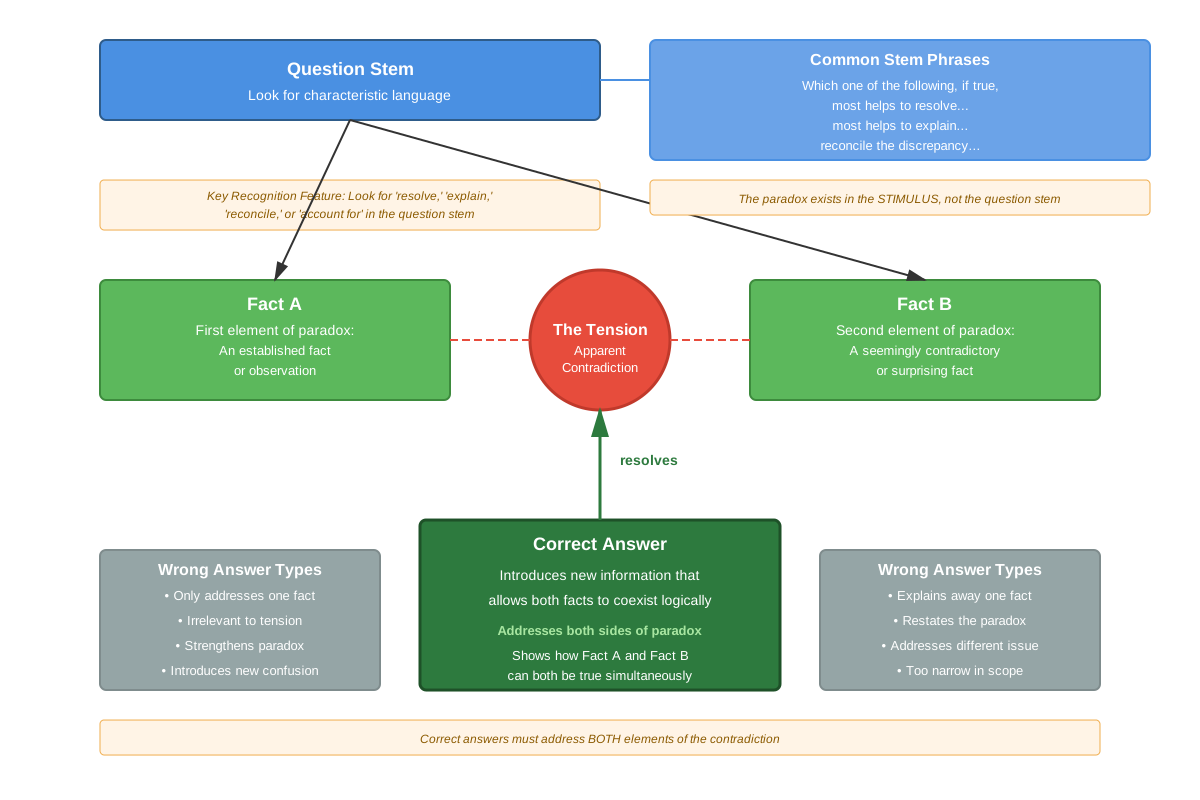
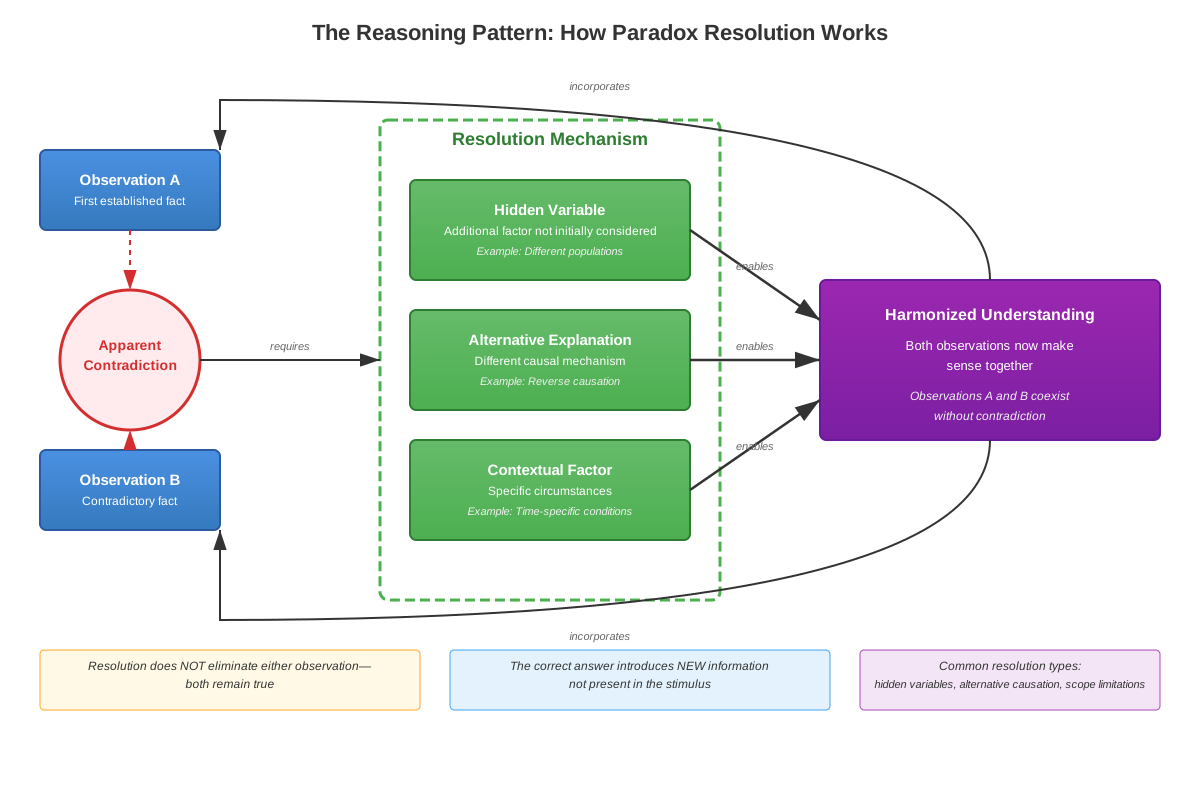
Resolve the paradox question stems are characterized by their presentation of an apparent contradiction, discrepancy, or surprising result that requires explanation. The stimulus typically contains two or more statements that seem incompatible or a single outcome that contradicts reasonable expectations. The correct answer introduces new information that allows both elements to be true simultaneously or explains why the surprising result occurred. Importantly, the correct answer does not eliminate one side of the paradox or prove one statement false; instead, it provides a framework within which both can coexist logically.
The paradox itself may be explicit, with the stimulus directly stating that something is "surprising" or "unexpected," or it may be implicit, requiring the test-taker to recognize the tension between presented facts. For example, a stimulus might state that a city implemented traffic reduction measures and traffic increased, or that a product became more expensive yet sales rose—both scenarios present outcomes contrary to normal expectations.
Recognizing Question Stem Language
Question stem recognition for paradox questions relies on identifying specific linguistic markers. Common phrasings include:
- "Which one of the following, if true, most helps to resolve the apparent paradox?"
- "Which one of the following, if true, most helps to explain the discrepancy described above?"
- "Which one of the following, if true, most helps to reconcile the seemingly contradictory findings?"
- "Which one of the following, if true, does most to explain the surprising result?"
- "Which one of the following, if true, most helps to account for the unexpected outcome?"
The key indicators are words like "resolve," "explain," "reconcile," "account for," and references to "paradox," "discrepancy," "contradiction," "surprising," or "unexpected." These stems signal that the task is explanatory rather than argumentative—the goal is understanding, not persuasion.
The Logical Structure of Paradoxes
Paradoxes on the LSAT follow predictable structural patterns:
- Statistical/Numerical Paradoxes: Data trends that seem contradictory (e.g., average scores increased but more students failed)
- Behavioral Paradoxes: Actions that contradict stated preferences or rational expectations (e.g., consumers prefer product A but buy product B)
- Causal Paradoxes: Expected causes don't produce expected effects, or unexpected effects occur (e.g., safety measures correlate with increased accidents)
- Temporal Paradoxes: Changes over time that defy expectations (e.g., a species thrives after its habitat shrinks)
Understanding these categories helps quickly identify what type of explanation will be needed. Statistical paradoxes often require understanding sampling, aggregation, or measurement issues. Behavioral paradoxes frequently involve distinguishing between stated preferences and revealed preferences, or identifying constraints on behavior. Causal paradoxes typically need alternative causal factors or intervening variables.
The Resolution Mechanism
A proper resolution introduces information that allows both sides of the paradox to be true without contradiction. This typically works through one of several mechanisms:
| Resolution Type | Mechanism | Example |
|---|---|---|
| Additional Variable | Introduces a third factor affecting the outcome | Traffic increased because population grew faster than reduction measures could offset |
| Distinction/Clarification | Clarifies that different groups or categories are involved | Average increased because low-scoring students dropped out, raising the average among remaining students |
| Temporal Sequencing | Explains timing differences | Sales increased initially due to publicity, though long-term trend is downward |
| Measurement Issue | Clarifies what's actually being measured | Reported accidents increased because reporting improved, not actual accident rates |
| Compensating Factor | Identifies an offsetting influence | Safety equipment led to riskier behavior that offset safety benefits |
Distinguishing from Similar Question Types
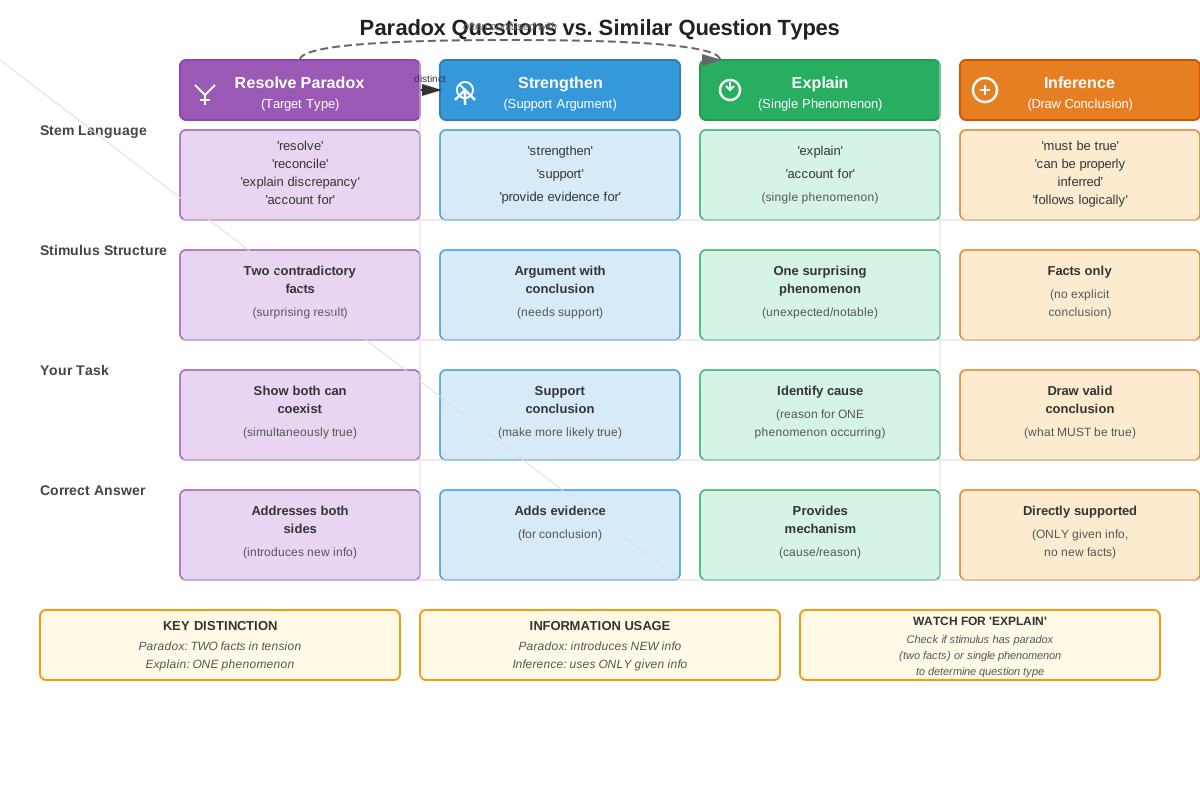
Resolve the paradox questions can superficially resemble other question types, making distinction crucial:
- Strengthen questions ask for information that makes a conclusion more likely to be true; paradox questions ask for information that explains how seemingly contradictory facts can both be true
- Explain questions may seem identical but typically ask for explanations of single phenomena rather than reconciliation of contradictions
- Inference questions ask what must be true based on the stimulus; paradox questions provide new information to explain the stimulus
- Assumption questions identify unstated premises necessary for an argument; paradox questions don't involve arguments requiring assumptions
The critical distinction is that paradox questions always involve apparent contradiction or surprise, and the answer adds new information rather than identifying something already implicit.
Common Wrong Answer Patterns
Understanding typical incorrect answer choices accelerates elimination:
- One-sided explanations: Address only one element of the paradox while ignoring the other
- Irrelevant information: Introduce facts that don't connect to the specific contradiction
- Restatements: Simply repeat information already in the stimulus without adding explanatory value
- Opposite effect: Would actually deepen the paradox rather than resolve it
- Partial resolutions: Move toward explanation but don't fully account for the discrepancy
Concept Relationships
The ability to identify resolve the paradox question stems serves as the gateway to applying the appropriate analytical framework. Once the question type is recognized, the test-taker activates a specific cognitive approach: identifying the paradox → understanding both elements that need reconciliation → evaluating answer choices for their explanatory power → selecting the choice that allows both elements to coexist.
This question type connects to broader logical reasoning skills, particularly causal reasoning and argument analysis. While paradox questions don't present formal arguments with conclusions, they require understanding how multiple factors interact to produce outcomes. The skills developed in analyzing causal relationships, identifying necessary and sufficient conditions, and recognizing the difference between correlation and causation all support paradox resolution.
Within question stem recognition, mastering paradox identification enables more efficient differentiation from strengthen/weaken questions (which involve arguments and conclusions) and assumption questions (which involve logical gaps). This differentiation is crucial because applying the wrong approach—such as looking for assumptions when the question asks for paradox resolution—leads to systematic errors.
The relationship map flows as follows:
Question Stem Recognition → identifies → Paradox Question Type → activates → Paradox Identification Strategy → leads to → Evaluation of Explanatory Answers → produces → Correct Answer Selection
Additionally, paradox questions connect to real-world legal reasoning where reconciling conflicting evidence, explaining unexpected outcomes, and identifying missing information are daily tasks. This practical connection reinforces why these questions appear on the LSAT and how the tested skills transfer to legal practice.
High-Yield Facts
⭐ Resolve the paradox questions always involve apparent contradiction or surprising results that need explanation, not argumentation
⭐ The correct answer allows both sides of the paradox to be true simultaneously; it never eliminates one side
⭐ Common question stem language includes "resolve," "explain," "reconcile," "account for," and references to "paradox," "discrepancy," or "surprising"
⭐ The most frequent wrong answer type is the one-sided explanation that addresses only one element of the contradiction
⭐ Statistical paradoxes often involve sampling issues, aggregation effects, or measurement changes rather than actual contradictions
- Paradox questions typically appear 2-4 times per LSAT across both Logical Reasoning sections
- The stimulus will contain factual claims rather than arguments with explicit conclusions
- Temporal factors (timing, sequence, duration) frequently provide the key to resolution
- Behavioral paradoxes often involve distinctions between stated preferences and actual behavior
- The correct answer introduces NEW information not already present in the stimulus
- Causal paradoxes frequently require identifying alternative causes or intervening variables
- Wrong answers may deepen the paradox rather than resolve it—these can be eliminated quickly
- The paradox may be explicitly labeled as surprising or may require recognition of implicit tension
- Resolution often involves distinguishing between different groups, categories, or time periods
- Understanding the specific nature of the paradox (statistical, behavioral, causal, temporal) guides answer evaluation
Quick check — test yourself on Resolve the paradox question stems so far.
Try Flashcards →Common Misconceptions
Misconception: Resolve the paradox questions ask which answer proves one side of the contradiction is false.
Correction: These questions require finding information that allows BOTH sides to be true simultaneously. The goal is reconciliation, not elimination. Both elements of the paradox remain factually accurate; the answer explains how they coexist.
Misconception: Any answer that provides additional information about the situation resolves the paradox.
Correction: The additional information must specifically address the tension between the contradictory elements. Irrelevant details, even if interesting or related to the general topic, don't resolve the specific discrepancy presented.
Misconception: Paradox questions are the same as strengthen questions because both involve supporting something.
Correction: Strengthen questions support a conclusion's validity; paradox questions explain how contradictory facts can both be true. Strengthen questions involve arguments; paradox questions involve apparent contradictions in factual claims.
Misconception: The correct answer to a paradox question must address both elements equally and explicitly.
Correction: While the correct answer must allow both elements to coexist, it may do so by introducing a third factor or clarifying a distinction rather than explicitly mentioning both sides. The resolution may be implicit in how the new information relates to the existing facts.
Misconception: If a stimulus seems confusing or contradictory, it must be a paradox question.
Correction: The question stem determines the question type, not the stimulus content. A confusing stimulus might be followed by an inference question, assumption question, or any other type. Always identify the question type from the stem before analyzing the stimulus.
Misconception: Paradox questions require finding the single cause of the surprising outcome.
Correction: Many paradoxes involve multiple factors, and the correct answer may identify one contributing factor among several, or may clarify a distinction rather than identifying a cause. The answer needs to resolve the apparent contradiction, which doesn't always mean identifying a single cause.
Worked Examples
Example 1: Statistical Paradox
Stimulus: "A recent study found that Hospital A has a higher overall mortality rate than Hospital B. However, when mortality rates are examined for each specific type of medical condition separately, Hospital A has a lower mortality rate than Hospital B for every single condition category."
Question Stem: "Which one of the following, if true, most helps to resolve the apparent paradox?"
Analysis:
First, identify the paradox: Hospital A has a HIGHER overall mortality rate but a LOWER mortality rate for every individual condition. This seems impossible—how can A be worse overall but better in every category?
This is a statistical paradox involving aggregation. The resolution likely involves understanding how the overall rate is calculated versus the category-specific rates.
Answer Choices:
(A) Hospital A treats a much higher proportion of patients with serious, life-threatening conditions than Hospital B does.
(B) Hospital B has more experienced doctors on average than Hospital A.
(C) The study examined mortality rates over a five-year period.
(D) Both hospitals have implemented new safety protocols in recent years.
(E) Hospital A is larger than Hospital B and treats more patients overall.
Evaluation:
(A) CORRECT: This resolves the paradox through case-mix differences. If Hospital A treats proportionally more serious cases (which have higher baseline mortality rates), its overall rate could be higher even though it performs better within each category. This is Simpson's Paradox—aggregation can reverse the direction of a relationship. Both facts can now be true: A is better at treating each condition but has worse overall outcomes because it treats a sicker patient population.
(B) Incorrect—one-sided explanation. This might explain why B has better outcomes, but it doesn't explain how A can be better in every category yet worse overall. It addresses only one side.
(C) Incorrect—irrelevant information. The time period doesn't explain the statistical discrepancy between category-specific and overall rates.
(D) Incorrect—irrelevant information. This affects both hospitals similarly and doesn't explain the paradox.
(E) Incorrect—doesn't resolve the contradiction. Size and volume don't explain how category-specific rates can all favor A while the overall rate favors B.
Connection to Learning Objectives: This example demonstrates identifying the question type (resolve the paradox), explaining the reasoning pattern (statistical aggregation effects), and applying the framework to select the correct answer.
Example 2: Behavioral Paradox
Stimulus: "Consumer surveys consistently show that people strongly prefer fresh, locally-grown produce over produce shipped from distant locations. However, sales data reveals that the majority of produce purchased comes from large-scale farms located hundreds or thousands of miles away, with only a small percentage of sales coming from local farms."
Question Stem: "Which one of the following, if true, most helps to explain the discrepancy described above?"
Analysis:
Identify the paradox: Consumers SAY they prefer local produce, but they BUY distant produce. This is a behavioral paradox involving stated versus revealed preferences.
The resolution likely involves identifying a constraint or factor that prevents people from acting on their stated preferences, or a distinction between what people prefer in principle versus what they choose given real-world constraints.
Answer Choices:
(A) Local farms typically grow a smaller variety of produce types than large-scale distant farms.
(B) Locally-grown produce is significantly more expensive than produce from distant large-scale farms and is often not available year-round.
(C) Many consumers are unaware of the environmental costs of transporting produce long distances.
(D) Large-scale farms use more pesticides than local farms do.
(E) Consumer preferences regarding produce have changed significantly over the past decade.
Evaluation:
(B) CORRECT: This resolves the paradox by identifying constraints that override stated preferences. People may prefer local produce in principle, but when faced with higher prices and limited availability, they choose the more affordable, consistently available option. Both facts are now reconciled: people genuinely prefer local (stated preference) but buy distant (revealed preference constrained by price and availability).
(A) Incorrect—partial resolution. While variety might contribute, this alone doesn't fully explain why the "majority" of purchases are distant produce. It's too weak to account for the large discrepancy.
(C) Incorrect—doesn't address the paradox. If people prefer local produce, they're already aligned with environmental benefits. Their lack of awareness about distant produce's costs doesn't explain why they buy it despite preferring local.
(D) Incorrect—deepens the paradox. This gives people another reason to prefer local, making it even more puzzling why they buy distant produce.
(E) Incorrect—contradicts the stimulus. The stimulus states preferences "consistently show" a preference for local, indicating stability rather than change.
Connection to Learning Objectives: This example shows how to identify behavioral paradoxes, recognize the distinction between stated and revealed preferences, and evaluate answers for their ability to reconcile both elements of the contradiction.
Exam Strategy
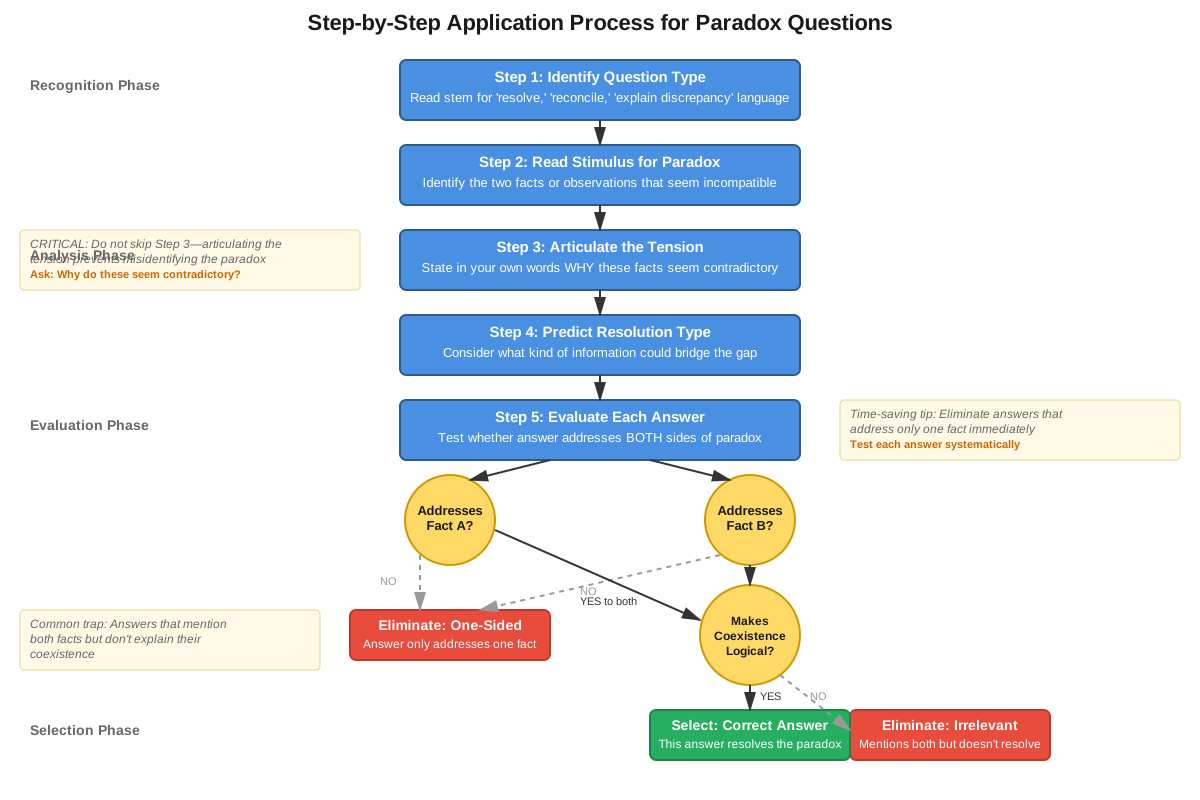
When approaching lsat resolve the paradox question stems, implement this systematic process:
Step 1: Confirm Question Type (5-10 seconds)
Read the question stem first. Look for trigger words: "resolve," "explain," "reconcile," "account for," "paradox," "discrepancy," "surprising," "unexpected." Confirm this is truly a paradox question and not a strengthen or explain question.
Step 2: Identify the Paradox (15-20 seconds)
Read the stimulus specifically looking for the contradiction or surprising result. Ask: "What two things seem incompatible?" or "What outcome contradicts normal expectations?" Mentally articulate both sides: "On one hand X, but on the other hand Y."
Step 3: Anticipate Resolution Type (5-10 seconds)
Quickly categorize: Is this statistical, behavioral, causal, or temporal? What kind of information would allow both sides to be true? Don't try to predict the exact answer, but have a sense of what type of explanation would work.
Step 4: Evaluate Answer Choices (30-40 seconds)
For each answer, ask: "If this were true, would both sides of the paradox make sense?" Eliminate:
- One-sided explanations that ignore half the paradox
- Irrelevant information unconnected to the specific contradiction
- Answers that deepen rather than resolve the paradox
- Restatements that add no new explanatory information
Step 5: Verify the Correct Answer (5-10 seconds)
Before selecting, confirm the answer allows BOTH elements to coexist. Mentally walk through: "Given this new information, X makes sense because... and Y makes sense because..."
Exam Tip: If you're stuck between two answers, identify which element of the paradox each addresses. The correct answer must account for both sides, even if implicitly.
Time Allocation: Allocate approximately 1:15-1:30 for paradox questions. They require careful reading but typically have more clearly correct answers than assumption or flaw questions once the paradox is properly identified.
Trigger Phrases to Watch For:
- "Surprisingly..." or "Unexpectedly..." in the stimulus signals the paradox
- "However," "but," "yet," "although" often introduce the contradictory element
- "Despite," "even though," "in spite of" indicate tension between elements
- Question stems with "if true" confirm you're adding new information (not making inferences)
Process of Elimination Tips:
- Eliminate any answer that makes the paradox worse or more puzzling
- Eliminate answers that address only the first or only the second element
- Eliminate answers about topics not mentioned in the stimulus
- Keep answers that introduce new variables, distinctions, or clarifications
Memory Techniques
PARADOX Mnemonic for approaching these questions:
Pinpoint the contradiction (identify both sides)
Anticipate what type of resolution would work
Read answers looking for new information
Address both sides (correct answer must reconcile both)
Distinguish from strengthen/weaken questions
One-sided answers are wrong
X-out irrelevant information quickly
The "Both-And" Visualization: Picture a scale with the two contradictory elements on opposite sides, tilted and unbalanced. The correct answer is the fulcrum or counterweight that brings the scale into balance, allowing both sides to exist simultaneously. This reinforces that you're not removing one side but finding equilibrium.
STAR Categories for paradox types:
Statistical (aggregation, sampling, measurement)
Temporal (timing, sequence, duration)
Actional/Behavioral (stated vs. revealed preferences)
Relational/Causal (expected causes don't produce expected effects)
The "Third Factor" Reminder: Most paradoxes resolve through introducing a third factor not mentioned in the stimulus. Visualize the paradox as two puzzle pieces that don't fit; the answer is the third piece that connects them.
Summary
Resolve the paradox questions are a high-frequency, high-value question type on the LSAT that test the ability to reconcile apparently contradictory information or explain surprising results. Success requires first recognizing the question type through characteristic stem language ("resolve," "explain," "reconcile," "account for"), then identifying the specific nature of the paradox in the stimulus (statistical, behavioral, causal, or temporal). The correct answer introduces new information that allows both sides of the apparent contradiction to be true simultaneously—it never eliminates one side or proves it false. Common wrong answers include one-sided explanations that address only one element, irrelevant information unconnected to the specific discrepancy, and restatements that add no explanatory value. Strategic approach involves confirming question type, articulating both sides of the paradox, anticipating the type of resolution needed, and systematically evaluating whether each answer choice allows both elements to coexist logically. These questions appear 2-4 times per test and directly test reasoning skills essential to legal practice, making them both practically important and strategically valuable for score improvement.
Key Takeaways
- Resolve the paradox question stems require identifying information that allows contradictory facts to coexist, not proving one side false
- Recognition depends on trigger words: "resolve," "explain," "reconcile," "account for," plus references to "paradox," "discrepancy," or "surprising"
- The correct answer always introduces NEW information not already present in the stimulus
- One-sided explanations that address only one element of the contradiction are the most common wrong answer type
- Statistical paradoxes often involve aggregation effects, sampling differences, or measurement changes (Simpson's Paradox)
- Behavioral paradoxes typically require distinguishing between stated preferences and revealed preferences, or identifying constraints on behavior
- Both elements of the paradox remain true in the correct answer—the resolution explains how they can coexist, not which one is false
Related Topics
Strengthen and Weaken Questions: After mastering paradox resolution, understanding how to strengthen or weaken arguments builds on similar skills of evaluating how new information affects logical relationships, though with the different goal of affecting argument validity rather than explaining contradictions.
Causal Reasoning: Paradox questions frequently involve causal relationships, so deepening understanding of causation, correlation, necessary and sufficient conditions, and alternative causes directly enhances paradox resolution skills.
Assumption Questions: While structurally different, assumption questions also require identifying missing information, though assumptions must be necessary for the argument rather than explanatory of a contradiction.
Flaw Questions: Understanding common logical flaws, particularly those involving sampling, generalization, and causal reasoning, helps identify what type of explanation might resolve statistical and causal paradoxes.
Inference Questions: These require drawing conclusions from given information rather than adding new information, but the careful reading skills developed for paradox identification transfer directly to inference questions.
Practice CTA
Now that you've mastered the conceptual framework for resolve the paradox questions, it's time to apply these skills to actual LSAT-style problems. The practice questions and flashcards will reinforce your ability to quickly recognize question stems, identify paradoxes, and evaluate answer choices systematically. Each practice question you complete strengthens the neural pathways for this question type, building both speed and accuracy. Remember: paradox questions are highly learnable—they follow predictable patterns, and with focused practice, they can become some of your most reliable points on test day. Approach each practice question strategically, and review not just which answer is correct but why the wrong answers fail to resolve the paradox. Your investment in deliberate practice now will pay dividends in your LSAT score.
Sign up free to keep reading
Create a free AnvayaPrep account to finish this LSAT guide on Resolve the paradox question stems — plus flashcards and practice questions.