Overview
Weaken question stems represent one of the most frequently tested question types in LSAT Logical Reasoning sections, appearing in approximately 4-6 questions per test. These questions assess a test-taker's ability to identify information that undermines, challenges, or casts doubt on an argument's reasoning or conclusion. Mastering lsat weaken question stems is essential because they test critical thinking skills that law schools value: the ability to spot flaws in reasoning, identify vulnerable assumptions, and evaluate the strength of evidence supporting a claim.
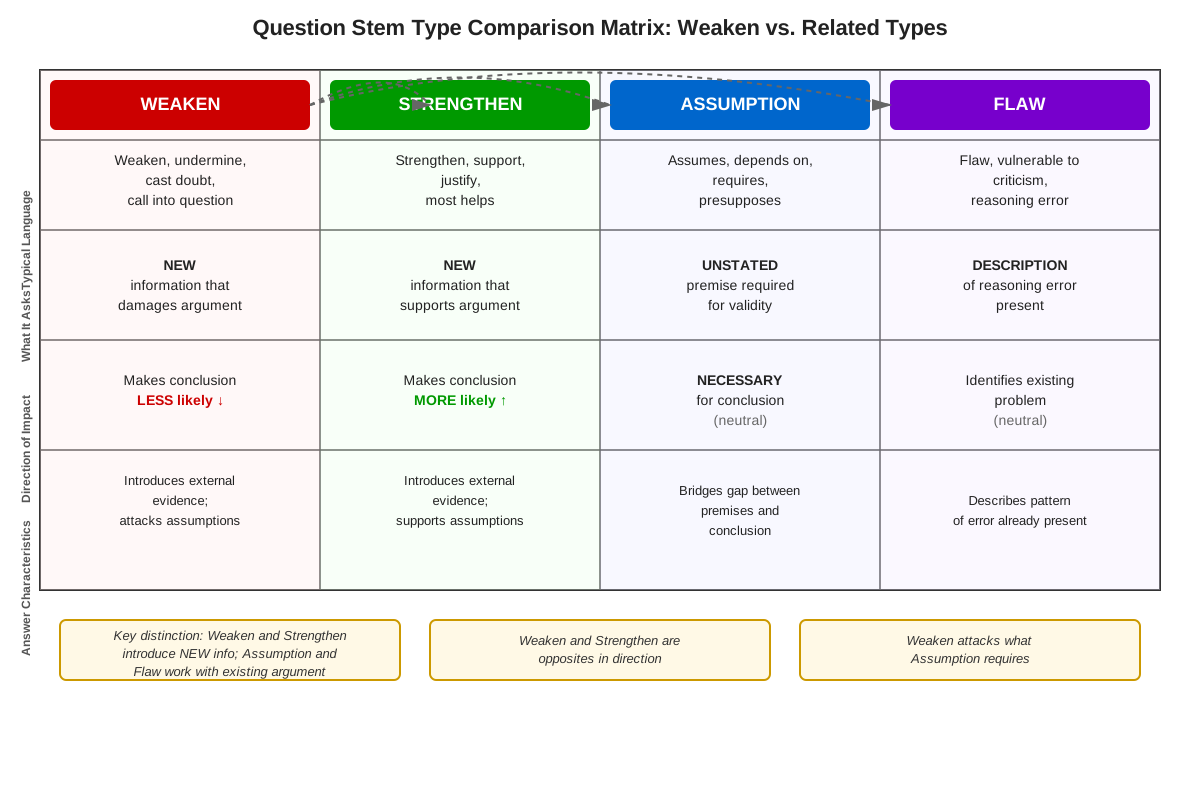
Understanding weaken questions requires recognizing that arguments on the LSAT consist of premises (evidence) and conclusions (claims based on that evidence), often connected by unstated assumptions. Weaken questions specifically ask test-takers to find answer choices that make the argument's conclusion less likely to be true or that expose problems in the reasoning connecting premises to conclusion. This differs from strengthen questions (which support the argument) or assumption questions (which identify what the argument takes for granted). The ability to distinguish weaken question stems from other question stem recognition patterns is foundational to efficient and accurate performance on the logical reasoning sections.
The strategic importance of weaken questions extends beyond their frequency. They serve as a gateway to understanding argument structure more broadly, as recognizing what weakens an argument necessarily requires understanding what the argument claims, what evidence supports it, and where gaps in reasoning exist. This makes weaken questions central to developing the analytical skills tested throughout the LSAT and essential for success in legal reasoning more generally.
Learning Objectives
- [ ] Identify how Weaken question stems appears in LSAT questions
- [ ] Explain the reasoning pattern behind Weaken question stems
- [ ] Apply Weaken question stems to solve LSAT-style problems accurately
- [ ] Distinguish weaken question stems from strengthen, assumption, and flaw question stems with 95%+ accuracy
- [ ] Predict the type of answer choice that will weaken an argument based on its structure and assumptions
- [ ] Evaluate answer choices efficiently by identifying which elements of an argument they target
Prerequisites
- Argument structure identification: Understanding premises, conclusions, and how they connect is essential because weaken questions target the relationship between evidence and claims
- Assumption recognition: Recognizing unstated assumptions helps identify where arguments are vulnerable, as weaken answers often exploit these gaps
- Conditional reasoning basics: Many weaken questions involve conditional statements, and understanding sufficient/necessary conditions aids in evaluating how new information affects arguments
- Causal reasoning fundamentals: Since many LSAT arguments make causal claims, understanding cause-and-effect relationships helps identify what would undermine such reasoning
Why This Topic Matters
Weaken questions appear with remarkable consistency on every LSAT administration, typically comprising 15-20% of all Logical Reasoning questions. This translates to approximately 8-12 questions across both LR sections on a typical test. Given that Logical Reasoning accounts for roughly 50% of the scored LSAT, mastering weaken questions can directly impact 7-10% of an overall LSAT score—potentially the difference between acceptance and rejection at competitive law schools.
Beyond test performance, weaken questions develop skills central to legal practice. Attorneys must constantly evaluate opposing arguments, identify weaknesses in reasoning, and anticipate counterarguments. The ability to spot vulnerable assumptions and recognize what evidence would undermine a position is fundamental to legal analysis, making weaken questions among the most practically relevant LSAT question types.
On the exam, weaken questions appear in several contexts. They may follow arguments about scientific studies, business decisions, policy recommendations, historical explanations, or everyday reasoning. The arguments can involve causal reasoning (X causes Y), analogical reasoning (X is like Y), statistical reasoning (sample represents population), or conditional reasoning (if X, then Y). Recognizing the argument type helps predict what kind of information would weaken it, making pattern recognition essential for efficiency under time pressure.
Core Concepts
Defining Weaken Questions
A weaken question asks test-takers to identify information that, if true, would make an argument's conclusion less likely to be true or would undermine the reasoning connecting premises to conclusion. The correct answer doesn't need to completely destroy the argument—it merely needs to make it less convincing or less probable than it was before. This is a crucial distinction: weaken answers reduce argumentative force rather than proving an argument false.
Weaken questions target the logical connection between evidence and conclusion. They exploit gaps in reasoning, challenge unstated assumptions, introduce alternative explanations, or provide counterevidence. Understanding this targeting mechanism is essential because it reveals what makes an answer choice correct: relevance to the argument's reasoning structure rather than mere contradiction of the conclusion.
Common Weaken Question Stem Formulations
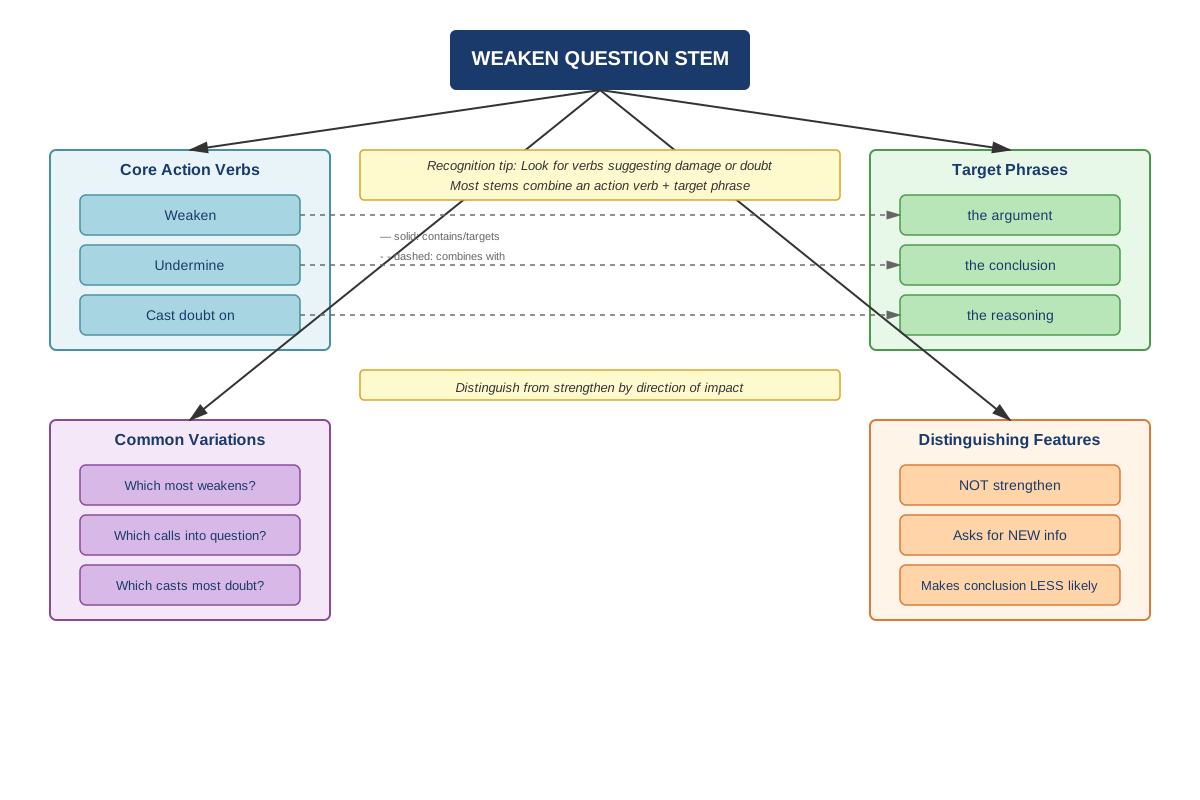
Recognizing weaken question stems requires familiarity with their various phrasings. The LSAT uses multiple formulations, all asking fundamentally the same thing:
| Question Stem Phrasing | What It's Asking |
|---|---|
| "Which one of the following, if true, most weakens the argument?" | Standard direct formulation |
| "Which one of the following, if true, most seriously undermines the conclusion?" | Emphasizes impact on conclusion |
| "Which one of the following, if true, casts the most doubt on the argument?" | Focuses on creating uncertainty |
| "Which one of the following, if true, most calls into question the reasoning above?" | Targets the logical connection |
| "Which one of the following, if true, would most weaken the support for the conclusion?" | Emphasizes evidence-conclusion link |
All these formulations share key features: they include the phrase "if true" (indicating you should accept the answer choice as factual) and they ask for what weakens, undermines, casts doubt on, or calls into question the argument. Recognizing these linguistic markers enables rapid question type identification.
The Anatomy of Arguments in Weaken Questions
To weaken an argument effectively, one must understand its structure. LSAT arguments in weaken questions typically contain:
- Background information: Context-setting facts not directly part of the reasoning
- Premises: Evidence or facts offered as support
- Conclusion: The claim the argument attempts to establish
- Unstated assumptions: Gaps between premises and conclusion that the argument takes for granted
Weaken answers typically target the unstated assumptions or introduce information that makes the conclusion less likely given the premises. For example, if an argument concludes that "Policy X will reduce crime" based on the premise that "Policy X reduced crime in City A," the unstated assumption is that conditions in City A are relevantly similar to conditions elsewhere. A weaken answer might reveal that City A had unique circumstances not present elsewhere.
Types of Weakening Strategies
Different argument structures are vulnerable to different weakening strategies:
1. Alternative Explanation Weakeners: When an argument claims X caused Y, showing that Z could have caused Y instead weakens the argument. This doesn't prove X didn't cause Y, but it makes the causal claim less certain.
2. Counterexample Weakeners: When an argument makes a general claim based on specific evidence, providing an example that contradicts the generalization weakens it. If an argument claims "all successful companies use strategy X" based on three examples, showing a successful company that doesn't use strategy X weakens the claim.
3. Assumption Attackers: These directly challenge unstated assumptions. If an argument assumes two groups are comparable, showing they differ in relevant ways weakens the argument.
4. Undermining Evidence Quality: These show that the evidence supporting the conclusion is flawed, biased, unrepresentative, or unreliable. If an argument relies on a survey, showing the survey had methodological problems weakens the argument.
5. Showing Negative Consequences: When an argument recommends an action to achieve a goal, showing the action would have counterproductive effects weakens the recommendation.
The "If True" Qualifier
Every weaken question includes the crucial phrase "if true," which instructs test-takers to accept the answer choice as factual regardless of whether it seems plausible in reality. This means:
- Don't reject answer choices because they seem unlikely or unrealistic
- Don't bring in outside knowledge to dispute answer choices
- Focus solely on the logical relationship between the answer choice and the argument
- Evaluate each answer choice as if it were an established fact
This qualifier levels the playing field among answer choices, making the question purely about logical relationships rather than real-world plausibility.
Degree of Weakening
Weaken questions typically ask for the answer that most weakens the argument. This comparative language means:
- Multiple answer choices may weaken the argument to some degree
- The correct answer weakens more than the others
- Evaluate the magnitude of impact each answer would have
- Consider whether an answer targets a central assumption or a peripheral issue
Stronger weakeners typically attack core assumptions or provide more direct counterevidence, while weaker ones address tangential issues or provide less relevant information.
Concept Relationships
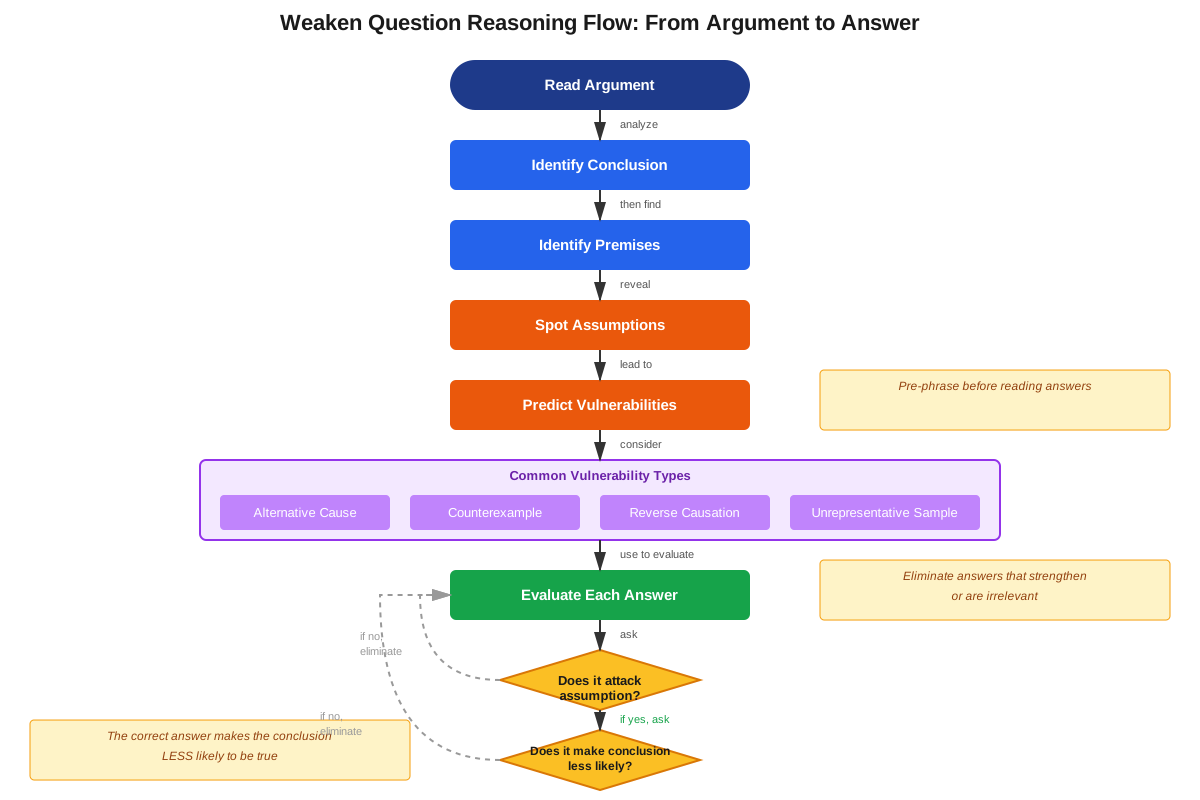
The concepts within weaken questions form an interconnected system. Question stem recognition serves as the entry point, enabling test-takers to identify that they're dealing with a weaken question. This identification triggers a specific analytical approach: identifying the argument structure (premises, conclusion, assumptions), which then reveals vulnerable points where the reasoning could be undermined. Understanding weakening strategies provides a framework for predicting what correct answers might look like, while the "if true" qualifier governs how to evaluate answer choices.
This topic connects directly to prerequisite knowledge of argument structure because one cannot weaken what one doesn't understand. It relates closely to assumption questions because assumptions represent the most vulnerable points in arguments—what an assumption question asks you to identify, a weaken question asks you to attack. The relationship to strengthen questions is inverse: what strengthens an argument is often the opposite of what weakens it, making these question types mirror images.
The progression flows: Question Stem Recognition → Argument Analysis → Assumption Identification → Prediction of Weakening Strategy → Answer Choice Evaluation. Each step depends on the previous one, creating a systematic approach to these questions.
High-Yield Facts
⭐ Weaken questions appear 4-6 times per LSAT test, making them one of the most common Logical Reasoning question types
⭐ The phrase "if true" appears in virtually all weaken question stems and means you must accept answer choices as factual
⭐ Correct weaken answers typically target unstated assumptions rather than directly contradicting stated premises
⭐ Weaken questions ask for what makes the conclusion "less likely" or "less supported"—not what proves it false
⭐ Alternative explanations are among the most common correct answers for causal reasoning arguments
- Weaken question stems use verbs like "weaken," "undermine," "cast doubt," "call into question," and "challenge"
- The correct answer doesn't need to destroy the argument completely—it only needs to weaken it more than other choices
- Answer choices that are irrelevant to the argument's reasoning cannot weaken it, regardless of how interesting they are
- Comparative language ("most weakens") indicates multiple answers may have some weakening effect
- Weaken questions test the same analytical skills as strengthen questions but in reverse
- Recognizing the argument type (causal, analogical, statistical) helps predict what kind of information would weaken it
- Time-efficient test-takers identify weaken questions within 2-3 seconds of reading the question stem
Quick check — test yourself on Weaken question stems so far.
Try Flashcards →Common Misconceptions
Misconception: The correct answer must prove the conclusion false → Correction: Weaken answers only need to make the conclusion less likely or less well-supported; they reduce the argument's strength rather than destroying it completely. An argument can be weakened while still remaining somewhat plausible.
Misconception: Any answer that contradicts something in the argument weakens it → Correction: Only information that undermines the logical connection between premises and conclusion weakens an argument. An answer choice might contradict background information or a premise while leaving the reasoning structure intact, making it irrelevant rather than weakening.
Misconception: Weaken questions and flaw questions are essentially the same → Correction: Flaw questions ask you to identify what's wrong with the reasoning as presented, while weaken questions ask what additional information would undermine the argument. Flaw questions work with what's given; weaken questions introduce new information.
Misconception: The "if true" qualifier is just formality and doesn't affect how to approach the question → Correction: The "if true" qualifier fundamentally changes the task by requiring you to accept answer choices as factual and evaluate only their logical impact. Ignoring this leads to incorrectly rejecting answers that seem implausible but would strongly weaken the argument if true.
Misconception: Weaken answers must be directly related to the conclusion → Correction: While weaken answers must be relevant to the argument's reasoning, they often work by attacking assumptions or undermining premises rather than directly addressing the conclusion. The most effective weakeners often target the connection between evidence and conclusion rather than the conclusion itself.
Misconception: Longer or more complex answer choices are more likely to be correct → Correction: Answer choice length has no correlation with correctness. The LSAT deliberately varies answer choice length and complexity to avoid patterns. Evaluate based on logical impact, not presentation.
Worked Examples
Example 1: Causal Reasoning Argument
Argument: "City officials attribute the 20% decrease in traffic accidents this year to the new traffic cameras installed at major intersections. The cameras were installed in January, and accident rates have declined steadily since then. Therefore, the traffic cameras have been effective in reducing accidents."
Question Stem: "Which of the following, if true, most weakens the argument above?"
Analysis Process:
- Identify the conclusion: The traffic cameras have been effective in reducing accidents
- Identify the premises: Cameras installed in January; accidents decreased 20% since then
- Identify the reasoning pattern: Causal reasoning (cameras caused the decrease)
- Identify unstated assumptions:
- No other factors caused the decrease
- The timing correlation indicates causation
- The decrease is attributable to the cameras specifically
- Predict weakening strategies:
- Alternative explanation (something else caused the decrease)
- Undermining the causal connection
- Showing the correlation is coincidental
Answer Choices:
(A) Traffic cameras have been shown to reduce accidents in other cities
(B) A major highway construction project that had caused traffic congestion for two years was completed in January
(C) The traffic cameras cost more than city officials initially projected
(D) Some drivers have complained about receiving tickets from the cameras
(E) The cameras were installed at only 15 of the city's 200 intersections
Evaluation:
- (A) This strengthens rather than weakens—it supports the causal claim
- (B) This provides an alternative explanation for the decrease: the construction project's completion, not the cameras, might have caused fewer accidents. This directly weakens the causal reasoning. CORRECT
- (C) Cost is irrelevant to whether the cameras reduced accidents
- (D) Complaints don't affect whether cameras reduced accidents
- (E) This might slightly weaken by suggesting limited coverage, but doesn't provide an alternative explanation or directly challenge the causal claim as strongly as (B)
Key Lesson: For causal arguments, alternative explanations are powerful weakeners. Answer choice (B) doesn't prove the cameras didn't work—it just makes that conclusion less certain by introducing another plausible cause.
Example 2: Analogical Reasoning Argument
Argument: "The new medication was highly effective in treating the disease in laboratory mice, with 85% showing complete recovery. Since the disease affects humans and mice similarly, the medication should be equally effective in human patients."
Question Stem: "Which of the following, if true, most seriously undermines the argument?"
Analysis Process:
- Identify the conclusion: The medication should be equally effective in humans
- Identify the premises: 85% of mice recovered; disease affects humans and mice similarly
- Identify the reasoning pattern: Analogical reasoning (what works in mice will work in humans)
- Identify unstated assumptions:
- Mice and humans are sufficiently similar in relevant ways
- The medication works through the same mechanism in both species
- No relevant differences exist between mouse and human physiology regarding this medication
- Predict weakening strategies:
- Show relevant differences between mice and humans
- Demonstrate the medication works differently in different species
- Provide evidence of failed translation from mice to humans
Answer Choices:
(A) The disease is more common in humans than in mice
(B) Humans metabolize the medication's active ingredient differently than mice do, rendering it inactive
(C) The study used a relatively small sample of mice
(D) Some other medications have successfully transitioned from mouse trials to human use
(E) The disease has multiple subtypes, some more severe than others
Evaluation:
- (A) Prevalence doesn't affect whether the medication works
- (B) This directly attacks the analogy by showing a crucial difference in how the species process the medication, making the conclusion that it will work equally well in humans much less likely. CORRECT
- (C) Sample size might weaken confidence in the mouse results but doesn't address the human-mouse comparison
- (D) This strengthens rather than weakens the analogical reasoning
- (E) This introduces complexity but doesn't specifically undermine the mouse-to-human inference
Key Lesson: Analogical arguments are weakened by showing relevant differences between the things being compared. The correct answer identifies a specific mechanism that breaks the analogy.
Exam Strategy
Rapid Question Stem Identification
Develop the habit of reading question stems before reading the argument. Look for the key markers:
- "If true" phrase (present in virtually all weaken questions)
- Weakening verbs: weaken, undermine, cast doubt, call into question, challenge
- Comparative language: "most" weakens/undermines
When you spot these elements, immediately shift into "weaken mode": you'll be looking for vulnerable assumptions and predicting what could undermine the reasoning.
Systematic Argument Analysis
Before looking at answer choices:
- Identify the conclusion (usually signaled by "therefore," "thus," "so," or "consequently")
- Identify the premises (evidence offered in support)
- Identify the reasoning pattern (causal, analogical, statistical, etc.)
- Articulate the gap (what assumption connects premises to conclusion?)
This process takes 20-30 seconds but dramatically improves accuracy and speed in answer choice evaluation.
Prediction Before Evaluation
After analyzing the argument, spend 5-10 seconds predicting what a correct answer might do:
- "This argument assumes X and Y are comparable, so an answer showing they differ would weaken it"
- "This causal claim could be weakened by an alternative explanation"
- "This generalization could be weakened by a counterexample"
Even if your prediction doesn't match any answer exactly, it focuses your evaluation on relevant considerations.
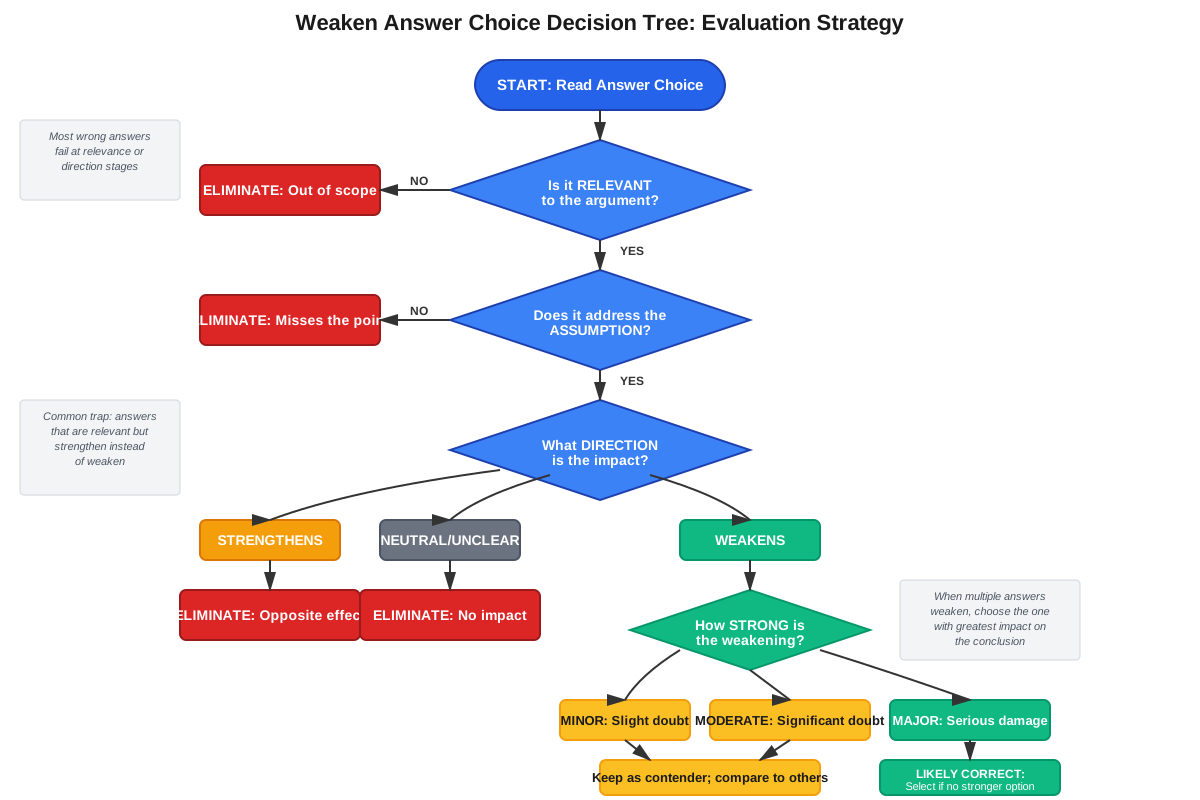
Answer Choice Evaluation Process
Evaluate each answer choice by asking:
- Is this relevant to the argument's reasoning? (If no, eliminate immediately)
- Does this make the conclusion more or less likely? (Less likely = potential weakener)
- What part of the argument does this affect? (Assumptions, premises, reasoning structure)
- How strong is the weakening effect? (Compare among choices that weaken)
Exam Tip: Wrong answers in weaken questions often strengthen the argument, are irrelevant to the reasoning, or address the wrong conclusion. Actively eliminate these categories.
Time Management
Allocate approximately:
- 20-30 seconds: Reading and analyzing the argument
- 5-10 seconds: Predicting weakening strategy
- 30-40 seconds: Evaluating answer choices
- Total: 60-80 seconds per weaken question
If you exceed 90 seconds, make your best choice and move on. Weaken questions shouldn't consume disproportionate time despite their importance.
Common Trap Patterns
Be alert for these recurring wrong answer types:
- Strengtheners disguised as weakeners: Read carefully to ensure the answer weakens rather than supports
- Irrelevant information: Interesting facts that don't affect the argument's reasoning
- Opposite conclusion: Answers that address a different conclusion than the one actually drawn
- Premise contradictions: Answers that contradict premises without affecting the reasoning structure
Memory Techniques
The WEAKEN Acronym
What's the conclusion?
Evidence provided (premises)?
Assumptions unstated?
Kind of reasoning (causal, analogical, etc.)?
Evaluate what would undermine it
Narrow to the strongest weakener
This provides a systematic approach to every weaken question.
The "If True" Reminder
Visualize a stamp that says "ACCEPT AS FACT" appearing on each answer choice. This mental image reinforces that you must evaluate logical impact, not real-world plausibility.
The Three A's of Weakening
Alternative explanations (for causal arguments)
Analogy breakers (for analogical arguments)
Assumption attackers (for all arguments)
This helps predict what correct answers might do based on argument type.
Visualization Strategy
Picture the argument as a bridge connecting premises (one side) to conclusion (other side), with assumptions as the support structure underneath. Weaken answers either:
- Introduce an alternative bridge (alternative explanation)
- Show the support structure is faulty (attack assumptions)
- Demonstrate the bridge doesn't reach the conclusion (undermine reasoning)
This spatial metaphor makes abstract logical relationships more concrete and memorable.
Summary
Weaken question stems represent a high-frequency, high-value question type on the LSAT Logical Reasoning sections, appearing 4-6 times per test and testing essential critical thinking skills. These questions ask test-takers to identify information that, if true, would make an argument's conclusion less likely or would undermine the reasoning connecting premises to conclusion. Recognizing weaken questions requires identifying key linguistic markers: the "if true" qualifier and weakening verbs like "weaken," "undermine," or "cast doubt." Success requires systematic argument analysis—identifying conclusions, premises, reasoning patterns, and unstated assumptions—followed by predicting what would undermine the argument and evaluating answer choices based on their logical impact rather than real-world plausibility. The most effective weaken answers typically target unstated assumptions, provide alternative explanations for causal claims, or break analogies by showing relevant differences. Mastering weaken questions requires understanding that correct answers need only reduce argumentative force, not prove conclusions false, and that the "most" weakening answer may be one among several that have some weakening effect.
Key Takeaways
- Weaken questions are identified by "if true" language and verbs like "weaken," "undermine," or "cast doubt," appearing 4-6 times per LSAT test
- Correct answers make conclusions less likely or undermine reasoning without needing to prove arguments completely false
- The "if true" qualifier requires accepting answer choices as factual and evaluating only their logical impact on the argument
- Unstated assumptions represent the most vulnerable points in arguments and are frequently targeted by correct weaken answers
- Alternative explanations effectively weaken causal arguments; relevant differences effectively weaken analogical arguments
- Systematic analysis—identifying conclusion, premises, reasoning pattern, and assumptions—is essential before evaluating answer choices
- Irrelevant information, strengtheners, and premise contradictions are common wrong answer types to actively eliminate
Related Topics
Strengthen Questions: The mirror image of weaken questions, asking what would make arguments more convincing; mastering weaken questions provides immediate insight into strengthen questions by understanding the inverse relationship.
Assumption Questions: These identify what arguments take for granted; since weaken answers often attack assumptions, mastering assumption identification directly improves weaken question performance.
Flaw Questions: These identify errors in reasoning as presented; understanding common flaws helps predict what external information would weaken arguments containing those flaws.
Evaluate Questions: These ask what information would be most useful in assessing an argument; understanding what weakens and strengthens arguments is essential for identifying relevant evaluation criteria.
Causal Reasoning: A specific reasoning pattern frequently tested in weaken questions; deeper study of causal reasoning improves ability to identify alternative explanations and correlation-causation issues.
Practice CTA
Now that you understand the structure, strategy, and common patterns of weaken question stems, it's time to apply this knowledge. Attempt the practice questions to reinforce your ability to identify weaken questions rapidly, analyze arguments systematically, and evaluate answer choices effectively. The flashcards will help cement the key concepts and recognition patterns. Remember: weaken questions are highly learnable through deliberate practice. Each question you work through strengthens your pattern recognition and analytical skills, building toward mastery of one of the LSAT's most important and frequent question types. Your investment in understanding these questions will pay dividends throughout the Logical Reasoning sections and beyond.
Sign up free to keep reading
Create a free AnvayaPrep account to finish this LSAT guide on Weaken question stems — plus flashcards and practice questions.