Overview
Weaken versus flaw stems represent two of the most frequently tested question types in LSAT Logical Reasoning sections, yet they are commonly confused by test-takers due to their superficial similarities. Both question types require critical analysis of arguments, but they demand fundamentally different analytical approaches and test distinct reasoning skills. Weaken questions ask test-takers to identify new information that would undermine an argument's conclusion, while flaw questions require recognition of inherent logical errors already present within the argument itself. Understanding this crucial distinction is essential for accurate question stem recognition and optimal performance on test day.
The ability to distinguish between these question types impacts not only accuracy but also efficiency. Misidentifying a weaken question as a flaw question (or vice versa) leads to wasted time, confusion, and incorrect answers. Weaken questions constitute approximately 10-12% of all Logical Reasoning questions, while flaw questions account for another 12-15%, making these two categories collectively responsible for nearly a quarter of all Logical Reasoning points. Mastering the distinction between lsat weaken versus flaw stems is therefore a high-yield investment of study time.
Within the broader landscape of Logical Reasoning, both question types belong to the "argument evaluation" family, which also includes strengthen, assumption, and evaluate questions. All these question types require understanding argument structure—identifying premises, conclusions, and the logical connections between them. However, weaken and flaw questions specifically focus on argument weaknesses, making them natural complements to one another. Students who master the distinction between these stems develop sharper analytical skills that transfer to other question types, particularly assumption questions, which often serve as the bridge between weaken and flaw reasoning.
Learning Objectives
- [ ] Identify how weaken versus flaw stems appears in LSAT questions by recognizing distinctive language patterns in question stems
- [ ] Explain the reasoning pattern behind weaken versus flaw stems, including the fundamental difference between introducing external information versus identifying internal logical errors
- [ ] Apply weaken versus flaw stems to solve LSAT-style problems accurately by selecting appropriate answer choices based on question type
- [ ] Distinguish between valid and invalid answer choices for each question type based on whether they introduce new information or identify existing flaws
- [ ] Predict common wrong answer traps specific to each question type and develop strategies to avoid them
- [ ] Analyze argument structure efficiently to determine which elements are relevant for weaken versus flaw questions
Prerequisites
- Argument structure identification: Understanding how to identify premises, conclusions, and intermediate conclusions is essential because both question types require analyzing how an argument's components relate to one another.
- Basic logical reasoning concepts: Familiarity with common reasoning patterns (causal reasoning, conditional logic, analogical reasoning) is necessary because flaws often exploit these patterns, and effective weakeners target them.
- Conditional logic fundamentals: Knowledge of sufficient and necessary conditions helps recognize when arguments confuse these relationships, a common flaw type, and when new information disrupts conditional chains.
- Causal reasoning principles: Understanding correlation versus causation distinctions is critical because many weaken questions introduce alternative causes, and many flaw questions identify unwarranted causal assumptions.
Why This Topic Matters
In legal practice, attorneys must both identify weaknesses in opposing arguments (analogous to weaken questions) and recognize logical fallacies in reasoning (analogous to flaw questions). Law schools value these distinct but complementary skills because effective legal analysis requires both evaluating external evidence and identifying internal logical inconsistencies. The LSAT tests these skills to predict success in legal education, where students must critique judicial opinions, construct counterarguments, and identify reasoning errors in legal briefs.
On the LSAT, weaken and flaw questions collectively appear 8-12 times per test across both Logical Reasoning sections, representing approximately 22-27% of all Logical Reasoning questions. This frequency makes them among the highest-yield question types for focused study. Weaken questions typically appear 4-6 times per test, while flaw questions appear 5-7 times. Both question types appear throughout each section, though flaw questions tend to cluster slightly more in the first half of sections.
These question types manifest in diverse contexts. Weaken questions often involve scientific studies, policy proposals, business decisions, and historical explanations, asking test-takers to identify evidence that challenges the argument's reasoning. Flaw questions frequently present arguments about causation, sampling, analogies, and conditional reasoning, requiring identification of the specific logical error committed. Both question types can appear with varying difficulty levels, from straightforward single-flaw arguments to complex multi-layered reasoning chains requiring sophisticated analysis.
Core Concepts
Defining Weaken Questions
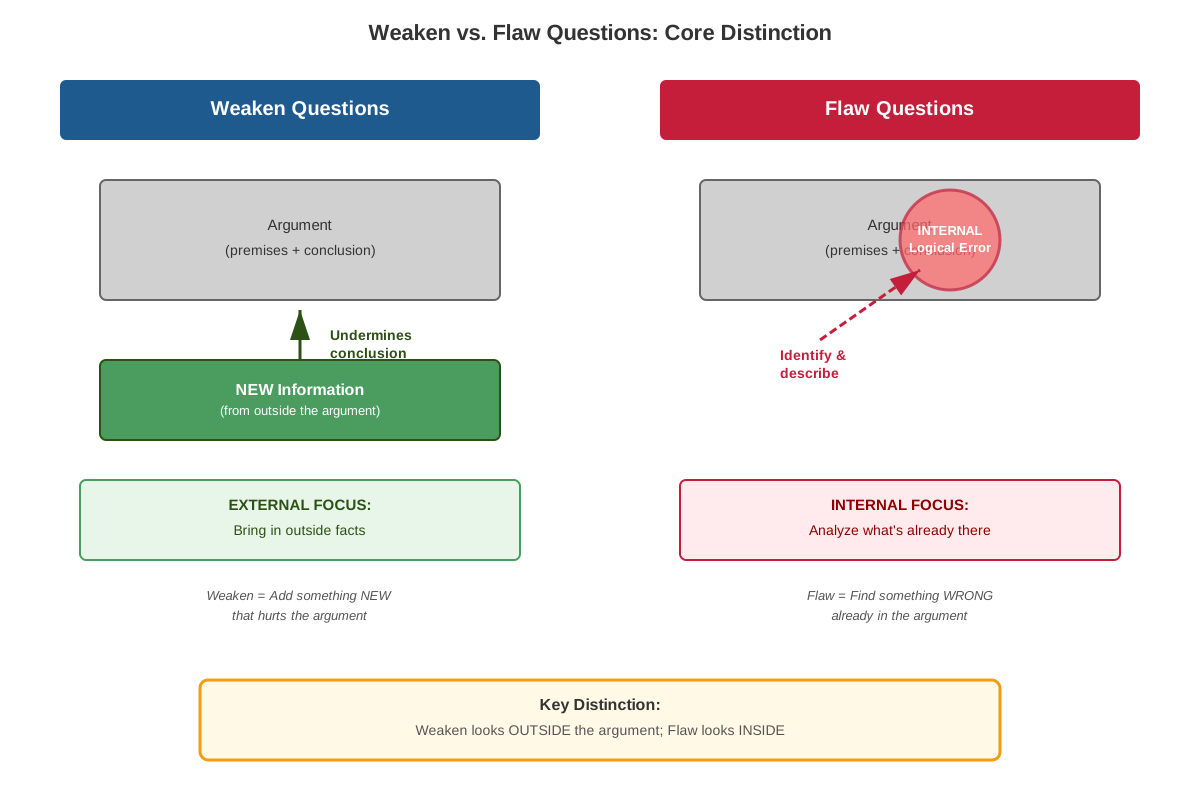
Weaken questions ask test-takers to identify answer choices that introduce new information making an argument's conclusion less likely to be true. The key characteristic of weaken questions is that they require bringing in external evidence, facts, or considerations not present in the original argument. The correct answer to a weaken question adds something new that undermines the logical connection between the premises and conclusion.
Weaken questions operate on the principle that arguments can be sound based on the information provided but vulnerable to additional evidence. The test-taker's task is to identify which new piece of information most damages the argument's reasoning. This does not require proving the conclusion false—merely making it less probable or less well-supported than it initially appeared.
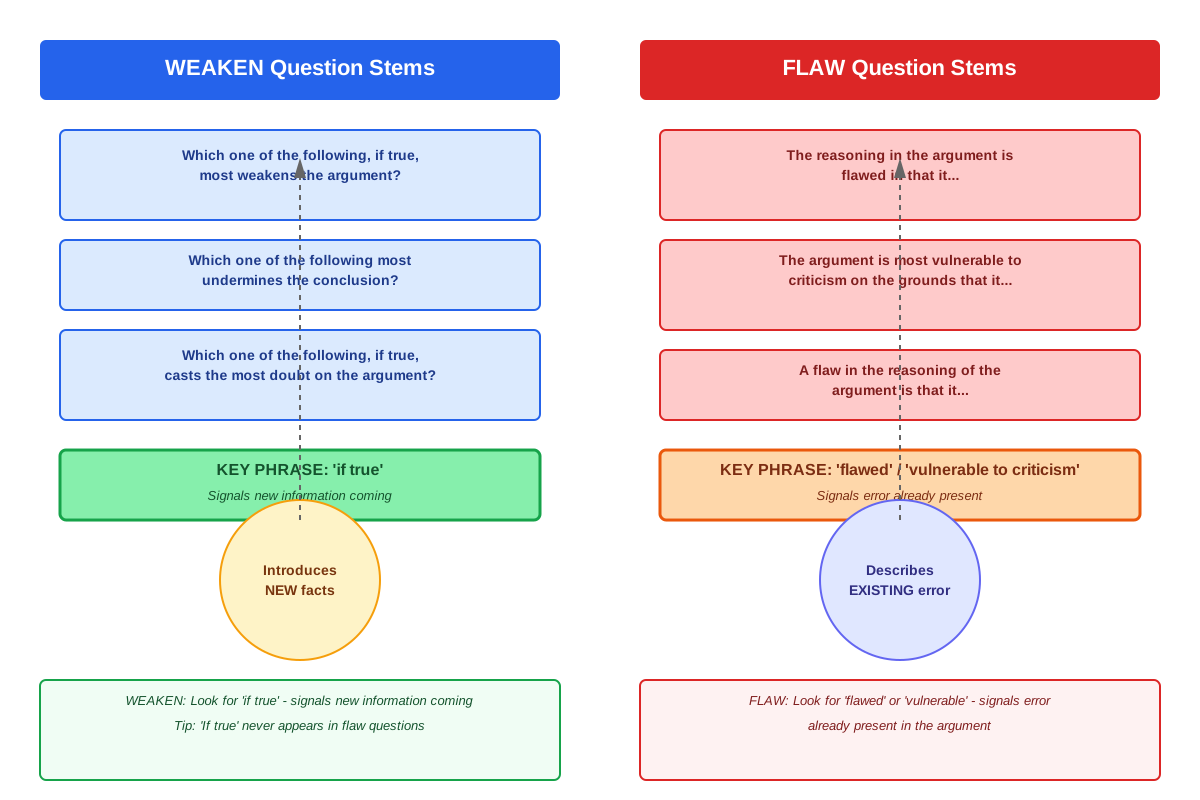
Common weaken question stems include:
- "Which one of the following, if true, most weakens the argument?"
- "Which one of the following, if true, most seriously undermines the conclusion?"
- "Which one of the following, if true, casts the most doubt on the argument?"
- "Which one of the following, if true, would most call into question the claim that...?"
Defining Flaw Questions
Flaw questions ask test-takers to identify the logical error already present within the argument as written. Unlike weaken questions, flaw questions do not involve introducing new information. Instead, they require recognizing what is wrong with the reasoning based solely on what the argument already contains. The correct answer describes the specific logical misstep the argument commits.
Flaw questions test the ability to recognize common reasoning errors: unwarranted assumptions, scope shifts, sampling problems, causal fallacies, and conditional logic errors. The argument itself is inherently flawed—the test-taker must identify and articulate that flaw. This requires understanding not just what the argument says, but what it assumes without justification.
Common flaw question stems include:
- "The reasoning in the argument is flawed in that the argument..."
- "The argument is most vulnerable to criticism on the grounds that it..."
- "A flaw in the argument is that it..."
- "The reasoning above is questionable because it..."
- "The argument is flawed in that it takes for granted that..."
The Fundamental Distinction
The core difference between these question types lies in information source. Weaken questions require external information (the "if true" clause signals this), while flaw questions require internal analysis (no new information is introduced). This distinction determines both how to approach the argument and what makes an answer choice correct.
| Feature | Weaken Questions | Flaw Questions |
|---|---|---|
| Information Source | External (new facts) | Internal (existing reasoning) |
| Question Stem Indicator | "If true" language | No "if true" language |
| Task | Find evidence against conclusion | Identify logical error |
| Correct Answer | Introduces new undermining fact | Describes existing flaw |
| Argument Quality | May be internally sound | Contains inherent error |
| Focus | What could challenge this? | What's wrong with this? |
Recognizing Question Stem Language
Question stem recognition is the critical first step in approaching these questions correctly. Certain linguistic markers reliably distinguish weaken from flaw questions:
Weaken stem markers:
- "If true" (the most reliable indicator)
- "If feasible"
- "If correct"
- "Assuming that"
- Action verbs: "weakens," "undermines," "casts doubt," "calls into question," "challenges"
Flaw stem markers:
- "Flawed" or "flaw"
- "Vulnerable to criticism"
- "Questionable"
- "Takes for granted"
- "Fails to consider"
- "Overlooks the possibility"
- Descriptive rather than conditional language
Analyzing Arguments for Each Question Type
When approaching a weaken question, focus on:
- The conclusion (what needs to be weakened)
- The evidence provided (what supports the conclusion)
- The logical gap (unstated assumptions connecting evidence to conclusion)
- Potential vulnerabilities (where new information could damage the reasoning)
When approaching a flaw question, focus on:
- The conclusion (what the argument claims)
- The premises (what evidence is offered)
- The logical connection (how premises supposedly support the conclusion)
- The reasoning error (what assumption is unwarranted or what logical principle is violated)
Common Flaw Types
Understanding common flaw categories helps identify errors quickly:
- Causal flaws: Assuming causation from correlation, ignoring alternative causes, reversing cause and effect
- Sampling flaws: Generalizing from unrepresentative samples, assuming part represents whole
- Conditional logic flaws: Confusing sufficient and necessary conditions, affirming the consequent, denying the antecedent
- Comparison flaws: Assuming comparability without justification, overlooking relevant differences
- Scope shifts: Conclusion addresses different subject than premises, equivocation on key terms
- Circular reasoning: Conclusion restates premises without adding support
- Ad hominem: Attacking source rather than addressing argument
- False dichotomy: Assuming only two options exist when others are possible
Common Weakening Strategies
Effective weaken answers typically employ these strategies:
- Introduce alternative explanations: Provide different causes for observed effects
- Challenge representativeness: Show sample or example is atypical
- Identify relevant differences: Highlight distinctions that undermine analogies or comparisons
- Present counterexamples: Offer cases where premises are true but conclusion false
- Undermine assumptions: Provide evidence against unstated assumptions
- Question methodology: Reveal problems with how evidence was gathered or interpreted
Concept Relationships
The distinction between weaken and flaw questions connects directly to the broader concept of argument evaluation in Logical Reasoning. Both question types require understanding argument structure (premises → conclusion), but they diverge in their analytical approach. Flaw questions → identify internal logical errors → which often reveal unstated assumptions → which weaken questions can then target with external evidence. This relationship means that understanding common flaws helps predict what would weaken an argument.
The connection to assumption questions is particularly strong. Assumptions are unstated premises necessary for an argument's reasoning. Flaw questions often identify unwarranted assumptions (internal analysis), while weaken questions introduce evidence showing those assumptions are false (external evidence). For example, if an argument assumes "no alternative causes exist" (a flaw), a weaken answer might provide an alternative cause (external evidence).
Both question types also relate to strengthen questions, which are the mirror image of weaken questions. If you can identify what would weaken an argument, you can often identify what would strengthen it by considering the opposite. Similarly, understanding flaws helps with method of reasoning questions, which ask how arguments proceed—often by committing the very flaws tested in flaw questions.
The prerequisite knowledge of causal reasoning and conditional logic directly enables success on both question types. Many flaw questions identify causal or conditional reasoning errors, while many weaken questions introduce information that disrupts causal chains or conditional relationships. Mastering these foundational concepts is therefore essential for both question types.
High-Yield Facts
⭐ Weaken questions always include "if true" or similar conditional language; flaw questions never do.
⭐ Flaw questions require identifying errors already in the argument; weaken questions require introducing new information.
⭐ The correct answer to a weaken question must be assumed true and must make the conclusion less likely.
⭐ The correct answer to a flaw question must accurately describe a logical error the argument actually commits.
⭐ Weaken questions can target sound arguments that are vulnerable to new evidence; flaw questions only appear with flawed arguments.
- Weaken and flaw questions collectively account for approximately 22-27% of all Logical Reasoning questions.
- Common wrong answers in weaken questions strengthen the argument or are irrelevant to the conclusion.
- Common wrong answers in flaw questions describe errors the argument does not commit or are too vague.
- Causal reasoning is the most frequently tested reasoning pattern in both question types.
- Weaken questions often introduce alternative explanations, counterexamples, or challenges to representativeness.
- The most common flaw types are causal flaws, sampling flaws, and conditional logic flaws.
- Scope shifts between premises and conclusion are frequent flaws that test-takers often miss.
- Weaken answers need only make the conclusion less likely, not prove it false.
- Flaw answers must be specific enough to describe the actual error, not just generally criticize the argument.
- Both question types require identifying the conclusion first, as it is the target of analysis.
Quick check — test yourself on Weaken versus flaw stems so far.
Try Flashcards →Common Misconceptions
Misconception: Weaken questions require proving the conclusion false. → Correction: Weaken questions only require making the conclusion less likely or less well-supported. The conclusion could still be true even after the weakening information is considered; it simply becomes less probable or less justified based on the evidence.
Misconception: Flaw questions allow introducing new information to show what's wrong with the argument. → Correction: Flaw questions require identifying errors based solely on what the argument already contains. The flaw must be present in the reasoning as written, not something that could be wrong if additional information were considered.
Misconception: Any criticism of an argument is a valid flaw answer. → Correction: Flaw answers must specifically describe the logical error the argument commits. Vague criticisms like "the argument is poorly reasoned" or criticisms of errors the argument does not actually make are incorrect, even if they sound sophisticated.
Misconception: Weaken and flaw questions are essentially the same because both deal with argument weaknesses. → Correction: While both involve argument weaknesses, they test fundamentally different skills. Weaken questions test the ability to evaluate external evidence against an argument, while flaw questions test the ability to identify internal logical errors. Confusing these leads to selecting wrong answer types.
Misconception: The "if true" language in weaken questions means you should question whether the answer choice is actually true. → Correction: The "if true" instruction means you must accept the answer choice as factually accurate and then determine whether it weakens the argument. Do not reject answer choices because they seem implausible; assume they are true and evaluate their impact.
Misconception: Flaw questions require finding the most serious or devastating flaw. → Correction: Flaw questions require finding the flaw the argument actually commits. An argument might have only a minor flaw, but if that's the flaw present, it's the correct answer. The severity of the flaw is less important than accurately identifying what logical error occurs.
Misconception: Strengthen answers are always wrong in weaken questions. → Correction: While strengthen answers are indeed wrong in weaken questions, not every wrong answer strengthens. Many wrong answers are simply irrelevant or address the wrong conclusion. Focus on finding what weakens rather than eliminating what strengthens.
Worked Examples
Example 1: Distinguishing Question Types
Passage: "City officials claim that the new traffic cameras have improved safety because traffic accidents decreased by 15% in the year after the cameras were installed. Therefore, the cameras should be installed at additional intersections throughout the city."
Question A: "Which one of the following, if true, most weakens the argument?"
Question B: "The reasoning in the argument is flawed in that it..."
Analysis:
For Question A (Weaken), we need to identify the question type first. The presence of "if true" immediately signals a weaken question. We need external information that makes the conclusion (cameras should be installed elsewhere) less likely to be justified.
The argument's reasoning: Accidents decreased 15% after cameras installed → cameras caused the decrease → cameras should be installed elsewhere.
Potential weakeners might:
- Provide alternative explanations for the accident decrease
- Show the decrease was not due to cameras
- Indicate the cameras wouldn't work elsewhere
- Reveal problems with the data or comparison
A strong weaken answer might be: "Traffic accidents decreased by 20% citywide during the same period, including at intersections without cameras." This introduces new information showing the decrease wasn't specifically due to cameras, undermining the causal reasoning.
For Question B (Flaw), we need to identify what's wrong with the reasoning as written, without introducing new information.
The argument assumes that correlation (cameras installed, accidents decreased) means causation (cameras caused the decrease). It also assumes conditions at the initial intersections are representative of other intersections.
A correct flaw answer might be: "takes for granted that the decrease in accidents was caused by the cameras rather than by other factors." This describes the causal reasoning error already present in the argument.
Key distinction: The weaken question requires introducing the specific fact about citywide decreases. The flaw question requires recognizing the causal assumption error without needing that external information.
Example 2: Full Problem Analysis
Argument: "Archaeologist: The pottery shards found at the northern site are nearly identical to those found at the southern site. Since the southern site dates to 300 BCE, the northern site must also date to approximately 300 BCE."
Question: "The archaeologist's reasoning is most vulnerable to criticism on the grounds that it..."
Step 1: Identify question type
"Vulnerable to criticism" + "on the grounds that it" = flaw question. No "if true" language. We need to identify the logical error in the reasoning as presented.
Step 2: Identify argument structure
- Premise: Pottery shards at northern and southern sites are nearly identical
- Premise: Southern site dates to 300 BCE
- Conclusion: Northern site dates to approximately 300 BCE
Step 3: Identify the reasoning pattern
This is analogical reasoning: two things are similar in one respect (pottery style), therefore similar in another respect (date).
Step 4: Identify the flaw
The argument assumes that similar pottery means similar dates. But pottery styles can persist across long time periods, or similar styles can develop independently. The argument fails to consider that similarity in pottery doesn't necessarily indicate similarity in date.
Step 5: Predict correct answer
The answer should describe this unwarranted assumption about what pottery similarity indicates. It might say something like: "presumes, without providing justification, that similarity in pottery style is sufficient to establish similarity in date."
Wrong answer types to avoid:
- Answers describing flaws the argument doesn't commit (e.g., "relies on the testimony of biased experts" when no experts are mentioned)
- Answers that are too vague (e.g., "relies on questionable evidence")
- Answers that would weaken the argument with new information rather than describing the existing flaw
Correct answer: "fails to consider that pottery styles may have remained consistent over an extended period"
This accurately describes the logical gap: the argument doesn't justify why similar pottery means similar dates, overlooking the possibility that the style persisted across different time periods.
Exam Strategy
Initial Approach
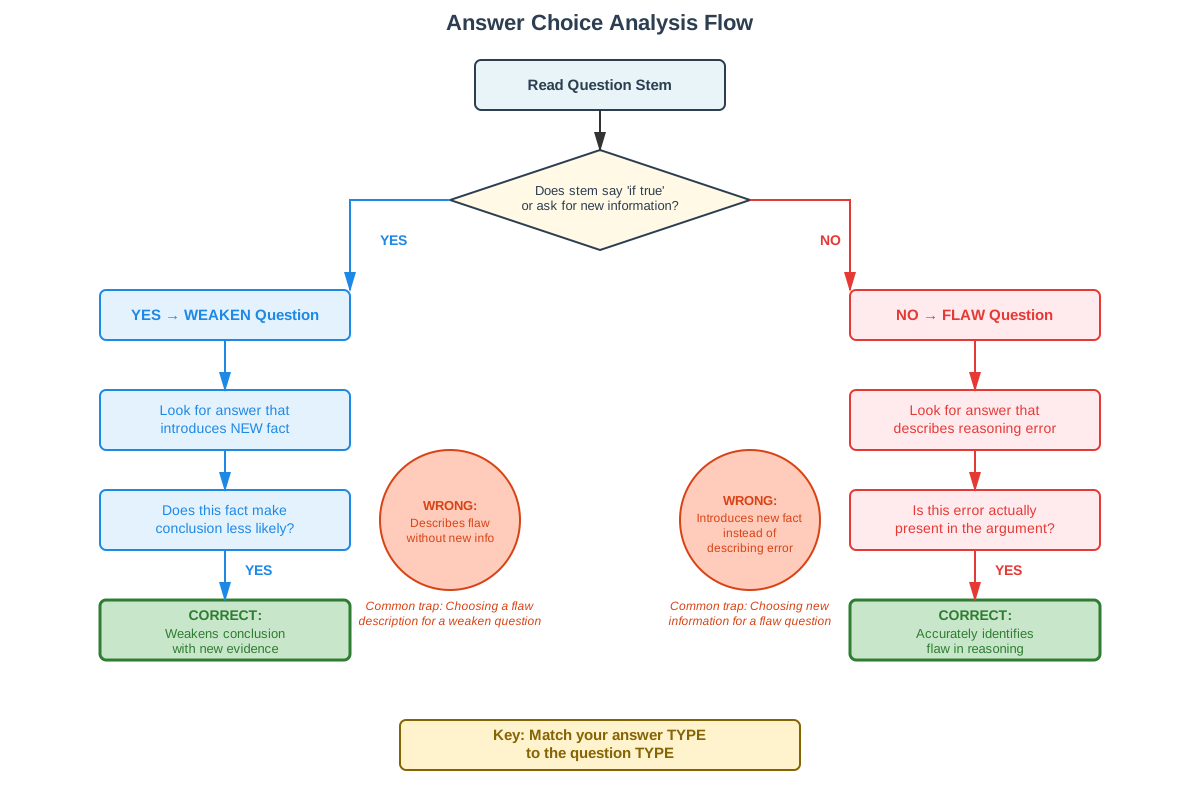
When encountering any Logical Reasoning question, read the question stem first to identify the question type before reading the argument. This allows you to read the argument with the correct analytical framework. For weaken versus flaw identification, look immediately for "if true" language (weaken) or "flaw/vulnerable/questionable" language (flaw).
Reading the Argument
For weaken questions, read actively for:
- The conclusion (what you need to weaken)
- The evidence (what supports it)
- Gaps in reasoning (where new information could damage the connection)
- Scope of the conclusion (exactly what is being claimed)
For flaw questions, read actively for:
- The conclusion (what is being claimed)
- The premises (what evidence is offered)
- The logical connection (how premises supposedly support conclusion)
- Reasoning patterns (causal, conditional, analogical, etc.)
- Unwarranted assumptions (what must be true for the reasoning to work)
Trigger Words and Phrases
Weaken question triggers:
- "If true" (most reliable)
- "Weakens," "undermines," "casts doubt," "calls into question"
- "Most seriously challenges"
- "Provides the strongest grounds for doubting"
Flaw question triggers:
- "Flaw," "flawed"
- "Vulnerable to criticism"
- "Questionable"
- "Takes for granted," "presumes," "assumes"
- "Fails to consider," "overlooks," "neglects"
Process of Elimination
For weaken questions, eliminate:
- Answers that strengthen the argument
- Answers that are irrelevant to the conclusion
- Answers that address a different conclusion than the one stated
- Answers that are too weak to significantly impact the reasoning
For flaw questions, eliminate:
- Answers describing flaws the argument doesn't commit
- Answers that are too vague or generic
- Answers that would require new information to identify
- Answers that criticize the conclusion rather than the reasoning
Time Allocation
Both question types typically require 1:15-1:30 per question. Spend:
- 10-15 seconds reading and identifying the question stem
- 30-40 seconds reading and analyzing the argument
- 30-40 seconds evaluating answer choices
If you're stuck between two answers, return to the argument and verify which answer actually accomplishes the task (weakens or describes the flaw). Don't rely on intuition—verify against the text.
Common Traps
Weaken questions: Watch for answers that seem relevant but don't actually weaken the specific conclusion stated. Also beware of answers that weaken a premise rather than the conclusion—you must accept premises as true.
Flaw questions: Watch for answers that describe what the argument "fails to establish" when the question asks what it "takes for granted." These are related but distinct—one describes what's missing, the other describes what's assumed.
Memory Techniques
The "IF-TRUE" Mnemonic
IF-TRUE = Introduce Facts That Reduce Understanding of Evidence
If you see "if true" in the question stem, you're introducing new facts to reduce how well the evidence supports the conclusion. This reminds you that weaken questions require external information.
The "FLAW" Acronym
Find Logical Assumptions Within
Flaw questions require finding logical problems within the argument as written, not introducing new information.
Visual Distinction
Imagine weaken questions as arrows pointing INTO the argument (bringing new information in), while flaw questions are magnifying glasses OVER the argument (examining what's already there).
The "Already There" Test
When unsure whether a question is weaken or flaw, ask: "Is the answer I'm looking for already there in the argument, or do I need to bring something new?" Already there = flaw. Need something new = weaken.
Common Flaw Categories: "CASC-SF"
Causal errors
Assumption problems
Sampling issues
Conditional logic mistakes
Scope shifts
False dichotomies
This acronym helps recall the most common flaw types to look for in flaw questions.
Summary
Weaken versus flaw stems represent a critical distinction in LSAT Logical Reasoning that directly impacts both accuracy and efficiency. Weaken questions require identifying external information that makes an argument's conclusion less likely, always signaled by "if true" or similar conditional language. Flaw questions require identifying logical errors already present within the argument's reasoning, signaled by language about flaws, vulnerabilities, or questionable reasoning. The fundamental difference lies in information source: weaken questions introduce new evidence, while flaw questions analyze existing reasoning. Mastering this distinction requires recognizing question stem language patterns, understanding common flaw types and weakening strategies, and applying the appropriate analytical framework to each question type. Success depends on immediately identifying which question type you're facing, reading the argument with the correct focus, and selecting answers that accomplish the specific task required—either introducing undermining evidence or describing existing logical errors.
Key Takeaways
- Question stem language is determinative: "If true" always signals weaken; "flaw/vulnerable/questionable" signals flaw questions
- Information source distinguishes the types: Weaken questions require external information; flaw questions require internal analysis
- Both question types are high-yield: Together they account for approximately 22-27% of Logical Reasoning questions
- Different analytical frameworks apply: Weaken questions focus on what could challenge the argument; flaw questions focus on what's wrong with the reasoning
- Common patterns exist: Causal reasoning, sampling, and conditional logic are frequently tested in both question types
- Precision matters: Weaken answers must actually weaken the specific conclusion; flaw answers must accurately describe the actual error committed
- Mastery transfers: Understanding these question types improves performance on assumption, strengthen, and evaluate questions
Related Topics
Strengthen Questions: The mirror image of weaken questions, requiring identification of information that makes conclusions more likely. Mastering weaken versus flaw stems provides the foundation for understanding strengthen questions, as the same argument structures appear with reversed tasks.
Assumption Questions: These questions identify unstated premises necessary for arguments to work. Understanding flaw questions (which often identify unwarranted assumptions) and weaken questions (which often target assumptions) directly enables success on assumption questions.
Evaluate Questions: These questions ask what information would be most useful in assessing an argument's strength. Success requires understanding both what would weaken and what would strengthen arguments, making weaken versus flaw mastery essential preparation.
Method of Reasoning Questions: These questions ask how arguments proceed or what role specific statements play. Many arguments proceed by committing the flaws tested in flaw questions, making flaw recognition valuable for method questions.
Parallel Reasoning Questions: These questions require matching argument structures. Understanding common flaw patterns helps identify structural similarities between arguments, as flawed reasoning patterns often appear in parallel reasoning questions.
Practice CTA
Now that you understand the critical distinction between weaken and flaw question stems, it's time to apply this knowledge. Attempt the practice questions to test your ability to identify question types, analyze arguments appropriately, and select correct answers. Use the flashcards to reinforce question stem recognition and common flaw patterns. Remember: the difference between these question types is not subtle—it's fundamental. With focused practice, you'll develop the automatic recognition that leads to consistent accuracy and improved timing. Every practice question is an opportunity to strengthen your command of these high-yield question types. Start practicing now to transform this knowledge into test-day performance.
Sign up free to keep reading
Create a free AnvayaPrep account to finish this LSAT guide on Weaken versus flaw stems — plus flashcards and practice questions.