Overview
Reference questions are a fundamental question type within LSAT reading comprehension that test a student's ability to locate and understand specific information explicitly stated in the passage. These questions ask test-takers to identify what the author or passage directly says about a particular concept, person, event, or idea. Unlike inference questions that require drawing conclusions beyond the text, reference questions demand precise textual support—the answer must be directly stated or paraphrased from the passage itself.
Understanding reference questions is essential for LSAT success because they represent a significant portion of reading comprehension question types and serve as foundational skills for more complex question varieties. Mastering reference questions builds the close reading abilities necessary for tackling inference, main point, and structure questions. These questions reward careful attention to detail and the ability to navigate back to relevant passage sections efficiently under time pressure.
Reference questions connect to broader reading comprehension skills by emphasizing the critical distinction between what a passage explicitly states versus what it implies. This distinction forms the bedrock of legal reasoning, where precise textual interpretation matters immensely. Success with lsat reference questions requires developing systematic passage mapping techniques, understanding question stem language, and maintaining strict adherence to textual evidence—skills that transfer directly to other question types and to legal practice itself.
Learning Objectives
- [ ] Identify how Reference questions appears in LSAT questions
- [ ] Explain the reasoning pattern behind Reference questions
- [ ] Apply Reference questions to solve LSAT-style problems accurately
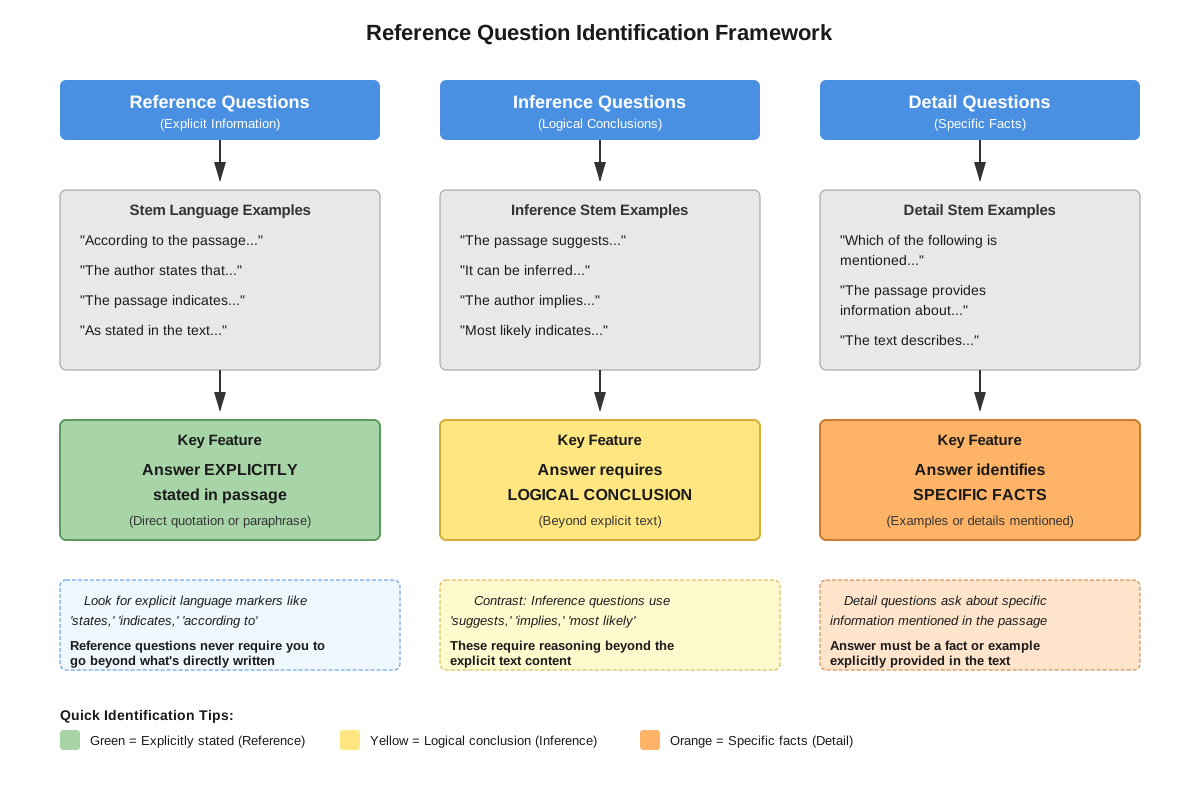
- [ ] Distinguish reference questions from inference and detail questions based on question stem language
- [ ] Develop efficient passage navigation strategies to locate referenced information quickly
- [ ] Evaluate answer choices by matching them precisely against passage text without adding unsupported interpretations
Prerequisites
- Basic reading comprehension skills: The ability to understand college-level prose is necessary to process LSAT passages effectively
- Familiarity with LSAT passage structure: Understanding how LSAT passages are organized helps locate information efficiently when answering reference questions
- Knowledge of passage annotation techniques: Basic marking strategies enable quick reference back to relevant sections during question answering
- Understanding of answer choice elimination: The fundamental skill of systematically evaluating and eliminating wrong answers applies across all question types
Why This Topic Matters
Reference questions appear in virtually every LSAT reading comprehension section, typically comprising 20-30% of all reading comprehension questions. This frequency makes them high-yield material that directly impacts overall scores. Unlike more complex question types, reference questions offer opportunities for confident, quick points when approached systematically—making them essential for efficient time management across the section.
In legal practice, the ability to locate and accurately cite specific textual support forms the foundation of legal analysis. Attorneys must constantly reference statutes, precedents, and documents with precision. Reference questions on the LSAT directly assess this fundamental lawyering skill, making them not merely test-taking exercises but genuine measures of professional aptitude.
These questions commonly appear after passages discussing scientific theories, legal arguments, historical events, or comparative analyses. They frequently ask about specific examples mentioned in the passage, the author's characterization of a particular viewpoint, details about a process or sequence, or explicit statements about relationships between concepts. Recognizing these patterns helps test-takers anticipate question types while reading and annotate accordingly.
Core Concepts
Defining Reference Questions
Reference questions are reading comprehension items that ask test-takers to identify information explicitly stated in the passage. The correct answer to a reference question must be directly supported by specific passage text—either through direct quotation or close paraphrase. These questions test reading accuracy rather than analytical reasoning, though they still require careful attention to nuance and context.
The key distinguishing feature of reference questions is their demand for textual evidence. While inference questions ask what "can be inferred" or what the passage "suggests," reference questions use language like "according to the passage," "the author states," "the passage indicates," or "the passage mentions." This linguistic distinction signals that the answer exists explicitly within the text rather than requiring logical extension beyond it.
Common Question Stem Formats
Reference questions appear in several recognizable formats, each with subtle variations in what they're asking:
Direct reference stems ask straightforwardly about passage content:
- "According to the passage, which of the following is true about X?"
- "The passage states that X is..."
- "The author mentions X in order to..."
Specific detail stems focus on particular elements:
- "Which of the following does the passage identify as a characteristic of X?"
- "The passage indicates that X occurred when..."
- "According to the passage, X differs from Y in that..."
Multiple reference stems require checking several passage locations:
- "The passage provides information that answers which of the following questions?"
- "The passage mentions all of the following EXCEPT..."
The Reasoning Pattern
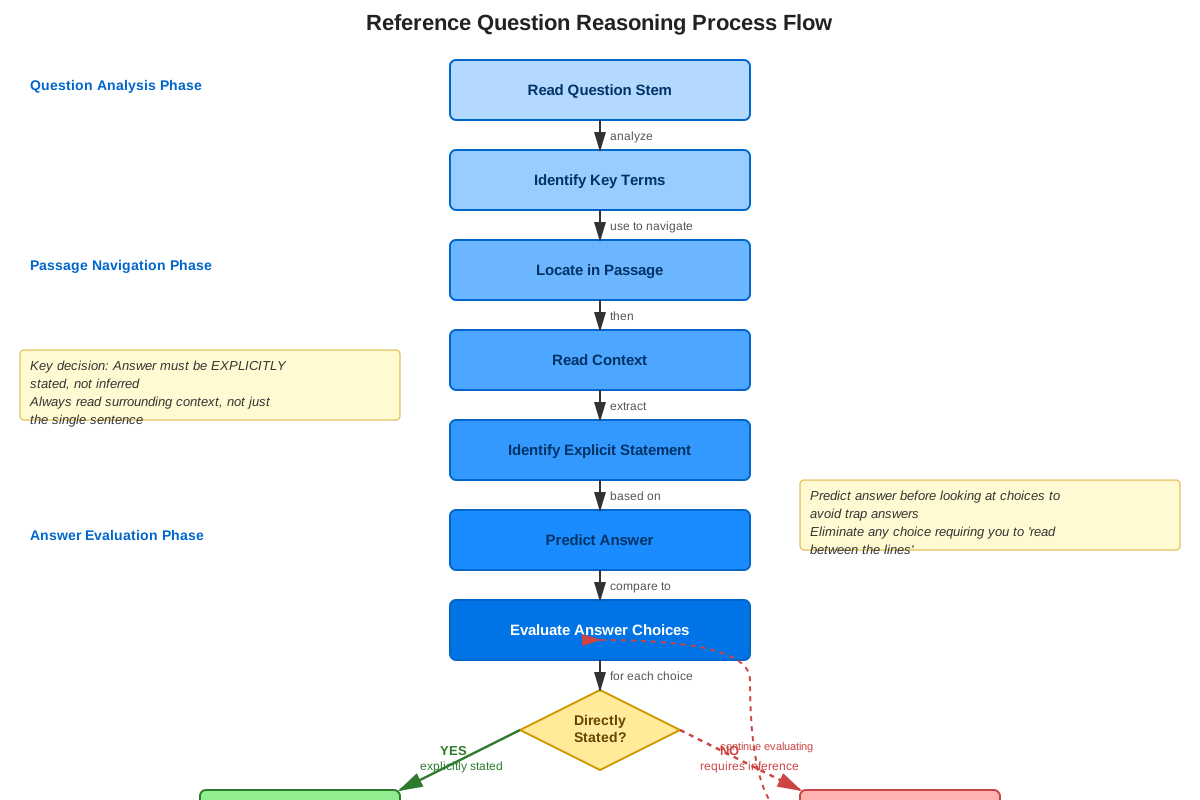
The reasoning pattern for reference questions follows a systematic three-step process:
- Identify the specific topic referenced in the question stem
- Locate the relevant passage section where that topic is discussed
- Match the passage text precisely to the answer choice that best represents what was stated
This pattern differs fundamentally from inference questions, where test-takers must extend beyond the text, or from main point questions, where synthesis across the entire passage is required. Reference questions reward methodical passage navigation and careful comparison between source text and answer choices.
Passage Mapping for Reference Questions
Effective handling of reference questions begins during the initial passage reading. Passage mapping—the practice of creating a mental or physical outline of passage structure—enables rapid location of referenced information. Key mapping strategies include:
- Noting the main topic of each paragraph in the margin
- Marking specific examples, dates, names, or technical terms
- Identifying transition points where the passage shifts topics
- Flagging author opinions versus reported viewpoints
When a reference question appears, this map allows immediate navigation to the relevant section without re-reading the entire passage, saving crucial time.
Textual Precision and Paraphrasing
Reference questions test the ability to recognize when an answer choice accurately represents passage content, even when worded differently. The LSAT rarely uses identical language between passage and correct answer; instead, correct answers typically paraphrase the original text. This requires understanding conceptual equivalence rather than mere word-matching.
For example, if a passage states "The theory gained widespread acceptance among researchers," a correct answer might say "The theory became popular in the scientific community." The wording differs, but the meaning aligns precisely. Wrong answers often use passage vocabulary but distort the meaning or introduce unsupported claims.
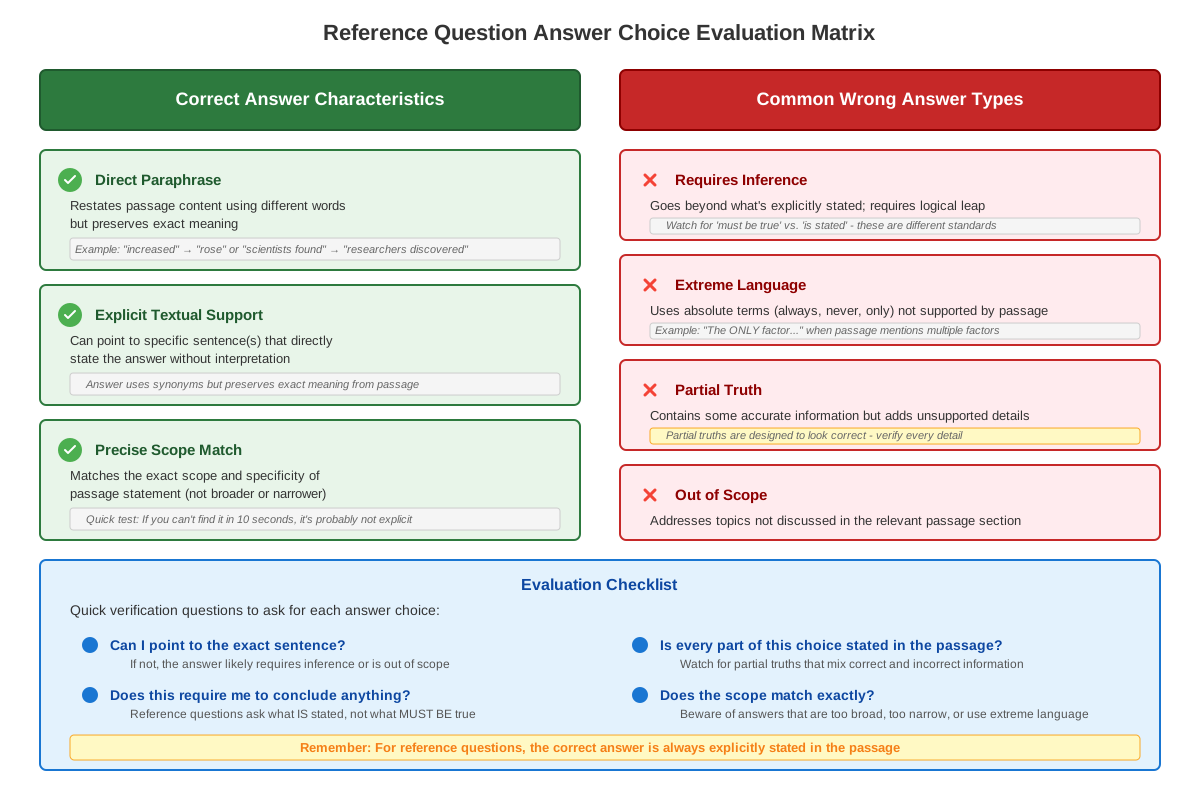
Common Wrong Answer Patterns
Understanding how wrong answers are constructed helps eliminate them efficiently:
| Wrong Answer Type | Description | Example |
|---|---|---|
| Out of Scope | Introduces information not discussed in the passage | Mentions concepts never addressed in the text |
| Distortion | Takes passage information and twists it slightly | Changes "some scientists" to "most scientists" |
| Reversal | States the opposite of what the passage says | Claims X caused Y when passage says Y caused X |
| Extreme Language | Uses absolute terms unsupported by passage | Uses "always," "never," "only" when passage is more moderate |
| Wrong Section | Accurately reflects passage content but from wrong context | Describes paragraph 2 when question asks about paragraph 4 |
Concept Relationships
Reference questions serve as the foundation for more complex reading comprehension question types. Mastering reference questions develops the close reading skills necessary for inference questions—if a test-taker cannot accurately identify what a passage explicitly states, drawing valid inferences becomes impossible. The relationship flows: Reference Questions → Inference Questions → Application Questions.
Within reference questions themselves, specific detail questions connect to broader "according to the passage" questions through shared methodology. Both require passage navigation and textual matching, but specific detail questions narrow the focus to particular passage elements while broader reference questions may synthesize information across multiple sentences.
The connection to passage structure understanding is bidirectional: strong structural awareness facilitates answering reference questions efficiently, while practicing reference questions reinforces understanding of how LSAT passages organize information. This creates a reinforcing cycle: Passage Structure Knowledge ↔ Reference Question Proficiency.
Reference questions also relate directly to annotation strategies developed during passage reading. Effective annotations create a roadmap that makes reference questions faster to answer, while the experience of answering reference questions teaches which passage elements are worth annotating. This relationship suggests: Strategic Annotation → Efficient Reference Question Answering → Refined Annotation Strategy.
High-Yield Facts
⭐ Reference questions require answers directly supported by passage text, not logical inferences beyond the text
⭐ Question stems containing "according to the passage," "the passage states," or "the passage indicates" signal reference questions
⭐ Correct answers typically paraphrase passage content rather than using identical wording
⭐ Wrong answers often use passage vocabulary but distort meaning or introduce unsupported claims
⭐ Efficient passage mapping during initial reading dramatically improves reference question speed and accuracy
- Reference questions comprise approximately 20-30% of all LSAT reading comprehension questions
- "EXCEPT" questions require checking all answer choices against the passage, making them more time-intensive
- The correct answer to a reference question can always be defended by pointing to specific passage lines
- Extreme language in answer choices (always, never, only, must) is often incorrect unless the passage uses equally strong language
- Multiple paragraphs may discuss the same topic; reference questions may require synthesizing information across these sections
- Author characterization questions ("the author describes X as...") are reference questions even when they seem interpretive
- Temporal and causal relationships stated in passages are frequent reference question topics
Quick check — test yourself on Reference questions so far.
Try Flashcards →Common Misconceptions
Misconception: Reference questions are always easy because they just ask what the passage says directly.
Correction: While reference questions don't require inference, they can be challenging due to complex paraphrasing, subtle distinctions between answer choices, and the need to locate information quickly in dense passages. The LSAT deliberately makes reference questions harder through sophisticated wrong answer construction.
Misconception: If an answer choice uses words from the passage, it must be correct.
Correction: Wrong answers frequently incorporate passage vocabulary while distorting the meaning or context. The LSAT tests whether students understand concepts, not whether they recognize familiar words. Always verify that the answer choice's meaning matches the passage, not just its vocabulary.
Misconception: Reference questions never require reading multiple passage sections.
Correction: Some reference questions, particularly those asking "which of the following does the passage mention" or "EXCEPT" questions, require checking information across multiple paragraphs. Effective passage mapping helps manage these more complex reference questions.
Misconception: The correct answer will be located in the same paragraph mentioned in the question stem.
Correction: While questions often reference specific paragraphs or lines, the complete answer may require information from adjacent sections. Always read slightly before and after the referenced location to ensure full context.
Misconception: Reference questions don't require understanding the passage's main point or structure.
Correction: While reference questions focus on specific details, understanding overall passage structure helps locate information efficiently and provides context for evaluating whether an answer choice accurately represents the passage's meaning. Context matters even for detail questions.
Worked Examples
Example 1: Direct Reference Question
Passage excerpt: "The Impressionist movement, which emerged in France during the 1870s, represented a radical departure from academic painting traditions. Rather than working in studios to create carefully composed scenes, Impressionist painters like Claude Monet and Pierre-Auguste Renoir painted outdoors, capturing the fleeting effects of natural light. Their technique involved applying paint in small, visible brushstrokes rather than blending colors smoothly, which initially shocked critics accustomed to the polished finish of academic art."
Question: According to the passage, Impressionist painters differed from academic painters in that Impressionist painters:
(A) received more favorable critical reception
(B) worked primarily outdoors rather than in studios
(C) focused exclusively on portraits rather than landscapes
(D) used more expensive materials in their work
(E) completed paintings more quickly than their predecessors
Solution Process:
Step 1: Identify what the question asks—specific differences between Impressionist and academic painters.
Step 2: Locate relevant passage sections. The passage explicitly discusses differences in the first three sentences: location (outdoors vs. studios), subject matter (fleeting light effects), and technique (visible brushstrokes vs. smooth blending).
Step 3: Evaluate each answer choice against passage text:
- (A) Incorrect - The passage states critics were "shocked," suggesting negative reception, not favorable
- (B) Correct - Directly stated: "Rather than working in studios...Impressionist painters...painted outdoors"
- (C) Incorrect - The passage mentions capturing "fleeting effects of natural light," not portraits exclusively
- (D) Incorrect - Materials are never discussed in the passage (out of scope)
- (E) Incorrect - Painting speed is never mentioned (out of scope)
Answer: (B) - This answer directly paraphrases the passage's explicit comparison between studio work and outdoor painting.
Example 2: "EXCEPT" Reference Question
Passage excerpt: "Coral reefs provide numerous ecological services. They serve as nurseries for juvenile fish, protecting young fish from predators until they mature. The complex three-dimensional structure of reefs creates habitats for thousands of marine species, supporting biodiversity that rivals tropical rainforests. Additionally, reefs protect coastlines from erosion by absorbing wave energy before it reaches shore. Tourism centered on reef ecosystems generates billions of dollars annually for coastal communities."
Question: The passage mentions all of the following as functions of coral reefs EXCEPT:
(A) providing shelter for young fish
(B) supporting diverse marine life
(C) generating tourism revenue
(D) filtering pollutants from ocean water
(E) protecting shores from wave damage
Solution Process:
Step 1: Recognize this as an "EXCEPT" question requiring verification of four answer choices against the passage and identification of one not mentioned.
Step 2: Systematically check each answer:
- (A) Mentioned - "serve as nurseries for juvenile fish, protecting young fish from predators"
- (B) Mentioned - "creates habitats for thousands of marine species, supporting biodiversity"
- (C) Mentioned - "Tourism centered on reef ecosystems generates billions of dollars"
- (D) NOT mentioned - Pollution or water filtering is never discussed
- (E) Mentioned - "protect coastlines from erosion by absorbing wave energy"
Step 3: Confirm that (D) introduces information absent from the passage.
Answer: (D) - While coral reefs may filter water in reality, this function is not mentioned in the passage. The question tests what the passage states, not general knowledge about coral reefs.
Exam Strategy
Approaching Reference Questions Systematically
When encountering a reference question, follow this efficient process:
- Read the question stem carefully to identify exactly what information is being requested
- Note any paragraph or line references provided in the question
- Navigate to the relevant passage section using your passage map
- Read 2-3 sentences before and after the referenced location for context
- Predict an answer in your own words before looking at choices
- Evaluate each answer choice against the passage text, eliminating those that don't match
Trigger Words and Phrases
Recognize these question stem indicators that signal reference questions:
- "According to the passage..."
- "The passage states/indicates/mentions..."
- "The author describes X as..."
- "Which of the following does the passage identify..."
- "The passage provides information that answers..."
- "As presented in the passage..."
These phrases indicate that the answer must be explicitly supported by passage text, not inferred or assumed.
Process of Elimination Tips
Eliminate answers that:
- Introduce concepts never mentioned in the passage
- Use extreme language (always, never, only, must) unless the passage is equally absolute
- Reverse cause-and-effect relationships stated in the passage
- Confuse which viewpoint holds which position
- Describe content from the wrong passage section
Keep answers that:
- Paraphrase passage content accurately, even with different wording
- Match the scope and tone of the passage
- Can be defended by pointing to specific passage lines
- Maintain the same qualifiers (some, many, often) as the passage
Time Allocation
Reference questions should typically take 45-60 seconds each, making them among the faster question types. If a reference question is taking longer than 90 seconds, mark it and return after completing other questions. The answer exists explicitly in the passage, so extended deliberation rarely helps—either you've located the right section or you need to re-read more carefully.
For "EXCEPT" questions, budget an additional 30-45 seconds since they require checking multiple answer choices against the passage.
Memory Techniques
R.E.F.E.R. Method for approaching reference questions:
- Read the question stem carefully
- Examine what specifically is being asked
- Find the relevant passage section
- Evaluate each answer against passage text
- Reconfirm your choice matches the passage
Visualization Strategy: Picture the passage as a filing cabinet where each paragraph is a drawer containing specific information. Reference questions ask you to open the correct drawer and retrieve a specific file. Your passage map is the label system that helps you find the right drawer quickly.
Paraphrase Recognition Mnemonic: "Same meaning, different words" - Train yourself to recognize conceptual equivalence rather than word-matching. Practice by reading a passage sentence and immediately restating it in your own words.
SCOPE Acronym for eliminating wrong answers:
- Same meaning as passage?
- Correct section referenced?
- Out of scope information added?
- Paraphrase accurate?
- Extreme language unsupported?
Summary
Reference questions form a foundational question type in LSAT reading comprehension, testing the ability to locate and accurately identify information explicitly stated in passages. These questions require precise textual support and reward systematic passage navigation, careful attention to paraphrasing, and strict adherence to what the passage actually states rather than what might be inferred. Success depends on developing efficient passage mapping during initial reading, recognizing question stem language that signals reference questions, and understanding common wrong answer patterns including distortions, reversals, and out-of-scope information. While reference questions don't require the analytical reasoning of inference questions, they demand careful reading and the ability to match answer choices to passage content despite different wording. Mastering reference questions builds essential skills for more complex question types and represents high-yield material given their frequency on the exam.
Key Takeaways
- Reference questions require answers directly stated in the passage, identifiable through question stems using "according to the passage" or "the passage states"
- Correct answers typically paraphrase passage content rather than using identical language, testing conceptual understanding
- Efficient passage mapping during initial reading enables rapid location of referenced information, saving crucial time
- Wrong answers often use passage vocabulary while distorting meaning, introducing unsupported claims, or describing content from wrong sections
- Systematic evaluation of each answer choice against specific passage text, rather than relying on memory, ensures accuracy
- "EXCEPT" questions require checking all answer choices and typically take longer than standard reference questions
- Reference question mastery builds foundational skills necessary for inference, application, and other complex question types
Related Topics
Inference Questions: After mastering reference questions, students progress to inference questions, which require drawing conclusions supported by but not explicitly stated in the passage. Understanding what a passage directly states provides the foundation for valid inferences.
Main Point Questions: These questions require synthesizing information across the entire passage to identify the author's primary argument. Reference question skills help locate supporting evidence for main point candidates.
Function Questions: These ask why the author included specific information or how it relates to the passage's argument. Reference skills help locate the relevant content, while additional analysis determines its purpose.
Detail Questions: A closely related question type that asks about specific passage elements. The distinction between detail and reference questions is subtle, but both require similar passage navigation and textual matching skills.
Passage Structure Analysis: Understanding how LSAT passages organize information enhances both passage mapping for reference questions and overall comprehension efficiency.
Practice CTA
Now that you understand the mechanics and strategy behind reference questions, it's time to apply these concepts to actual LSAT passages. Complete the practice questions associated with this topic, focusing on implementing the R.E.F.E.R. method and identifying the question stem patterns discussed. Use the flashcards to reinforce recognition of common wrong answer types and trigger words. Remember: reference questions offer high-confidence points when approached systematically—master them to build momentum through the reading comprehension section and establish the foundational skills necessary for more complex question types. Your ability to locate and accurately identify explicit passage content will serve you throughout the LSAT and in legal practice beyond.
Sign up free to keep reading
Create a free AnvayaPrep account to finish this LSAT guide on Reference questions — plus flashcards and practice questions.