Overview
Haworth projections are a standardized method of representing the cyclic structures of monosaccharides in a simplified, two-dimensional format. Named after British chemist Sir Walter Norman Haworth, these projections depict the ring form of sugars as planar polygons (typically pentagons for furanoses or hexagons for pyranoses) viewed from an angle that shows the ring perpendicular to the plane of the page. This representation is essential for understanding carbohydrate structure and reactivity, as monosaccharides predominantly exist in cyclic rather than linear forms in aqueous solution. The ability to draw, interpret, and interconvert between Fischer projections and Haworth projections is a fundamental skill in Biochemistry that appears regularly on the MCAT.
Understanding Haworth projections is critical for the MCAT because carbohydrates constitute a significant portion of biological molecules tested on the exam. Questions may require students to identify anomeric carbons, distinguish between α and β anomers, recognize specific monosaccharides from their structures, or predict the products of glycosidic bond formation. The MCAT frequently integrates carbohydrate chemistry into passages about metabolism, enzyme mechanisms, or structural biology, making visual literacy with these structures non-negotiable for competitive performance.
Within the broader context of Biochemistry, Haworth projections connect directly to topics including glycolysis, gluconeogenesis, glycogen metabolism, and the pentose phosphate pathway. They also relate to the structural roles of carbohydrates in glycoproteins, proteoglycans, and cell surface markers. Mastery of Haworth projections enables students to understand how subtle stereochemical differences—such as the orientation of a single hydroxyl group—can dramatically alter biological function, as seen in the difference between glucose and galactose or between α and β glycosidic linkages in starch versus cellulose.
Learning Objectives
- [ ] Define Haworth projections using accurate Biochemistry terminology
- [ ] Explain why Haworth projections matter for the MCAT
- [ ] Apply Haworth projections to exam-style questions
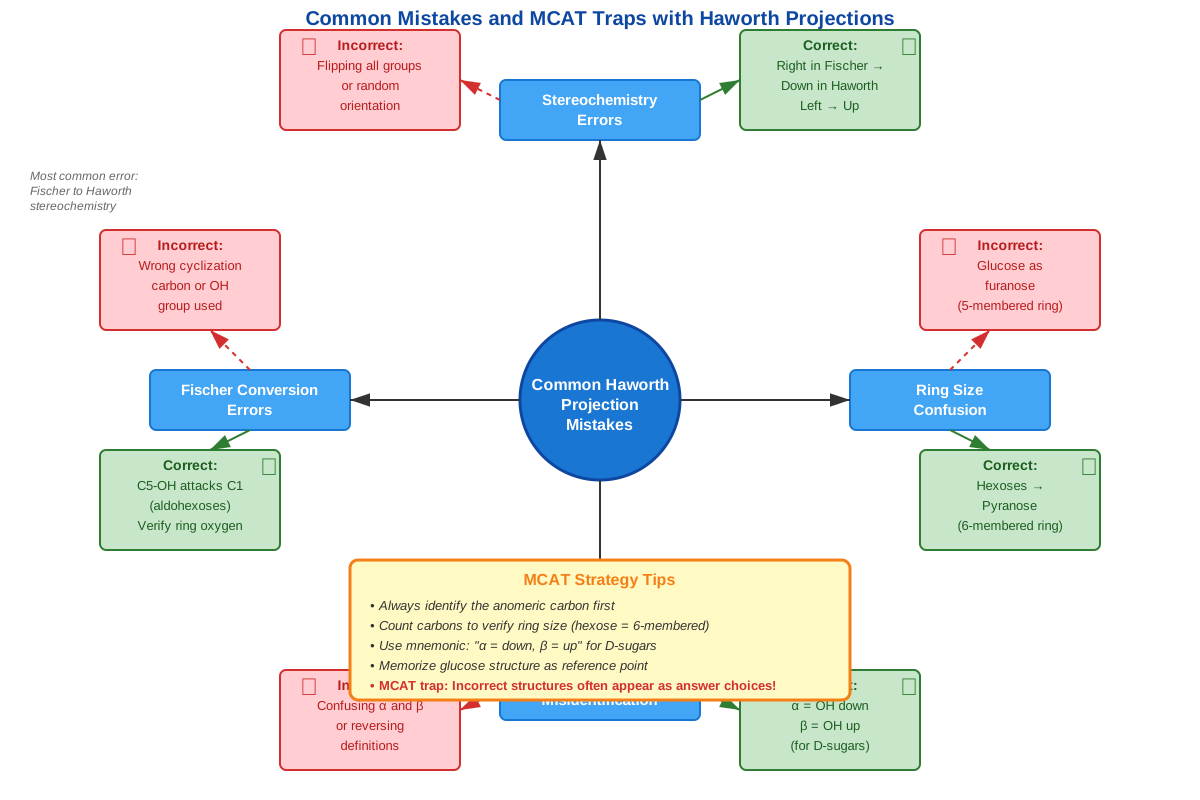
- [ ] Identify common mistakes related to Haworth projections
- [ ] Connect Haworth projections to related Biochemistry concepts
- [ ] Convert Fischer projections to Haworth projections accurately
- [ ] Distinguish between α and β anomers in Haworth projection format
- [ ] Identify the anomeric carbon and recognize mutarotation
- [ ] Predict the structure of disaccharides from glycosidic linkage descriptions
Prerequisites
- Fischer projections: Understanding linear representations of monosaccharides is essential because Haworth projections are derived from these structures through cyclization
- Stereochemistry basics: Knowledge of D/L configurations and R/S nomenclature provides the foundation for understanding sugar stereochemistry
- Functional group chemistry: Familiarity with aldehydes, ketones, and alcohols is necessary to understand hemiacetal and hemiketal formation
- Basic organic reaction mechanisms: Understanding nucleophilic addition reactions explains how the cyclic forms of sugars arise from linear precursors
- Carbohydrate classification: Knowing the difference between aldoses and ketoses, and between trioses through hexoses, contextualizes which ring sizes form
Why This Topic Matters
Haworth projections represent a high-yield topic for the MCAT because carbohydrate structure appears in approximately 5-8% of Biochemistry questions on the exam. These questions often test multiple concepts simultaneously—for example, a passage might describe an enzyme that cleaves specific glycosidic bonds, requiring students to identify the substrate structure, predict products, and understand the biological consequences. The ability to rapidly interpret Haworth projections can save valuable time during the exam and prevent careless errors.
Clinically, understanding carbohydrate structure has direct relevance to human health. Lactose intolerance results from inability to cleave the β-1,4-glycosidic bond between galactose and glucose. Glycogen storage diseases involve abnormal branching patterns (α-1,6 linkages) or chain lengths. Blood type antigens are determined by specific monosaccharide residues on cell surface glycoproteins. Diabetes management requires understanding glucose structure and its detection methods. These real-world applications frequently appear in MCAT passages, making Haworth projections not merely an abstract drawing exercise but a practical tool for medical reasoning.
On the MCAT, Haworth projections most commonly appear in discrete questions asking for structure identification, in passage-based questions about metabolic pathways (especially glycolysis and glycogen metabolism), and in questions about disaccharide or polysaccharide structure. Students may be asked to identify which monosaccharide is shown, determine whether an anomer is α or β, predict the product of glycosidic bond formation, or explain why certain enzymes can digest starch but not cellulose. The visual nature of these questions means that students who can rapidly and accurately interpret these structures have a significant advantage.
Core Concepts
Definition and Basic Structure
Haworth projections are simplified three-dimensional representations of cyclic monosaccharides drawn as planar rings. The ring is depicted as if viewed at an angle, with the edge closest to the viewer drawn as a bold or thickened line. Substituents attached to the ring carbons are shown as projecting either above or below the plane of the ring. For pyranoses (six-membered rings containing five carbons and one oxygen), the structure resembles a hexagon, while furanoses (five-membered rings with four carbons and one oxygen) appear as pentagons.
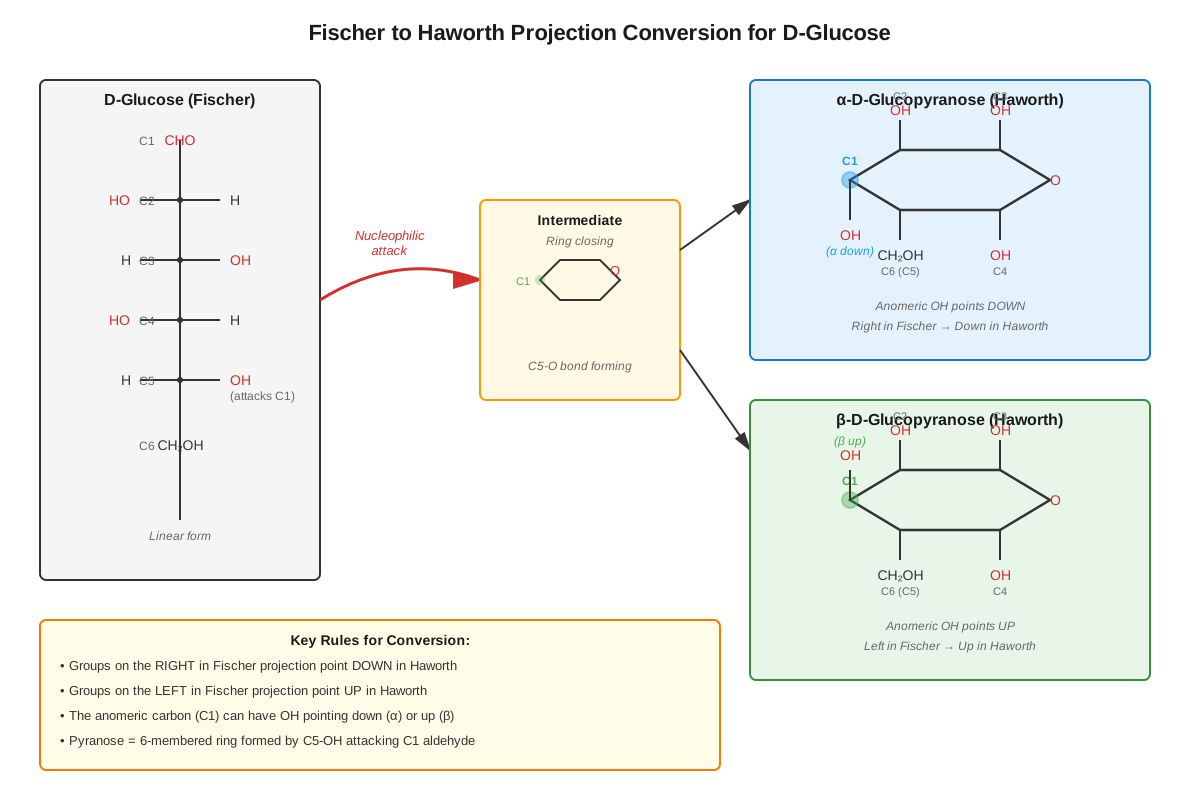
The convention for drawing Haworth projections places the ring oxygen at the back right for pyranoses (top right for furanoses), with the anomeric carbon (the carbon that was the carbonyl carbon in the linear form) positioned to the right of the oxygen. Carbons are numbered clockwise around the ring, starting with the anomeric carbon as C1 for aldoses. Substituents that pointed to the right in the Fischer projection generally point downward in the Haworth projection, while those pointing left in Fischer point upward in Haworth—though this rule requires modification based on the ring orientation.
Converting Fischer to Haworth Projections
The conversion process from Fischer to Haworth projections involves several systematic steps:
- Identify the carbonyl carbon (C1 for aldoses, C2 for ketoses) that will become the anomeric carbon
- Determine ring size: For hexoses, the C5 hydroxyl typically attacks the C1 carbonyl to form a six-membered pyranose ring
- Rotate the Fischer projection mentally so that the carbon chain curves back, positioning C5 near C1
- Form the hemiacetal or hemiketal: The C5 hydroxyl performs nucleophilic attack on the carbonyl carbon
- Assign substituent positions: Groups on the right in Fischer generally go down in Haworth; groups on the left go up
- Determine anomer: The newly formed hydroxyl at the anomeric carbon can be either α (down for D-sugars) or β (up for D-sugars)
For D-glucose, the most important monosaccharide for the MCAT, the conversion yields a pyranose ring with the CH₂OH group (C6) pointing upward. The hydroxyl groups at C2, C3, and C4 alternate in a down-up-down pattern for the β anomer. This specific pattern distinguishes glucose from other hexoses like galactose (which differs at C4) or mannose (which differs at C2).
Anomers and the Anomeric Carbon
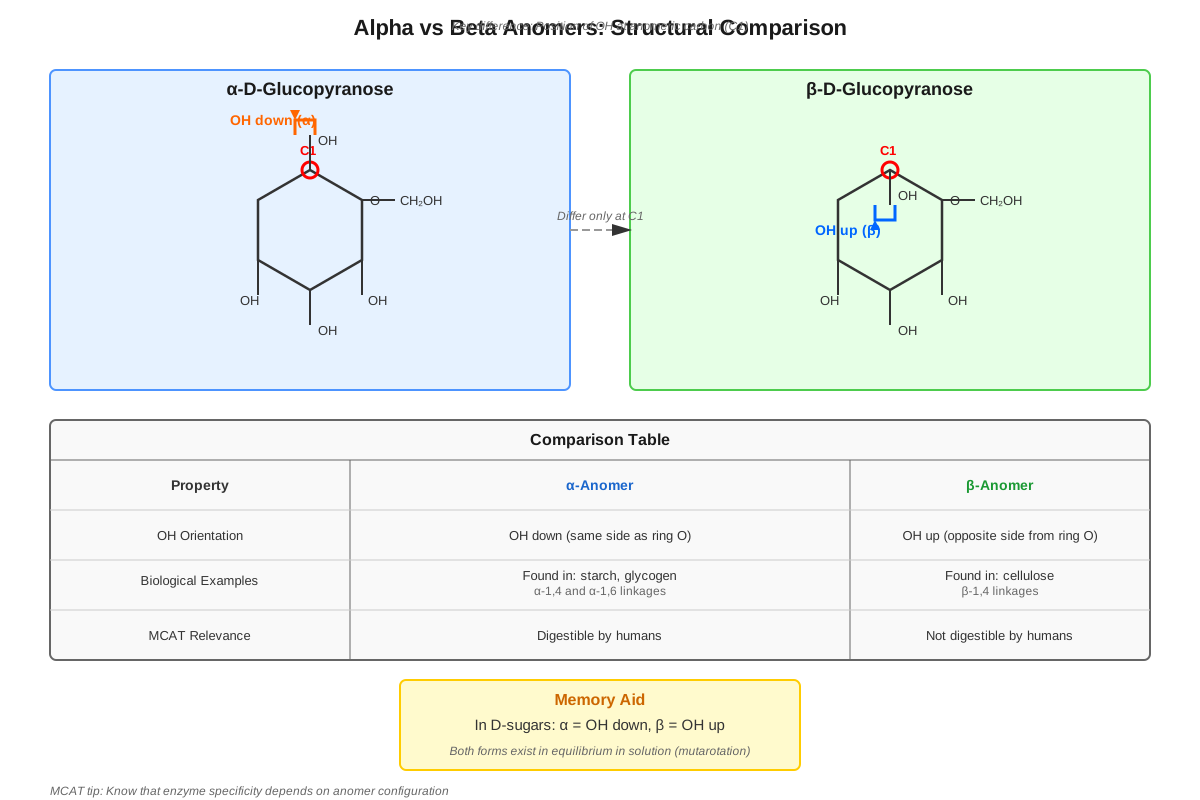
The anomeric carbon is the carbon atom that becomes a new stereocenter when the ring forms. In the linear form, this carbon was the carbonyl carbon (aldehyde or ketone). Upon cyclization, the carbonyl oxygen becomes a hydroxyl group, and this hydroxyl can be oriented in two different ways, creating two anomers: α and β.
For D-sugars in Haworth projection:
- α-anomer: The anomeric hydroxyl points in the opposite direction from the CH₂OH group (downward for D-sugars in standard orientation)
- β-anomer: The anomeric hydroxyl points in the same direction as the CH₂OH group (upward for D-sugars)
The distinction between α and β anomers is crucial for biological function. Mutarotation is the spontaneous interconversion between α and β forms through the linear intermediate, occurring in aqueous solution until equilibrium is reached. For glucose, the equilibrium mixture contains approximately 36% α-D-glucopyranose and 64% β-D-glucopyranose, with less than 1% in the linear form. This equilibrium is catalyzed by acid or base and occurs continuously in biological systems.
Key Monosaccharides in Haworth Form
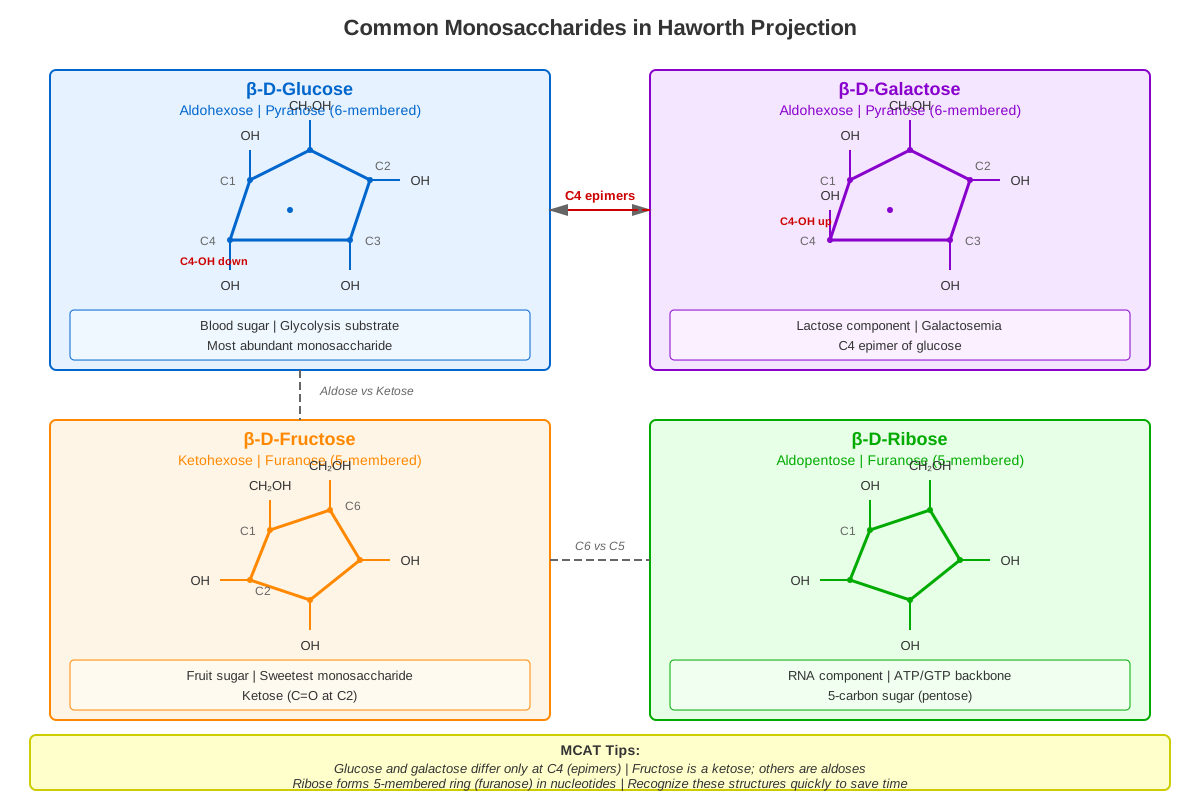
| Monosaccharide | Ring Type | Key Distinguishing Features | Biological Importance |
|---|---|---|---|
| D-Glucose | Pyranose | All equatorial hydroxyls in chair form; β-anomer predominates | Primary energy source; blood sugar |
| D-Galactose | Pyranose | C4-OH points up (opposite to glucose) | Component of lactose; glycolipids |
| D-Fructose | Furanose (in sucrose) | Five-membered ring; C2 is anomeric | Fruit sugar; sucrose component |
| D-Ribose | Furanose | All hydroxyls on same side in β form | RNA backbone component |
| D-Mannose | Pyranose | C2-OH points up (opposite to glucose) | Glycoprotein component |
Glycosidic Bonds in Haworth Projections
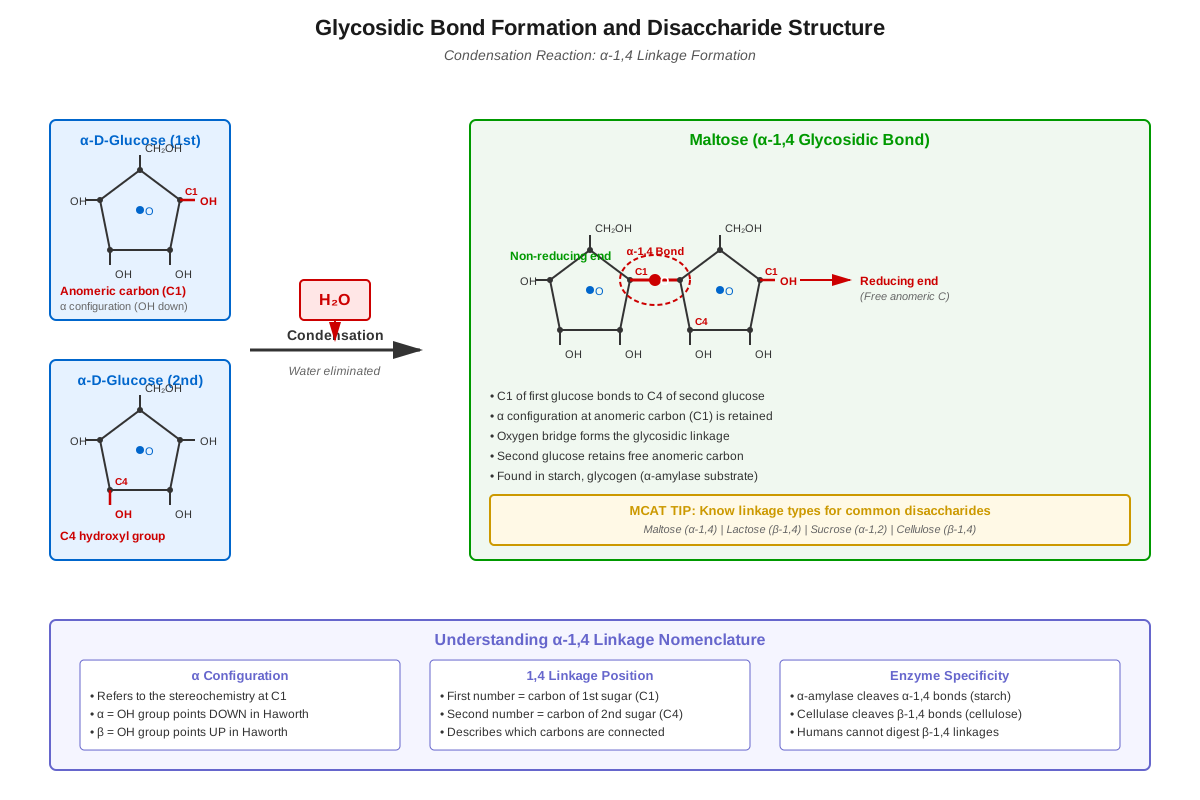
Glycosidic bonds form when the anomeric hydroxyl of one sugar reacts with a hydroxyl group of another molecule (another sugar, protein, or lipid), releasing water. The bond is named according to:
- The configuration at the anomeric carbon (α or β)
- The carbon number of the anomeric carbon
- The carbon number of the accepting hydroxyl
For example, maltose contains an α-1,4-glycosidic bond (α configuration at C1 of the first glucose, connected to C4 of the second glucose). Lactose contains a β-1,4-glycosidic bond between galactose and glucose. Sucrose has an α-1,2-glycosidic bond between glucose and fructose, making it a non-reducing sugar because both anomeric carbons are involved in the bond.
The orientation of glycosidic bonds determines digestibility. Humans produce α-amylase to cleave α-1,4 bonds in starch but lack enzymes to cleave β-1,4 bonds in cellulose, despite both being glucose polymers. This single stereochemical difference explains why starch is digestible but cellulose (dietary fiber) is not.
Chair Conformations and Haworth Projections
While Haworth projections are useful for showing stereochemistry, they depict the ring as planar when it actually adopts a chair conformation to minimize steric strain. In the chair form of β-D-glucopyranose, all hydroxyl groups and the CH₂OH group occupy equatorial positions, making it the most stable hexose. This exceptional stability contributes to glucose's predominance in biology.
For MCAT purposes, students should recognize that Haworth projections are simplified representations. When a question asks about the most stable conformation, the answer involves chair conformations with maximum equatorial substitution. However, most MCAT questions use Haworth projections for clarity and simplicity.
Concept Relationships
Haworth projections serve as the central visual tool connecting multiple carbohydrate concepts. The relationship flow begins with Fischer projections (linear form) → cyclization mechanism (hemiacetal formation) → Haworth projections (cyclic form) → anomers and mutarotation (dynamic equilibrium) → glycosidic bond formation (disaccharides and polysaccharides) → biological function (metabolism and structure).
Understanding Haworth projections enables comprehension of reducing sugars: sugars with a free anomeric carbon that can undergo mutarotation and reduce Benedict's or Fehling's reagent. This connects to laboratory detection methods and explains why sucrose is non-reducing while maltose and lactose are reducing sugars.
The stereochemistry visible in Haworth projections directly relates to enzyme specificity. Hexokinase phosphorylates glucose at C6, glucokinase shows specificity for glucose over other hexoses, and lactase specifically cleaves β-1,4-glycosidic bonds. These enzyme-substrate interactions depend on the precise three-dimensional arrangement of hydroxyl groups shown in Haworth projections.
Haworth projections also connect to metabolic pathways. Glucose-6-phosphate in glycolysis, UDP-glucose in glycogen synthesis, and ribulose-5-phosphate in the pentose phosphate pathway all require understanding of cyclic sugar structure. The ability to recognize these structures in pathway diagrams is essential for MCAT passage analysis.
Quick check — test yourself on Haworth projections so far.
Try Flashcards →High-Yield Facts
⭐ In D-sugars, the β-anomer has the anomeric hydroxyl pointing up (same direction as CH₂OH), while the α-anomer has it pointing down
⭐ The anomeric carbon is the only carbon in a monosaccharide that is bonded to two oxygen atoms (one in the ring, one as a hydroxyl or glycosidic bond)
⭐ Glucose and galactose differ only at C4; glucose and mannose differ only at C2
⭐ Mutarotation is the interconversion between α and β anomers through the linear form, reaching equilibrium in aqueous solution
⭐ α-1,4-glycosidic bonds (starch, glycogen) are digestible by humans; β-1,4-glycosidic bonds (cellulose) are not
- In Haworth projections, groups pointing right in Fischer projections generally point down, and groups pointing left point up
- Pyranoses are six-membered rings (five carbons + one oxygen); furanoses are five-membered rings (four carbons + one oxygen)
- Reducing sugars have a free anomeric carbon capable of existing in equilibrium with the linear form
- Sucrose is a non-reducing disaccharide because both anomeric carbons participate in the glycosidic bond (α-1,2)
- β-D-glucopyranose is the most stable hexose because all substituents are equatorial in the chair conformation
- The ring oxygen in Haworth projections is conventionally drawn at the back right for pyranoses
- Fructose typically forms a furanose ring when part of sucrose but can form a pyranose ring when free
Common Misconceptions
Misconception: All hydroxyl groups pointing right in Fischer projections point down in Haworth projections without exception.
Correction: While this is a useful starting rule, it requires adjustment based on how the chain is curved to form the ring. The C5 hydroxyl that attacks the carbonyl must be positioned appropriately, which may require rotating the Fischer projection. For D-hexoses forming pyranoses, the CH₂OH (C6) ends up pointing upward despite being on the right in Fischer projection.
Misconception: The anomeric carbon is always C1.
Correction: The anomeric carbon is C1 for aldoses but C2 for ketoses. In fructose, C2 is the anomeric carbon because fructose is a ketose with the carbonyl at C2 in the linear form.
Misconception: α and β refer to absolute stereochemistry (R/S configuration).
Correction: α and β are relative descriptors specific to carbohydrate chemistry. For D-sugars, α means the anomeric hydroxyl is on the opposite side from the reference group (CH₂OH), while β means it's on the same side. This is independent of R/S nomenclature.
Misconception: Haworth projections accurately represent the three-dimensional shape of the sugar ring.
Correction: Haworth projections are simplified, planar representations. The actual ring adopts a puckered chair or boat conformation to minimize angle and torsional strain. Haworth projections are useful for showing stereochemistry but not true molecular geometry.
Misconception: Once a sugar forms a ring, it remains locked in that form.
Correction: In aqueous solution, sugars undergo mutarotation, continuously interconverting between α-anomer, linear form, and β-anomer until equilibrium is established. This dynamic process is essential for sugar reactivity and detection.
Misconception: All hexoses form six-membered pyranose rings exclusively.
Correction: While hexoses predominantly form pyranose rings, they can also form furanose rings under certain conditions. Fructose, for example, exists primarily as a pyranose when free but forms a furanose ring when incorporated into sucrose.
Worked Examples
Example 1: Converting D-Galactose from Fischer to Haworth Projection
Problem: Draw the β-D-galactopyranose in Haworth projection, starting from the Fischer projection of D-galactose.
Solution:
Step 1: Recall the Fischer projection of D-galactose. It differs from glucose only at C4, where the hydroxyl points to the left instead of right.
Step 2: Identify that we're forming a pyranose (six-membered ring), so the C5 hydroxyl will attack the C1 aldehyde.
Step 3: Mentally curve the carbon chain so C5 approaches C1. The chain curves to the right for D-sugars.
Step 4: Draw the hexagonal ring with oxygen at the back right position. Place C1 (anomeric carbon) to the right of the oxygen.
Step 5: Assign substituents:
- C6 (CH₂OH): Points up (characteristic of D-sugars)
- C2-OH: Was on the right in Fischer → points down
- C3-OH: Was on the left in Fischer → points up
- C4-OH: Was on the LEFT in Fischer (this is where galactose differs from glucose) → points UP
- C1-OH (anomeric): For β-anomer, points up (same direction as CH₂OH)
Step 6: Verify the structure shows the key difference: at C4, galactose has the hydroxyl pointing up while glucose has it pointing down.
Key Learning Point: This example reinforces that systematic conversion requires tracking each carbon's stereochemistry and understanding how the Fischer projection maps to the Haworth projection. The C4 difference between glucose and galactose is biologically significant—it's why lactase is needed to digest lactose and why galactosemia results from inability to metabolize galactose.
Example 2: Identifying Glycosidic Linkage Type
Problem: A disaccharide is formed when the anomeric carbon of α-D-glucose (C1) forms a bond with the C4 hydroxyl of another D-glucose molecule. The second glucose is in the β configuration. Name the glycosidic bond and identify the disaccharide.
Solution:
Step 1: Identify the configuration at the anomeric carbon of the first glucose: α (anomeric hydroxyl pointing down).
Step 2: Identify which carbon of the first glucose is involved: C1 (the anomeric carbon).
Step 3: Identify which carbon of the second glucose receives the bond: C4.
Step 4: Name the bond: α-1,4-glycosidic bond.
Step 5: Determine if this is a reducing sugar. The second glucose has a free anomeric carbon (C1) that can undergo mutarotation, so YES, this is a reducing sugar.
Step 6: Identify the disaccharide. An α-1,4-glycosidic bond between two glucose molecules is maltose.
Step 7: Draw the structure: The first glucose in α configuration connects through its C1 to the C4 of the second glucose. The second glucose can be drawn in either α or β form since it's in equilibrium (reducing end).
Key Learning Point: This example demonstrates how to systematically name glycosidic bonds and identify disaccharides. Maltose is the repeating unit in starch and glycogen, making it highly relevant for metabolism questions. The fact that maltose is a reducing sugar (unlike sucrose) is a common MCAT test point.
Exam Strategy
When approaching MCAT questions involving Haworth projections, begin by identifying what the question is actually asking. Common question types include: (1) structure identification—which monosaccharide is shown? (2) anomer determination—is this α or β? (3) glycosidic bond naming—what type of linkage connects these sugars? (4) reducing sugar identification—does this have a free anomeric carbon? (5) enzyme specificity—which bond can this enzyme cleave?
Exam Tip: The fastest way to distinguish glucose from galactose in Haworth projection is to check C4. If C4-OH points down, it's glucose; if it points up, it's galactose. For mannose, check C2—if C2-OH points up, it's mannose.
Trigger words to watch for include "anomeric carbon" (look for the carbon bonded to two oxygens), "reducing sugar" (check if an anomeric carbon is free), "mutarotation" (interconversion between anomers), "glycosidic bond" (connection between sugars), and "α or β configuration" (check anomeric hydroxyl orientation relative to CH₂OH).
For process-of-elimination, remember that wrong answer choices often contain common errors: confusing α and β configurations, misidentifying the anomeric carbon, claiming non-reducing sugars can reduce Benedict's reagent, or stating that humans can digest β-1,4-glycosidic bonds. If an answer choice contradicts these fundamental principles, eliminate it immediately.
Time allocation: Discrete questions on Haworth projections should take 45-60 seconds. If a question requires drawing or converting structures, budget 90 seconds. For passage-based questions, the structure interpretation should take no more than 30 seconds, with the remaining time for applying that knowledge to the specific question. If you find yourself spending more than 90 seconds on structure interpretation alone, mark the question and return to it later.
When a passage presents an unfamiliar carbohydrate structure, focus on identifying: (1) ring size (furanose or pyranose), (2) anomeric carbon location and configuration, (3) any unusual substituents or modifications, and (4) glycosidic linkages if it's a disaccharide or oligosaccharide. These four features will answer most questions about the structure.
Memory Techniques
Mnemonic for D-Glucose hydroxyl pattern (β-anomer, C2-C4): "Down, Up, Down" or "DUD"—the hydroxyl groups at C2, C3, and C4 follow this pattern when the CH₂OH is up.
Mnemonic for Galactose: "Galactose is Glucose with C4 flipped"—remember "G-G-C4" (Galactose-Glucose-Carbon 4).
Mnemonic for α vs β: "β is Better"—the β-anomer is more stable for glucose and predominates at equilibrium. Also, "β is Up" for D-sugars (anomeric OH points up).
Visualization strategy: Picture the Haworth projection as a "stop sign" (octagon) viewed at an angle. The oxygen is always at the "back right corner" for pyranoses. This spatial anchor helps maintain consistent orientation.
Acronym for reducing sugars: "MALTS" (Maltose, All monosaccharides, Lactose, Trehalose is NOT, Sucrose is NOT)—helps remember which common disaccharides are reducing.
Memory aid for glycosidic bonds: "Configuration-Carbon-Carbon" (α-1,4)—always name in this order: first the configuration at the anomeric carbon, then the anomeric carbon number, then the accepting carbon number.
Visualization for mutarotation: Imagine a "door" swinging open (ring opening to linear form) and then closing in either of two positions (α or β). This dynamic image reinforces that sugars are not static structures.
Summary
Haworth projections are essential two-dimensional representations of cyclic monosaccharides that depict the ring structure as a planar polygon with substituents projecting above or below the plane. Mastery of Haworth projections requires understanding the conversion from Fischer projections, recognizing the anomeric carbon as the former carbonyl carbon now bonded to two oxygens, and distinguishing between α and β anomers based on the orientation of the anomeric hydroxyl relative to the reference CH₂OH group. For D-sugars, β-anomers have the anomeric hydroxyl pointing up (same direction as CH₂OH), while α-anomers have it pointing down. The ability to identify key monosaccharides like glucose, galactose, and fructose in Haworth form, understand glycosidic bond nomenclature, and recognize reducing versus non-reducing sugars is critical for MCAT success. These structures connect directly to metabolic pathways, enzyme specificity, and biological function, making them high-yield for both discrete questions and passage-based analysis.
Key Takeaways
- Haworth projections represent cyclic monosaccharides as planar rings with the anomeric carbon positioned to the right of the ring oxygen
- The anomeric carbon is identified by being bonded to two oxygen atoms and determines α/β configuration
- For D-sugars: β-anomer has anomeric OH pointing up (same as CH₂OH); α-anomer has it pointing down
- Glucose, galactose, and mannose differ by single hydroxyl orientations at C4, C4, and C2 respectively
- Glycosidic bonds are named by configuration-carbon-carbon (e.g., α-1,4), and their stereochemistry determines digestibility
- Reducing sugars have a free anomeric carbon capable of mutarotation; non-reducing sugars have both anomeric carbons in glycosidic bonds
- Mutarotation is the equilibrium interconversion between α and β anomers through the linear form in aqueous solution
Related Topics
Chair Conformations of Carbohydrates: Understanding the three-dimensional puckered structure of pyranose rings explains stability differences and why β-D-glucose is the most stable hexose. This builds directly on Haworth projection knowledge by adding conformational analysis.
Glycolysis and Gluconeogenesis: These central metabolic pathways involve phosphorylated glucose derivatives. Recognizing glucose-6-phosphate and fructose-6-phosphate in Haworth form is essential for understanding these pathways.
Glycogen Structure and Metabolism: Glycogen contains α-1,4-glycosidic bonds in linear chains and α-1,6-glycosidic bonds at branch points. Understanding these linkages in Haworth projection format is necessary for comprehending glycogen synthesis and breakdown.
Disaccharides and Polysaccharides: Lactose, sucrose, maltose, starch, cellulose, and glycogen all require understanding of how monosaccharides connect through glycosidic bonds, which is best visualized using Haworth projections.
Pentose Phosphate Pathway: This pathway involves ribose-5-phosphate and other pentose sugars. Recognizing five-membered furanose rings extends Haworth projection skills beyond hexoses.
Practice CTA
Now that you've mastered the fundamentals of Haworth projections, it's time to solidify your understanding through active practice. Challenge yourself with the practice questions and flashcards designed specifically for this topic. Focus on rapid structure identification and conversion between Fischer and Haworth projections—these skills will save you valuable time on test day. Remember, carbohydrate chemistry is highly visual, and the more structures you draw and analyze, the more automatic your recognition will become. Every practice question you complete builds the pattern recognition that distinguishes top MCAT performers. You've got this!
Sign up free to keep reading
Create a free AnvayaPrep account to finish this MCAT guide on Haworth projections — plus flashcards and practice questions.