Overview
The atomic number is one of the most fundamental properties of an element, serving as the unique identifier that distinguishes one element from all others on the periodic table. In General Chemistry, the atomic number represents the number of protons in the nucleus of an atom and defines the element's identity. For carbon, the atomic number is 6; for oxygen, it is 8; for gold, it is 79. This seemingly simple concept forms the foundation for understanding atomic structure, chemical behavior, periodic trends, and nuclear chemistry—all of which are heavily tested on the MCAT.
Understanding atomic number is essential for the MCAT because it connects directly to electron configuration, periodic trends, chemical reactivity, and isotope identification. Questions on the Chemical and Physical Foundations of Biological Systems section frequently require students to interpret periodic table data, predict chemical properties based on atomic structure, or distinguish between isotopes of the same element. The atomic number provides the starting point for all these analyses. Without a solid grasp of what atomic number represents and how it relates to other atomic properties, students will struggle with questions involving electron shells, ionization energy, electronegativity, and nuclear reactions.
Within the broader context of Atomic Structure and Periodic Trends, atomic number serves as the organizing principle of the periodic table and the key to understanding why elements behave the way they do. It determines the number of electrons in a neutral atom, which in turn governs chemical bonding and reactivity. The atomic number also helps distinguish between different isotopes of the same element (which share the same atomic number but differ in mass number) and is critical for understanding nuclear decay processes. Mastering this topic creates a strong foundation for more advanced concepts in general chemistry, organic chemistry, and biochemistry that appear throughout the MCAT.
Learning Objectives
- [ ] Define atomic number using accurate General Chemistry terminology
- [ ] Explain why atomic number matters for the MCAT
- [ ] Apply atomic number to exam-style questions
- [ ] Identify common mistakes related to atomic number
- [ ] Connect atomic number to related General Chemistry concepts
- [ ] Distinguish between atomic number, mass number, and atomic mass
- [ ] Use atomic number to determine electron configuration for neutral atoms and ions
- [ ] Predict periodic trends based on atomic number patterns
Prerequisites
- Basic atomic structure: Understanding that atoms consist of protons, neutrons, and electrons is essential because atomic number specifically refers to the proton count
- Periodic table organization: Familiarity with how elements are arranged allows recognition that atomic number increases sequentially across the table
- Charge and ions: Knowledge of how gaining or losing electrons affects charge is necessary to understand that atomic number remains constant even when atoms become ions
- Isotope concept: Basic awareness that atoms of the same element can have different masses helps distinguish atomic number from mass number
Why This Topic Matters
Clinical and Real-World Significance
Atomic number has profound implications in medical imaging, radiation therapy, and diagnostic procedures. Radioactive isotopes used in PET scans and cancer treatment are selected based on their atomic number and nuclear properties. Understanding atomic number helps medical professionals predict how different elements will interact with biological tissues—for example, why heavy elements like barium (atomic number 56) are used as contrast agents in X-rays, or why iodine (atomic number 53) concentrates in the thyroid gland. In radiation oncology, the atomic number of tissues determines how they absorb radiation, which is critical for treatment planning.
MCAT Exam Statistics
Atomic number appears in approximately 5-8% of Chemical and Physical Foundations questions, either directly or as prerequisite knowledge for more complex problems. The MCAT tests this concept through:
- Discrete questions asking students to identify elements or predict properties based on periodic table position
- Passage-based questions involving isotopes, nuclear chemistry, or periodic trends
- Data interpretation requiring students to analyze graphs or tables organized by atomic number
- Integrated questions connecting atomic structure to biological systems (e.g., metal cofactors in enzymes)
Common Exam Contexts
The MCAT frequently embeds atomic number concepts within passages about:
- Radioisotope dating or medical imaging techniques
- Transition metal chemistry in biological systems
- Periodic trend analysis for predicting reactivity
- Nuclear decay processes and stability
- Spectroscopy and electron transitions
- Coordination chemistry and metal-ligand interactions
Core Concepts
Definition and Fundamental Properties
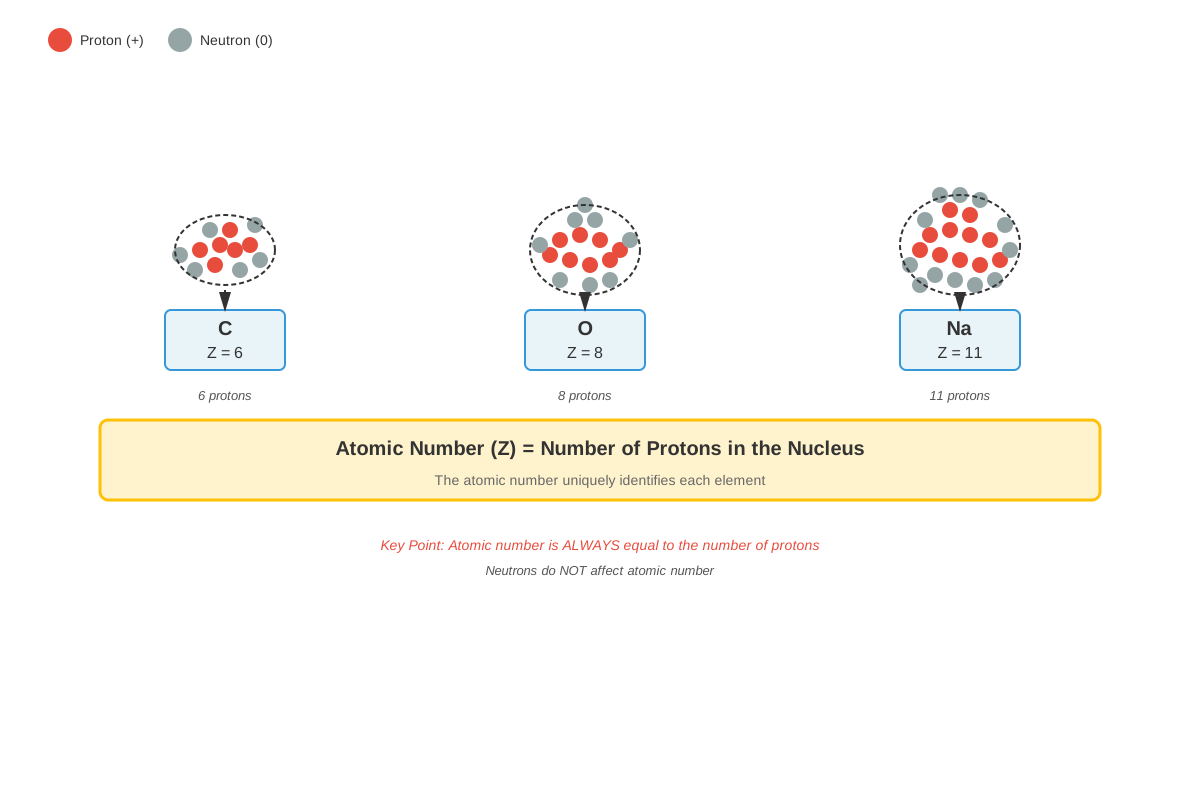
The atomic number (symbol: Z) is defined as the number of protons present in the nucleus of an atom. This value is always a positive integer and serves as the unique identifier for each element. Every atom of a given element has the same atomic number, regardless of the number of neutrons or electrons it contains. For example, all carbon atoms have exactly 6 protons (Z = 6), all nitrogen atoms have 7 protons (Z = 7), and all uranium atoms have 92 protons (Z = 92).
The atomic number determines the element's position on the periodic table, which is organized in order of increasing atomic number from left to right and top to bottom. Hydrogen, with Z = 1, occupies the first position, while elements with higher atomic numbers follow sequentially. This organization is not arbitrary—it reflects the fundamental relationship between atomic number and chemical properties.
Atomic Number vs. Mass Number vs. Atomic Mass
Students must clearly distinguish between three related but distinct concepts:
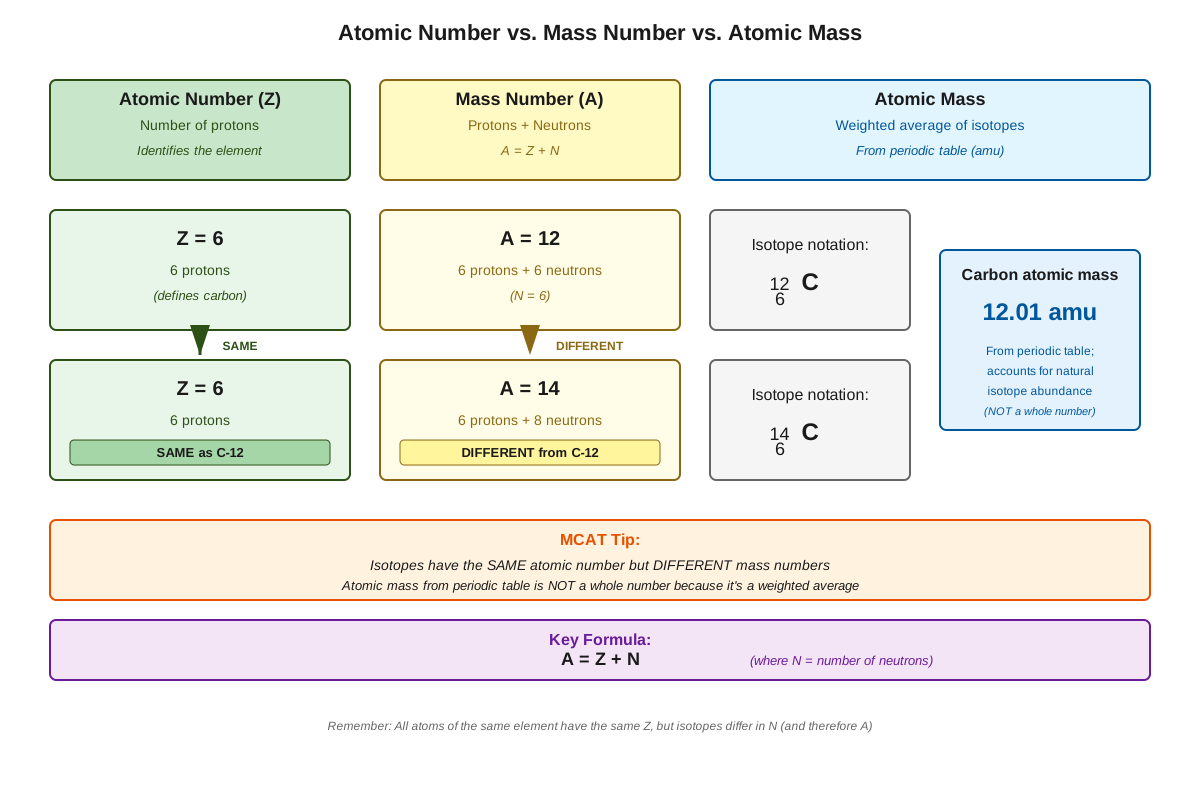
| Property | Symbol | Definition | Example (Carbon-12) |
|---|---|---|---|
| Atomic Number | Z | Number of protons | 6 |
| Mass Number | A | Protons + neutrons | 12 |
| Atomic Mass | — | Weighted average of isotope masses | 12.01 amu |
The mass number (A) represents the total number of nucleons (protons plus neutrons) in a specific isotope. Unlike atomic number, mass number varies among isotopes of the same element. For instance, carbon-12 has a mass number of 12 (6 protons + 6 neutrons), while carbon-14 has a mass number of 14 (6 protons + 8 neutrons). Both isotopes have the same atomic number (6) because they are both carbon.
Atomic mass (also called atomic weight) is the weighted average of all naturally occurring isotopes of an element, measured in atomic mass units (amu). This value appears on the periodic table and is typically not a whole number because it reflects the relative abundance of different isotopes.
Relationship to Electron Configuration
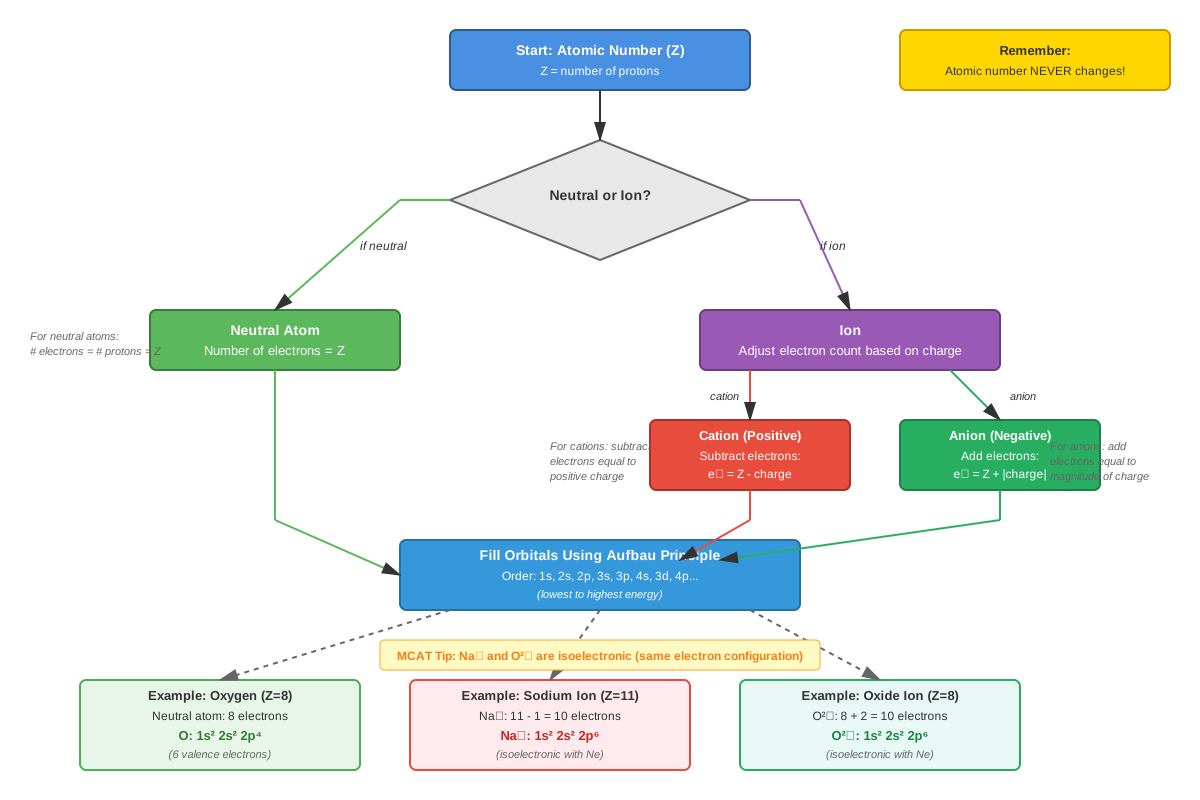
In a neutral atom, the atomic number equals the number of electrons. This relationship is crucial for determining electron configuration, which governs chemical bonding and reactivity. For example, sodium (Z = 11) has 11 electrons in its neutral state, with the electron configuration 1s² 2s² 2p⁶ 3s¹.
When atoms gain or lose electrons to form ions, the number of electrons changes, but the atomic number remains constant. A sodium ion (Na⁺) still has an atomic number of 11 (11 protons) but now has only 10 electrons. The atomic number continues to identify the element as sodium, even though its electron count has changed.
This principle is essential for MCAT questions involving:
- Isoelectronic species (different atoms/ions with the same number of electrons)
- Oxidation states and redox reactions
- Ionic radius trends
- Spectroscopic analysis
Atomic Number and Periodic Trends
The atomic number directly influences periodic trends because it determines the nuclear charge experienced by electrons. As atomic number increases across a period (left to right), several trends emerge:
- Effective nuclear charge (Z_eff) increases because more protons attract the same shell of electrons
- Atomic radius decreases due to stronger nuclear attraction
- Ionization energy increases as electrons are held more tightly
- Electronegativity increases as atoms more strongly attract bonding electrons
- Electron affinity generally becomes more negative (more energy released when gaining electrons)
Down a group (top to bottom), atomic number increases but additional electron shells are added, which:
- Increases atomic radius due to additional shells
- Decreases ionization energy because outer electrons are farther from the nucleus
- Decreases electronegativity as bonding electrons are farther from the nucleus
Isotopes and Atomic Number
Isotopes are atoms of the same element (same atomic number) with different numbers of neutrons (different mass numbers). The notation for isotopes uses the format:
   A
   X
   Z
Where X is the element symbol, A is the mass number, and Z is the atomic number. For example, the three naturally occurring isotopes of hydrogen are:
- Protium: ¹₁H (1 proton, 0 neutrons)
- Deuterium: ²₁H (1 proton, 1 neutron)
- Tritium: ³₁H (1 proton, 2 neutrons)
All three have atomic number 1, identifying them as hydrogen, but they have different mass numbers. The MCAT frequently tests whether students understand that isotopes have identical chemical properties (because they have the same number of electrons) but different physical properties (because they have different masses).
Nuclear Stability and Atomic Number
The atomic number plays a critical role in nuclear stability. For lighter elements (Z < 20), stable nuclei typically have approximately equal numbers of protons and neutrons (N ≈ Z). For heavier elements, stable nuclei require more neutrons than protons (N > Z) to offset the increasing electrostatic repulsion between protons.
Elements with very high atomic numbers (Z > 82, beyond lead) have no stable isotopes and undergo radioactive decay. Understanding this relationship helps predict which isotopes are likely to be radioactive and what types of decay they might undergo—concepts that appear in MCAT passages about nuclear medicine and radioisotope applications.
Concept Relationships
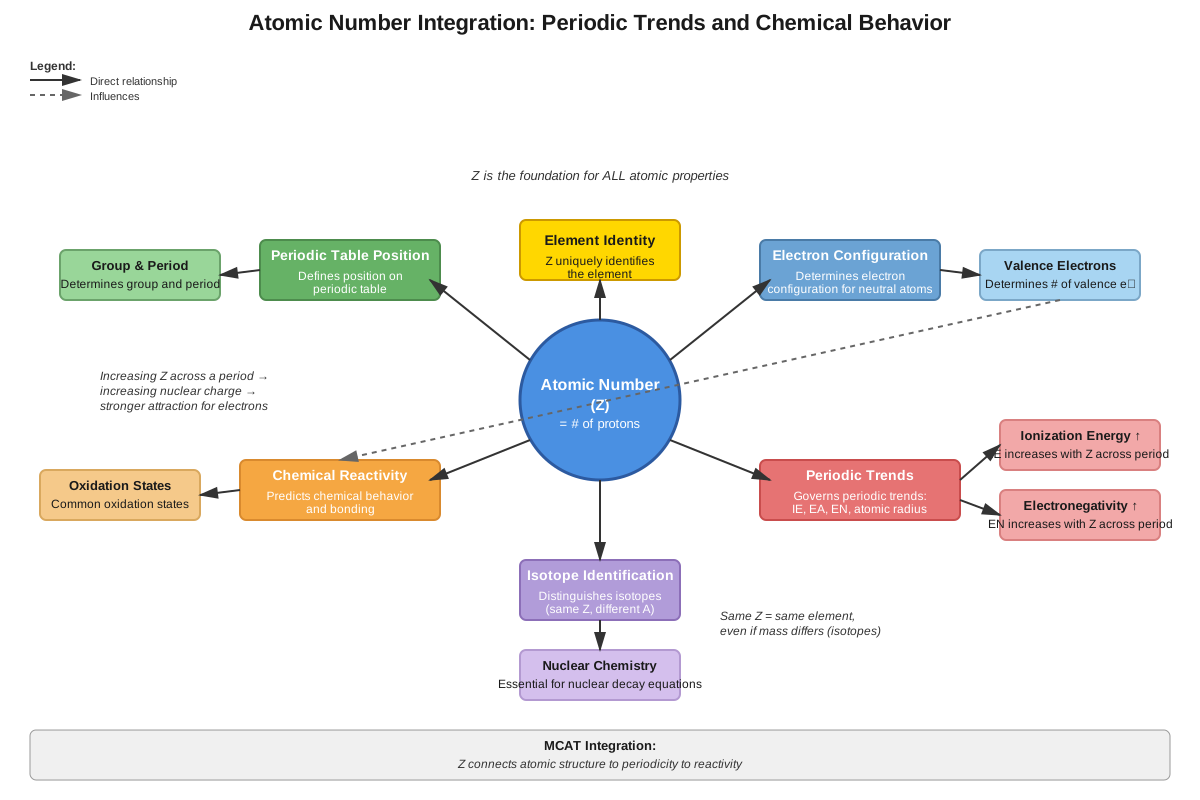
The atomic number serves as the central organizing principle connecting multiple concepts in general chemistry. The relationship map flows as follows:
Atomic Number (Z) → determines → Number of Protons → defines → Element Identity
Atomic Number (Z) → equals (in neutral atoms) → Number of Electrons → determines → Electron Configuration → governs → Chemical Properties and Reactivity
Atomic Number (Z) → organizes → Periodic Table Position → predicts → Periodic Trends (ionization energy, electronegativity, atomic radius)
Atomic Number (Z) → remains constant across → Isotopes → which differ in → Mass Number (A) → due to different → Number of Neutrons
Atomic Number (Z) → influences → Nuclear Stability → determines → Radioactive Decay Patterns
These relationships connect atomic number to prerequisite topics like basic atomic structure and extend to more advanced topics including quantum mechanics (electron orbitals), chemical bonding (Lewis structures, molecular geometry), and nuclear chemistry (decay equations, half-life calculations). Understanding atomic number as the foundation allows students to build a coherent mental model of how atomic properties determine chemical behavior.
Quick check — test yourself on Atomic number so far.
Try Flashcards →High-Yield Facts
⭐ The atomic number (Z) equals the number of protons in an atom's nucleus and uniquely identifies the element
⭐ In a neutral atom, atomic number equals the number of electrons; in ions, the number of electrons changes but atomic number remains constant
⭐ Isotopes of the same element have identical atomic numbers but different mass numbers due to varying neutron counts
⭐ The periodic table is organized by increasing atomic number, which explains periodic trends in chemical properties
⭐ Atomic number determines the electron configuration of neutral atoms, which governs chemical bonding and reactivity
- Mass number (A) = atomic number (Z) + number of neutrons (N)
- Atomic mass on the periodic table is a weighted average of isotope masses, not the same as mass number
- Elements with Z > 82 (beyond lead) have no stable isotopes and are all radioactive
- Isoelectronic species have the same number of electrons but different atomic numbers (e.g., O²⁻, F⁻, Ne, Na⁺, Mg²⁺ all have 10 electrons)
- The effective nuclear charge experienced by outer electrons increases with atomic number across a period
- Transition metals have atomic numbers from 21-30, 39-48, 57-80, and 89-112
- The atomic number appears as the subscript in isotope notation (e.g., ¹⁴₆C)
Common Misconceptions
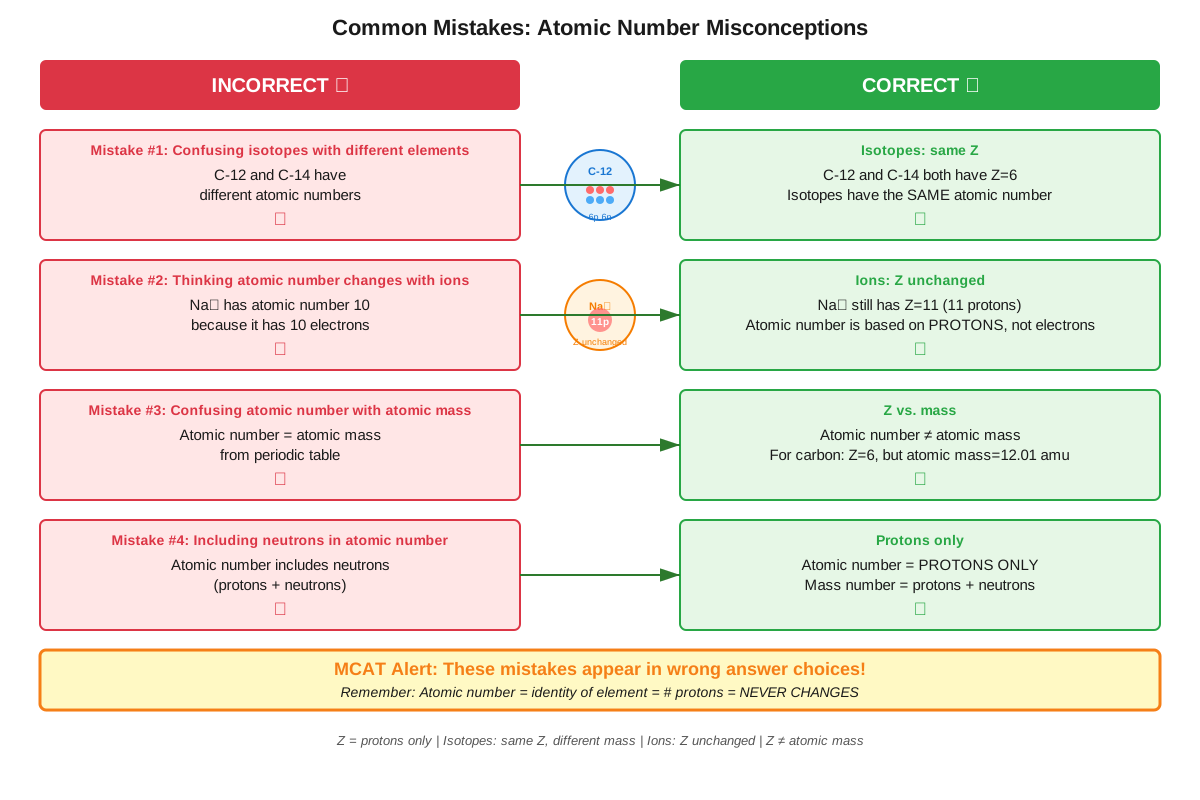
Misconception: Atomic number and mass number are the same thing
Correction: Atomic number (Z) is the number of protons only, while mass number (A) is the sum of protons and neutrons. Carbon-12 has atomic number 6 but mass number 12.
Misconception: When an atom becomes an ion, its atomic number changes
Correction: Atomic number never changes for a given atom—it defines the element's identity. When sodium (Z = 11) loses an electron to become Na⁺, it still has 11 protons and remains sodium. Only the electron count changes.
Misconception: Isotopes have different atomic numbers
Correction: Isotopes are defined as atoms with the same atomic number but different mass numbers. Carbon-12 and carbon-14 both have atomic number 6 (both are carbon) but differ in neutron count.
Misconception: The atomic number tells you the number of neutrons
Correction: Atomic number only tells you the number of protons. To find neutrons, you must subtract atomic number from mass number: N = A - Z.
Misconception: Atomic mass and mass number are interchangeable terms
Correction: Mass number is an integer representing the nucleon count in a specific isotope (e.g., 12 for carbon-12), while atomic mass is the weighted average of all isotopes (12.01 amu for carbon) and appears on the periodic table.
Misconception: Elements with higher atomic numbers are always heavier
Correction: While generally true, this refers to nuclear mass. In terms of atomic radius, elements with higher atomic numbers in the same period are actually smaller due to increased nuclear charge pulling electrons closer.
Misconception: You need to memorize the atomic number of every element
Correction: The MCAT provides a periodic table. Focus on understanding what atomic number represents and how to use it, rather than memorizing specific values. However, knowing common elements (H=1, C=6, N=7, O=8, Na=11, Cl=17, Ca=20) can save time.
Worked Examples
Example 1: Isotope Identification and Calculations
Question: An atom has 17 protons, 18 neutrons, and 18 electrons. (a) What is its atomic number? (b) What element is it? (c) What is its mass number? (d) What is its charge? (e) Write the complete isotope notation.
Solution:
(a) Atomic number: The atomic number equals the number of protons, regardless of neutrons or electrons.
- Z = 17
(b) Element identification: Looking at the periodic table, the element with atomic number 17 is chlorine (Cl).
(c) Mass number: Mass number is the sum of protons and neutrons.
- A = Z + N = 17 + 18 = 35
(d) Charge: A neutral atom has equal numbers of protons and electrons. This atom has 17 protons but 18 electrons.
- Charge = protons - electrons = 17 - 18 = -1
- This is a chloride ion (Cl⁻)
(e) Isotope notation: The complete notation is ³⁵₁₇Cl⁻ or simply Cl-35 with a -1 charge.
Key takeaway: This problem demonstrates that atomic number remains constant (17) and identifies the element as chlorine, even though the atom has gained an extra electron to become an ion. The mass number (35) reflects the specific isotope, while the charge (-1) indicates the ion state.
Example 2: Periodic Trend Prediction
Question: Consider three elements: Element A (Z = 11), Element B (Z = 12), and Element C (Z = 17). All are in Period 3. Without using a periodic table, predict: (a) Which element has the highest first ionization energy? (b) Which has the largest atomic radius? (c) Which is most likely to form a +2 cation?
Solution:
(a) Highest first ionization energy: Ionization energy increases across a period (left to right) as atomic number increases because effective nuclear charge increases, holding electrons more tightly.
- Element C (Z = 17) has the highest ionization energy
- The trend is: A < B < C
(b) Largest atomic radius: Atomic radius decreases across a period as atomic number increases because the increasing nuclear charge pulls electrons closer without adding new shells.
- Element A (Z = 11) has the largest atomic radius
- The trend is: A > B > C
(c) Most likely to form +2 cation: Element B (Z = 12) is most likely to form a +2 cation.
- With Z = 12, Element B is magnesium (though we're not using the periodic table, we can deduce it's in Group 2)
- Group 2 elements characteristically lose 2 electrons to achieve noble gas configuration
- Element A (Z = 11, sodium) would form +1, and Element C (Z = 17, chlorine) would form -1
Key takeaway: Atomic number directly determines periodic position, which allows prediction of trends. As Z increases across a period, nuclear charge increases, leading to smaller radius, higher ionization energy, and greater electronegativity. Understanding these relationships allows you to answer MCAT questions even with limited periodic table information.
Exam Strategy
Approaching MCAT Questions on Atomic Number
When encountering questions involving atomic number, follow this systematic approach:
- Identify what's being asked: Is the question asking about element identity, electron configuration, periodic trends, or isotope relationships?
- Locate the atomic number: Check if it's given directly, implied by element name/symbol, or needs to be calculated from other information
- Determine what remains constant: Remember that atomic number never changes for a given element, even when forming ions or comparing isotopes
- Apply the appropriate relationship: Use Z to find electrons (in neutral atoms), predict trends, or distinguish isotopes
Trigger Words and Phrases
Watch for these key phrases that signal atomic number concepts:
- "Number of protons" → directly refers to atomic number
- "Element identity" → determined by atomic number
- "Neutral atom" → atomic number = number of electrons
- "Isotopes of..." → same atomic number, different mass numbers
- "Across the period" → increasing atomic number, predict trends
- "Isoelectronic species" → same electron count, different atomic numbers
- "Nuclear charge" → directly related to atomic number (number of protons)
Process of Elimination Tips
When using process of elimination:
- Eliminate answers that confuse atomic number with mass number (atomic number is always smaller and is a whole number)
- Eliminate answers suggesting atomic number changes during ion formation (it never does)
- Eliminate answers that reverse periodic trends (e.g., claiming atomic radius increases with atomic number across a period)
- For isotope questions, eliminate answers that suggest different chemical properties (isotopes have identical chemistry because they have the same atomic number)
Time Allocation
Atomic number questions are typically straightforward and should take 30-60 seconds for discrete questions. For passage-based questions:
- Spend 10-15 seconds identifying the atomic number or element
- Spend 20-30 seconds applying the concept to the specific question
- Don't overthink—these questions usually test fundamental understanding rather than complex calculations
Exam Tip: If a question seems to require memorizing specific atomic numbers beyond common elements (H, C, N, O, Na, Cl, Ca), you're probably missing something. The MCAT provides a periodic table, so focus on understanding relationships rather than memorization.
Memory Techniques
Mnemonics for Common Elements
"Happy Cows Need Oxygen For Sodium Meals, Phosphorus Snacks, Chlorine Drinks, And Calcium"
- H (1), C (6), N (7), O (8), F (9), Na (11), Mg (12), P (15), S (16), Cl (17), Ca (20)
Visualization Strategy
Picture the periodic table as a "staircase of increasing atomic number" starting at hydrogen (top left) and descending to the right and down. Each step up in atomic number adds one proton to the nucleus. Visualize the nucleus growing larger (more protons) as you move through the periodic table.
Acronym for Atomic Number Properties
"PENI" - What atomic number tells you:
- Protons (number of)
- Element identity
- Neutral atom electrons (equals Z)
- Isotope distinction (same Z, different A)
Relationship Memory Aid
"Z is the ID, A is the weight, mass is the average"
- Z (atomic number) identifies the element like an ID card
- A (mass number) is the "weight" of that specific isotope
- Atomic mass is the weighted average of all isotopes
Trend Direction Memory
"Right and Up = Tight and Tough"
- Moving right (increasing Z) across a period: atoms get tighter (smaller radius), tougher to ionize (higher ionization energy)
- Moving up (decreasing Z) a group: same effect
Summary
The atomic number is the fundamental property that defines an element's identity by specifying the number of protons in its nucleus. Represented by the symbol Z, atomic number serves as the organizing principle of the periodic table and determines an element's position and chemical behavior. In neutral atoms, atomic number equals the number of electrons, which governs electron configuration and chemical reactivity. However, when atoms form ions, the atomic number remains constant even as electron count changes—this constancy makes atomic number the unchanging identifier of an element. Atomic number must be distinguished from mass number (protons plus neutrons) and atomic mass (weighted average of isotopes). Understanding atomic number enables prediction of periodic trends: as Z increases across a period, atomic radius decreases while ionization energy and electronegativity increase due to greater effective nuclear charge. Isotopes share the same atomic number but differ in mass number, giving them identical chemical properties but different physical properties. For the MCAT, atomic number serves as the foundation for understanding atomic structure, periodic trends, electron configuration, and nuclear chemistry—making it an essential concept that appears throughout the Chemical and Physical Foundations section.
Key Takeaways
- Atomic number (Z) equals the number of protons and uniquely identifies each element
- In neutral atoms, Z equals the number of electrons; in ions, electron count changes but Z remains constant
- Atomic number ≠ mass number ≠ atomic mass (know the distinctions)
- Isotopes have the same Z but different mass numbers due to varying neutron counts
- Increasing atomic number across a period drives periodic trends: smaller radius, higher ionization energy, greater electronegativity
- The periodic table is organized by increasing atomic number, which explains the periodicity of chemical properties
- Atomic number determines electron configuration in neutral atoms, which governs all chemical bonding and reactivity
Related Topics
Electron Configuration: Atomic number determines how electrons fill orbitals in neutral atoms, following the Aufbau principle, Hund's rule, and the Pauli exclusion principle. Mastering atomic number enables you to write electron configurations and predict chemical behavior.
Periodic Trends: Understanding how atomic number increases across periods and down groups explains trends in atomic radius, ionization energy, electron affinity, and electronegativity—all high-yield MCAT topics.
Isotopes and Nuclear Chemistry: Atomic number remains constant while mass number varies among isotopes, which is essential for understanding radioactive decay, nuclear stability, and medical imaging applications.
Effective Nuclear Charge: The net positive charge experienced by electrons depends on atomic number (total protons) minus shielding effects, explaining why periodic trends occur.
Ionic and Atomic Radius: Comparing sizes of atoms and ions requires understanding that atomic number determines nuclear charge, which affects how tightly electrons are held.
Quantum Numbers: The principal quantum number and electron shell structure relate directly to atomic number, as electrons fill shells in order as Z increases.
Practice CTA
Now that you've mastered the concept of atomic number and its central role in atomic structure and periodic trends, it's time to solidify your understanding through active practice. Test yourself with practice questions that challenge you to apply atomic number concepts to isotope identification, periodic trend prediction, and electron configuration problems. Use flashcards to reinforce the relationships between atomic number and related properties. Remember, the MCAT rewards not just knowledge but the ability to apply concepts quickly and accurately under pressure—and that skill comes only through deliberate practice. You've built a strong foundation; now strengthen it through application!
Sign up free to keep reading
Create a free AnvayaPrep account to finish this MCAT guide on Atomic number — plus flashcards and practice questions.