Overview
The mass number is one of the most fundamental properties of an atom, representing the total count of protons and neutrons in an atom's nucleus. This seemingly simple concept forms the foundation for understanding isotopes, nuclear chemistry, atomic mass calculations, and radioactive decay—all of which appear regularly on the MCAT. While the mass number itself is straightforward to calculate, its implications extend throughout General Chemistry, biochemistry, and even physics passages on the exam. Students who master this topic gain the ability to quickly identify isotopes, predict nuclear reactions, and solve stoichiometry problems involving isotopic abundance.
Understanding mass number is essential for the MCAT because it bridges atomic structure with practical applications in medicine and research. Nuclear medicine techniques like PET scans and radioactive tracers rely on specific isotopes distinguished by their mass numbers. The MCAT frequently tests this concept through questions about isotopic notation, average atomic mass calculations, and nuclear decay processes. Questions may appear as discrete items testing basic definitions or embedded within complex passages about radiopharmaceuticals, carbon dating, or mass spectrometry.
Within the broader context of Atomic Structure and Periodic Trends, mass number connects directly to atomic number, isotopes, and the organization of the periodic table. While the atomic number (number of protons) defines an element's identity and chemical properties, the mass number accounts for nuclear mass and stability. This distinction becomes critical when analyzing why certain isotopes are radioactive while others are stable, or when calculating the weighted average atomic mass listed on the periodic table. Mastering mass number early in MCAT preparation creates a solid foundation for more advanced topics in nuclear chemistry, thermodynamics, and even organic chemistry where isotopic labeling experiments appear.
Learning Objectives
- [ ] Define mass number using accurate General Chemistry terminology
- [ ] Explain why mass number matters for the MCAT
- [ ] Apply mass number to exam-style questions
- [ ] Identify common mistakes related to mass number
- [ ] Connect mass number to related General Chemistry concepts
- [ ] Calculate average atomic mass from isotopic abundance data using mass numbers
- [ ] Distinguish between mass number, atomic number, and atomic mass in various contexts
- [ ] Predict the mass number of products in nuclear decay reactions
Prerequisites
- Atomic structure basics: Understanding that atoms consist of protons, neutrons, and electrons is essential because mass number specifically counts nuclear particles
- Periodic table organization: Familiarity with how elements are arranged by atomic number enables quick identification of proton counts needed for mass number calculations
- Basic arithmetic and algebra: Required for calculating average atomic masses and solving isotope abundance problems
- Scientific notation: Necessary for expressing very small masses and performing calculations with atomic mass units
Why This Topic Matters
Clinical and Real-World Significance
Mass number has direct clinical applications that the MCAT loves to test. Radioactive isotopes used in diagnostic imaging (like Technetium-99m) and cancer treatment (like Iodine-131) are identified by their mass numbers. PET scans rely on Fluorine-18, a positron-emitting isotope whose mass number distinguishes it from stable Fluorine-19. Carbon-14 dating, used in archaeological and geological research, depends on understanding how this isotope (mass number 14) differs from the more abundant Carbon-12. Medical students must understand isotopic notation to interpret nuclear medicine reports and understand radiopharmaceutical mechanisms.
Exam Statistics and Question Types
Mass number appears on the MCAT with medium frequency, typically in 2-4 questions per exam either directly or as prerequisite knowledge. Questions fall into several categories:
- Discrete questions testing isotopic notation and basic definitions (15-20% of chemistry discrete items)
- Passage-based questions about nuclear medicine, radioactive decay, or mass spectrometry (appearing in approximately 10% of chemistry passages)
- Calculation problems requiring average atomic mass determination from isotope data
- Nuclear equation balancing where mass numbers must be conserved
Common Exam Contexts
The MCAT integrates mass number into passages about:
- Radiopharmaceutical development and mechanism of action
- Mass spectrometry analysis of organic compounds
- Carbon dating and geological time scales
- Nuclear power generation and radioactive waste
- Isotopic labeling in biochemical pathway studies
- Stable isotope ratios in environmental science
Core Concepts
Definition and Fundamental Properties
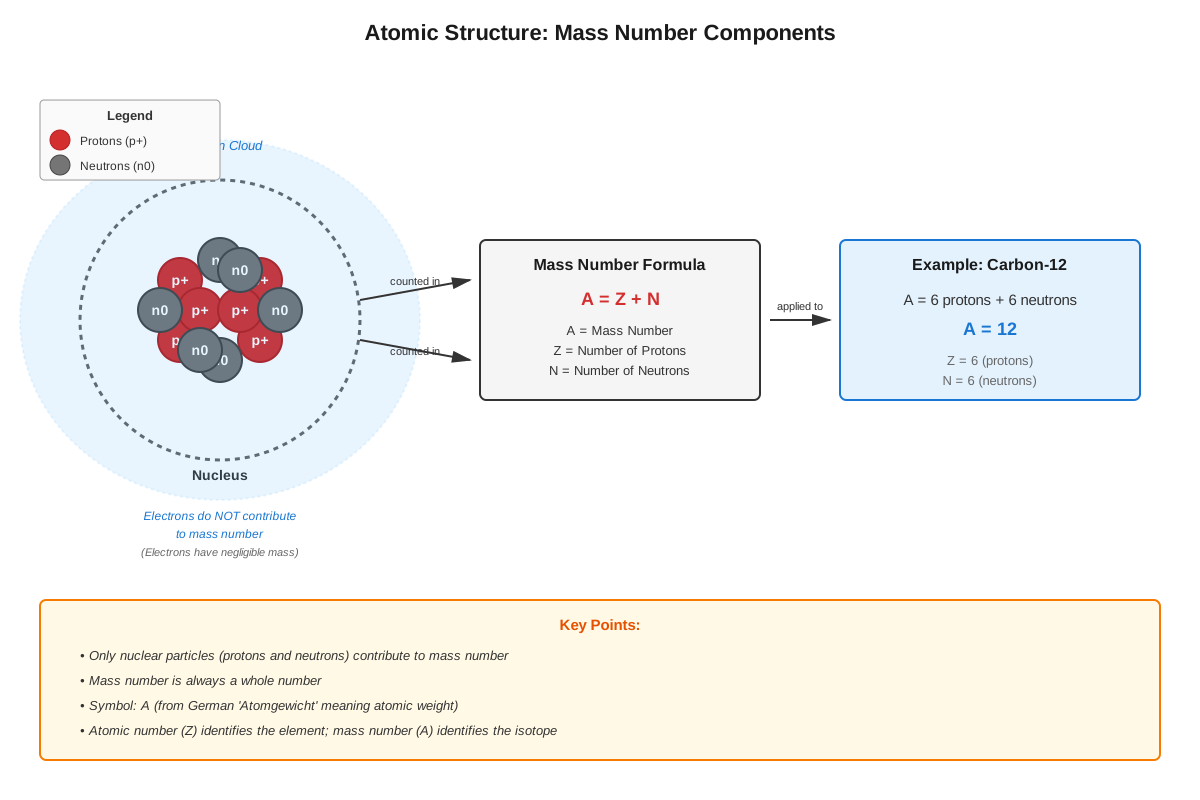
The mass number (symbol: A) is defined as the total number of protons and neutrons in an atom's nucleus. Mathematically, this relationship is expressed as:
A = Z + NWhere:
- A = mass number (always a whole number)
- Z = atomic number (number of protons)
- N = number of neutrons
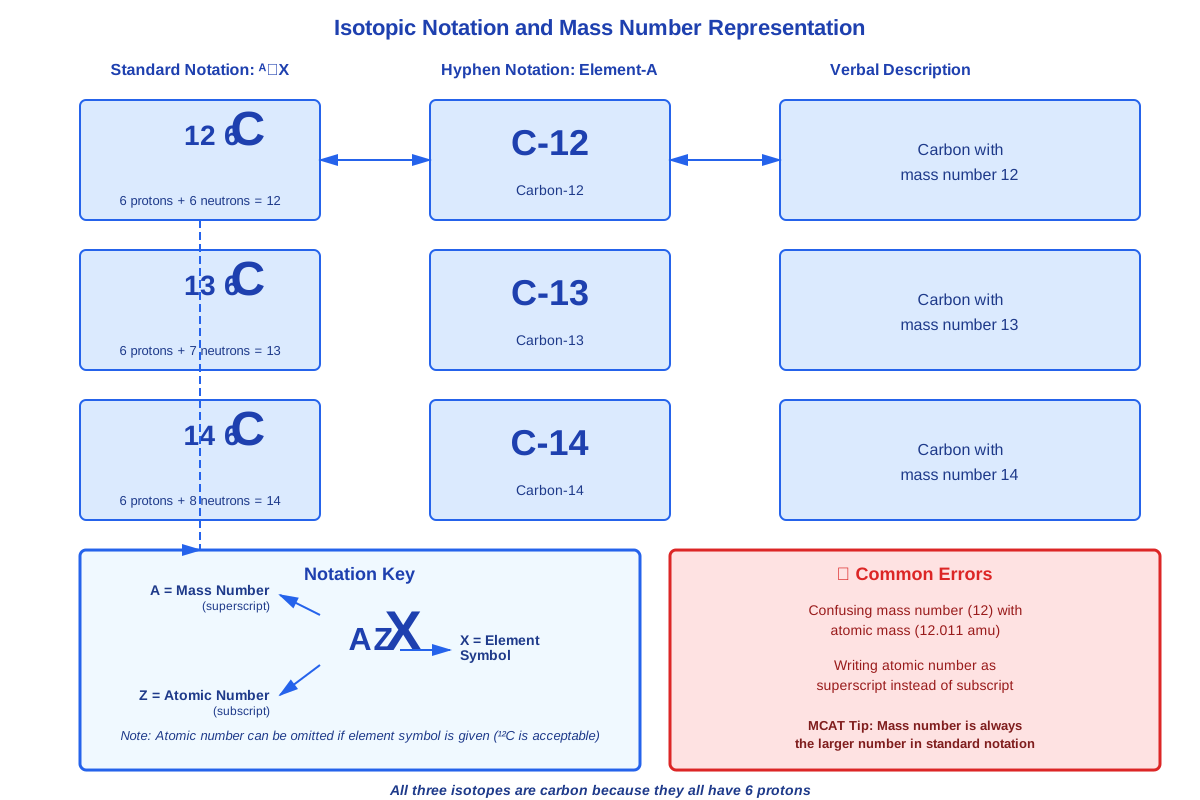
The mass number is always written as a superscript to the left of the element symbol in isotopic notation. For example, Carbon-12 is written as ¹²C or 12C, where 12 is the mass number. This notation immediately tells us that this carbon atom contains 12 total nuclear particles.
Unlike atomic mass (which is measured in atomic mass units and includes decimal values), mass number is always an integer because you cannot have a fractional proton or neutron. This distinction is crucial for MCAT questions that attempt to confuse these related but distinct concepts.
Isotopes and Mass Number Variation
Isotopes are atoms of the same element (same atomic number) that have different mass numbers due to varying numbers of neutrons. This concept is inseparable from understanding mass number. For example:
| Isotope | Notation | Protons (Z) | Neutrons (N) | Mass Number (A) |
|---|---|---|---|---|
| Hydrogen-1 | ¹H | 1 | 0 | 1 |
| Hydrogen-2 (Deuterium) | ²H | 1 | 1 | 2 |
| Hydrogen-3 (Tritium) | ³H | 1 | 2 | 3 |
| Carbon-12 | ¹²C | 6 | 6 | 12 |
| Carbon-13 | ¹³C | 6 | 7 | 13 |
| Carbon-14 | ¹⁴C | 6 | 8 | 14 |
All hydrogen isotopes have 1 proton (defining them as hydrogen), but their different neutron counts give them different mass numbers. This variation affects nuclear stability, with some isotopes being radioactive (like ³H and ¹⁴C) while others are stable (like ¹H and ¹²C).
Mass Number vs. Atomic Mass
A critical distinction for MCAT success involves differentiating mass number from atomic mass:
Mass number is:
- An integer (whole number)
- The count of protons plus neutrons in a specific isotope
- Different for each isotope of an element
- Used in isotopic notation
Atomic mass (or atomic weight) is:
- A decimal number
- The weighted average of all naturally occurring isotopes
- Listed on the periodic table
- Measured in atomic mass units (amu or u)
For example, the periodic table lists carbon's atomic mass as 12.01 amu. This is NOT the mass number of any carbon isotope. Instead, it reflects the weighted average of Carbon-12 (98.9% natural abundance) and Carbon-13 (1.1% natural abundance), with trace amounts of Carbon-14.
Calculating Average Atomic Mass
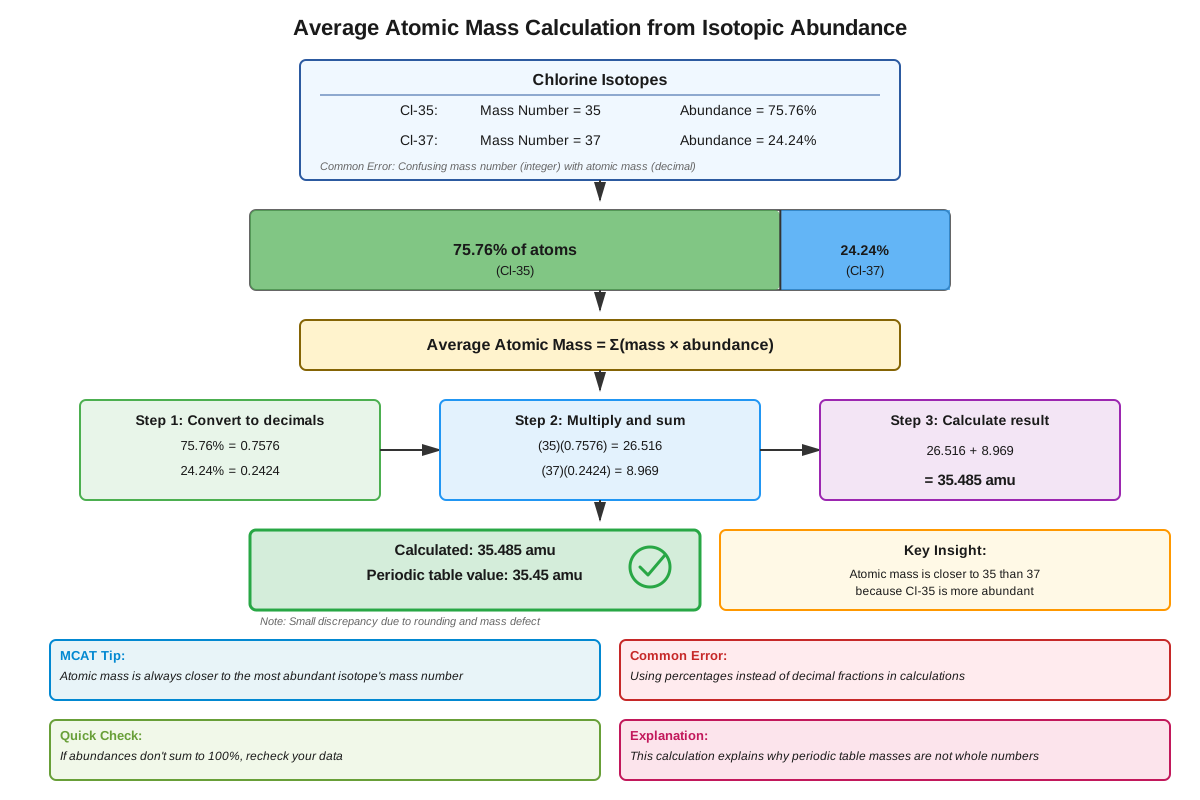
The MCAT frequently tests the ability to calculate average atomic mass from isotopic data using mass numbers. The formula is:
Average Atomic Mass = Σ(mass number × fractional abundance)The fractional abundance is the percentage abundance divided by 100. This calculation requires understanding that each isotope contributes to the average proportionally to how common it is in nature.
Mass Number in Nuclear Reactions
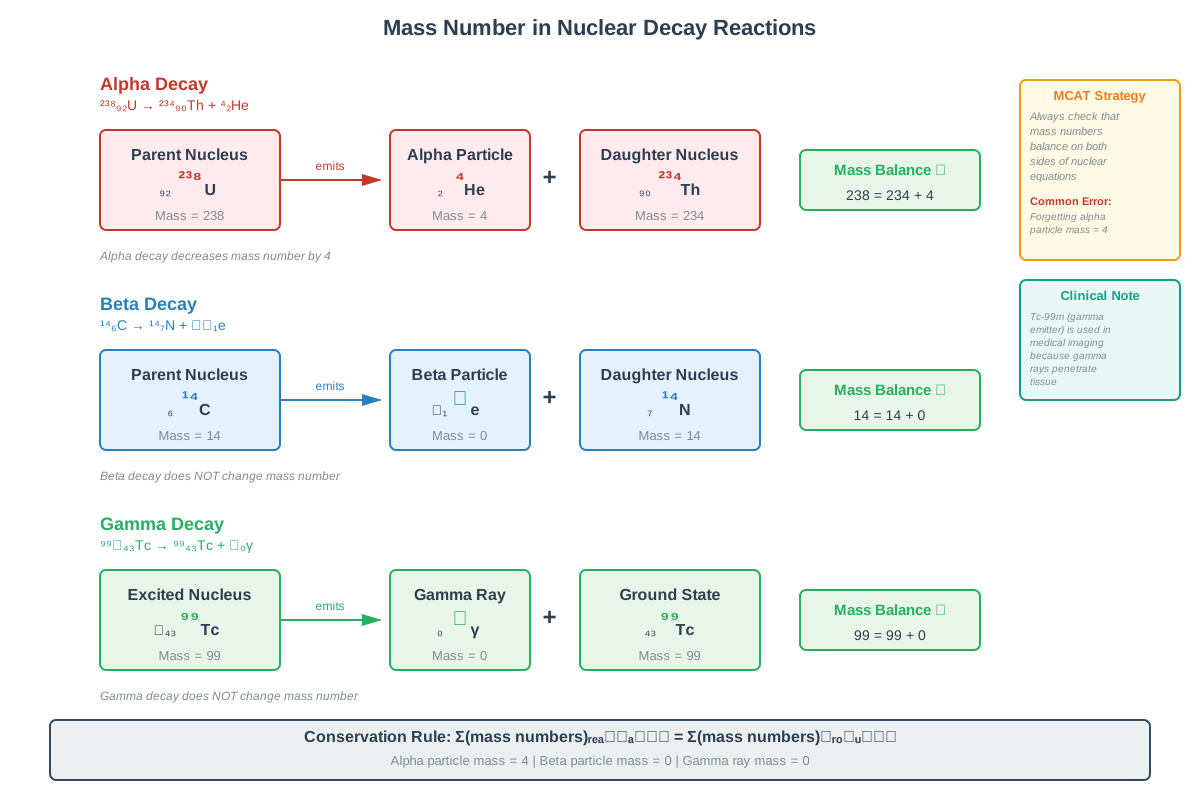
In nuclear reactions, mass number must be conserved—the sum of mass numbers on the reactant side must equal the sum on the product side. This principle allows prediction of unknown products in nuclear decay equations.
For alpha decay:
²³⁸U → ²³⁴Th + ⁴HeMass numbers: 238 = 234 + 4 ✓
For beta decay:
¹⁴C → ¹⁴N + ⁰eMass numbers: 14 = 14 + 0 ✓
Notice that in beta decay, the mass number remains unchanged because a neutron converts to a proton, keeping the total nuclear particle count constant.
Standard Isotopic Notation
The complete isotopic notation includes both mass number and atomic number:
ᴬX
 ᶻ
Where A is the mass number (top) and Z is the atomic number (bottom). For example:
- ¹²C represents Carbon-12
⁶
- ²³⁵U represents Uranium-235
⁹²
The atomic number is sometimes omitted in shorthand notation (like ¹²C) because the element symbol already identifies the number of protons. However, including both numbers is useful for balancing nuclear equations and avoiding ambiguity.
Relationship to Nuclear Stability
The ratio of neutrons to protons (N/Z ratio), which can be derived from mass number and atomic number, determines nuclear stability. For lighter elements (Z < 20), stable nuclei typically have N/Z ratios close to 1. For heavier elements, stable nuclei require more neutrons than protons (N/Z > 1) to overcome proton-proton repulsion.
Isotopes with mass numbers far from the stable range for their element tend to be radioactive. For example, Carbon-12 and Carbon-13 are stable, but Carbon-14 (with two extra neutrons) undergoes beta decay. Understanding this relationship helps predict which isotopes might be used in medical applications or pose radiation hazards.
Concept Relationships
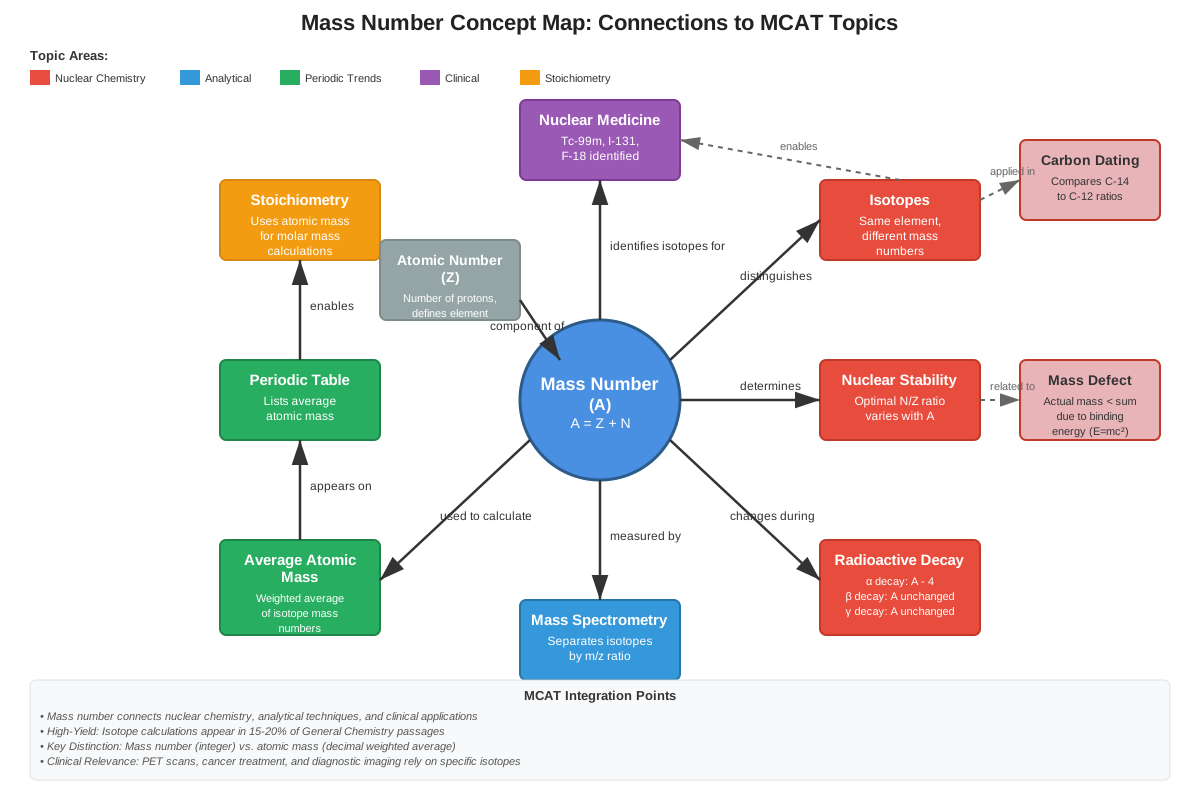
The mass number serves as a central hub connecting multiple concepts in General Chemistry and Atomic Structure and Periodic Trends:
Atomic Number → Mass Number: The atomic number (Z) defines the element's identity and determines the minimum mass number possible (when N = 0, though this is rare). Adding neutrons to the proton count gives the mass number.
Mass Number → Isotopes: Different mass numbers for the same element create isotopes. This relationship is bidirectional—knowing an element has multiple isotopes immediately tells us multiple mass numbers exist for that element.
Mass Number + Isotopic Abundance → Atomic Mass: The weighted average of mass numbers (adjusted for actual nuclear masses) produces the atomic mass on the periodic table. This calculation bridges the discrete nature of individual atoms with bulk properties.
Mass Number → Nuclear Stability: The mass number, combined with atomic number, determines the N/Z ratio, which predicts whether an isotope is stable or radioactive. This connects to radioactive decay and nuclear chemistry.
Mass Number Conservation → Nuclear Reactions: In all nuclear processes, mass number conservation provides a tool for balancing equations and predicting products, linking to stoichiometry and reaction mechanisms.
Mass Number → Mass Spectrometry: Mass spectrometers separate ions by mass-to-charge ratio, which for singly charged ions directly reflects mass number. This connects atomic structure to analytical chemistry techniques.
The prerequisite knowledge of atomic structure (protons, neutrons, electrons) provides the foundation, while mass number enables progression to more complex topics like radioactive decay kinetics, nuclear binding energy, and isotopic labeling in biochemistry.
Quick check — test yourself on Mass number so far.
Try Flashcards →High-Yield Facts
⭐ Mass number (A) equals the sum of protons (Z) and neutrons (N) in an atom's nucleus
⭐ Mass number is always a whole number, while atomic mass is a decimal representing a weighted average
⭐ Isotopes of an element have the same atomic number but different mass numbers
⭐ In nuclear reactions, the sum of mass numbers must be conserved on both sides of the equation
⭐ The mass number is written as a superscript to the left of the element symbol (e.g., ¹²C)
- Carbon-12 is the standard reference for atomic mass units, defined as exactly 12 amu
- Most elements exist naturally as mixtures of isotopes with different mass numbers
- Beta decay changes atomic number but not mass number (neutron → proton + electron)
- Alpha decay decreases mass number by 4 and atomic number by 2
- The most abundant isotope of an element usually has a mass number closest to the atomic mass on the periodic table
- Hydrogen is the only element with specific names for its isotopes: protium (¹H), deuterium (²H), and tritium (³H)
- Mass number does not account for electrons because their mass is negligible (~1/2000 of a proton)
- Neutron number can be calculated by subtracting atomic number from mass number: N = A - Z
Common Misconceptions
Misconception: Mass number and atomic mass are the same thing.
Correction: Mass number is an integer count of nuclear particles in a specific isotope, while atomic mass is the weighted average of all naturally occurring isotopes expressed in atomic mass units. The periodic table shows atomic mass (12.01 for carbon), not mass number (12 for Carbon-12).
Misconception: The mass number changes during chemical reactions.
Correction: Mass number only changes during nuclear reactions, not chemical reactions. Chemical reactions involve electron rearrangement and do not affect the nucleus. The same isotope entering a chemical reaction exits with the same mass number.
Misconception: All atoms of an element have the same mass number.
Correction: Atoms of the same element have the same atomic number (protons) but can have different mass numbers due to varying neutron counts. These are called isotopes. For example, Chlorine-35 and Chlorine-37 are both chlorine but have different mass numbers.
Misconception: The atomic number is always smaller than the mass number.
Correction: While this is true for most atoms (since they contain neutrons), Hydrogen-1 (protium) has an atomic number of 1 and a mass number of 1 because it has zero neutrons. The relationship is A ≥ Z, not A > Z.
Misconception: Mass number includes electrons.
Correction: Mass number only counts protons and neutrons in the nucleus. Electrons have negligible mass (~0.0005 amu) and are not included in the mass number calculation, though they are included in precise atomic mass measurements.
Misconception: Isotopes with higher mass numbers are always radioactive.
Correction: While many heavy isotopes are radioactive, mass number alone doesn't determine stability. The neutron-to-proton ratio is more important. For example, Carbon-13 (mass number 13) is stable, while Carbon-14 (mass number 14) is radioactive, but both are considered "heavy" isotopes of carbon.
Misconception: The mass number in amu equals the actual mass of the atom.
Correction: The mass number is a dimensionless count of particles. The actual mass in amu is close to but not exactly equal to the mass number due to nuclear binding energy (mass defect). For example, Carbon-12 is defined as exactly 12 amu, but Carbon-13 has an actual mass of 13.003 amu, not exactly 13.
Worked Examples
Example 1: Calculating Average Atomic Mass from Isotope Data
Problem: Chlorine exists naturally as two isotopes: Chlorine-35 (mass number 35) with 75.8% abundance and Chlorine-37 (mass number 37) with 24.2% abundance. Calculate the average atomic mass of chlorine.
Solution:
Step 1: Convert percentages to fractional abundances
- Cl-35: 75.8% = 0.758
- Cl-37: 24.2% = 0.242
Step 2: Apply the weighted average formula
Average Atomic Mass = (mass₁ × abundance₁) + (mass₂ × abundance₂)Step 3: Substitute values
Average Atomic Mass = (35 × 0.758) + (37 × 0.242)Step 4: Calculate
Average Atomic Mass = 26.53 + 8.954 = 35.48 amuAnswer: The average atomic mass of chlorine is 35.48 amu (which matches the periodic table value of 35.45 amu, with slight differences due to rounding and actual nuclear masses being slightly different from mass numbers).
Connection to Learning Objectives: This problem demonstrates how mass numbers of individual isotopes combine with abundance data to produce the atomic mass, distinguishing between these related concepts and applying mass number to quantitative calculations.
Example 2: Balancing Nuclear Equations Using Mass Number Conservation
Problem: Complete the following nuclear decay equation and identify the type of decay:
²²⁶Ra → ? + ⁴He
⁸⁸ ²Solution:
Step 1: Identify what we know
- Reactant: Radium-226 (mass number = 226, atomic number = 88)
- One product: Helium-4 (alpha particle, mass number = 4, atomic number = 2)
- Unknown product: ?
Step 2: Apply mass number conservation
Mass number (reactant) = Mass number (products)
226 = A(unknown) + 4
A(unknown) = 226 - 4 = 222
Step 3: Apply atomic number conservation
Atomic number (reactant) = Atomic number (products)
88 = Z(unknown) + 2
Z(unknown) = 88 - 2 = 86
Step 4: Identify the element with Z = 86
- Element with atomic number 86 is Radon (Rn)
Step 5: Write the complete equation
²²⁶Ra → ²²²Rn + ⁴He
⁸⁸ ⁸⁶ ²Answer: The unknown product is Radon-222, and this is alpha decay (emission of a helium nucleus).
Connection to Learning Objectives: This problem applies mass number conservation to predict nuclear reaction products, demonstrates proper isotopic notation, and connects mass number to nuclear chemistry—a common MCAT question type.
Exam Strategy
Approaching MCAT Questions on Mass Number
When encountering mass number questions on the MCAT, follow this systematic approach:
- Identify the question type: Is it asking for a definition, calculation, or application to nuclear reactions?
- Check isotopic notation carefully: Distinguish between superscripts (mass number) and subscripts (atomic number)
- Write out the formula A = Z + N if calculating any of these three values
- For average atomic mass problems: Set up the weighted average formula before calculating
- For nuclear equations: Write conservation equations for both mass number and atomic number separately
Trigger Words and Phrases
Watch for these key phrases that signal mass number concepts:
- "Isotope" → Different mass numbers for the same element
- "Nuclear reaction" or "radioactive decay" → Mass number conservation required
- "Average atomic mass" or "atomic weight" → Weighted average of mass numbers
- "Mass spectrometry" → Separation by mass number (for singly charged ions)
- "Neutron number" → Calculate using N = A - Z
- "Alpha particle" or "⁴He" → Mass number decreases by 4
- "Beta particle" or "electron" → Mass number unchanged
- "Notation ᴬX" → A is the mass number
ᶻ
Process of Elimination Tips
When unsure of an answer:
- Eliminate options confusing mass number with atomic number: Mass number is always ≥ atomic number
- Eliminate decimal answers for mass number questions: Mass number must be a whole number
- Check conservation: In nuclear equations, eliminate any option that doesn't conserve mass number
- Use periodic table values: If the question involves a real element, the correct average atomic mass should be close to the periodic table value
- Eliminate isotopes with impossible neutron counts: Very few stable isotopes have more than 1.5 times as many neutrons as protons
Time Allocation Advice
- Discrete mass number questions: 30-45 seconds (straightforward definition or simple calculation)
- Isotope abundance calculations: 60-90 seconds (requires setup and arithmetic)
- Nuclear equation balancing: 45-60 seconds (systematic application of conservation laws)
- Passage-based questions: 60-90 seconds after passage reading (may require integrating multiple concepts)
Exam Tip: If a question seems to require complex calculations with mass number, check whether you can estimate or use the answer choices to work backwards. The MCAT rarely requires extensive arithmetic—there's usually a conceptual shortcut.
Memory Techniques
Mnemonics
"A = Z + N" can be remembered as "Amazing Zebras Need" (A equals Z plus N)
"PAN" for the three nuclear particles counted differently:
- Protons: counted in both atomic number AND mass number
- Atomic number: protons only
- Neutrons: mass number minus atomic number
"MASS" for what mass number represents:
- Measure of nuclear particles
- Always a whole number
- Sum of protons and neutrons
- Superscript in notation
Visualization Strategy
Picture the atom as a building:
- The foundation (atomic number) determines what building it is (element identity)
- The total floors (mass number) can vary for the same building type (isotopes)
- The extra floors above the foundation are neutrons (N = A - Z)
Acronym for Nuclear Decay Effects
"ABBA" for remembering decay effects on mass number:
- Alpha decay: Big decrease (mass number drops by 4)
- Beta decay: Absolutely no change (mass number stays the same)
Isotope Notation Memory Aid
Remember isotopic notation position with "SUPER-hero stands ABOVE":
- SUPERscript = mass number
- ABOVE the element symbol
The atomic number goes below (subscript) like a "sub-marine" goes under water.
Summary
Mass number is the fundamental count of protons and neutrons in an atom's nucleus, expressed as a whole number and written as a superscript in isotopic notation. This concept distinguishes individual isotopes of an element and differs critically from atomic mass, which is the weighted average of all naturally occurring isotopes. Understanding mass number enables students to balance nuclear equations through conservation principles, calculate average atomic masses from isotopic abundance data, and interpret nuclear medicine applications. The MCAT tests this concept through discrete questions on definitions and notation, calculation problems involving isotope abundance, and passage-based questions about radioactive decay and mass spectrometry. Success requires distinguishing mass number from related concepts (atomic number, atomic mass), applying the formula A = Z + N systematically, and recognizing that mass number only changes during nuclear reactions, not chemical reactions. Mastery of mass number provides the foundation for understanding nuclear stability, radioactive decay mechanisms, and isotopic applications in medicine and research.
Key Takeaways
- Mass number (A) = protons (Z) + neutrons (N) and is always a whole number representing nuclear particle count
- Isotopes have identical atomic numbers but different mass numbers due to varying neutron counts
- Mass number ≠ atomic mass: mass number is an integer for one isotope; atomic mass is a weighted average decimal
- Mass number is conserved in nuclear reactions, enabling prediction of unknown products in decay equations
- Isotopic notation places mass number as a superscript to the left of the element symbol (e.g., ¹²C)
- Average atomic mass calculations require multiplying each isotope's mass number by its fractional abundance
- Mass number only changes during nuclear reactions, never during chemical reactions involving electron transfer
Related Topics
Atomic Number and Element Identity: Understanding how proton count defines elements while mass number can vary enables deeper comprehension of periodic table organization and chemical properties.
Isotopes and Nuclear Stability: Building on mass number knowledge, this topic explores why certain neutron-to-proton ratios create stable versus radioactive isotopes, connecting to nuclear medicine applications.
Radioactive Decay: Mass number conservation becomes essential for balancing alpha, beta, and gamma decay equations, predicting decay products, and understanding half-life calculations.
Mass Spectrometry: This analytical technique separates ions by mass-to-charge ratio, directly applying mass number concepts to identify compounds and determine isotopic composition.
Nuclear Binding Energy and Mass Defect: Advanced topics showing why actual atomic masses differ slightly from mass numbers due to Einstein's mass-energy equivalence (E = mc²).
Average Atomic Mass Calculations: Quantitative problems requiring weighted averages of isotope mass numbers appear frequently on the MCAT and in general chemistry courses.
Practice CTA
Now that you've mastered the fundamentals of mass number, it's time to solidify your understanding through active practice. Attempt the practice questions and flashcards associated with this topic to test your ability to distinguish mass number from related concepts, perform isotope abundance calculations, and balance nuclear equations. Remember, the MCAT rewards not just knowledge but the ability to apply concepts quickly and accurately under time pressure. Each practice question you complete builds the pattern recognition and problem-solving speed essential for test day success. You've built a strong foundation—now strengthen it through deliberate practice!
Sign up free to keep reading
Create a free AnvayaPrep account to finish this MCAT guide on Mass number — plus flashcards and practice questions.