Overview
Dipole-dipole forces represent a critical category of intermolecular forces that govern the physical properties and behavior of polar molecules. These electrostatic attractions occur between the positive end of one polar molecule and the negative end of another, creating a network of interactions that significantly influence boiling points, melting points, solubility, and vapor pressure. Understanding dipole-dipole forces is fundamental to mastering Bonding and Molecular Structure within General Chemistry, as these forces bridge the gap between molecular-level properties and macroscopic observations that appear frequently in MCAT passages.
For the MCAT, dipole-dipole forces MCAT questions typically appear in contexts requiring students to predict relative boiling points, explain solubility patterns, or analyze experimental data involving polar substances. The Chemical and Physical Foundations of Biological Systems section regularly tests the ability to distinguish between different types of intermolecular forces and predict their relative strengths. Questions may present molecular structures and ask students to rank compounds by physical properties, or provide experimental data requiring interpretation based on intermolecular force strength. Mastery of this topic enables students to quickly eliminate incorrect answer choices and confidently approach passages involving phase transitions, chromatography, or molecular recognition.
Within the broader landscape of General Chemistry, dipole-dipole forces connect intimately with electronegativity, molecular geometry, London dispersion forces, and hydrogen bonding. These forces represent the intermediate strength category of intermolecular attractions—stronger than London dispersion forces but generally weaker than hydrogen bonds. Understanding dipole-dipole interactions provides the foundation for predicting molecular behavior in biological systems, pharmaceutical design, and biochemical processes that form the core of MCAT content.
Learning Objectives
- [ ] Define dipole-dipole forces using accurate General Chemistry terminology
- [ ] Explain why dipole-dipole forces matters for the MCAT
- [ ] Apply dipole-dipole forces to exam-style questions
- [ ] Identify common mistakes related to dipole-dipole forces
- [ ] Connect dipole-dipole forces to related General Chemistry concepts
- [ ] Quantitatively compare the relative strengths of dipole-dipole forces to other intermolecular forces
- [ ] Predict physical properties of compounds based on the presence and strength of dipole-dipole interactions
- [ ] Analyze molecular structures to determine whether dipole-dipole forces will be the dominant intermolecular attraction
Prerequisites
- Electronegativity and bond polarity: Understanding electronegativity differences creates the foundation for recognizing when bonds are polar, which is essential for identifying molecules capable of dipole-dipole interactions
- Molecular geometry and VSEPR theory: Molecular shape determines whether individual bond dipoles cancel or create a net molecular dipole, making geometry critical for predicting dipole-dipole force presence
- Lewis structures: The ability to draw accurate Lewis structures enables identification of molecular polarity and prediction of dipole moments
- Intermolecular vs. intramolecular forces: Distinguishing between forces within molecules (bonds) and between molecules (intermolecular forces) prevents conceptual confusion about what dipole-dipole forces actually represent
Why This Topic Matters
Clinical and Real-World Significance
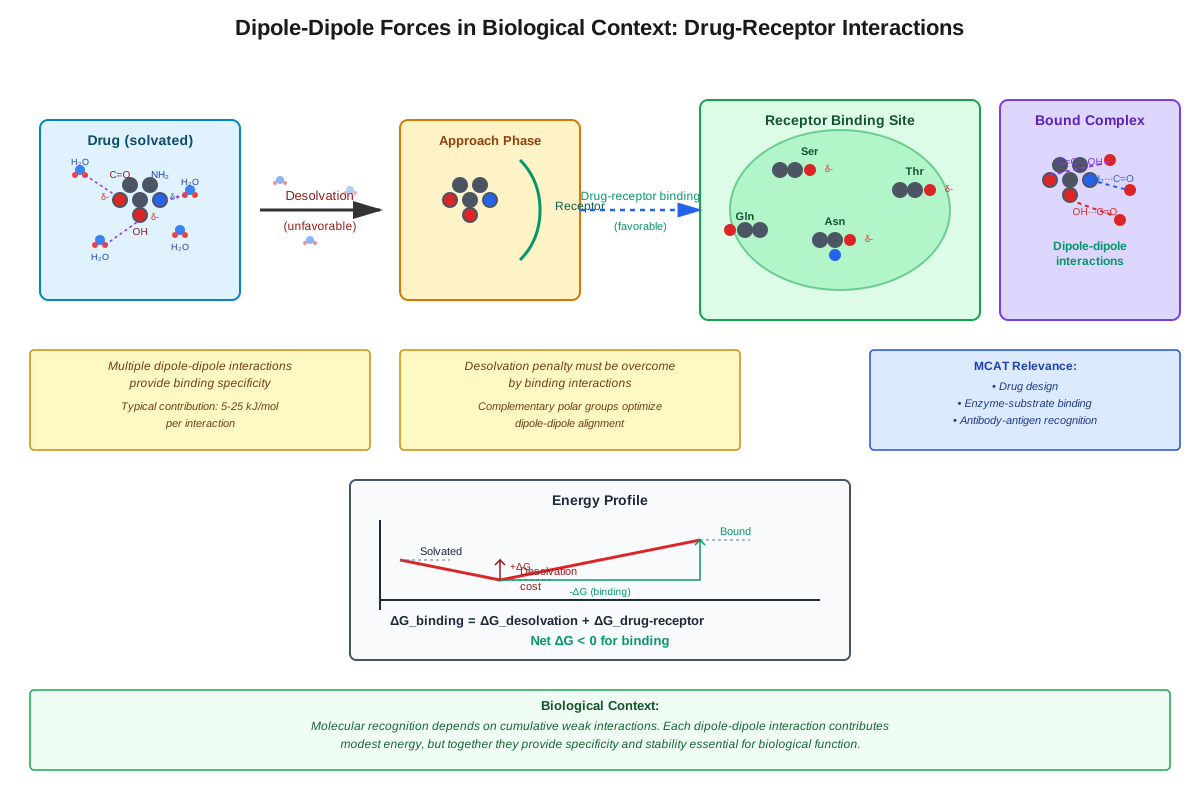
Dipole-dipole forces govern countless biological and pharmaceutical processes. Drug solubility in aqueous environments depends heavily on the ability of polar drug molecules to form dipole-dipole interactions with water. Membrane permeability, protein folding, and enzyme-substrate recognition all involve dipole-dipole interactions as part of the complex network of forces stabilizing biological structures. Anesthetics, for example, must possess appropriate polarity to cross lipid membranes while maintaining sufficient dipole-dipole interactions to reach target sites. Understanding these forces enables prediction of drug distribution, metabolism, and efficacy.
MCAT Exam Statistics
Dipole-dipole forces appear in approximately 3-5 questions per MCAT exam, either as the primary focus or as part of broader questions about intermolecular forces. These questions most commonly appear in:
- Standalone questions asking students to rank compounds by boiling point or solubility
- Passage-based questions involving chromatography, where polarity determines retention time
- Experimental analysis passages presenting data on phase transitions or vapor pressure
- Biochemistry passages discussing protein structure or membrane transport
Common Exam Contexts
The MCAT frequently embeds dipole-dipole force questions within passages about separation techniques (distillation, chromatography), pharmaceutical development, or physical property measurements. Questions may present structural formulas and ask students to identify which compound has the highest boiling point, or provide experimental boiling point data and ask students to explain the trend. Recognizing dipole-dipole forces as the underlying principle allows rapid problem-solving and confident answer selection.
Core Concepts
Definition and Fundamental Nature
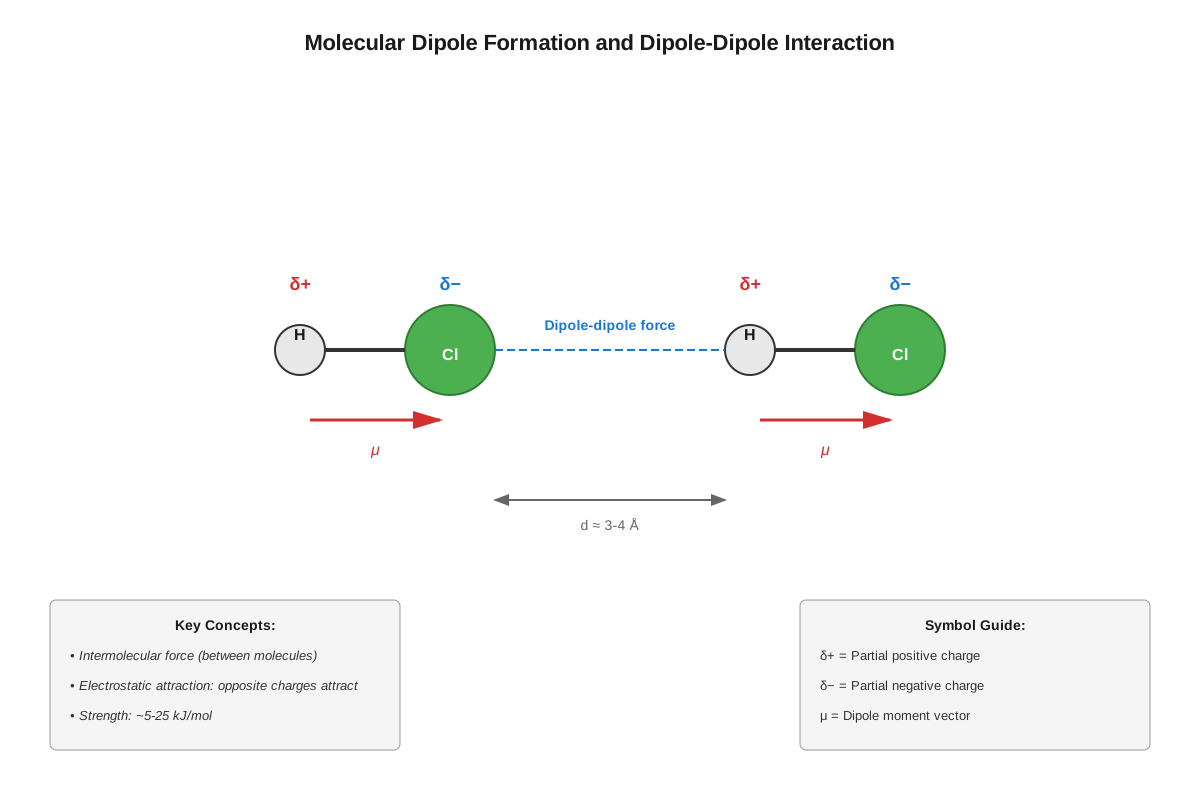
Dipole-dipole forces are electrostatic attractions between the partially positive end of one polar molecule and the partially negative end of another polar molecule. These forces arise when molecules possess a permanent dipole moment—a separation of charge resulting from unequal electron distribution within the molecule. The strength of dipole-dipole interactions depends on the magnitude of the dipole moments involved and the distance between molecules.
The term "dipole" refers to the separation of positive and negative charge centers within a molecule. When a bond forms between atoms with different electronegativities, electrons spend more time near the more electronegative atom, creating a partial negative charge (δ-) on that atom and a partial positive charge (δ+) on the less electronegative atom. If the molecular geometry does not cause these individual bond dipoles to cancel, the molecule possesses a net dipole moment and can participate in dipole-dipole interactions.
Requirements for Dipole-Dipole Forces
For dipole-dipole forces to exist as the dominant intermolecular attraction, three conditions must be met:
- Polar bonds must be present: At least one bond in the molecule must connect atoms with significantly different electronegativities (typically a difference > 0.4)
- Molecular geometry must not cancel bond dipoles: The three-dimensional arrangement of atoms must result in a net molecular dipole moment
- The molecule must not be capable of hydrogen bonding: If N-H, O-H, or F-H bonds are present, hydrogen bonding (a special, stronger type of dipole-dipole interaction) becomes the dominant force
Molecular Polarity and Geometry
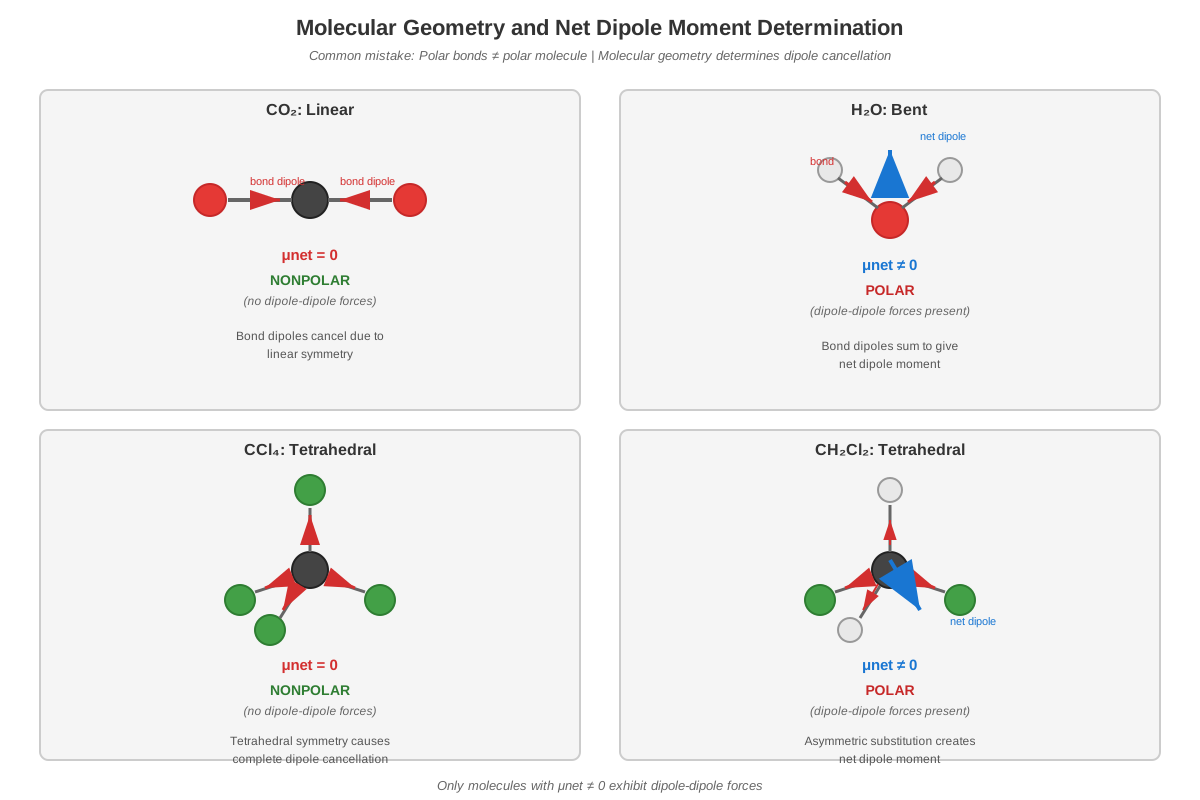
Understanding the relationship between molecular geometry and net dipole moment is crucial for predicting dipole-dipole forces. Consider these examples:
| Molecule | Geometry | Individual Bond Polarity | Net Dipole? | Dipole-Dipole Forces? |
|---|---|---|---|---|
| CO₂ | Linear | C=O bonds are polar | No (cancel) | No |
| H₂O | Bent | O-H bonds are polar | Yes | Yes (H-bonding dominant) |
| CH₃Cl | Tetrahedral | C-Cl bond is polar | Yes | Yes |
| CCl₄ | Tetrahedral | C-Cl bonds are polar | No (cancel) | No |
| NH₃ | Trigonal pyramidal | N-H bonds are polar | Yes | Yes (H-bonding dominant) |
| CH₂Cl₂ | Tetrahedral | C-Cl bonds are polar | Yes | Yes |
The key insight is that symmetrical molecules with polar bonds often have no net dipole because the individual bond dipoles are vectors that cancel when summed. Asymmetrical molecules or molecules with lone pairs typically possess net dipole moments.
Strength of Dipole-Dipole Forces
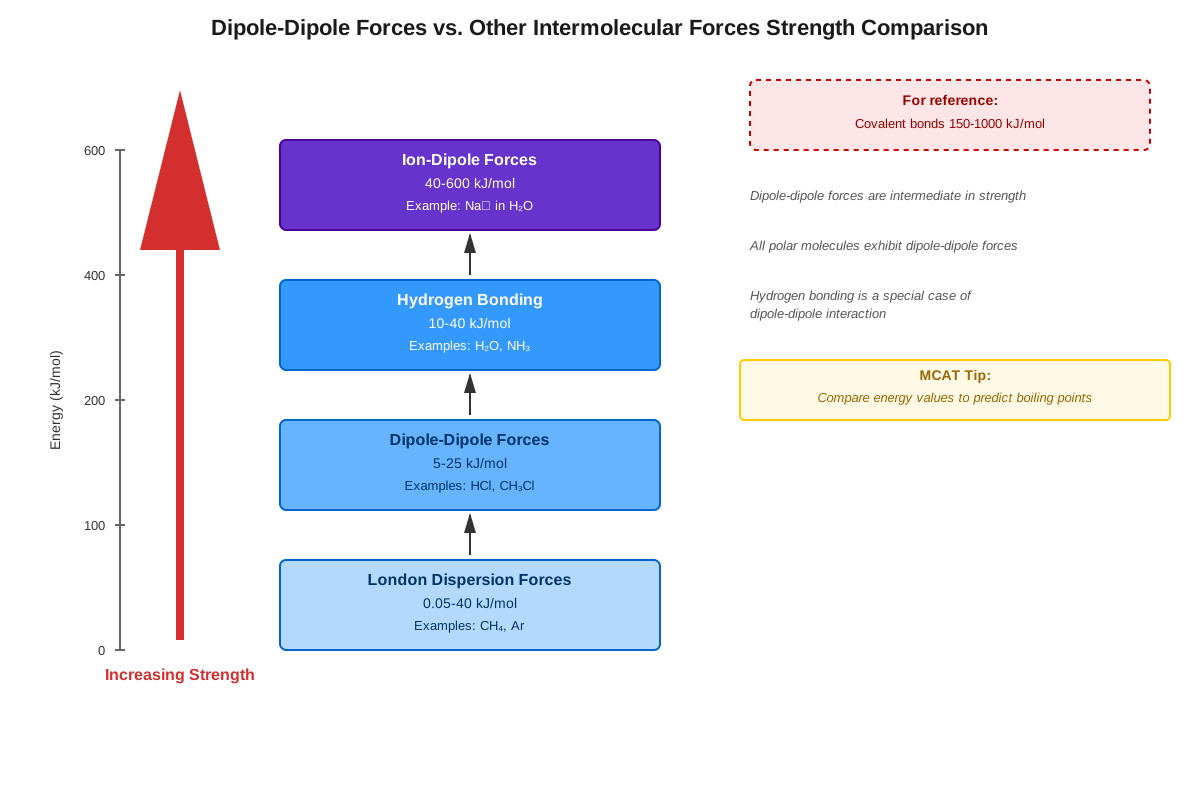
Dipole-dipole forces are intermediate in strength among intermolecular forces. The typical energy range is 5-25 kJ/mol, compared to:
- London dispersion forces: 1-10 kJ/mol (weakest)
- Dipole-dipole forces: 5-25 kJ/mol (intermediate)
- Hydrogen bonds: 10-40 kJ/mol (strongest intermolecular force)
- Covalent bonds: 150-1000 kJ/mol (intramolecular, much stronger)
The strength of dipole-dipole interactions increases with:
- Greater dipole moment magnitude: Molecules with larger charge separations experience stronger attractions
- Closer molecular approach: Force strength follows Coulomb's law, increasing as distance decreases
- More favorable molecular orientation: Maximum attraction occurs when molecules align with opposite charges adjacent
Temperature Dependence
Temperature significantly affects dipole-dipole forces. At higher temperatures, increased kinetic energy causes molecules to move more rapidly and randomly, disrupting the favorable orientations that maximize dipole-dipole attractions. This explains why substances held together primarily by dipole-dipole forces have moderate boiling points—sufficient thermal energy can overcome these interactions, but more energy is required than for substances with only London dispersion forces.
Impact on Physical Properties
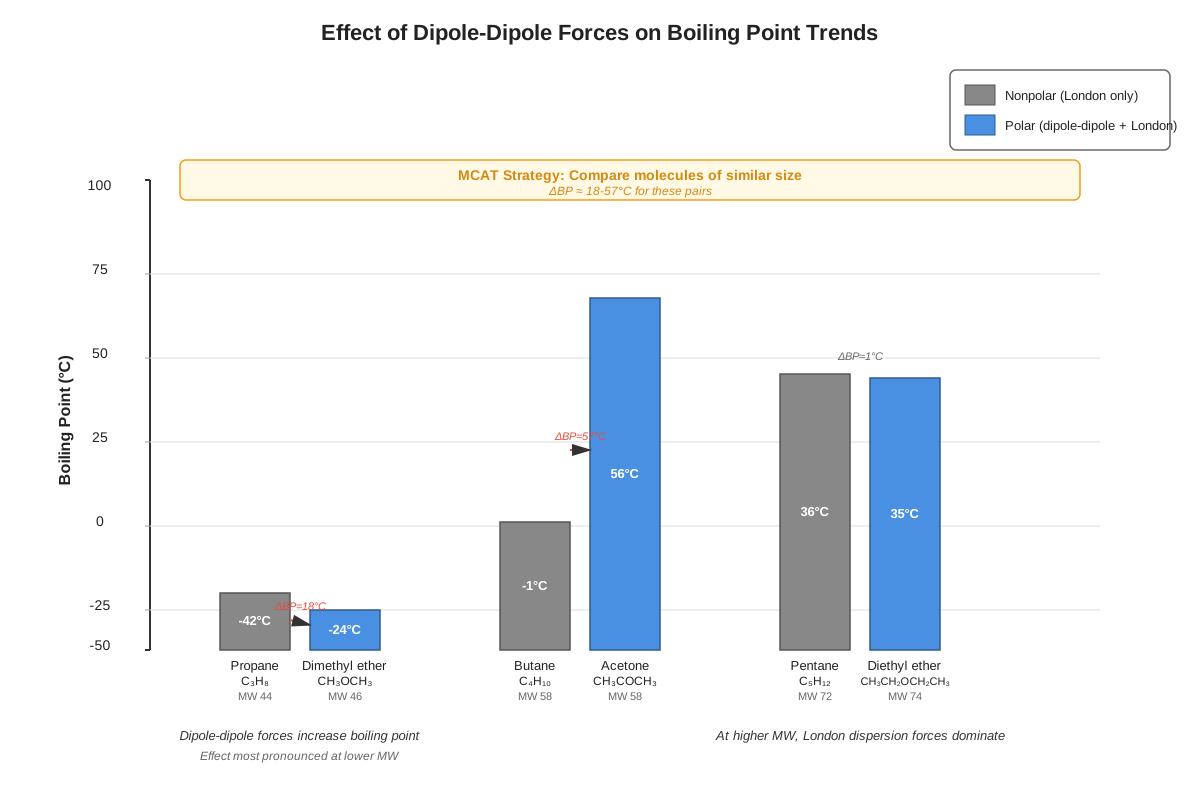
Boiling Point: Compounds with dipole-dipole forces as the dominant intermolecular attraction have higher boiling points than nonpolar compounds of similar molecular weight. The additional energy required to overcome dipole-dipole attractions increases the temperature at which vapor pressure equals atmospheric pressure.
Melting Point: Dipole-dipole forces contribute to higher melting points by stabilizing the solid state. However, crystal packing efficiency also plays a significant role, sometimes making melting point predictions less straightforward than boiling point predictions.
Solubility: The principle "like dissolves like" reflects the importance of dipole-dipole forces. Polar solvents (like acetone or ethanol) dissolve polar solutes effectively because dipole-dipole interactions between solvent and solute molecules are energetically favorable. Nonpolar solutes do not dissolve well in polar solvents because the strong dipole-dipole interactions between solvent molecules are not compensated by solute-solvent interactions.
Vapor Pressure: Substances with strong dipole-dipole forces have lower vapor pressures at a given temperature because fewer molecules have sufficient energy to escape the liquid phase and overcome intermolecular attractions.
Distinguishing Dipole-Dipole from Other Forces
A critical MCAT skill involves distinguishing dipole-dipole forces from other intermolecular forces:
Dipole-Dipole vs. London Dispersion: All molecules experience London dispersion forces (also called van der Waals forces), which arise from temporary, induced dipoles. Dipole-dipole forces are additional attractions present only in polar molecules. When comparing two molecules, if one is polar and one is nonpolar with similar molecular weights, the polar molecule will have stronger total intermolecular forces.
Dipole-Dipole vs. Hydrogen Bonding: Hydrogen bonding is a special, exceptionally strong type of dipole-dipole interaction occurring when hydrogen is bonded to N, O, or F. While technically a subset of dipole-dipole forces, hydrogen bonding is so much stronger that it's treated as a separate category. On the MCAT, if a molecule can form hydrogen bonds, that interaction dominates over ordinary dipole-dipole forces.
Dipole-Dipole vs. Ion-Dipole: Ion-dipole forces occur between ions and polar molecules (such as Na⁺ ions surrounded by water molecules in solution). These are significantly stronger than dipole-dipole forces because full charges are involved rather than partial charges.
Concept Relationships
The understanding of dipole-dipole forces builds hierarchically from fundamental concepts and connects to numerous related topics. Electronegativity differences → create polar bonds → which may produce molecular dipole moments depending on molecular geometry → enabling dipole-dipole forces → which influence physical properties like boiling point and solubility.
Within the topic itself, the magnitude of the dipole moment directly determines the strength of dipole-dipole interactions, which in turn governs the extent to which physical properties are affected. The relationship between molecular structure and dipole-dipole forces connects to VSEPR theory and Lewis structures, as accurate prediction of molecular geometry is essential for determining whether a net dipole exists.
Dipole-dipole forces relate to other intermolecular forces through a spectrum of interaction strength. London dispersion forces represent the baseline present in all molecules, while dipole-dipole forces add additional attraction in polar molecules. Hydrogen bonding represents the strongest end of the dipole-dipole spectrum. Understanding this progression enables comparative analysis—a key MCAT skill.
The connection to solubility and phase transitions makes dipole-dipole forces relevant to biochemistry topics including membrane structure, protein folding, and drug design. The principle that polar molecules interact favorably with other polar molecules through dipole-dipole forces underlies countless biological processes tested on the MCAT.
High-Yield Facts
⭐ Dipole-dipole forces occur only between polar molecules with permanent dipole moments
⭐ Dipole-dipole forces are stronger than London dispersion forces but weaker than hydrogen bonds
⭐ Molecules with similar molecular weights but different polarities will have different boiling points, with polar molecules boiling at higher temperatures
⭐ Symmetrical molecules (like CO₂ or CCl₄) have no net dipole moment despite having polar bonds
⭐ The strength of dipole-dipole interactions increases with increasing dipole moment magnitude
- Dipole-dipole forces are electrostatic in nature, following Coulomb's law principles
- Temperature increases disrupt dipole-dipole interactions by increasing molecular kinetic energy
- Polar molecules dissolve best in polar solvents due to favorable dipole-dipole interactions
- Dipole-dipole forces contribute 5-25 kJ/mol of intermolecular attraction energy
- Molecules capable of hydrogen bonding will have that interaction dominate over ordinary dipole-dipole forces
- The presence of dipole-dipole forces lowers vapor pressure compared to nonpolar molecules of similar size
- Dipole moment is a vector quantity with both magnitude and direction
- Lone pairs on central atoms often create molecular asymmetry leading to net dipole moments
- Ion-dipole forces (between ions and polar molecules) are significantly stronger than dipole-dipole forces
- All polar molecules experience both London dispersion forces AND dipole-dipole forces simultaneously
Quick check — test yourself on Dipole dipole forces so far.
Try Flashcards →Common Misconceptions
Misconception: All molecules with polar bonds have dipole-dipole forces.
Correction: Only molecules with polar bonds AND a net molecular dipole moment experience dipole-dipole forces. Symmetrical molecules like CO₂ and CCl₄ have polar bonds but no net dipole because the bond dipoles cancel due to molecular geometry.
Misconception: Dipole-dipole forces are stronger than hydrogen bonds.
Correction: Hydrogen bonding is actually a special, exceptionally strong type of dipole-dipole interaction. Ordinary dipole-dipole forces (5-25 kJ/mol) are weaker than hydrogen bonds (10-40 kJ/mol). When a molecule can form hydrogen bonds, that interaction dominates.
Misconception: Larger molecules always have stronger dipole-dipole forces.
Correction: While molecular size affects London dispersion forces, dipole-dipole force strength depends primarily on dipole moment magnitude, not molecular size. A small molecule with a large dipole moment can have stronger dipole-dipole interactions than a larger molecule with a small dipole moment.
Misconception: Dipole-dipole forces only affect boiling point, not other properties.
Correction: Dipole-dipole forces influence multiple physical properties including boiling point, melting point, vapor pressure, solubility, viscosity, and surface tension. Any property related to intermolecular attractions is affected.
Misconception: Nonpolar molecules cannot interact with polar molecules.
Correction: While dipole-dipole forces specifically occur between polar molecules, polar molecules can induce temporary dipoles in nonpolar molecules, creating dipole-induced dipole interactions. Additionally, all molecules experience London dispersion forces with each other.
Misconception: The presence of any electronegative atom automatically creates dipole-dipole forces.
Correction: The electronegative atom must create bond polarity that results in a net molecular dipole. For example, carbon tetrachloride (CCl₄) contains highly electronegative chlorine atoms, but the symmetrical tetrahedral geometry causes the bond dipoles to cancel, resulting in no net dipole moment and no dipole-dipole forces.
Misconception: Dipole-dipole forces are intramolecular forces like covalent bonds.
Correction: Dipole-dipole forces are intermolecular forces—they act between separate molecules, not within a single molecule. They are much weaker than intramolecular forces (covalent bonds) and can be overcome by phase transitions, while covalent bonds require chemical reactions to break.
Worked Examples
Example 1: Ranking Compounds by Boiling Point
Question: Rank the following compounds in order of increasing boiling point: CH₃CH₂CH₃ (propane), CH₃CHO (acetaldehyde), CH₃CH₂OH (ethanol).
Solution:
Step 1: Identify the molecular weights to ensure they're comparable.
- Propane: C₃H₈ = 44 g/mol
- Acetaldehyde: C₂H₄O = 44 g/mol
- Ethanol: C₂H₆O = 46 g/mol
The molecular weights are very similar, so differences in boiling point will primarily reflect differences in intermolecular forces.
Step 2: Determine the types of intermolecular forces present in each molecule.
Propane (CH₃CH₂CH₃): This is a nonpolar hydrocarbon. All C-H bonds have minimal polarity, and the symmetrical structure results in no net dipole. Only London dispersion forces are present.
Acetaldehyde (CH₃CHO): This molecule contains a polar C=O bond. The molecular geometry is not symmetrical, so there is a net dipole moment pointing toward the oxygen. Dipole-dipole forces and London dispersion forces are present. Note: There is no O-H or N-H bond, so hydrogen bonding is not possible.
Ethanol (CH₃CH₂OH): This molecule contains an O-H bond, making it capable of hydrogen bonding. Hydrogen bonding, dipole-dipole forces, and London dispersion forces are all present, with hydrogen bonding being the dominant intermolecular force.
Step 3: Rank by intermolecular force strength.
- Weakest: London dispersion only (propane)
- Intermediate: Dipole-dipole + London dispersion (acetaldehyde)
- Strongest: Hydrogen bonding + dipole-dipole + London dispersion (ethanol)
Step 4: Connect intermolecular force strength to boiling point.
Stronger intermolecular forces require more energy to overcome, resulting in higher boiling points.
Answer: CH₃CH₂CH₃ < CH₃CHO < CH₃CH₂OH
Actual boiling points: Propane (-42°C), Acetaldehyde (20°C), Ethanol (78°C)
Key Takeaway: This example demonstrates how dipole-dipole forces create intermediate boiling points between nonpolar compounds and hydrogen-bonding compounds. The presence of the polar carbonyl group in acetaldehyde creates dipole-dipole interactions that significantly elevate the boiling point compared to the nonpolar propane, even though their molecular weights are identical.
Example 2: Predicting Solubility Based on Dipole-Dipole Forces
Question: A student has three compounds: hexane (C₆H₁₄), acetone (CH₃COCH₃), and sodium chloride (NaCl). Which solvent-solute combinations will result in dissolution, and why?
Solution:
Step 1: Characterize each substance by its intermolecular forces.
Hexane: Nonpolar hydrocarbon with only London dispersion forces
Acetone: Polar molecule with a C=O bond creating a significant dipole moment; experiences dipole-dipole forces and London dispersion forces
Sodium chloride: Ionic compound held together by ionic bonds in the solid state; when dissolved, ions interact with solvent through ion-dipole forces
Step 2: Apply the "like dissolves like" principle.
Hexane + Acetone: Hexane is nonpolar; acetone is polar. The strong dipole-dipole interactions between acetone molecules are not compensated by interactions with nonpolar hexane. Limited solubility (though some mixing occurs due to London dispersion forces).
Hexane + NaCl: Hexane is nonpolar and cannot provide the strong ion-dipole interactions needed to overcome the ionic lattice energy of NaCl. No significant dissolution.
Acetone + NaCl: Acetone is polar with a significant dipole moment. The partially negative oxygen can interact with Na⁺ ions, and the partially positive carbon/hydrogen regions can interact with Cl⁻ ions through ion-dipole forces. However, acetone's dipole moment is not as large as water's, and it cannot form hydrogen bonds. Limited solubility (much less than in water, but some dissolution occurs).
Step 3: Explain the role of dipole-dipole forces.
For acetone to dissolve NaCl, the ion-dipole interactions between acetone and the ions must compensate for breaking the ionic bonds in the NaCl crystal and the dipole-dipole interactions between acetone molecules. While acetone's polarity allows some interaction with ions, water (which forms stronger hydrogen bonds and has a larger dipole moment) is a much better solvent for NaCl.
Answer:
- Hexane and acetone: Limited mixing
- Hexane and NaCl: No dissolution
- Acetone and NaCl: Limited dissolution
Key Takeaway: This example illustrates that dipole-dipole forces enable polar solvents to dissolve polar solutes and (to a limited extent) ionic solutes. The strength of the dipole moment matters—acetone's moderate polarity makes it less effective than water at dissolving ionic compounds, but more effective than nonpolar solvents. Understanding the relative strengths of different intermolecular forces allows prediction of solubility patterns.
Exam Strategy
Approaching MCAT Questions on Dipole-Dipole Forces
Step 1: Identify the question type. Dipole-dipole force questions typically ask you to:
- Rank compounds by physical properties (boiling point, melting point, vapor pressure)
- Predict solubility patterns
- Explain experimental observations
- Identify the dominant intermolecular force in a given molecule
Step 2: Draw or visualize structures. Even if structures are provided, quickly sketch them or visualize their 3D geometry. Identify:
- Polar bonds (look for electronegativity differences)
- Molecular geometry (use VSEPR)
- Presence of symmetry (which might cancel dipoles)
- Potential for hydrogen bonding (N-H, O-H, F-H bonds)
Step 3: Systematically categorize intermolecular forces. Create a mental hierarchy:
- Can the molecule form hydrogen bonds? (If yes, this dominates)
- Does the molecule have a net dipole? (If yes, dipole-dipole forces are present)
- All molecules have London dispersion forces
Step 4: Compare molecular weights if needed. When comparing compounds with different intermolecular forces, ensure molecular weights are similar. If one compound is much larger, London dispersion forces might dominate despite polarity differences.
Trigger Words and Phrases
Watch for these terms that signal dipole-dipole force questions:
- "Polar molecule"
- "Boiling point"
- "Intermolecular forces"
- "Solubility in polar solvents"
- "Vapor pressure"
- "Dipole moment"
- "Electrostatic attraction"
- "Like dissolves like"
Process of Elimination Tips
Eliminate answers that:
- Claim nonpolar molecules have dipole-dipole forces
- Suggest dipole-dipole forces are stronger than hydrogen bonds
- Confuse intramolecular and intermolecular forces
- Ignore molecular geometry when assessing polarity
- Rank boiling points based solely on molecular weight without considering polarity
Keep answers that:
- Correctly identify symmetrical molecules as nonpolar
- Recognize hydrogen bonding as the dominant force when present
- Account for both molecular weight and polarity in property predictions
- Apply "like dissolves like" correctly
Time Allocation
For standalone questions on dipole-dipole forces, allocate 60-90 seconds. The key is rapid structure analysis:
- 15-20 seconds: Analyze molecular structures
- 20-30 seconds: Categorize intermolecular forces
- 20-30 seconds: Apply logic to answer the question
- 10 seconds: Verify and select answer
For passage-based questions, the passage may provide experimental data or context. Spend time understanding the passage setup, then apply dipole-dipole force principles to interpret the data or predict outcomes.
Memory Techniques
Mnemonic for Intermolecular Force Strength
"London's Dull, Dipoles Dance, Hydrogen Hugs"
- London's Dull: London dispersion forces are the weakest
- Dipoles Dance: Dipole-dipole forces are intermediate
- Hydrogen Hugs: Hydrogen bonds are the strongest intermolecular forces
Visualization Strategy for Molecular Polarity
Imagine each polar bond as an arrow pointing toward the more electronegative atom. Mentally add these vectors. If they cancel (arrows pointing in opposite directions with equal magnitude), no net dipole exists. If they don't cancel, a net dipole exists, and dipole-dipole forces are present.
Acronym for Hydrogen Bonding Atoms
"FON" - Fluorine, Oxygen, Nitrogen
Only when hydrogen is bonded to F, O, or N can hydrogen bonding occur. If you see H bonded to FON, hydrogen bonding dominates over ordinary dipole-dipole forces.
The Symmetry Rule
"Symmetry Cancels, Asymmetry Attracts"
Symmetrical molecules with polar bonds have no net dipole (bond dipoles cancel). Asymmetrical molecules or those with lone pairs on the central atom typically have net dipoles and experience dipole-dipole forces.
Boiling Point Ranking Shortcut
When ranking boiling points of compounds with similar molecular weights:
- First, identify if any can hydrogen bond (highest BP)
- Second, identify which are polar but can't hydrogen bond (intermediate BP)
- Third, nonpolar compounds have the lowest BP
Summary
Dipole-dipole forces are electrostatic attractions between polar molecules, arising from the interaction between permanent dipole moments. These forces require both polar bonds and molecular geometries that produce net dipole moments—symmetrical molecules with polar bonds do not experience dipole-dipole forces because their bond dipoles cancel. With strengths of 5-25 kJ/mol, dipole-dipole forces are intermediate between London dispersion forces and hydrogen bonds. They significantly influence physical properties including boiling point, melting point, vapor pressure, and solubility. On the MCAT, questions involving dipole-dipole forces typically require students to analyze molecular structures, predict physical properties, or explain experimental observations. Success requires systematic analysis of molecular geometry, identification of polar bonds, assessment of symmetry, and recognition that hydrogen bonding (when possible) dominates over ordinary dipole-dipole interactions. The principle "like dissolves like" reflects the importance of dipole-dipole forces in determining solubility patterns, with polar molecules dissolving best in polar solvents due to favorable dipole-dipole interactions.
Key Takeaways
- Dipole-dipole forces occur only between polar molecules with permanent net dipole moments resulting from asymmetric charge distribution
- These forces are intermediate in strength (5-25 kJ/mol), stronger than London dispersion forces but weaker than hydrogen bonds
- Molecular geometry determines whether polar bonds create a net dipole—symmetrical molecules have canceling dipoles despite polar bonds
- Dipole-dipole forces significantly elevate boiling points, lower vapor pressures, and influence solubility compared to nonpolar molecules of similar molecular weight
- When hydrogen bonding is possible (H bonded to F, O, or N), it dominates over ordinary dipole-dipole forces
- The "like dissolves like" principle reflects favorable dipole-dipole interactions between polar solutes and polar solvents
- MCAT questions frequently test the ability to rank compounds by physical properties based on intermolecular force analysis
Related Topics
Hydrogen Bonding: A special, stronger type of dipole-dipole interaction occurring when hydrogen bonds to highly electronegative atoms (F, O, N). Mastering dipole-dipole forces provides the foundation for understanding why hydrogen bonds are exceptionally strong and how they govern biological structure.
London Dispersion Forces: The weakest intermolecular forces, present in all molecules. Understanding the progression from London forces to dipole-dipole forces to hydrogen bonds creates a complete picture of intermolecular attraction strength.
Molecular Polarity and VSEPR Theory: The geometric principles that determine whether molecules have net dipole moments. Deeper study of VSEPR enables rapid prediction of molecular polarity and dipole-dipole force presence.
Colligative Properties: Vapor pressure lowering, boiling point elevation, and freezing point depression all relate to intermolecular forces. Understanding dipole-dipole forces enables prediction of how these properties change with solute addition.
Chromatography and Separation Techniques: These analytical methods exploit differences in polarity and intermolecular forces. Mastery of dipole-dipole forces enables prediction of retention times and separation efficiency.
Practice CTA
Now that you've mastered the core concepts of dipole-dipole forces, it's time to solidify your understanding through active practice. Attempt the practice questions and flashcards to test your ability to analyze molecular structures, predict physical properties, and apply these concepts to MCAT-style scenarios. Remember: understanding the theory is just the first step—exam success requires the ability to rapidly apply these principles under time pressure. Each practice question you complete strengthens your pattern recognition and builds the confidence needed to excel on test day. You've built a strong foundation—now prove it through practice!
Sign up free to keep reading
Create a free AnvayaPrep account to finish this MCAT guide on Dipole dipole forces — plus flashcards and practice questions.