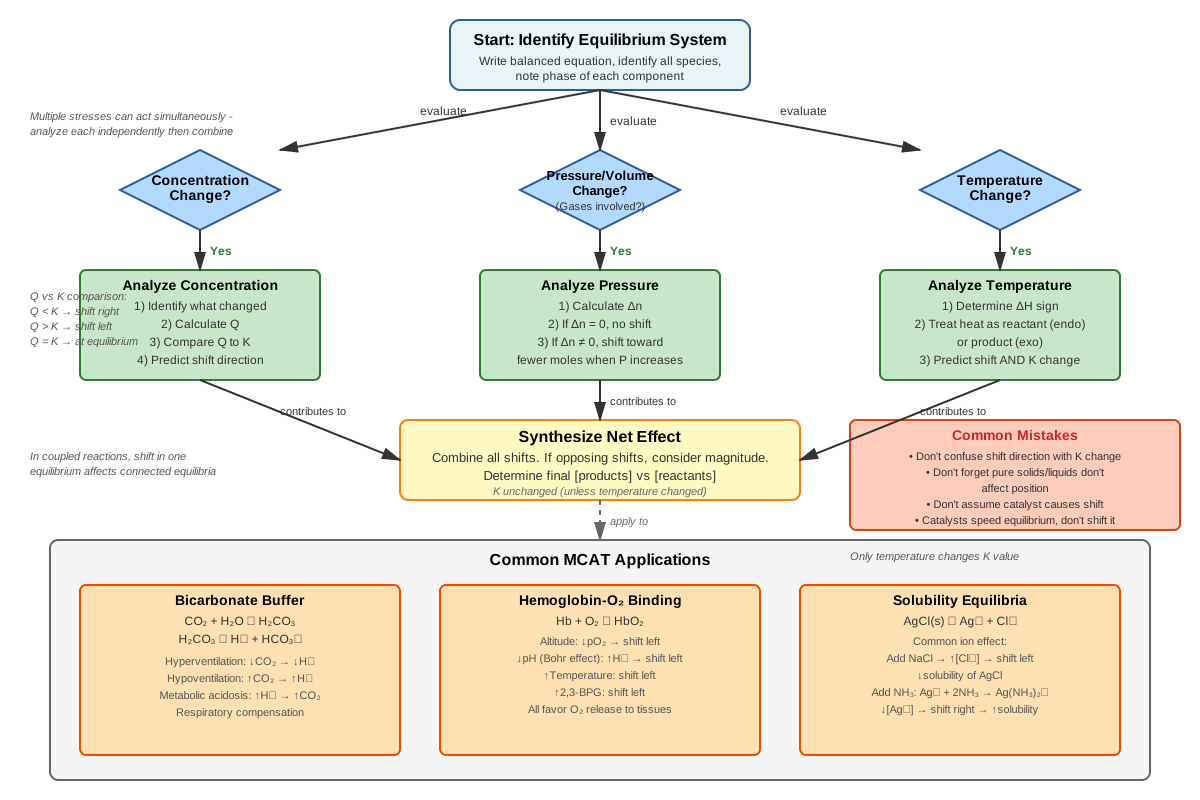
Overview
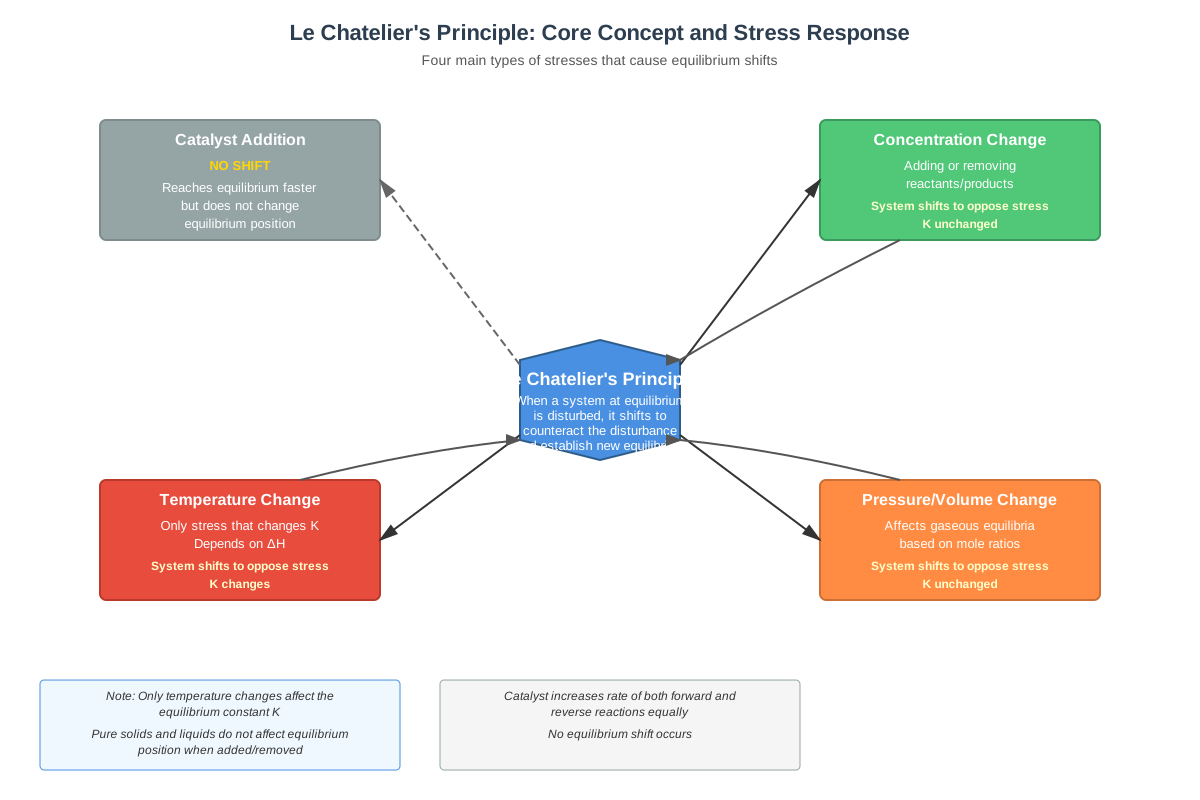
Le Chatelier's principle is a cornerstone concept in General Chemistry that predicts how chemical systems at equilibrium respond to external stresses. Named after French chemist Henri Louis Le Chatelier, this principle states that when a system at equilibrium experiences a disturbance—such as changes in concentration, pressure, volume, or temperature—the system will shift its equilibrium position to counteract that disturbance and establish a new equilibrium state. This predictive framework is essential for understanding dynamic equilibrium in reversible reactions and forms the conceptual bridge between kinetics and equilibrium, two fundamental pillars of chemical behavior tested extensively on the MCAT.
For MCAT preparation, Le Chatelier's principle represents more than an isolated concept—it is a practical tool that appears across multiple contexts within the Chemical and Physical Foundations of Biological Systems section. Students encounter this principle when analyzing buffer systems in biochemistry, understanding gas exchange in the lungs (oxygen-hemoglobin binding), predicting the direction of metabolic pathways, and solving equilibrium problems involving acids, bases, and solubility. The principle's predictive power makes it invaluable for both discrete questions and passage-based reasoning, where experimental manipulations require students to predict outcomes based on equilibrium shifts.
Within the broader landscape of General Chemistry, Le Chatelier's principle connects thermodynamics (specifically Gibbs free energy and spontaneity), reaction quotients, equilibrium constants, and kinetic considerations. Understanding this principle requires recognizing that equilibrium is dynamic—forward and reverse reactions continue to occur, but at equal rates—and that shifts in equilibrium position do not change the equilibrium constant K (except when temperature changes). This nuanced understanding separates high-scoring students from those who merely memorize rules without grasping the underlying molecular behavior.
Learning Objectives
- [ ] Define Le Chatelier's principle using accurate General Chemistry terminology
- [ ] Explain why Le Chatelier's principle matters for the MCAT
- [ ] Apply Le Chatelier's principle to exam-style questions
- [ ] Identify common mistakes related to Le Chatelier's principle
- [ ] Connect Le Chatelier's principle to related General Chemistry concepts
- [ ] Predict the direction of equilibrium shifts in response to changes in concentration, pressure, volume, and temperature
- [ ] Distinguish between changes that affect equilibrium position versus those that affect the equilibrium constant K
- [ ] Analyze multi-step equilibrium problems involving coupled reactions and buffer systems
Prerequisites
- Chemical equilibrium fundamentals: Understanding that equilibrium represents a dynamic state where forward and reverse reaction rates are equal is essential for comprehending why systems shift when disturbed
- Equilibrium constant (K) expressions: Familiarity with writing and interpreting K expressions allows students to predict which direction favors products or reactants
- Reaction quotient (Q): Knowing how to calculate Q and compare it to K provides the mathematical foundation for determining shift direction
- Basic thermodynamics: Understanding exothermic versus endothermic reactions is necessary for predicting temperature effects on equilibrium
- Gas laws: Knowledge of pressure-volume relationships helps predict equilibrium shifts in gaseous systems
- Molarity and concentration calculations: Quantitative manipulation of concentrations is required for solving equilibrium problems
Why This Topic Matters
Le Chatelier's principle has profound clinical and biological significance that extends far beyond theoretical chemistry. In human physiology, this principle explains how the body maintains pH homeostasis through the bicarbonate buffer system: when blood becomes too acidic, the equilibrium shifts to consume excess H⁺ ions, and when too basic, it shifts to release H⁺. The principle also governs oxygen transport—at high altitudes where oxygen partial pressure is low, hemoglobin's oxygen-binding equilibrium shifts to favor release, explaining altitude sickness. In pharmacology, drug-receptor binding equilibria shift based on drug concentration, explaining dose-response relationships and competitive inhibition mechanisms.
On the MCAT, Le Chatelier's principle appears in approximately 3-5 questions per exam, distributed across both discrete questions and passage-based items. The Chemical and Physical Foundations section frequently presents experimental scenarios where researchers manipulate reaction conditions—adding reagents, changing temperature, or altering pressure—and asks students to predict outcomes. Biological passages may describe metabolic pathways where product accumulation feeds back to shift earlier equilibria, or respiratory passages where CO₂ levels affect blood pH through carbonic acid equilibrium. The principle also appears in questions about solubility equilibria, acid-base titrations, and industrial processes like the Haber process for ammonia synthesis.
Common question formats include: (1) predicting the direction of shift given a specific stress, (2) identifying which manipulation will increase product yield, (3) explaining why certain changes do or do not affect K, (4) analyzing graphs showing concentration changes over time after a disturbance, and (5) applying the principle to biological systems like hemoglobin cooperativity or enzyme regulation. High-yield passages often combine Le Chatelier's principle with thermodynamics, requiring students to integrate ΔG, K, and equilibrium shifts into a coherent analysis.
Core Concepts
Definition and Fundamental Statement
Le Chatelier's principle states that if a dynamic equilibrium system is subjected to a change in concentration, pressure, volume, or temperature, the system will adjust its equilibrium position to partially counteract the imposed change. The key word "partially" is crucial—the system does not completely reverse the change but rather responds in a direction that opposes it. This principle applies only to systems already at equilibrium; if a system is not at equilibrium, comparing Q to K determines the direction of spontaneous change.
The molecular basis for this behavior lies in the dynamic nature of equilibrium. At equilibrium, the forward reaction rate (r_forward) equals the reverse reaction rate (r_reverse). When a stress is applied, one of these rates temporarily exceeds the other, causing a net shift in one direction until a new equilibrium is established where rates are again equal. Importantly, unless temperature changes, the equilibrium constant K remains unchanged—only the equilibrium position (the specific concentrations at equilibrium) shifts.
Effect of Concentration Changes
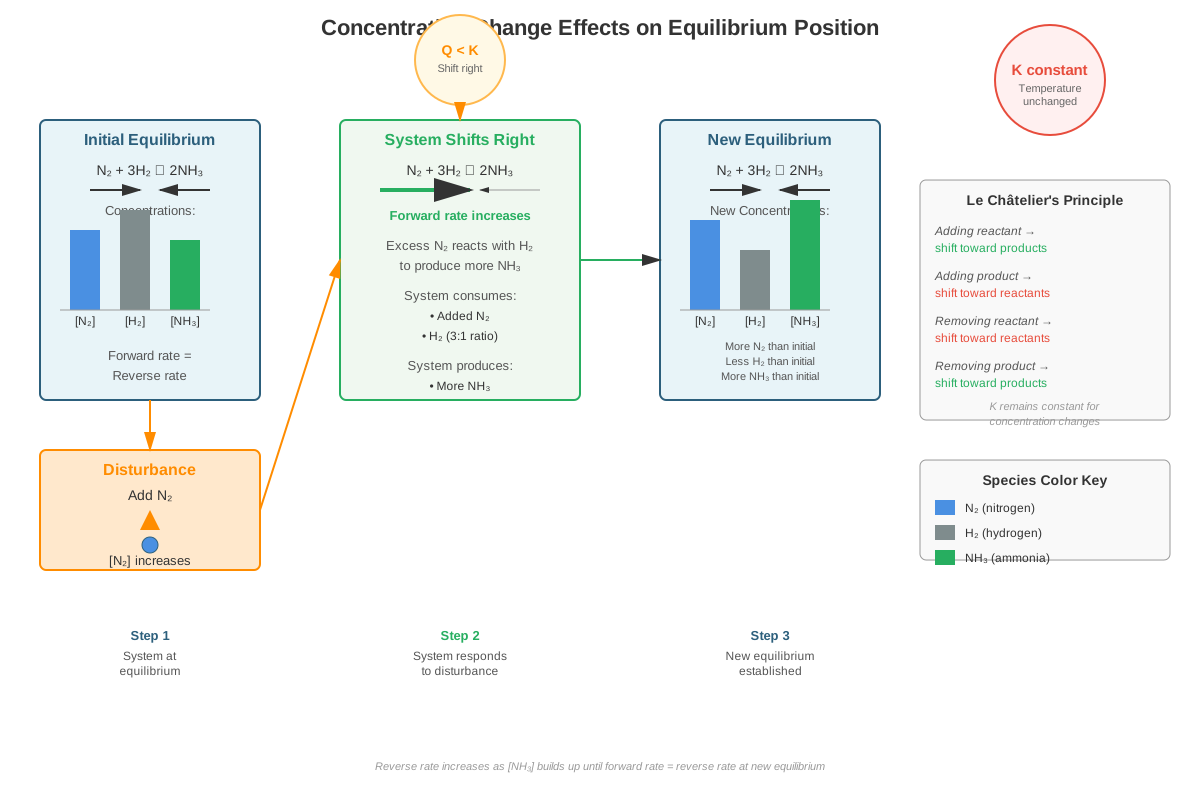
When the concentration of a reactant or product is changed, the equilibrium shifts to consume the added substance or replace the removed substance. Consider the general equilibrium:
aA + bB ⇌ cC + dDAdding a reactant (increasing [A] or [B]) shifts the equilibrium to the right (toward products) to consume the excess reactant. Conversely, removing a reactant shifts the equilibrium to the left (toward reactants) to replace what was removed. Adding a product (increasing [C] or [D]) shifts the equilibrium to the left to consume the excess product, while removing a product shifts the equilibrium to the right to replace the removed product.
This behavior can be understood through the reaction quotient Q. When a substance is added or removed, Q temporarily differs from K. If Q < K, the reaction proceeds forward (right); if Q > K, the reaction proceeds in reverse (left). The system continues shifting until Q = K again at the new equilibrium position.
Exam Tip: Pure solids and pure liquids do not appear in equilibrium expressions, so adding or removing them does NOT shift the equilibrium. Only substances that appear in the K expression (aqueous and gaseous species) cause shifts when their concentrations change.
Effect of Pressure and Volume Changes
Pressure and volume changes affect equilibria involving gases. Since pressure and volume are inversely related (P ∝ 1/V at constant temperature), these effects are mirror images of each other.
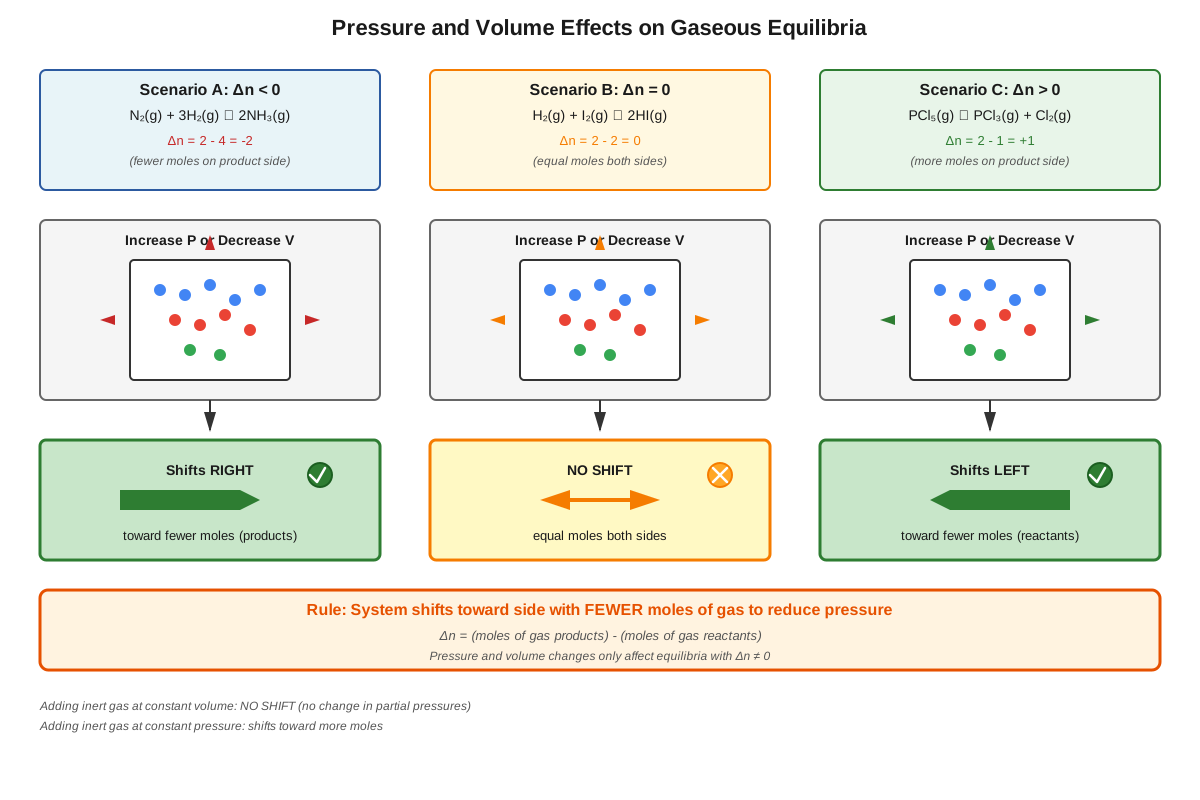
Increasing pressure (or decreasing volume) shifts the equilibrium toward the side with fewer moles of gas. This response reduces the total number of gas molecules, thereby partially relieving the pressure increase. Decreasing pressure (or increasing volume) shifts the equilibrium toward the side with more moles of gas, increasing the total number of gas molecules to partially compensate for the pressure decrease.
For example, in the reaction:
N₂(g) + 3H₂(g) ⇌ 2NH₃(g)The left side has 4 moles of gas (1 + 3) while the right side has 2 moles. Increasing pressure shifts the equilibrium to the right (toward NH₃) because this reduces the total moles of gas from 4 to 2, partially relieving the pressure stress.
If both sides have equal moles of gas, pressure/volume changes do NOT shift the equilibrium position. Additionally, adding an inert gas at constant volume does not shift equilibrium because it doesn't change the partial pressures of the reacting gases.
| Stress | System Response | Equilibrium Shift |
|---|---|---|
| Increase pressure (decrease volume) | Shift toward fewer gas moles | Side with fewer moles |
| Decrease pressure (increase volume) | Shift toward more gas moles | Side with more moles |
| Add inert gas (constant volume) | No change in partial pressures | No shift |
| Add inert gas (constant pressure) | Volume increases | Shift toward more moles |
Effect of Temperature Changes
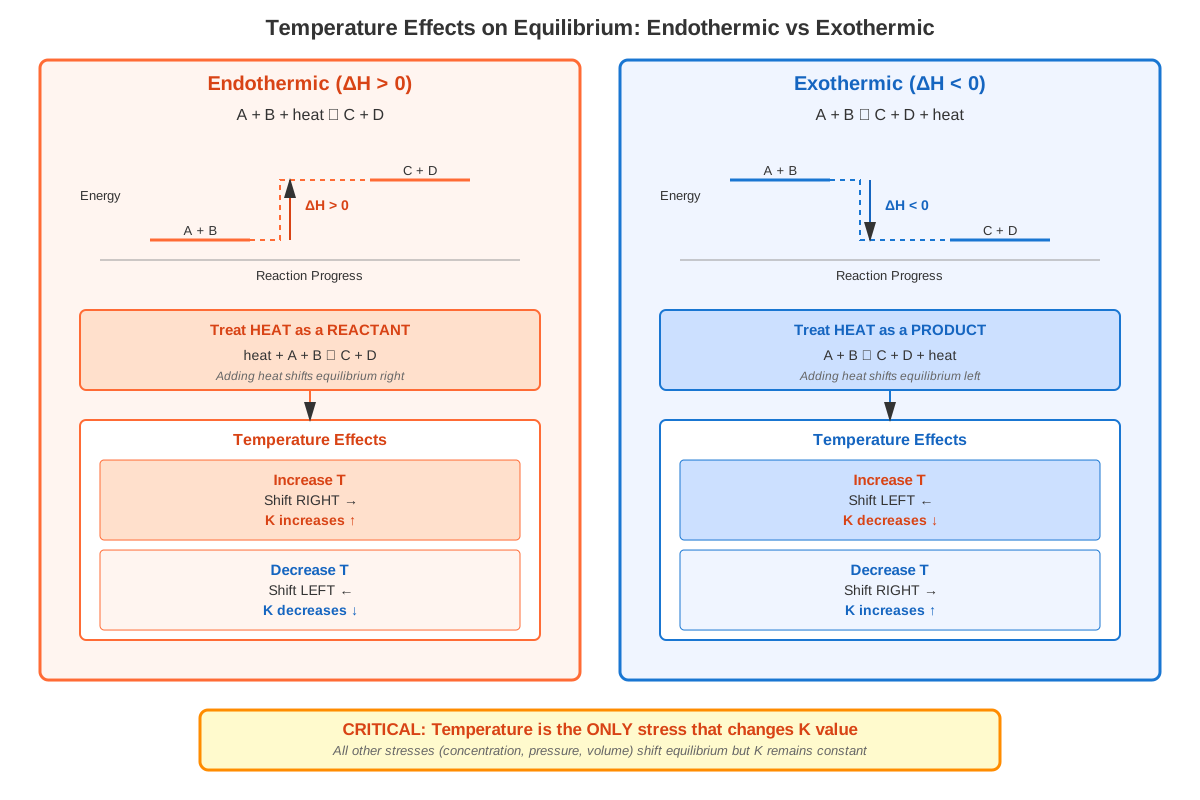
Temperature changes are unique because they actually alter the value of the equilibrium constant K, unlike concentration or pressure changes which only shift the equilibrium position while K remains constant. The direction of shift depends on whether the reaction is exothermic or endothermic.
For an exothermic reaction (ΔH < 0), heat can be considered a product:
Reactants ⇌ Products + HeatIncreasing temperature adds heat, shifting the equilibrium to the left (toward reactants) to consume the excess heat. This decreases K. Decreasing temperature removes heat, shifting the equilibrium to the right (toward products), increasing K.
For an endothermic reaction (ΔH > 0), heat can be considered a reactant:
Reactants + Heat ⇌ ProductsIncreasing temperature adds heat, shifting the equilibrium to the right (toward products) to consume the added heat. This increases K. Decreasing temperature removes heat, shifting the equilibrium to the left (toward reactants), decreasing K.
The quantitative relationship between temperature and K is given by the van't Hoff equation, though the MCAT typically requires only qualitative predictions.
High-Yield: Temperature is the ONLY stress that changes the value of K. All other stresses (concentration, pressure, volume) change the equilibrium position but not K.
Effect of Catalysts
Catalysts do not shift equilibrium position and do not change the equilibrium constant K. Catalysts work by lowering the activation energy for both the forward and reverse reactions equally, allowing the system to reach equilibrium faster but not changing where that equilibrium lies. This is a common MCAT trap—students may incorrectly think catalysts favor product formation, but they merely speed up the approach to equilibrium.
Coupled Reactions and Le Chatelier's Principle
In biological systems, unfavorable reactions (positive ΔG) are often coupled with favorable reactions (negative ΔG) to drive them forward. Le Chatelier's principle explains how removing products of the unfavorable reaction shifts its equilibrium toward products. For example, ATP hydrolysis (favorable) is coupled with many biosynthetic reactions (unfavorable). As ATP is consumed and ADP is produced, the equilibrium of the biosynthetic reaction shifts forward, and the continuous removal of products by subsequent reactions maintains the forward drive.
Concept Relationships
Le Chatelier's principle serves as the conceptual bridge connecting equilibrium constants (K), reaction quotients (Q), and thermodynamics (ΔG). When a stress is applied to a system at equilibrium, Q temporarily deviates from K. The relationship ΔG = RT ln(Q/K) indicates that when Q ≠ K, ΔG ≠ 0, and the reaction proceeds spontaneously in the direction that returns Q to K. This spontaneous shift is precisely what Le Chatelier's principle predicts qualitatively.
The principle connects directly to kinetics through reaction rates. At equilibrium, r_forward = r_reverse. When a stress is applied, one rate temporarily exceeds the other, creating the net shift. For instance, adding a reactant increases the collision frequency for the forward reaction, temporarily making r_forward > r_reverse until equilibrium is reestablished.
Temperature effects link Le Chatelier's principle to thermodynamics through the relationship between K and ΔG°: ΔG° = -RT ln K. When temperature changes, both K and ΔG° change. For exothermic reactions, increasing temperature makes ΔG° less negative (less favorable), decreasing K. For endothermic reactions, increasing temperature makes ΔG° more negative (more favorable), increasing K.
The principle also connects to acid-base chemistry through buffer systems. The bicarbonate buffer (H₂CO₃ ⇌ H⁺ + HCO₃⁻) responds to pH changes via Le Chatelier's principle: adding acid (H⁺) shifts equilibrium left, consuming H⁺; adding base (which removes H⁺) shifts equilibrium right, releasing H⁺. This maintains relatively constant pH.
Relationship map: Equilibrium constant K → defines equilibrium position → disturbance creates Q ≠ K → ΔG ≠ 0 drives spontaneous shift → Le Chatelier's principle predicts shift direction → new equilibrium established where Q = K again → kinetic rates rebalance (r_forward = r_reverse)
Quick check — test yourself on Le Chatelier principle so far.
Try Flashcards →High-Yield Facts
⭐ Le Chatelier's principle states that a system at equilibrium responds to stress by shifting to partially counteract that stress
⭐ Temperature is the only stress that changes the equilibrium constant K; all other stresses change only the equilibrium position
⭐ Adding a reactant or removing a product shifts equilibrium toward products (right); adding a product or removing a reactant shifts toward reactants (left)
⭐ Increasing pressure (or decreasing volume) shifts equilibrium toward the side with fewer moles of gas
⭐ For exothermic reactions, increasing temperature shifts equilibrium toward reactants (left) and decreases K; for endothermic reactions, increasing temperature shifts toward products (right) and increases K
- Pure solids and pure liquids do not affect equilibrium position when added or removed because they don't appear in the equilibrium expression
- Catalysts speed up the approach to equilibrium but do not shift the equilibrium position or change K
- Adding an inert gas at constant volume does not shift equilibrium because partial pressures of reactants and products remain unchanged
- Decreasing pressure (or increasing volume) shifts equilibrium toward the side with more moles of gas
- In coupled reactions, removing the product of an unfavorable reaction shifts its equilibrium forward, allowing the reaction to proceed
- The bicarbonate buffer system in blood uses Le Chatelier's principle to maintain pH homeostasis
- Hemoglobin-oxygen binding equilibrium shifts based on oxygen partial pressure, explaining oxygen loading in lungs and unloading in tissues
Common Misconceptions
Misconception: Le Chatelier's principle means the system completely reverses the applied stress.
Correction: The system shifts to partially counteract the stress, not completely reverse it. If you add reactant, the equilibrium shifts right, but not all the added reactant is consumed—the new equilibrium has more of both reactants and products than before.
Misconception: Catalysts shift equilibrium toward products because they speed up reactions.
Correction: Catalysts lower activation energy for both forward and reverse reactions equally, so they speed up the approach to equilibrium but do not change the equilibrium position or K. The ratio of products to reactants at equilibrium remains the same.
Misconception: Adding a solid reactant or removing a solid product will shift the equilibrium.
Correction: Pure solids (and pure liquids) have constant activity and do not appear in equilibrium expressions. Only changes in concentration of aqueous or gaseous species shift equilibrium. For example, in CaCO₃(s) ⇌ CaO(s) + CO₂(g), only changing [CO₂] shifts the equilibrium.
Misconception: Increasing pressure always shifts equilibrium toward products.
Correction: Increasing pressure shifts equilibrium toward the side with fewer moles of gas, which may be reactants or products depending on the balanced equation. You must count moles of gas on each side to predict the direction.
Misconception: All stresses change the equilibrium constant K.
Correction: Only temperature changes alter K. Changes in concentration, pressure, and volume shift the equilibrium position (changing the actual concentrations at equilibrium) but K remains constant. This is because K depends only on temperature for a given reaction.
Misconception: Le Chatelier's principle applies to systems not at equilibrium.
Correction: The principle specifically describes how systems at equilibrium respond to stress. For systems not at equilibrium, compare Q to K: if Q < K, the reaction proceeds forward; if Q > K, it proceeds in reverse, regardless of any "stress."
Misconception: Adding an inert gas always shifts equilibrium.
Correction: Adding an inert gas at constant volume does not shift equilibrium because it doesn't change the partial pressures of reactants or products. However, adding an inert gas at constant pressure increases volume, which can shift equilibrium toward the side with more gas moles.
Worked Examples
Example 1: Haber Process for Ammonia Synthesis
Problem: The Haber process produces ammonia via the following exothermic reaction:
N₂(g) + 3H₂(g) ⇌ 2NH₃(g) ΔH = -92 kJ/molAn industrial chemist wants to maximize ammonia production. Predict the effect of each change on ammonia yield:
(a) Increasing the pressure
(b) Increasing the temperature
(c) Removing NH₃ as it forms
(d) Adding a catalyst
Solution:
(a) Increasing pressure: Count moles of gas on each side. Left side: 1 + 3 = 4 moles gas. Right side: 2 moles gas. Increasing pressure shifts equilibrium toward the side with fewer moles of gas (right), increasing NH₃ yield. This is why the Haber process operates at high pressure (150-300 atm).
(b) Increasing temperature: The reaction is exothermic (ΔH < 0), so heat is a product. Increasing temperature adds heat, shifting equilibrium left (toward reactants) to consume the excess heat. This decreases NH₃ yield and decreases K. However, higher temperature increases reaction rate, so industrial processes balance yield (favored by low temperature) with rate (favored by high temperature), typically operating at 400-500°C.
(c) Removing NH₃: Removing a product shifts equilibrium right (toward products) to replace what was removed, increasing NH₃ yield. Industrial processes continuously remove ammonia by condensation to drive the reaction forward.
(d) Adding a catalyst: Catalysts do not shift equilibrium position or change K. The catalyst (typically iron with promoters) speeds up the approach to equilibrium but does not change NH₃ yield at equilibrium. However, reaching equilibrium faster is economically valuable.
Key Learning Objective Connection: This example demonstrates applying Le Chatelier's principle to predict equilibrium shifts for multiple types of stresses and connects to industrial/real-world applications.
Example 2: Bicarbonate Buffer System and Blood pH
Problem: The bicarbonate buffer system maintains blood pH around 7.4:
CO₂(g) + H₂O(l) ⇌ H₂CO₃(aq) ⇌ H⁺(aq) + HCO₃⁻(aq)A patient hyperventilates, rapidly exhaling CO₂. Predict the effect on blood pH and explain using Le Chatelier's principle. Then predict what happens if the patient holds their breath (hypoventilation).
Solution:
Hyperventilation (rapid CO₂ exhalation): Removing CO₂ decreases [CO₂] in the blood. According to Le Chatelier's principle, the equilibrium shifts left to replace the removed CO₂. This shift consumes H⁺ ions, decreasing [H⁺]. Since pH = -log[H⁺], decreasing [H⁺] increases pH, making blood more basic (alkaline). This condition is called respiratory alkalosis.
Step-by-step reasoning:
- Hyperventilation removes CO₂ (reactant)
- Equilibrium shifts left to replace CO₂
- Shifting left consumes H⁺ and HCO₃⁻ to form H₂CO₃, then CO₂ + H₂O
- [H⁺] decreases
- pH increases (becomes more basic)
Hypoventilation (breath holding): Retaining CO₂ increases [CO₂] in the blood. The equilibrium shifts right to consume the excess CO₂. This shift produces more H⁺ ions, increasing [H⁺]. Increasing [H⁺] decreases pH, making blood more acidic. This condition is called respiratory acidosis.
Step-by-step reasoning:
- Hypoventilation increases CO₂ (reactant)
- Equilibrium shifts right to consume excess CO₂
- Shifting right produces H₂CO₃, which dissociates to H⁺ + HCO₃⁻
- [H⁺] increases
- pH decreases (becomes more acidic)
Clinical Connection: The body uses this system to regulate pH. The respiratory system controls CO₂ levels (fast response, minutes), while the kidneys control HCO₃⁻ levels (slow response, hours to days). This demonstrates how Le Chatelier's principle governs physiological homeostasis.
Key Learning Objective Connection: This example applies Le Chatelier's principle to a biological system, demonstrates clinical relevance, and shows how removing a gaseous component shifts equilibrium.
Exam Strategy
When approaching MCAT questions on Le Chatelier's principle, follow this systematic strategy:
Step 1: Confirm the system is at equilibrium. The principle only applies to systems already at equilibrium. If the question describes a system not at equilibrium, use Q vs. K comparison instead.
Step 2: Identify the stress. Determine what change is being applied: concentration change (adding/removing a substance), pressure/volume change, temperature change, or catalyst addition.
Step 3: Determine the direction of shift. Use these trigger words:
- "Add reactant" or "remove product" → shift right (toward products)
- "Remove reactant" or "add product" → shift left (toward reactants)
- "Increase pressure" or "decrease volume" → shift toward fewer gas moles
- "Increase temperature" → shift away from heat (left for exothermic, right for endothermic)
- "Add catalyst" → no shift
Step 4: Check for exceptions. Watch for pure solids/liquids (no effect), inert gases (usually no effect at constant volume), and equal moles of gas on both sides (pressure has no effect).
Step 5: Distinguish between equilibrium position and K. If the question asks about K, remember only temperature changes K. If it asks about concentrations or amounts at equilibrium, all stresses (except catalysts) can shift position.
Time allocation: Le Chatelier questions typically require 60-90 seconds. Discrete questions are usually straightforward applications (45-60 seconds). Passage-based questions may require integrating experimental data or graphs (90-120 seconds).
Process of elimination tips:
- Eliminate any answer choice suggesting catalysts shift equilibrium or change K
- Eliminate choices that claim solids/liquids shift equilibrium when added/removed
- For temperature questions, eliminate choices that don't consider whether the reaction is exothermic or endothermic
- For pressure questions, eliminate choices that don't account for moles of gas on each side
Common trigger phrases:
- "To maximize product yield..." → look for stresses that shift right
- "The system will respond by..." → apply Le Chatelier's principle
- "What happens to K when..." → only temperature changes K
- "At the new equilibrium..." → equilibrium position shifts but K unchanged (unless temperature changed)
Memory Techniques
Mnemonic for concentration changes: "RARP"
- Reactant Added → Right shift (toward Products)
- Reactant Removed → left shift (toward reactants)
- Product Added → left shift (toward reactants)
- Product Removed → Right shift (toward Products)
Mnemonic for temperature and exothermic reactions: "HEAT IS A PRODUCT"
For exothermic reactions, literally write "+ Heat" on the product side. Then apply RARP: adding heat (increasing temperature) shifts left; removing heat (decreasing temperature) shifts right.
Mnemonic for pressure changes: "LESS IS MORE"
Increasing pressure shifts toward LESS (fewer) moles of gas. Decreasing pressure shifts toward MORE moles of gas.
Visualization for equilibrium shifts: Picture a balanced scale. When you add weight (substance) to one side, the scale tips, and the system responds by moving toward the other side to rebalance. This isn't perfect (since equilibrium is dynamic, not static), but it helps remember the "counteract" aspect.
Acronym for what changes K: "T-ONLY"
Temperature is the ONLY stress that changes K. Everything else changes position only.
Memory aid for catalysts: "Catalysts are like GPS—they help you get there faster but don't change your destination." The destination (equilibrium position) stays the same; you just arrive sooner.
Summary
Le Chatelier's principle is a predictive tool stating that systems at equilibrium respond to external stresses by shifting to partially counteract those stresses. When concentration changes occur, equilibrium shifts to consume added substances or replace removed ones. Pressure increases (or volume decreases) shift equilibrium toward the side with fewer gas moles, while pressure decreases favor the side with more gas moles. Temperature changes uniquely alter the equilibrium constant K itself: increasing temperature shifts exothermic reactions toward reactants (decreasing K) and endothermic reactions toward products (increasing K). Catalysts accelerate the approach to equilibrium without shifting position or changing K. This principle connects deeply to thermodynamics through the relationship between Q, K, and ΔG, and appears extensively on the MCAT in contexts ranging from industrial chemistry to physiological buffer systems. Mastering Le Chatelier's principle requires understanding that equilibrium is dynamic, recognizing which stresses affect position versus K, and avoiding common misconceptions about catalysts and pure solids/liquids.
Key Takeaways
- Le Chatelier's principle predicts that equilibrium systems shift to partially counteract applied stresses, maintaining dynamic balance between forward and reverse reactions
- Temperature is the only stress that changes K; concentration, pressure, and volume changes shift equilibrium position while K remains constant
- Adding reactants or removing products shifts equilibrium toward products; the opposite shifts toward reactants
- Pressure increases shift equilibrium toward fewer gas moles; pressure decreases shift toward more gas moles
- Exothermic reactions shift left (toward reactants) when heated; endothermic reactions shift right (toward products) when heated
- Catalysts speed equilibrium attainment but do not shift position or change K
- Pure solids and liquids do not affect equilibrium when added or removed because they don't appear in equilibrium expressions
Related Topics
Equilibrium Constants (Kc, Kp, Ka, Kb, Ksp): Understanding how to calculate and interpret various equilibrium constants builds directly on Le Chatelier's principle, as shifts in equilibrium position change the concentrations used in K expressions (though K itself remains constant except for temperature changes).
Reaction Quotient (Q) and Spontaneity: Q provides the mathematical framework for understanding Le Chatelier's principle—when a stress is applied, Q temporarily differs from K, and the spontaneous shift (predicted by Le Chatelier) returns Q to K.
Acid-Base Equilibria and Buffers: Buffer systems like the bicarbonate buffer and Henderson-Hasselbalch equation rely on Le Chatelier's principle to resist pH changes, making this principle essential for understanding physiological pH regulation.
Solubility Equilibria and the Common Ion Effect: Le Chatelier's principle explains why adding a common ion decreases solubility—the equilibrium shifts to consume the added ion, precipitating more solid.
Thermodynamics and Gibbs Free Energy: The relationship between ΔG, K, and temperature connects Le Chatelier's principle to broader thermodynamic concepts, particularly explaining why temperature uniquely changes K.
Hemoglobin and Cooperative Binding: The Bohr effect and oxygen-hemoglobin dissociation curve demonstrate Le Chatelier's principle in action, as pH and CO₂ levels shift oxygen-binding equilibria.
Practice CTA
Now that you've mastered the core concepts of Le Chatelier's principle, it's time to solidify your understanding through active practice. Challenge yourself with MCAT-style practice questions that test your ability to predict equilibrium shifts under various conditions, analyze experimental scenarios, and apply this principle to biological systems. Use flashcards to drill high-yield facts, especially the distinctions between stresses that change K versus those that only shift position. Remember: understanding Le Chatelier's principle isn't just about memorizing rules—it's about developing the chemical intuition to predict how dynamic systems respond to change. This skill will serve you not only on test day but throughout your medical career as you encounter countless equilibrium systems in physiology, pharmacology, and biochemistry. You've got this!
Sign up free to keep reading
Create a free AnvayaPrep account to finish this MCAT guide on Le Chatelier principle — plus flashcards and practice questions.