Overview
Boiling point elevation is a fundamental colligative property that describes the phenomenon whereby the boiling point of a solvent increases when a non-volatile solute is dissolved in it. This concept sits at the intersection of thermodynamics, solution chemistry, and phase behavior, making it a high-yield topic for the MCAT. Understanding boiling point elevation requires mastery of vapor pressure, intermolecular forces, and the relationship between solution composition and physical properties. The MCAT frequently tests this concept both as standalone calculation problems and within the context of experimental passages involving solution preparation, purification techniques, or biological systems.
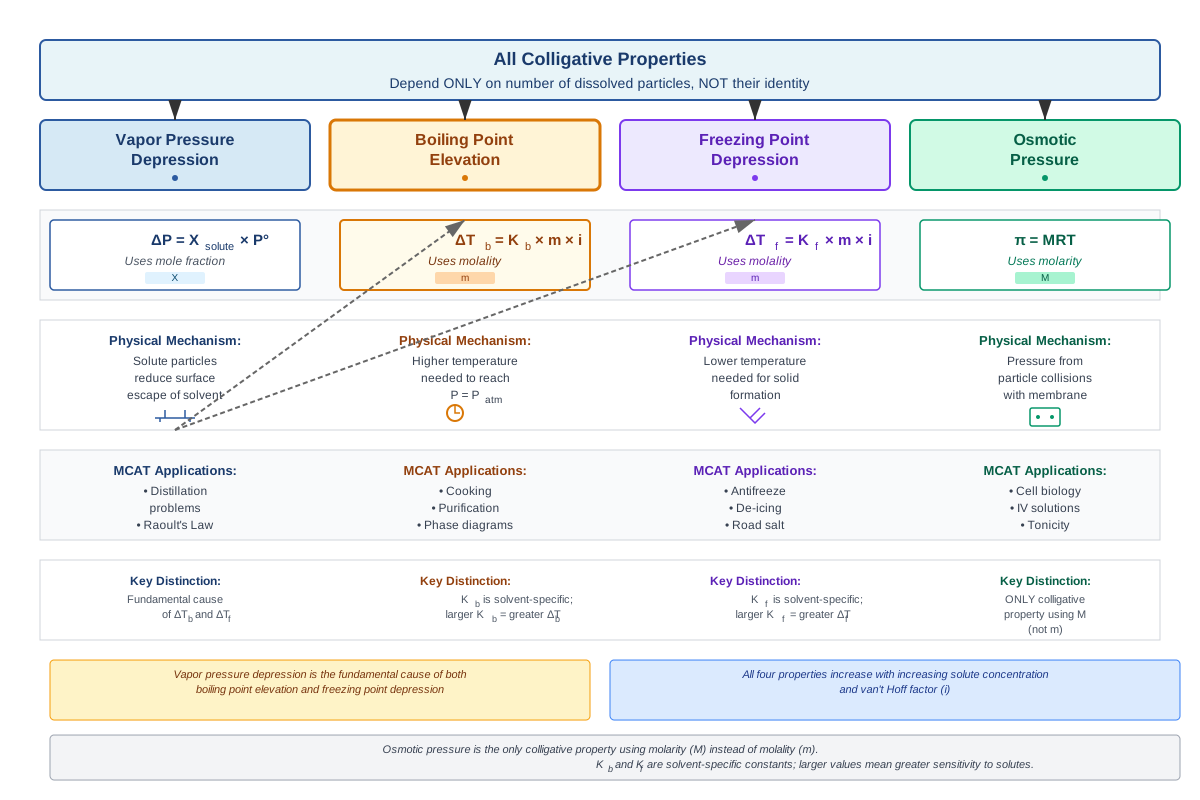
The importance of boiling point elevation in General Chemistry extends beyond simple calculations. This colligative property provides insight into how solutes affect solvent behavior at the molecular level, which has direct applications in biological systems, pharmaceutical formulations, and laboratory techniques. For MCAT success, students must understand not only the mathematical relationship (ΔTb = Kb × m × i) but also the underlying physical principles that explain why adding solute particles disrupts the solvent's ability to enter the gas phase. This topic connects intimately with vapor pressure depression, freezing point depression, and osmotic pressure—the four colligative properties that collectively explain how solution composition affects phase transitions.
Within the broader context of Solutions and Phase Behavior, boiling point elevation serves as a practical application of thermodynamic principles and solution theory. The MCAT expects students to recognize that colligative properties depend solely on the number of dissolved particles, not their identity, which distinguishes these phenomena from other solution properties. This concept frequently appears in passages discussing physiological processes (such as the concentration of urine in the kidneys), laboratory techniques (like distillation and purification), and real-world applications (such as antifreeze in car radiators or salt's effect on cooking water). Mastering this topic provides a foundation for understanding more complex solution behaviors tested on the exam.
Learning Objectives
- [ ] Define boiling point elevation using accurate General Chemistry terminology
- [ ] Explain why boiling point elevation matters for the MCAT
- [ ] Apply boiling point elevation to exam-style questions
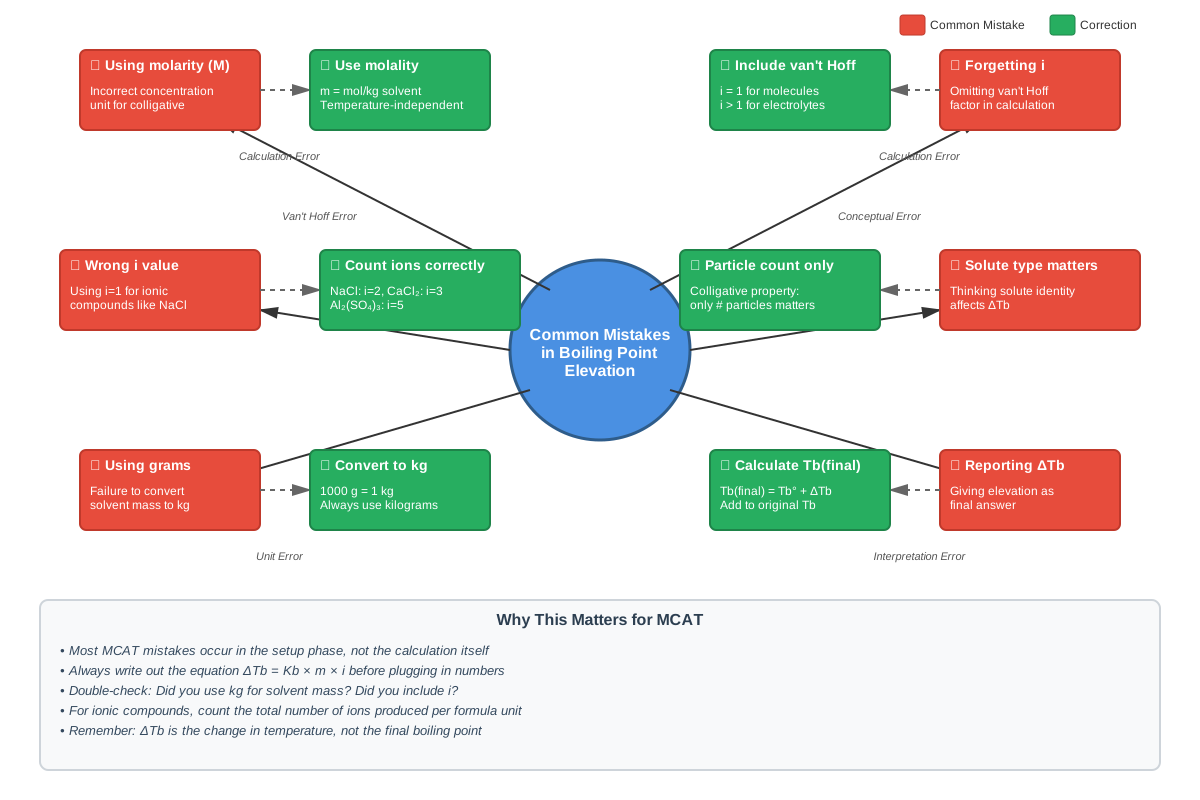
- [ ] Identify common mistakes related to boiling point elevation
- [ ] Connect boiling point elevation to related General Chemistry concepts
- [ ] Calculate the boiling point elevation for both electrolyte and non-electrolyte solutions using the van't Hoff factor
- [ ] Explain the molecular mechanism by which solute particles increase the boiling point of a solvent
- [ ] Predict the relative magnitude of boiling point elevation for different solutes and concentrations
- [ ] Distinguish between colligative and non-colligative properties in solution chemistry
Prerequisites
- Vapor pressure and phase diagrams: Understanding that boiling occurs when vapor pressure equals atmospheric pressure is essential for comprehending why solutes elevate boiling points
- Molality calculations: Boiling point elevation uses molality (mol solute/kg solvent) rather than molarity, requiring facility with this concentration unit
- Intermolecular forces: Knowledge of how particles interact in solution explains why solute particles disrupt solvent vaporization
- Colligative properties concept: Recognition that some properties depend only on particle number, not identity, provides the theoretical framework
- Electrolyte dissociation: Understanding how ionic compounds dissociate in solution is necessary for applying the van't Hoff factor correctly
Why This Topic Matters
Boiling point elevation appears regularly on the MCAT in multiple contexts, making it a medium-to-high yield topic that rewards thorough preparation. Clinically, this concept underlies important physiological processes such as the concentration of bodily fluids and the regulation of osmotic balance in cells. The kidneys, for example, produce concentrated urine through mechanisms that effectively increase solute concentration, which affects both boiling and freezing points of the solution. Pharmaceutical applications include the formulation of intravenous solutions, where understanding colligative properties ensures proper osmotic balance with blood.
From an exam statistics perspective, boiling point elevation MCAT questions appear in approximately 15-20% of General Chemistry passages dealing with solutions, and the concept frequently serves as a foundation for more complex questions about phase behavior and solution properties. The MCAT typically presents this topic in three formats: (1) direct calculation problems requiring application of the boiling point elevation equation, (2) conceptual questions asking students to predict or compare boiling points of different solutions, and (3) passage-based questions where boiling point elevation appears as part of an experimental setup or data interpretation challenge.
Common exam scenarios include passages about laboratory purification techniques (where understanding boiling point changes helps interpret distillation results), biological systems (where solute concentration affects physiological processes), and experimental design (where students must predict how solution composition affects measured properties). The MCAT particularly favors questions that require students to integrate boiling point elevation with other colligative properties or to recognize when this concept applies versus when other factors (like molecular structure or chemical reactivity) dominate. Understanding this topic thoroughly enables students to quickly identify question types and apply the appropriate problem-solving strategy, saving valuable time on test day.
Core Concepts
Definition and Fundamental Principle
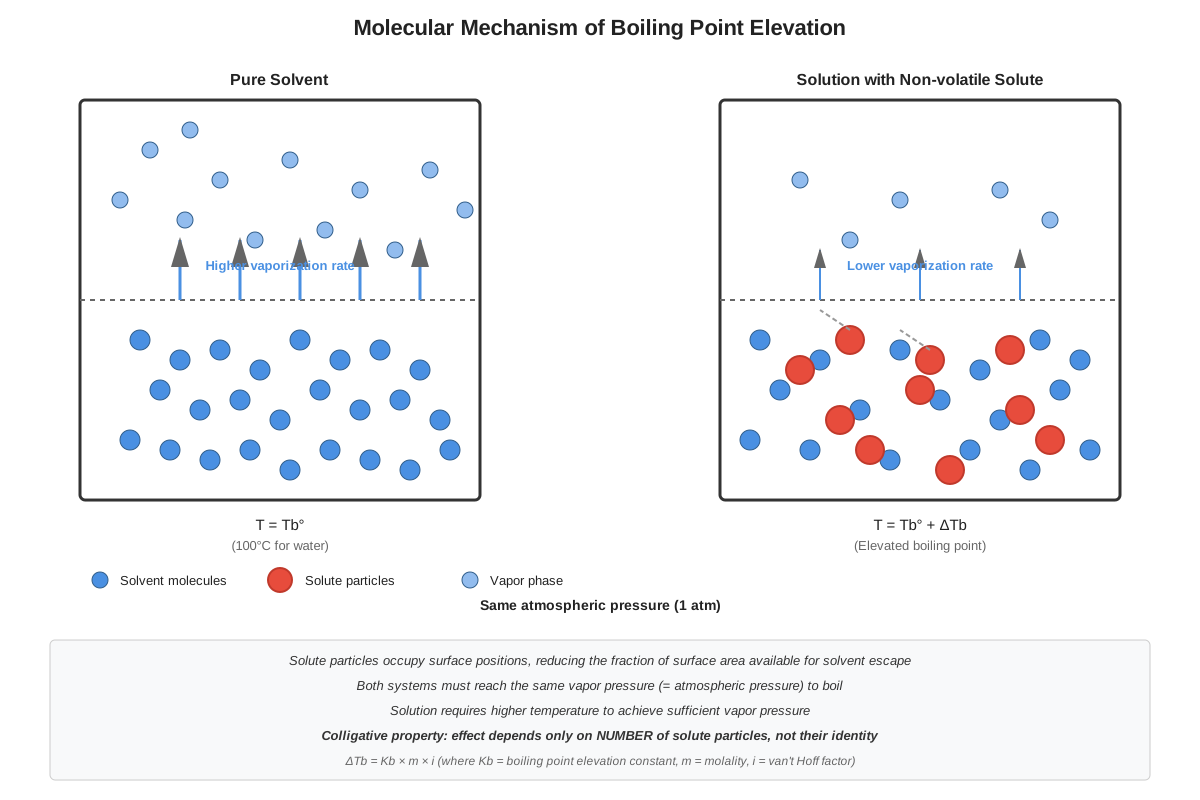
Boiling point elevation is the increase in the boiling point of a solvent that occurs when a non-volatile solute is dissolved in it. The boiling point itself is defined as the temperature at which the vapor pressure of a liquid equals the external atmospheric pressure. When solute particles are added to a pure solvent, they interfere with the solvent molecules' ability to escape into the gas phase, effectively lowering the vapor pressure of the solution compared to the pure solvent. Since a higher temperature is now required to increase the vapor pressure to match atmospheric pressure, the boiling point increases.
This phenomenon is classified as a colligative property, meaning it depends only on the number of dissolved solute particles, not on their chemical identity or structure. Whether the solute is sugar, salt, or any other substance, the magnitude of boiling point elevation depends solely on how many particles are present in solution. This particle-counting principle distinguishes colligative properties from other solution behaviors that depend on specific chemical interactions.
The Boiling Point Elevation Equation
The quantitative relationship for boiling point elevation is expressed as:
ΔTb = Kb × m × iWhere:
- ΔTb = change in boiling point (Tb,solution - Tb,pure solvent)
- Kb = ebullioscopic constant (boiling point elevation constant), a solvent-specific value
- m = molality of the solution (mol solute/kg solvent)
- i = van't Hoff factor (number of particles produced per formula unit of solute)
The ebullioscopic constant (Kb) is unique to each solvent and reflects how readily that solvent's boiling point responds to added solute. For water, Kb = 0.512 °C·kg/mol, meaning that a 1 molal solution of a non-dissociating solute raises water's boiling point by 0.512 °C. Different solvents have different Kb values based on their molecular properties and intermolecular forces.
The Van't Hoff Factor
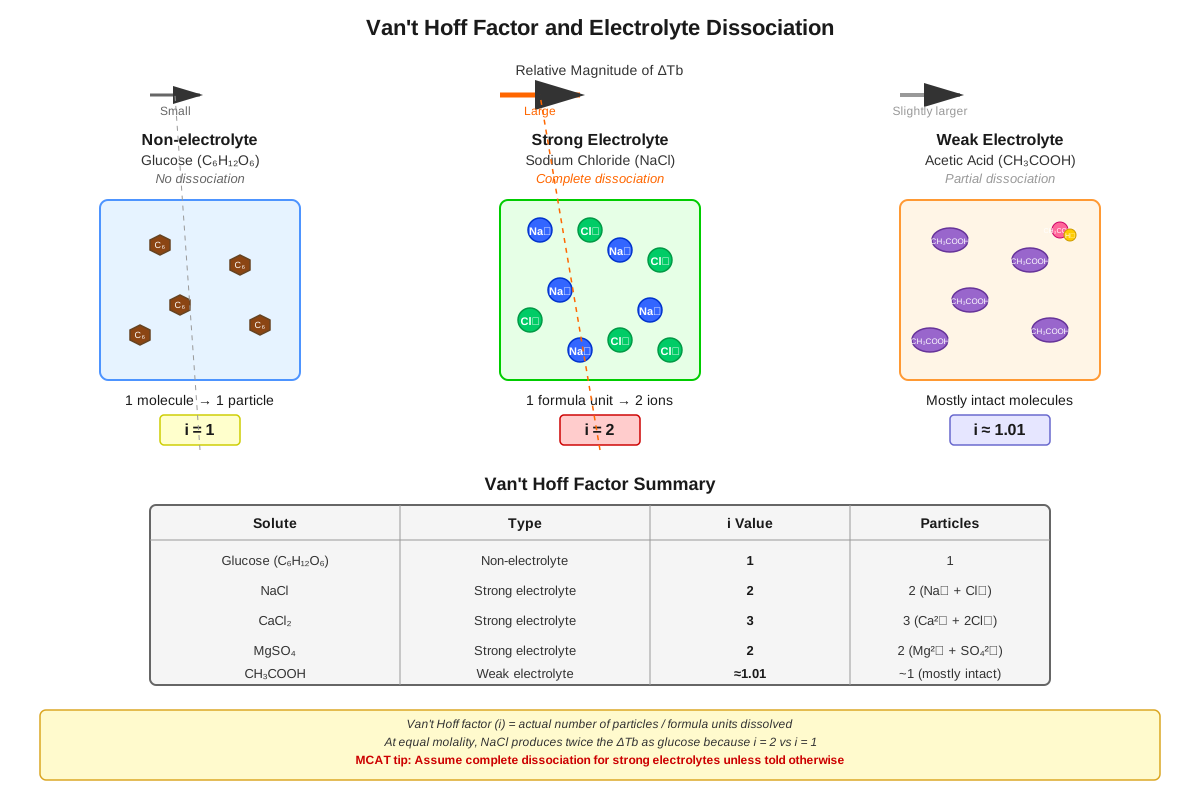
The van't Hoff factor (i) accounts for the dissociation or association of solute particles in solution. For non-electrolytes (substances that don't dissociate), i = 1. For electrolytes (ionic compounds that dissociate), i equals the number of ions produced per formula unit:
| Solute Type | Example | Van't Hoff Factor (i) |
|---|---|---|
| Non-electrolyte | Glucose (C₆H₁₂O₆) | 1 |
| Binary ionic compound | NaCl | 2 (Na⁺ + Cl⁻) |
| Ternary ionic compound | CaCl₂ | 3 (Ca²⁺ + 2Cl⁻) |
| Complex ionic compound | Na₂SO₄ | 3 (2Na⁺ + SO₄²⁻) |
| Weak electrolyte | CH₃COOH | Between 1 and 2 (partial dissociation) |
For MCAT purposes, assume complete dissociation for strong electrolytes unless the question specifically indicates otherwise. Weak electrolytes and the effects of ion pairing at high concentrations represent more advanced considerations that rarely appear on the exam.
Molecular Mechanism
At the molecular level, boiling point elevation occurs because solute particles occupy positions at the liquid surface and in the bulk solution, physically interfering with solvent molecules' ability to escape into the vapor phase. In pure solvent, molecules at the surface can readily overcome intermolecular forces and enter the gas phase when they possess sufficient kinetic energy. When solute particles are present, they reduce the number of solvent molecules at the surface and create additional interactions that must be overcome.
This interference effectively lowers the vapor pressure of the solution compared to pure solvent at any given temperature. Since boiling occurs when vapor pressure equals atmospheric pressure, and the solution's vapor pressure is lower than that of pure solvent, a higher temperature is required to achieve the vapor pressure necessary for boiling. The more solute particles present, the greater the vapor pressure depression, and consequently, the greater the boiling point elevation.
Relationship to Vapor Pressure
Boiling point elevation is directly connected to Raoult's Law and vapor pressure depression. Raoult's Law states that the vapor pressure of a solution is proportional to the mole fraction of solvent:
Psolution = Xsolvent × P°solventWhere Xsolvent is the mole fraction of solvent and P°solvent is the vapor pressure of pure solvent. As solute is added, Xsolvent decreases (because Xsolute + Xsolvent = 1), causing Psolution to decrease. This vapor pressure depression necessitates heating the solution to a higher temperature to achieve the vapor pressure required for boiling.
Practical Considerations and Limitations
Several practical factors affect boiling point elevation measurements and calculations:
- Concentration range: The equation ΔTb = Kb × m × i assumes ideal solution behavior, which holds best at low to moderate concentrations (typically below 1-2 molal)
- Non-volatile solute requirement: The solute must have negligible vapor pressure; if the solute is volatile, it contributes to the total vapor pressure and the simple equation no longer applies
- Temperature dependence: Kb values are temperature-dependent, though this variation is usually negligible for MCAT-level problems
- Pressure effects: The equation assumes constant atmospheric pressure (typically 1 atm); changes in external pressure affect the boiling point independently
Magnitude and Practical Applications
The magnitude of boiling point elevation is typically small for aqueous solutions at practical concentrations. For example, a 1 molal NaCl solution (i = 2) raises water's boiling point by only about 1 °C (ΔTb = 0.512 × 1 × 2 = 1.024 °C). This explains why adding salt to cooking water has minimal effect on boiling point—the concentrations typically used in cooking are far too low to produce significant elevation.
However, in biological systems where precise temperature and osmotic regulation matter, even small changes in boiling point (which correlate with changes in other colligative properties) become physiologically significant. The same principles that govern boiling point elevation also determine freezing point depression and osmotic pressure, which have more dramatic effects at biological concentrations and temperatures.
Concept Relationships
Boiling point elevation connects intimately with other colligative properties through their shared dependence on particle number. The relationship flows as follows: Solute addition → Vapor pressure depression (via Raoult's Law) → Boiling point elevation (requires higher temperature to achieve vapor pressure equal to atmospheric pressure). This same particle-counting principle simultaneously produces freezing point depression (solute particles interfere with crystal lattice formation) and osmotic pressure (solute particles create concentration gradients across semipermeable membranes).
The connection to vapor pressure is fundamental: boiling point elevation is essentially a consequence of vapor pressure depression. Understanding that vapor pressure increases with temperature and that boiling occurs when vapor pressure equals atmospheric pressure provides the mechanistic link. The mathematical relationship between these concepts can be derived from thermodynamic principles, though the MCAT focuses on conceptual understanding and application rather than derivation.
Molality serves as the concentration unit for boiling point elevation (rather than molarity) because molality is temperature-independent—it's based on mass of solvent rather than volume of solution. Since boiling point elevation involves temperature changes, using a temperature-independent concentration unit prevents circular reasoning and ensures accurate calculations. This connects to prerequisite knowledge of concentration units and their appropriate applications.
The van't Hoff factor links boiling point elevation to electrolyte chemistry and dissociation equilibria. Strong electrolytes produce predictable integer values of i, while weak electrolytes require consideration of equilibrium constants and percent dissociation. This connection extends to acid-base chemistry and solubility equilibria, where understanding the degree of dissociation becomes crucial for accurate predictions.
Within the broader context of phase behavior, boiling point elevation represents one way that solution composition affects phase transitions. This connects to phase diagrams, where the liquid-vapor equilibrium line shifts when solute is added. The concept also relates to distillation and purification techniques, where differences in boiling points enable separation of components—understanding how solutes affect boiling points helps predict and interpret distillation results.
High-Yield Facts
⭐ Boiling point elevation is a colligative property that depends only on the number of dissolved particles, not their identity
⭐ The equation ΔTb = Kb × m × i requires molality (not molarity) and includes the van't Hoff factor for electrolytes
⭐ For water, Kb = 0.512 °C·kg/mol, the most commonly used value on the MCAT
⭐ Ionic compounds produce greater boiling point elevation than non-electrolytes at the same molality due to dissociation (higher i values)
⭐ Boiling point elevation occurs because solute particles lower vapor pressure, requiring higher temperature to reach atmospheric pressure
- The van't Hoff factor equals the number of particles produced per formula unit: NaCl gives i = 2, CaCl₂ gives i = 3, glucose gives i = 1
- Boiling point elevation and freezing point depression are related phenomena—both result from solute particles disrupting solvent phase transitions
- Non-volatile solutes are required for the standard equation; volatile solutes contribute to vapor pressure and complicate the relationship
- The magnitude of boiling point elevation is typically small (1-2 °C) for aqueous solutions at practical concentrations
- Boiling point elevation has the same mathematical form as freezing point depression, with Kb replaced by Kf and opposite sign convention
Quick check — test yourself on Boiling point elevation so far.
Try Flashcards →Common Misconceptions
Misconception: Boiling point elevation depends on the type of solute dissolved, with some chemicals producing larger effects than others at the same concentration.
Correction: Boiling point elevation is a colligative property that depends only on the number of particles, not their chemical identity. A 1 molal solution of glucose produces the same ΔTb as a 1 molal solution of urea because both have i = 1. The only way chemical identity matters is through the van't Hoff factor—electrolytes produce more particles per formula unit than non-electrolytes.
Misconception: Molarity and molality can be used interchangeably in the boiling point elevation equation.
Correction: The equation specifically requires molality (mol solute/kg solvent), not molarity (mol solute/L solution). Molality is temperature-independent, which is essential when dealing with temperature changes. Using molarity would introduce errors because solution volume changes with temperature.
Misconception: The van't Hoff factor for NaCl is always exactly 2.0 in real solutions.
Correction: While the theoretical van't Hoff factor for NaCl is 2 (one Na⁺ and one Cl⁻), the actual value in concentrated solutions is slightly less due to ion pairing and non-ideal behavior. For MCAT purposes, assume i = 2 unless the question provides specific information, but recognize that real solutions show deviations from ideal behavior at high concentrations.
Misconception: Adding salt to cooking water significantly increases the boiling point, making food cook faster.
Correction: The amount of salt typically added to cooking water produces a negligible boiling point elevation (less than 0.5 °C). The primary purpose of salt in cooking water is flavor, not temperature elevation. To produce a meaningful increase in boiling point would require impractically large amounts of salt.
Misconception: Boiling point elevation only applies to aqueous solutions.
Correction: Boiling point elevation occurs for any solvent when a non-volatile solute is added. Each solvent has its own Kb value. While water is most commonly discussed (and most relevant for the MCAT), the principle applies universally to solutions. Organic solvents like benzene or ethanol also exhibit boiling point elevation with their own characteristic Kb values.
Misconception: A solution with higher boiling point elevation always has higher vapor pressure.
Correction: This is backwards—solutions with higher boiling point elevation actually have lower vapor pressure than pure solvent at the same temperature. The boiling point increases precisely because vapor pressure is depressed, requiring higher temperature to achieve the vapor pressure necessary for boiling.
Misconception: Boiling point elevation can be used to determine the molecular weight of electrolytes directly.
Correction: While boiling point elevation can help determine molecular weight for non-electrolytes (where i = 1), electrolytes complicate this analysis because dissociation must be accounted for. Without knowing the van't Hoff factor independently, molecular weight determination becomes ambiguous for ionic compounds.
Worked Examples
Example 1: Calculating Boiling Point Elevation for an Electrolyte
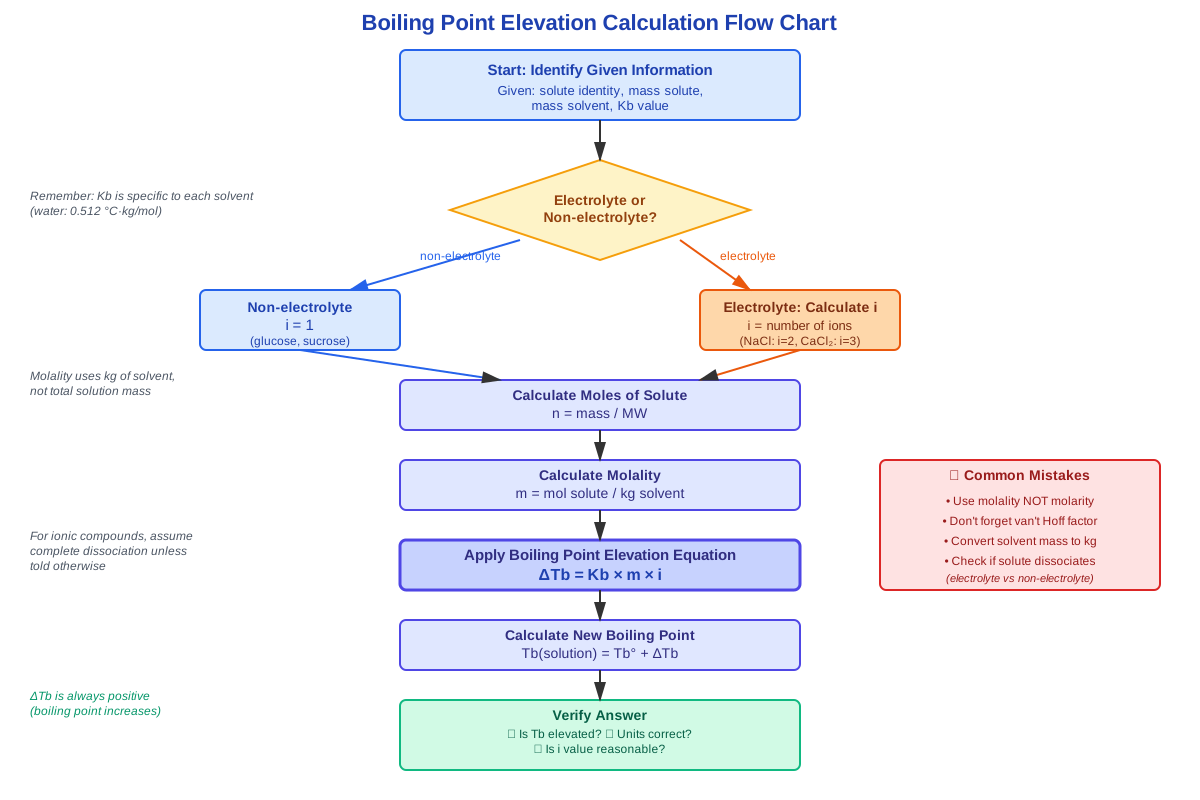
Problem: What is the boiling point of a solution prepared by dissolving 58.5 g of NaCl in 500 g of water? (Kb for water = 0.512 °C·kg/mol; molar mass of NaCl = 58.5 g/mol)
Solution:
Step 1: Calculate moles of NaCl
moles NaCl = 58.5 g ÷ 58.5 g/mol = 1.00 molStep 2: Calculate molality
molality = 1.00 mol ÷ 0.500 kg = 2.00 mStep 3: Determine the van't Hoff factor
NaCl is a strong electrolyte that dissociates completely: NaCl → Na⁺ + Cl⁻
Therefore, i = 2
Step 4: Apply the boiling point elevation equation
ΔTb = Kb × m × i
ΔTb = 0.512 °C·kg/mol × 2.00 mol/kg × 2
ΔTb = 2.05 °C
Step 5: Calculate the new boiling point
Tb,solution = Tb,pure water + ΔTb
Tb,solution = 100.0 °C + 2.05 °C = 102.05 °CAnswer: The solution boils at approximately 102.1 °C
Key reasoning: This problem requires recognizing that NaCl is an electrolyte (i = 2), using molality rather than molarity, and applying the equation systematically. The MCAT often tests whether students remember to include the van't Hoff factor for ionic compounds.
Example 2: Comparing Boiling Points of Different Solutions
Problem: Rank the following aqueous solutions in order of increasing boiling point:
- Solution A: 1.0 m glucose (C₆H₁₂O₆)
- Solution B: 0.5 m CaCl₂
- Solution C: 0.75 m NaCl
- Solution D: Pure water
Solution:
Step 1: Recognize that boiling point elevation is a colligative property depending on total particle concentration
Step 2: Calculate effective particle concentration (m × i) for each solution
Solution A (glucose):
- Glucose is a non-electrolyte, so i = 1
- Effective concentration = 1.0 m × 1 = 1.0 m
Solution B (CaCl₂):
- CaCl₂ dissociates: CaCl₂ → Ca²⁺ + 2Cl⁻, so i = 3
- Effective concentration = 0.5 m × 3 = 1.5 m
Solution C (NaCl):
- NaCl dissociates: NaCl → Na⁺ + Cl⁻, so i = 2
- Effective concentration = 0.75 m × 2 = 1.5 m
Solution D (pure water):
- No solute, so effective concentration = 0
Step 3: Rank by effective concentration (higher concentration = higher boiling point)
- Solution D: 0 (lowest boiling point, 100.0 °C)
- Solution A: 1.0 m
- Solutions B and C: 1.5 m (tied for highest boiling point)
Answer: D < A < B = C (increasing boiling point)
Key reasoning: This problem tests conceptual understanding of the van't Hoff factor and the ability to compare solutions without explicit calculation. The MCAT frequently asks comparison questions that require recognizing that effective particle concentration (m × i) determines colligative properties. Note that Solutions B and C have the same effective concentration despite different molalities and different solutes, illustrating the colligative nature of the property.
Example 3: Experimental Design Application
Problem: A researcher measures the boiling point of an aqueous solution and finds it to be 100.77 °C. If the solution was prepared by dissolving 0.100 mol of a non-volatile, non-electrolyte solute in 250 g of water, what is the experimental value of Kb for water? Compare this to the theoretical value of 0.512 °C·kg/mol and suggest a reason for any discrepancy.
Solution:
Step 1: Calculate ΔTb
ΔTb = 100.77 °C - 100.00 °C = 0.77 °CStep 2: Calculate molality
molality = 0.100 mol ÷ 0.250 kg = 0.400 mStep 3: Identify the van't Hoff factor
Non-electrolyte, so i = 1
Step 4: Rearrange the equation to solve for Kb
ΔTb = Kb × m × i
Kb = ΔTb ÷ (m × i)
Kb = 0.77 °C ÷ (0.400 mol/kg × 1)
Kb = 1.93 °C·kg/mol
Step 5: Compare to theoretical value and analyze
The experimental value (1.93 °C·kg/mol) is significantly higher than the theoretical value (0.512 °C·kg/mol), suggesting experimental error or non-ideal solution behavior.
Possible explanations:
- Measurement error in temperature (most likely)
- Incorrect mass of solvent (water may have evaporated)
- Solute may actually be an electrolyte with i > 1
- Non-ideal solution behavior at this concentration
Answer: Experimental Kb = 1.93 °C·kg/mol; the discrepancy suggests measurement error or that the solute may not be a true non-electrolyte.
Key reasoning: This problem integrates experimental design with boiling point elevation calculations, requiring students to work backwards from data to determine a constant. The MCAT often presents experimental scenarios where students must identify sources of error or explain unexpected results, testing both calculation skills and conceptual understanding.
Exam Strategy
When approaching boiling point elevation MCAT questions, begin by identifying the question type: calculation, comparison/ranking, or conceptual explanation. For calculation problems, immediately check whether the solute is an electrolyte or non-electrolyte to determine the van't Hoff factor—this is the most common source of errors. Write down the equation ΔTb = Kb × m × i and identify which variables are given and which must be calculated.
Trigger words and phrases that signal boiling point elevation questions include: "colligative property," "non-volatile solute," "boiling point of the solution," "ebullioscopic constant," and any mention of comparing boiling points of different solutions. Passages discussing distillation, purification, or solution preparation often incorporate boiling point elevation concepts. Watch for phrases like "particles in solution" or "dissolved species," which hint at the importance of the van't Hoff factor.
For process-of-elimination strategies, remember these key principles:
- Eliminate any answer choice suggesting that boiling point elevation depends on solute identity (rather than particle number) for colligative properties
- Eliminate choices that confuse molarity with molality
- For ranking problems, eliminate any ordering that doesn't account for dissociation of electrolytes
- Eliminate answers that suggest volatile solutes behave the same as non-volatile solutes
Time allocation: Simple calculation problems should take 60-90 seconds once you've identified the question type. Spend 10-15 seconds identifying the van't Hoff factor, 20-30 seconds calculating molality if needed, and 30-45 seconds applying the equation and checking your answer. For comparison/ranking questions, spend 30-45 seconds calculating effective concentrations (m × i) for each solution, then rank immediately. Don't waste time calculating exact ΔTb values if the question only asks for relative ordering.
Exam Tip: If a question provides Kb for a solvent other than water, it's likely testing whether you recognize that boiling point elevation applies to all solvents, not just water. Don't panic—the equation and approach remain identical.
For passage-based questions, scan for data tables showing boiling points of different solutions or experimental procedures involving heating solutions. These often set up questions about colligative properties. If the passage discusses biological systems or physiological processes, consider whether boiling point elevation (or the related concept of osmotic pressure) might explain observed phenomena.
Memory Techniques
Mnemonic for colligative properties: "Boiling Freezes Osmosis Vapor" helps remember the four colligative properties: Boiling point elevation, Freezing point depression, Osmotic pressure, Vapor pressure depression. All depend on particle number, not identity.
Mnemonic for the equation: "Keep My Ice" reminds you that ΔTb = Kb × m × i (Kb, molality, van't Hoff factor).
Visualization strategy: Picture solute particles as "obstacles" at the liquid surface, physically blocking solvent molecules from escaping into the vapor phase. The more obstacles (higher concentration), the harder it is for molecules to escape, requiring more energy (higher temperature) to achieve boiling. This mental image reinforces both the mechanism and the relationship between concentration and effect magnitude.
Van't Hoff factor memory aid: "Count the ions" is the simplest rule. For any ionic compound, write the dissociation equation and count the total particles produced. NaCl → 2 particles, CaCl₂ → 3 particles, Al₂(SO₄)₃ → 5 particles. For non-electrolytes, remember "molecules stay whole" (i = 1).
Molality vs. Molarity: Remember "molality uses mass" (mol/kg) while "Molarity uses volume" (mol/L). Since boiling point elevation involves temperature changes and volume changes with temperature, molality (mass-based) is the appropriate unit.
Acronym for problem-solving steps: "DIVE" helps remember the systematic approach:
- Determine the van't Hoff factor (electrolyte or non-electrolyte?)
- Identify or calculate molality
- Verify the Kb value (usually 0.512 for water)
- Evaluate using ΔTb = Kb × m × i
Summary
Boiling point elevation is a colligative property describing the increase in a solvent's boiling point when a non-volatile solute is dissolved in it. This phenomenon occurs because solute particles interfere with solvent molecules' escape into the vapor phase, lowering vapor pressure and requiring higher temperature to achieve boiling. The quantitative relationship ΔTb = Kb × m × i incorporates the ebullioscopic constant (Kb, solvent-specific), molality (m, mol solute/kg solvent), and the van't Hoff factor (i, accounting for dissociation). For MCAT success, students must recognize that this property depends only on particle number, not chemical identity, making it essential to account for electrolyte dissociation through the van't Hoff factor. Water's Kb value of 0.512 °C·kg/mol is the most commonly tested constant. The concept connects intimately with vapor pressure depression, other colligative properties, and phase behavior, appearing in calculation problems, comparison questions, and passage-based scenarios involving laboratory techniques or biological systems. Mastery requires both computational facility with the equation and conceptual understanding of the molecular mechanism underlying the phenomenon.
Key Takeaways
- Boiling point elevation is a colligative property depending solely on the number of dissolved particles, not their chemical identity
- The equation ΔTb = Kb × m × i requires molality (not molarity) and must include the van't Hoff factor for electrolytes
- For water, Kb = 0.512 °C·kg/mol; this value appears frequently on the MCAT
- Electrolytes produce greater boiling point elevation than non-electrolytes at equal molality due to dissociation (higher i values)
- The molecular mechanism involves solute particles lowering vapor pressure, requiring higher temperature to reach atmospheric pressure for boiling
- Boiling point elevation connects to vapor pressure depression, freezing point depression, and osmotic pressure through shared colligative principles
- MCAT questions test both calculation skills and conceptual understanding, often requiring comparison of solutions or interpretation of experimental data
Related Topics
Freezing Point Depression: The complementary colligative property where solute particles lower the freezing point of a solvent; uses the same mathematical form (ΔTf = Kf × m × i) and conceptual framework as boiling point elevation. Mastering boiling point elevation provides direct preparation for understanding freezing point depression.
Osmotic Pressure: Another colligative property with significant biological relevance; understanding particle counting and the van't Hoff factor from boiling point elevation directly transfers to osmotic pressure calculations (Π = iMRT).
Vapor Pressure and Raoult's Law: The fundamental principle underlying boiling point elevation; deeper study of vapor pressure relationships provides mechanistic insight into why boiling points change with solute addition.
Phase Diagrams: Graphical representations of phase transitions; understanding how solution composition shifts phase boundaries builds on boiling point elevation concepts and extends to more complex systems.
Distillation and Purification Techniques: Practical applications of boiling point differences; mastering boiling point elevation enables prediction and interpretation of separation techniques commonly discussed in MCAT passages.
Practice CTA
Now that you've mastered the core concepts of boiling point elevation, it's time to solidify your understanding through active practice. Attempt the practice questions and flashcards associated with this topic to test your ability to apply these concepts under exam-like conditions. Focus particularly on problems involving electrolytes and the van't Hoff factor, as these represent the most common challenge areas. Remember that mastery comes through repeated application—each practice problem strengthens your pattern recognition and problem-solving speed for test day. You've built a strong foundation; now reinforce it through deliberate practice!
Sign up free to keep reading
Create a free AnvayaPrep account to finish this MCAT guide on Boiling point elevation — plus flashcards and practice questions.