Overview
Freezing point depression is a fundamental colligative property that describes the phenomenon whereby the freezing point of a solvent decreases when a solute is dissolved in it. This concept sits at the intersection of Solutions and Phase Behavior within General Chemistry, representing a critical principle that governs how dissolved particles affect the physical properties of solutions. Understanding freezing point depression requires integrating knowledge of intermolecular forces, solution thermodynamics, and phase equilibria—all high-yield topics for the MCAT.
For MCAT preparation, freezing point depression General Chemistry questions frequently appear in both discrete questions and passage-based formats, often integrated with biological contexts such as antifreeze proteins in Arctic fish, cryopreservation of cells, or the physiological effects of electrolyte imbalances. The MCAT tests not only the mathematical application of freezing point depression formulas but also conceptual understanding of why solutes disrupt the crystalline structure formation necessary for freezing. This topic typically appears 2-3 times per exam, either as standalone calculations or embedded within larger thermodynamics or biochemistry passages.
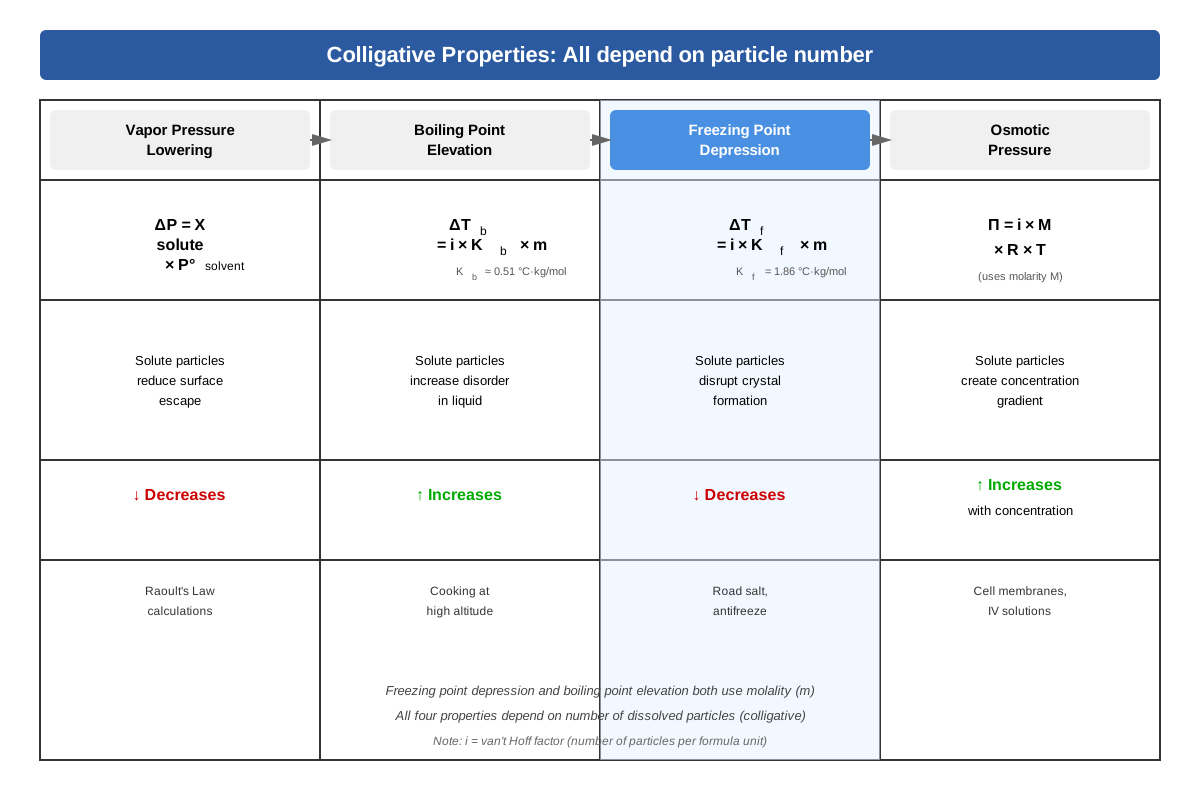
The broader significance of freezing point depression MCAT content extends beyond simple calculations. It connects to vapor pressure lowering, boiling point elevation, and osmotic pressure—the four colligative properties that depend solely on the number of dissolved particles rather than their chemical identity. Mastering freezing point depression provides a foundation for understanding how biological systems maintain liquid water below 0°C, how road salt prevents ice formation, and how cells respond to hypertonic or hypotonic environments. This topic exemplifies the MCAT's emphasis on applying physical chemistry principles to biological and medical scenarios.
Learning Objectives
- [ ] Define freezing point depression using accurate General Chemistry terminology
- [ ] Explain why freezing point depression matters for the MCAT
- [ ] Apply freezing point depression to exam-style questions
- [ ] Identify common mistakes related to freezing point depression
- [ ] Connect freezing point depression to related General Chemistry concepts
- [ ] Calculate the freezing point of solutions given solute concentration and van't Hoff factor
- [ ] Predict the relative freezing points of different solutions based on particle concentration
- [ ] Explain the molecular mechanism by which solutes disrupt solvent crystallization
Prerequisites
- Molality and molarity: Understanding concentration units is essential because freezing point depression calculations use molality (moles solute per kilogram solvent)
- Colligative properties fundamentals: Recognition that certain properties depend on particle number, not identity, provides the conceptual framework
- Phase diagrams and phase transitions: Knowledge of what occurs at the freezing point (solid-liquid equilibrium) enables understanding of how solutes shift this equilibrium
- Van't Hoff factor (i): Familiarity with how ionic compounds dissociate into multiple particles is critical for accurate calculations
- Intermolecular forces: Understanding hydrogen bonding and dipole interactions explains why solutes disrupt the ordered crystalline structure of frozen solvents
Why This Topic Matters
Clinical and Real-World Significance
Freezing point depression has profound biological and medical applications that make it particularly relevant for future physicians. Antifreeze proteins in cold-water fish prevent ice crystal formation in their blood by depressing the freezing point below the ambient water temperature. In medicine, cryopreservation of cells, tissues, and organs relies on cryoprotectants like dimethyl sulfoxide (DMSO) and glycerol, which lower the freezing point and prevent destructive ice crystal formation. Intravenous fluid formulations must account for freezing point depression to ensure solutions remain liquid during storage and transport. Additionally, understanding colligative properties helps explain why hyperosmolar states (like diabetic ketoacidosis) affect cellular function and why electrolyte imbalances can be life-threatening.
MCAT Exam Statistics
Freezing point depression appears on approximately 60-70% of MCAT exams, typically in 1-3 questions per test. Questions most commonly appear in the Chemical and Physical Foundations of Biological Systems section but occasionally surface in Biological and Biochemical Foundations when discussing cellular osmotic stress or adaptation to extreme environments. The MCAT favors conceptual questions over pure calculation, though students must be prepared for both. Common question formats include:
- Ranking solutions by freezing point based on solute concentration
- Calculating the freezing point of a solution given mass and molecular weight data
- Interpreting experimental data showing freezing point changes
- Applying freezing point depression to biological scenarios (antifreeze proteins, cell preservation)
- Comparing colligative properties across different solutions
Common Passage Contexts
MCAT passages frequently embed freezing point depression within broader experimental or biological contexts. Typical scenarios include research on extremophile organisms, pharmaceutical formulation studies, environmental chemistry (road salt effects), or clinical scenarios involving fluid and electrolyte management. Passages may present data tables showing freezing points of various solutions and ask students to draw conclusions about solute concentration or identity.
Core Concepts
Definition and Fundamental Principle
Freezing point depression is the decrease in the freezing point of a pure solvent that occurs when a non-volatile solute is dissolved in it. The freezing point itself represents the temperature at which the liquid and solid phases of a substance exist in equilibrium at a given pressure. When solute particles are introduced into a solvent, they disrupt the formation of the ordered crystalline lattice structure required for the solid phase, thereby requiring a lower temperature to achieve the solid-liquid equilibrium.
This phenomenon is classified as a colligative property, meaning it depends exclusively on the concentration of dissolved particles (molecules or ions) rather than their chemical identity. Whether the solute is glucose, sodium chloride, or any other substance, the magnitude of freezing point depression depends only on how many particles are present in solution.
Mathematical Relationship
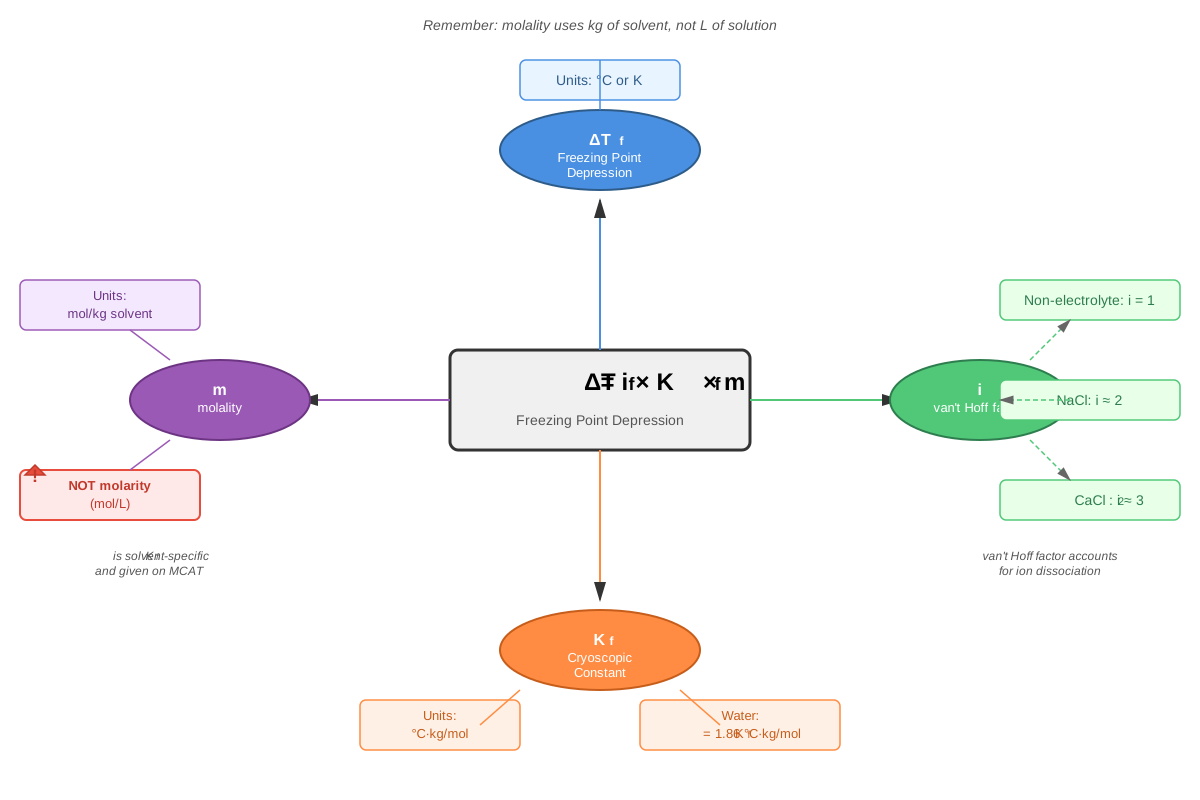
The quantitative relationship for freezing point depression is expressed by the equation:
ΔTf = i × Kf × mWhere:
- ΔTf = freezing point depression (the change in freezing point, always a positive value)
- i = van't Hoff factor (number of particles produced per formula unit of solute)
- Kf = cryoscopic constant or freezing point depression constant (a solvent-specific property)
- m = molality of the solution (moles of solute per kilogram of solvent)
The actual freezing point of the solution is calculated as:
Tf(solution) = Tf(pure solvent) - ΔTfFor water, the most common solvent on the MCAT, Kf = 1.86 °C·kg/mol, and the normal freezing point is 0°C.
The Van't Hoff Factor
The van't Hoff factor (i) accounts for the dissociation of ionic compounds in solution. For non-electrolytes (molecular compounds that don't dissociate), i = 1. For ionic compounds, i equals the number of ions produced when one formula unit dissolves:
| Compound Type | Example | Van't Hoff Factor (i) |
|---|---|---|
| Non-electrolyte | Glucose (C₆H₁₂O₆) | 1 |
| Binary ionic | NaCl | 2 (Na⁺ + Cl⁻) |
| Ternary ionic | CaCl₂ | 3 (Ca²⁺ + 2Cl⁻) |
| Complex ionic | Na₂SO₄ | 3 (2Na⁺ + SO₄²⁻) |
| Quaternary ionic | FeCl₃ | 4 (Fe³⁺ + 3Cl⁻) |
Note that the theoretical van't Hoff factor assumes complete dissociation. In reality, ion pairing and incomplete dissociation may result in effective i values slightly lower than theoretical predictions, particularly at high concentrations.
Molecular Mechanism
At the molecular level, freezing point depression occurs because solute particles interfere with the solvent molecules' ability to form the regular, ordered crystalline lattice characteristic of the solid phase. In pure water, hydrogen bonding allows water molecules to arrange into a hexagonal ice crystal structure at 0°C. When solute particles are present, they occupy positions at the liquid-solid interface, physically blocking water molecules from joining the growing ice crystal. This disruption of the crystallization process means that a lower temperature (greater thermal energy reduction) is required to overcome the entropic advantage of the disordered liquid state and achieve the ordered solid state.
From a thermodynamic perspective, the presence of solute particles increases the entropy of the liquid phase, making it more thermodynamically favorable relative to the pure solid phase. The system must reach a lower temperature before the enthalpy change of freezing can overcome this increased entropy difference.
Relationship to Chemical Potential
The underlying thermodynamic explanation involves chemical potential. The addition of solute lowers the chemical potential of the solvent in the liquid phase but does not affect the chemical potential of the pure solid phase (assuming the solute doesn't incorporate into the solid). At equilibrium (the freezing point), the chemical potentials of the liquid and solid phases must be equal. Since the solute has lowered the liquid's chemical potential, a lower temperature is required to decrease the solid's chemical potential to match, thereby establishing a new equilibrium at a depressed freezing point.
Concentration Dependence
The linear relationship between freezing point depression and molality (ΔTf = i × Kf × m) holds true for dilute solutions, typically those with molality less than 1 mol/kg. At higher concentrations, deviations from ideality occur due to:
- Ion pairing (reducing effective i)
- Solute-solute interactions
- Changes in solvent activity
- Non-ideal solution behavior
For MCAT purposes, assume ideal behavior unless the question specifically indicates otherwise or provides data suggesting non-ideality.
Why Molality, Not Molarity?
Freezing point depression calculations use molality (moles solute/kg solvent) rather than molarity (moles solute/L solution) because molality is temperature-independent. Since freezing point depression involves temperature changes, using a concentration unit that doesn't vary with temperature ensures consistency. Molarity changes with temperature because solution volume expands or contracts, but the mass of solvent remains constant regardless of temperature.
Concept Relationships
Freezing point depression exists within a network of interconnected General Chemistry concepts. The mathematical relationship (ΔTf = i × Kf × m) directly connects to molality calculations, requiring students to convert between mass, moles, and molecular weight. The van't Hoff factor links to ionic dissociation and electrolyte chemistry, as understanding how compounds break apart in solution is essential for accurate predictions.
Within colligative properties, freezing point depression is inversely related to boiling point elevation—both stem from the same fundamental principle of solute particles disrupting phase transitions. The relationship can be mapped as:
Solute addition → Disrupts solvent organization → Lowers vapor pressure → Requires lower temperature for freezing (freezing point depression) AND Requires higher temperature for boiling (boiling point elevation)
Freezing point depression also connects to osmotic pressure, as both depend on particle concentration. In biological systems, understanding how solute concentration affects freezing point helps explain osmotic stress on cells and the function of osmoregulation mechanisms.
The concept bridges to thermodynamics through entropy and Gibbs free energy considerations. The increased entropy of the solution (compared to pure solvent) makes the liquid phase more stable, requiring additional energy removal (lower temperature) to achieve the solid phase. This connects to the broader principle that ΔG = ΔH - TΔS, where the entropy term becomes more significant in solutions.
Finally, freezing point depression relates to phase diagrams, as the addition of solute effectively shifts the solid-liquid equilibrium line to lower temperatures. This graphical representation helps visualize how colligative properties modify phase behavior.
Quick check — test yourself on Freezing point depression so far.
Try Flashcards →High-Yield Facts
⭐ Freezing point depression is a colligative property that depends only on the number of dissolved particles, not their chemical identity
⭐ The formula ΔTf = i × Kf × m requires molality (mol/kg solvent), not molarity
⭐ For water, Kf = 1.86 °C·kg/mol, the most commonly tested value on the MCAT
⭐ Ionic compounds produce greater freezing point depression than molecular compounds at equal molality due to dissociation (higher i values)
⭐ The van't Hoff factor (i) equals the number of particles produced per formula unit: NaCl gives i = 2, CaCl₂ gives i = 3
- The actual freezing point equals the pure solvent freezing point minus ΔTf: Tf(solution) = Tf(pure) - ΔTf
- Solutions with higher particle concentrations have lower freezing points
- Freezing point depression explains why salt melts ice on roads (creates a solution with a freezing point below the ambient temperature)
- Antifreeze proteins in organisms work by binding to ice crystals and preventing their growth, not by traditional colligative freezing point depression
- The cryoscopic constant (Kf) is a solvent-specific property that varies between different solvents
- Freezing point depression and boiling point elevation are related phenomena stemming from vapor pressure lowering
- In biological systems, cryoprotectants like glycerol prevent ice crystal formation during cell freezing by significantly depressing the freezing point
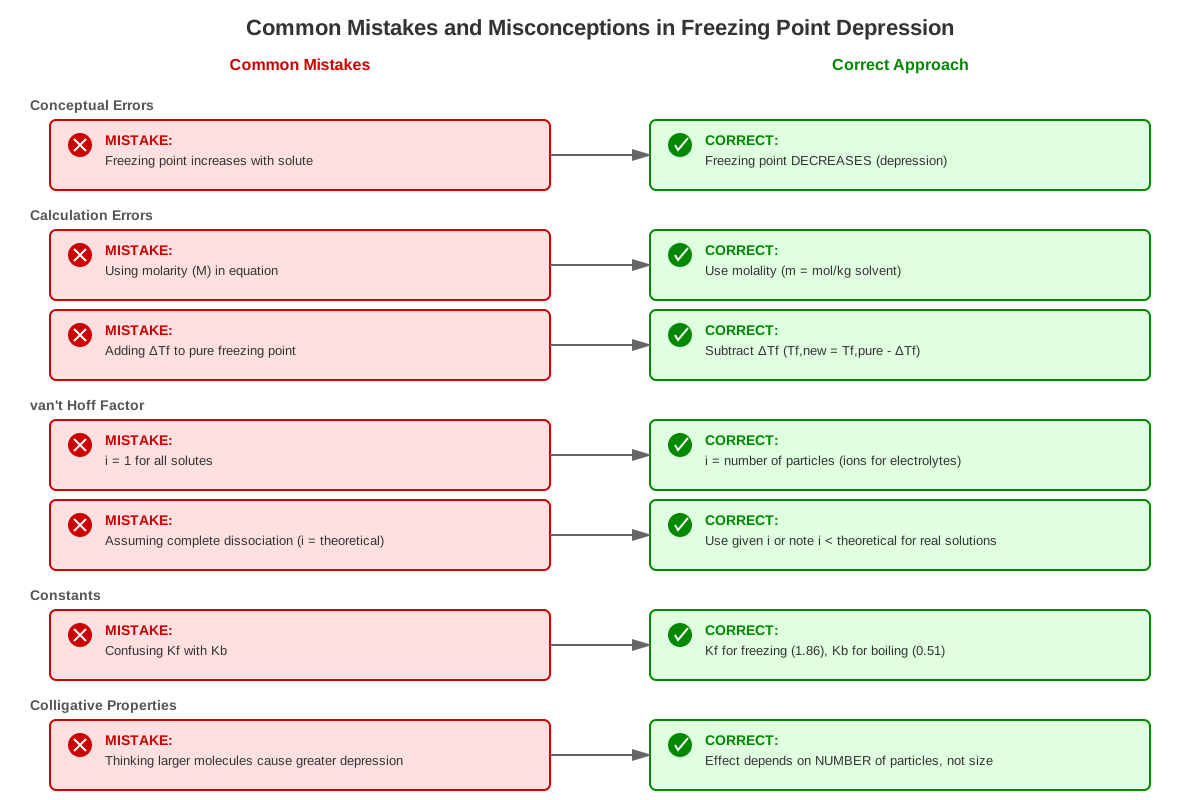
Common Misconceptions
Misconception: Freezing point depression depends on the type of solute dissolved
Correction: Freezing point depression is a colligative property depending only on the number of particles, not their identity. A mole of glucose particles produces the same ΔTf as a mole of urea particles (both have i = 1), even though they are chemically different.
Misconception: The van't Hoff factor for NaCl is always exactly 2.0 in all solutions
Correction: While the theoretical van't Hoff factor for NaCl is 2, the effective value in real solutions may be slightly less (around 1.8-1.9) due to ion pairing, especially at higher concentrations. For MCAT purposes, use i = 2 unless data suggests otherwise.
Misconception: Molarity and molality are interchangeable in freezing point depression calculations
Correction: Only molality (moles solute per kg solvent) should be used because it is temperature-independent. Molarity changes with temperature as solution volume changes, making it inappropriate for calculations involving temperature changes.
Misconception: A solution with a freezing point of -5°C has ΔTf = -5°C
Correction: ΔTf is defined as a positive value representing the magnitude of depression. If pure water freezes at 0°C and the solution freezes at -5°C, then ΔTf = 5°C (not -5°C). The actual freezing point is calculated as Tf(solution) = 0°C - 5°C = -5°C.
Misconception: Adding more solute will always proportionally decrease the freezing point
Correction: The linear relationship (ΔTf = i × Kf × m) holds only for dilute solutions. At high concentrations, non-ideal behavior occurs, and the relationship may deviate from linearity due to ion pairing and solute-solute interactions.
Misconception: Freezing point depression only applies to aqueous solutions
Correction: Freezing point depression occurs in any solution where a non-volatile solute is dissolved in a solvent. Different solvents have different Kf values. For example, benzene has Kf = 5.12 °C·kg/mol, much larger than water's 1.86 °C·kg/mol.
Misconception: The solute must be ionic to cause freezing point depression
Correction: Both ionic and molecular (non-ionic) solutes cause freezing point depression. Molecular solutes like glucose or ethylene glycol are effective, though ionic solutes produce greater effects per mole due to dissociation into multiple particles.
Worked Examples
Example 1: Calculating Freezing Point Depression
Question: What is the freezing point of a solution prepared by dissolving 18.0 g of glucose (C₆H₁₂O₆, MW = 180 g/mol) in 500 g of water? (Kf for water = 1.86 °C·kg/mol)
Solution:
Step 1: Calculate moles of glucose
moles = mass / molecular weight = 18.0 g / 180 g/mol = 0.10 molStep 2: Calculate molality
molality = moles solute / kg solvent = 0.10 mol / 0.500 kg = 0.20 mol/kgStep 3: Identify the van't Hoff factor
Glucose is a molecular compound that doesn't dissociate, so i = 1
Step 4: Calculate ΔTf
ΔTf = i × Kf × m = 1 × 1.86 °C·kg/mol × 0.20 mol/kg = 0.372 °CStep 5: Calculate the actual freezing point
Tf(solution) = Tf(pure water) - ΔTf = 0°C - 0.372°C = -0.372°CAnswer: The solution freezes at approximately -0.37°C
Key Connections: This problem addresses the learning objectives of applying freezing point depression to calculations and correctly using the van't Hoff factor for molecular compounds. It demonstrates the importance of converting mass to moles and using molality rather than molarity.
Example 2: Comparing Freezing Points of Different Solutions
Question: Rank the following solutions from highest to lowest freezing point:
- Solution A: 1.0 m glucose (C₆H₁₂O₆)
- Solution B: 0.5 m NaCl
- Solution C: 0.5 m CaCl₂
- Solution D: Pure water
Solution:
Step 1: Determine the effective particle concentration for each solution
Solution A: Glucose doesn't dissociate, i = 1
Effective concentration = 1.0 m × 1 = 1.0 m particles
Solution B: NaCl dissociates into Na⁺ and Cl⁻, i = 2
Effective concentration = 0.5 m × 2 = 1.0 m particles
Solution C: CaCl₂ dissociates into Ca²⁺ and 2Cl⁻, i = 3
Effective concentration = 0.5 m × 3 = 1.5 m particles
Solution D: Pure water has no solute particles
Effective concentration = 0 m particles
Step 2: Apply the principle that greater particle concentration produces greater freezing point depression (lower freezing point)
Solution D (pure water) has the highest freezing point (0°C)
Solutions A and B have equal particle concentrations, so equal freezing point depression
Solution C has the highest particle concentration, so the lowest freezing point
Step 3: Rank from highest to lowest freezing point
Answer: D > A = B > C
Key Connections: This problem tests conceptual understanding of how the van't Hoff factor affects colligative properties and demonstrates that ionic compounds produce greater effects than molecular compounds at equal molality. It addresses the learning objective of predicting relative freezing points and connecting freezing point depression to ionic dissociation.
Exam Strategy
Approaching MCAT Questions
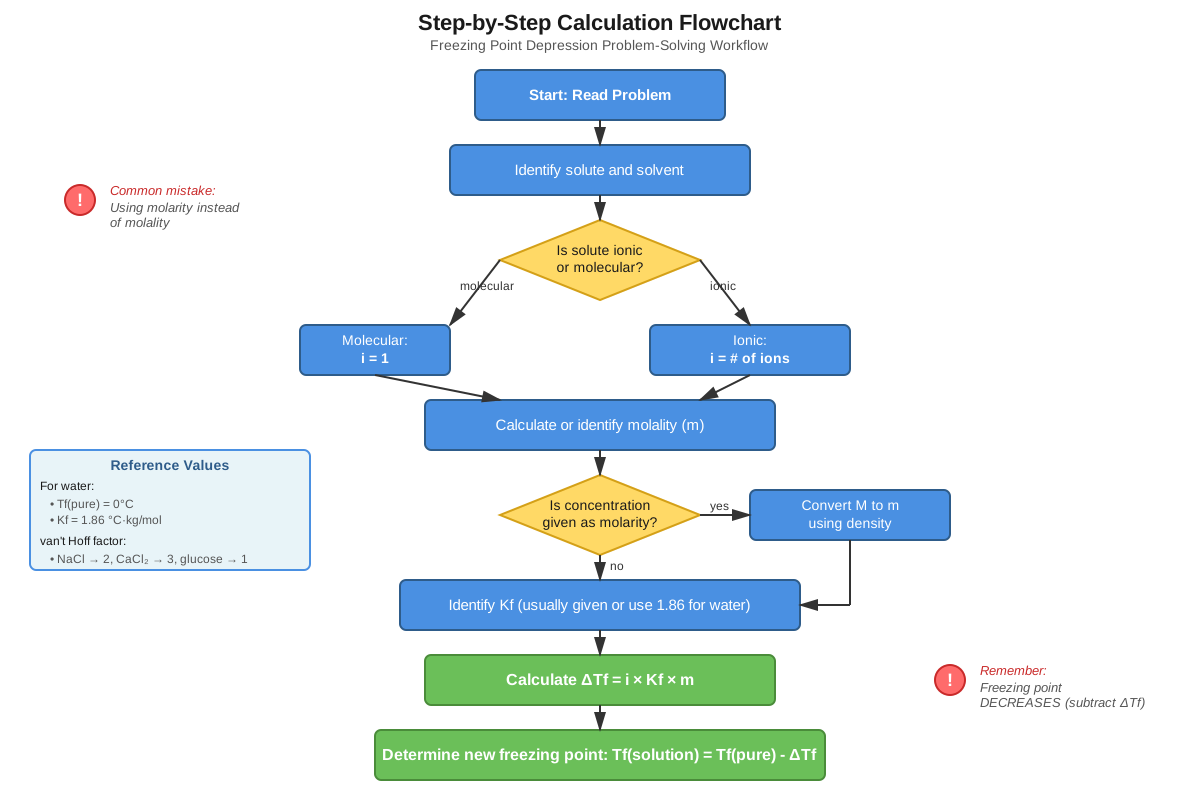
When encountering freezing point depression questions on the MCAT, follow this systematic approach:
- Identify the question type: Is it asking for a calculation, a ranking, or a conceptual explanation?
- Extract key information: Note the solute identity (ionic vs. molecular), concentration, and solvent
- Determine the van't Hoff factor: Count ions produced by dissociation
- Check units: Ensure concentration is in molality; convert if necessary
- Apply the formula systematically: Write out ΔTf = i × Kf × m even if not calculating numerically
Trigger Words and Phrases
Watch for these key phrases that signal freezing point depression content:
- "Colligative property"
- "Depression of freezing point"
- "Solution freezes at..."
- "Cryoprotectant" or "antifreeze"
- "Molality" (strong indicator of colligative property question)
- "Dissociation" or "ionization" (signals need to consider van't Hoff factor)
- "Rank the solutions by freezing point"
Process of Elimination Tips
When ranking solutions by freezing point:
- Eliminate pure solvent first: It always has the highest freezing point
- Compare effective particle concentrations: Multiply molality by van't Hoff factor
- Ionic compounds beat molecular compounds: At equal molality, ionic solutions have lower freezing points
- Higher concentration means lower freezing point: This is the most direct relationship
For calculation questions:
- Eliminate answers with wrong sign: If the question asks for ΔTf, eliminate negative values
- Check magnitude reasonableness: For dilute aqueous solutions, ΔTf is typically less than 10°C
- Verify van't Hoff factor: Eliminate answers that don't account for ionic dissociation
Time Allocation
For discrete questions on freezing point depression, allocate 60-90 seconds. These are typically straightforward calculations or rankings that shouldn't consume excessive time. For passage-based questions, spend 30-45 seconds per question after reading the passage. If a calculation becomes complex, consider whether estimation or process of elimination might be faster than complete calculation.
Exam Tip: The MCAT rarely requires complex calculations. If you find yourself doing extensive arithmetic, reconsider whether there's a conceptual shortcut or whether you can estimate and eliminate answer choices.
Memory Techniques
Mnemonic for Colligative Properties
"Four Properties Don't Care About Identity"
- Freezing point depression
- Pressure (osmotic)
- Don't
- Care
- About
- Identity (also: boiling point elevation and vapor pressure lowering)
Visualization for Van't Hoff Factor
Picture ionic compounds "breaking apart" in water:
- NaCl: Imagine a salt crystal splitting into two pieces (i = 2)
- CaCl₂: Visualize a triangle breaking into three pieces (i = 3)
- Glucose: Picture a whole molecule staying intact (i = 1)
Formula Memory Aid
"I Know Freezing Means Cold"
- I = van't Hoff factor (first variable)
- K = Kf (second variable)
- F = Freezing point depression
- M = molality (third variable)
- C = Colligative property
This gives you: ΔTf = i × Kf × m
Acronym for Calculation Steps
"MICE" for solving freezing point depression problems:
- Moles: Calculate moles of solute
- I: Determine van't Hoff factor
- Concentration: Calculate molality
- Equation: Apply ΔTf = i × Kf × m
Conceptual Memory Device
Remember: "More particles, more disruption, more depression"
This captures the essence that increasing the number of dissolved particles increases the disruption of crystallization, leading to greater freezing point depression (lower freezing point).
Summary
Freezing point depression represents a fundamental colligative property where dissolved solute particles lower the freezing point of a solvent by disrupting the formation of the ordered crystalline solid phase. The quantitative relationship ΔTf = i × Kf × m incorporates the van't Hoff factor (i) to account for ionic dissociation, the solvent-specific cryoscopic constant (Kf), and the concentration expressed as molality (m). This phenomenon depends exclusively on the number of dissolved particles, not their chemical identity, making it a true colligative property. For the MCAT, students must master both computational applications—calculating freezing points of solutions and ranking solutions by freezing point—and conceptual understanding of the molecular mechanism whereby solute particles interfere with solvent crystallization. The topic connects broadly to other colligative properties, solution chemistry, thermodynamics, and biological applications including cryopreservation and osmoregulation. Success on MCAT questions requires recognizing that ionic compounds produce greater effects than molecular compounds due to dissociation, that molality (not molarity) must be used in calculations, and that the magnitude of freezing point depression increases linearly with particle concentration in dilute solutions.
Key Takeaways
- Freezing point depression is a colligative property: It depends only on the number of dissolved particles, not their chemical identity or structure
- The formula ΔTf = i × Kf × m is essential: Know each variable and use molality (mol/kg solvent), not molarity
- Van't Hoff factor accounts for dissociation: Ionic compounds have i > 1, producing greater freezing point depression than molecular compounds at equal molality
- For water, Kf = 1.86 °C·kg/mol: This is the most frequently tested cryoscopic constant on the MCAT
- Greater particle concentration means lower freezing point: This direct relationship enables ranking of solutions
- Molecular mechanism involves crystallization disruption: Solute particles physically interfere with the ordered arrangement needed for solid phase formation
- Applications span from road salt to antifreeze proteins: Understanding both the calculation and biological relevance is crucial for MCAT success
Related Topics
Boiling Point Elevation: The complementary colligative property where solute particles raise the boiling point of a solution. Mastering freezing point depression provides the foundation for understanding boiling point elevation, as both stem from vapor pressure lowering.
Osmotic Pressure: Another colligative property particularly relevant to biological systems. Understanding particle concentration effects in freezing point depression directly translates to predicting osmotic pressure and cellular responses to osmotic stress.
Vapor Pressure Lowering (Raoult's Law): The fundamental colligative property from which freezing point depression and boiling point elevation derive. This topic explains why solutes affect phase transition temperatures.
Solution Concentration Units: Deep understanding of molality, molarity, mole fraction, and percent composition enables accurate colligative property calculations and conversions between concentration expressions.
Ionic Equilibria and Dissociation: Mastery of how ionic compounds dissociate in solution and the factors affecting dissociation extent (concentration, ion pairing) refines predictions of effective van't Hoff factors.
Phase Diagrams: Graphical representations of phase behavior that show how pressure and temperature affect phase transitions. Understanding how solutes shift phase boundaries provides visual insight into colligative properties.
Practice CTA
Now that you've mastered the core concepts of freezing point depression, it's time to solidify your understanding through active practice. Attempt the practice questions and flashcards associated with this topic to test your ability to apply these principles under exam conditions. Focus particularly on questions requiring you to rank solutions by freezing point and those involving van't Hoff factor calculations, as these represent the highest-yield question types on the MCAT. Remember that mastery comes through repeated application—each practice problem strengthens your pattern recognition and problem-solving speed. You've built a strong conceptual foundation; now transform that knowledge into points on test day through deliberate practice!
Sign up free to keep reading
Create a free AnvayaPrep account to finish this MCAT guide on Freezing point depression — plus flashcards and practice questions.