Overview
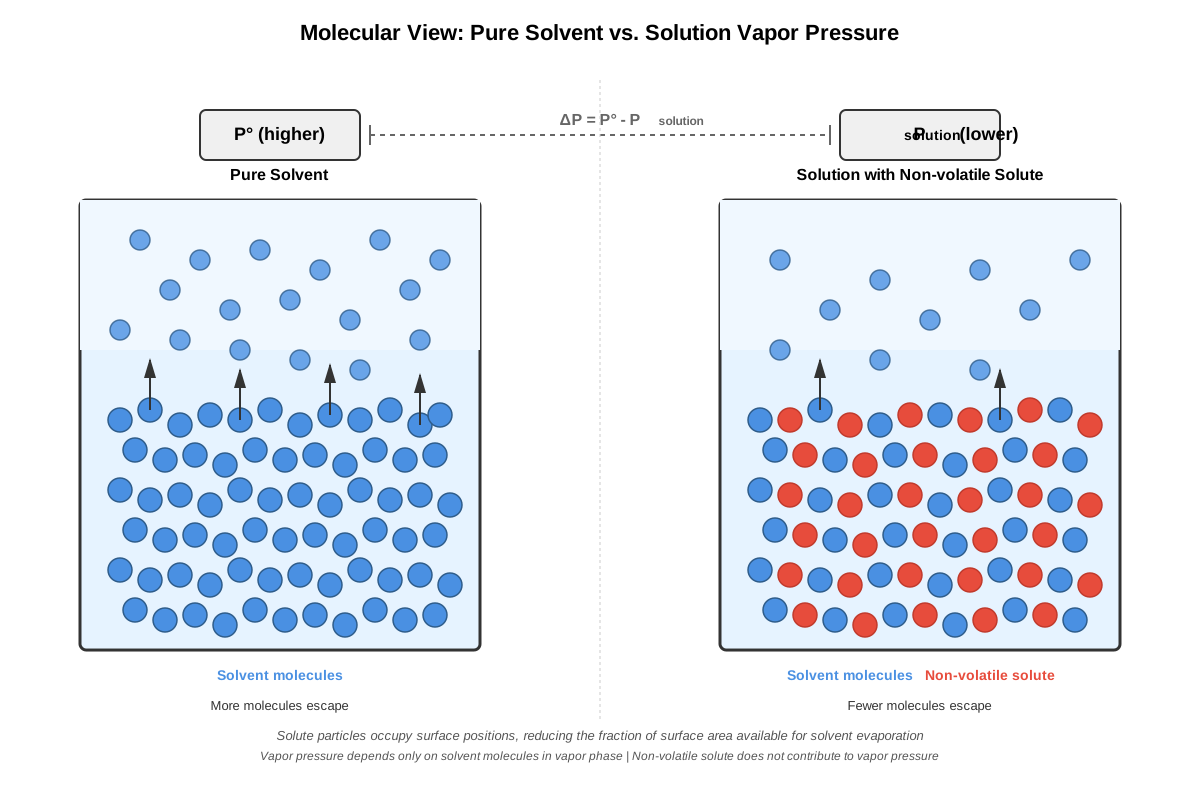
Vapor pressure lowering is a fundamental colligative property that describes the decrease in vapor pressure of a solvent when a non-volatile solute is dissolved in it. This phenomenon is central to understanding Solutions and Phase Behavior in General Chemistry and represents one of the four major colligative properties tested on the MCAT, alongside boiling point elevation, freezing point depression, and osmotic pressure. When a solute dissolves in a solvent, solute particles occupy positions at the liquid surface, physically reducing the number of solvent molecules that can escape into the vapor phase. This reduction in the rate of evaporation directly lowers the equilibrium vapor pressure of the solution compared to the pure solvent.
Understanding vapor pressure lowering is essential for the MCAT because it forms the theoretical foundation for explaining other colligative properties and frequently appears in passages involving solution chemistry, phase diagrams, and biological systems. The MCAT tests this concept both quantitatively through Raoult's Law calculations and qualitatively through conceptual questions about solution behavior. Students must recognize that vapor pressure lowering depends solely on the number of solute particles (not their identity), making it a true colligative property. This principle has direct applications in biological systems, including understanding how dissolved substances affect water movement across membranes and how antifreeze solutions protect against freezing.
The relationship between vapor pressure lowering and other General Chemistry concepts is extensive. It connects directly to intermolecular forces (explaining why vapor pressure exists), thermodynamics (relating to entropy and free energy changes), and phase equilibria (affecting boiling and freezing points). Mastery of this topic enables students to predict solution behavior, interpret phase diagrams, and solve complex problems involving multiple colligative properties—all high-yield skills for achieving a competitive MCAT score.
Learning Objectives
- [ ] Define vapor pressure lowering using accurate General Chemistry terminology
- [ ] Explain why vapor pressure lowering matters for the MCAT
- [ ] Apply vapor pressure lowering to exam-style questions
- [ ] Identify common mistakes related to vapor pressure lowering
- [ ] Connect vapor pressure lowering to related General Chemistry concepts
- [ ] Calculate the vapor pressure of a solution using Raoult's Law
- [ ] Distinguish between the effects of volatile and non-volatile solutes on vapor pressure
- [ ] Predict the relative magnitude of vapor pressure lowering based on solute properties and concentration
- [ ] Interpret phase diagrams showing the effects of vapor pressure lowering
Prerequisites
- Intermolecular forces (hydrogen bonding, dipole-dipole, London dispersion): Understanding why molecules escape from liquid to vapor phase and what holds them in solution
- Vapor pressure of pure substances: Recognizing that vapor pressure is the pressure exerted by a vapor in equilibrium with its liquid phase at a given temperature
- Mole fraction and molality: These concentration units are essential for quantitative calculations involving Raoult's Law
- Colligative properties concept: General understanding that some properties depend on particle number rather than particle identity
- Phase equilibria basics: Knowledge that phase changes involve dynamic equilibrium between phases
- Solution terminology (solute, solvent, concentration): Fundamental vocabulary for discussing solution behavior
Why This Topic Matters
Vapor pressure lowering has significant real-world and clinical applications that make it relevant beyond the MCAT. In biological systems, the presence of dissolved proteins, ions, and other solutes in bodily fluids affects water's tendency to evaporate, influencing processes like respiration, perspiration, and cellular water balance. Pharmaceutical formulations must account for vapor pressure changes when designing liquid medications, and understanding this principle is crucial for developing intravenous solutions that won't cause cell lysis or crenation. In everyday life, vapor pressure lowering explains why seawater evaporates more slowly than freshwater and why adding salt to cooking water subtly affects its properties.
From an exam perspective, vapor pressure lowering appears on the MCAT with moderate frequency, typically in 1-3 questions per exam either as standalone discrete questions or embedded within passages about solution chemistry, phase behavior, or biological transport. The MCAT tests this concept in several ways: quantitative problems requiring Raoult's Law calculations, qualitative reasoning about how solutes affect solution properties, interpretation of phase diagrams showing vapor pressure curves, and application to biological scenarios involving osmosis or membrane transport. Questions often integrate vapor pressure lowering with other colligative properties, requiring students to recognize relationships between different solution phenomena.
Common passage contexts include: experimental investigations of solution properties, biological scenarios involving cell membranes and osmotic balance, industrial processes like distillation or antifreeze production, and environmental chemistry involving aqueous solutions. The MCAT particularly favors questions that test conceptual understanding over pure calculation, asking students to predict trends, explain mechanisms, or apply principles to novel situations. Recognizing vapor pressure lowering as the fundamental cause of other colligative properties gives students a powerful framework for approaching these integrated questions efficiently.
Core Concepts
Definition and Fundamental Principle
Vapor pressure lowering is the decrease in the equilibrium vapor pressure of a solvent that occurs when a non-volatile solute is dissolved in it. The vapor pressure of a pure liquid represents the pressure exerted by its vapor when the liquid and vapor phases are in dynamic equilibrium at a specific temperature. When solute particles are introduced into the solvent, they occupy positions at the liquid surface, reducing the surface area available for solvent molecules to escape into the vapor phase. This physical obstruction decreases the rate of evaporation while leaving the rate of condensation initially unchanged, establishing a new equilibrium at a lower vapor pressure.
The magnitude of vapor pressure lowering depends exclusively on the mole fraction of solute particles in solution, not on the chemical identity of those particles. This makes vapor pressure lowering a true colligative property—one that depends on the number of dissolved particles rather than their nature. For ionic compounds that dissociate in solution, each ion counts as a separate particle, amplifying the effect. For example, dissolving one mole of NaCl (which dissociates into Na⁺ and Cl⁻) produces twice the vapor pressure lowering as dissolving one mole of glucose (which remains as intact molecules).
Raoult's Law
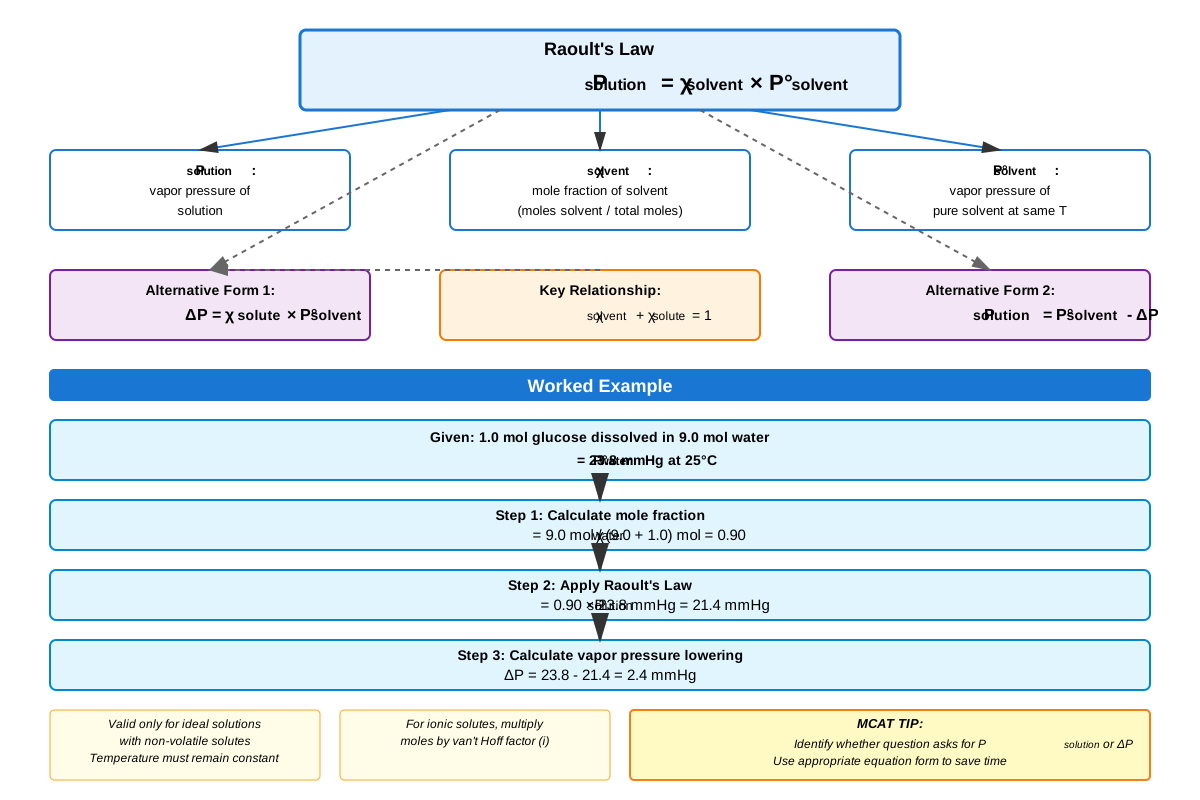
Raoult's Law provides the quantitative relationship for calculating vapor pressure lowering. For an ideal solution containing a non-volatile solute, the law states:
P_solution = χ_solvent × P°_solventWhere:
- P_solution = vapor pressure of the solution
- χ_solvent = mole fraction of the solvent
- P°_solvent = vapor pressure of the pure solvent at the same temperature
The vapor pressure lowering (ΔP) can be calculated as:
ΔP = P°_solvent - P_solution = χ_solute × P°_solventThis equation reveals that vapor pressure lowering is directly proportional to the mole fraction of solute particles. Since χ_solvent + χ_solute = 1, increasing solute concentration necessarily decreases solvent mole fraction and thus lowers vapor pressure proportionally.
The van't Hoff Factor
The van't Hoff factor (i) accounts for the dissociation or association of solute particles in solution. For non-electrolytes like glucose or sucrose that remain intact in solution, i = 1. For electrolytes that dissociate, i equals the number of particles produced per formula unit in an ideal solution:
| Solute Type | Formula | Ideal i value | Example |
|---|---|---|---|
| Non-electrolyte | - | 1 | Glucose, sucrose, urea |
| Strong electrolyte (1:1) | AB | 2 | NaCl, KBr, HCl |
| Strong electrolyte (1:2 or 2:1) | AB₂ or A₂B | 3 | CaCl₂, Na₂SO₄ |
| Strong electrolyte (2:3 or 3:2) | A₂B₃ or A₃B₂ | 5 | Al₂(SO₄)₃ |
In real solutions, the actual van't Hoff factor is often slightly less than the theoretical value due to ion pairing and other non-ideal interactions. The modified equation incorporating the van't Hoff factor becomes:
ΔP = i × χ_solute × P°_solventMolecular Mechanism and Entropy
At the molecular level, vapor pressure lowering can be understood through both kinetic and thermodynamic perspectives. Kinetically, solute particles at the liquid surface create a physical barrier that reduces the number of solvent molecules with sufficient energy to escape into the vapor phase. The rate of evaporation decreases proportionally to the fraction of surface area occupied by solute particles, while the condensation rate remains initially constant, driving the system to a new equilibrium at lower vapor pressure.
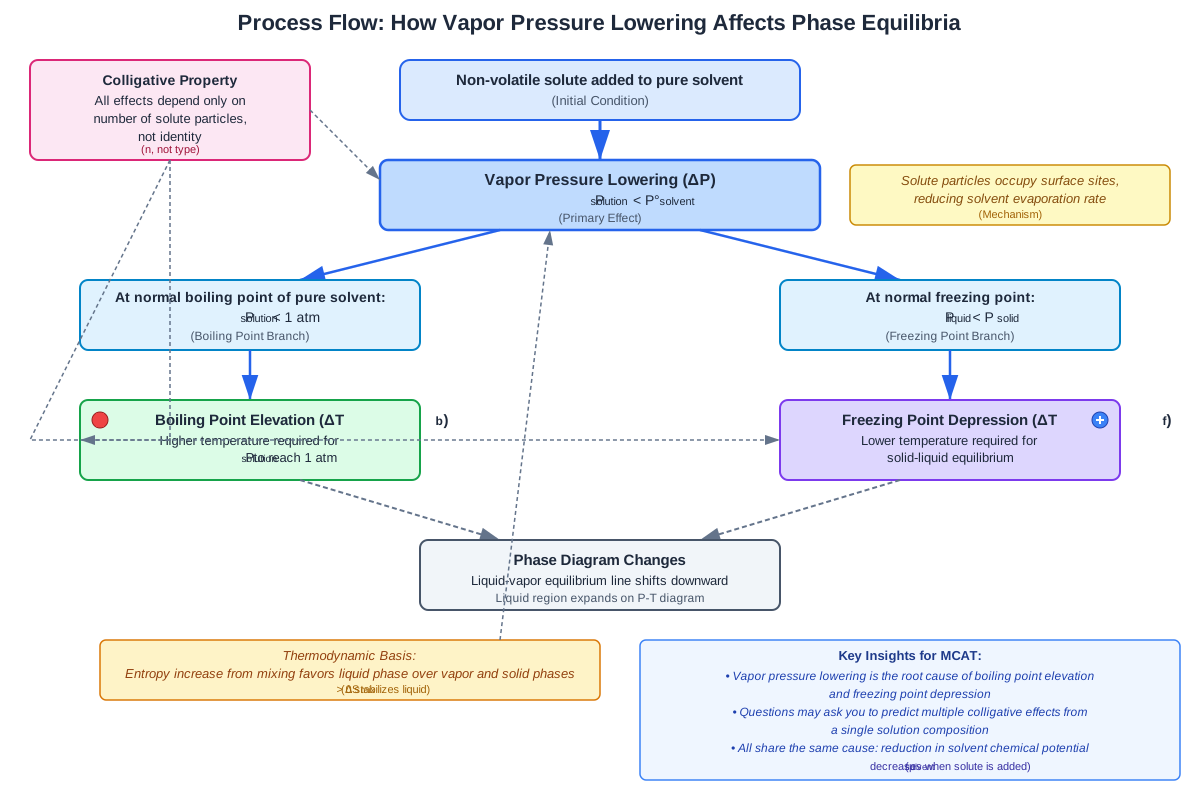
Thermodynamically, dissolving a solute increases the entropy of the liquid phase by introducing disorder. This entropy increase stabilizes the liquid phase relative to the vapor phase, making the liquid-to-vapor transition less favorable. The free energy change for vaporization becomes more positive, requiring a lower vapor pressure to maintain equilibrium. This entropy-based explanation connects vapor pressure lowering to the broader thermodynamic principle that systems naturally evolve toward states of maximum entropy.
Ideal vs. Non-Ideal Solutions
Ideal solutions obey Raoult's Law exactly across all concentrations. This occurs when solute-solvent interactions are essentially identical to solvent-solvent and solute-solute interactions. In such cases, the enthalpy of mixing is zero (ΔH_mix = 0), and the only driving force for mixing is the entropy increase. Examples include mixtures of chemically similar substances like benzene and toluene, or hexane and heptane.
Non-ideal solutions deviate from Raoult's Law due to differences in intermolecular forces. Positive deviations (vapor pressure higher than predicted) occur when solute-solvent attractions are weaker than the average of solute-solute and solvent-solvent attractions. Negative deviations (vapor pressure lower than predicted) occur when solute-solvent attractions are stronger than the average of the pure component interactions. For MCAT purposes, most problems assume ideal behavior unless explicitly stated otherwise.
Volatile Solutes
When both solute and solvent are volatile (both have significant vapor pressures), Raoult's Law must be applied to each component:
P_total = P_A + P_B = (χ_A × P°_A) + (χ_B × P°_B)The total vapor pressure equals the sum of the partial pressures of each component. This scenario is less commonly tested on the MCAT but may appear in passages about distillation or separation techniques. The key distinction is that volatile solutes contribute to the total vapor pressure, whereas non-volatile solutes only lower it.
Connection to Other Colligative Properties
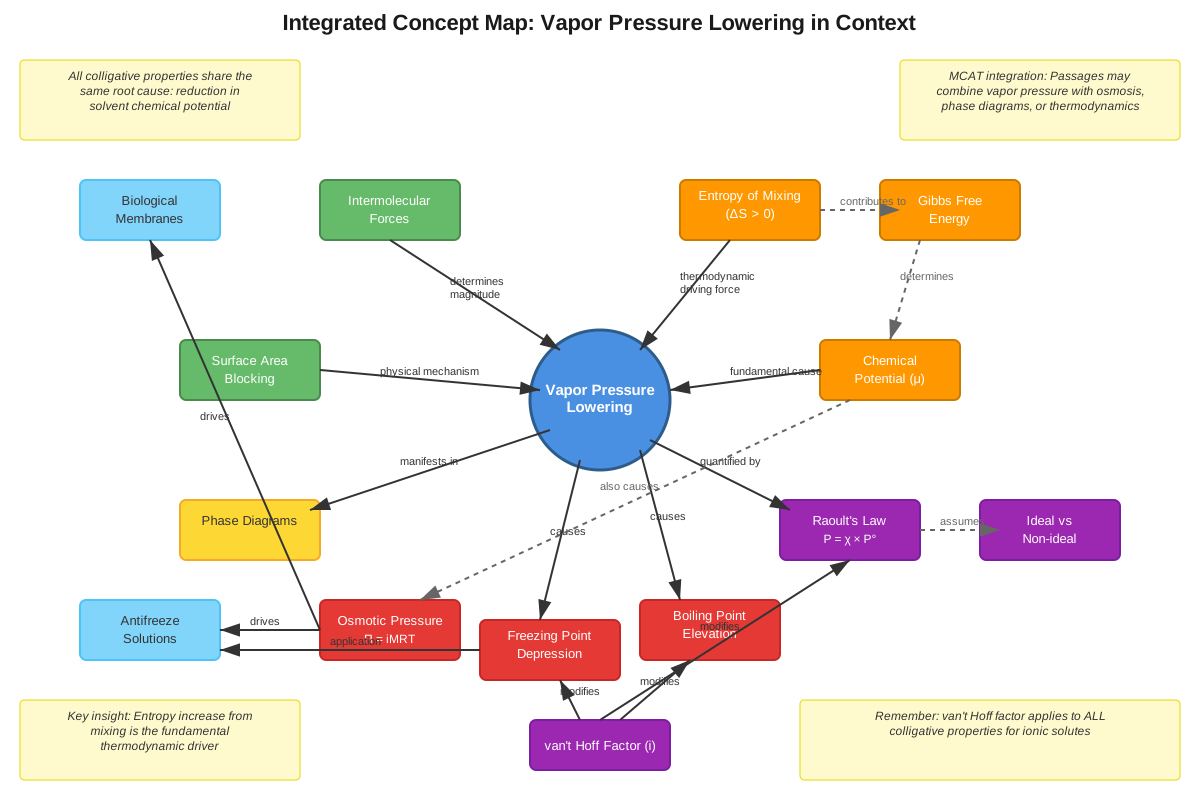
Vapor pressure lowering serves as the mechanistic foundation for understanding the other colligative properties. Boiling point elevation occurs because the lowered vapor pressure means the solution must be heated to a higher temperature before its vapor pressure equals atmospheric pressure. Freezing point depression results because the lowered vapor pressure of the liquid phase shifts the solid-liquid equilibrium, requiring a lower temperature for the solid and liquid phases to have equal vapor pressures. Osmotic pressure arises from the tendency of solvent to move from regions of high vapor pressure (low solute concentration) to regions of low vapor pressure (high solute concentration) across a semipermeable membrane.
Concept Relationships
The concepts within vapor pressure lowering form an interconnected framework. The fundamental definition of vapor pressure lowering → leads to → Raoult's Law as the quantitative expression → which requires → understanding of mole fraction and concentration units → and incorporates → the van't Hoff factor for electrolytes → all of which connect to → the molecular mechanism involving surface area and entropy → ultimately explaining → the relationship to other colligative properties.
Vapor pressure lowering connects to prerequisite topics through multiple pathways. Intermolecular forces determine the magnitude of pure solvent vapor pressure and influence whether solutions behave ideally. Phase equilibria concepts explain why vapor pressure represents a dynamic balance between evaporation and condensation. Thermodynamics provides the entropy-based explanation for why dissolving solutes stabilizes the liquid phase. Solution concentration units (mole fraction, molality, molarity) enable quantitative calculations using Raoult's Law.
Looking forward, mastery of vapor pressure lowering enables understanding of boiling point elevation (solutions boil at higher temperatures), freezing point depression (solutions freeze at lower temperatures), osmotic pressure (pressure required to prevent solvent flow across membranes), phase diagrams (graphical representations showing how solutes affect phase boundaries), and distillation (separation technique exploiting vapor pressure differences). The concept also connects to biological applications including osmosis, tonicity, and membrane transport—all high-yield topics for the MCAT's Biological and Biochemical Foundations section.
Quick check — test yourself on Vapor pressure lowering so far.
Try Flashcards →High-Yield Facts
⭐ Vapor pressure lowering is directly proportional to the mole fraction of solute particles, not the mass or molarity of solute
⭐ Raoult's Law for non-volatile solutes: P_solution = χ_solvent × P°_solvent, where χ_solvent = moles solvent / (moles solvent + moles solute)
⭐ The van't Hoff factor (i) for NaCl is approximately 2, for CaCl₂ is approximately 3, and for glucose is 1
⭐ Vapor pressure lowering is a colligative property—it depends only on the number of dissolved particles, not their chemical identity
⭐ Adding a non-volatile solute always decreases vapor pressure; the solution's vapor pressure is always less than the pure solvent's vapor pressure
- Vapor pressure lowering provides the mechanistic basis for boiling point elevation and freezing point depression
- In ideal solutions, solute-solvent interactions equal the average of solute-solute and solvent-solvent interactions
- The magnitude of vapor pressure lowering increases with increasing solute concentration at constant temperature
- Ionic compounds produce greater vapor pressure lowering per mole than molecular compounds due to dissociation
- At the molecular level, solute particles at the surface physically reduce the number of solvent molecules that can escape to the vapor phase
- The entropy increase upon dissolving a solute thermodynamically stabilizes the liquid phase relative to the vapor phase
- For solutions containing two volatile components, the total vapor pressure equals the sum of the partial pressures calculated using Raoult's Law for each component
- Real solutions often show slight deviations from Raoult's Law due to non-ideal interactions, but MCAT problems typically assume ideal behavior
Common Misconceptions
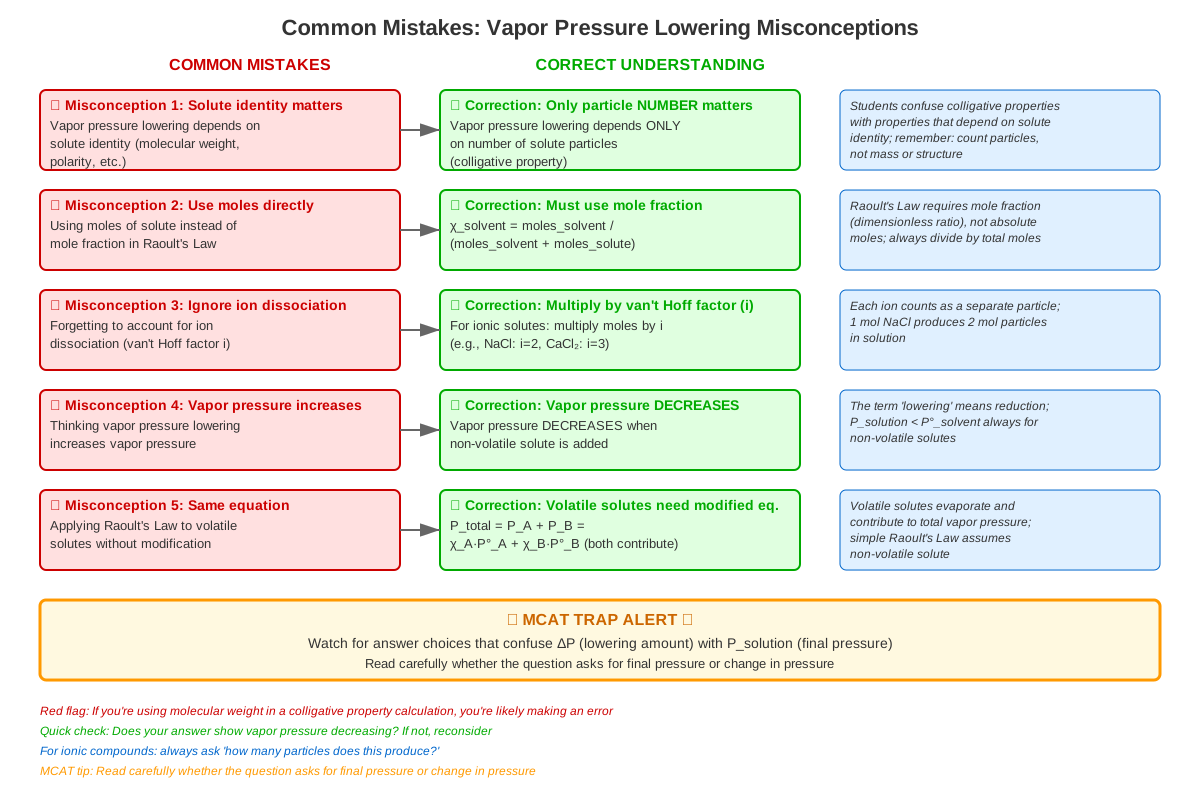
Misconception: Vapor pressure lowering depends on the type of solute dissolved, with some chemicals lowering vapor pressure more than others at the same concentration.
Correction: Vapor pressure lowering is a colligative property that depends only on the number of dissolved particles, not their chemical identity. One mole of glucose particles produces the same vapor pressure lowering as one mole of urea particles. The only chemical factor that matters is whether the solute dissociates (affecting the van't Hoff factor).
Misconception: Adding solute increases the vapor pressure of a solution because more particles are present.
Correction: Adding a non-volatile solute always decreases vapor pressure. Solute particles occupy surface positions and physically block solvent molecules from escaping into the vapor phase, reducing the evaporation rate and lowering equilibrium vapor pressure.
Misconception: Vapor pressure lowering is calculated using molarity as the concentration unit.
Correction: Raoult's Law requires mole fraction, not molarity. Mole fraction is the ratio of moles of one component to total moles of all components. Molarity (moles per liter of solution) is temperature-dependent and doesn't directly appear in Raoult's Law, though it can be converted to mole fraction if needed.
Misconception: The van't Hoff factor for NaCl is exactly 2.0 in all aqueous solutions.
Correction: While the theoretical van't Hoff factor for NaCl is 2 (one Na⁺ and one Cl⁻), the actual value in real solutions is typically 1.8-1.9 due to ion pairing and other non-ideal interactions. For MCAT calculations, use i = 2 unless the question specifies otherwise or provides experimental data.
Misconception: Vapor pressure lowering only affects the liquid-vapor equilibrium and has no connection to freezing or boiling points.
Correction: Vapor pressure lowering is the fundamental cause of both boiling point elevation and freezing point depression. The lowered vapor pressure of the solution means it must be heated to a higher temperature to boil (vapor pressure = atmospheric pressure) and cooled to a lower temperature to freeze (solid and liquid vapor pressures equal).
Misconception: In a solution with a volatile solute, the total vapor pressure is lower than the pure solvent's vapor pressure.
Correction: When both components are volatile, each contributes to the total vapor pressure according to Raoult's Law. The total vapor pressure may be higher or lower than either pure component's vapor pressure, depending on the mole fractions and individual vapor pressures. Only non-volatile solutes guarantee a decrease in total vapor pressure.
Misconception: Doubling the amount of solute doubles the vapor pressure lowering in all cases.
Correction: This is only approximately true for dilute solutions. Vapor pressure lowering depends on mole fraction, which is a ratio. In dilute solutions where the solvent moles greatly exceed solute moles, doubling solute approximately doubles mole fraction and thus vapor pressure lowering. In concentrated solutions, the relationship is more complex because adding solute significantly changes the total moles in the denominator of the mole fraction calculation.
Worked Examples
Example 1: Calculating Vapor Pressure Lowering for a Non-Electrolyte
Problem: At 25°C, pure water has a vapor pressure of 23.8 mmHg. Calculate the vapor pressure of a solution prepared by dissolving 36.0 g of glucose (C₆H₁₂O₆, MW = 180 g/mol) in 500 g of water (MW = 18 g/mol).
Solution:
Step 1: Calculate moles of each component
- Moles of glucose = 36.0 g ÷ 180 g/mol = 0.200 mol
- Moles of water = 500 g ÷ 18 g/mol = 27.78 mol
Step 2: Calculate mole fraction of water (solvent)
- χ_water = moles water / (moles water + moles glucose)
- χ_water = 27.78 / (27.78 + 0.200) = 27.78 / 27.98 = 0.9929
Step 3: Apply Raoult's Law
- P_solution = χ_water × P°_water
- P_solution = 0.9929 × 23.8 mmHg = 23.6 mmHg
Step 4: Calculate vapor pressure lowering
- ΔP = P°_water - P_solution = 23.8 - 23.6 = 0.2 mmHg
Key Insights: This problem demonstrates that even a relatively concentrated solution (0.200 mol glucose in 27.78 mol water) produces only a small absolute change in vapor pressure. The mole fraction approach is essential—using mass fractions or molarity would yield incorrect results. Notice that glucose doesn't dissociate (i = 1), so we use the actual moles dissolved.
Example 2: Comparing Vapor Pressure Lowering for Electrolytes vs. Non-Electrolytes
Problem: Two solutions are prepared, each containing 0.10 mol of solute dissolved in 1.00 kg of water. Solution A contains glucose (non-electrolyte), and Solution B contains NaCl (strong electrolyte). If pure water has a vapor pressure of 23.8 mmHg at 25°C, calculate the vapor pressure of each solution and explain the difference.
Solution:
For Solution A (glucose):
- Moles of water = 1000 g ÷ 18 g/mol = 55.56 mol
- Moles of glucose = 0.10 mol (i = 1, no dissociation)
- χ_water = 55.56 / (55.56 + 0.10) = 0.9982
- P_A = 0.9982 × 23.8 mmHg = 23.76 mmHg
- ΔP_A = 23.8 - 23.76 = 0.04 mmHg
For Solution B (NaCl):
- Moles of water = 55.56 mol (same as above)
- Moles of NaCl = 0.10 mol, but i = 2 (dissociates into Na⁺ and Cl⁻)
- Effective moles of particles = 0.10 × 2 = 0.20 mol
- χ_water = 55.56 / (55.56 + 0.20) = 0.9964
- P_B = 0.9964 × 23.8 mmHg = 23.71 mmHg
- ΔP_B = 23.8 - 23.71 = 0.09 mmHg
Key Insights: Solution B (NaCl) shows approximately twice the vapor pressure lowering as Solution A (glucose) despite containing the same number of moles of solute compound. This demonstrates the critical importance of the van't Hoff factor—ionic compounds that dissociate produce more particles and thus greater colligative effects. The ratio ΔP_B / ΔP_A = 0.09 / 0.04 ≈ 2.25, close to the theoretical ratio of 2.0 (the slight difference arises from rounding in the mole fraction calculations). This principle applies to all colligative properties: electrolytes produce proportionally greater effects based on their degree of dissociation.
Exam Strategy
When approaching vapor pressure lowering questions on the MCAT, first identify whether the problem requires qualitative reasoning or quantitative calculation. Qualitative questions often ask about trends, comparisons, or mechanisms—these can usually be answered by remembering that vapor pressure lowering is a colligative property depending only on particle number. Quantitative questions require Raoult's Law and careful attention to the van't Hoff factor.
Trigger words and phrases to watch for include: "vapor pressure of the solution," "colligative property," "non-volatile solute," "mole fraction," "dissociation," and "compared to pure solvent." Questions asking about "boiling point" or "freezing point" may actually be testing vapor pressure lowering as the underlying mechanism. Passages describing experimental measurements of solution properties or phase diagrams often incorporate vapor pressure concepts even if not explicitly stated.
Process-of-elimination strategies specific to this topic:
- Eliminate any answer choice suggesting vapor pressure increases when non-volatile solute is added (it always decreases)
- For comparison questions, eliminate choices that rank solutions incorrectly based on particle number (more particles = lower vapor pressure)
- When van't Hoff factor matters, eliminate answers that ignore dissociation or treat all solutes identically
- For calculation questions, eliminate answers that used molarity instead of mole fraction, or that forgot to multiply by the van't Hoff factor
Time allocation advice: Straightforward Raoult's Law calculations should take 60-90 seconds. If a problem requires multiple conversions (mass to moles, then to mole fraction, then applying Raoult's Law), budget 2-3 minutes. Qualitative questions about vapor pressure lowering should take 30-45 seconds—if you find yourself spending more time, you may be overthinking. Remember that the MCAT rewards efficient problem-solving; if a calculation seems excessively complex, look for a conceptual shortcut or proportional reasoning approach.
Exam Tip: When comparing vapor pressure lowering between solutions, you often don't need to calculate absolute values. Instead, compare the effective number of particles (moles × van't Hoff factor) directly. The solution with more particles has lower vapor pressure.
Memory Techniques
Mnemonic for Raoult's Law: "Pure Solvent Changes X-tremely" → P_solution = χ_solvent × P°_solvent
Visualization strategy: Picture the liquid surface as a crowded dance floor. Solvent molecules (dancers) can leave the floor (evaporate) only from positions at the edge. When you add solute particles (non-dancers standing at the edge), they block some exit positions, reducing the rate at which dancers can leave. Fewer dancers leaving = lower vapor pressure.
Acronym for colligative properties: "Very Big Fish Often" → Vapor pressure lowering, Boiling point elevation, Freezing point depression, Osmotic pressure. All depend on particle number, not identity.
van't Hoff factor memory aid: "Salt Splits Twice" (NaCl → 2), "Calcium Chloride Cuts Three" (CaCl₂ → 3), "Glucose Goes Once" (glucose → 1). The number of capital letters in the phrase matches the van't Hoff factor.
Conceptual anchor: "Solute Stabilizes Solution" → Adding solute increases entropy, stabilizing the liquid phase and making evaporation less favorable, thus lowering vapor pressure. The three S's remind you of the entropy-based thermodynamic explanation.
Summary
Vapor pressure lowering is a fundamental colligative property describing how dissolving a non-volatile solute decreases the equilibrium vapor pressure of a solvent. Quantitatively expressed through Raoult's Law (P_solution = χ_solvent × P°_solvent), this phenomenon depends exclusively on the number of dissolved particles, not their chemical identity. The molecular mechanism involves solute particles occupying surface positions and physically reducing solvent evaporation, while thermodynamically, the entropy increase upon mixing stabilizes the liquid phase. The van't Hoff factor accounts for electrolyte dissociation, with ionic compounds producing proportionally greater effects. Vapor pressure lowering serves as the mechanistic foundation for understanding boiling point elevation and freezing point depression, making it essential for predicting solution behavior. MCAT questions test both quantitative calculations using Raoult's Law and qualitative reasoning about trends and mechanisms. Mastery requires understanding the relationship between particle number and vapor pressure, correctly applying mole fraction calculations, and recognizing connections to other colligative properties and phase behavior.
Key Takeaways
- Vapor pressure lowering is a colligative property—it depends only on the number of dissolved particles, not their chemical identity
- Raoult's Law (P_solution = χ_solvent × P°_solvent) quantifies vapor pressure lowering using mole fraction, not molarity or molality
- The van't Hoff factor accounts for dissociation: i = 1 for non-electrolytes, i = 2 for NaCl, i = 3 for CaCl₂
- Adding non-volatile solute always decreases vapor pressure by reducing the surface area available for solvent evaporation
- Vapor pressure lowering mechanistically explains boiling point elevation (solution must reach higher temperature for vapor pressure to equal atmospheric pressure) and freezing point depression
- For MCAT calculations, convert all masses to moles, calculate mole fractions, apply the van't Hoff factor, then use Raoult's Law
- Qualitative questions can often be answered by comparing the effective number of particles (moles × i) without detailed calculations
Related Topics
Boiling Point Elevation: Understanding how vapor pressure lowering causes solutions to boil at higher temperatures than pure solvents; uses similar calculations with the ebullioscopic constant.
Freezing Point Depression: Explores how lowered vapor pressure shifts the solid-liquid equilibrium, requiring lower temperatures for freezing; critical for understanding antifreeze and biological applications.
Osmotic Pressure: Examines how vapor pressure differences drive solvent movement across semipermeable membranes; essential for understanding cell biology and tonicity.
Phase Diagrams: Graphical representations showing how temperature and pressure affect phase equilibria; vapor pressure lowering shifts the liquid-vapor boundary.
Ideal vs. Non-Ideal Solutions: Advanced treatment of deviations from Raoult's Law due to intermolecular force differences; includes positive and negative deviations.
Distillation and Separation Techniques: Practical applications exploiting vapor pressure differences to separate mixture components; relevant for organic chemistry laboratory passages.
Practice CTA
Now that you've mastered the core concepts of vapor pressure lowering, it's time to solidify your understanding through active practice. Work through the practice questions to test your ability to apply Raoult's Law, compare solutions with different solutes, and reason through qualitative scenarios. Use the flashcards to reinforce high-yield facts and ensure rapid recall of key equations and concepts. Remember, the MCAT rewards not just knowledge but the ability to apply that knowledge efficiently under time pressure—practice is what builds that skill. You've got this!
Sign up free to keep reading
Create a free AnvayaPrep account to finish this MCAT guide on Vapor pressure lowering — plus flashcards and practice questions.