Overview
Heating curves are graphical representations that illustrate the relationship between heat energy added to a substance and the resulting temperature change as the substance transitions through different phases of matter. In General Chemistry, heating curves serve as powerful visual tools that integrate thermodynamics, phase transitions, and intermolecular forces into a single, interpretable diagram. These curves plot temperature (y-axis) versus heat added (x-axis) and reveal critical information about a substance's physical properties, including melting point, boiling point, heat capacity, and enthalpies of phase transitions.
For the MCAT, heating curves represent a medium-yield topic that frequently appears in both discrete questions and passage-based scenarios within the Chemical and Physical Foundations of Biological Systems section. Understanding heating curves MCAT questions requires synthesizing knowledge from multiple domains: thermochemistry (heat transfer and energy calculations), phase equilibria (understanding what occurs at phase boundaries), and molecular structure (recognizing how intermolecular forces influence transition temperatures). The MCAT often presents heating curves in the context of experimental data interpretation, requiring students to extract quantitative information from graphs and apply thermodynamic principles to novel situations.
The significance of heating curves extends beyond isolated graph interpretation. This topic connects fundamentally to Solutions and Phase Behavior, as it provides the framework for understanding how pure substances and mixtures respond to energy input. Mastery of heating curves enables deeper comprehension of colligative properties, phase diagrams, and the energetics of dissolution—all high-yield MCAT topics. Additionally, heating curves reinforce core principles of energy conservation and the distinction between temperature (intensive property) and heat (extensive property), concepts that permeate all of General Chemistry and appear across multiple MCAT sections.
Learning Objectives
- [ ] Define heating curves using accurate General Chemistry terminology
- [ ] Explain why heating curves matters for the MCAT
- [ ] Apply heating curves to exam-style questions
- [ ] Identify common mistakes related to heating curves
- [ ] Connect heating curves to related General Chemistry concepts
- [ ] Calculate heat energy required for complete phase transitions using specific heat capacities and enthalpies of fusion/vaporization
- [ ] Interpret the molecular-level processes occurring during each segment of a heating curve
- [ ] Predict how changes in intermolecular forces affect the shape and features of heating curves
Prerequisites
- Thermochemistry fundamentals: Understanding heat (q), temperature (T), and the relationship q = mcΔT is essential for calculating energy changes in the sloped regions of heating curves
- States of matter: Knowledge of solid, liquid, and gas phases and their molecular arrangements provides the foundation for understanding what occurs during phase transitions
- Intermolecular forces: Familiarity with hydrogen bonding, dipole-dipole interactions, and London dispersion forces explains why different substances have different melting and boiling points
- Energy and enthalpy: Understanding that phase transitions involve enthalpy changes (ΔH) without temperature changes is critical for interpreting plateau regions
- Basic graphing skills: Ability to interpret x-y plots and extract quantitative information from graphical data
Why This Topic Matters
Heating curves appear regularly on the MCAT because they efficiently test multiple competencies simultaneously: graph interpretation, quantitative reasoning, thermodynamic principles, and conceptual understanding of phase behavior. Approximately 2-4 questions per exam directly or indirectly involve heating curve concepts, often embedded within passages describing calorimetry experiments, phase transition studies, or material science applications.
Clinically, the principles underlying heating curves are relevant to numerous biomedical applications. Cryopreservation of biological tissues and cells requires precise understanding of freezing processes and the energy changes involved. Fever management involves heat transfer principles identical to those governing heating curves. Pharmaceutical formulation often requires knowledge of melting points and phase behavior to ensure drug stability. Surgical techniques like cryotherapy and thermal ablation rely on controlled phase transitions in tissues.
On the MCAT, heating curves typically appear in three contexts: (1) data interpretation passages presenting experimental heating curve data and asking students to extract thermodynamic values, (2) discrete questions testing conceptual understanding of what occurs at different curve segments, and (3) integrated questions connecting heating curves to colligative properties, phase diagrams, or solution behavior. The MCAT particularly favors questions that require students to distinguish between temperature changes (sloped regions) and phase transitions (plateau regions), or to calculate total energy requirements for multi-step heating processes.
Core Concepts
Anatomy of a Heating Curve
A heating curve displays five distinct regions when a substance is heated from below its melting point to above its boiling point at constant pressure. The x-axis represents heat energy added (typically in joules or kilojoules), while the y-axis shows temperature (in Kelvin or Celsius). Understanding each segment is crucial for MCAT success.
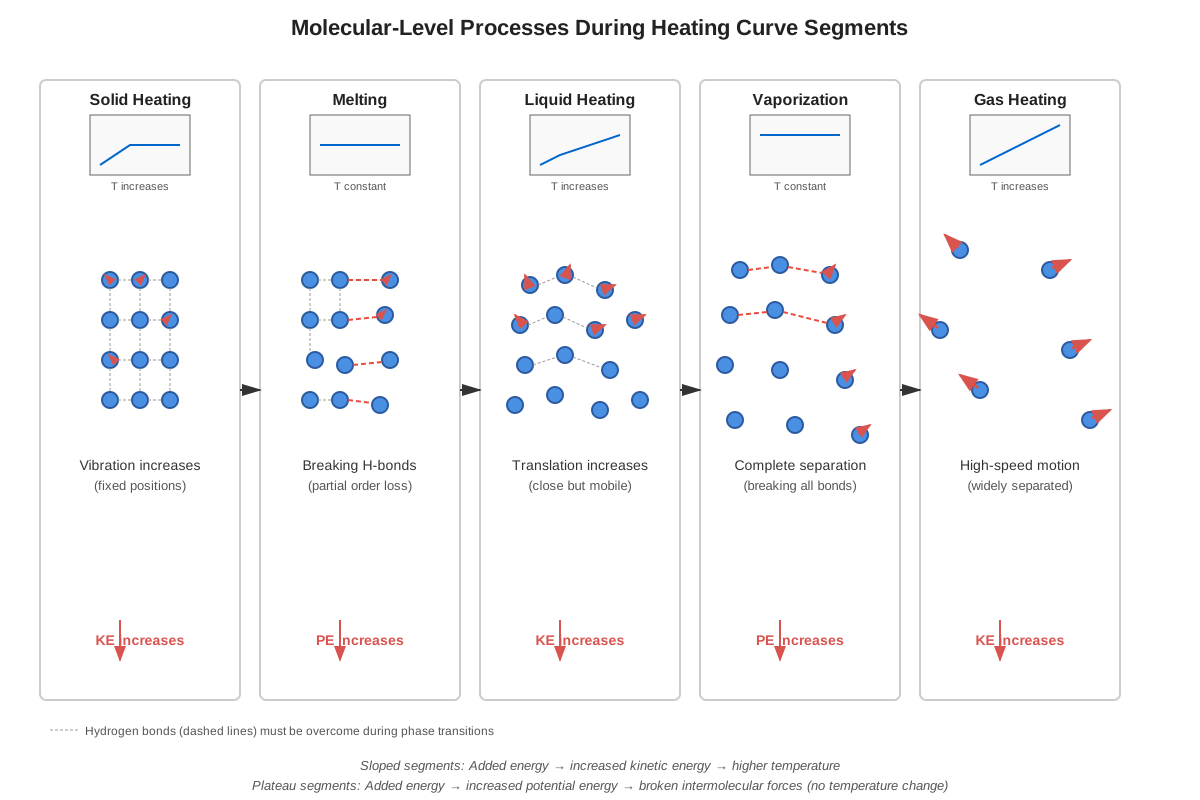
Region 1: Heating the Solid - This initial sloped segment shows temperature increasing as heat is added to the solid phase. The slope is determined by the specific heat capacity of the solid (cs), which quantifies how much energy is required to raise the temperature of one gram of substance by one degree. The equation governing this region is:
q = ms × cs × ΔTwhere ms is the mass of the solid, cs is the specific heat capacity of the solid, and ΔT is the temperature change. Substances with strong intermolecular forces typically have higher specific heat capacities because more energy is required to increase molecular kinetic energy against these attractive forces.
Region 2: Melting (Fusion) - This horizontal plateau occurs at the melting point (or freezing point), where solid and liquid phases coexist in equilibrium. Despite continuous heat input, temperature remains constant because all added energy is used to overcome intermolecular forces holding the solid lattice together, not to increase kinetic energy. This energy is the enthalpy of fusion (ΔHfus), also called the heat of fusion. The equation for this region is:
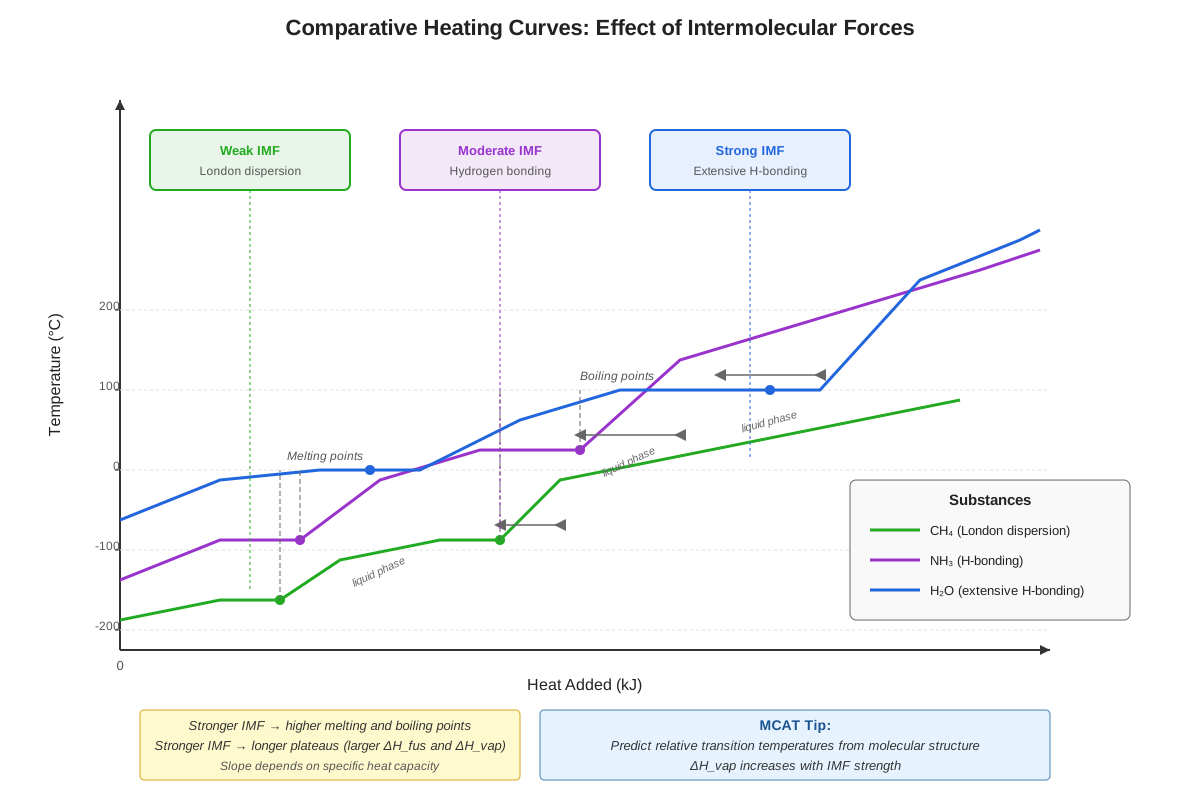
q = n × ΔHfuswhere n is the number of moles. The length of this plateau (horizontal distance) is proportional to ΔHfus—substances with stronger intermolecular forces require more energy to melt and exhibit longer plateaus.
Region 3: Heating the Liquid - After melting completes, temperature rises again as the liquid is heated. This sloped segment follows:
q = ml × cl × ΔTwhere cl is the specific heat capacity of the liquid. For most substances, cl > cs because liquids have more degrees of freedom for molecular motion. The slope of this region is typically less steep than Region 1, indicating that liquids generally require more energy per degree of temperature increase.
Region 4: Vaporization (Boiling) - The second horizontal plateau occurs at the boiling point, where liquid and gas phases coexist. The enthalpy of vaporization (ΔHvap) represents the energy required to completely overcome intermolecular forces and separate molecules into the gas phase:
q = n × ΔHvapThis plateau is significantly longer than the melting plateau because ΔHvap >> ΔHfus. Vaporization requires much more energy than fusion because molecules must be completely separated rather than merely loosened from fixed positions.
Region 5: Heating the Gas - The final sloped segment shows temperature increasing as the gas is heated:
q = mg × cg × ΔTwhere cg is the specific heat capacity of the gas. This region typically has the steepest slope (smallest specific heat capacity) because gases have the weakest intermolecular interactions, so less energy is needed to increase temperature.
Molecular Interpretation of Heating Curves
At the molecular level, heating curves reveal the competition between kinetic energy (temperature) and potential energy (intermolecular forces). During sloped regions, added heat increases the average kinetic energy of molecules, manifesting as temperature increase. Molecules move faster, vibrate more vigorously, or translate more rapidly depending on the phase.
During plateau regions (phase transitions), added heat increases potential energy by overcoming intermolecular attractions. Temperature remains constant because average kinetic energy doesn't change—molecules are gaining energy to break free from neighbors, not to move faster. This distinction between kinetic and potential energy changes is fundamental to understanding Solutions and Phase Behavior on the MCAT.
The relative lengths of plateaus provide information about intermolecular force strength. Water, with extensive hydrogen bonding, exhibits particularly long plateaus compared to nonpolar substances of similar molecular weight. Comparing heating curves of different substances reveals structure-property relationships central to General Chemistry.
Quantitative Calculations with Heating Curves
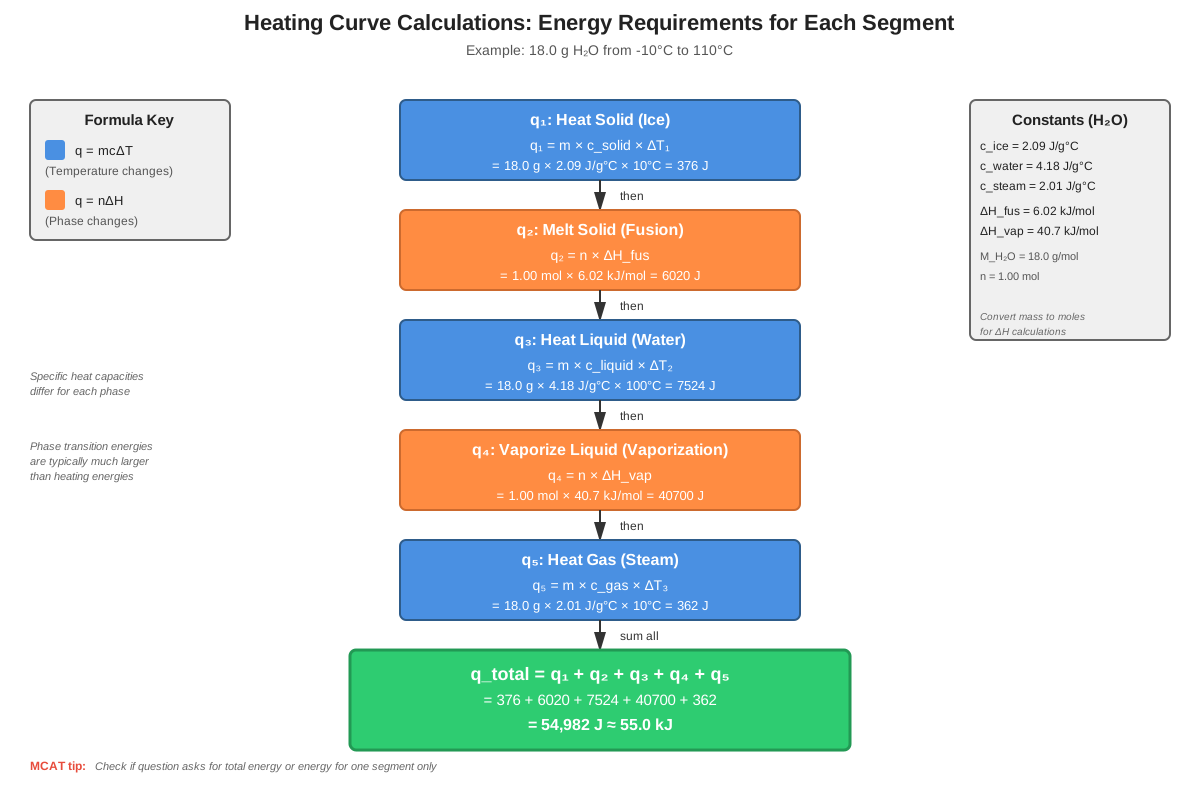
MCAT questions frequently require calculating the total heat needed to convert a substance from one temperature and phase to another. This involves summing contributions from all relevant regions:
qtotal = q1 + q2 + q3 + q4 + q5For example, heating ice at -20°C to steam at 120°C requires five separate calculations corresponding to the five regions. The key strategy is identifying which regions are relevant for the given temperature range and applying the appropriate equation for each.
Cooling Curves
Cooling curves are the reverse of heating curves, showing temperature versus heat removed. The same five regions appear, but phase transitions occur in reverse order (condensation instead of vaporization, freezing instead of melting). The plateau temperatures remain identical—the melting point equals the freezing point, and the boiling point equals the condensation point. However, supercooling can occur, where liquids cool below their freezing point without solidifying, creating a temporary dip below the expected plateau before crystallization begins.
Factors Affecting Heating Curve Shape
| Factor | Effect on Heating Curve |
|---|---|
| Stronger intermolecular forces | Higher melting/boiling points; longer plateaus; potentially higher specific heats |
| Greater molecular mass | Generally higher specific heats (more thermal inertia); less steep slopes |
| Higher pressure | Elevated boiling point; minimal effect on melting point for most substances |
| Impurities present | Depressed melting point; elevated boiling point (colligative properties) |
| Crystalline vs. amorphous solid | Sharp melting point vs. gradual softening over temperature range |
Concept Relationships
Heating curves integrate multiple fundamental concepts in General Chemistry. The relationship flows as follows:
Intermolecular Forces → determine → Melting and Boiling Points → which appear as → Plateau Temperatures on Heating Curves → while → Specific Heat Capacities → determine → Slope of Temperature-Change Regions
The connection to thermochemistry is direct: heating curves are visual representations of the First Law of Thermodynamics (energy conservation). All heat added to the system either increases temperature (kinetic energy) or causes phase transitions (potential energy), with no energy lost in an ideal system.
Heating curves connect to phase diagrams by representing a horizontal line (constant pressure) through the phase diagram. Each plateau on a heating curve corresponds to crossing a phase boundary on the phase diagram. Understanding this relationship helps students transition between different representations of phase behavior.
The link to Solutions and Phase Behavior becomes apparent when considering how solutes affect heating curves. Dissolved solutes lower the freezing point and elevate the boiling point (colligative properties), shifting plateau positions and potentially changing plateau lengths. This connection frequently appears in MCAT passages involving solution chemistry.
Heating curves also relate to calorimetry, as the data to construct heating curves typically comes from calorimetric experiments. The heat capacity of the calorimeter and the principle of heat transfer between system and surroundings underlie experimental determination of specific heats and enthalpies of transition.
Quick check — test yourself on Heating curves so far.
Try Flashcards →High-Yield Facts
⭐ The temperature remains constant during phase transitions because energy is used to overcome intermolecular forces (changing potential energy) rather than increasing molecular kinetic energy
⭐ ΔHvap is always significantly larger than ΔHfus for the same substance because complete molecular separation requires more energy than loosening from fixed positions
⭐ The slope of each region is inversely proportional to the specific heat capacity: steeper slopes indicate lower specific heat (less energy needed per degree)
⭐ For water, the specific heat of liquid water (4.18 J/g°C) is unusually high due to extensive hydrogen bonding, making the liquid region relatively flat
⭐ Plateau length (horizontal distance) is proportional to the enthalpy of the phase transition and the amount of substance present
- The melting point and freezing point occur at the same temperature for pure substances at equilibrium
- During phase transitions, two phases coexist in dynamic equilibrium
- Pressure affects boiling point significantly but has minimal effect on melting point for most substances
- The total area under a heating curve (if plotted as temperature vs. time with constant heating rate) represents total energy added
- Substances with stronger intermolecular forces require more total energy to convert from solid to gas
Common Misconceptions
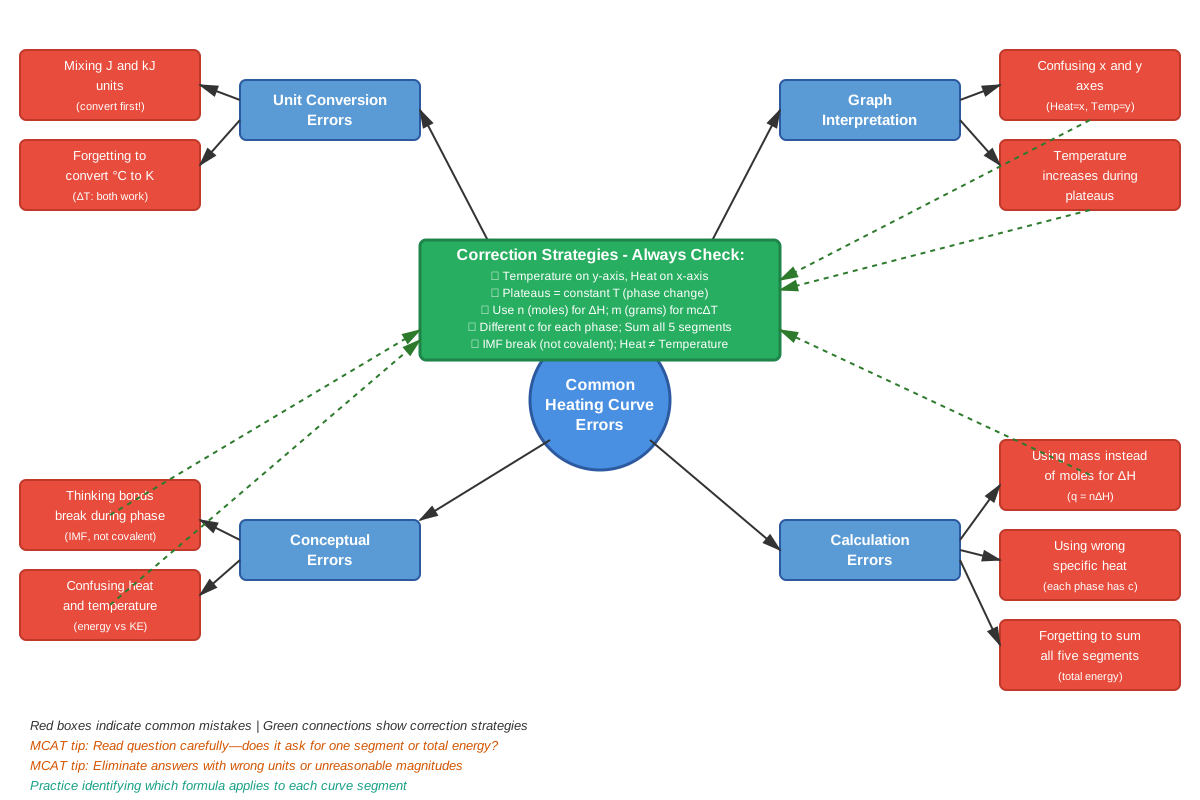
Misconception: Temperature increases continuously as heat is added to a substance
Correction: Temperature remains constant during phase transitions (plateaus) even though heat is continuously added. The energy goes into breaking intermolecular forces, not increasing kinetic energy.
Misconception: The longer a plateau, the higher the melting or boiling point
Correction: Plateau length represents the magnitude of ΔHfus or ΔHvap (how much energy is required for the transition), not the temperature at which the transition occurs. A substance can have a low boiling point but a large ΔHvap.
Misconception: The specific heat capacity is the same for all three phases of a substance
Correction: Specific heat capacity differs between phases. For most substances, csolid < cliquid, and cgas is typically smallest. Each phase has distinct molecular arrangements and degrees of freedom affecting heat capacity.
Misconception: The steeper the slope on a heating curve, the more energy is required to heat that phase
Correction: Steeper slopes indicate lower specific heat capacity, meaning less energy is required per degree of temperature change. A steeper slope means the substance heats up more quickly with the same energy input.
Misconception: All substances have heating curves with the same general shape and proportions
Correction: While all heating curves have five regions, the relative lengths of plateaus and slopes vary dramatically based on molecular structure and intermolecular forces. Water's heating curve looks very different from that of methane or iron.
Misconception: During melting, all molecules simultaneously transition from solid to liquid
Correction: Phase transitions occur gradually at the molecular level. During the plateau, solid and liquid phases coexist, with molecules continuously transitioning between phases in dynamic equilibrium until all solid has melted.
Worked Examples
Example 1: Calculating Total Energy for Multi-Phase Heating
Question: How much energy is required to convert 50.0 g of ice at -10.0°C to steam at 110.0°C? Given: cs(ice) = 2.09 J/g°C, cl(water) = 4.18 J/g°C, cg(steam) = 2.01 J/g°C, ΔHfus = 334 J/g, ΔHvap = 2260 J/g.
Solution:
This problem requires calculating energy for all five regions of the heating curve:
Region 1 - Heating ice from -10.0°C to 0°C:
q1 = ms × cs × ΔT = 50.0 g × 2.09 J/g°C × 10.0°C = 1,045 JRegion 2 - Melting ice at 0°C:
q2 = m × ΔHfus = 50.0 g × 334 J/g = 16,700 JRegion 3 - Heating water from 0°C to 100°C:
q3 = ml × cl × ΔT = 50.0 g × 4.18 J/g°C × 100.0°C = 20,900 JRegion 4 - Vaporizing water at 100°C:
q4 = m × ΔHvap = 50.0 g × 2260 J/g = 113,000 JRegion 5 - Heating steam from 100°C to 110°C:
q5 = mg × cg × ΔT = 50.0 g × 2.01 J/g°C × 10.0°C = 1,005 JTotal energy:
qtotal = 1,045 + 16,700 + 20,900 + 113,000 + 1,005 = 152,650 J ≈ 153 kJKey insight: Notice that vaporization (q4) accounts for approximately 74% of the total energy, demonstrating that ΔHvap dominates the energy requirements. This is a high-yield concept for the MCAT.
Example 2: Interpreting Experimental Heating Curve Data
Question: A heating curve is obtained for an unknown substance. The plateau at the melting point lasts for 2.5 minutes, while the plateau at the boiling point lasts for 18.0 minutes. If heat is supplied at a constant rate of 500 J/min and 25.0 g of substance is used, calculate ΔHfus and ΔHvap in J/g.
Solution:
For the melting plateau:
qfusion = heating rate × time = 500 J/min × 2.5 min = 1,250 JΔHfus = qfusion / mass = 1,250 J / 25.0 g = 50 J/gFor the boiling plateau:
qvaporization = heating rate × time = 500 J/min × 18.0 min = 9,000 JΔHvap = qvaporization / mass = 9,000 J / 25.0 g = 360 J/gKey insight: The ratio ΔHvap/ΔHfus = 360/50 = 7.2, which is typical for many substances. This ratio reflects that complete molecular separation (vaporization) requires much more energy than partial separation (melting). This relationship frequently appears in MCAT questions asking students to compare phase transition energies.
Exam Strategy
When approaching heating curves MCAT questions, follow this systematic strategy:
Step 1: Identify the question type - Is it asking for conceptual understanding (what's happening during a plateau?), quantitative calculation (how much energy?), or data interpretation (extract values from a graph)?
Step 2: Locate the relevant region(s) - Determine which segments of the heating curve are involved. Pay careful attention to the starting and ending temperatures and phases.
Step 3: Select the appropriate equation(s) - Use q = mcΔT for sloped regions and q = nΔH for plateaus. Don't mix them up.
Step 4: Watch for unit consistency - Convert between grams and moles as needed. Ensure temperature units match (Celsius vs. Kelvin for ΔT calculations, though the difference is the same in both).
Trigger words to recognize:
- "Phase transition," "melting," "vaporization" → plateau region, use ΔH
- "Temperature increases," "heating the solid/liquid/gas" → sloped region, use mcΔT
- "Total energy required" → sum all relevant regions
- "Constant temperature" → phase transition occurring
- "Coexistence of phases" → at a plateau
Process of elimination tips:
- If an answer choice suggests temperature changes during a phase transition, eliminate it
- If a calculation ignores the phase transition enthalpies (ΔHfus or ΔHvap), it's likely wrong for multi-phase problems
- Answers that treat specific heat as constant across all phases are incorrect
- If comparing substances, the one with stronger intermolecular forces will have higher melting/boiling points and larger ΔH values
Time allocation: For discrete questions, spend 60-90 seconds. For passage-based questions with heating curve data, allocate 90-120 seconds to extract information from the graph, then 60 seconds per question. Don't get bogged down in complex calculations—the MCAT often tests conceptual understanding more than computational skill.
Memory Techniques
Mnemonic for the five regions: "Solid Melts, Liquid Vaporizes, Gas" (SMLVG)
- Solid heating
- Melting (fusion)
- Liquid heating
- Vaporization (boiling)
- Gas heating
Visualization strategy: Picture an ice cube in a pot on a stove. As heat is added:
- The ice gets colder to warmer (but still solid) - sloped
- The ice melts into water (temperature stays at 0°C) - flat
- The water gets warmer (but still liquid) - sloped
- The water boils into steam (temperature stays at 100°C) - flat
- The steam gets hotter - sloped
Acronym for remembering ΔHvap > ΔHfus: "Very Big" (Vaporization is Bigger)
Slope memory trick: "Steep Slopes = Small Specific heat" (four S's)
Plateau principle: "Flat means Forces breaking" - during flat (plateau) regions, intermolecular forces are being broken
Summary
Heating curves are graphical representations of temperature versus heat added that reveal the thermodynamic behavior of substances as they transition through phases. The five distinct regions—heating solid, melting, heating liquid, vaporization, and heating gas—each follow specific mathematical relationships and reflect different molecular processes. Sloped regions represent temperature changes governed by specific heat capacity (q = mcΔT), while horizontal plateaus represent phase transitions governed by enthalpies of fusion or vaporization (q = nΔH). The temperature remains constant during phase transitions because energy is used to overcome intermolecular forces rather than increase kinetic energy. For the MCAT, students must be able to interpret heating curve graphs, perform multi-step energy calculations, understand the molecular basis for curve features, and connect heating curves to broader concepts in thermodynamics and phase behavior. The relative magnitudes of ΔHvap and ΔHfus, the relationship between slope and specific heat, and the distinction between kinetic and potential energy changes are particularly high-yield concepts that appear frequently in exam questions.
Key Takeaways
- Heating curves have five regions: three sloped (temperature changing) and two flat (phase transitions at constant temperature)
- Temperature remains constant during phase transitions because energy breaks intermolecular forces (potential energy change) rather than increasing molecular motion (kinetic energy change)
- ΔHvap is always much larger than ΔHfus because complete molecular separation requires more energy than loosening from fixed positions
- Slope steepness is inversely related to specific heat capacity—steeper slopes mean less energy is needed per degree of temperature change
- Total energy calculations require summing contributions from all relevant regions using appropriate equations for each
- Plateau length reflects the magnitude of the phase transition enthalpy and the amount of substance present
- Heating curves connect to intermolecular forces, thermodynamics, phase diagrams, and colligative properties—making them integrative MCAT topics
Related Topics
Phase Diagrams - Three-dimensional representations showing how temperature, pressure, and phase relate. Heating curves represent horizontal lines (constant pressure) through phase diagrams, and mastering heating curves provides the foundation for understanding phase diagram interpretation.
Colligative Properties - The presence of solutes alters heating curves by depressing freezing points and elevating boiling points. Understanding pure substance heating curves is prerequisite to understanding how solutions behave differently.
Thermochemistry and Calorimetry - The experimental techniques used to generate heating curve data rely on calorimetric principles. Mastering heating curves enhances understanding of heat transfer and energy measurement.
Intermolecular Forces - The strength and type of intermolecular forces directly determine the positions and lengths of plateaus on heating curves. This connection reinforces structure-property relationships central to organic and general chemistry.
Kinetic Molecular Theory - The molecular interpretation of heating curves relies on understanding how molecular kinetic energy relates to temperature and how potential energy relates to intermolecular forces.
Practice CTA
Now that you've mastered the fundamentals of heating curves, it's time to solidify your understanding through active practice. Work through the practice questions to test your ability to interpret graphs, perform calculations, and apply concepts to novel scenarios. Use the flashcards to reinforce high-yield facts and relationships. Remember, heating curves integrate multiple concepts—thermodynamics, phase behavior, and intermolecular forces—so mastering this topic strengthens your overall General Chemistry foundation. The MCAT rewards students who can move fluidly between conceptual understanding and quantitative application, and heating curves provide the perfect opportunity to develop both skills. You've got this!
Sign up free to keep reading
Create a free AnvayaPrep account to finish this MCAT guide on Heating curves — plus flashcards and practice questions.