Overview
Internal energy is a fundamental concept in thermodynamics that represents the total energy contained within a system at the molecular level. For the MCAT, understanding internal energy is crucial because it forms the foundation for analyzing energy transformations in chemical reactions, biological processes, and physical changes. Internal energy encompasses all kinetic and potential energy contributions from molecular motion, intermolecular forces, and chemical bonds within a system. This concept appears frequently on the MCAT in both the Chemical and Physical Foundations of Biological Systems section and in passages involving metabolic processes, calorimetry, and phase transitions.
The significance of internal energy in General Chemistry extends beyond isolated thermodynamic calculations. It serves as the bridge connecting microscopic molecular behavior to macroscopic observable properties like temperature and heat capacity. When students master internal energy, they gain the ability to predict whether reactions will absorb or release energy, understand why certain processes occur spontaneously, and analyze complex biological systems from an energetic perspective. The MCAT frequently tests this concept through multi-step problems involving the First Law of Thermodynamics, where internal energy changes must be calculated from heat and work values.
Understanding internal energy also provides essential context for related topics including enthalpy, entropy, and Gibbs free energy—concepts that dominate MCAT thermodynamics questions. The relationship between internal energy and these state functions allows test-takers to approach complex passages systematically, identifying which thermodynamic quantity is most relevant for a given scenario. This topic typically appears in 3-5 questions per MCAT exam, either directly or as a component of more complex thermodynamic analyses, making it a high-yield area for focused study.
Learning Objectives
- [ ] Define Internal energy using accurate General Chemistry terminology
- [ ] Explain why Internal energy matters for the MCAT
- [ ] Apply Internal energy to exam-style questions
- [ ] Identify common mistakes related to Internal energy
- [ ] Connect Internal energy to related General Chemistry concepts
- [ ] Calculate changes in internal energy using the First Law of Thermodynamics
- [ ] Distinguish between state functions and path functions in the context of internal energy
- [ ] Predict how internal energy changes during phase transitions and chemical reactions
- [ ] Analyze the molecular basis for internal energy in terms of kinetic and potential energy contributions
Prerequisites
- Basic thermodynamic terminology: Understanding system, surroundings, and universe is essential for defining where internal energy resides and how it changes
- Kinetic molecular theory: Knowledge of molecular motion and temperature relationships provides the microscopic foundation for internal energy
- Conservation of energy: The First Law of Thermodynamics builds directly on energy conservation principles
- Heat and work concepts: These represent the two mechanisms by which internal energy can change
- Chemical bonding fundamentals: Bond energies contribute significantly to the potential energy component of internal energy
- Basic calculus concepts: Understanding that internal energy is a state function requires familiarity with path-independent quantities
Why This Topic Matters
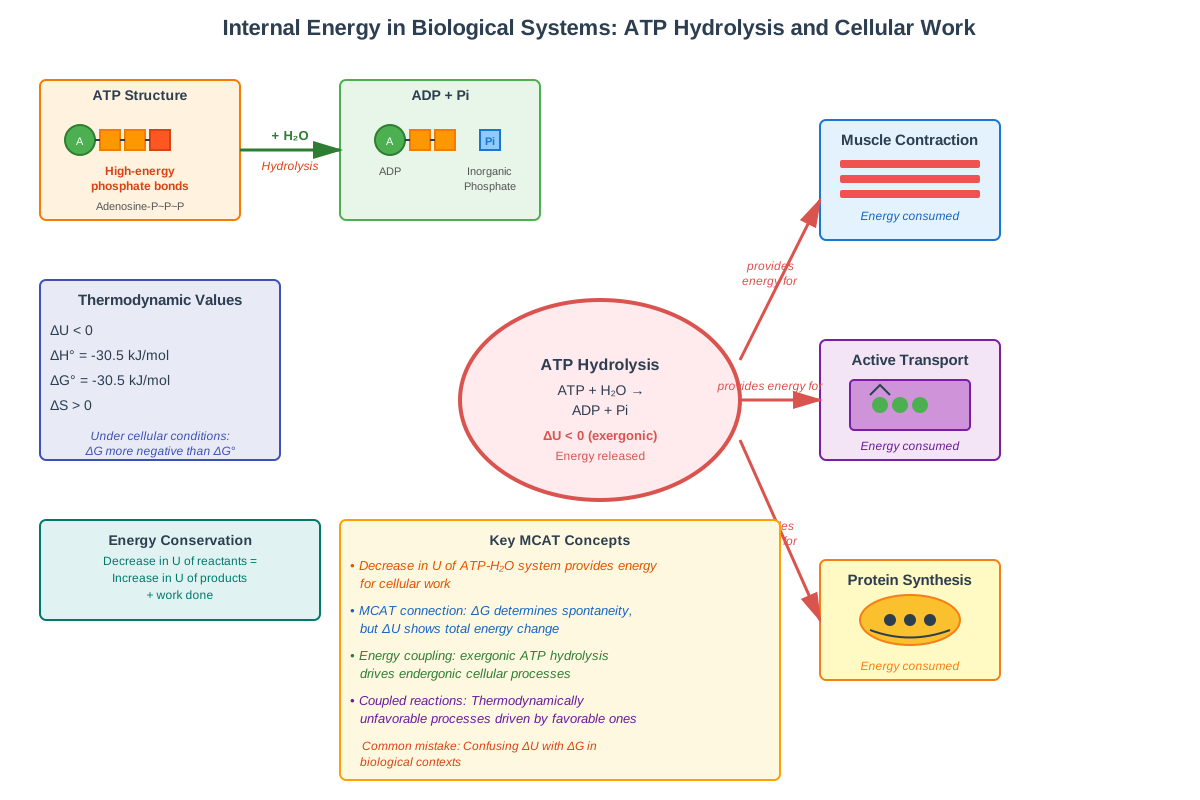
Internal energy represents one of the most clinically and biologically relevant concepts tested on the MCAT. In living organisms, internal energy changes drive all metabolic processes, from ATP synthesis to muscle contraction. When cells break down glucose during cellular respiration, the decrease in internal energy of the glucose-oxygen system provides the energy needed to phosphorylate ADP. Understanding internal energy allows students to quantify these energy transformations and predict the feasibility of biochemical reactions.
From an exam statistics perspective, internal energy appears in approximately 8-12% of General Chemistry questions on the MCAT, with particular emphasis in passages involving calorimetry, bomb calorimeters, and metabolic energy calculations. The AAMC consistently includes at least one passage per exam that requires students to apply the First Law of Thermodynamics to calculate internal energy changes. These questions often integrate multiple concepts, requiring students to distinguish between heat capacity at constant volume versus constant pressure, or to recognize when work terms can be neglected.
Common exam presentations include: (1) calorimetry passages where students must calculate ΔU from measured temperature changes, (2) biochemical passages analyzing energy yield from nutrient metabolism, (3) physical chemistry passages involving gas expansions where both heat and work contribute to internal energy changes, and (4) comparative questions asking students to rank processes by their internal energy changes. The MCAT particularly favors questions that require students to recognize internal energy as a state function, meaning its change depends only on initial and final states, not the path taken—a concept that frequently appears in discrete questions and as a key insight for solving complex passage-based problems.
Core Concepts
Definition and Nature of Internal Energy
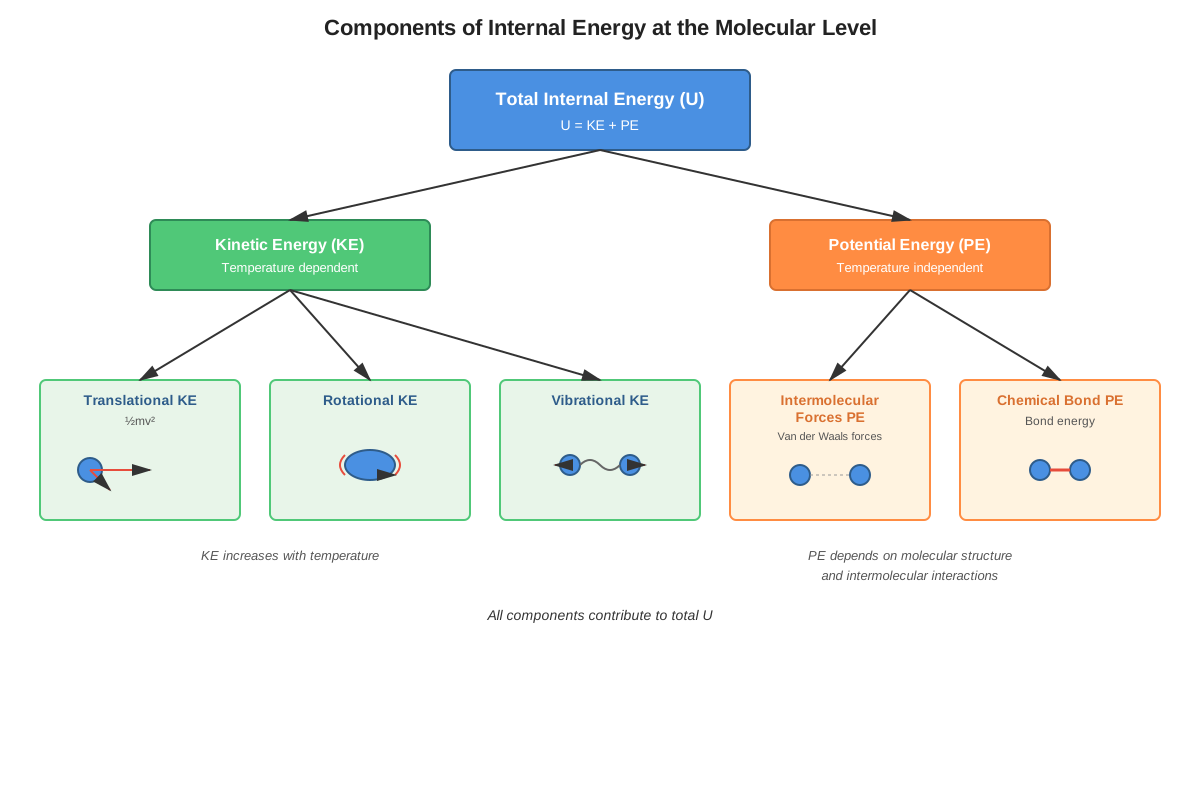
Internal energy (symbolized as U or E) represents the total energy contained within a thermodynamic system, encompassing all forms of energy at the molecular and atomic level. This includes the kinetic energy of molecular translation, rotation, and vibration, as well as the potential energy stored in chemical bonds, intermolecular forces, and electronic configurations. For the MCAT, internal energy should be understood as a state function—a property that depends only on the current state of the system (defined by temperature, pressure, volume, and composition) rather than the pathway used to reach that state.
The absolute value of internal energy for any system cannot be measured directly; only changes in internal energy (ΔU) can be determined experimentally. This limitation does not hinder practical applications because thermodynamic calculations require only energy differences, not absolute values. The change in internal energy is defined mathematically as:
ΔU = U_final - U_initialWhen ΔU is positive, the system has gained energy from its surroundings; when negative, the system has released energy to its surroundings. This sign convention is critical for MCAT problem-solving and must be applied consistently.
Molecular Components of Internal Energy
At the molecular level, internal energy comprises several distinct contributions:
Translational kinetic energy arises from the linear motion of molecules through space. For an ideal gas, this component relates directly to temperature through the equation:
KE_translational = (3/2)nRTwhere n is the number of moles, R is the gas constant, and T is absolute temperature. This relationship explains why temperature serves as a measure of average molecular kinetic energy.
Rotational and vibrational kinetic energy contribute additional energy from molecular tumbling and bond oscillations. These modes become increasingly important at higher temperatures and for more complex molecules. Diatomic and polyatomic molecules possess more degrees of freedom than monatomic species, resulting in higher internal energies at the same temperature.
Potential energy contributions include: (1) chemical bond energy stored in intramolecular bonds, (2) intermolecular forces (van der Waals forces, hydrogen bonds, dipole-dipole interactions), and (3) electronic energy levels. During chemical reactions, changes in bond energies typically dominate the internal energy change. Phase transitions primarily involve changes in intermolecular potential energy while kinetic energy remains relatively constant.
The First Law of Thermodynamics
The First Law of Thermodynamics provides the fundamental equation governing internal energy changes:
ΔU = q + wwhere q represents heat transferred to or from the system, and w represents work done on or by the system. This equation embodies the principle of energy conservation: energy cannot be created or destroyed, only transferred between system and surroundings or converted between different forms.
The sign conventions are crucial for MCAT success:
- q is positive when heat flows into the system (endothermic process)
- q is negative when heat flows out of the system (exothermic process)
- w is positive when work is done on the system (compression)
- w is negative when work is done by the system (expansion)
For processes involving gases, work is typically pressure-volume work, calculated as:
w = -P_external × ΔVThe negative sign ensures that when a gas expands (ΔV > 0), work is done by the system (w < 0), decreasing internal energy if no compensating heat is added.
Internal Energy in Different Processes
| Process Type | ΔU Behavior | Key Characteristics |
|---|---|---|
| Isothermal (constant T) | ΔU = 0 for ideal gas | Heat and work exactly balance; q = -w |
| Adiabatic (q = 0) | ΔU = w | No heat exchange; temperature changes |
| Isochoric (constant V) | ΔU = q_v | No work done; all heat changes internal energy |
| Isobaric (constant P) | ΔU = q_p - PΔV | Work and heat both contribute |
| Isolated system | ΔU = 0 | No energy exchange with surroundings |
For isochoric processes (constant volume), the work term equals zero because ΔV = 0. This simplifies the First Law to ΔU = q_v, making constant-volume calorimetry the most direct method for measuring internal energy changes. Bomb calorimeters exploit this principle by conducting reactions in rigid, sealed containers.
For isothermal processes involving ideal gases, internal energy depends only on temperature. Since temperature remains constant, ΔU = 0, and therefore q = -w. This counterintuitive result means that all heat absorbed by an isothermally expanding gas is converted to work done by the gas.
Internal Energy vs. Enthalpy
A critical distinction for the MCAT involves differentiating internal energy from enthalpy (H). While internal energy represents total system energy, enthalpy is defined as:
H = U + PVEnthalpy becomes the more relevant quantity for processes occurring at constant pressure (most laboratory and biological conditions). The relationship between their changes is:
ΔH = ΔU + Δ(PV) = ΔU + PΔV (at constant P)For reactions involving only solids and liquids, volume changes are negligible, making ΔH ≈ ΔU. However, for reactions involving gases, the PΔV term can be significant. The MCAT frequently tests whether students recognize when to use ΔU versus ΔH, particularly in calorimetry contexts.
State Function Properties
The state function nature of internal energy has profound implications for thermodynamic calculations. Because ΔU depends only on initial and final states, it can be calculated using any convenient pathway, even if that pathway differs from the actual process. This principle enables Hess's Law calculations and allows complex processes to be broken into simpler steps.
Mathematically, for a state function, the integral around any closed loop equals zero:
∮ dU = 0This contrasts with path functions like heat and work, which depend on the specific process pathway. The MCAT exploits this distinction in questions asking students to compare different pathways between the same initial and final states.
Temperature Dependence and Heat Capacity
For systems with constant composition, internal energy increases with temperature. The rate of increase is characterized by the heat capacity at constant volume (C_v):
C_v = (∂U/∂T)_VFor an ideal gas, C_v relates to the number of degrees of freedom (f) through:
C_v = (f/2)nRMonatomic gases have three translational degrees of freedom (f = 3), giving C_v = (3/2)nR. Diatomic gases add two rotational degrees (f = 5), yielding C_v = (5/2)nR. At higher temperatures, vibrational modes contribute additional degrees of freedom.
Concept Relationships
Internal energy serves as the central organizing concept in thermodynamics, connecting microscopic molecular properties to macroscopic observables. The relationship map flows as follows:
Molecular kinetic theory → provides the microscopic foundation → Internal energy → governed by → First Law of Thermodynamics → relates to → Heat and Work → which determine → Temperature and Volume changes
Internal energy connects directly to prerequisite knowledge of chemical bonding because bond energies constitute the primary potential energy contribution. When chemical reactions occur, the internal energy change reflects the difference between bond energies in products versus reactants. This relationship extends to Hess's Law and bond energy calculations, both high-yield MCAT topics.
The state function property of internal energy enables its connection to entropy (another state function) through the fundamental thermodynamic relationship. Together, internal energy and entropy determine Gibbs free energy, which predicts reaction spontaneity—a critical concept for biological systems.
Internal energy also relates to calorimetry through the First Law. Bomb calorimeters measure q_v directly, which equals ΔU for constant-volume processes. Coffee cup calorimeters measure q_p, which equals ΔH. Understanding when each measurement applies requires mastery of internal energy concepts.
The distinction between internal energy and enthalpy emerges from the relationship H = U + PV. This connection explains why biochemistry typically uses enthalpy (constant pressure conditions) while physical chemistry problems may require internal energy (constant volume or varying pressure conditions).
Quick check — test yourself on Internal energy so far.
Try Flashcards →High-Yield Facts
⭐ Internal energy is a state function—its change depends only on initial and final states, not the pathway taken between them
⭐ The First Law of Thermodynamics states ΔU = q + w, where q is heat and w is work, with specific sign conventions that must be memorized
⭐ For an ideal gas undergoing an isothermal process, ΔU = 0 because internal energy depends only on temperature
⭐ At constant volume, ΔU = q_v because no PV work is done, making bomb calorimetry a direct measure of internal energy changes
⭐ The relationship between ΔH and ΔU is ΔH = ΔU + PΔV at constant pressure, with the PΔV term significant only when gases are involved
- Internal energy includes both kinetic energy (translational, rotational, vibrational) and potential energy (bonds, intermolecular forces)
- For reactions involving only liquids and solids, ΔH ≈ ΔU because volume changes are negligible
- In an isolated system, ΔU = 0 because no heat or work can be exchanged with surroundings
- The heat capacity at constant volume (C_v) describes how internal energy changes with temperature: C_v = (∂U/∂T)_V
- For adiabatic processes (q = 0), all internal energy change comes from work: ΔU = w
- Exothermic reactions have negative ΔU when conducted at constant volume, indicating energy release to surroundings
- The internal energy of an ideal gas depends only on temperature, not pressure or volume
Common Misconceptions
Misconception: Internal energy and enthalpy are the same thing and can be used interchangeably.
Correction: Internal energy (U) and enthalpy (H) are distinct state functions related by H = U + PV. Use ΔU for constant-volume processes and ΔH for constant-pressure processes. They are approximately equal only when volume changes are negligible (reactions without gases).
Misconception: A positive ΔU always means the system got hotter.
Correction: A positive ΔU means the system gained energy, but temperature may not increase if the energy goes into phase transitions or chemical bond formation. For example, melting ice has ΔU > 0 but occurs at constant temperature (0°C).
Misconception: In an exothermic reaction, internal energy increases because heat is released.
Correction: In an exothermic reaction at constant volume, internal energy decreases (ΔU < 0) because the system loses energy to the surroundings. The negative sign of q indicates energy leaving the system, making ΔU negative when w = 0.
Misconception: Work done by a gas during expansion increases the internal energy of the gas.
Correction: Work done by a gas during expansion (w < 0) decreases internal energy unless compensated by heat input. The gas uses its internal energy to push against external pressure, converting internal energy to mechanical work.
Misconception: The pathway taken between two states affects the change in internal energy.
Correction: Internal energy is a state function, so ΔU depends only on initial and final states, never on the pathway. While q and w individually depend on the path, their sum (ΔU) does not. This is the foundation of Hess's Law.
Misconception: At constant temperature, no energy changes occur in the system.
Correction: At constant temperature, the internal energy of an ideal gas remains constant (ΔU = 0), but heat and work can still be exchanged with surroundings. For isothermal expansion, the gas absorbs heat (q > 0) and does work (w < 0) with q = -w, keeping ΔU = 0.
Misconception: Internal energy can be measured directly for any system.
Correction: Only changes in internal energy (ΔU) can be measured; absolute internal energy values cannot be determined. This limitation doesn't affect practical calculations because thermodynamics deals with energy differences, not absolute values.
Worked Examples
Example 1: Calculating Internal Energy Change for a Gas Expansion
Problem: A sample of ideal gas expands from 2.0 L to 5.0 L against a constant external pressure of 3.0 atm. During this expansion, the gas absorbs 450 J of heat from the surroundings. Calculate the change in internal energy of the gas. (Use 1 L·atm = 101.3 J)
Solution:
Step 1: Identify the given information and what we need to find.
- Initial volume: V_i = 2.0 L
- Final volume: V_f = 5.0 L
- External pressure: P_ext = 3.0 atm
- Heat absorbed: q = +450 J (positive because heat flows into the system)
- Find: ΔU
Step 2: Apply the First Law of Thermodynamics.
ΔU = q + wStep 3: Calculate the work done. For expansion against constant external pressure:
w = -P_ext × ΔVStep 4: Calculate ΔV.
ΔV = V_f - V_i = 5.0 L - 2.0 L = 3.0 LStep 5: Calculate work in L·atm, then convert to joules.
w = -(3.0 atm)(3.0 L) = -9.0 L·atm
w = -9.0 L·atm × 101.3 J/(L·atm) = -911.7 J
The negative sign indicates work done by the system (expansion).
Step 6: Calculate ΔU.
ΔU = q + w = 450 J + (-911.7 J) = -461.7 J ≈ -462 JAnswer: The internal energy of the gas decreases by approximately 462 J.
Key Insights: Even though the gas absorbed heat, its internal energy decreased because it did more work during expansion than the heat it absorbed. This demonstrates that both q and w must be considered when determining ΔU. The negative ΔU indicates the gas cooled during this process (unless it's an ideal gas at constant temperature, which would require different conditions).
Example 2: Bomb Calorimeter and Internal Energy
Problem: A 1.50 g sample of glucose (C₆H₁₂O₆) is combusted in a bomb calorimeter with a heat capacity of 8.75 kJ/°C. The temperature increases from 22.0°C to 28.4°C. Calculate the change in internal energy per mole of glucose combusted. (Molar mass of glucose = 180 g/mol)
Solution:
Step 1: Understand the setup. A bomb calorimeter operates at constant volume, so no PV work is done (w = 0). Therefore:
ΔU = q_vStep 2: Calculate the heat absorbed by the calorimeter.
q_calorimeter = C_calorimeter × ΔT
q_calorimeter = 8.75 kJ/°C × (28.4°C - 22.0°C)
q_calorimeter = 8.75 kJ/°C × 6.4°C = 56.0 kJ
Step 3: Apply conservation of energy. The heat released by combustion equals the heat absorbed by the calorimeter:
q_combustion = -q_calorimeter = -56.0 kJThe negative sign indicates the combustion released energy (exothermic).
Step 4: Calculate moles of glucose combusted.
n = 1.50 g ÷ 180 g/mol = 0.00833 molStep 5: Calculate ΔU per mole.
ΔU = -56.0 kJ ÷ 0.00833 mol = -6,720 kJ/mol ≈ -6.72 × 10³ kJ/molAnswer: The change in internal energy for glucose combustion is approximately -6,720 kJ/mol or -2,800 kJ/g.
Key Insights: This problem demonstrates why bomb calorimeters directly measure ΔU rather than ΔH. The constant-volume condition eliminates the work term, making q_v equal to ΔU. The large negative value indicates glucose combustion releases substantial energy, explaining why it serves as a primary metabolic fuel. For MCAT purposes, recognizing that bomb calorimetry measures ΔU while coffee cup calorimetry measures ΔH is crucial for selecting the correct thermodynamic quantity.
Exam Strategy
When approaching MCAT questions on internal energy, begin by identifying whether the problem involves a state function or path function. If the question asks about the change in internal energy between two states, remember that the pathway is irrelevant—this often eliminates incorrect answer choices that focus on process details rather than initial and final states.
Trigger words and phrases to watch for include:
- "Constant volume" → signals ΔU = q_v and w = 0
- "Bomb calorimeter" → measures ΔU directly
- "Isothermal process" → for ideal gases, ΔU = 0
- "Adiabatic" → means q = 0, so ΔU = w
- "Isolated system" → means ΔU = 0
- "State function" → pathway-independent, focus on endpoints
For process-of-elimination strategies, immediately eliminate answer choices that:
- Confuse ΔU with ΔH without justification
- Claim internal energy depends on the pathway taken
- Ignore sign conventions (especially for work during expansion vs. compression)
- State that temperature always increases when ΔU > 0
- Suggest internal energy can be measured absolutely rather than as a change
When facing calculation questions, write out the First Law (ΔU = q + w) explicitly and assign signs carefully before substituting numbers. Many MCAT questions test sign convention mastery rather than complex calculations. If a problem seems algebraically complicated, check whether it's actually testing conceptual understanding of state functions or the relationship between ΔU and ΔH.
Time allocation: For discrete questions on internal energy, allocate 60-90 seconds. For passage-based questions, spend 30-45 seconds per question after reading the passage. If a calculation requires more than 2 minutes, you've likely missed a conceptual shortcut—look for ways to apply state function properties or recognize when terms cancel.
For questions comparing multiple processes, create a quick table listing q, w, and ΔU for each process. This visual organization prevents sign errors and helps identify patterns. Remember that the MCAT favors questions where conceptual understanding eliminates the need for extensive calculation.
Memory Techniques
Mnemonic for First Law sign conventions: "Quiet In, Work On" (QIWO)
- Quiet In: Heat into the system is positive (q > 0)
- Work On: Work done on the system is positive (w > 0)
Mnemonic for state functions: "Unique Homes Stand Grand"
- Unique = Internal energy (U)
- Homes = Enthalpy (H)
- Stand = Entropy (S)
- Grand = Gibbs free energy (G)
All are state functions; their changes are path-independent.
Visualization for internal energy components: Picture a molecular "energy bank account" with two divisions:
- Kinetic energy (checking account): readily accessible, increases with temperature, includes translation, rotation, vibration
- Potential energy (savings account): stored in bonds and intermolecular forces, released during reactions
Acronym for constant-condition processes: "I'T'V'P" (It's Very Practical)
- Isothermal: constant Temperature
- Thermal: (reminder that isothermal relates to temperature)
- Volume: Isochoric means constant Volume
- Pressure: Isobaric means constant Pressure
Memory aid for ΔU = 0 conditions:
- Isothermal ideal gas: "Same Temperature, Same U" (for ideal gases only)
- Isolated system: "No Interaction, No U change"
- Complete cycle: "Circle back, U unchanged" (state function property)
Summary
Internal energy represents the total molecular energy within a thermodynamic system, encompassing kinetic energy from molecular motion and potential energy from bonds and intermolecular forces. As a state function, internal energy changes depend only on initial and final states, not the pathway taken—a property that distinguishes it from heat and work, which are path-dependent. The First Law of Thermodynamics (ΔU = q + w) governs all internal energy changes, with strict sign conventions: heat into the system and work done on the system are positive. For MCAT success, students must distinguish between internal energy and enthalpy, recognizing that ΔU applies to constant-volume processes while ΔH applies to constant-pressure conditions. Bomb calorimeters measure ΔU directly because they operate at constant volume (w = 0), making ΔU = q_v. For ideal gases, internal energy depends only on temperature, leading to ΔU = 0 for isothermal processes. Understanding internal energy enables analysis of energy transformations in chemical reactions, phase transitions, and biological processes—all high-yield topics for the MCAT.
Key Takeaways
- Internal energy (U) is a state function representing total molecular energy; only changes (ΔU) can be measured, and these depend solely on initial and final states
- The First Law of Thermodynamics (ΔU = q + w) requires careful attention to sign conventions: q > 0 for heat in, w > 0 for work on the system
- At constant volume, ΔU = q_v because no PV work occurs; bomb calorimeters exploit this to measure internal energy changes directly
- For ideal gases, internal energy depends only on temperature, making ΔU = 0 for isothermal processes regardless of pressure or volume changes
- Internal energy differs from enthalpy by the PV term: ΔH = ΔU + PΔV, with the distinction critical for choosing the correct thermodynamic quantity
- Common MCAT scenarios include calorimetry calculations, gas expansions/compressions, and distinguishing between state functions and path functions
- Mastering internal energy enables understanding of metabolic energy transformations, reaction energetics, and the thermodynamic basis for spontaneity
Related Topics
Enthalpy and Hess's Law: Building on internal energy concepts, enthalpy extends thermodynamic analysis to constant-pressure conditions (most laboratory and biological settings). Hess's Law exploits the state function property shared by both U and H to calculate reaction energies from tabulated formation data.
Entropy and the Second Law: While internal energy addresses the quantity of energy, entropy addresses energy quality and dispersal. Together, these concepts determine reaction spontaneity through Gibbs free energy.
Calorimetry: Practical measurement of energy changes relies on understanding when calorimeters measure ΔU (bomb calorimeter, constant volume) versus ΔH (coffee cup calorimeter, constant pressure).
Ideal Gas Law and Kinetic Molecular Theory: The molecular basis of internal energy connects directly to gas behavior, providing microscopic explanations for macroscopic thermodynamic observations.
Chemical Kinetics and Activation Energy: Internal energy changes determine reaction thermodynamics (whether reactions are favorable), while activation energy determines kinetics (how fast reactions proceed).
Biochemical Energetics: Metabolic pathways involve continuous internal energy transformations, with ATP serving as the cellular energy currency. Understanding ΔU and ΔH enables quantitative analysis of metabolic efficiency.
Practice CTA
Now that you've mastered the fundamentals of internal energy, it's time to solidify your understanding through active practice. Work through the practice questions to test your ability to apply the First Law of Thermodynamics, distinguish between state and path functions, and solve calorimetry problems. Use the flashcards to reinforce high-yield facts and sign conventions—these quick reviews are perfect for studying between classes or during short breaks. Remember, thermodynamics questions on the MCAT reward systematic thinking and careful attention to signs and units. Each practice problem you complete builds the pattern recognition skills that lead to rapid, confident performance on test day. You've got this!
Sign up free to keep reading
Create a free AnvayaPrep account to finish this MCAT guide on Internal energy — plus flashcards and practice questions.