Overview
Specific heat is a fundamental thermodynamic property that quantifies the amount of thermal energy required to raise the temperature of a substance. In General Chemistry, specific heat represents the heat capacity per unit mass, expressed as the energy needed to increase one gram of a substance by one degree Celsius (or one Kelvin). This concept bridges the macroscopic observations of temperature change with the microscopic behavior of molecular energy distribution, making it essential for understanding energy transfer in chemical and biological systems.
For the MCAT, specific heat appears frequently in both General Chemistry and Chemical and Physical Foundations of Biological Systems sections. Questions may involve calorimetry calculations, phase transitions, metabolic heat production, or thermoregulation in biological organisms. The MCAT tests not only computational proficiency with specific heat equations but also conceptual understanding of why different substances require different amounts of energy to change temperature. This topic integrates seamlessly with broader thermodynamics principles including the first law of thermodynamics, enthalpy changes, and heat transfer mechanisms.
Understanding specific heat provides the foundation for analyzing more complex thermodynamic processes such as calorimetry experiments, bomb calorimeter measurements, and physiological temperature regulation. The concept connects directly to molecular structure and intermolecular forces, as substances with stronger intermolecular attractions typically exhibit higher specific heat values. Mastery of this topic enables students to predict and calculate energy changes in chemical reactions, biological processes, and physical transformations—all high-yield areas for MCAT success.
Learning Objectives
- [ ] Define specific heat using accurate General Chemistry terminology
- [ ] Explain why specific heat matters for the MCAT
- [ ] Apply specific heat to exam-style questions
- [ ] Identify common mistakes related to specific heat
- [ ] Connect specific heat to related General Chemistry concepts
- [ ] Calculate heat transfer using the specific heat equation with appropriate units
- [ ] Compare specific heat values of different substances and explain molecular-level reasons for differences
- [ ] Integrate specific heat concepts with calorimetry and phase change problems
- [ ] Predict the temperature change of substances given mass, specific heat, and energy input
Prerequisites
- Basic algebra and unit conversion: Essential for manipulating the specific heat equation and converting between temperature scales (Celsius, Kelvin, Fahrenheit)
- Temperature vs. heat distinction: Understanding that temperature measures average kinetic energy while heat represents energy transfer prevents conceptual confusion
- Energy units (joules, calories, kilocalories): Necessary for interpreting specific heat values and performing calculations with consistent units
- States of matter and molecular motion: Provides context for why different phases and molecular structures affect specific heat capacity
- First law of thermodynamics: The conservation of energy principle underlies all heat transfer calculations involving specific heat
Why This Topic Matters
Clinical and Real-World Significance
Specific heat governs numerous physiological processes critical to human health. Water's exceptionally high specific heat (4.18 J/g°C) makes it an ideal biological solvent and temperature buffer, preventing rapid temperature fluctuations in organisms. This property explains why humans, composed of approximately 60% water, can maintain stable body temperatures despite environmental changes. Fever management, hypothermia treatment, and heat stroke prevention all rely on understanding heat capacity principles. Medical devices such as heating pads, cold packs, and therapeutic hypothermia protocols apply specific heat concepts directly.
MCAT Exam Statistics
Specific heat appears in approximately 3-5% of General Chemistry questions and frequently integrates into passage-based questions in the Chemical and Physical Foundations section. The MCAT typically presents specific heat in three formats: (1) direct calculation problems requiring the equation q = mcΔT, (2) conceptual questions comparing heat capacities of different substances, and (3) integrated passages involving calorimetry, metabolic energy, or environmental temperature regulation. Questions often combine specific heat with other thermodynamic concepts like enthalpy of fusion, vaporization, or reaction.
Common Exam Presentations
MCAT passages frequently embed specific heat within experimental scenarios such as coffee cup calorimetry, bomb calorimeter experiments, or physiological vignettes about thermoregulation. Discrete questions may ask students to calculate final temperatures when substances at different initial temperatures are mixed, or to determine the energy required for temperature changes in biological tissues. The exam favors questions that test conceptual understanding—such as explaining why coastal regions have more moderate climates than inland areas (due to water's high specific heat)—over pure computational problems.
Core Concepts
Definition and Mathematical Expression
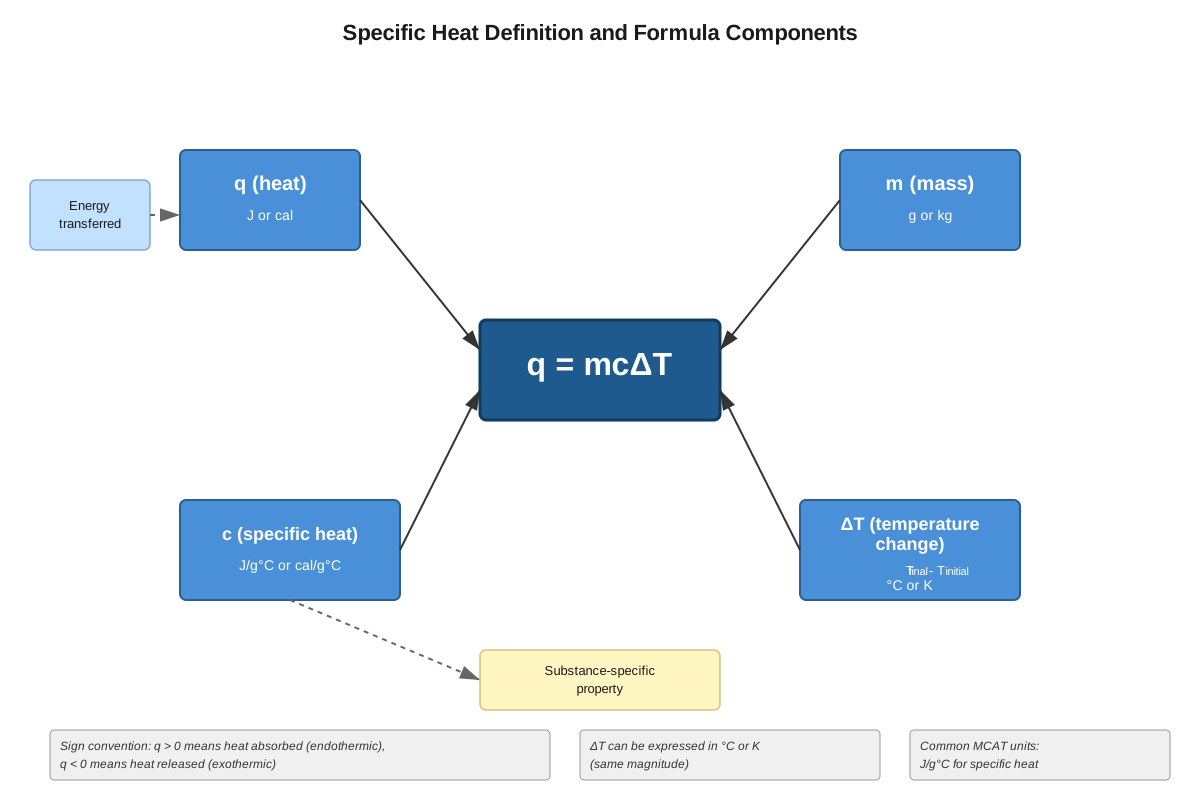
Specific heat (symbol: c or s) represents the amount of thermal energy required to raise the temperature of one gram of a substance by one degree Celsius (or one Kelvin). The fundamental equation relating heat transfer to specific heat is:
q = mcΔTWhere:
- q = heat energy transferred (joules or calories)
- m = mass of substance (grams)
- c = specific heat capacity (J/g°C or cal/g°C)
- ΔT = change in temperature (T_final - T_initial)
This equation assumes no phase change occurs during heating or cooling. The heat capacity (C) of an object differs from specific heat in that it represents the total energy needed to change the object's temperature by one degree, regardless of mass: C = mc. Specific heat is an intensive property (independent of amount), while heat capacity is extensive (depends on amount).
Units and Conversions
Specific heat values appear in multiple unit systems on the MCAT:
| Unit System | Specific Heat Units | Common Usage |
|---|---|---|
| SI (Standard) | J/(g·°C) or J/(g·K) | Most MCAT problems |
| Calorie-based | cal/(g·°C) | Older literature, nutritional contexts |
| Molar basis | J/(mol·°C) | When dealing with molar quantities |
The conversion factor between joules and calories is: 1 calorie = 4.184 joules. Note that nutritional "Calories" (capital C) are actually kilocalories: 1 Cal = 1000 cal = 4184 J. Temperature changes in Celsius and Kelvin are equivalent (ΔT in °C = ΔT in K) because both scales have the same degree size, simplifying calculations.
Specific Heat Values of Common Substances
Different substances exhibit vastly different specific heat capacities due to molecular structure and intermolecular forces:
| Substance | Specific Heat (J/g°C) | Relative Value |
|---|---|---|
| Water (liquid) | 4.18 | Very high |
| Ethanol | 2.44 | High |
| Ice | 2.09 | Moderate |
| Steam | 2.01 | Moderate |
| Aluminum | 0.897 | Low |
| Iron | 0.449 | Low |
| Copper | 0.385 | Very low |
| Gold | 0.129 | Very low |
Water possesses the highest specific heat of common substances due to extensive hydrogen bonding networks that must absorb energy before molecular motion (temperature) increases significantly. Metals have low specific heat values because their delocalized electrons efficiently distribute kinetic energy throughout the structure. This explains why metal objects feel cold to touch—they rapidly absorb heat from your hand—and why they heat quickly on stoves.
Molecular Basis of Specific Heat
At the molecular level, specific heat reflects the number of ways a substance can store thermal energy. Energy absorbed during heating distributes among:
- Translational motion: Movement of molecules through space (all substances)
- Rotational motion: Spinning of molecules (polyatomic molecules)
- Vibrational motion: Oscillation of bonds (molecules with multiple atoms)
- Intermolecular interactions: Energy stored in breaking/forming intermolecular forces
Substances with more degrees of freedom (ways to store energy) generally have higher specific heat values. Water's high specific heat results from both its polyatomic structure (allowing rotation and vibration) and strong hydrogen bonding that absorbs energy without immediate temperature increase. Monatomic gases like helium have lower molar heat capacities because they can only store energy as translational motion.
Calorimetry Applications
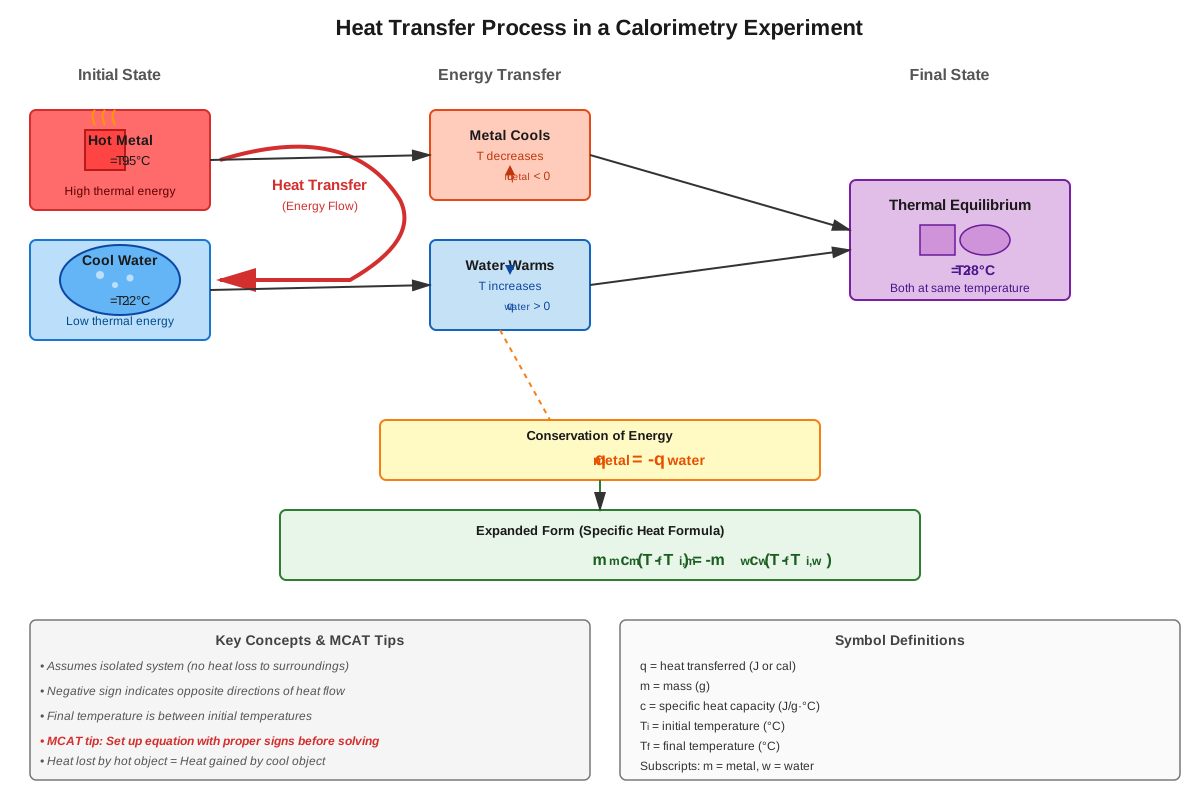
Calorimetry measures heat transfer using specific heat principles. In a coffee cup calorimeter (constant pressure), the heat lost by a hot substance equals the heat gained by a cold substance, assuming no heat escapes to surroundings:
q_lost = -q_gained
m₁c₁ΔT₁ = -m₂c₂ΔT₂
This principle enables determination of unknown specific heat values or final equilibrium temperatures. A bomb calorimeter (constant volume) measures heat of combustion reactions, using the calorimeter's known heat capacity to calculate energy released. The MCAT frequently tests whether students recognize that exothermic processes release heat (q negative for the system, positive for surroundings) while endothermic processes absorb heat (q positive for the system).
Temperature Change Predictions
Rearranging the specific heat equation allows prediction of temperature changes:
ΔT = q/(mc)This relationship reveals that for a given energy input (q):
- Substances with higher specific heat experience smaller temperature changes (better thermal buffers)
- Substances with lower specific heat experience larger temperature changes (heat/cool rapidly)
- Objects with greater mass experience smaller temperature changes (more thermal inertia)
This explains why oceans moderate coastal climates (large mass, high specific heat of water) while deserts experience extreme temperature swings (low mass of air, low specific heat of sand).
Phase Changes and Specific Heat
Specific heat values differ for the same substance in different phases. Water demonstrates this clearly:
- Ice: 2.09 J/g°C
- Liquid water: 4.18 J/g°C
- Steam: 2.01 J/g°C
Liquid water's higher specific heat results from hydrogen bonding networks that absorb energy. During phase transitions (melting, boiling), temperature remains constant despite continued energy input because energy breaks intermolecular forces rather than increasing kinetic energy. The heat of fusion (ΔH_fus) and heat of vaporization (ΔH_vap) quantify these phase change energies separately from specific heat calculations.
Concept Relationships
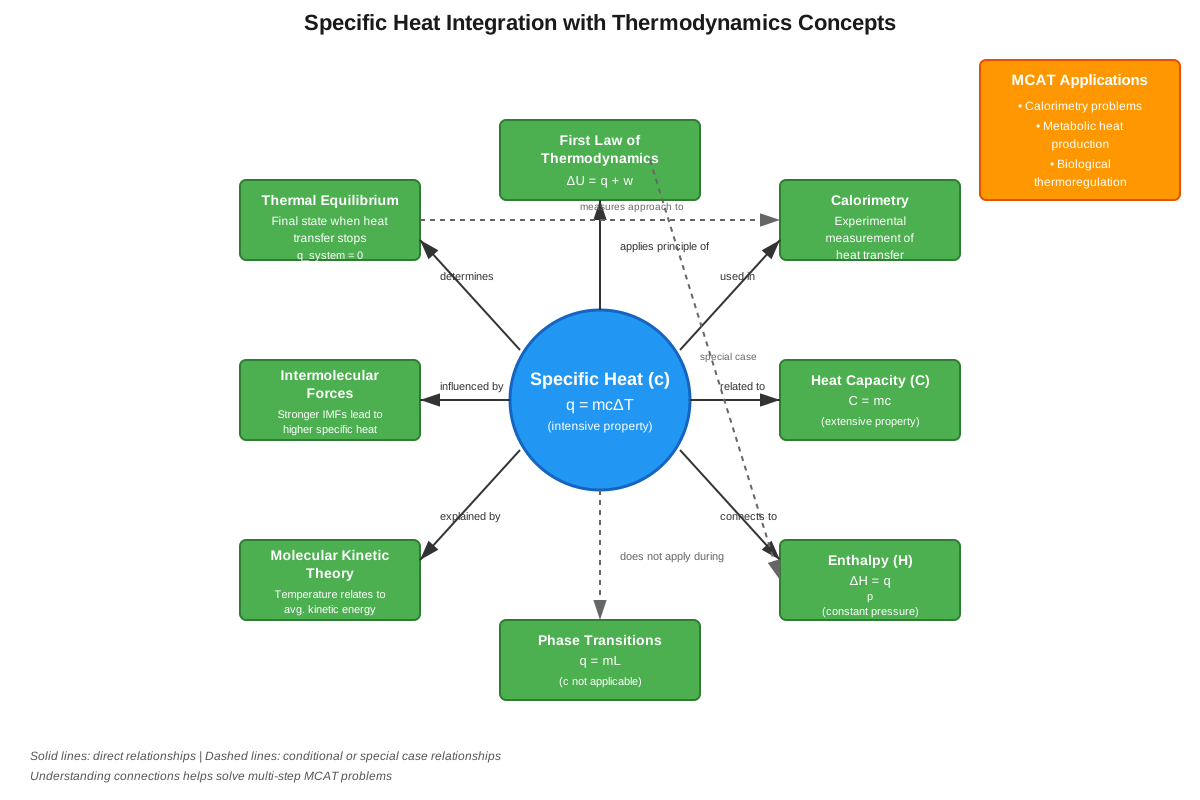
Specific heat serves as a central node connecting multiple thermodynamic concepts. The relationship begins with the first law of thermodynamics (ΔU = q + w), where specific heat calculations determine the heat component (q) of internal energy changes. This connects directly to enthalpy (H), as heat transfer at constant pressure equals enthalpy change: q_p = ΔH.
The conceptual flow proceeds: Molecular structure and intermolecular forces → determine → Specific heat values → enable calculation of → Heat transfer (q) → which affects → Temperature changes → measured in → Calorimetry experiments → used to determine → Enthalpy changes of reactions.
Specific heat also bridges to kinetic molecular theory, as temperature represents average molecular kinetic energy. Higher specific heat indicates more energy required per degree of temperature (kinetic energy) increase. This connects to phase transitions, where specific heat differs between phases and becomes undefined at transition temperatures (energy input doesn't change temperature during melting/boiling).
The concept extends to heat transfer mechanisms: conduction, convection, and radiation all depend on specific heat values to determine temperature changes in materials. In biological systems, specific heat connects to metabolism (heat production from ATP hydrolysis) and thermoregulation (sweating, shivering, vasodilation/vasoconstriction).
Quick check — test yourself on Specific heat so far.
Try Flashcards →High-Yield Facts
⭐ Water has the highest specific heat of common substances (4.18 J/g°C) due to extensive hydrogen bonding networks
⭐ The specific heat equation q = mcΔT applies only when no phase change occurs; phase transitions require separate enthalpy calculations
⭐ Metals have low specific heat values (typically < 1 J/g°C), causing them to heat and cool rapidly
⭐ In calorimetry, heat lost by hot substance equals heat gained by cold substance: q_lost = -q_gained (assuming isolated system)
⭐ Specific heat is an intensive property (independent of amount), while heat capacity is extensive (depends on mass)
- Temperature changes in Celsius equal temperature changes in Kelvin (ΔT°C = ΔTK) because both scales have identical degree sizes
- Substances with higher specific heat make better thermal buffers, resisting temperature changes
- The sign of q indicates direction: positive q means heat absorbed (endothermic), negative q means heat released (exothermic)
- Specific heat values differ for different phases of the same substance (ice ≠ water ≠ steam)
- Molar heat capacity (J/mol·°C) relates to specific heat by multiplying by molar mass: C_molar = c × M
- Polyatomic molecules generally have higher specific heat than monatomic species due to additional rotational and vibrational energy storage modes
- The specific heat of biological tissues approximates that of water due to high water content in living organisms
Common Misconceptions
Misconception: Specific heat and heat capacity are the same thing.
Correction: Specific heat (c) is heat capacity per unit mass (intensive property), while heat capacity (C) is the total energy needed to change an object's temperature by one degree (extensive property). They relate by C = mc.
Misconception: Temperature and heat are interchangeable terms.
Correction: Temperature measures average kinetic energy of particles (intensive), while heat (q) represents energy transfer between systems (extensive). A large cold object can contain more total thermal energy than a small hot object.
Misconception: The specific heat equation applies during phase changes.
Correction: During melting, freezing, boiling, or condensation, temperature remains constant despite energy input/output. Phase changes require heat of fusion (ΔH_fus) or heat of vaporization (ΔH_vap) calculations, not specific heat equations.
Misconception: Higher specific heat means a substance heats up faster.
Correction: Higher specific heat means a substance requires MORE energy to change temperature, so it heats (and cools) more slowly. Low specific heat substances change temperature rapidly with small energy inputs.
Misconception: ΔT always equals T_final - T_initial regardless of context.
Correction: While ΔT = T_final - T_initial is correct, students must carefully track signs. For cooling processes, ΔT is negative; for heating, ΔT is positive. The sign of q follows: q = mc(ΔT) will be negative for cooling (heat released) and positive for heating (heat absorbed).
Misconception: All liquids have high specific heat like water.
Correction: Water's specific heat is exceptionally high due to hydrogen bonding. Most other liquids have significantly lower specific heat values (e.g., ethanol: 2.44 J/g°C, oil: ~2 J/g°C).
Misconception: Specific heat changes with temperature.
Correction: While specific heat can vary slightly with temperature, MCAT problems treat it as constant over the temperature ranges presented. This approximation is valid for most substances over moderate temperature ranges.
Worked Examples
Example 1: Calculating Final Temperature in Mixing Problems
Problem: A 50.0 g sample of iron at 95.0°C is placed in 200.0 g of water at 22.0°C in an insulated container. What is the final equilibrium temperature? (c_iron = 0.449 J/g°C, c_water = 4.18 J/g°C)
Solution:
Step 1: Identify the principle. In an isolated system, heat lost by hot substance equals heat gained by cold substance:
q_iron = -q_waterStep 2: Express using specific heat equation:
m_iron × c_iron × ΔT_iron = -m_water × c_water × ΔT_waterStep 3: Define temperature changes in terms of final temperature (T_f):
- For iron (cooling): ΔT_iron = T_f - 95.0°C
- For water (heating): ΔT_water = T_f - 22.0°C
Step 4: Substitute values:
50.0 g × 0.449 J/g°C × (T_f - 95.0°C) = -200.0 g × 4.18 J/g°C × (T_f - 22.0°C)Step 5: Simplify:
22.45(T_f - 95.0) = -836(T_f - 22.0)
22.45T_f - 2132.75 = -836T_f + 18,392
Step 6: Solve for T_f:
858.45T_f = 20,524.75
T_f = 23.9°CInterpretation: The final temperature (23.9°C) is much closer to water's initial temperature (22.0°C) than iron's (95.0°C) because water has both greater mass and much higher specific heat, giving it far greater thermal inertia. This demonstrates why water is an excellent temperature buffer.
Example 2: Determining Specific Heat from Calorimetry Data
Problem: A 75.0 g sample of an unknown metal at 100.0°C is placed in 150.0 g of water at 20.0°C. The final temperature is 23.5°C. Calculate the specific heat of the metal. (c_water = 4.18 J/g°C)
Solution:
Step 1: Apply conservation of energy:
q_metal = -q_waterStep 2: Calculate heat gained by water:
q_water = m_water × c_water × ΔT_water
q_water = 150.0 g × 4.18 J/g°C × (23.5°C - 20.0°C)
q_water = 150.0 × 4.18 × 3.5 = 2194.5 J
Step 3: Heat lost by metal equals heat gained by water (with opposite sign):
q_metal = -2194.5 JStep 4: Use specific heat equation to find c_metal:
q_metal = m_metal × c_metal × ΔT_metal
-2194.5 J = 75.0 g × c_metal × (23.5°C - 100.0°C)
-2194.5 = 75.0 × c_metal × (-76.5)
-2194.5 = -5737.5 × c_metal
Step 5: Solve:
c_metal = 2194.5 / 5737.5 = 0.382 J/g°CInterpretation: The calculated specific heat (0.382 J/g°C) is close to copper's specific heat (0.385 J/g°C), suggesting the unknown metal is likely copper. This problem demonstrates how calorimetry experiments determine specific heat values experimentally. The small temperature change in water (3.5°C) versus large change in metal (76.5°C) again illustrates water's high specific heat.
Exam Strategy
Approaching MCAT Specific Heat Questions
Begin by identifying whether the question requires calculation or conceptual understanding. For calculations, immediately write down the specific heat equation (q = mcΔT) and identify given values. Create a table listing known and unknown variables for each substance involved. Always check units—convert calories to joules if needed (1 cal = 4.184 J) and ensure temperature changes use the same scale.
Trigger Words and Phrases
Watch for these key phrases that signal specific heat problems:
- "Heat absorbed" or "heat released" → calculate q
- "Final temperature" or "equilibrium temperature" → mixing problem, set q_hot = -q_cold
- "Calorimeter" → energy conservation, isolated system
- "Temperature change" → use ΔT = q/(mc)
- "Thermal buffer" or "temperature stability" → conceptual question about high specific heat
- "Heats up quickly" or "cools rapidly" → low specific heat substance
Process of Elimination Tips
For conceptual questions comparing substances:
- Eliminate choices suggesting metals have high specific heat (they don't)
- Eliminate answers claiming temperature and heat are identical
- Eliminate options stating specific heat applies during phase changes
- For "which substance changes temperature most" questions, eliminate substances with high specific heat (they change least)
For calculation questions:
- Eliminate answers with wrong units (temperature in joules, energy in degrees)
- Eliminate final temperatures outside the range between initial temperatures in mixing problems
- Eliminate answers suggesting heat flows from cold to hot (violates second law)
Time Allocation
Allocate 60-90 seconds for straightforward calculation problems using q = mcΔT. For mixing problems requiring solving for final temperature, budget 90-120 seconds due to algebraic manipulation. Conceptual questions about specific heat properties should take 30-45 seconds. If a passage presents calorimetry data, spend extra time (30 seconds) analyzing the experimental setup before attempting questions, as this context prevents errors.
Exam Tip: When solving for final temperature in mixing problems, check that your answer falls between the two initial temperatures. If T_final is outside this range, you've made a sign error or calculation mistake.
Memory Techniques
Mnemonic for Water's High Specific Heat
"Water Holds Heat Heavily" - Remember that water's specific heat (4.18) is the highest of common substances due to hydrogen bonding. The four H's remind you of the approximate value (4) and the reason (hydrogen bonding).
Visualization Strategy for Specific Heat Magnitude
Picture a thermal sponge: substances with high specific heat (like water) act as "energy sponges" that soak up large amounts of heat without much temperature change. Metals are like "energy sieves" that let heat pass through quickly, changing temperature rapidly. This visual helps predict behavior without calculation.
Acronym for Calorimetry Setup
HELIC - Heat Exchange in Isolated Container
- Heat lost = heat gained
- Energy conserved
- Lost heat is negative
- Isolated system (no heat escapes)
- Calculate using q = mcΔT
Sign Convention Memory Aid
"Positive Absorbs, Negative Releases" (PANR) - When q is positive, the substance absorbs heat (endothermic, temperature increases). When q is negative, the substance releases heat (exothermic, temperature decreases). This prevents sign errors in calculations.
Specific Heat Value Anchors
Memorize water's specific heat (4.18 J/g°C) as the reference point. Remember:
- Metals are roughly 10× lower (~0.4 J/g°C)
- Ice is roughly half of liquid water (~2 J/g°C)
- Most organic liquids are between ice and water (2-3 J/g°C)
Summary
Specific heat quantifies the thermal energy required to change a substance's temperature per unit mass, expressed mathematically as q = mcΔT. This intensive property varies widely among substances due to differences in molecular structure, intermolecular forces, and available energy storage modes. Water's exceptionally high specific heat (4.18 J/g°C) results from extensive hydrogen bonding, making it an ideal biological temperature buffer and explaining its role in climate moderation. Metals possess low specific heat values, causing rapid temperature changes with minimal energy input. Calorimetry applications rely on energy conservation principles, where heat lost by hot substances equals heat gained by cold substances in isolated systems. The MCAT tests both computational proficiency with specific heat calculations and conceptual understanding of thermal behavior, frequently embedding these concepts within passages about physiological thermoregulation, experimental calorimetry, or environmental temperature dynamics. Mastery requires distinguishing specific heat from heat capacity, recognizing that the equation applies only when no phase change occurs, and carefully tracking signs to indicate heat flow direction.
Key Takeaways
- Specific heat (c) is the energy required to raise one gram of substance by one degree Celsius, calculated using q = mcΔT
- Water has the highest specific heat of common substances (4.18 J/g°C) due to hydrogen bonding, making it an excellent thermal buffer
- Metals have low specific heat values (typically < 1 J/g°C), causing rapid heating and cooling
- In calorimetry, energy conservation requires q_lost = -q_gained for isolated systems
- Specific heat is intensive (independent of amount), while heat capacity is extensive (depends on mass)
- The specific heat equation applies only when no phase change occurs; phase transitions require separate enthalpy calculations
- Higher specific heat means greater resistance to temperature change, explaining water's role in climate moderation and biological temperature regulation
Related Topics
Calorimetry and Enthalpy of Reaction: Building on specific heat principles, calorimetry experiments measure heat changes in chemical reactions, enabling determination of enthalpy values (ΔH_rxn) critical for thermodynamic predictions.
Phase Transitions and Latent Heat: Understanding specific heat provides foundation for studying heat of fusion and vaporization, where energy input doesn't change temperature but breaks intermolecular forces.
First Law of Thermodynamics: Specific heat calculations represent the heat component (q) in the fundamental relationship ΔU = q + w, connecting to broader energy conservation principles.
Intermolecular Forces: Mastering specific heat enables deeper understanding of how hydrogen bonding, dipole-dipole interactions, and London dispersion forces affect thermal properties.
Biological Thermoregulation: Specific heat concepts apply directly to physiological mechanisms of temperature control, including sweating, metabolic heat production, and countercurrent heat exchange.
Practice CTA
Now that you've mastered the core concepts of specific heat, reinforce your understanding by attempting practice questions and flashcards. Focus on both calculation-based problems and conceptual questions about thermal behavior. Challenge yourself with mixing problems that require algebraic manipulation, and practice identifying trigger words in passage-based questions. The more you apply these principles to varied scenarios, the more automatic your problem-solving approach will become on test day. Remember: specific heat appears frequently on the MCAT, and confident mastery of this topic will boost your score in both General Chemistry and integrated passages. You've got this!
Sign up free to keep reading
Create a free AnvayaPrep account to finish this MCAT guide on Specific heat — plus flashcards and practice questions.