Overview
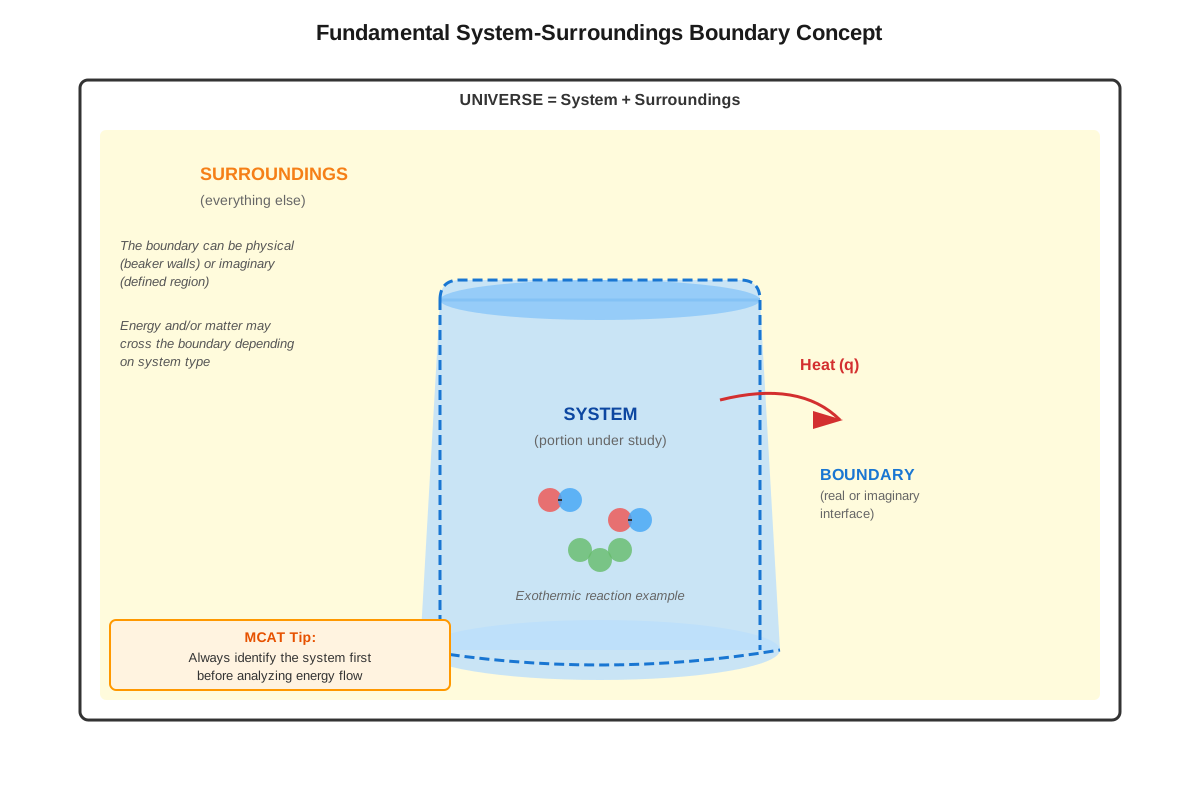
In thermodynamics, every chemical or physical process must be analyzed by carefully defining what is being studied and what lies beyond those boundaries. The system represents the specific portion of the universe under investigation—perhaps a chemical reaction in a beaker, a biological cell, or gas molecules in a piston—while the surroundings encompass everything else in the universe that can exchange energy or matter with that system. This fundamental distinction forms the conceptual foundation for understanding energy transfer, heat flow, work, and the laws of thermodynamics that govern all chemical and biological processes.
For MCAT success, mastering system and surroundings is essential because this framework appears throughout General Chemistry, Physics, and even Biological Sciences passages. Questions frequently require students to identify whether energy flows into or out of a system, determine the sign conventions for heat and work, or predict how changes in one component affect the other. The MCAT tests not just definitional knowledge but the ability to apply these concepts to complex scenarios involving calorimetry, phase changes, biochemical reactions, and physiological processes like cellular respiration.
Understanding system and surroundings provides the conceptual scaffolding for more advanced thermodynamics topics including enthalpy, entropy, Gibbs free energy, and the laws of thermodynamics. Without a clear mental model of where the "boundary" lies in any given problem, students cannot correctly apply conservation of energy principles, interpret calorimetry data, or predict spontaneity of reactions—all high-yield MCAT topics that build directly upon this foundational concept.
Learning Objectives
- [ ] Define system and surroundings using accurate General Chemistry terminology
- [ ] Explain why system and surroundings matters for the MCAT
- [ ] Apply system and surroundings to exam-style questions
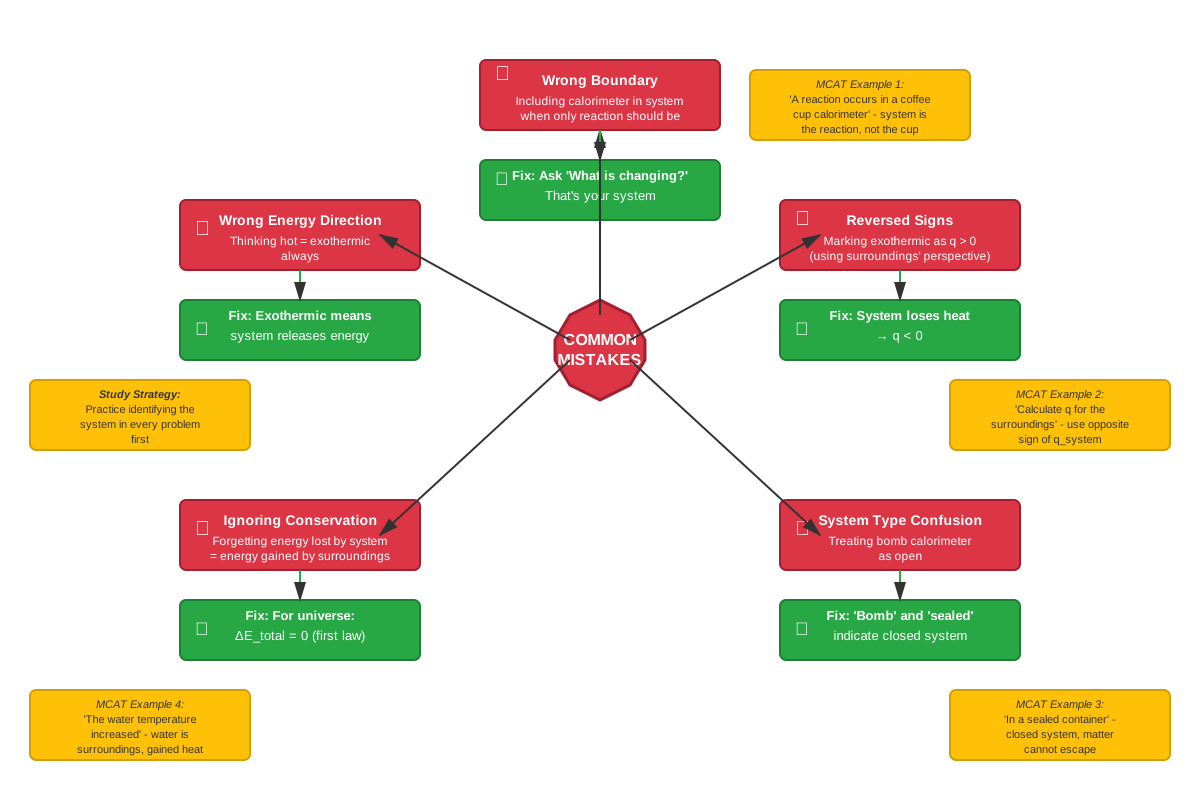
- [ ] Identify common mistakes related to system and surroundings
- [ ] Connect system and surroundings to related General Chemistry concepts
- [ ] Distinguish between open, closed, and isolated systems with specific examples
- [ ] Determine the direction of energy and matter transfer between system and surroundings in various scenarios
- [ ] Apply proper sign conventions for heat (q) and work (w) based on system-surroundings interactions
Prerequisites
- Basic energy concepts: Understanding kinetic and potential energy is necessary to comprehend energy transfer between system and surroundings
- Conservation of energy: The first law of thermodynamics builds directly on the principle that energy cannot be created or destroyed
- States of matter: Recognizing phase changes and molecular behavior helps visualize system boundaries and energy exchanges
- Chemical reactions: Familiarity with reactants and products provides context for identifying what constitutes the system in chemical thermodynamics
Why This Topic Matters
Clinical and Real-World Significance
The system-surroundings framework is fundamental to understanding physiological processes. When cells perform cellular respiration, the mitochondria represent the system releasing energy (as heat and ATP) to the surroundings (cytoplasm and organism). Fever represents the body (system) releasing excess heat to the environment (surroundings). Medical devices like calorimeters measure metabolic rate by quantifying heat exchange between a patient (system) and a controlled chamber (surroundings). Pharmacokinetics relies on understanding drug molecules (system) distributing into body compartments (surroundings).
MCAT Exam Statistics
System and surroundings concepts appear in approximately 15-20% of General Chemistry questions and frequently in passage-based questions across all science sections. The MCAT particularly favors questions that require students to:
- Identify the system in a described experimental setup
- Determine whether processes are endothermic or exothermic based on energy flow direction
- Apply sign conventions correctly when calculating ΔH, q, or w
- Interpret calorimetry data by tracking energy transfer
Common Exam Presentations
Passages often embed system-surroundings concepts within calorimetry experiments, bomb calorimeter descriptions, biological energy metabolism, or phase change scenarios. Discrete questions may present a chemical reaction and ask students to identify what happens to the surroundings' temperature. Physics passages about heat engines or refrigerators require clear system definition. Biochemistry passages about ATP hydrolysis or protein folding necessitate understanding energy release to surroundings.
Core Concepts
Defining the System
The system is the specific part of the universe chosen for thermodynamic analysis. This selection is arbitrary but must be clearly defined before any thermodynamic calculations can proceed. In General Chemistry, the system typically consists of:
- Reactants and products in a chemical reaction
- A specific quantity of gas in a container
- A solution in a calorimeter
- A phase undergoing transformation
The system boundary can be real (like a beaker wall) or imaginary (like a defined volume of ocean water). The key principle is that the system must be precisely specified to determine what energy and matter exchanges are relevant.
Defining the Surroundings
The surroundings comprise everything in the universe external to the system. Practically, for thermodynamics calculations, the surroundings include only those parts of the universe that can interact with the system through energy or matter exchange. For a reaction in a beaker, the surroundings include:
- The beaker itself
- The air in the room
- The laboratory bench
- Measuring instruments in contact with the system
Distant galaxies are technically part of the surroundings but have no practical thermodynamic interaction with laboratory systems, so they are ignored in calculations.
Types of Systems
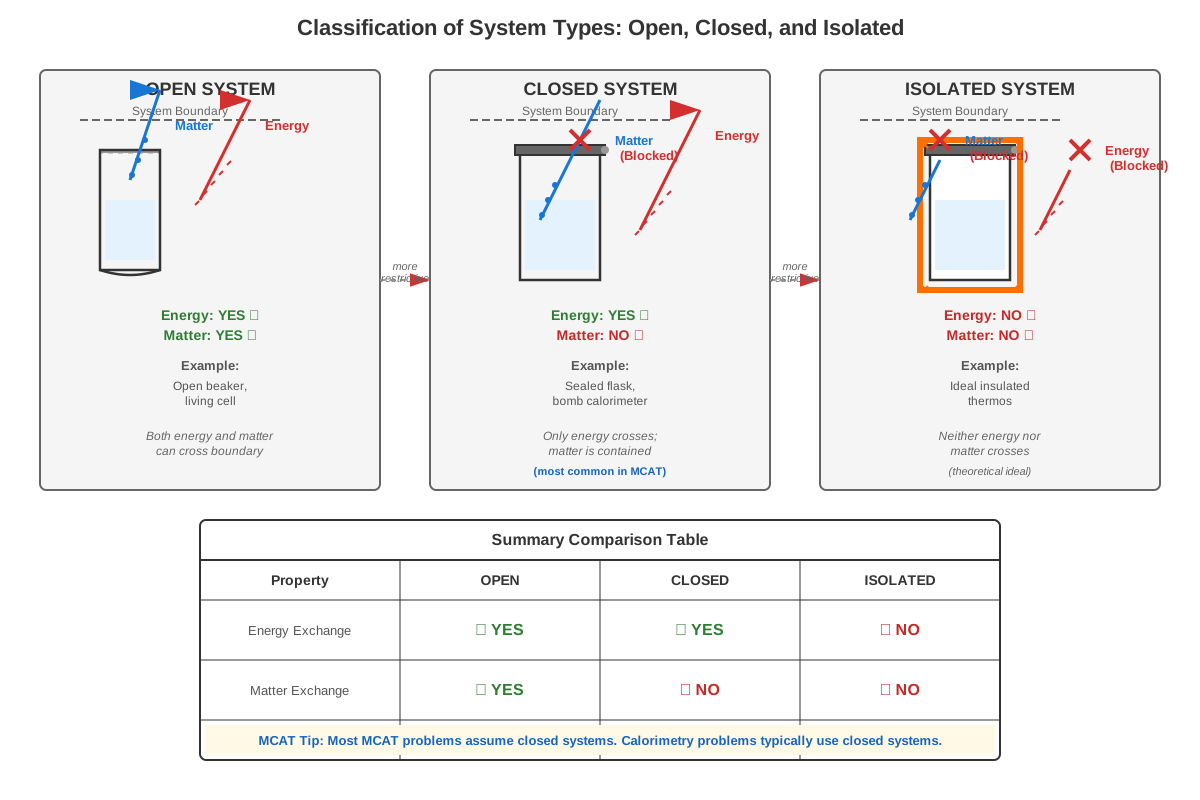
Systems are classified based on their ability to exchange energy and matter with surroundings:
| System Type | Energy Exchange | Matter Exchange | Example |
|---|---|---|---|
| Open System | Yes | Yes | Boiling water in an open pot (steam escapes, heat transfers) |
| Closed System | Yes | No | Sealed flask with a reaction (heat transfers through walls, but no mass leaves) |
| Isolated System | No | No | Ideal thermos bottle (no heat or matter exchange) |
Open systems are most common in biological contexts—living cells exchange both nutrients (matter) and heat (energy) with their environment. Closed systems are typical in laboratory chemistry where reactions occur in sealed containers but temperature changes are measured. Isolated systems are theoretical ideals; perfect isolation is impossible, but high-quality calorimeters approximate this condition.
Energy Transfer: Heat (q)
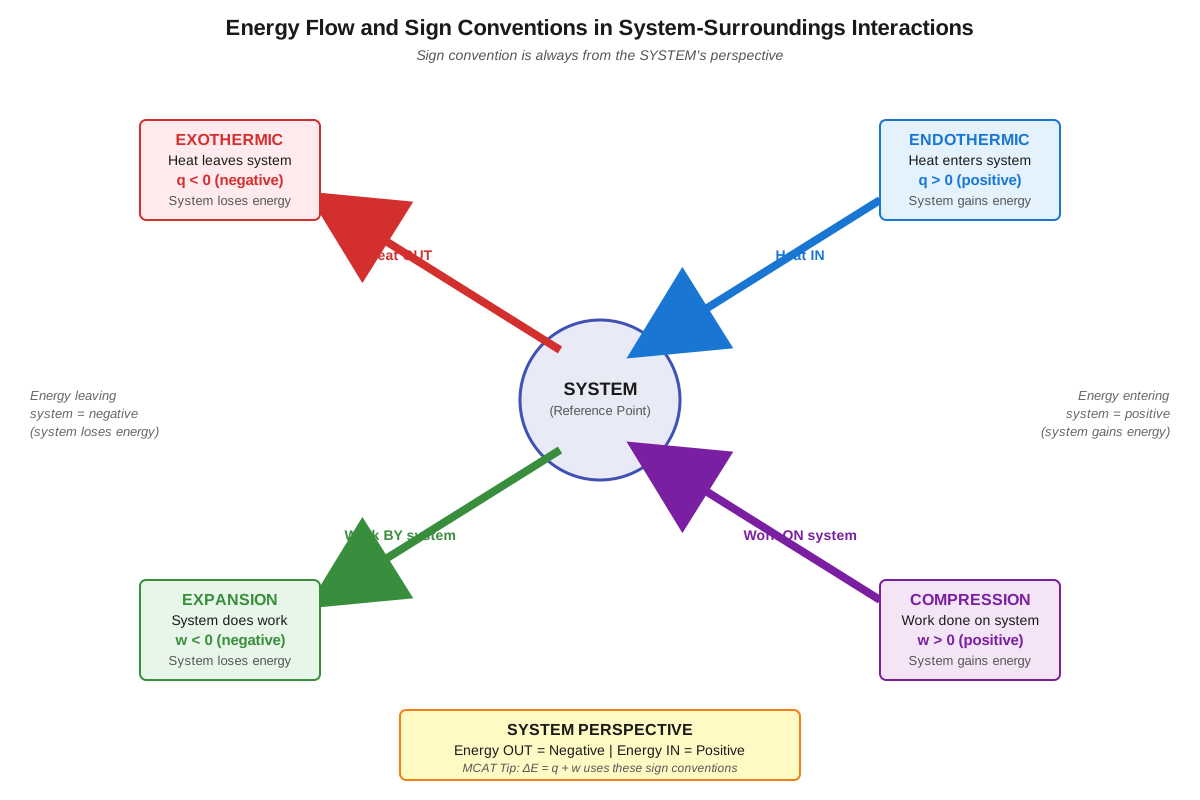
Heat represents thermal energy transferred between system and surroundings due to temperature differences. Energy flows spontaneously from higher temperature to lower temperature regions. The sign convention for heat from the system's perspective:
q > 0 (positive): Heat flows INTO the system (endothermic)
q < 0 (negative): Heat flows OUT OF the system (exothermic)
When a system absorbs heat, its internal energy increases, and the surroundings lose an equivalent amount of energy. For the surroundings, the sign is opposite: if q_system = +50 J, then q_surroundings = -50 J. This reciprocal relationship reflects energy conservation.
Energy Transfer: Work (w)
Work represents energy transfer through mechanical means—compression, expansion, electrical current, or other non-thermal processes. For MCAT purposes, pressure-volume work is most important:
w = -PΔV (for constant external pressure)The sign convention for work from the system's perspective:
w > 0 (positive): Work done ON the system (compression)
w < 0 (negative): Work done BY the system (expansion)
When gas expands against external pressure, the system does work on the surroundings, losing energy (w < 0). When gas is compressed, the surroundings do work on the system, increasing its energy (w > 0).
The Universe: System + Surroundings
A fundamental principle in thermodynamics states:
ΔE_universe = ΔE_system + ΔE_surroundings = 0The total energy of the universe remains constant (First Law of Thermodynamics). Any energy gained by the system must equal energy lost by the surroundings, and vice versa. This conservation principle allows calculation of one component if the other is known.
Boundary Characteristics
The nature of the system boundary determines what exchanges can occur:
- Permeable boundaries: Allow matter transfer (open systems)
- Impermeable boundaries: Prevent matter transfer (closed and isolated systems)
- Diathermal boundaries: Allow heat transfer (open and closed systems)
- Adiabatic boundaries: Prevent heat transfer (isolated systems and adiabatic processes)
Understanding boundary properties helps predict system behavior. A reaction in a Styrofoam cup calorimeter has approximately adiabatic boundaries (minimal heat loss), while a reaction in a thin metal beaker has diathermal boundaries (rapid heat exchange).
Practical System Selection
Choosing the appropriate system is crucial for problem-solving. Consider a hot metal block placed in cool water:
Option 1: System = metal block
- Heat flows OUT of system (q < 0)
- Temperature of system decreases
- Surroundings (water) warm up
Option 2: System = water
- Heat flows INTO system (q > 0)
- Temperature of system increases
- Surroundings (metal) cool down
Option 3: System = metal + water (isolated)
- No heat exchange with surroundings
- Total energy conserved within system
- Final temperature determined by heat capacities
Each choice is valid but leads to different calculation approaches. The MCAT often tests whether students can correctly identify which components belong to the system versus surroundings in a given problem.
Concept Relationships
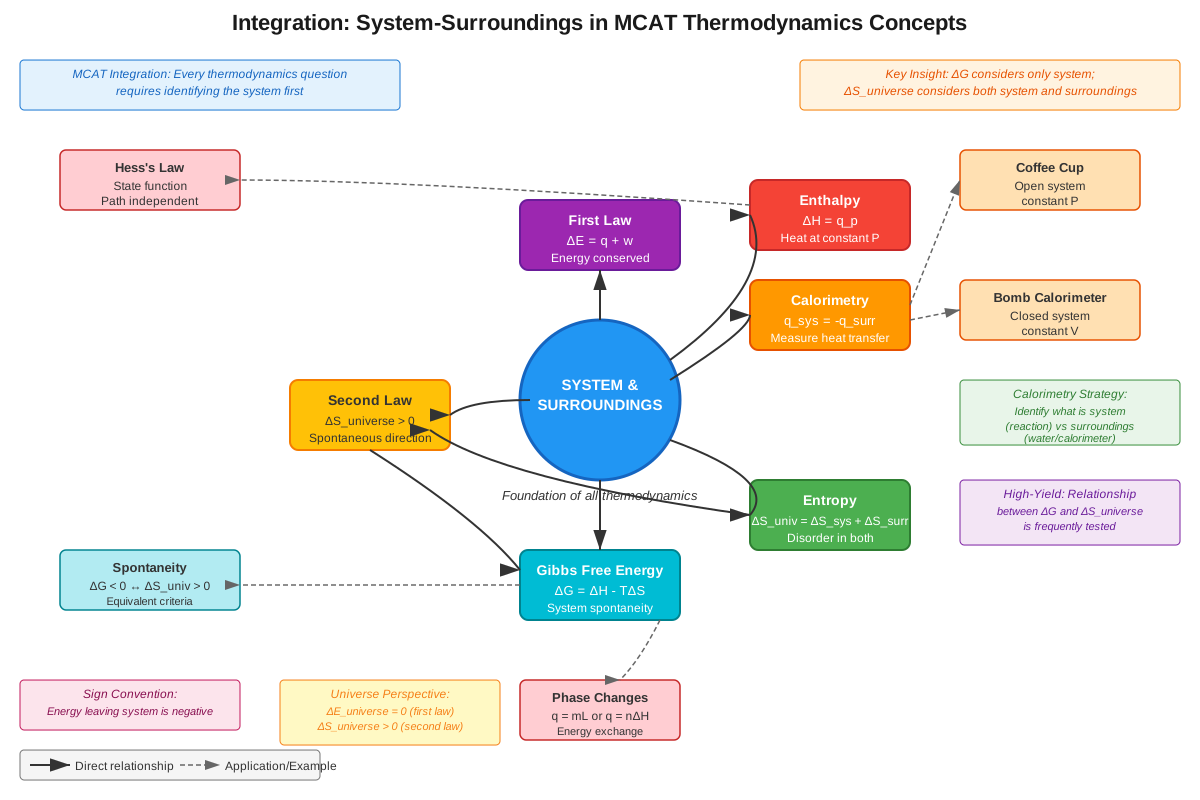
The system-surroundings framework serves as the foundation for all thermodynamic analysis. System definition → determines → boundary identification → determines → type of energy/matter exchange possible → determines → applicable thermodynamic equations.
This topic connects directly to internal energy (ΔE), which represents the total energy change of the system through the relationship ΔE = q + w. Understanding what constitutes the system versus surroundings is essential for correctly applying sign conventions in this equation.
The concept extends to enthalpy (ΔH), which measures heat transfer at constant pressure. When ΔH < 0 (exothermic), the system releases heat to the surroundings; when ΔH > 0 (endothermic), the system absorbs heat from the surroundings. Without clear system definition, students cannot interpret enthalpy values correctly.
Calorimetry depends entirely on system-surroundings analysis. The calorimeter measures temperature changes in the surroundings (usually water) to calculate heat released or absorbed by the system (the reaction). The equation q = mcΔT applies to the surroundings, while the system's heat change has the opposite sign.
The framework also connects to entropy and Gibbs free energy. Spontaneous processes increase the entropy of the universe (system + surroundings), not necessarily the system alone. A reaction may decrease system entropy if it increases surroundings entropy by a greater amount through heat release.
In biological contexts, cellular metabolism represents the system (biochemical reactions) exchanging energy with surroundings (cellular environment). ATP hydrolysis releases energy from the system (ATP molecule) to the surroundings (cellular processes requiring energy).
High-Yield Facts
⭐ The system is the specific portion of the universe under study; the surroundings are everything else that can interact with the system
⭐ Energy gained by the system equals energy lost by the surroundings: ΔE_system = -ΔE_surroundings
⭐ Positive q means heat flows INTO the system (endothermic); negative q means heat flows OUT of the system (exothermic)
⭐ Positive w means work is done ON the system (compression); negative w means work is done BY the system (expansion)
⭐ Open systems exchange both energy and matter; closed systems exchange only energy; isolated systems exchange neither
- The universe (system + surroundings) has constant total energy according to the First Law of Thermodynamics
- Sign conventions are always from the system's perspective unless explicitly stated otherwise
- In calorimetry, the reaction is typically the system and the water/calorimeter is the surroundings
- Diathermal boundaries allow heat transfer; adiabatic boundaries prevent heat transfer
- For any process, q_system + q_surroundings = 0 and w_system + w_surroundings = 0
- The choice of system is arbitrary but must remain consistent throughout a problem
- Exothermic reactions release heat to surroundings, increasing surroundings temperature
- Endothermic reactions absorb heat from surroundings, decreasing surroundings temperature
- Gas expansion does negative work (system loses energy); gas compression involves positive work (system gains energy)
- Biological systems are typically open systems exchanging both matter (nutrients, waste) and energy (heat, work)
Quick check — test yourself on System and surroundings so far.
Try Flashcards →Common Misconceptions
Misconception: The system must be the smaller or more active component in a scenario
Correction: System selection is arbitrary and based on what the problem asks you to analyze. You can define the system as the reaction, the container, or even both together—the choice depends on what makes calculations most straightforward for the specific question.
Misconception: Heat always flows from the system to the surroundings
Correction: Heat flows from higher temperature to lower temperature, regardless of system boundaries. In endothermic processes, heat flows FROM surroundings TO system. The direction depends on the temperature gradient and the nature of the process, not on which component is labeled "system."
Misconception: Positive ΔH means the surroundings gain energy
Correction: Positive ΔH means the SYSTEM gains energy (endothermic). The surroundings lose an equivalent amount of energy. Students often confuse the perspective; thermodynamic values are reported from the system's viewpoint unless explicitly stated otherwise.
Misconception: In an isolated system, no processes can occur
Correction: Isolated systems cannot exchange energy or matter with surroundings, but internal processes still occur. Chemical reactions, phase changes, and mixing can happen within an isolated system—the constraint is that total system energy remains constant because no external exchange occurs.
Misconception: The surroundings include the entire universe in practical calculations
Correction: While technically the surroundings encompass everything outside the system, practical calculations only consider the immediate surroundings that can meaningfully interact with the system. For a reaction in a calorimeter, the surroundings are the water and calorimeter walls, not distant objects.
Misconception: Work and heat are properties of the system like temperature or pressure
Correction: Heat and work are energy transfer processes, not state functions or system properties. They describe energy crossing the system boundary during a process. A system doesn't "contain" heat or work; it has internal energy that can change through heat transfer or work.
Misconception: If the system does work, the surroundings must also do work
Correction: Work is energy transfer between system and surroundings. If the system does work ON the surroundings (w_system < 0), then the surroundings have work done ON them BY the system (w_surroundings > 0). The work is the same energy transfer viewed from different perspectives, not two separate work processes.
Worked Examples
Example 1: Calorimetry Problem
Problem: A 5.00 g sample of methane (CH₄) undergoes complete combustion in a bomb calorimeter. The calorimeter contains 2000 g of water, and the temperature increases from 20.0°C to 35.5°C. The heat capacity of the calorimeter (excluding water) is 1500 J/°C. Identify the system and surroundings, determine the heat absorbed by the surroundings, and calculate the heat released by the system.
Solution:
Step 1: Define system and surroundings
- System: The combustion reaction (CH₄ + O₂ → CO₂ + H₂O)
- Surroundings: The water and calorimeter apparatus
Step 2: Calculate heat absorbed by water (part of surroundings)
q_water = m × c × ΔT
q_water = (2000 g)(4.184 J/g°C)(35.5°C - 20.0°C)
q_water = (2000)(4.184)(15.5)
q_water = 129,704 J = 129.7 kJ
Step 3: Calculate heat absorbed by calorimeter (part of surroundings)
q_calorimeter = C × ΔT
q_calorimeter = (1500 J/°C)(15.5°C)
q_calorimeter = 23,250 J = 23.3 kJ
Step 4: Calculate total heat absorbed by surroundings
q_surroundings = q_water + q_calorimeter
q_surroundings = 129.7 kJ + 23.3 kJ = 153.0 kJ
Step 5: Apply energy conservation to find system heat
q_system = -q_surroundings
q_system = -153.0 kJInterpretation: The negative sign indicates the system (combustion reaction) released 153.0 kJ of energy to the surroundings. This is an exothermic reaction. The surroundings absorbed this energy, evidenced by the temperature increase.
MCAT Connection: This problem type appears frequently in passages about calorimetry, metabolism, or thermochemistry. The key is recognizing that temperature changes occur in the surroundings, which you use to calculate the system's energy change with opposite sign.
Example 2: Gas Expansion Work
Problem: A gas in a cylinder with a movable piston expands from 2.0 L to 5.0 L against a constant external pressure of 3.0 atm. During this expansion, the gas absorbs 250 J of heat from the surroundings. Define the system, calculate the work done, and determine the change in internal energy of the system.
Solution:
Step 1: Define system and surroundings
- System: The gas in the cylinder
- Surroundings: The piston, cylinder walls, and external environment
Step 2: Calculate work done by the system
w = -P_ext × ΔV
ΔV = 5.0 L - 2.0 L = 3.0 L
w = -(3.0 atm)(3.0 L)
w = -9.0 L·atm
Convert to Joules (1 L·atm = 101.3 J):
w = -9.0 × 101.3 J = -912 JStep 3: Identify heat from system perspective
The problem states the gas "absorbs 250 J of heat from the surroundings"
q_system = +250 J (positive because heat enters the system)Step 4: Calculate change in internal energy using First Law
ΔE = q + w
ΔE = 250 J + (-912 J)
ΔE = -662 JInterpretation:
- The system did 912 J of work on the surroundings (expansion work, w < 0)
- The system absorbed 250 J of heat from the surroundings (q > 0)
- The net effect is a decrease in system internal energy of 662 J
- The surroundings gained 912 J from work but lost 250 J as heat, for a net gain of 662 J
- Energy is conserved: ΔE_system + ΔE_surroundings = -662 J + 662 J = 0
MCAT Connection: Gas expansion problems test understanding of sign conventions and the First Law. Remember that expansion means the system does work (negative w), and compression means work is done on the system (positive w). Always track energy from the system's perspective unless asked otherwise.
Exam Strategy
Approaching MCAT Questions
Step 1: Immediately identify what the question defines as the system. Look for phrases like "the reaction," "the gas," "the solution," or "the calorimeter contents." Underline or mentally note this definition.
Step 2: Determine what remains as the surroundings. Everything that can interact with the system but isn't part of it belongs to the surroundings.
Step 3: Identify the direction of energy transfer. Look for temperature changes, volume changes, or explicit statements about heat absorption/release.
Step 4: Apply correct sign conventions from the system's perspective:
- Heat absorbed by system: q > 0
- Heat released by system: q < 0
- Work done on system: w > 0
- Work done by system: w < 0
Step 5: Use conservation of energy if needed: energy gained by one component equals energy lost by the other.
Trigger Words and Phrases
- "The reaction releases heat" → System loses energy, q_system < 0, exothermic
- "The surroundings cool down" → Heat flows from surroundings to system, q_system > 0, endothermic
- "The gas expands" → System does work, w_system < 0
- "The piston compresses the gas" → Work done on system, w_system > 0
- "Temperature of the water increases" → If water is surroundings, system released heat
- "Isolated system" → No energy or matter exchange, ΔE_universe = 0 but processes can occur internally
- "Bomb calorimeter" → Constant volume, no PV work, q_v = ΔE
Process of Elimination Tips
When answer choices involve sign errors:
- Eliminate options that violate energy conservation (system and surroundings must have opposite signs for energy changes)
- Eliminate options that use incorrect sign conventions (e.g., claiming expansion gives positive work)
- Eliminate options that confuse system and surroundings perspectives
When answer choices involve system identification:
- Eliminate options that include components the question explicitly places outside the system
- Eliminate options that ignore stated boundaries or containers
- Eliminate options that confuse open/closed/isolated classifications
Time Allocation
System-surroundings questions typically require 60-90 seconds:
- 15 seconds: Read and identify system/surroundings
- 20 seconds: Determine energy transfer direction
- 25 seconds: Apply appropriate equation with correct signs
- 10 seconds: Check answer reasonableness
For passage-based questions, the passage usually defines the system clearly. Spend 10-15 seconds during passage reading to identify and mentally note the system definition, which will save time on individual questions.
Memory Techniques
Sign Convention Mnemonic: "HERO"
Heat Enters = Reaction Obsorbs (positive q, endothermic)
When heat enters the system, q is positive. The opposite (heat exits) means q is negative (exothermic).
Work Sign Mnemonic: "COPS"
Compression = On = Positive = System gains energy
When gas is compressed, work is done ON the system, w is positive. The opposite (expansion) means w is negative.
System Types Mnemonic: "OCI"
Open: Can Interact with everything (matter + energy)
Closed: Interaction limited (energy only)
Isolated: Interaction impossible (neither)
Visualization Strategy: The Box Method
Draw a box representing the system boundary. Arrows pointing INTO the box represent positive energy changes (heat absorbed, work done on system). Arrows pointing OUT OF the box represent negative energy changes (heat released, work done by system). This visual immediately clarifies sign conventions.
Energy Conservation Reminder: "See-Saw"
Think of system and surroundings on opposite ends of a see-saw. When one goes up (gains energy), the other must go down (loses energy) by the same amount. The total (universe) stays level (constant energy).
Summary
System and surroundings form the conceptual foundation of thermodynamics by dividing the universe into the portion under study (system) and everything else capable of interaction (surroundings). The system can be open (exchanging both matter and energy), closed (exchanging only energy), or isolated (exchanging neither). Energy transfers between system and surroundings occur through heat (thermal energy transfer due to temperature differences) and work (mechanical energy transfer). Sign conventions are critical: from the system's perspective, positive q means heat absorbed and positive w means work done on the system, while negative values indicate the opposite. Energy conservation requires that any energy gained by the system equals energy lost by the surroundings, and vice versa, maintaining constant total universal energy. For MCAT success, students must quickly identify the system in any problem, apply correct sign conventions, and recognize that thermodynamic values are reported from the system's viewpoint. This framework enables analysis of calorimetry, enthalpy changes, metabolic processes, and all subsequent thermodynamic concepts.
Key Takeaways
- The system is the defined portion under study; the surroundings are everything else that can interact with it
- Energy conservation requires ΔE_system = -ΔE_surroundings, making the universe's total energy constant
- Sign conventions from the system's perspective: positive q (heat in), negative q (heat out), positive w (work on), negative w (work by)
- Open systems exchange matter and energy; closed systems exchange only energy; isolated systems exchange neither
- Calorimetry problems define the reaction as the system and measure temperature changes in the surroundings to calculate system energy changes
- Correct system identification is the first critical step in solving any thermodynamics problem
- All thermodynamic quantities (ΔH, ΔE, ΔG) are reported from the system's perspective unless explicitly stated otherwise
Related Topics
Internal Energy and the First Law of Thermodynamics: Building directly on system-surroundings concepts, this topic quantifies energy changes through ΔE = q + w and establishes energy conservation principles essential for all thermodynamic calculations.
Enthalpy and Thermochemistry: Understanding heat transfer between system and surroundings at constant pressure leads to enthalpy concepts, Hess's Law, and bond energy calculations frequently tested on the MCAT.
Calorimetry: This experimental technique applies system-surroundings analysis to measure heat changes, requiring mastery of sign conventions and energy conservation to interpret temperature data correctly.
Entropy and the Second Law: Expanding beyond energy to disorder, this topic examines how spontaneous processes increase total entropy of the universe (system + surroundings), not necessarily the system alone.
Gibbs Free Energy: Combining enthalpy and entropy, this concept predicts reaction spontaneity by considering both system energy changes and entropy changes in system and surroundings.
Practice CTA
Now that you've mastered the fundamental concepts of system and surroundings, it's time to solidify your understanding through active practice. Attempt the practice questions and flashcards designed specifically for this topic—they'll challenge you to apply sign conventions, identify systems in complex scenarios, and solve problems under timed conditions. Remember, thermodynamics mastery comes from repeated application of these principles to diverse problems. Each practice question strengthens your ability to quickly recognize system-surroundings relationships on test day, building the confidence and speed you need for MCAT success. You've built the foundation—now reinforce it through deliberate practice!
Sign up free to keep reading
Create a free AnvayaPrep account to finish this MCAT guide on System and surroundings — plus flashcards and practice questions.