Overview
Work is a fundamental concept in thermodynamics that describes energy transfer between a system and its surroundings through mechanical means. In General Chemistry, work represents one of the two primary mechanisms by which energy crosses system boundaries—the other being heat. Understanding work is essential for mastering the First Law of Thermodynamics, which states that the change in internal energy of a system equals the heat added to the system minus the work done by the system. This relationship forms the foundation for analyzing chemical reactions, phase transitions, and physical processes that appear frequently on the MCAT.
For the MCAT, work appears in multiple contexts across the Chemical and Physical Foundations of Biological Systems section. Students encounter work calculations in gas expansion problems, pressure-volume relationships, and energy conservation scenarios. The concept bridges pure chemistry with physics applications, making it a high-yield topic that tests both computational skills and conceptual understanding. Work problems often appear in passage-based questions involving calorimetry, engine cycles, or biological energy transformations, requiring students to integrate thermodynamic principles with experimental data interpretation.
The relationship between work and other General Chemistry concepts extends throughout thermodynamics and beyond. Work directly connects to internal energy, enthalpy, entropy, and Gibbs free energy—all critical topics for MCAT success. Additionally, understanding work provides the foundation for comprehending how chemical potential energy converts to mechanical energy in biological systems, such as ATP hydrolysis driving muscle contraction or ion pumps maintaining cellular gradients. Mastering work ensures students can tackle complex, multi-step thermodynamics problems that frequently distinguish high-scoring test-takers.
Learning Objectives
- [ ] Define Work using accurate General Chemistry terminology
- [ ] Explain why Work matters for the MCAT
- [ ] Apply Work to exam-style questions
- [ ] Identify common mistakes related to Work
- [ ] Connect Work to related General Chemistry concepts
- [ ] Calculate work done by or on a system during gas expansion or compression
- [ ] Distinguish between work in reversible and irreversible processes
- [ ] Interpret pressure-volume diagrams to determine work values
- [ ] Apply sign conventions correctly to determine energy flow direction
Prerequisites
- Basic algebra and unit conversions: Essential for manipulating work equations and converting between pressure-volume units and energy units (L·atm to joules)
- Understanding of pressure and volume: Work calculations fundamentally involve these variables, particularly in gas systems
- Energy concepts: Work represents energy transfer, requiring familiarity with energy units (joules, calories) and conservation principles
- System versus surroundings: Thermodynamic analysis depends on clearly defining what constitutes the system being studied
- Gas laws (ideal gas law): Many work problems involve gases, requiring PV = nRT relationships
Why This Topic Matters
Work appears in approximately 3-5% of MCAT Chemical and Physical Foundations questions, making it a moderate-to-high-yield topic that students cannot afford to neglect. Beyond direct calculation questions, work concepts underpin passage-based questions about calorimetry, thermochemistry, and energy transformations in biological systems. The MCAT frequently tests work in the context of the First Law of Thermodynamics, requiring students to integrate multiple concepts simultaneously.
Clinically and biologically, work manifests in numerous physiological processes. Cardiac muscle performs work pumping blood against pressure gradients. Respiratory muscles perform work expanding the thoracic cavity against atmospheric pressure. At the cellular level, molecular motors perform mechanical work using chemical energy from ATP hydrolysis. Understanding work provides insight into metabolic efficiency, energy requirements for physical activity, and the thermodynamic basis of life processes.
On the MCAT, work typically appears in three question formats: (1) direct calculation problems requiring students to compute work from pressure and volume data, (2) conceptual questions about sign conventions and energy flow direction, and (3) passage-based questions integrating work with experimental data about engines, reactions, or biological systems. Passages may present pressure-volume graphs requiring students to determine work from curve areas, or describe processes requiring students to identify whether work is done by or on a system. Recognizing these patterns enables efficient question analysis and accurate problem-solving.
Core Concepts
Definition of Work in Thermodynamics
Work in thermodynamics represents energy transfer between a system and its surroundings through organized, mechanical means involving force and displacement. Unlike heat, which involves random molecular motion, work involves coordinated motion in a specific direction. The fundamental definition of work comes from physics:
w = F × dwhere F represents force and d represents displacement. However, in thermodynamics, work most commonly involves pressure-volume changes, particularly in gas systems.
For pressure-volume work (also called PV work or expansion work), the relationship becomes:
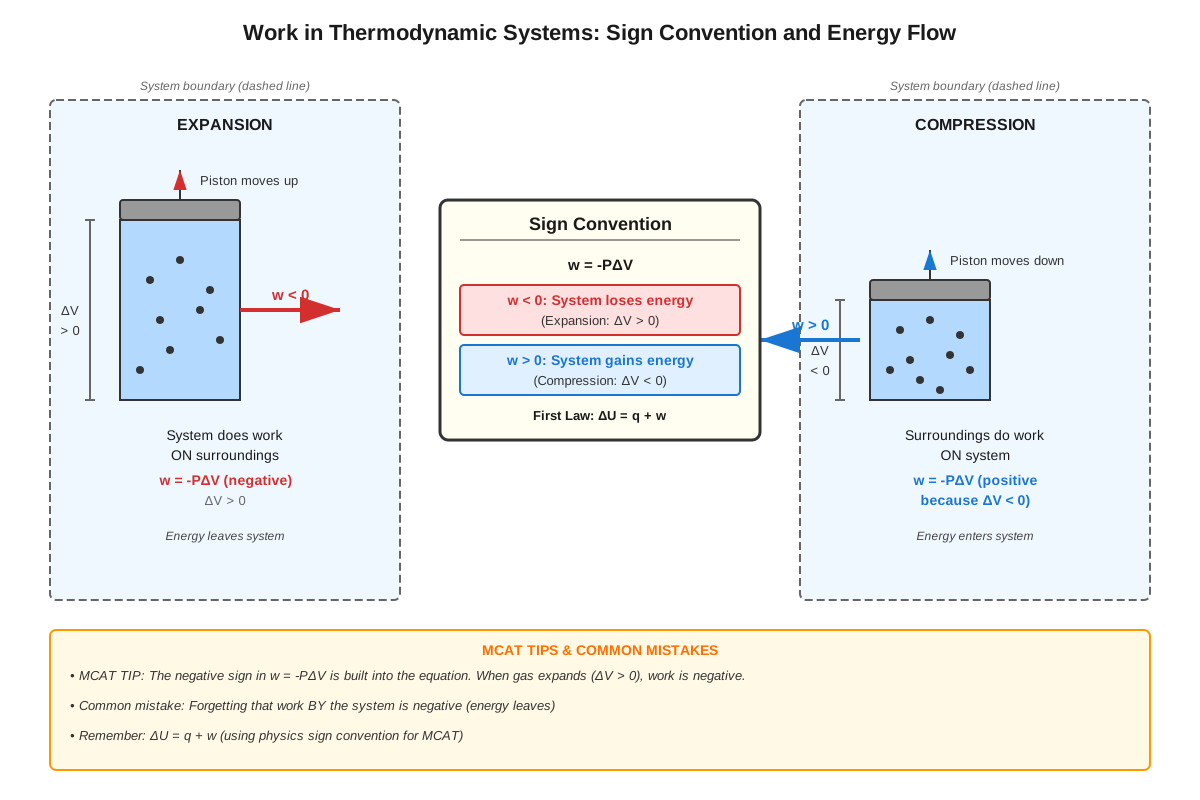
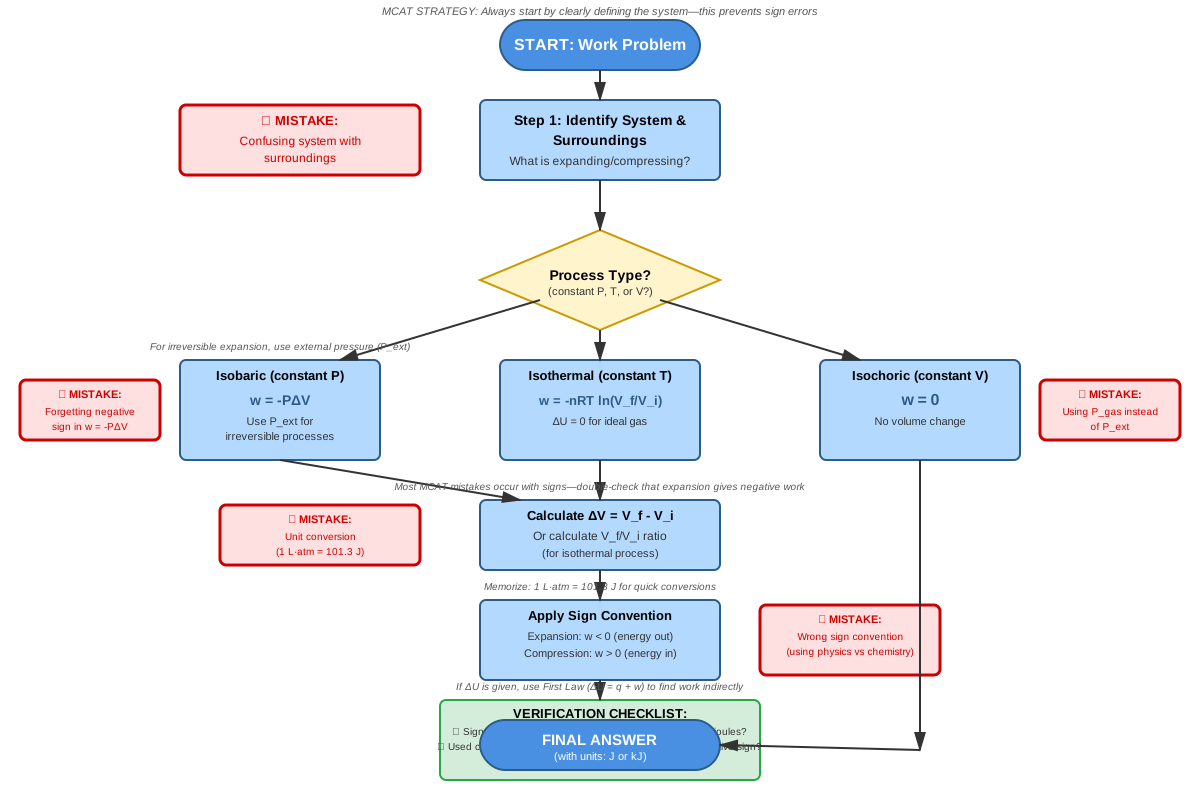
w = -P_ext × ΔVwhere P_ext is the external pressure opposing the expansion or compression, and ΔV represents the volume change (V_final - V_initial). The negative sign reflects the sign convention used in chemistry: work done by the system on the surroundings is negative (energy leaves the system), while work done on the system by the surroundings is positive (energy enters the system).
Sign Conventions and Energy Flow
Understanding sign conventions is crucial for MCAT success, as sign errors represent one of the most common mistakes students make. The chemistry sign convention (used on the MCAT) defines work from the system's perspective:
| Process | ΔV | Sign of w | Energy Flow |
|---|---|---|---|
| Expansion | Positive (V increases) | Negative | System does work; energy leaves |
| Compression | Negative (V decreases) | Positive | Surroundings do work; energy enters |
| Constant volume | Zero | Zero | No PV work occurs |
When a gas expands, it pushes against external pressure, performing work on the surroundings. This requires energy, which comes from the system's internal energy, making w negative. Conversely, when a gas is compressed, the surroundings perform work on the system, adding energy to it, making w positive.
Calculating Work for Different Processes
Constant External Pressure (Irreversible Expansion)
For processes occurring against constant external pressure, work calculation is straightforward:
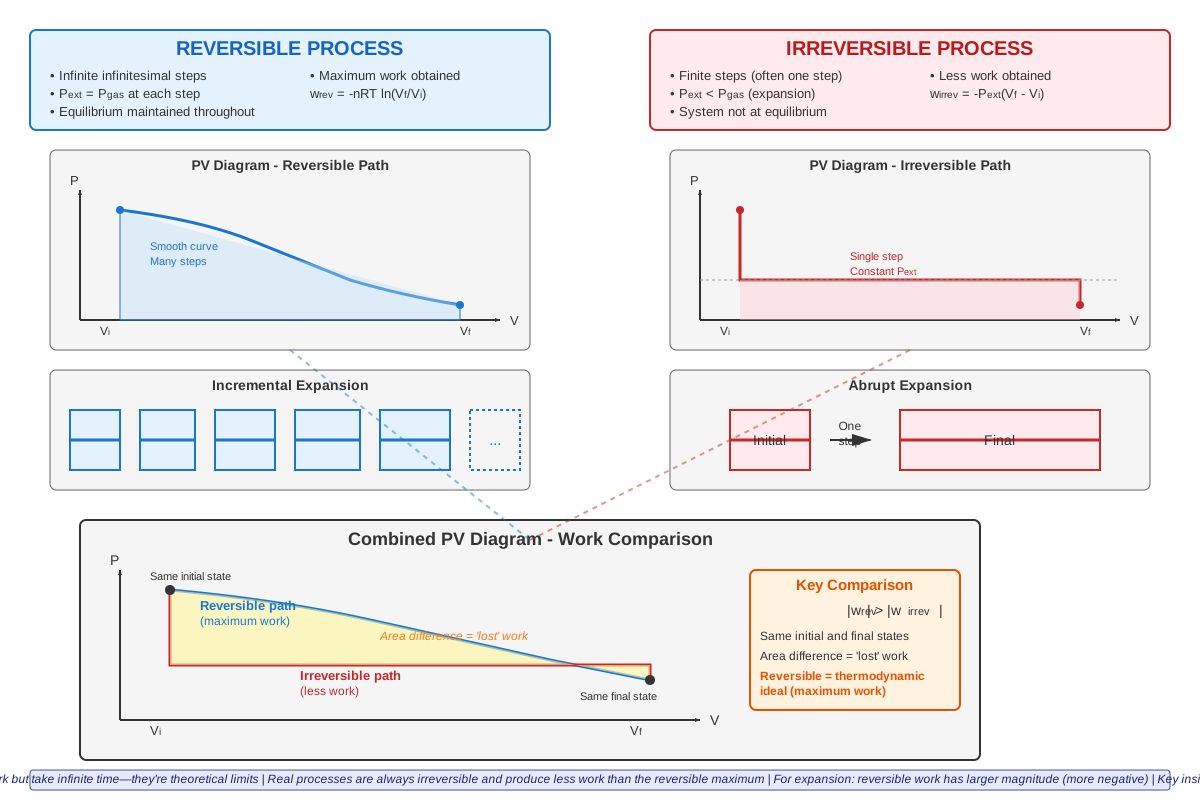
w = -P_ext × ΔV = -P_ext × (V_f - V_i)This applies to irreversible processes, which occur rapidly and do not maintain equilibrium throughout. Most real-world processes are irreversible. For example, if a gas expands from 2.0 L to 5.0 L against a constant external pressure of 1.0 atm:
w = -1.0 atm × (5.0 L - 2.0 L) = -3.0 L·atmConverting to joules (1 L·atm = 101.3 J):
w = -3.0 L·atm × 101.3 J/L·atm = -304 JReversible Expansion (Maximum Work)
Reversible processes occur infinitely slowly, maintaining equilibrium at every stage. The external pressure equals the internal pressure throughout, and the system performs maximum possible work. For an ideal gas undergoing isothermal (constant temperature) reversible expansion:
w = -nRT ln(V_f/V_i) = -nRT ln(P_i/P_f)where n is moles of gas, R is the gas constant (8.314 J/mol·K), and T is absolute temperature. Reversible processes represent theoretical ideals that provide upper bounds for work values.
Work at Constant Volume (Isochoric Process)
When volume remains constant (ΔV = 0), no pressure-volume work occurs:
w = 0This situation occurs in rigid containers or bomb calorimeters. Even though chemical reactions may occur and energy may transfer as heat, no mechanical work is performed.
Pressure-Volume Diagrams
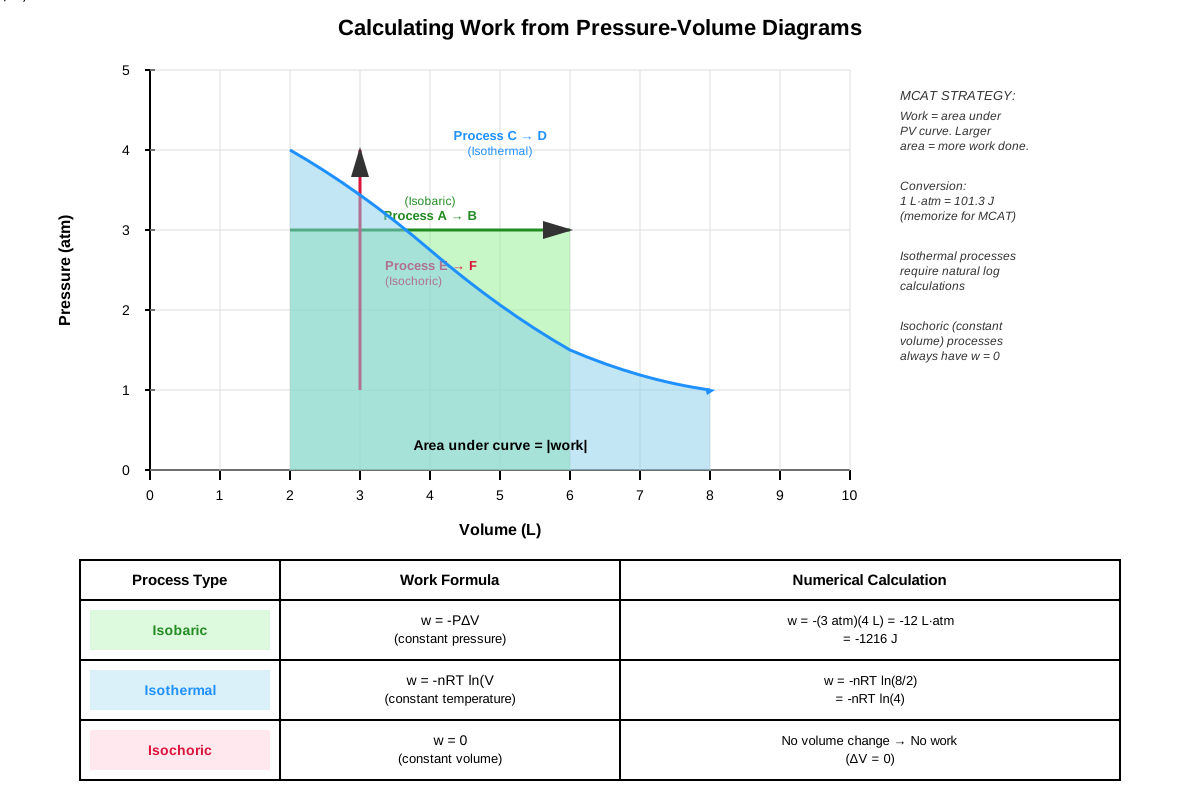
PV diagrams graphically represent thermodynamic processes, with pressure on the y-axis and volume on the x-axis. The area under the curve represents work magnitude:
w = -∫P_ext dVFor processes on PV diagrams:
- Expansion (rightward movement): System does work; w is negative
- Compression (leftward movement): Surroundings do work; w is positive
- Larger area under curve: Greater work magnitude
- Path-dependent: Different paths between the same initial and final states yield different work values
The path-dependence of work is crucial: work is a path function, not a state function. The amount of work depends on how a process occurs, not just the initial and final states.
Work and the First Law of Thermodynamics
Work integrates into the First Law of Thermodynamics, which expresses energy conservation:
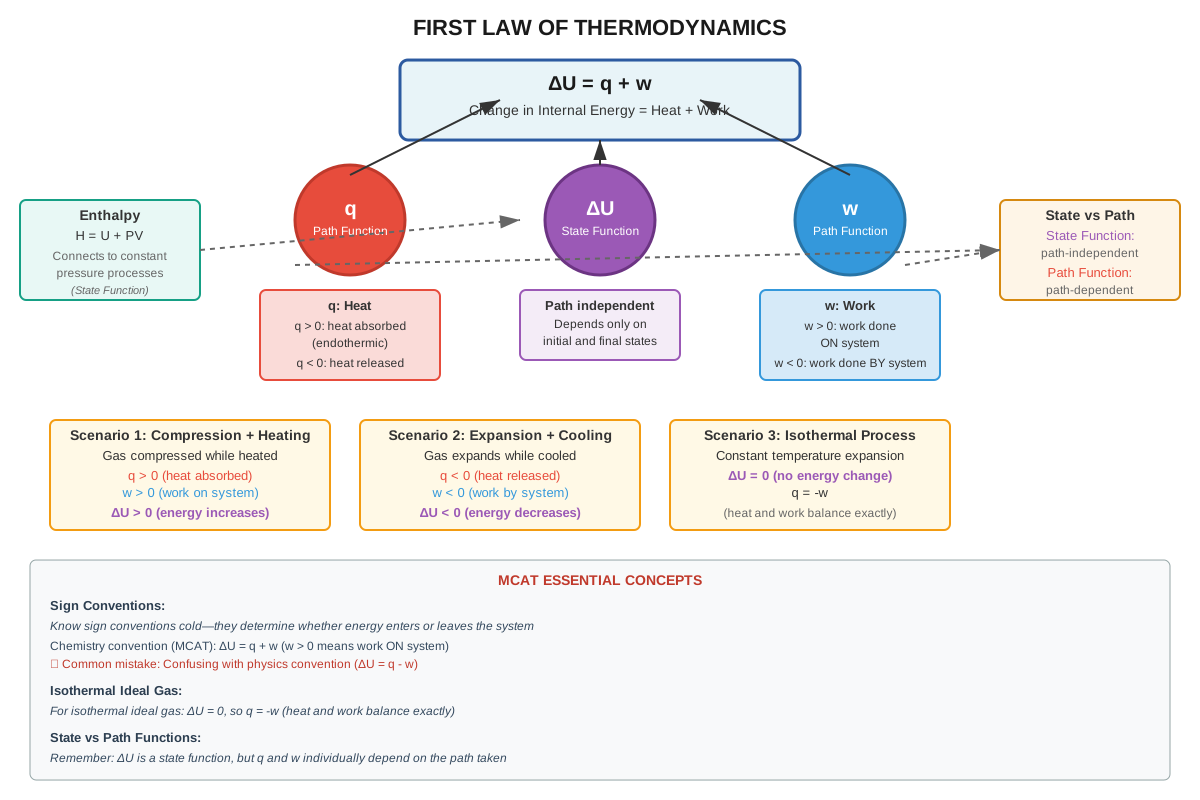
ΔU = q + wwhere ΔU is the change in internal energy (a state function), q is heat transferred, and w is work done. This equation shows that a system's internal energy changes through heat transfer and work. Rearranging:
ΔU = q - P_ext × ΔVThis form explicitly shows both energy transfer mechanisms. For processes at constant pressure (isobaric), this relationship connects to enthalpy:
ΔH = ΔU + PΔV = q_pwhere q_p represents heat at constant pressure.
Types of Work Beyond PV Work
While pressure-volume work dominates MCAT questions, other work types exist:
- Electrical work: w = -nFE (where n is moles of electrons, F is Faraday's constant, E is cell potential)
- Surface work: Changing surface area against surface tension
- Mechanical work: Direct force × displacement applications
For the MCAT, focus primarily on PV work, but recognize that work encompasses any organized energy transfer.
Concept Relationships
Work connects intimately with internal energy through the First Law of Thermodynamics: ΔU = q + w. This relationship shows that work and heat are equivalent mechanisms for changing a system's energy content. When a system performs work (w negative), its internal energy decreases unless compensated by heat input. Conversely, work done on a system (w positive) increases internal energy unless offset by heat loss.
The relationship between work and enthalpy emerges at constant pressure: ΔH = ΔU + PΔV. Since PΔV represents work at constant pressure, enthalpy changes incorporate both internal energy changes and work effects. This connection explains why enthalpy is particularly useful for chemical reactions occurring in open containers at atmospheric pressure—the natural laboratory condition.
Work links to entropy through reversible processes. Maximum work occurs during reversible processes, which also define entropy changes: ΔS = q_rev/T. The connection between maximum work and entropy underlies the concept of Gibbs free energy (ΔG = ΔH - TΔS), which represents the maximum non-PV work available from a process at constant temperature and pressure.
The ideal gas law (PV = nRT) provides the bridge between work and molecular behavior. Work calculations for gases require understanding how pressure, volume, and temperature interrelate. Isothermal expansions maintain constant temperature while pressure and volume change inversely, affecting work calculations through the logarithmic relationship.
Concept flow: Ideal Gas Law → Pressure-Volume relationships → Work calculations → First Law of Thermodynamics → Internal Energy changes → Enthalpy at constant pressure → Gibbs Free Energy and spontaneity
Quick check — test yourself on Work so far.
Try Flashcards →High-Yield Facts
⭐ Work done BY a system (expansion) is negative; work done ON a system (compression) is positive in the chemistry sign convention used on the MCAT
⭐ Work equals -P_ext × ΔV for constant external pressure processes, the most common calculation type on the MCAT
⭐ Work is a path function, not a state function—the amount of work depends on how a process occurs, not just initial and final states
⭐ The First Law of Thermodynamics states ΔU = q + w, connecting work to internal energy and heat
⭐ At constant volume, no PV work occurs (w = 0), even if chemical reactions proceed
- Reversible processes perform maximum work and occur infinitely slowly at equilibrium
- The area under a curve on a PV diagram represents work magnitude
- 1 L·atm = 101.3 J, the essential conversion factor for work problems
- For isothermal reversible expansion of an ideal gas: w = -nRT ln(V_f/V_i)
- Work and heat are equivalent forms of energy transfer but differ in organization: work is organized, heat is random
- In biological systems, ATP hydrolysis couples chemical energy to mechanical work
- Compression always requires energy input (positive work), regardless of the process details
Common Misconceptions
Misconception: Work is always negative.
Correction: Work can be positive or negative depending on direction. Expansion yields negative work (system does work), while compression yields positive work (surroundings do work on system). The sign indicates energy flow direction.
Misconception: Work and heat are different types of energy.
Correction: Work and heat are not types of energy but rather mechanisms of energy transfer. Both transfer energy between system and surroundings; energy in transit as work or heat becomes internal energy once transferred.
Misconception: Work is a state function like internal energy or enthalpy.
Correction: Work is a path function—its value depends on the process path, not just initial and final states. Two different paths between the same states yield different work values. Only state functions (U, H, S, G) are path-independent.
Misconception: The formula w = -PΔV uses the system's internal pressure.
Correction: The formula uses external pressure (P_ext), the pressure opposing expansion or causing compression. For irreversible processes, external and internal pressures differ. Only in reversible processes do they remain equal throughout.
Misconception: If ΔV is zero, no energy changes occur.
Correction: Zero volume change means no PV work (w = 0), but heat transfer can still occur, changing internal energy. In a rigid container, ΔU = q since w = 0. Chemical reactions at constant volume still involve energy changes.
Misconception: Larger volume changes always mean more work.
Correction: Work depends on both volume change AND external pressure (w = -P_ext × ΔV). A large volume change against minimal pressure produces less work than a small volume change against high pressure. Both factors matter equally.
Misconception: The negative sign in w = -PΔV is just a mathematical convention without physical meaning.
Correction: The negative sign has physical significance—it ensures energy conservation. When a gas expands (positive ΔV), it loses energy doing work, so w must be negative to correctly decrease internal energy in ΔU = q + w.
Worked Examples
Example 1: Gas Expansion Against Constant Pressure
Problem: A gas expands from 3.0 L to 8.0 L against a constant external pressure of 2.5 atm. Calculate the work done in joules. Is work done by or on the system?
Solution:
Step 1: Identify the given information
- V_i = 3.0 L
- V_f = 8.0 L
- P_ext = 2.5 atm
- Process occurs at constant external pressure (irreversible expansion)
Step 2: Calculate ΔV
ΔV = V_f - V_i = 8.0 L - 3.0 L = 5.0 LStep 3: Apply the work formula for constant pressure
w = -P_ext × ΔV = -2.5 atm × 5.0 L = -12.5 L·atmStep 4: Convert to joules using 1 L·atm = 101.3 J
w = -12.5 L·atm × 101.3 J/L·atm = -1266 J ≈ -1.3 kJStep 5: Interpret the sign
The negative sign indicates work is done BY the system ON the surroundings. The gas expanded, pushing against external pressure, requiring energy from the system.
Connection to learning objectives: This problem demonstrates applying work calculations to exam-style questions, using accurate terminology (system vs. surroundings), and correctly interpreting sign conventions—all critical MCAT skills.
Example 2: Integrating Work with the First Law
Problem: A gas undergoes compression from 10.0 L to 4.0 L against a constant external pressure of 3.0 atm. During this process, 450 J of heat is released to the surroundings. Calculate the change in internal energy of the gas.
Solution:
Step 1: Calculate work
ΔV = V_f - V_i = 4.0 L - 10.0 L = -6.0 Lw = -P_ext × ΔV = -3.0 atm × (-6.0 L) = +18.0 L·atmConvert to joules:
w = 18.0 L·atm × 101.3 J/L·atm = 1823 J ≈ 1.8 kJThe positive work indicates energy enters the system through compression.
Step 2: Determine heat value with correct sign
Heat is released TO the surroundings, meaning heat leaves the system:
q = -450 J = -0.45 kJStep 3: Apply the First Law of Thermodynamics
ΔU = q + w = -450 J + 1823 J = +1373 J ≈ +1.4 kJStep 4: Interpret the result
The positive ΔU indicates the system's internal energy increased by 1.4 kJ. Despite losing heat, the system gained more energy through compression work, resulting in net energy increase.
Connection to learning objectives: This problem connects work to related concepts (First Law, internal energy, heat), demonstrates proper sign convention application, and shows how work integrates into comprehensive thermodynamic analysis—exactly what MCAT passages require.
Exam Strategy
When approaching MCAT questions about work, first identify the process type: expansion or compression. This immediately tells you the work sign—expansion gives negative work, compression gives positive work. Many students lose points on sign errors alone, so make this your first step.
Trigger words to recognize:
- "Expands," "increases in volume" → negative work (system does work)
- "Compresses," "decreases in volume" → positive work (done on system)
- "Constant pressure" → use w = -P_ext × ΔV
- "Reversible" → maximum work; may need w = -nRT ln(V_f/V_i)
- "Rigid container," "constant volume" → w = 0
For passage-based questions, scan for PV diagrams immediately. If present, the question likely asks about work as the area under the curve. Remember that the area represents work magnitude; apply the sign based on direction (rightward = expansion = negative work).
When questions provide the First Law equation (ΔU = q + w), create a sign table before calculating:
| Variable | Value | Sign | Reasoning |
|---|---|---|---|
| q | Heat in (+) or out (-) | ||
| w | Compression (+) or expansion (-) | ||
| ΔU | Calculate from q + w |
For process-of-elimination, remember these principles:
- If volume increases, work CANNOT be positive (eliminates choices)
- If volume is constant, work MUST be zero (eliminates choices)
- Work magnitude cannot exceed energy available in the system
- Reversible work is always greater in magnitude than irreversible work between the same states
Time allocation: Straightforward work calculations should take 30-45 seconds. If a problem requires more than 90 seconds, you may be overcomplicating it—look for a conceptual shortcut or sign-based elimination strategy.
Memory Techniques
PAVE for work formula components:
- Pressure (external)
- And (multiplication)
- Volume change
- Equals work (with negative sign)
"Expansion = Exit": When gas expands, energy exits the system (negative work). Both words start with "Ex" to reinforce the connection.
Sign Convention Mnemonic - "COWS":
- Compression = On system = Work positive = System gains energy
First Law Triangle Visualization: Picture a triangle with ΔU at the top, q and w at the base corners. Energy flows into ΔU from both q and w. If either q or w is negative, that arrow points away from ΔU, decreasing internal energy.
PV Diagram Direction Rule:
- Right = Expansion = Negative work (both have "R")
- Left = Compression = Positive work (opposite of right)
Unit Conversion Memory: "Large Amount: 101" reminds you that 1 L·atm = 101.3 J (approximately 101, a "large amount" compared to 1).
Path Function vs. State Function: "Work takes different paths to the same destination" (path function), while "Your state of being depends only on where you are now, not how you got there" (state function).
Summary
Work represents organized energy transfer between a system and surroundings through mechanical means, most commonly as pressure-volume work in gas systems. The fundamental relationship w = -P_ext × ΔV governs constant-pressure processes, with the negative sign ensuring proper energy accounting: expansion (positive ΔV) yields negative work as the system expends energy, while compression (negative ΔV) yields positive work as energy enters the system. Work integrates with heat through the First Law of Thermodynamics (ΔU = q + w), making it essential for understanding energy conservation in chemical and physical processes. Unlike state functions such as internal energy and enthalpy, work is path-dependent—different processes between identical initial and final states produce different work values. For MCAT success, students must master sign conventions, recognize process types from descriptive language, perform accurate calculations with proper unit conversions (1 L·atm = 101.3 J), and integrate work concepts with broader thermodynamic principles including internal energy, enthalpy, and the First Law.
Key Takeaways
- Work is energy transfer through organized mechanical means; w = -P_ext × ΔV for constant pressure processes
- Sign convention: expansion gives negative work (energy leaves system), compression gives positive work (energy enters system)
- Work is a path function, not a state function—the process path determines work magnitude
- The First Law of Thermodynamics (ΔU = q + w) connects work to internal energy and heat transfer
- At constant volume, no PV work occurs (w = 0), even during chemical reactions
- PV diagrams show work as the area under the process curve; direction indicates sign
- Master unit conversion: 1 L·atm = 101.3 J for all MCAT work calculations
Related Topics
Internal Energy and the First Law of Thermodynamics: Understanding how work combines with heat to change a system's total energy; essential for comprehensive thermodynamic analysis and directly builds on work concepts.
Enthalpy and Thermochemistry: Enthalpy incorporates PV work at constant pressure (ΔH = ΔU + PΔV), making work understanding crucial for reaction energetics and calorimetry problems.
Entropy and the Second Law: Reversible processes that perform maximum work connect to entropy definitions and spontaneity predictions, bridging work to broader thermodynamic principles.
Gibbs Free Energy: ΔG represents maximum non-PV work available from a process, directly extending work concepts to predict reaction spontaneity and equilibrium.
Ideal Gas Law Applications: Gas behavior under various conditions determines work calculations, particularly for isothermal and adiabatic processes requiring integrated approaches.
Practice CTA
Now that you've mastered the fundamentals of work in thermodynamics, it's time to solidify your understanding through active practice. Attempt the practice questions to test your ability to apply sign conventions, perform calculations accurately, and integrate work with the First Law of Thermodynamics. Use the flashcards to reinforce high-yield facts and relationships, ensuring rapid recall during timed exam conditions. Remember: understanding work isn't just about memorizing formulas—it's about developing the conceptual framework to tackle any thermodynamics problem the MCAT presents. Your investment in mastering this foundational topic will pay dividends across multiple General Chemistry and physics questions. You've got this!
Sign up free to keep reading
Create a free AnvayaPrep account to finish this MCAT guide on Work — plus flashcards and practice questions.