Overview
Voltage is one of the foundational concepts in Electricity and Magnetism and represents a critical component of Physics tested on the MCAT. At its core, voltage describes the electric potential difference between two points in an electric field, quantifying the work required to move a charge from one location to another. Understanding voltage is essential not only for solving circuit problems but also for grasping how electrical signals propagate through biological systems, including nerve impulses and cardiac conduction. The MCAT frequently tests voltage in the context of circuits, capacitors, and electrochemical cells, making it a medium-yield topic that appears in both passage-based and discrete questions.
The concept of voltage bridges multiple areas of physics, connecting electrostatics, energy conservation, and circuit analysis. When students master voltage, they gain the ability to analyze complex electrical systems by understanding how energy is distributed and transformed. This understanding extends beyond simple circuit problems to applications in medical devices, cellular physiology, and diagnostic equipment. The MCAT expects students to not only calculate voltage values but also to reason qualitatively about how voltage changes affect system behavior.
For MCAT Physics, voltage serves as a gateway concept that links electric fields, electric potential energy, current, resistance, and power. A solid grasp of voltage enables students to tackle questions involving Kirchhoff's laws, capacitor charging and discharging, and the electrochemical gradients that drive biological processes. This topic typically appears in 2-4 questions per MCAT exam, either directly or as part of more complex scenarios involving circuits or biological membranes.
Learning Objectives
- [ ] Define Voltage using accurate Physics terminology
- [ ] Explain why Voltage matters for the MCAT
- [ ] Apply Voltage to exam-style questions
- [ ] Identify common mistakes related to Voltage
- [ ] Connect Voltage to related Physics concepts
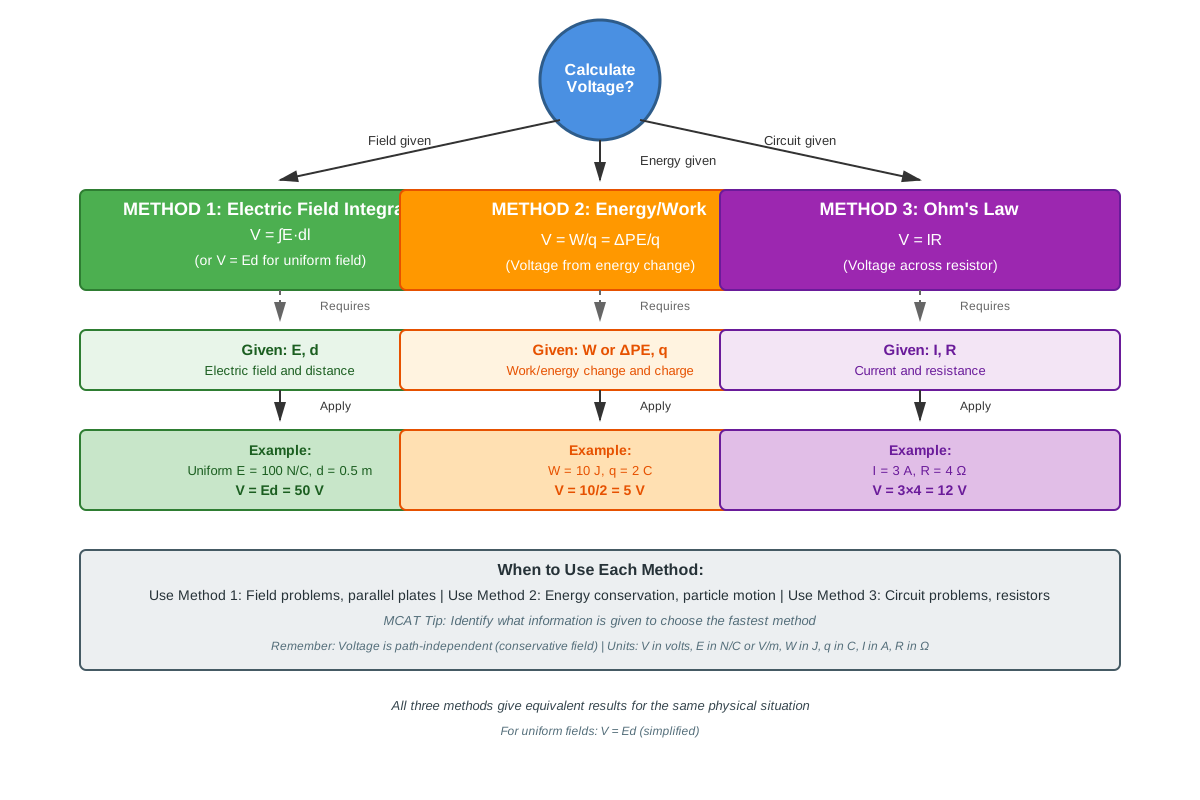
- [ ] Calculate voltage differences using multiple methods (electric field integration, energy considerations, Ohm's law)
- [ ] Analyze voltage distribution in series and parallel circuits
- [ ] Interpret voltage in biological contexts, including membrane potentials and action potentials
Prerequisites
- Electric charge and Coulomb's law: Understanding charge interactions provides the foundation for electric potential energy, which directly relates to voltage
- Electric fields: Voltage represents the work done moving charges through electric fields, making field concepts essential
- Work and energy: Voltage is fundamentally an energy concept (energy per unit charge), requiring solid mechanics foundations
- Basic algebra and calculus: Calculating voltage often involves manipulating equations and understanding relationships between variables
- SI units and dimensional analysis: Voltage is measured in volts (joules per coulomb), requiring unit fluency
Why This Topic Matters
Clinical and Real-World Significance
Voltage is ubiquitous in medical practice and biological systems. The human nervous system operates through voltage changes across cell membranes, with action potentials representing rapid voltage fluctuations that propagate signals. Electrocardiograms (ECGs) measure voltage differences on the body surface to diagnose cardiac conditions. Defibrillators apply high voltage to reset abnormal heart rhythms. Understanding voltage is essential for comprehending how pacemakers function, how electrolyte imbalances affect cellular function, and how electrical burns damage tissue. Medical imaging techniques like electroencephalography (EEG) rely on detecting minute voltage changes in the brain.
Exam Statistics and Question Types
Voltage appears in approximately 10-15% of MCAT Physics questions, making it a medium-yield topic with consistent representation across exam administrations. Questions typically fall into three categories: (1) quantitative circuit analysis requiring voltage calculations using Ohm's law or Kirchhoff's voltage law, (2) conceptual questions about voltage distribution in circuits or across capacitors, and (3) passage-based questions connecting voltage to biological systems like neurons or electrochemical cells. The MCAT often embeds voltage concepts within longer passages about medical devices, cellular physiology, or experimental apparatus.
Common Exam Appearances
Voltage frequently appears in passages describing experimental setups with batteries and resistors, biological membranes with ion gradients, or medical devices like pacemakers. Discrete questions may ask students to calculate voltage drops across resistors, determine the voltage across a charged capacitor, or compare voltages at different points in a circuit. The MCAT particularly favors questions that require students to apply Kirchhoff's voltage law or to reason about how voltage changes when circuit components are modified. Biological passages may present voltage in the context of resting membrane potential or the Nernst equation.
Core Concepts
Definition and Fundamental Nature of Voltage
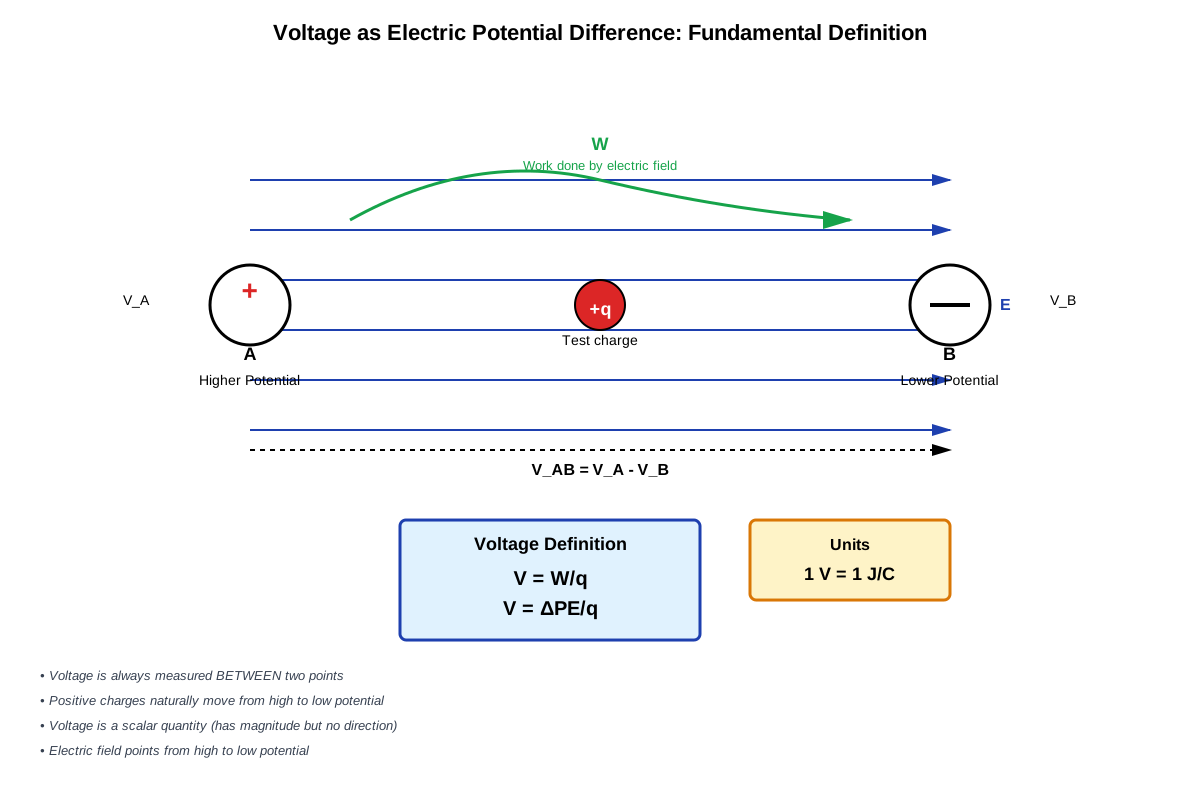
Voltage, also called electric potential difference, is defined as the work done per unit charge to move a test charge between two points in an electric field. Mathematically, voltage (V) is expressed as:
V = ΔPE/q = W/qwhere ΔPE is the change in electric potential energy, W is the work done, and q is the charge. The SI unit of voltage is the volt (V), which equals one joule per coulomb (1 V = 1 J/C). This definition reveals that voltage is fundamentally an energy concept—it quantifies how much energy each unit of charge gains or loses when moving between two points.
Voltage is a scalar quantity, meaning it has magnitude but no direction, though we conventionally speak of voltage "across" a component or "between" two points. The sign of voltage indicates whether a positive charge would gain or lose potential energy: a positive voltage difference means a positive charge moving in that direction loses potential energy (and gains kinetic energy), while a negative voltage difference means it gains potential energy.
Voltage and Electric Fields
Voltage relates intimately to electric fields through the relationship:
V = -∫E·dlThis equation states that voltage equals the negative line integral of the electric field along a path. For a uniform electric field, this simplifies to:
V = Edwhere E is the electric field strength and d is the distance moved in the direction of the field. This relationship shows that voltage represents the "push" an electric field exerts on charges over a distance. A stronger field or greater distance results in a larger voltage difference.
In practical terms, this means that anywhere an electric field exists, there must be an associated voltage difference. Conversely, if a voltage difference exists between two points, an electric field must exist in the region between them. This bidirectional relationship is crucial for understanding both electrostatics and circuits.
Voltage in Circuits
In electrical circuits, voltage takes on specific meanings depending on context. A voltage source (like a battery) maintains a constant potential difference between its terminals, providing energy to charges flowing through the circuit. The terminal voltage of a battery may differ from its electromotive force (EMF) due to internal resistance.
Ohm's law provides the fundamental relationship between voltage, current, and resistance:
V = IRwhere V is voltage, I is current, and R is resistance. This equation allows calculation of the voltage drop across any resistive element when current flows through it. The voltage "drop" terminology reflects that charges lose potential energy as they move through a resistor, with that energy converted to heat.
Kirchhoff's Voltage Law
Kirchhoff's voltage law (KVL) states that the sum of all voltage changes around any closed loop in a circuit equals zero:
ΣV = 0This law reflects energy conservation: a charge that travels around a complete loop must return to its starting potential. Voltage increases (from batteries or other sources) must equal voltage decreases (across resistors or other loads). KVL is essential for analyzing complex circuits with multiple loops and components.
Voltage Distribution in Series and Parallel Circuits
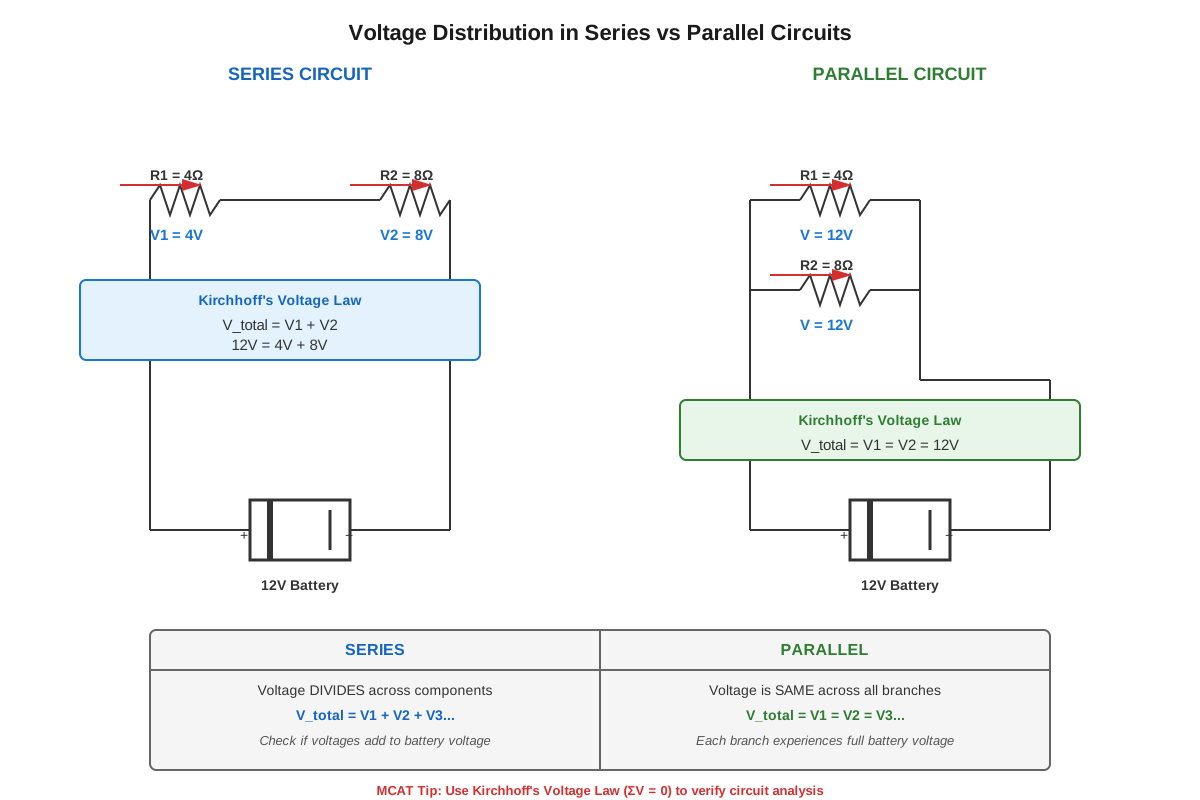
The way voltage distributes across circuit components depends critically on their configuration:
| Configuration | Voltage Behavior | Key Relationship |
|---|---|---|
| Series | Voltage divides among components | V_total = V₁ + V₂ + V₃ + ... |
| Parallel | Voltage is identical across all components | V₁ = V₂ = V₃ = V_total |
In series circuits, the total voltage supplied by the source divides among the components proportionally to their resistance. Components with higher resistance receive a larger share of the total voltage. In parallel circuits, all components experience the full source voltage, which is why household electrical outlets provide the same voltage to all connected devices.
Voltage and Capacitors
For capacitors, voltage relates to stored charge through:
Q = CVwhere Q is charge, C is capacitance, and V is voltage. The voltage across a capacitor represents the electric field between its plates. As a capacitor charges, voltage increases linearly with stored charge. The energy stored in a capacitor depends on voltage:
U = (1/2)CV²This quadratic relationship means that doubling the voltage across a capacitor quadruples the stored energy, making voltage a critical parameter in capacitor applications.
Voltage in Biological Systems
Biological membranes maintain voltage differences called membrane potentials. The typical resting membrane potential of a neuron is approximately -70 mV (inside negative relative to outside). This voltage arises from unequal ion distributions maintained by active transport pumps and selective membrane permeability. The Nernst equation calculates the equilibrium potential for a specific ion:
E = (RT/zF) ln([ion]_outside/[ion]_inside)where R is the gas constant, T is temperature, z is ion valence, and F is Faraday's constant. Action potentials represent rapid voltage changes (depolarization and repolarization) that propagate along nerve and muscle cells, enabling neural communication and muscle contraction.
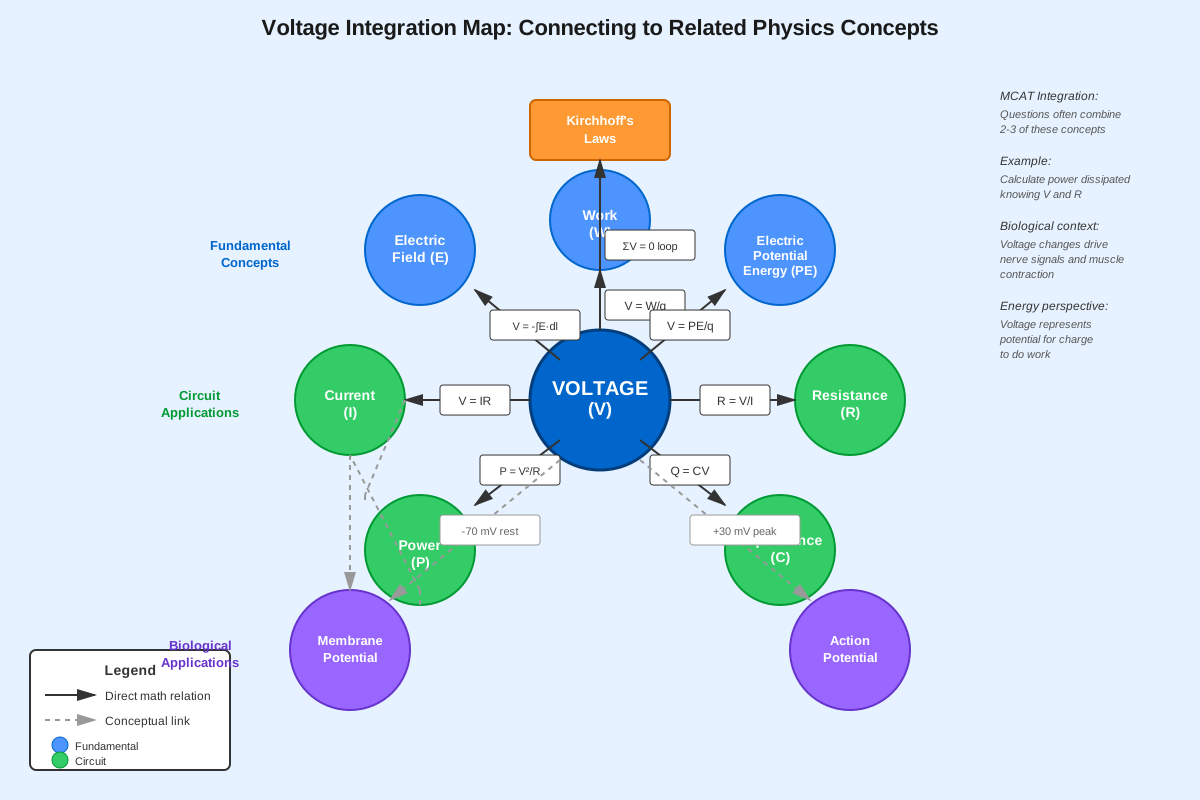
Concept Relationships
Voltage serves as a central hub connecting multiple physics concepts. Electric fields generate voltage differences, while voltage differences create electric fields—this bidirectional relationship means understanding one requires understanding the other. Electric potential energy relates to voltage through the charge: PE = qV, showing that voltage represents potential energy per unit charge.
Current flows in response to voltage differences, with Ohm's law (V = IR) linking these quantities through resistance. Power dissipation in circuits depends on voltage: P = IV = V²/R = I²R, connecting voltage to energy transfer rates. Capacitance relates stored charge to voltage (Q = CV), making voltage essential for understanding capacitor behavior.
The relationship map flows as follows: Electric fields → Voltage → Current → Power, with resistance modulating the voltage-current relationship and capacitance modulating the voltage-charge relationship. In biological contexts, voltage connects to osmosis and diffusion through electrochemical gradients, where both concentration differences and voltage differences drive ion movement.
Energy conservation principles underlie voltage behavior, with Kirchhoff's voltage law representing energy conservation in circuits. The work-energy theorem from mechanics translates to voltage in electrical contexts, with voltage representing work per unit charge rather than work per unit mass.
Quick check — test yourself on Voltage so far.
Try Flashcards →High-Yield Facts
⭐ Voltage is defined as electric potential energy per unit charge (V = PE/q) and is measured in volts (1 V = 1 J/C)
⭐ In series circuits, voltages add (V_total = V₁ + V₂ + ...), while in parallel circuits, voltage is the same across all branches
⭐ Kirchhoff's voltage law states that the sum of voltage changes around any closed loop equals zero (ΣV = 0)
⭐ Ohm's law (V = IR) relates voltage, current, and resistance for resistive elements
⭐ The voltage across a capacitor relates to stored charge by Q = CV, and stored energy by U = (1/2)CV²
- Voltage is a scalar quantity but is always measured between two points (potential difference)
- A uniform electric field creates a voltage difference V = Ed, where d is the distance in the field direction
- The terminal voltage of a real battery is less than its EMF due to internal resistance: V = EMF - Ir
- Resting membrane potential in neurons is approximately -70 mV (inside negative)
- Voltage sources (batteries) maintain constant potential difference; current sources maintain constant current
- The voltage across an ideal wire (zero resistance) is zero, regardless of current
- Voltmeters measure voltage and must be connected in parallel with the component being measured
- Doubling the voltage across a resistor doubles the current (if resistance is constant) and quadruples the power dissipation
Common Misconceptions
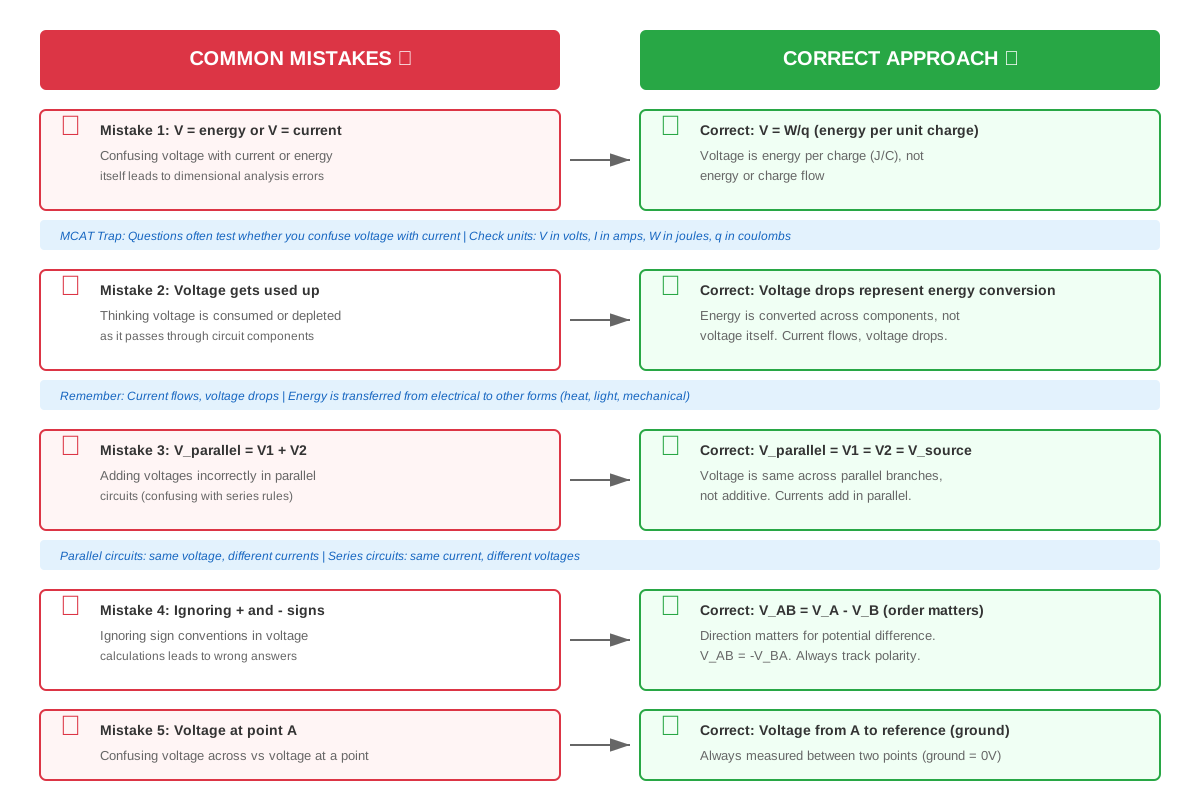
Misconception: Voltage flows through a circuit like water through a pipe → Correction: Current (charge per unit time) flows through circuits; voltage is the potential difference that drives current flow. Voltage doesn't "flow"—it exists as a difference between two points.
Misconception: Voltage is used up as current passes through a resistor → Correction: Voltage represents energy per unit charge. When current passes through a resistor, each charge loses potential energy (voltage drops), but the charges themselves continue flowing. The voltage difference drives continuous current flow.
Misconception: A battery provides constant current to a circuit → Correction: An ideal battery provides constant voltage (potential difference) between its terminals. The current that flows depends on the total resistance of the circuit according to Ohm's law (I = V/R).
Misconception: Higher voltage always means more danger → Correction: While higher voltage can drive more current through a given resistance, the danger depends on both voltage and current. A high-voltage source with very high internal resistance (like static electricity) may deliver minimal current and be relatively safe, while lower voltage with low resistance can be lethal.
Misconception: Voltage across parallel resistors divides like in series circuits → Correction: In parallel configurations, voltage is identical across all branches. Current divides inversely proportional to resistance, but voltage remains constant across parallel elements.
Misconception: The voltage at a single point in a circuit has absolute meaning → Correction: Voltage is always a potential difference between two points. When we speak of "the voltage at point A," we implicitly mean the voltage difference between point A and a reference point (usually ground or the negative terminal).
Misconception: Capacitors block all current flow → Correction: Capacitors block steady-state DC current but allow current flow during charging and discharging. AC current can effectively "pass through" capacitors because the voltage continuously changes, causing continuous charging and discharging.
Worked Examples
Example 1: Series Circuit Voltage Distribution
Problem: A 12 V battery is connected to three resistors in series: R₁ = 2 Ω, R₂ = 4 Ω, and R₃ = 6 Ω. Calculate the voltage drop across each resistor.
Solution:
Step 1: Calculate total resistance in series
R_total = R₁ + R₂ + R₃ = 2 + 4 + 6 = 12 ΩStep 2: Calculate total current using Ohm's law
I = V_total/R_total = 12 V / 12 Ω = 1 AStep 3: Calculate voltage drop across each resistor using V = IR
V₁ = IR₁ = (1 A)(2 Ω) = 2 V
V₂ = IR₂ = (1 A)(4 Ω) = 4 V
V₃ = IR₃ = (1 A)(6 Ω) = 6 V
Step 4: Verify using Kirchhoff's voltage law
V_total = V₁ + V₂ + V₃ = 2 + 4 + 6 = 12 V ✓Key insight: In series circuits, voltage divides proportionally to resistance. The resistor with the highest resistance (R₃) has the largest voltage drop. This connects to Learning Objective 3 (applying voltage to exam-style questions) and demonstrates the practical application of Ohm's law and KVL.
Example 2: Capacitor Charging and Voltage
Problem: A 10 μF capacitor is connected to a 9 V battery until fully charged, then disconnected and connected to a 5 μF capacitor (initially uncharged). What is the final voltage across each capacitor?
Solution:
Step 1: Calculate initial charge on the 10 μF capacitor
Q_initial = C₁V_initial = (10 × 10⁻⁶ F)(9 V) = 90 × 10⁻⁶ C = 90 μCStep 2: Recognize that when capacitors are connected in parallel, charge redistributes but total charge is conserved
Q_total = Q_initial = 90 μCStep 3: When connected, both capacitors will have the same final voltage (parallel configuration)
Q_total = Q₁ + Q₂ = C₁V_f + C₂V_f = (C₁ + C₂)V_fStep 4: Solve for final voltage
V_f = Q_total/(C₁ + C₂) = 90 μC/(10 μF + 5 μF) = 90 μC/15 μF = 6 VStep 5: Verify by calculating final charges
Q₁_final = C₁V_f = (10 μF)(6 V) = 60 μC
Q₂_final = C₂V_f = (5 μF)(6 V) = 30 μC
Q₁_final + Q₂_final = 60 + 30 = 90 μC ✓
Key insight: When capacitors share charge, voltage equalizes while total charge is conserved. The final voltage (6 V) is less than the initial voltage (9 V) because the same charge is now distributed over a larger total capacitance. This problem demonstrates the relationship between charge, capacitance, and voltage (Q = CV) and connects to biological applications where membrane capacitance affects voltage changes during action potentials.
Exam Strategy
Approaching MCAT Voltage Questions
When encountering voltage questions on the MCAT, first identify whether the question involves circuits, capacitors, or biological systems. For circuit problems, immediately sketch the circuit diagram if not provided, labeling all known values and the quantity being sought. Determine whether components are in series (same current) or parallel (same voltage)—this distinction is crucial for selecting the correct approach.
Trigger Words and Phrases
Watch for these key phrases that signal voltage concepts:
- "Potential difference" = voltage
- "Across the component" = voltage measurement
- "Terminal voltage" = voltage accounting for internal resistance
- "EMF" or "electromotive force" = ideal voltage source
- "Voltage drop" = decrease in potential, typically across resistors
- "Membrane potential" = voltage across biological membrane
- "Depolarization" = voltage becoming less negative (or more positive)
Process of Elimination Tips
For conceptual questions about voltage distribution, eliminate answers that violate fundamental principles:
- Any answer suggesting voltage "flows" or is "used up" is incorrect
- For parallel circuits, eliminate answers showing different voltages across branches
- For series circuits, eliminate answers showing voltages that don't sum to the source voltage
- If a question asks about voltage and provides only resistance values without current or power, you likely need to use ratios rather than absolute calculations
Time Allocation
Straightforward voltage calculations using Ohm's law or voltage division should take 30-45 seconds. Complex circuit analysis requiring Kirchhoff's laws may require 90-120 seconds. For passage-based questions, spend 15-20 seconds identifying the relevant voltage concept before attempting calculations. If a problem requires extensive algebra, check whether the question asks for a ratio or qualitative comparison rather than an absolute value—this can save significant time.
Memory Techniques
Voltage Mnemonics
"VIR" (pronounced "veer"): Remember Ohm's law as V = IR by thinking "VIR" (Voltage = Current × Resistance)
"Series Splits, Parallel Parallels": In series circuits, voltage splits (divides) among components; in parallel circuits, voltage is the same (parallel) across all branches
"Energy Per Charge": Remember voltage definition by thinking "Voltage = Energy Per Charge" (VEPC)
Visualization Strategy
Visualize voltage as the "height" in an electrical landscape. Just as gravitational potential energy depends on height, electric potential energy depends on voltage. A battery is like a pump that lifts charges to a higher "elevation" (higher voltage). As charges flow through resistors, they "fall" to lower elevations (voltage drops), converting potential energy to heat. This analogy helps understand why charges naturally flow from high to low voltage and why voltage differences drive current.
Kirchhoff's Voltage Law Memory Aid
"Loop-de-Loop Returns to Zero": Imagine tracing a loop in a circuit—you must return to your starting voltage, so all voltage changes must sum to zero. Think of hiking a trail loop: if you end where you started, your net elevation change is zero.
Series vs. Parallel Acronym
SVIP: Series Voltage Is Partitioned (divided), while Parallel Voltage Is Same (PVIS)
Summary
Voltage represents the electric potential difference between two points, quantifying the work done per unit charge to move charges through an electric field. Defined as V = W/q and measured in volts (joules per coulomb), voltage is fundamentally an energy concept that drives current flow in circuits and underlies electrical phenomena in biological systems. The MCAT tests voltage through circuit analysis problems requiring application of Ohm's law (V = IR) and Kirchhoff's voltage law (ΣV = 0), as well as through biological contexts involving membrane potentials and action potentials. Understanding voltage distribution in series circuits (voltages add) versus parallel circuits (voltages are equal) is essential for solving circuit problems efficiently. Voltage relates intimately to electric fields (V = Ed for uniform fields), capacitance (Q = CV), and power (P = IV), making it a central concept connecting multiple areas of physics. For MCAT success, students must be able to calculate voltage differences, analyze voltage distribution in circuits, and apply voltage concepts to biological systems like neurons and electrochemical cells.
Key Takeaways
- Voltage is electric potential energy per unit charge (V = PE/q), measured in volts (1 V = 1 J/C)
- In series circuits, voltages add across components; in parallel circuits, voltage is identical across all branches
- Ohm's law (V = IR) and Kirchhoff's voltage law (ΣV = 0) are essential tools for circuit analysis
- Voltage drives current flow from high to low potential, with the relationship modulated by resistance
- Biological membranes maintain voltage differences (membrane potentials) that enable neural signaling and cellular function
- Voltage is always measured between two points—it represents a difference, not an absolute value
- The relationship Q = CV connects voltage to charge storage in capacitors, with energy U = (1/2)CV²
Related Topics
Electric Current and Resistance: Understanding how voltage drives current flow and how resistance opposes that flow builds directly on voltage concepts, enabling analysis of complete circuits.
Capacitors and Dielectrics: Voltage across capacitors determines stored charge and energy, making voltage mastery essential for understanding capacitor behavior in circuits and biological membranes.
Kirchhoff's Laws and Circuit Analysis: Kirchhoff's voltage law extends voltage concepts to complex multi-loop circuits, enabling systematic analysis of any circuit configuration.
Electric Power: Power dissipation and transfer in circuits depends critically on voltage through relationships like P = IV and P = V²/R.
Electrochemistry and Galvanic Cells: Voltage in electrochemical cells (cell potential) drives redox reactions and relates to thermodynamic favorability through the Nernst equation.
Neurophysiology and Action Potentials: Voltage changes across neural membranes underlie all nervous system function, connecting physics to biology and medicine.
Practice CTA
Now that you've mastered the fundamentals of voltage, it's time to solidify your understanding through active practice. Attempt the practice questions and flashcards associated with this topic to test your ability to apply these concepts under exam conditions. Focus particularly on distinguishing series from parallel voltage behavior and on connecting voltage to biological systems—these are high-yield areas where practice yields significant score improvements. Remember, understanding voltage opens the door to mastering circuits, capacitors, and neurophysiology. Your investment in this foundational topic will pay dividends across multiple MCAT Physics questions. You've got this!
Sign up free to keep reading
Create a free AnvayaPrep account to finish this MCAT guide on Voltage — plus flashcards and practice questions.