Overview
Density is a fundamental physical property that describes how much mass is contained within a given volume of a substance. In the context of Physics and Fluids, density serves as a critical bridge between the macroscopic properties of matter and their behavior in various physical situations. Understanding Density Physics is essential for predicting how objects will behave when submerged in fluids, how fluids will stratify based on their composition, and how pressure varies with depth in fluid columns.
For the MCAT, density represents one of the highest-yield topics within the Fluids unit. Questions involving density appear frequently across both passage-based and discrete questions, often integrated with concepts such as buoyancy, pressure, specific gravity, and fluid dynamics. The MCAT tests not only the ability to calculate density values but also the capacity to reason qualitatively about how density differences drive physical phenomena in biological systems—from blood cell sedimentation to respiratory gas exchange to the function of swim bladders in fish.
Density MCAT questions typically require students to integrate multiple concepts simultaneously. A single passage might require understanding how density relates to buoyant forces, how temperature affects density, and how density gradients create pressure differentials. Mastery of density provides the foundation for understanding Archimedes' principle, Pascal's principle, and Bernoulli's equation—all of which are testable MCAT concepts. Additionally, density calculations frequently appear in dimensional analysis problems, making this topic essential for both the Chemical and Physical Foundations of Biological Systems section and occasionally in biochemistry contexts involving solution concentrations.
Learning Objectives
- [ ] Define Density using accurate Physics terminology
- [ ] Explain why Density matters for the MCAT
- [ ] Apply Density to exam-style questions
- [ ] Identify common mistakes related to Density
- [ ] Connect Density to related Physics concepts
- [ ] Calculate density from mass and volume measurements with appropriate unit conversions
- [ ] Predict the relative behavior of objects in fluids based on density comparisons
- [ ] Analyze how temperature and pressure changes affect the density of substances
Prerequisites
- Basic algebra and unit conversions: Essential for manipulating the density equation and converting between metric units (g/cm³, kg/m³, g/mL)
- Understanding of mass and volume: Density is defined as the ratio of these two fundamental properties
- States of matter: Necessary to understand why solids, liquids, and gases have characteristically different density ranges
- Temperature effects on matter: Provides context for understanding thermal expansion and its effect on density
Why This Topic Matters
Clinical and Real-World Significance
Density plays a crucial role in numerous physiological and medical contexts that appear on the MCAT. Centrifugation separates blood components based on density differences—red blood cells settle at the bottom, white blood cells and platelets form the buffy coat, and plasma remains on top. Lipoproteins are classified by density (VLDL, LDL, HDL), with important implications for cardiovascular health. Pulmonary function depends on the density of respiratory gases, affecting diffusion rates and the work of breathing. Bone density measurements diagnose osteoporosis, while urine specific gravity (a density-related measurement) helps assess hydration status and kidney function.
Exam Statistics and Question Types
Density appears in approximately 15-20% of MCAT Physics passages related to fluids, making it one of the most frequently tested topics in this unit. Questions typically fall into several categories:
- Direct calculation problems: Given two of three variables (mass, volume, density), calculate the third
- Buoyancy predictions: Determine whether objects will float or sink based on density comparisons
- Experimental analysis: Interpret data from experiments measuring density or using density-based separation techniques
- Integrated problems: Combine density with pressure calculations, particularly in fluid columns
Common Passage Contexts
MCAT passages frequently present density in the following contexts:
- Biological separations: Ultracentrifugation, density gradient centrifugation, or chromatography
- Cardiovascular physiology: Blood viscosity, atherosclerotic plaque composition, or contrast agents in medical imaging
- Respiratory physiology: Gas density effects on breathing mechanics or diving physiology
- Experimental techniques: Measuring protein concentrations, cell counting, or material characterization
Core Concepts
Definition and Mathematical Formulation
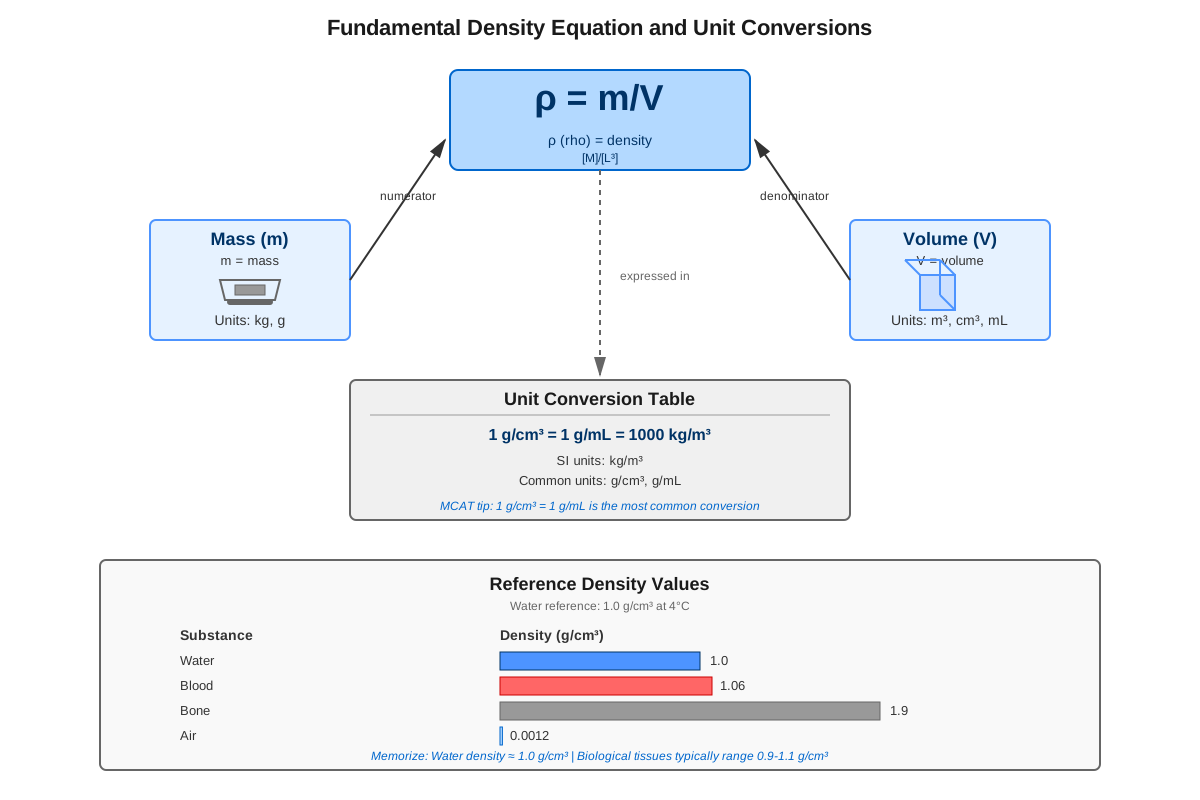
Density (symbol: ρ, Greek letter "rho") is defined as mass per unit volume. The fundamental equation is:
ρ = m/VWhere:
- ρ = density (typically in kg/m³ or g/cm³)
- m = mass (in kg or g)
- V = volume (in m³ or cm³)
This equation can be algebraically rearranged to solve for any variable:
- m = ρV (mass equals density times volume)
- V = m/ρ (volume equals mass divided by density)
Density is an intensive property, meaning it does not depend on the amount of substance present. A drop of water has the same density as an ocean of water (at the same temperature and pressure). This distinguishes density from extensive properties like mass and volume, which scale with the amount of material.
Units and Conversions
The MCAT uses multiple unit systems for density, and facility with conversions is essential:
| Unit System | Density Unit | Common Usage |
|---|---|---|
| SI | kg/m³ | Gases, theoretical problems |
| CGS | g/cm³ | Liquids, solids, most practical problems |
| Medical | g/mL | Biological fluids (note: 1 g/mL = 1 g/cm³) |
Key conversion: 1 g/cm³ = 1000 kg/m³
Water serves as the reference standard with a density of approximately 1 g/cm³ (or 1000 kg/m³) at 4°C. This convenient value makes water an excellent reference point for MCAT problems.
Density Ranges by State of Matter
Understanding typical density ranges helps with rapid estimation and error-checking:
- Solids: Generally 1-20 g/cm³ (metals can exceed 20 g/cm³)
- Liquids: Generally 0.5-3 g/cm³ (most biological fluids near 1 g/cm³)
- Gases: Generally 0.001-0.01 g/cm³ at standard conditions (roughly 1000× less dense than liquids)
This hierarchy exists because molecular packing is tightest in solids, intermediate in liquids, and loosest in gases. Notable exceptions include ice (less dense than liquid water) and certain foams or aerogels (solids less dense than some liquids).
Specific Gravity
Specific gravity (SG) is the ratio of a substance's density to the density of water:
SG = ρ_substance / ρ_waterSpecific gravity is dimensionless (has no units) because it's a ratio of two densities. For practical purposes with water at 4°C:
- SG = ρ (when ρ is expressed in g/cm³)
- A substance with SG > 1 is denser than water and will sink
- A substance with SG < 1 is less dense than water and will float
The MCAT frequently uses specific gravity in clinical contexts, such as urine specific gravity (normal range: 1.003-1.030), which indicates urine concentration relative to water.
Temperature and Pressure Effects
Density is not constant for a given substance—it varies with temperature and pressure:
Temperature Effects
For most substances:
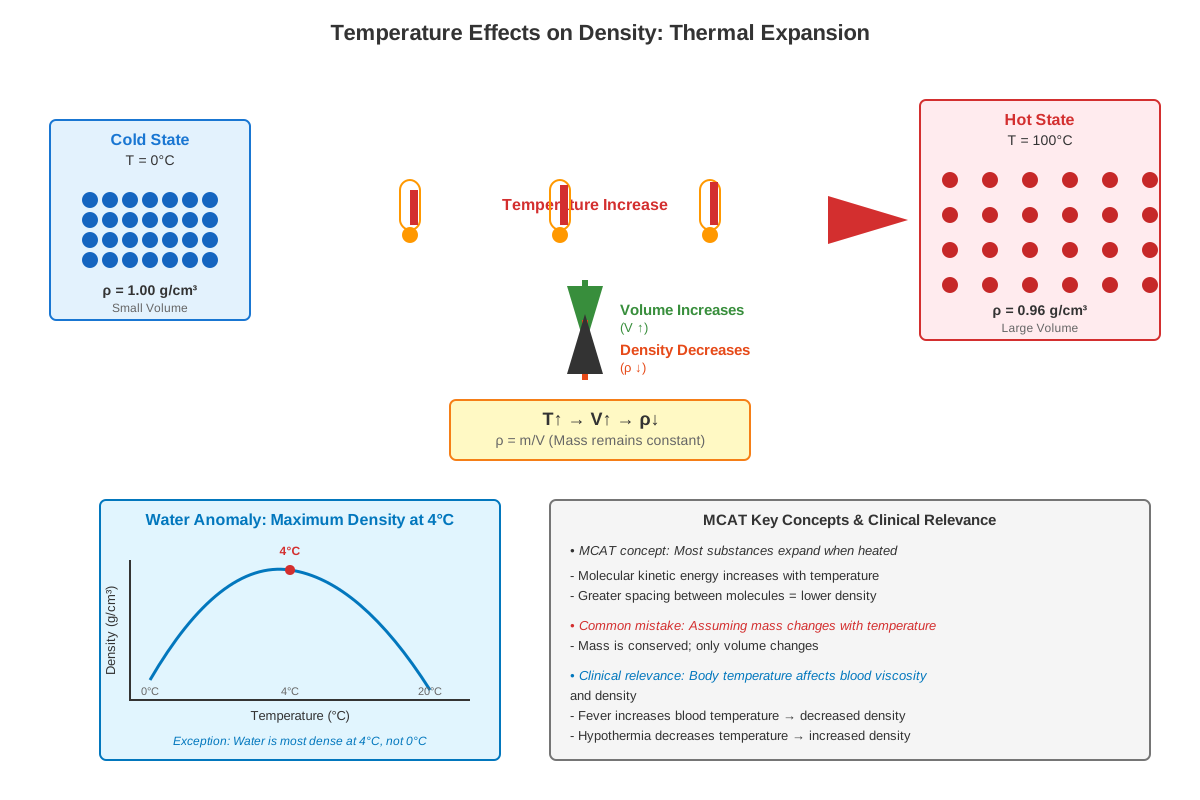
- Increasing temperature → decreasing density (thermal expansion increases volume while mass remains constant)
- Decreasing temperature → increasing density (thermal contraction decreases volume)
The relationship for small temperature changes:
ρ_T = ρ_0 / (1 + βΔT)Where β is the coefficient of volumetric thermal expansion.
Water's anomaly: Water reaches maximum density at 4°C. Below this temperature, water becomes less dense (which is why ice floats). This unusual behavior results from hydrogen bonding creating an open crystalline structure in ice.
Pressure Effects
- Liquids and solids: Nearly incompressible, so density changes minimally with pressure (can be ignored for MCAT purposes)
- Gases: Highly compressible, density increases proportionally with pressure according to the ideal gas law
For ideal gases:
ρ = PM / RTWhere P = pressure, M = molar mass, R = gas constant, T = temperature
Density and Buoyancy
The relationship between density and buoyancy is critical for MCAT success:
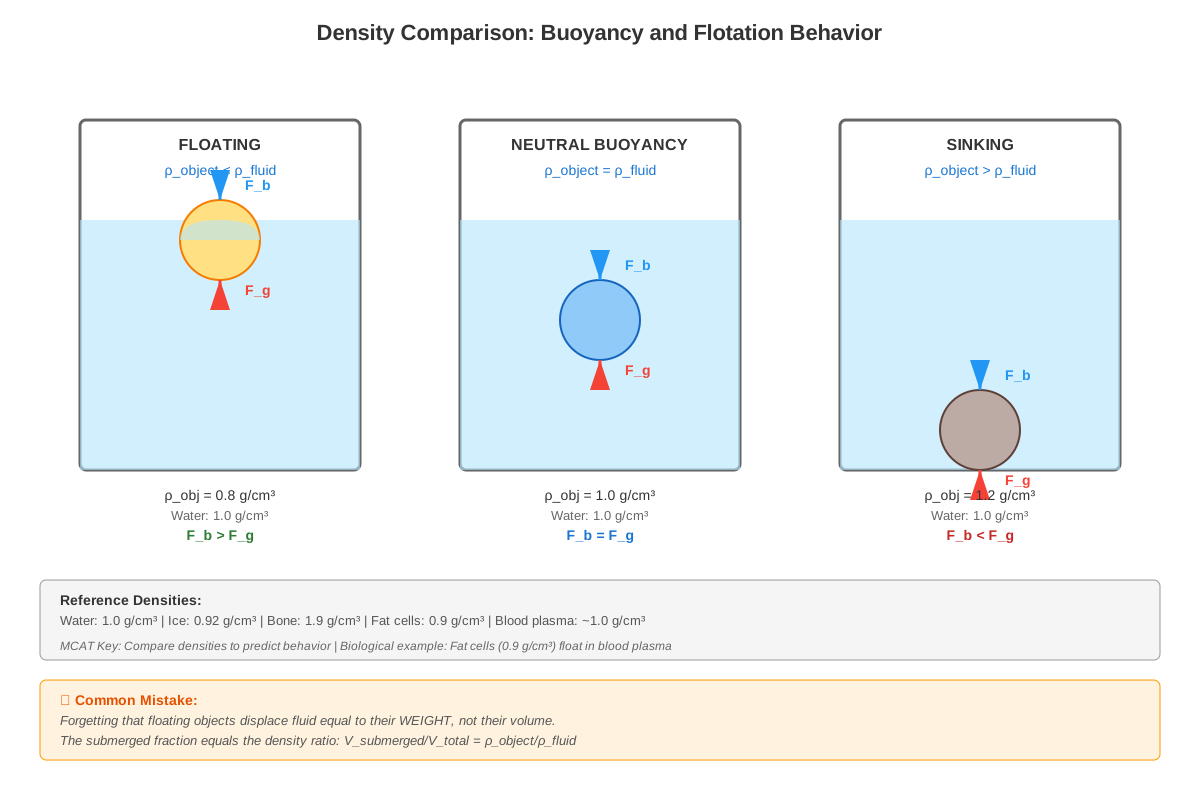
- Object density < Fluid density: Object floats (experiences net upward force)
- Object density = Fluid density: Object is neutrally buoyant (suspended in fluid)
- Object density > Fluid density: Object sinks (experiences net downward force)
The buoyant force (F_b) is given by Archimedes' principle:
F_b = ρ_fluid × V_displaced × gThis principle explains why ships made of steel (density ~8 g/cm³) can float on water (density ~1 g/cm³)—the overall density of the ship including its air-filled interior is less than water.
Density in Fluid Columns
In a static fluid column, pressure increases with depth according to:
P = P_0 + ρghWhere:
- P = pressure at depth h
- P_0 = pressure at surface
- ρ = fluid density
- g = gravitational acceleration (9.8 m/s²)
- h = depth below surface
This equation demonstrates that denser fluids create greater pressure increases with depth. This principle is essential for understanding blood pressure variations in the circulatory system and pressure changes during diving.
Density Stratification
When multiple immiscible fluids are combined, they stratify (layer) according to density, with the densest fluid at the bottom:
Example stratification (from bottom to top):
- Mercury (ρ = 13.6 g/cm³)
- Water (ρ = 1.0 g/cm³)
- Vegetable oil (ρ = 0.92 g/cm³)
- Air (ρ = 0.0013 g/cm³)
This principle underlies density gradient centrifugation, a technique used to separate cellular components, lipoproteins, or nucleic acids based on their buoyant densities.
Concept Relationships
Density serves as a central hub connecting multiple physics and biological concepts:
Mass and Volume → Density: The fundamental definition establishes density as the ratio of these two extensive properties, converting them into an intensive property that characterizes materials.
Density → Buoyancy: Density differences between objects and fluids determine buoyant forces through Archimedes' principle. This relationship is essential for understanding flotation, sinking, and neutral buoyancy.
Density → Pressure in Fluids: The density of a fluid directly determines how rapidly pressure increases with depth (P = P₀ + ρgh), connecting density to hydrostatic pressure calculations.
Density → Specific Gravity: Specific gravity normalizes density relative to water, providing a dimensionless comparison useful in clinical measurements.
Temperature → Density: Thermal expansion and contraction create an inverse relationship between temperature and density, with important exceptions like water's maximum density at 4°C.
Pressure → Gas Density: For gases, the ideal gas law creates a direct proportional relationship between pressure and density (at constant temperature).
Density → Fluid Dynamics: In Bernoulli's equation and continuity equation applications, density appears as a critical parameter affecting flow behavior and energy conservation.
Density → Centrifugation: Density differences enable separation of mixtures through centrifugal force, with applications in clinical diagnostics and research.
Relationship Map:
Mass & Volume → Density ← Temperature & Pressure
                  ↓
        ┌─────────┼─────────┐
        ↓         ↓         ↓
    Buoyancy  Pressure  Specific Gravity
        ↓         ↓         ↓
    Flotation  Fluid    Clinical
    Behavior   Statics  Measurements
High-Yield Facts
⭐ Water has a density of 1 g/cm³ (or 1000 kg/m³), serving as the reference standard for specific gravity calculations and providing a convenient benchmark for MCAT problems.
⭐ Objects float when their density is less than the fluid density and sink when their density is greater than the fluid density—this is the fundamental principle for all buoyancy predictions.
⭐ Density is an intensive property that does not change with the amount of substance, unlike mass and volume which are extensive properties.
⭐ Ice floats on water because it is less dense (ρ_ice ≈ 0.92 g/cm³), resulting from water's anomalous expansion upon freezing due to hydrogen bonding.
⭐ The density equation ρ = m/V can be rearranged to solve for any variable: m = ρV or V = m/ρ, and all three forms appear regularly on the MCAT.
- Gases are approximately 1000 times less dense than liquids and solids at standard conditions, which explains why buoyant forces on objects in air are typically negligible.
- Specific gravity is dimensionless and equals the numerical value of density when density is expressed in g/cm³ or g/mL.
- Increasing temperature generally decreases density for most substances due to thermal expansion, but water is densest at 4°C.
- Pressure increases with depth in a fluid column according to P = P₀ + ρgh, meaning denser fluids create larger pressure gradients.
- Lipoproteins are classified by density: VLDL (very low density), LDL (low density), and HDL (high density), with clinical implications for cardiovascular disease risk.
- Blood is slightly denser than water (ρ ≈ 1.06 g/cm³) due to dissolved proteins and cellular components, which is why blood cells can be separated by centrifugation.
- Mercury is the densest common liquid (ρ = 13.6 g/cm³), which is why it was historically used in barometers and manometers to measure pressure.
Quick check — test yourself on Density so far.
Try Flashcards →Common Misconceptions
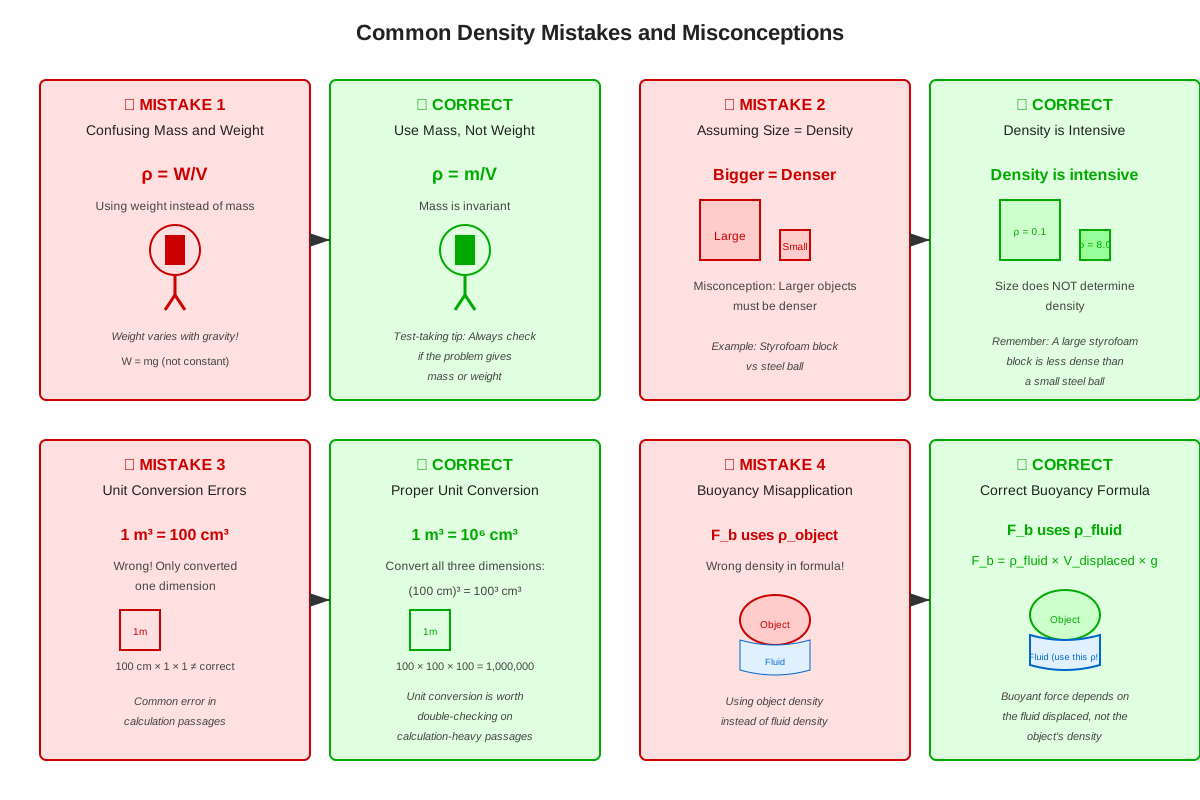
Misconception: Heavier objects are always denser than lighter objects.
Correction: Density is mass per unit volume, not total mass. A large piece of Styrofoam can be heavier than a small piece of lead, but lead is far denser. The MCAT tests understanding that density is an intensive property independent of sample size.
Misconception: Density and weight are the same thing.
Correction: Weight is a force (mass × gravity) measured in newtons, while density is mass per unit volume measured in kg/m³ or g/cm³. An object has the same density on Earth and the Moon, but different weights due to different gravitational fields.
Misconception: All solids are denser than all liquids.
Correction: While most solids are denser than most liquids, exceptions exist. Ice floats on water, cork floats on water, and lithium metal (ρ = 0.53 g/cm³) floats on water. The MCAT frequently tests these exceptions.
Misconception: Density changes when you change the shape of an object.
Correction: Reshaping an object changes its volume and may change its mass distribution, but the density of the material itself remains constant. A steel ball and a steel sheet have the same density. However, a hollow steel sphere filled with air has a lower overall density than solid steel, which is why ships float.
Misconception: Specific gravity has units of g/cm³.
Correction: Specific gravity is a ratio of two densities and is therefore dimensionless (unitless). While the numerical value of specific gravity equals density in g/cm³ when using water as the reference, specific gravity itself has no units.
Misconception: Gases have negligible density and can be ignored in calculations.
Correction: While gas densities are much smaller than liquid or solid densities, they are not zero and can be significant in certain contexts. The MCAT may test gas density in problems involving buoyancy of balloons, respiratory physiology, or ideal gas law applications.
Misconception: Density always decreases with increasing temperature.
Correction: While this is true for most substances, water is a critical exception. Water's density increases from 0°C to 4°C, then decreases above 4°C. This anomaly has profound ecological consequences and appears frequently on the MCAT.
Worked Examples
Example 1: Calculating Density and Predicting Buoyancy
Problem: A researcher has a sample of an unknown biological material with a mass of 45.0 g and a volume of 50.0 mL. (a) Calculate the density of the material in g/cm³. (b) Will this material float or sink in water? (c) Will it float or sink in vegetable oil (density = 0.92 g/cm³)?
Solution:
(a) Calculate density
Step 1: Identify the given information
- Mass (m) = 45.0 g
- Volume (V) = 50.0 mL = 50.0 cm³ (since 1 mL = 1 cm³)
Step 2: Apply the density equation
ρ = m/V = 45.0 g / 50.0 cm³ = 0.90 g/cm³(b) Behavior in water
Step 3: Compare to water's density
- Material density: 0.90 g/cm³
- Water density: 1.00 g/cm³
- Since ρ_material < ρ_water, the material will float in water
Step 4: Explain the physics
When the material is placed in water, it displaces water equal to its submerged volume. The buoyant force (F_b = ρ_water × V_displaced × g) exceeds the weight of the material (F_g = m × g) because water is denser. The net upward force causes the material to float, with approximately 90% of its volume submerged (the ratio of densities).
(c) Behavior in vegetable oil
Step 5: Compare to oil's density
- Material density: 0.90 g/cm³
- Oil density: 0.92 g/cm³
- Since ρ_material < ρ_oil (but only slightly), the material will float in oil, but barely
Step 6: Qualitative reasoning
The material will float in oil, but because the densities are very close (0.90 vs 0.92 g/cm³), it will be almost completely submerged—approximately 98% of its volume will be below the oil surface. This demonstrates that the smaller the density difference, the less buoyant force is available to support the object.
Connection to Learning Objectives: This problem demonstrates the application of the density equation, the relationship between density and buoyancy, and the importance of density comparisons in predicting physical behavior—all critical MCAT skills.
Example 2: Density Changes with Temperature
Problem: A sealed container holds 1.00 L of water at 25°C with a density of 0.997 g/cm³. The water is cooled to 4°C, where its density is 1.000 g/cm³. (a) What is the mass of water in the container? (b) What is the volume of water at 4°C? (c) Explain why this behavior is unusual and its biological significance.
Solution:
(a) Calculate mass
Step 1: Recognize that mass is conserved
The mass of water does not change when temperature changes (assuming the container is sealed and no water escapes).
Step 2: Use initial conditions to find mass
- V₁ = 1.00 L = 1000 cm³
- ρ₁ = 0.997 g/cm³
- m = ρ₁ × V₁ = 0.997 g/cm³ × 1000 cm³ = 997 g
(b) Calculate volume at 4°C
Step 3: Use the density equation with new density
- m = 997 g (unchanged)
- ρ₂ = 1.000 g/cm³
- V₂ = m/ρ₂ = 997 g / 1.000 g/cm³ = 997 cm³ = 0.997 L
Step 4: Interpret the result
The volume decreased from 1000 cm³ to 997 cm³ (a decrease of 3 cm³) as the water cooled and became denser. This contraction is expected for most substances when cooled.
(c) Biological significance
Step 5: Explain water's anomaly
Water is unusual because it reaches maximum density at 4°C. If cooled further to 0°C (ice), the density decreases to approximately 0.92 g/cm³. This means ice floats on liquid water—a rare property where the solid phase is less dense than the liquid phase.
Step 6: Connect to biological importance
This property has critical ecological consequences:
- Lakes freeze from the top down, allowing aquatic life to survive beneath the ice layer
- If ice were denser than water, lakes would freeze from the bottom up, potentially killing all aquatic organisms
- The insulating ice layer on top slows further freezing of the water below
- This anomaly results from hydrogen bonding creating an open hexagonal crystal structure in ice
Connection to Learning Objectives: This problem illustrates how density changes with temperature, demonstrates the conservation of mass while volume changes, and connects density concepts to biologically relevant phenomena—exactly the type of integrated reasoning the MCAT requires.
Exam Strategy
Approaching MCAT Density Questions
Step 1: Identify what's being asked
- Direct calculation (find ρ, m, or V)?
- Qualitative prediction (float or sink)?
- Comparison between substances?
- Application to a biological system?
Step 2: Extract given information
- List all provided values with units
- Identify which variable you're solving for
- Note any reference values (water = 1 g/cm³)
Step 3: Check units immediately
- Convert all volumes to the same unit (cm³ or m³)
- Convert all masses to the same unit (g or kg)
- Ensure density units match the problem requirements
Step 4: Apply the appropriate relationship
- For calculations: ρ = m/V (or rearranged forms)
- For buoyancy: compare densities
- For pressure: P = P₀ + ρgh
- For specific gravity: SG = ρ_substance/ρ_water
Trigger Words and Phrases
Watch for these high-yield terms that signal density-related questions:
- "Specific gravity": Immediately think density ratio to water
- "Float," "sink," "suspend": Compare object density to fluid density
- "Centrifugation," "sedimentation": Density-based separation
- "Stratify," "layer": Density differences causing vertical arrangement
- "Buoyant force": Requires density of fluid
- "Hydrostatic pressure": Requires fluid density (P = P₀ + ρgh)
- "Thermal expansion": Temperature affecting density
- "Compressibility": Pressure affecting gas density
Process of Elimination Tips
For qualitative questions:
- Eliminate answers that violate the float/sink rule (compare densities)
- Eliminate answers that confuse intensive vs. extensive properties
- Eliminate answers that ignore temperature effects when temperature is mentioned
- Eliminate answers that treat gases as incompressible or liquids as highly compressible
For calculation questions:
- Eliminate answers with wrong units
- Eliminate answers that are orders of magnitude off (use water as reference)
- Eliminate answers that violate physical constraints (negative density, density of solid less than gas)
- Use dimensional analysis to eliminate answers with impossible unit combinations
Time Allocation
- Simple density calculations: 30-45 seconds
- Multi-step problems (calculate density, then apply to buoyancy): 60-90 seconds
- Passage-based questions with data interpretation: 90-120 seconds
- Complex integrated problems (density + pressure + buoyancy): 120-150 seconds
Exam Tip: If a problem seems to require complex calculations, look for a qualitative approach. Many MCAT density questions can be answered by comparing relative densities without calculating exact values.
Memory Techniques
Mnemonics
"Dense Matters Very Much" - Remember the density equation:
- Density = Mass / Volume
- Helps recall ρ = m/V
"FLOAT" - Conditions for floating:
- Fluid density
- Larger than
- Object's
- Average
- Total density
"Water's Weird at 4" - Remember water's maximum density:
- Water reaches maximum density at 4°C
- Above and below this temperature, density decreases
Visualization Strategies
The Density Pyramid:
Visualize substances stacked by density:
        Air (gas) - least dense
    ─────────────────────
      Oil (liquid)
    ─────────────────────
      Water (liquid)
    ─────────────────────
    Mercury (liquid) - most dense
This mental image helps quickly predict layering and buoyancy.
The Seesaw Method:
For ρ = m/V, visualize a seesaw:
- Mass on one side, Volume on the other
- Density is the balance point
- If mass increases (volume constant), density tips toward mass (increases)
- If volume increases (mass constant), density tips away from mass (decreases)
Acronyms
"SG = D/W" - Specific Gravity calculation:
- Specific Gravity = Density of substance / Water's density
"TIPS" - Factors affecting density:
- Temperature (inverse relationship for most substances)
- Intensive property (doesn't depend on amount)
- Pressure (affects gases significantly)
- State of matter (solid > liquid > gas, generally)
Summary
Density, defined as mass per unit volume (ρ = m/V), is a fundamental intensive property that characterizes materials and predicts their behavior in fluids. For the MCAT, mastery of density requires both quantitative facility with calculations and qualitative reasoning about buoyancy, stratification, and pressure relationships. Water's density of 1 g/cm³ serves as the essential reference point, enabling rapid specific gravity calculations and buoyancy predictions. Objects float when less dense than the surrounding fluid and sink when denser—a principle underlying countless biological phenomena from lipoprotein classification to blood cell separation. Temperature generally decreases density through thermal expansion, with water's anomalous maximum density at 4°C representing a critical exception with profound ecological implications. Density connects directly to hydrostatic pressure (P = P₀ + ρgh), buoyant force (F_b = ρ_fluid × V_displaced × g), and gas behavior through the ideal gas law. MCAT success requires recognizing density's role in experimental techniques like centrifugation, understanding its clinical applications in specific gravity measurements, and integrating density concepts with broader fluid mechanics principles. The ability to rapidly convert units, compare densities qualitatively, and apply the density equation in multiple forms distinguishes high-scoring students on exam day.
Key Takeaways
- Density (ρ = m/V) is an intensive property that characterizes materials independent of sample size, measured in g/cm³ or kg/m³, with water at 1 g/cm³ serving as the reference standard
- Buoyancy depends on density comparison: objects float when ρ_object < ρ_fluid, sink when ρ_object > ρ_fluid, and are neutrally buoyant when densities are equal
- Temperature and density are inversely related for most substances due to thermal expansion, but water reaches maximum density at 4°C before decreasing as it freezes
- Specific gravity is the dimensionless ratio of a substance's density to water's density, commonly used in clinical measurements like urine specific gravity
- Density determines pressure gradients in fluids through P = P₀ + ρgh, with denser fluids creating steeper pressure increases with depth
- The density equation can be rearranged to solve for any variable (m = ρV or V = m/ρ), and all forms appear regularly on the MCAT
- Gases are approximately 1000× less dense than liquids and solids, but their density varies significantly with pressure and temperature according to the ideal gas law
Related Topics
Buoyancy and Archimedes' Principle: Builds directly on density concepts to quantify the upward force exerted by fluids on submerged objects, essential for understanding flotation and apparent weight in fluids.
Hydrostatic Pressure: Uses density as a key parameter in calculating pressure variations with depth (P = P₀ + ρgh), critical for understanding blood pressure, diving physiology, and fluid statics.
Fluid Dynamics and Bernoulli's Equation: Incorporates density into energy conservation principles for moving fluids, explaining blood flow, respiratory mechanics, and circulatory physiology.
Specific Gravity and Clinical Measurements: Applies density concepts to diagnostic tests including urine specific gravity, blood component analysis, and lipoprotein classification.
Thermal Expansion: Explains the physical basis for temperature-dependent density changes, connecting thermodynamics to fluid behavior.
Ideal Gas Law: Relates gas density to pressure, temperature, and molar mass through PV = nRT, enabling calculations of gas density under varying conditions.
Centrifugation and Separation Techniques: Applies density differences to separate mixtures, fundamental to clinical diagnostics and biochemical research methods.
Practice CTA
Now that you've mastered the core concepts of density, it's time to solidify your understanding through active practice. Challenge yourself with MCAT-style practice questions that test your ability to calculate densities, predict buoyancy, and integrate density concepts with other fluid mechanics principles. Use flashcards to drill high-yield facts like water's density, the density equation rearrangements, and the relationship between density and specific gravity. Remember: passive reading builds familiarity, but active problem-solving builds mastery. The difference between a good MCAT score and a great one often comes down to confident, rapid application of fundamental concepts like density. You've built the foundation—now strengthen it through deliberate practice!
Sign up free to keep reading
Create a free AnvayaPrep account to finish this MCAT guide on Density — plus flashcards and practice questions.