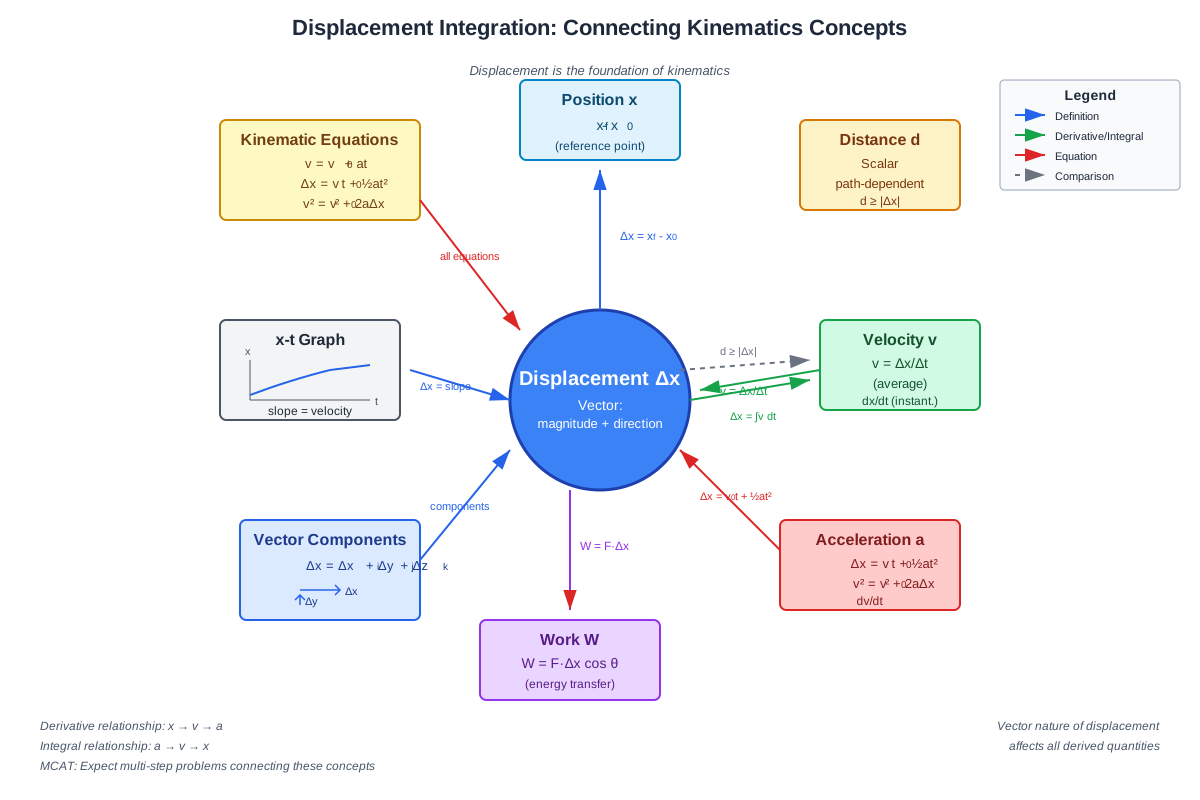
Overview
Displacement is a foundational concept in Mechanics and serves as one of the most fundamental vector quantities in Physics. Unlike distance, which measures the total path traveled, displacement describes the straight-line change in position from an initial point to a final point, incorporating both magnitude and direction. This distinction between scalar and vector quantities forms the bedrock of kinematics and appears throughout the MCAT Physics section. Understanding displacement enables students to analyze motion in one, two, and three dimensions, solve projectile motion problems, and interpret graphical representations of motion—all high-yield topics for the exam.
For the MCAT, displacement represents more than just a mathematical definition; it serves as the gateway to understanding velocity, acceleration, and the relationships between position, time, and motion. The MCAT frequently tests displacement in the context of passage-based questions involving experimental setups, biological systems in motion, or clinical scenarios requiring spatial reasoning. Questions may present displacement graphically, algebraically, or conceptually, requiring students to translate between representations fluently. The ability to distinguish displacement from distance, recognize vector properties, and apply displacement to calculate other kinematic variables is essential for success on test day.
Displacement connects intimately with nearly every topic in mechanics, from Newton's laws to energy conservation. It provides the foundation for defining velocity (the rate of change of displacement) and appears in work calculations (force applied over a displacement). Understanding displacement in the context of Displacement Physics prepares students for more complex applications in electromagnetism, waves, and even biological systems where spatial changes matter. Mastery of this concept ensures students can confidently approach any Displacement MCAT question, whether it appears as a discrete item or embedded within a complex passage.
Learning Objectives
- [ ] Define Displacement using accurate Physics terminology
- [ ] Explain why Displacement matters for the MCAT
- [ ] Apply Displacement to exam-style questions
- [ ] Identify common mistakes related to Displacement
- [ ] Connect Displacement to related Physics concepts
- [ ] Calculate displacement in one, two, and three dimensions using vector addition
- [ ] Distinguish between displacement and distance in various motion scenarios
- [ ] Interpret position-time graphs to determine displacement values
- [ ] Apply displacement concepts to solve problems involving relative motion
Prerequisites
- Scalar vs. Vector Quantities: Displacement is a vector, requiring understanding of magnitude and direction; this distinction is essential for proper calculation and interpretation
- Coordinate Systems: Displacement requires a reference frame and coordinate system to define position changes meaningfully
- Basic Algebra: Solving for displacement involves algebraic manipulation of equations and understanding of variables
- Pythagorean Theorem: Two- and three-dimensional displacement calculations require this geometric relationship
- Trigonometry Basics: Determining displacement components and angles requires sine, cosine, and tangent functions
Why This Topic Matters
Displacement appears in approximately 5-8% of MCAT Physics questions, either directly or as a component of more complex problems. The concept bridges multiple high-yield topics including kinematics, projectile motion, work-energy relationships, and graphical analysis. Understanding displacement is clinically relevant in contexts such as analyzing patient movement during gait analysis, calculating drug diffusion distances in tissues, tracking cellular migration, or determining the effective range of medical imaging equipment.
On the MCAT, displacement questions typically appear in three formats: discrete questions testing conceptual understanding, passage-based calculations requiring quantitative problem-solving, and graphical interpretation questions where students must extract displacement from position-time or velocity-time graphs. The exam frequently embeds displacement within experimental passages describing motion tracking, biomechanical studies, or physics demonstrations. Questions may ask students to compare displacement and distance, calculate net displacement from multiple movement segments, or determine displacement from velocity data.
The MCAT particularly favors questions that test whether students truly understand displacement as a vector quantity versus distance as a scalar. Passages may describe complex paths—such as a molecule moving through a cell, a patient walking through a rehabilitation course, or a projectile following a parabolic trajectory—and ask for the displacement despite the circuitous route. This tests both conceptual clarity and the ability to focus on initial and final positions while ignoring the path taken. Students who master displacement gain confidence in tackling the entire kinematics section and develop vector reasoning skills applicable throughout the Physics and Chemical and Physical Foundations sections.
Core Concepts
Definition of Displacement
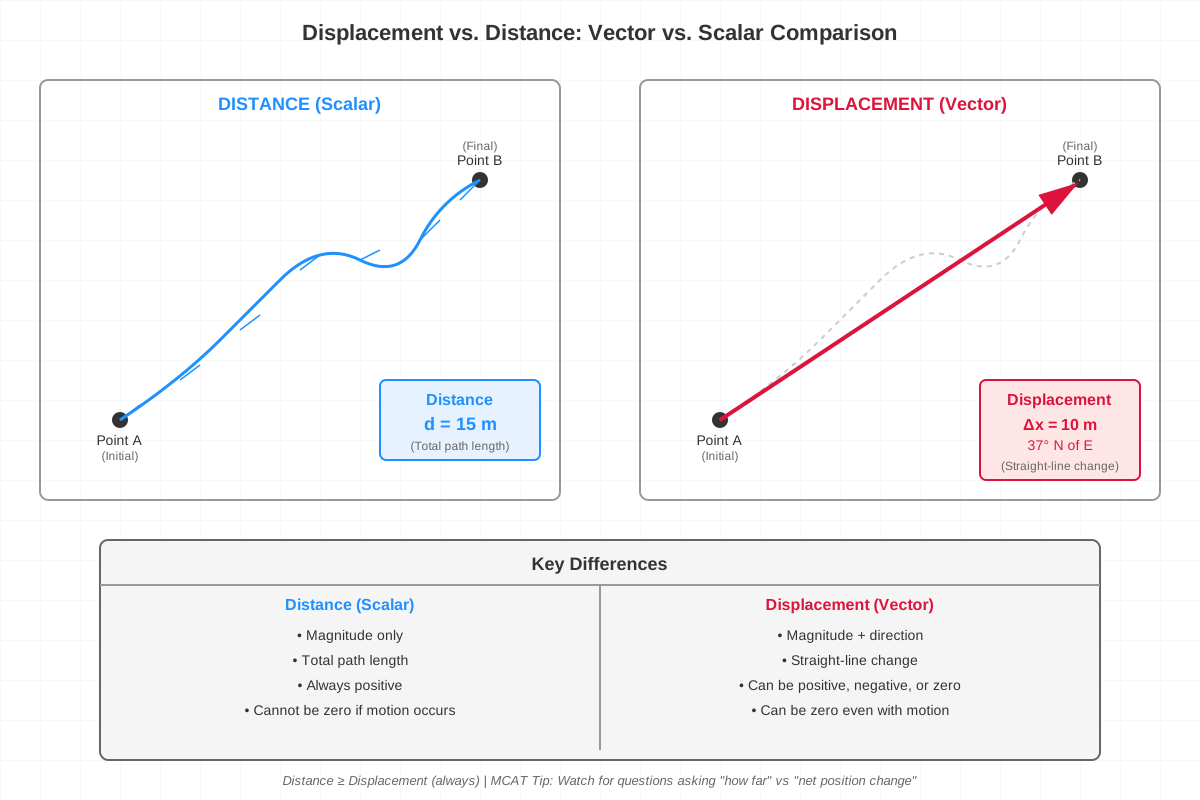
Displacement is defined as the vector quantity representing the change in position of an object, measured from the initial position to the final position along a straight line. Mathematically, displacement is expressed as:
Δx = x_f - x_iwhere Δx represents displacement, x_f is the final position, and x_i is the initial position. The Greek letter delta (Δ) universally denotes "change in" throughout physics. Because displacement is a vector, it possesses both magnitude (how far) and direction (which way). The magnitude is measured in SI units of meters (m), though the MCAT may present problems using centimeters, kilometers, or other length units.
The direction of displacement points from the starting position directly toward the ending position, regardless of the actual path traveled. In one-dimensional motion, direction is indicated by sign: positive displacement typically indicates motion in the positive coordinate direction (often rightward or upward), while negative displacement indicates motion in the negative direction (leftward or downward). In two or three dimensions, direction is specified using angles, unit vectors, or component notation.
Displacement vs. Distance
The distinction between displacement and distance represents one of the most frequently tested concepts in Displacement MCAT questions. Distance is a scalar quantity measuring the total length of the path traveled, regardless of direction. Displacement, conversely, measures only the straight-line separation between start and finish points.
| Property | Displacement | Distance |
|---|---|---|
| Type | Vector | Scalar |
| Direction | Yes (from initial to final position) | No |
| Path Dependence | Path-independent | Path-dependent |
| Can Be Zero | Yes (if initial = final position) | Only if no motion occurs |
| Can Be Negative | Yes (in 1D motion) | No (always positive or zero) |
| Magnitude Comparison | Always ≤ distance | Always ≥ displacement magnitude |
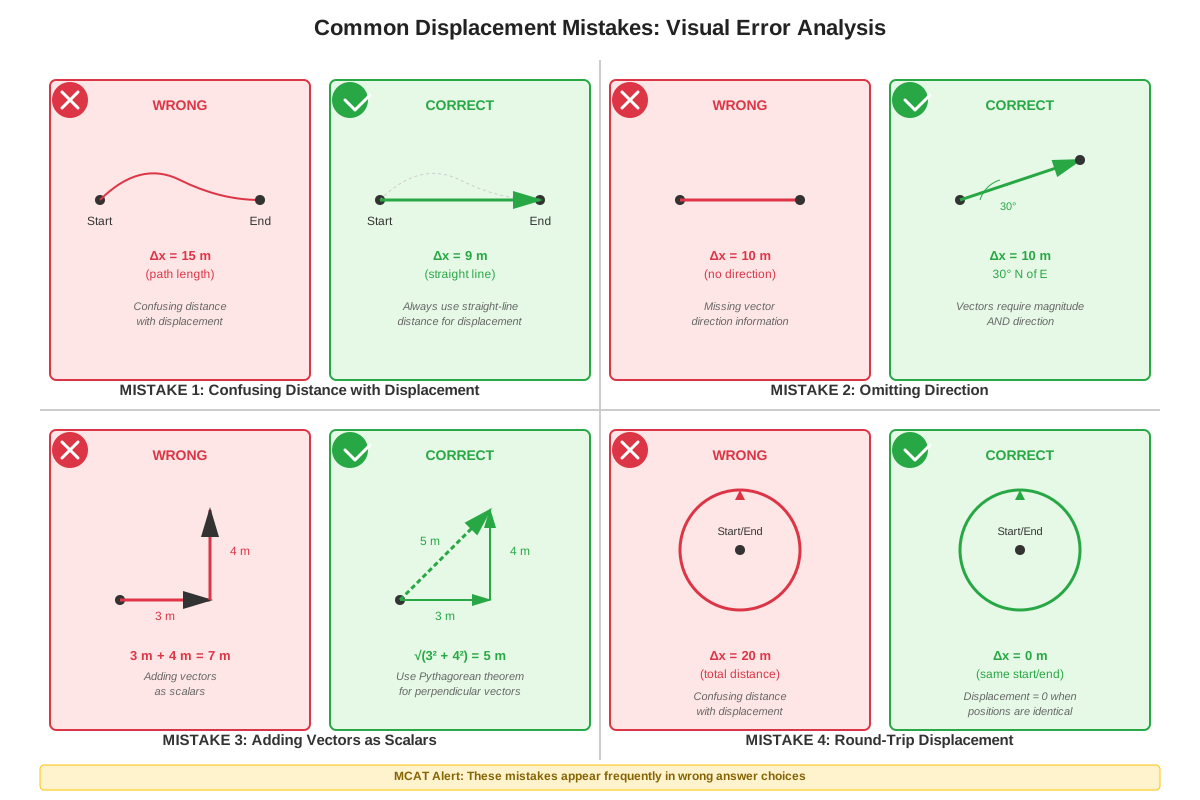
Consider a student walking 3 meters east, then 4 meters north. The distance traveled is 7 meters (3 + 4), but the displacement magnitude is 5 meters (using the Pythagorean theorem: √(3² + 4²) = 5), directed northeast at an angle of arctan(4/3) ≈ 53° from east. If the student then returns to the starting point, the total distance becomes 14 meters, but the displacement is zero because the initial and final positions are identical.
Vector Nature of Displacement
As a vector quantity, displacement obeys the rules of vector addition and subtraction. When an object undergoes multiple displacements, the net displacement (or total displacement) is found by vector addition of the individual displacement vectors. In one dimension, this simplifies to algebraic addition with attention to signs:
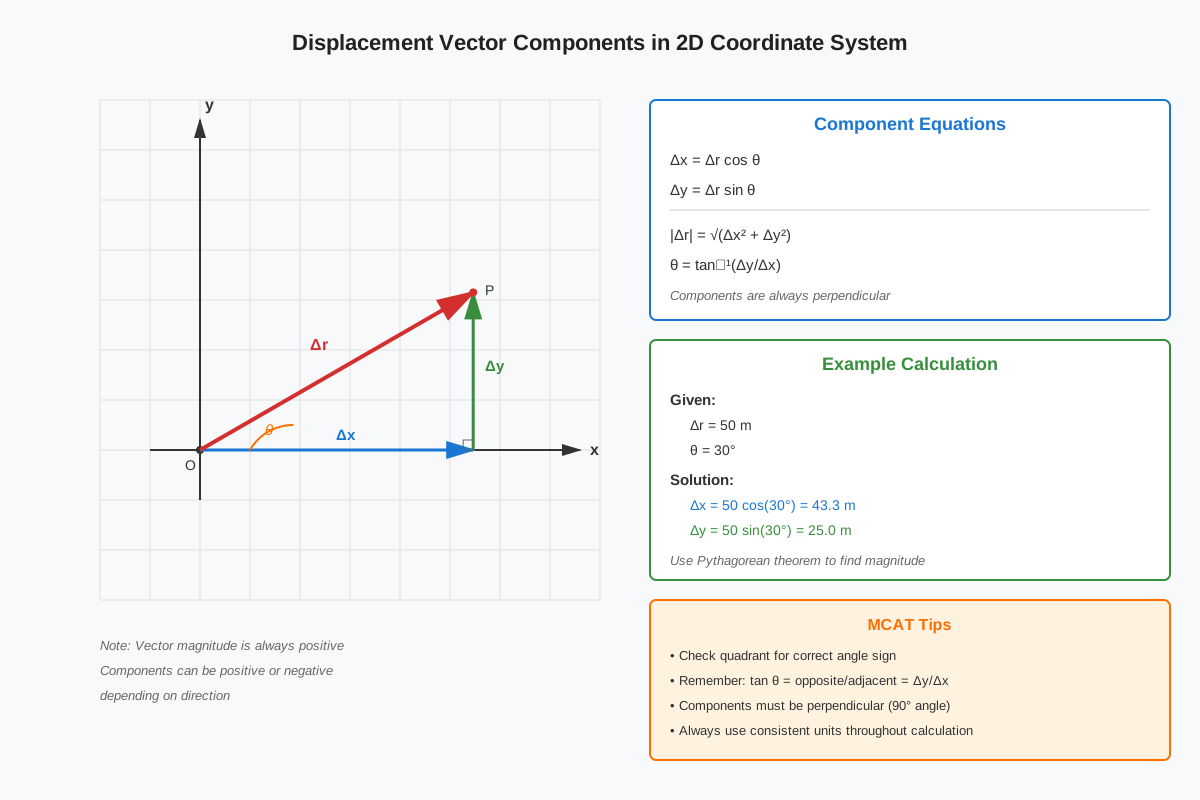
Δx_total = Δx_1 + Δx_2 + Δx_3 + ...In two or three dimensions, vector addition requires either graphical methods (tip-to-tail construction) or component methods. The component method involves breaking each displacement into perpendicular components (typically x and y, or x, y, and z), summing components separately, then recombining:
Δx_total = Δx_1 + Δx_2 + ...
Δy_total = Δy_1 + Δy_2 + ...
The magnitude of the resultant displacement is:
|Δr| = √(Δx_total² + Δy_total²)The direction (angle θ from the positive x-axis) is:
θ = arctan(Δy_total / Δx_total)Displacement in Multiple Dimensions
In two-dimensional motion, displacement is often represented as a position vector with components. For example, if an object moves from position (2, 3) to position (5, 7) in a Cartesian coordinate system (units in meters), the displacement vector is:
Δr = (5-2)î + (7-3)ĵ = 3î + 4ĵ meterswhere î and ĵ are unit vectors in the x and y directions. The magnitude is 5 meters, and the direction is 53° above the positive x-axis. This vector notation is particularly useful in Mechanics problems involving projectile motion, circular motion, or any scenario where motion occurs in a plane.
Three-dimensional displacement adds a z-component, requiring the three-dimensional distance formula:
|Δr| = √(Δx² + Δy² + Δz²)While less common on the MCAT, three-dimensional problems may appear in passages describing molecular motion, medical imaging, or spatial reasoning in biological contexts.
Displacement and Reference Frames
Displacement is always measured relative to a chosen reference frame or coordinate system. The choice of reference frame affects the numerical values of displacement but not the physical reality of the motion. For example, a passenger walking forward in a moving train has one displacement relative to the train and a different displacement relative to the ground. The MCAT may test understanding of relative motion by presenting scenarios where different observers measure different displacements for the same object.
When solving problems, establishing a clear coordinate system with a defined origin and positive direction is essential. Consistency in applying this system throughout the problem prevents sign errors and confusion. The MCAT rewards students who explicitly identify their reference frame when ambiguity exists.
Graphical Representation of Displacement
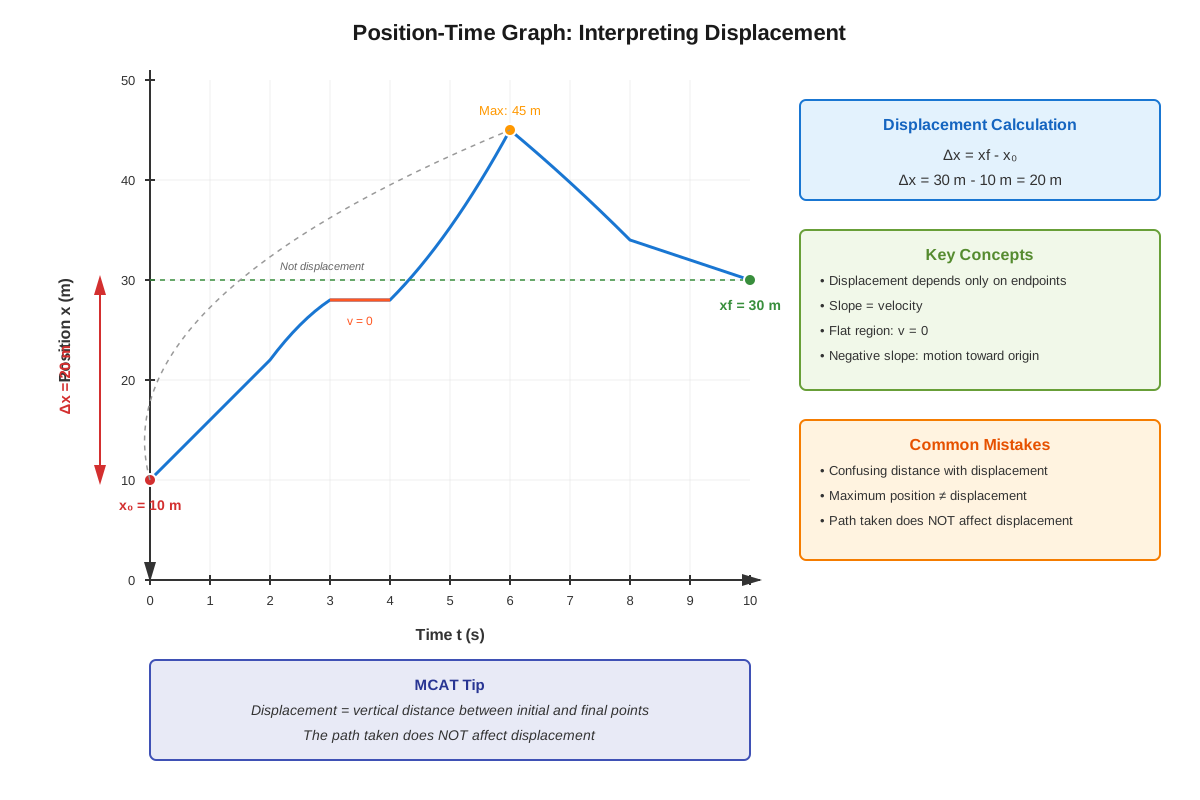
Position-time graphs provide a powerful visual representation of displacement. On such graphs, the vertical axis represents position (x) and the horizontal axis represents time (t). Displacement between two time points is found by calculating the vertical change (Δx) between those points:
Δx = x(t_2) - x(t_1)The slope of a position-time graph represents velocity, not displacement. However, the vertical distance between two points on the curve directly represents the displacement during that time interval. A horizontal line indicates zero displacement (stationary object), while a line returning to its starting height indicates zero net displacement despite possible motion.
Velocity-time graphs can also be used to determine displacement. The area under a velocity-time curve between two time points equals the displacement during that interval. This relationship derives from the definition of velocity as the rate of change of displacement and the fundamental theorem of calculus.
Concept Relationships
Displacement serves as the foundational concept from which velocity and acceleration are derived. Displacement → defines → Velocity through the relationship v = Δx/Δt (average velocity) or v = dx/dt (instantaneous velocity). Understanding displacement as the numerator in the velocity equation clarifies why velocity is also a vector quantity with the same direction as displacement for motion in a straight line.
Velocity → defines → Acceleration through a = Δv/Δt, creating a hierarchical relationship: displacement is the first derivative of position with respect to time, velocity is the first derivative of displacement (or second derivative of position), and acceleration is the first derivative of velocity (or third derivative of position). This mathematical relationship appears throughout kinematics problems.
Displacement → connects to → Work through the equation W = F·d, where d represents displacement in the direction of force. This connection bridges kinematics and dynamics, showing how displacement relates to energy transfer. Similarly, Displacement → appears in → Kinematic Equations, where it serves as one of the five key variables (along with initial velocity, final velocity, acceleration, and time) that can be solved using the standard kinematic formulas.
The vector nature of displacement connects it to all vector operations in physics. Vector Addition → applies to → Displacement when calculating net displacement from multiple movements. Pythagorean Theorem → calculates → Displacement Magnitude in two dimensions, while Trigonometry → determines → Displacement Direction through angle calculations.
Displacement also relates to the prerequisite concept of coordinate systems. Reference Frame → defines → Displacement, as the numerical value and even the direction of displacement depend on the chosen coordinate system. This relationship becomes particularly important in relative motion problems where multiple reference frames exist simultaneously.
Quick check — test yourself on Displacement so far.
Try Flashcards →High-Yield Facts
⭐ Displacement is a vector quantity with both magnitude and direction, while distance is a scalar with only magnitude
⭐ The magnitude of displacement is always less than or equal to the distance traveled, with equality only when motion is in a straight line without direction changes
⭐ Net displacement can be zero even when distance traveled is not zero (e.g., round trips)
⭐ In one-dimensional motion, displacement can be positive, negative, or zero depending on direction and whether the object returns to its starting point
⭐ Displacement is calculated as final position minus initial position (Δx = x_f - x_i), making it path-independent
- Displacement has SI units of meters (m), though any length unit is acceptable with proper conversion
- On position-time graphs, displacement is the vertical change between two points, not the slope
- Vector addition of multiple displacements requires component-wise addition in multi-dimensional problems
- The direction of displacement points from the initial position directly toward the final position along a straight line
- Displacement appears in the numerator of the average velocity equation: v_avg = Δx/Δt
- In projectile motion, horizontal and vertical displacements are calculated independently using component analysis
- Relative displacement between two objects requires subtracting their individual displacement vectors
- The area under a velocity-time curve equals the displacement during that time interval
- Displacement in circular motion can be zero (complete circle) despite continuous movement
- When an object changes direction, the displacement magnitude is less than the sum of individual displacement magnitudes
Common Misconceptions
Misconception: Displacement and distance are the same thing and can be used interchangeably.
Correction: Displacement is a vector measuring straight-line change in position, while distance is a scalar measuring total path length. They have equal magnitudes only for straight-line motion without direction reversal. The MCAT specifically tests this distinction.
Misconception: Displacement is always positive because it represents "how far" something moved.
Correction: In one-dimensional motion, displacement can be positive, negative, or zero depending on the direction of motion relative to the chosen coordinate system. Negative displacement indicates motion in the negative coordinate direction, not a mathematical error.
Misconception: If an object is moving, its displacement cannot be zero.
Correction: Displacement depends only on initial and final positions, not on the motion between them. An object that returns to its starting point has zero displacement regardless of the distance traveled or the complexity of the path taken.
Misconception: The displacement for a curved path is the length of the curve.
Correction: Displacement is always the straight-line distance from start to finish, regardless of the actual path. The length of a curved path is the distance traveled, not the displacement. This distinction is crucial for projectile motion and circular motion problems.
Misconception: On a position-time graph, the slope represents displacement.
Correction: The slope of a position-time graph represents velocity (rate of change of position). Displacement is represented by the vertical change (Δx) between two points on the graph, not the slope of the line connecting them.
Misconception: Adding displacements in two dimensions is done by simply adding their magnitudes.
Correction: Displacement vectors must be added using vector addition (component method or graphical tip-to-tail method), not simple arithmetic addition of magnitudes. The magnitude of the resultant displacement typically differs from the sum of individual magnitudes unless all displacements are in the same direction.
Misconception: Displacement always has the same direction as velocity.
Correction: While instantaneous velocity is tangent to the path at any moment, displacement points from initial to final position. For curved paths or motion with direction changes, these directions differ. Only for straight-line motion in one direction do displacement and velocity share the same direction.
Worked Examples
Example 1: Multi-Segment Path with Direction Changes
Problem: A medical student walks through a hospital as follows: 40 m east, then 30 m north, then 20 m west. Calculate (a) the total distance traveled, (b) the displacement magnitude, and (c) the direction of displacement.
Solution:
(a) Total Distance: Distance is the sum of all path segments regardless of direction.
Distance = 40 m + 30 m + 20 m = 90 m(b) Displacement Magnitude: First, establish a coordinate system with east as +x and north as +y. Calculate net displacement in each direction:
x-component:
Δx = 40 m (east) - 20 m (west) = +20 my-component:
Δy = 30 m (north) = +30 mUsing the Pythagorean theorem:
|Δr| = √(Δx² + Δy²) = √(20² + 30²) = √(400 + 900) = √1300 ≈ 36.1 m(c) Direction: Calculate the angle from the positive x-axis (east):
θ = arctan(Δy/Δx) = arctan(30/20) = arctan(1.5) ≈ 56.3°The displacement is 36.1 m at 56.3° north of east.
Key Insight: Notice that the displacement magnitude (36.1 m) is much less than the distance traveled (90 m), illustrating the path-independent nature of displacement. This type of problem frequently appears on the MCAT to test understanding of vector addition and the displacement-distance distinction.
Example 2: Displacement from a Position-Time Graph
Problem: A position-time graph shows an object's position as follows: at t = 0 s, x = 5 m; at t = 2 s, x = 15 m; at t = 4 s, x = 10 m; at t = 6 s, x = 5 m. Calculate (a) the displacement from t = 0 to t = 2 s, (b) the displacement from t = 2 s to t = 6 s, and (c) the total displacement from t = 0 to t = 6 s.
Solution:
(a) Displacement from t = 0 to t = 2 s:
Δx₁ = x(2s) - x(0s) = 15 m - 5 m = +10 mThe positive sign indicates motion in the positive x-direction.
(b) Displacement from t = 2 s to t = 6 s:
Δx₂ = x(6s) - x(2s) = 5 m - 15 m = -10 mThe negative sign indicates motion in the negative x-direction (back toward the origin).
(c) Total displacement from t = 0 to t = 6 s:
Δx_total = x(6s) - x(0s) = 5 m - 5 m = 0 mAlternatively, using vector addition of the individual displacements:
Δx_total = Δx₁ + Δx₂ = 10 m + (-10 m) = 0 mKey Insight: The object returned to its starting position, resulting in zero net displacement despite having moved during the time interval. The distance traveled would be 10 m + 5 m + 5 m = 20 m (calculating the total path length), demonstrating again that displacement and distance are fundamentally different quantities. This example reinforces the concept that displacement depends only on initial and final positions, a principle the MCAT tests regularly through graphical analysis questions.
Exam Strategy
When approaching Displacement MCAT questions, begin by identifying whether the question asks for displacement or distance—this distinction appears in nearly every kinematics problem. Look for trigger words: "displacement," "change in position," or "straight-line distance" indicate displacement, while "total distance," "path length," or "distance traveled" indicate distance. If the question asks for a vector quantity or specifies direction, displacement is required.
For calculation problems, immediately establish a coordinate system and label it clearly. Define positive and negative directions explicitly (e.g., "let east be positive x"). This prevents sign errors, which are among the most common mistakes on displacement problems. When dealing with multiple displacement segments, organize your work by calculating components separately before combining them.
On graphical questions, remember that position-time graphs show displacement as vertical change, not slope. If given a velocity-time graph, recall that the area under the curve equals displacement. Practice quickly identifying which type of graph is presented and what information it provides about displacement.
For process-of-elimination strategies, immediately eliminate answer choices that confuse displacement with distance. If a problem describes a path that returns to the starting point or involves direction changes, eliminate any answer that equals the sum of all path segments—this is distance, not displacement. Also eliminate answers with incorrect units or those that treat displacement as a scalar when direction is requested.
Time management is crucial: straightforward displacement calculations should take 30-45 seconds, while complex multi-step problems involving vector addition may require 90-120 seconds. If a problem requires extensive calculation, ensure it's worth the time investment by checking its point value. Sometimes, conceptual understanding alone can eliminate wrong answers without full calculation.
Exam Tip: When a passage describes complex motion (circular paths, zigzag patterns, or multiple direction changes), immediately recognize that displacement will be much smaller than distance. This insight often allows you to eliminate incorrect answer choices without detailed calculation.
Memory Techniques
Mnemonic for Displacement vs. Distance: "Displacement is Direct" (straight line from start to finish), while "Distance is Detailed" (follows every detail of the path).
Vector vs. Scalar Memory Aid: Remember "Vector Values Vary with Viewpoint" (vectors like displacement depend on direction and reference frame), while "Scalars Stay Simple" (scalars like distance are just magnitudes).
Sign Convention Visualization: Picture a number line with your starting position. If you end up to the right of where you started, displacement is positive; to the left, negative; at the same spot, zero. This mental image prevents sign errors in one-dimensional problems.
Component Method Acronym - BRAC: Break vectors into components, Resolve each direction separately, Add components in each direction, Combine using Pythagorean theorem. This four-step process works for any multi-dimensional displacement problem.
Graph Interpretation Reminder: "Position graphs show Placement change" (vertical distance = displacement), while "Velocity graphs show Volume under curve" (area = displacement). The alliteration helps distinguish what each graph type reveals about displacement.
Round Trip Rule: Any time an object returns to its starting point, displacement equals zero—visualize a boomerang that always comes back. This image immediately signals zero displacement for circular paths, oscillations, or any closed loop motion.
Summary
Displacement represents the vector quantity describing the straight-line change in position from an initial point to a final point, incorporating both magnitude (measured in meters) and direction. Unlike distance, which measures the total path length traveled, displacement is path-independent and depends only on starting and ending positions. This fundamental distinction between vector and scalar quantities forms the foundation of kinematics and appears throughout MCAT Physics questions. Displacement is calculated as final position minus initial position (Δx = x_f - x_i) and can be positive, negative, or zero depending on direction and whether the object returns to its starting point. In multi-dimensional problems, displacement requires vector addition using component methods or graphical techniques, with the magnitude found using the Pythagorean theorem and direction specified by angle or unit vector notation. Displacement serves as the basis for defining velocity and appears in work calculations, kinematic equations, and graphical analysis. Mastery requires distinguishing displacement from distance, applying vector addition correctly, interpreting position-time graphs accurately, and recognizing that net displacement can be zero even when significant motion occurs.
Key Takeaways
- Displacement is a vector quantity (magnitude and direction) measuring straight-line position change, while distance is a scalar measuring total path length
- Displacement magnitude is always less than or equal to distance traveled, with equality only for straight-line motion without direction reversal
- Calculate displacement as Δx = x_f - x_i, making it path-independent and dependent only on initial and final positions
- Net displacement can be zero when an object returns to its starting point, despite non-zero distance traveled
- Multi-dimensional displacement requires vector addition using component methods: break into perpendicular components, sum separately, then recombine using the Pythagorean theorem
- On position-time graphs, displacement is the vertical change between two points, not the slope (which represents velocity)
- Displacement forms the foundation for velocity (v = Δx/Δt) and connects to work (W = F·d), making it essential for understanding mechanics comprehensively
Related Topics
Velocity and Speed: Building directly on displacement, velocity is defined as the rate of change of displacement with respect to time, while speed is the rate of change of distance. Mastering displacement enables understanding of instantaneous versus average velocity and the vector nature of velocity.
Acceleration: As the rate of change of velocity, acceleration represents the second derivative of displacement. Understanding displacement provides the foundation for analyzing how motion changes over time.
Kinematic Equations: These equations relate displacement, velocity, acceleration, and time for constant acceleration scenarios. Displacement appears as one of the five key variables in these high-yield MCAT formulas.
Projectile Motion: Two-dimensional motion problems require calculating horizontal and vertical displacement components independently, then combining them vectorially—a direct application of displacement principles.
Work and Energy: Work is defined as force applied over a displacement (W = F·d·cosθ), connecting kinematics to dynamics and energy concepts. Understanding displacement is essential for work-energy theorem applications.
Relative Motion: Analyzing motion from different reference frames requires understanding how displacement transforms between coordinate systems, building on the vector nature of displacement.
Practice CTA
Now that you've mastered the core concepts of displacement, it's time to solidify your understanding through active practice. Attempt the practice questions and flashcards associated with this topic to test your ability to distinguish displacement from distance, perform vector calculations, and interpret graphical representations. Focus particularly on problems that combine multiple concepts or present information in unfamiliar contexts—these mirror the integrative nature of MCAT questions. Remember, understanding displacement unlocks the entire kinematics section and provides essential tools for success throughout the Physics section. Your investment in mastering this foundational concept will pay dividends across multiple question types on test day. Challenge yourself with progressively difficult problems, and don't hesitate to revisit this guide when you encounter concepts that need reinforcement. You've got this!
Sign up free to keep reading
Create a free AnvayaPrep account to finish this MCAT guide on Displacement — plus flashcards and practice questions.