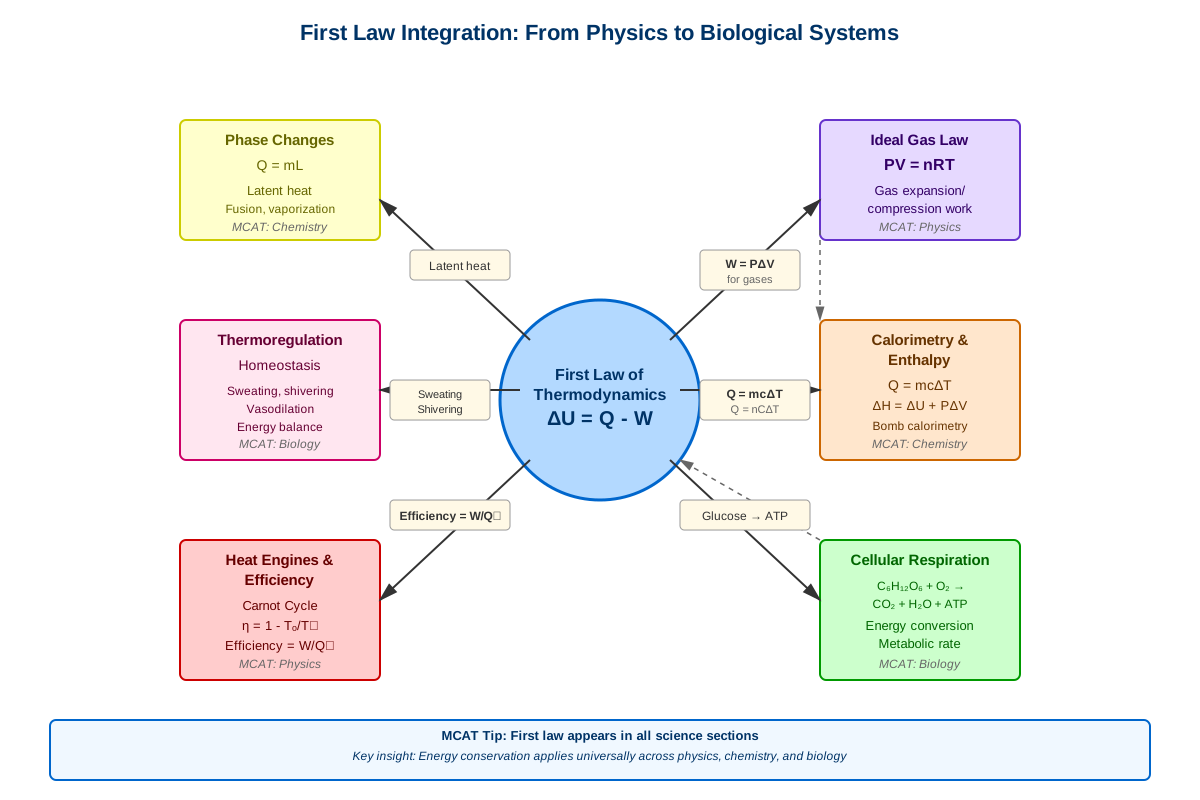
Overview
The First law of thermodynamics physics represents one of the most fundamental principles governing energy transformations in the universe. This law, also known as the law of conservation of energy, states that energy cannot be created or destroyed—only converted from one form to another. In the context of thermodynamics and gases, this principle becomes particularly relevant when analyzing how systems exchange energy with their surroundings through heat transfer and mechanical work. For MCAT preparation, understanding this law provides the foundation for analyzing biological processes, from cellular respiration to muscle contraction, and forms the basis for solving quantitative problems involving energy changes in physical systems.
The First law of thermodynamics MCAT questions typically require students to track energy flow between a system and its surroundings, calculate work done by or on gases, and determine changes in internal energy. This topic bridges multiple disciplines tested on the MCAT: it connects directly to biochemistry (metabolic pathways and ATP synthesis), biology (homeostasis and thermoregulation), and general chemistry (enthalpy and calorimetry). The mathematical formulation of the first law—ΔU = Q - W—appears frequently in both passage-based and discrete questions, making it essential for achieving competitive scores in the Chemical and Physical Foundations of Biological Systems section.
Within the broader framework of Physics, the first law of thermodynamics connects energy conservation principles to practical applications involving heat engines, refrigerators, and biological systems. It serves as the quantitative tool that allows us to predict how systems respond to energy inputs and outputs, making it indispensable for understanding everything from atmospheric phenomena to the energetics of human metabolism. Mastery of this topic enables students to approach complex multi-step problems systematically and confidently.
Learning Objectives
- [ ] Define First law of thermodynamics physics using accurate Physics terminology
- [ ] Explain why First law of thermodynamics physics matters for the MCAT
- [ ] Apply First law of thermodynamics physics to exam-style questions
- [ ] Identify common mistakes related to First law of thermodynamics physics
- [ ] Connect First law of thermodynamics physics to related Physics concepts
- [ ] Calculate changes in internal energy given heat transfer and work values with correct sign conventions
- [ ] Distinguish between different thermodynamic processes (isothermal, adiabatic, isobaric, isochoric) and apply the first law to each
- [ ] Interpret pressure-volume (PV) diagrams to determine work done and relate them to the first law
Prerequisites
- Basic algebra and equation manipulation: Required to rearrange the first law equation and solve for unknown variables in multi-step problems
- Understanding of energy and work concepts: Foundation for recognizing different forms of energy and how mechanical work relates to force and displacement
- Familiarity with the ideal gas law (PV = nRT): Necessary for connecting pressure, volume, and temperature changes in thermodynamic processes
- Knowledge of heat and temperature: Essential for distinguishing between thermal energy transfer and the measure of average kinetic energy
- Sign conventions in physics: Critical for correctly applying positive and negative values to heat and work in thermodynamic calculations
Why This Topic Matters
The First law of thermodynamics physics appears consistently across MCAT administrations, typically in 2-4 questions per exam. These questions may appear as discrete items testing direct application of ΔU = Q - W, or more commonly, embedded within passages describing biological systems, heat engines, or experimental setups involving gas expansion or compression. Understanding this topic is crucial because it provides the quantitative framework for analyzing energy transformations that underlie virtually all biological processes.
From a clinical and real-world perspective, the first law governs phenomena ranging from how the human body maintains thermal equilibrium through metabolic heat production to how medical devices like ventilators and anesthesia machines control gas volumes and pressures. Physicians must understand energy balance when treating patients with metabolic disorders, hypothermia, or hyperthermia. The principle also explains why calorimetry can accurately measure the energy content of foods and why certain medical procedures require careful thermal management.
On the MCAT, this topic commonly appears in passages involving: (1) experimental setups with pistons and cylinders where gases expand or compress, (2) biological contexts describing cellular respiration or muscle contraction efficiency, (3) heat engine cycles and their efficiency, and (4) phase transitions and calorimetry experiments. Questions often require students to integrate multiple concepts, such as combining the first law with ideal gas law relationships or interpreting graphical data from PV diagrams. The ability to quickly identify which thermodynamic process is occurring and apply the appropriate simplification of the first law equation is a high-yield skill that distinguishes top-scoring students.
Core Concepts
The First Law Equation and Its Components
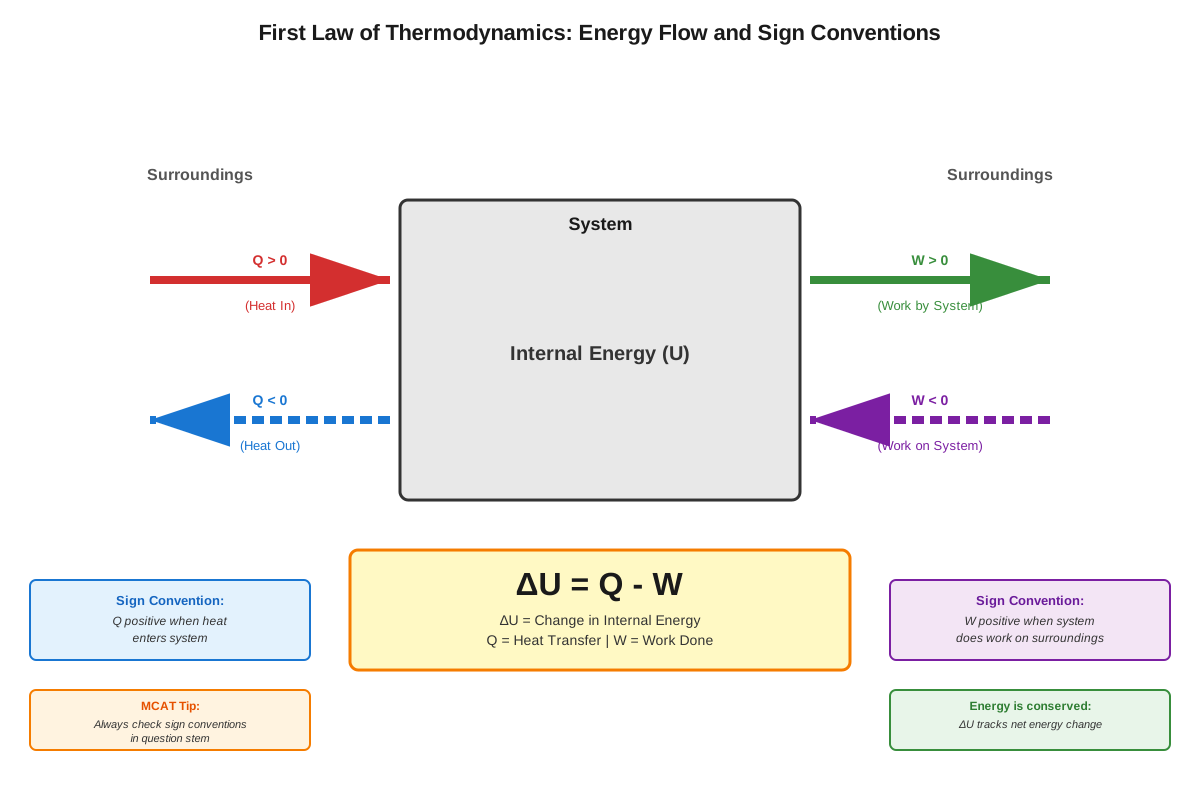
The First law of thermodynamics is mathematically expressed as:
ΔU = Q - WWhere:
- ΔU (delta U) represents the change in internal energy of the system
- Q represents heat transferred to or from the system
- W represents work done by or on the system
The internal energy of a system encompasses all microscopic forms of energy, including the kinetic energy of molecular motion (translational, rotational, and vibrational) and potential energy from intermolecular forces. For an ideal gas, internal energy depends only on temperature and is directly proportional to it. When temperature increases, internal energy increases; when temperature decreases, internal energy decreases.
Sign Conventions: The Critical Detail
Understanding sign conventions is absolutely essential for correctly applying the first law. The MCAT uses the following standard conventions:
| Quantity | Positive (+) | Negative (-) |
|---|---|---|
| Q (Heat) | Heat flows INTO the system | Heat flows OUT OF the system |
| W (Work) | Work done BY the system (expansion) | Work done ON the system (compression) |
| ΔU (Internal Energy) | Internal energy increases | Internal energy decreases |
Many students struggle with the work sign convention because it differs from some textbooks. Remember: when a gas expands and pushes against external pressure, it does work on the surroundings, losing energy, so W is positive and ΔU decreases (assuming no heat input). Conversely, when a gas is compressed, work is done on it, W is negative, and ΔU increases (assuming no heat loss).
Work in Thermodynamic Processes
For a gas expanding or compressing against external pressure, work is calculated as:
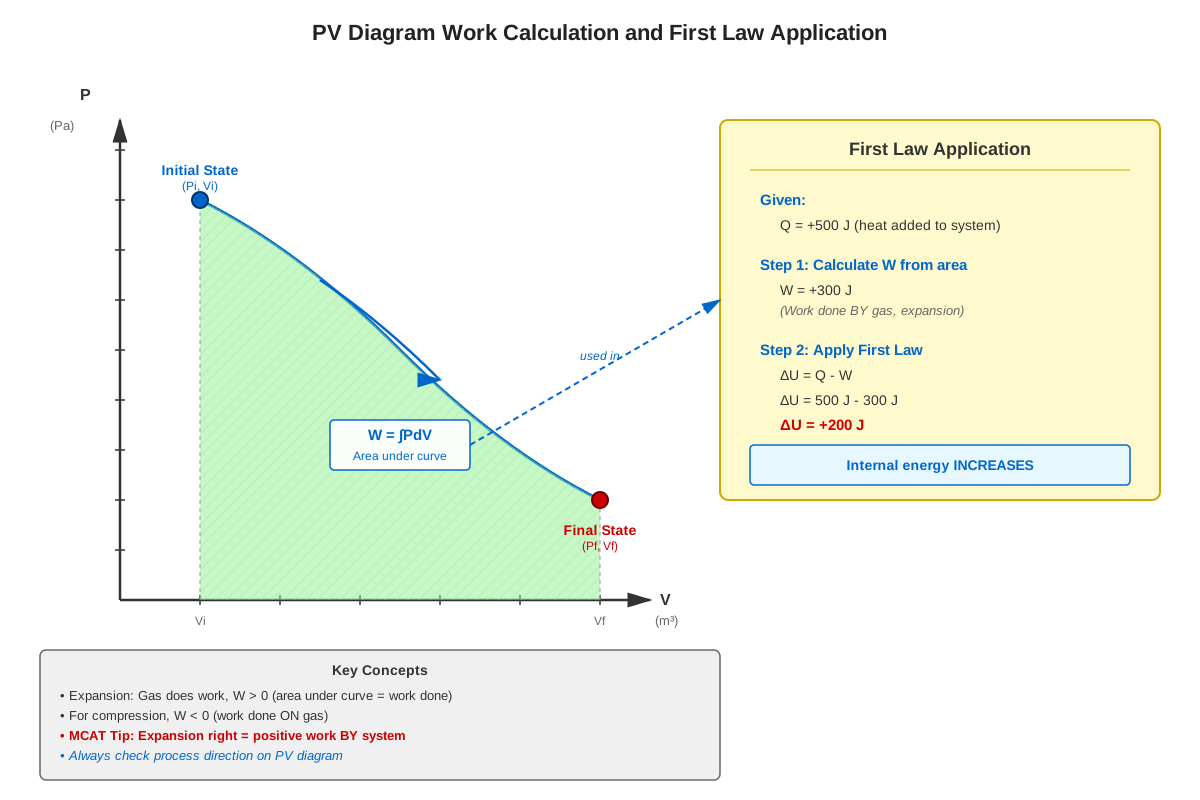
W = PΔV = P(V_f - V_i)For constant pressure processes, this simplification applies directly. For processes where pressure changes, work equals the area under the curve on a pressure-volume (PV) diagram. The geometric interpretation is crucial for MCAT questions:
- Expansion (V increases): Area under curve represents positive work done by the gas
- Compression (V decreases): Area under curve represents negative work (work done on the gas)
- Cyclic processes: Net work equals the area enclosed by the cycle
Special Thermodynamic Processes
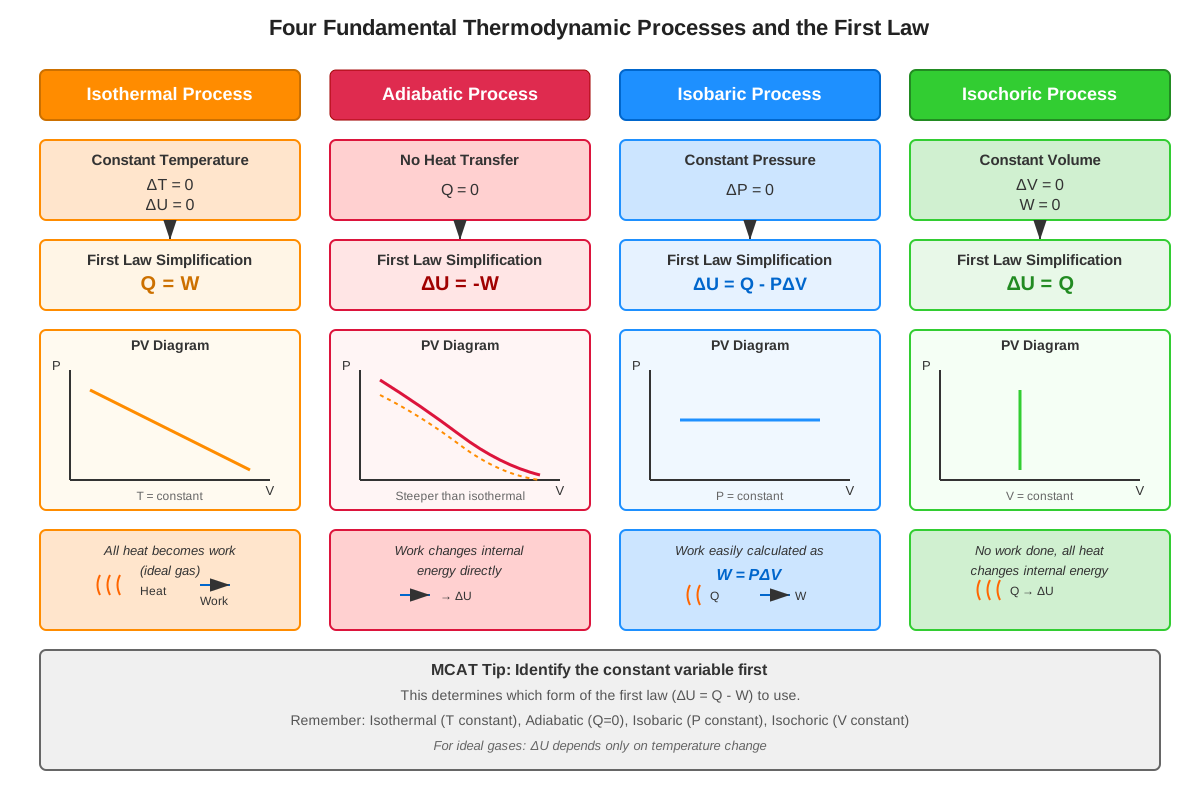
Understanding how the first law simplifies for different processes is high-yield for the MCAT:
Isothermal Process (Constant Temperature)
In an isothermal process, temperature remains constant. For an ideal gas, if T is constant, then ΔU = 0 (since internal energy depends only on temperature). The first law becomes:
0 = Q - W → Q = WThis means all heat added to the system is converted to work, or all work done on the system is released as heat. Isothermal processes occur slowly, allowing thermal equilibrium with surroundings.
Adiabatic Process (No Heat Transfer)
In an adiabatic process, no heat is exchanged with surroundings (Q = 0). This occurs when a system is thermally insulated or when processes happen so rapidly that heat doesn't have time to transfer. The first law becomes:
ΔU = -WFor adiabatic expansion, the gas does work (W > 0), so ΔU < 0 and temperature decreases. For adiabatic compression, work is done on the gas (W < 0), so ΔU > 0 and temperature increases. This explains why a bicycle pump gets hot when you compress air rapidly.
Isobaric Process (Constant Pressure)
In an isobaric process, pressure remains constant. Work is simply W = PΔV. The first law retains all three terms:
ΔU = Q - PΔVMany biological processes approximate isobaric conditions since they occur at atmospheric pressure. The heat transferred in an isobaric process relates to enthalpy change (ΔH), a concept that bridges thermodynamics and chemistry.
Isochoric Process (Constant Volume)
In an isochoric process, volume remains constant, so ΔV = 0 and therefore W = 0. The first law simplifies to:
ΔU = QAll heat transferred directly changes the internal energy. This occurs in rigid containers where volume cannot change. For an ideal gas in an isochoric process, Q = nC_vΔT, where C_v is the molar heat capacity at constant volume.
Energy Conservation and System Analysis
The first law is fundamentally a statement of energy conservation: energy entering a system (as heat or work) must either increase the system's internal energy or leave the system (as heat or work). When analyzing any thermodynamic problem, the systematic approach involves:
- Define the system: Clearly identify what constitutes the system versus surroundings
- Identify the process type: Determine which quantity (P, V, T, or Q) remains constant or zero
- Assign signs carefully: Use conventions consistently for Q and W
- Apply the appropriate form: Use the simplified first law equation for the specific process
- Check reasonableness: Verify that energy changes make physical sense
Connection to Ideal Gas Law
The ideal gas law (PV = nRT) frequently combines with the first law in MCAT problems. For example, in an isothermal expansion of an ideal gas:
- Temperature constant → ΔU = 0
- PV = nRT → if T is constant, then PV is constant
- As V increases, P must decrease proportionally
- Q = W, and both can be calculated from the PV relationship
This integration of concepts is exactly what the MCAT tests—the ability to synthesize multiple principles to solve complex problems.
Concept Relationships
The First law of thermodynamics serves as a central hub connecting multiple physics and chemistry concepts. At its core, it represents the principle of energy conservation applied specifically to thermal systems, which itself derives from the broader law of conservation of energy in mechanics.
The relationship flows as follows: Energy conservation → First law of thermodynamics → Specific thermodynamic processes (isothermal, adiabatic, isobaric, isochoric) → Applications (heat engines, biological systems, phase transitions).
Within the topic itself, the three components (ΔU, Q, and W) are interdependent. Changes in internal energy result from the net effect of heat transfer and work. The ideal gas law connects to the first law by relating pressure, volume, and temperature—variables that appear in both equations. When temperature changes, both internal energy (in the first law) and the PV product (in the ideal gas law) change correspondingly.
The first law connects backward to prerequisite topics: work from mechanics (W = Fd) extends to thermodynamic work (W = PΔV), and kinetic theory explains why internal energy relates to temperature. It connects forward to more advanced topics: the second law of thermodynamics (entropy and spontaneity), enthalpy (heat transfer at constant pressure), and Gibbs free energy (spontaneity of chemical reactions).
In biological contexts, the first law underlies metabolic energy balance: food energy (Q in) converts to work (muscle contraction, biosynthesis) and heat (maintaining body temperature), with any excess stored as chemical potential energy (ΔU). This same framework applies to cellular respiration, where glucose oxidation releases energy that cells partition between ATP synthesis (stored energy) and heat production.
Quick check — test yourself on First law of thermodynamics physics so far.
Try Flashcards →High-Yield Facts
⭐ The first law equation is ΔU = Q - W, where positive Q means heat into the system and positive W means work done by the system
⭐ For an ideal gas, internal energy depends only on temperature; if ΔT = 0, then ΔU = 0 regardless of pressure or volume changes
⭐ In an isothermal process (constant T), ΔU = 0, so Q = W; all heat input converts to work output
⭐ In an adiabatic process (Q = 0), ΔU = -W; work done by the gas decreases its internal energy and temperature
⭐ In an isochoric process (constant V), W = 0, so ΔU = Q; all heat transfer changes internal energy directly
- In an isobaric process (constant P), work is calculated as W = PΔV, and the first law includes all three terms
- Work on a PV diagram equals the area under the curve; expansion gives positive work, compression gives negative work
- When a gas expands adiabatically, it cools because internal energy converts to work without heat input to compensate
- When a gas is compressed adiabatically, it heats because work input increases internal energy without heat loss to compensate
- The first law applies to all processes, reversible or irreversible, and to all substances, not just ideal gases
- In cyclic processes where the system returns to its initial state, ΔU = 0 for the complete cycle, so Q_net = W_net
- Heat capacity at constant volume (C_v) relates to internal energy changes: ΔU = nC_vΔT for any process
Common Misconceptions
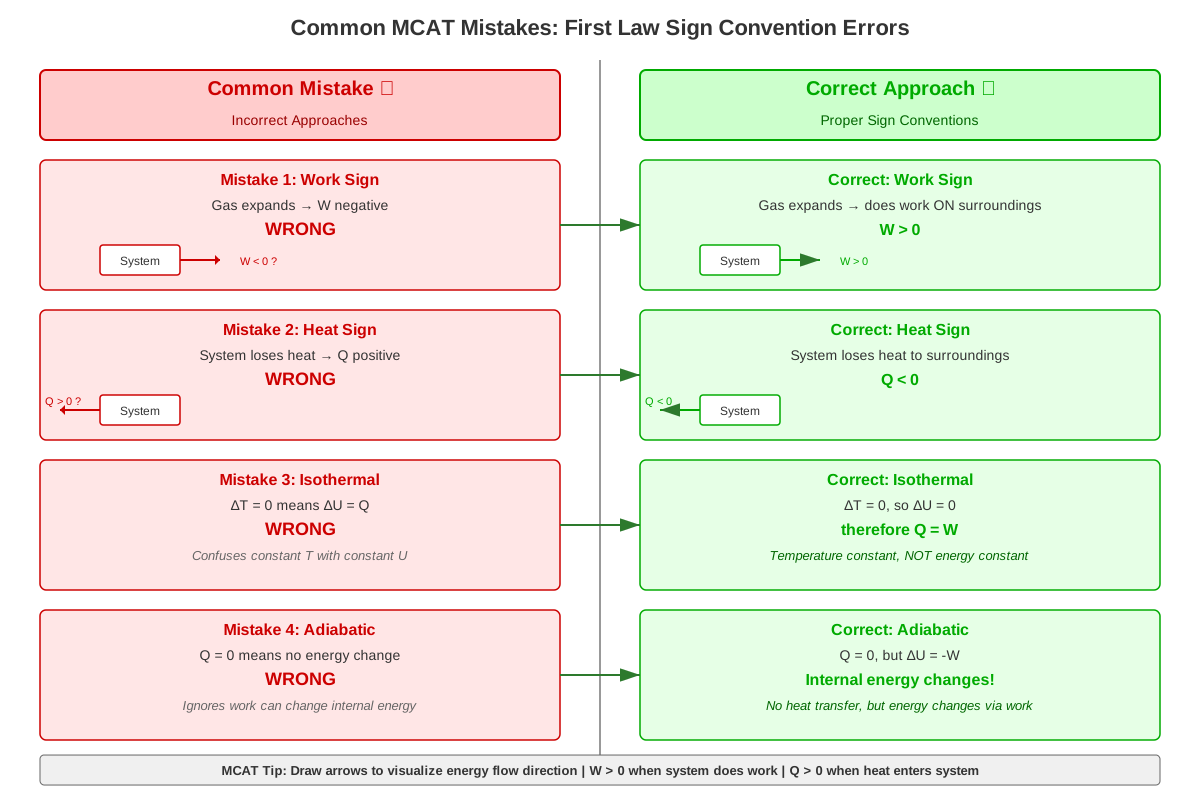
Misconception: Heat and temperature are the same thing, so adding heat always increases temperature.
Correction: Heat (Q) is energy transfer, while temperature measures average kinetic energy. In an isothermal process, heat is added but temperature remains constant because the energy converts entirely to work. In phase transitions, heat is added without temperature change as energy breaks intermolecular bonds.
Misconception: Work is always positive when a force is applied.
Correction: In thermodynamics, work sign depends on direction relative to the system. Work done BY the system (expansion) is positive; work done ON the system (compression) is negative. This convention ensures energy accounting is correct: when a gas expands and does work, it loses energy (ΔU decreases if no heat is added).
Misconception: If ΔU = 0, then nothing happened to the system.
Correction: ΔU = 0 means the system returned to its original internal energy state, but significant processes may have occurred. In an isothermal expansion, the gas changes volume and pressure dramatically, with heat input exactly balancing work output, yet ΔU = 0 because temperature is unchanged.
Misconception: Adiabatic means no energy changes occur.
Correction: Adiabatic means no heat transfer (Q = 0), but work and internal energy changes definitely occur. In adiabatic compression, work input increases internal energy and temperature significantly. The term "adiabatic" refers only to the absence of heat transfer, not the absence of energy changes.
Misconception: The first law only applies to gases.
Correction: The first law is universal and applies to all systems—solids, liquids, gases, and even biological organisms. While MCAT problems often feature gases because their behavior is mathematically tractable, the principle ΔU = Q - W governs energy changes in any system, including human metabolism and chemical reactions.
Misconception: Internal energy and temperature are completely independent variables.
Correction: For an ideal gas, internal energy is directly proportional to absolute temperature (U ∝ T). However, for real substances, internal energy also includes potential energy from intermolecular forces, so the relationship is more complex. Still, temperature change generally indicates internal energy change for any substance.
Worked Examples
Example 1: Isothermal Expansion of an Ideal Gas
Problem: An ideal gas undergoes an isothermal expansion at 300 K. During this process, the gas absorbs 500 J of heat from the surroundings. Calculate: (a) the change in internal energy, (b) the work done by the gas, and (c) explain the energy transformation.
Solution:
Step 1: Identify the process type
The problem states "isothermal," meaning constant temperature (T = 300 K throughout).
Step 2: Determine ΔU
For an ideal gas, internal energy depends only on temperature. Since T is constant:
ΔU = 0Step 3: Apply the first law
ΔU = Q - W
0 = Q - W
W = Q
Step 4: Calculate work
Given Q = +500 J (heat absorbed by the system is positive):
W = 500 JStep 5: Interpret the result
The positive work value means the gas did 500 J of work on the surroundings by expanding. The energy transformation: heat energy from surroundings → work done by gas expansion. The internal energy remained constant because the temperature didn't change; all absorbed heat converted to mechanical work.
Key takeaway: In isothermal processes for ideal gases, heat and work are equal in magnitude, and internal energy doesn't change. This demonstrates perfect conversion of thermal energy to mechanical energy.
Example 2: Adiabatic Compression with Temperature Change
Problem: A gas in a thermally insulated cylinder is compressed rapidly by a piston. The work done on the gas is 300 J. The gas contains 2 moles, and its molar heat capacity at constant volume is C_v = 20 J/(mol·K). Calculate: (a) the change in internal energy, (b) the heat transferred, and (c) the temperature change.
Solution:
Step 1: Identify the process type
"Thermally insulated" and "rapidly" indicate an adiabatic process (Q = 0).
Step 2: Determine Q
For an adiabatic process:
Q = 0Step 3: Apply the first law
ΔU = Q - W = 0 - W = -WStep 4: Calculate ΔU
Work done ON the gas means W is negative (by convention):
W = -300 J
ΔU = -(-300 J) = +300 J
The internal energy increases by 300 J.
Step 5: Calculate temperature change
For any process involving an ideal gas:
ΔU = nC_vΔT
300 J = (2 mol)(20 J/(mol·K))ΔT
300 = 40ΔT
ΔT = 7.5 K
Step 6: Interpret the result
The temperature increased by 7.5 K because compression work increased the internal energy. No heat was transferred (adiabatic), so all the work input converted directly to increased molecular kinetic energy, manifesting as higher temperature. This explains why pumping air into a tire makes the pump warm.
Key takeaway: In adiabatic processes, work directly changes internal energy and temperature. Compression increases temperature; expansion decreases temperature. This principle underlies diesel engines and atmospheric phenomena.
Exam Strategy
When approaching First law of thermodynamics MCAT questions, follow this systematic strategy:
1. Identify the process type immediately
Look for keywords: "isothermal" (constant T), "adiabatic" or "insulated" (Q = 0), "constant pressure" (isobaric), "rigid container" (isochoric). This determines which simplification of the first law to use and saves calculation time.
2. Watch for sign convention triggers
- "Heat absorbed" or "heat added" → Q is positive
- "Heat released" or "heat lost" → Q is negative
- "Gas expands" or "work done by gas" → W is positive
- "Gas compressed" or "work done on gas" → W is negative
3. Use process-of-elimination based on physical reasoning
If a question asks about temperature change in an isothermal process, immediately eliminate any answer showing ΔT ≠ 0. If a question describes adiabatic expansion, eliminate answers showing temperature increase (it must decrease).
4. Check for ideal gas assumptions
Most MCAT problems assume ideal gas behavior unless stated otherwise. This means internal energy depends only on temperature, and you can use ΔU = nC_vΔT when needed.
5. Draw quick PV diagrams for visualization
Even a rough sketch helps identify whether work is positive or negative and whether the process involves expansion or compression. The area under the curve represents work magnitude.
6. Time allocation
Straightforward first law calculations should take 30-45 seconds. If you're spending more than 90 seconds, you may be overcomplicating the problem. Look for the simplification based on process type.
7. Common question formats
- Direct calculation: Given two of three variables (ΔU, Q, W), find the third
- Process identification: Describe what happens in a specific thermodynamic process
- Graph interpretation: Analyze PV diagrams to determine work and relate to first law
- Conceptual application: Explain biological or mechanical systems using first law principles
Exam Tip: If a passage describes a complex system, focus on energy flow. Ask: Where does energy enter? Where does it leave? What form does it take? This framework applies the first law systematically.
Memory Techniques
Mnemonic for sign conventions: "HIBO-WOBO"
- Heat In = Boost (positive)
- Heat Out = Bust (negative)
- Work Out (done by system) = Boost W (positive)
- Work In (done on system) = Bust W (negative)
Acronym for special processes: "I-A-I-I" (pronounced "eye-ay-eye-eye")
- Isothermal: ΔU = 0, Q = W
- Adiabatic: Q = 0, ΔU = -W
- Isobaric: W = PΔV, all terms present
- Isochoric: W = 0, ΔU = Q
Visualization for work sign
Picture a gas in a cylinder with a piston:
- Expansion: Gas pushes piston outward → gas loses energy doing work → W positive, ΔU decreases
- Compression: Piston pushes inward on gas → gas gains energy from work → W negative, ΔU increases
Memory phrase for the first law
"Understand Quickly: Work matters"
This reminds you of the equation ΔU = Q - W and the importance of work sign.
Temperature-Internal Energy Connection
For ideal gases, remember: "Temperature Tells U (internal energy)"
If temperature is constant (isothermal), internal energy is constant (ΔU = 0).
Summary
The First law of thermodynamics is the principle of energy conservation applied to thermal systems, mathematically expressed as ΔU = Q - W. This equation states that the change in a system's internal energy equals the heat transferred to the system minus the work done by the system. Mastering sign conventions is critical: positive Q means heat flows into the system, positive W means the system does work on surroundings. For ideal gases, internal energy depends only on temperature, which simplifies analysis considerably. The first law takes special forms for different processes: isothermal (ΔU = 0, Q = W), adiabatic (Q = 0, ΔU = -W), isobaric (W = PΔV), and isochoric (W = 0, ΔU = Q). On PV diagrams, work equals the area under the curve. This principle applies universally—to heat engines, biological metabolism, and all energy transformations—making it essential for MCAT success in both physics and biological contexts.
Key Takeaways
- The first law equation ΔU = Q - W quantifies energy conservation in thermodynamic systems, with specific sign conventions for heat and work
- For ideal gases, internal energy depends only on temperature; constant temperature means ΔU = 0 regardless of pressure or volume changes
- Each special process (isothermal, adiabatic, isobaric, isochoric) has a simplified form of the first law that accelerates problem-solving
- Work on PV diagrams equals the area under the curve; expansion produces positive work, compression produces negative work
- Adiabatic processes involve no heat transfer but significant temperature changes due to work-energy conversion
- The first law applies to all systems including biological organisms, where metabolic energy balance follows ΔU = Q - W
- Systematic problem-solving requires identifying the process type, applying correct sign conventions, and using the appropriate simplified equation
Related Topics
Second Law of Thermodynamics and Entropy: Builds on the first law by introducing the concept of entropy and explaining why certain processes are irreversible and spontaneous. Understanding the first law is essential before tackling entropy and the direction of spontaneous change.
Enthalpy and Thermochemistry: Enthalpy (H = U + PV) relates to heat transfer at constant pressure, directly connecting to the first law. Mastering ΔU = Q - W enables understanding of ΔH and its role in chemical reactions.
Heat Engines and Efficiency: Applications of the first law to cyclic processes where heat converts to work. The first law provides the foundation for calculating engine efficiency and understanding the Carnot cycle.
Kinetic Molecular Theory: Explains the microscopic basis for internal energy and temperature, providing the molecular interpretation of the macroscopic first law.
Calorimetry and Specific Heat: Practical applications of the first law to measuring heat transfer and calculating temperature changes in substances, bridging physics and chemistry.
Practice CTA
Now that you've mastered the core concepts of the First law of thermodynamics, it's time to solidify your understanding through active practice. Attempt the practice questions to test your ability to apply ΔU = Q - W in various contexts, and use the flashcards to reinforce sign conventions and special process simplifications. Remember, the difference between understanding a concept and scoring points on the MCAT lies in repeated application under timed conditions. You've built the foundation—now strengthen it through deliberate practice. Every problem you solve increases your confidence and speed for test day!
Sign up free to keep reading
Create a free AnvayaPrep account to finish this MCAT guide on First law of thermodynamics physics — plus flashcards and practice questions.