Overview
Phase changes represent one of the most fundamental concepts in thermodynamics, describing the transformations that matter undergoes when transitioning between solid, liquid, and gas states. On the MCAT, understanding phase changes is essential not only for Physics questions but also for interpreting passages in the Chemical and Physical Foundations of Biological Systems section. These transformations involve energy transfer without temperature change during the transition itself—a counterintuitive concept that frequently appears in exam questions designed to test conceptual understanding rather than mere calculation ability.
The study of phase changes Physics encompasses both qualitative and quantitative aspects. Students must grasp the molecular-level mechanisms driving these transitions, the thermodynamic principles governing energy flow, and the mathematical relationships that predict system behavior. Phase changes MCAT questions often integrate multiple concepts from Thermodynamics and Gases, requiring students to apply principles of heat transfer, energy conservation, and molecular kinetics simultaneously. This integration makes phase changes a medium-difficulty topic that serves as a bridge between basic thermodynamics and more complex applications.
Understanding phase changes provides crucial context for biological and chemical processes tested on the MCAT. From the evaporative cooling mechanism that regulates body temperature to the behavior of anesthetic gases, phase transitions appear throughout the exam in both obvious and subtle ways. Mastery of this topic enables students to approach interdisciplinary passages with confidence, recognizing when phase change principles apply even when not explicitly stated in the question stem.
Learning Objectives
- [ ] Define Phase changes using accurate Physics terminology
- [ ] Explain why Phase changes matters for the MCAT
- [ ] Apply Phase changes to exam-style questions
- [ ] Identify common mistakes related to Phase changes
- [ ] Connect Phase changes to related Physics concepts
- [ ] Calculate the energy required for complete phase transitions using latent heat values
- [ ] Interpret heating curves and identify regions of temperature change versus phase change
- [ ] Predict the direction of phase transitions based on pressure and temperature conditions
- [ ] Distinguish between heat of fusion and heat of vaporization and explain their relative magnitudes
Prerequisites
- Basic thermodynamics principles: Understanding heat, temperature, and energy transfer provides the foundation for analyzing energy changes during phase transitions
- Kinetic molecular theory: Knowledge of molecular motion and intermolecular forces explains why substances change phase under different conditions
- States of matter: Familiarity with solid, liquid, and gas properties enables recognition of the characteristics that distinguish each phase
- Heat capacity and specific heat: These concepts are essential for calculating temperature changes that occur before and after phase transitions
- Energy conservation: The first law of thermodynamics governs all energy calculations involving phase changes
Why This Topic Matters
Phase changes appear regularly on the MCAT, typically in 2-4 questions per exam either as standalone items or embedded within longer passages. The topic's clinical relevance makes it particularly valuable for the exam's emphasis on real-world applications. Evaporative cooling explains thermoregulation through perspiration, a concept that bridges physics and biology. Anesthesiology relies on understanding vapor pressure and the transition of liquid anesthetics to gaseous form. Cryotherapy and hypothermia protocols require knowledge of heat extraction during freezing processes.
From an exam strategy perspective, phase change questions often appear in passages describing experimental setups involving heating or cooling of substances. These passages may present calorimetry experiments, distillation procedures, or environmental scenarios involving water's unique properties. The MCAT frequently tests whether students recognize that temperature remains constant during a phase transition despite continuous energy input—a conceptual understanding that separates high-scorers from average performers.
Phase change questions also serve as vehicles for testing graph interpretation skills, as heating curves provide rich opportunities for data analysis. Students must extract information from plateaus, slopes, and transition points while integrating mathematical calculations with conceptual understanding. This multi-layered approach to assessment makes phase changes a high-yield topic that rewards thorough preparation.
Core Concepts
Definition and Fundamental Principles
A phase change (also called a phase transition) is the transformation of matter from one state to another—solid to liquid, liquid to gas, or any reverse transition. During a phase change, substances absorb or release energy while maintaining constant temperature. This energy, called latent heat, breaks or forms intermolecular bonds rather than increasing molecular kinetic energy. The term "latent" means hidden, reflecting that this energy doesn't manifest as a temperature increase despite being absorbed by the system.
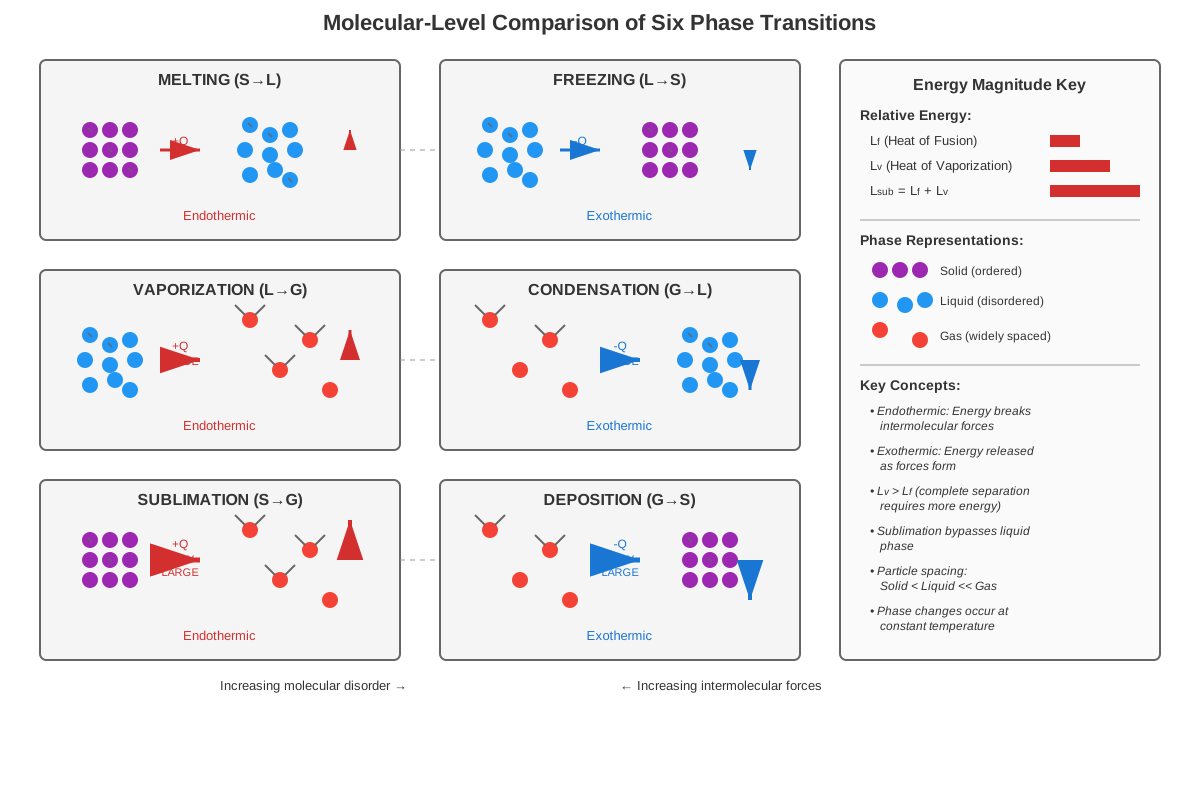
The six primary phase changes are:
- Melting (fusion): solid → liquid
- Freezing (solidification): liquid → solid
- Vaporization (evaporation/boiling): liquid → gas
- Condensation: gas → liquid
- Sublimation: solid → gas
- Deposition: gas → solid
Energy Requirements and Latent Heat
Two critical values characterize phase transitions: heat of fusion (Lf) and heat of vaporization (Lv). The heat of fusion represents the energy required to convert one unit mass of solid to liquid at the melting point. The heat of vaporization represents the energy needed to convert one unit mass of liquid to gas at the boiling point.
The energy required for a phase change is calculated using:
Q = mLWhere:
- Q = heat energy (J or cal)
- m = mass (kg or g)
- L = latent heat (J/kg or cal/g)
For water, the most commonly tested substance:
- Lf = 334 J/g (80 cal/g)
- Lv = 2260 J/g (540 cal/g)
The heat of vaporization is always significantly larger than the heat of fusion for any substance. This occurs because vaporization requires completely overcoming all intermolecular forces to separate molecules into the gas phase, while melting only requires partial disruption of the ordered solid structure.
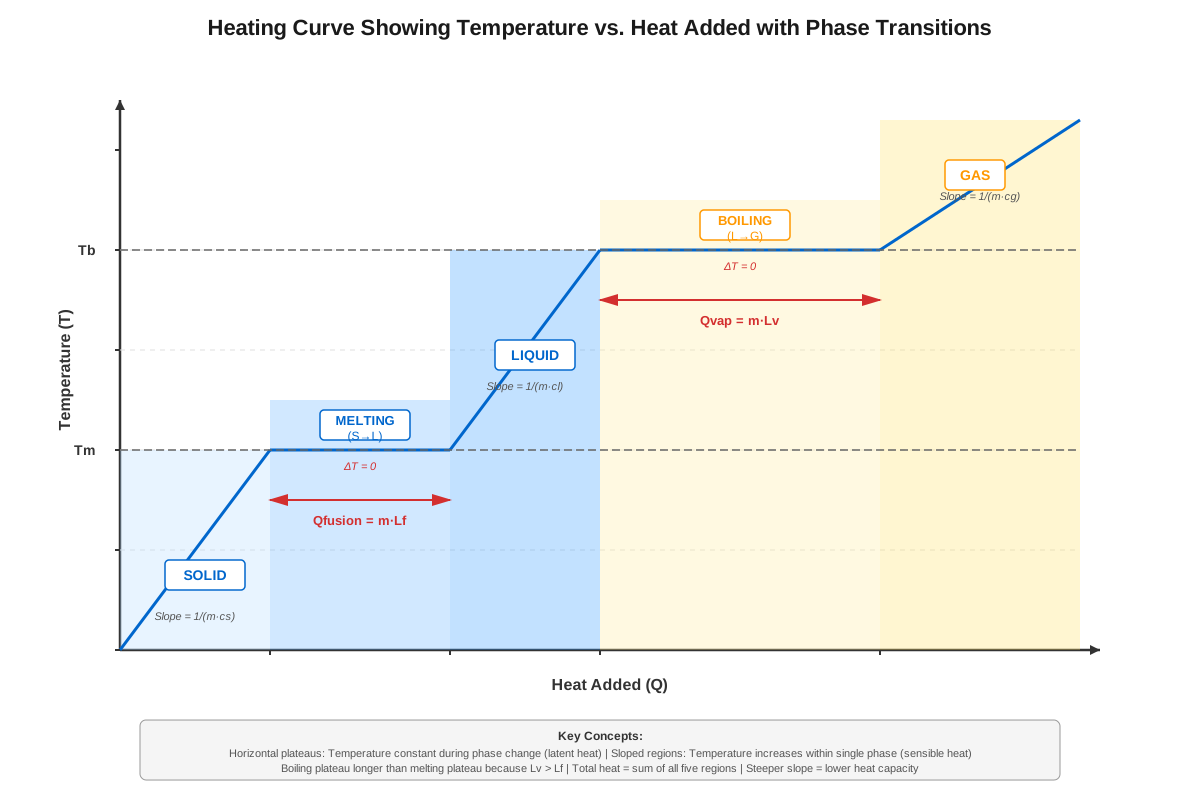
Heating Curves
A heating curve graphically represents temperature versus heat added to a system. These curves contain five distinct regions:
| Region | Process | Temperature Change | Energy Use |
|---|---|---|---|
| 1 | Heating solid | Increasing | Raising kinetic energy |
| 2 | Melting | Constant (at melting point) | Breaking intermolecular bonds |
| 3 | Heating liquid | Increasing | Raising kinetic energy |
| 4 | Vaporization | Constant (at boiling point) | Breaking intermolecular bonds |
| 5 | Heating gas | Increasing | Raising kinetic energy |
The slope of regions 1, 3, and 5 depends on the specific heat capacity of each phase. Steeper slopes indicate lower heat capacity (less energy needed per degree of temperature change). The horizontal plateaus at regions 2 and 4 represent phase transitions where temperature remains constant despite continuous energy input.
Molecular Perspective
At the molecular level, phase changes involve alterations in intermolecular forces and molecular arrangement. In solids, molecules occupy fixed positions with strong intermolecular attractions, vibrating in place. During melting, absorbed energy increases vibrational amplitude until molecules can slip past one another, creating the liquid phase's fluidity while maintaining close proximity.
Vaporization requires even more energy because molecules must completely separate and overcome all attractive forces. In the gas phase, molecules move independently with negligible intermolecular interactions. The reverse processes (freezing, condensation, deposition) release the same amount of energy that was absorbed during the forward transition, as energy is conserved.
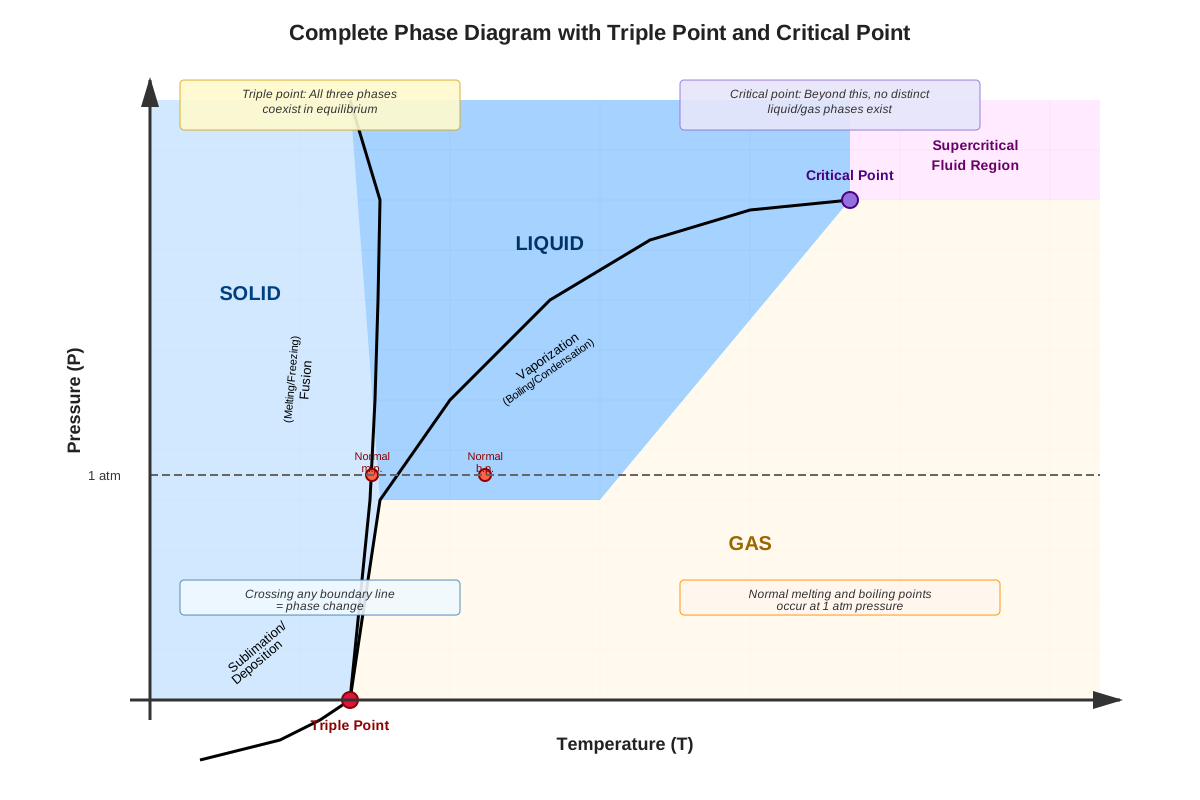
Pressure-Temperature Phase Diagrams
Phase diagrams map the conditions under which each phase exists, plotting pressure versus temperature. Three curves divide the diagram into regions corresponding to solid, liquid, and gas phases:
- Fusion curve: separates solid and liquid regions
- Vaporization curve: separates liquid and gas regions
- Sublimation curve: separates solid and gas regions
The triple point represents the unique pressure-temperature combination where all three phases coexist in equilibrium. The critical point marks the end of the vaporization curve, beyond which the distinction between liquid and gas disappears, creating a supercritical fluid.
For water, the fusion curve has a negative slope (unusual behavior), meaning ice melts under increased pressure at constant temperature. This explains why ice skating works—pressure from the blade melts ice, creating a lubricating water layer.
Vapor Pressure and Boiling
Vapor pressure is the pressure exerted by a vapor in equilibrium with its liquid phase. As temperature increases, more molecules have sufficient kinetic energy to escape the liquid surface, increasing vapor pressure. Boiling occurs when vapor pressure equals external atmospheric pressure, allowing bubbles to form throughout the liquid rather than just at the surface.
This principle explains why water boils at lower temperatures at high altitudes where atmospheric pressure is reduced. It also clarifies why pressure cookers work—increased pressure raises the boiling point, allowing water to reach higher temperatures before vaporizing.
Evaporation and Cooling
Evaporation differs from boiling in that it occurs at the liquid surface at any temperature below the boiling point. Only the highest-energy molecules escape, leaving behind lower-energy molecules and reducing the average kinetic energy of the remaining liquid. This process, called evaporative cooling, is crucial for biological temperature regulation through perspiration.
The rate of evaporation depends on:
- Temperature (higher temperature → faster evaporation)
- Surface area (larger area → faster evaporation)
- Air movement (wind increases evaporation)
- Humidity (lower humidity → faster evaporation)
Concept Relationships
Phase changes connect intimately with multiple thermodynamics concepts. Heat transfer mechanisms (conduction, convection, radiation) determine how energy reaches a substance to drive phase transitions. The first law of thermodynamics (energy conservation) ensures that energy absorbed during melting equals energy released during freezing for the same mass.
Specific heat capacity governs temperature changes between phase transitions, while latent heat governs the transitions themselves. Together, these concepts enable complete analysis of heating or cooling processes: Q_total = Q_temperature change + Q_phase change.
The relationship flows as: Molecular kinetic energy → determines → Temperature → influences → Phase state → affects → Physical properties (density, volume, compressibility). Changes in pressure and temperature → shift → Phase equilibrium → observable through → Phase diagrams.
Intermolecular forces (hydrogen bonding, dipole-dipole, London dispersion) → determine → Magnitude of latent heats → explains → Relative energy requirements for different substances. Stronger intermolecular forces require more energy to overcome, resulting in higher melting and boiling points.
The concept map extends to entropy: Phase transitions from solid → liquid → gas represent increasing disorder, with positive entropy changes. This connects to Gibbs free energy (ΔG = ΔH - TΔS), where phase transitions occur spontaneously when ΔG < 0.
Quick check — test yourself on Phase changes so far.
Try Flashcards →High-Yield Facts
⭐ Temperature remains constant during a phase change despite continuous energy input or removal
⭐ Heat of vaporization is always greater than heat of fusion for any substance (typically 5-10 times larger)
⭐ Water's heat of vaporization (2260 J/g) is approximately 7 times its heat of fusion (334 J/g)
⭐ Boiling occurs when vapor pressure equals atmospheric pressure, not at a fixed temperature
⭐ Evaporation causes cooling because high-energy molecules preferentially escape the liquid
- Phase changes are reversible processes that absorb energy in one direction and release the same amount in the reverse direction
- The horizontal plateaus on heating curves represent phase transitions where Q = mL applies
- Sublimation and deposition involve the largest energy changes because they skip the liquid phase entirely
- Increased pressure generally favors the denser phase (except for water's unusual ice-liquid transition)
- The triple point of water occurs at 0.01°C and 0.006 atm (611 Pa)
- Supercritical fluids exist beyond the critical point and have properties of both liquids and gases
- The slope of temperature-change regions on heating curves is inversely proportional to heat capacity
- Intermolecular force strength directly correlates with melting point, boiling point, and latent heat values
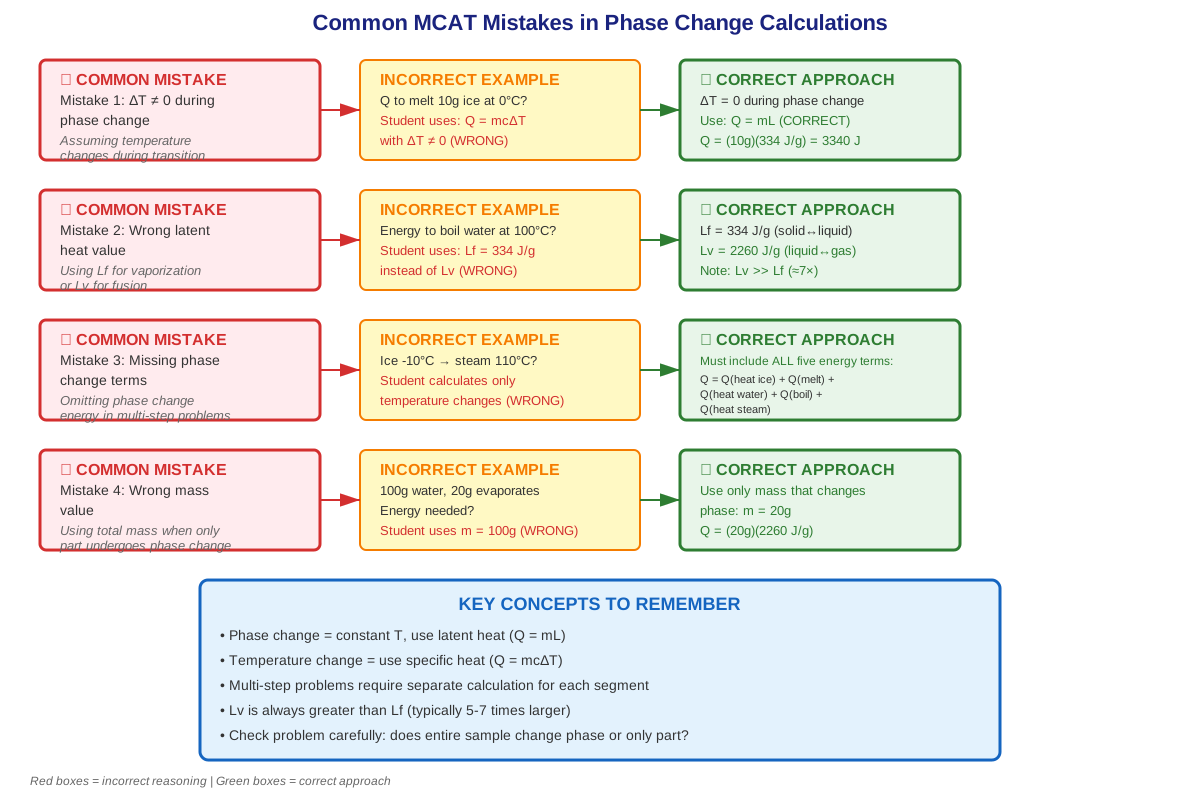
Common Misconceptions
Misconception: Temperature increases continuously when heat is added to a substance.
Correction: Temperature remains constant during phase transitions. The added energy breaks intermolecular bonds rather than increasing kinetic energy. Only after the phase change completes does temperature resume increasing.
Misconception: Heat of fusion and heat of vaporization are the same for a given substance.
Correction: Heat of vaporization is always significantly larger because complete molecular separation requires more energy than partial disruption of solid structure. For water, Lv ≈ 7 × Lf.
Misconception: Boiling always occurs at 100°C for water.
Correction: Boiling temperature depends on atmospheric pressure. Water boils at 100°C only at 1 atm pressure. At higher altitudes (lower pressure), water boils at lower temperatures.
Misconception: Evaporation and boiling are the same process.
Correction: Evaporation occurs at the liquid surface at any temperature and involves only high-energy molecules escaping. Boiling occurs throughout the liquid when vapor pressure equals atmospheric pressure, forming bubbles.
Misconception: The energy required to melt ice and heat the resulting water to 100°C is less than the energy to vaporize that water.
Correction: Vaporizing water at 100°C requires more energy than melting ice and heating to 100°C. For 1 g of water: melting + heating = 334 J + 418 J = 752 J, while vaporization = 2260 J.
Misconception: All substances expand when transitioning from solid to liquid.
Correction: Most substances expand upon melting, but water contracts (ice is less dense than liquid water) due to hydrogen bonding creating an open crystal structure in ice.
Misconception: Phase changes occur instantaneously.
Correction: Phase transitions require time for energy transfer and molecular rearrangement. The duration depends on heat transfer rate, mass, and latent heat value.
Worked Examples
Example 1: Complete Heating Process
Question: How much energy is required to convert 50 g of ice at -10°C to steam at 120°C? Use: c_ice = 2.09 J/g°C, c_water = 4.18 J/g°C, c_steam = 2.01 J/g°C, Lf = 334 J/g, Lv = 2260 J/g.
Solution:
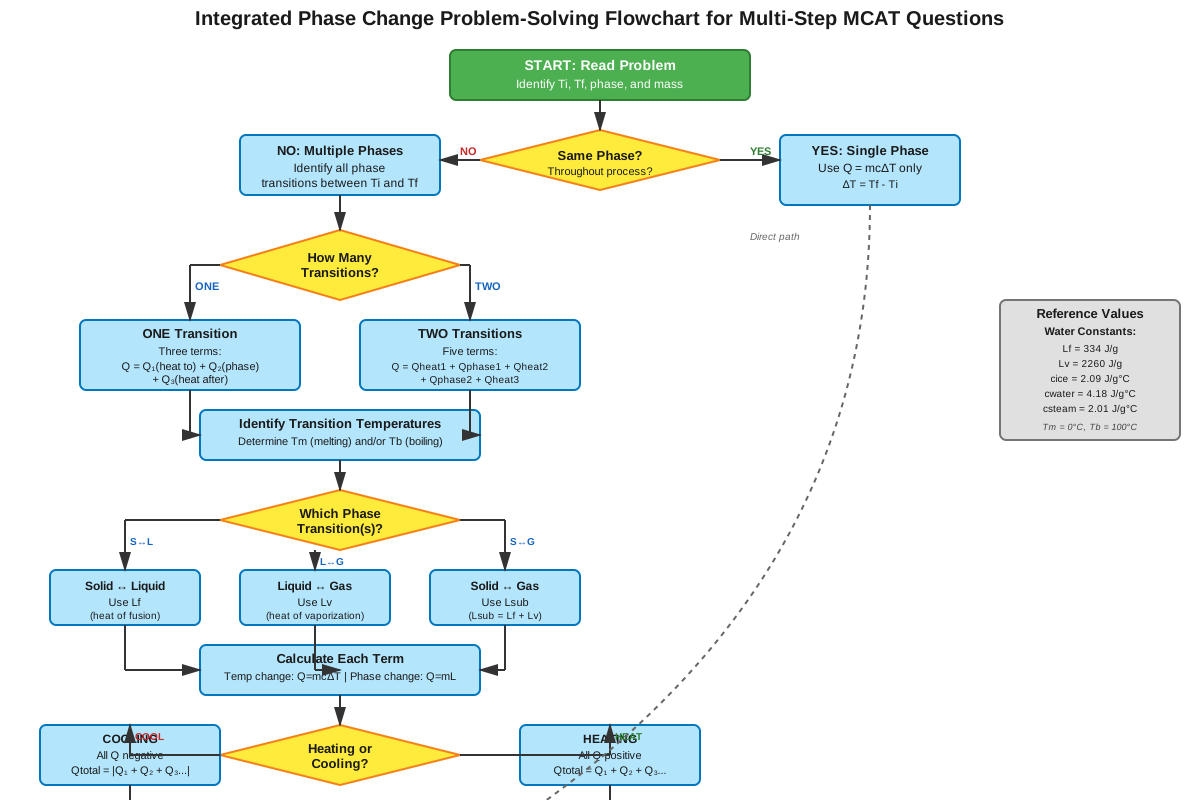
This problem requires five separate calculations corresponding to the five regions of a heating curve.
Step 1: Heat ice from -10°C to 0°C
Q₁ = mc_ice ΔT = (50 g)(2.09 J/g°C)(10°C) = 1,045 JStep 2: Melt ice at 0°C
Q₂ = mLf = (50 g)(334 J/g) = 16,700 JStep 3: Heat water from 0°C to 100°C
Q₃ = mc_water ΔT = (50 g)(4.18 J/g°C)(100°C) = 20,900 JStep 4: Vaporize water at 100°C
Q₄ = mLv = (50 g)(2260 J/g) = 113,000 JStep 5: Heat steam from 100°C to 120°C
Q₅ = mc_steam ΔT = (50 g)(2.01 J/g°C)(20°C) = 2,010 JTotal energy:
Q_total = Q₁ + Q₂ + Q₃ + Q₄ + Q₅ = 1,045 + 16,700 + 20,900 + 113,000 + 2,010 = 153,655 J ≈ 154 kJKey insight: Notice that vaporization (Q₄) accounts for approximately 73% of the total energy, demonstrating why heat of vaporization dominates in phase change calculations.
Example 2: Evaporative Cooling
Question: A person's skin temperature is 33°C. If 2.0 g of water evaporates from the skin surface, how much heat is removed from the body? Assume all energy comes from the body. (Lv at 33°C ≈ 2400 J/g)
Solution:
Step 1: Identify the process
This is evaporation at a temperature below the normal boiling point. The water absorbs energy from the skin to vaporize.
Step 2: Apply the latent heat equation
Q = mLv = (2.0 g)(2400 J/g) = 4,800 J = 4.8 kJStep 3: Interpret the result
The body loses 4.8 kJ of thermal energy through evaporative cooling. This heat removal lowers skin temperature, demonstrating the effectiveness of perspiration as a thermoregulatory mechanism.
Key insight: Evaporative cooling is highly efficient because the heat of vaporization is large. This explains why sweating effectively cools the body even when small amounts of water evaporate. The MCAT often tests this concept in passages about thermoregulation or heat stress.
Extension: If this person has a mass of 70 kg and the specific heat of human tissue is approximately 3.5 J/g°C, the temperature decrease would be:
ΔT = Q/(mc) = 4800 J / (70,000 g × 3.5 J/g°C) ≈ 0.02°CThis small change reflects that only a small portion of body mass is directly affected, but continuous evaporation over time produces significant cooling.
Exam Strategy
When approaching phase changes MCAT questions, first identify whether the question involves a single phase transition or a complete heating/cooling process spanning multiple phases. Look for trigger words like "melting," "boiling," "condensing," or "subliming" that indicate phase transitions, versus "heating" or "cooling" that suggest temperature changes.
Exam Tip: If a question provides a heating curve, immediately identify the five regions and determine which region the question addresses. Horizontal plateaus always indicate phase changes where Q = mL applies, while sloped regions indicate temperature changes where Q = mcΔT applies.
Process-of-elimination strategies work well for phase change questions. If an answer choice suggests temperature increases during a phase transition, eliminate it immediately. If a choice claims heat of fusion exceeds heat of vaporization, eliminate it. These fundamental principles never vary.
Watch for questions that test conceptual understanding rather than calculation. The MCAT frequently asks "why" questions: Why does evaporation cool a surface? Why does water boil at lower temperatures at high altitude? Why is steam more dangerous than boiling water at the same temperature? These require understanding energy transfer and molecular behavior, not just formula application.
Time management for phase change calculations: If a problem requires multiple steps (like Example 1 above), quickly sketch the five regions of a heating curve and label which calculations you need. This prevents missing steps and provides a clear roadmap. Allocate approximately 1.5-2 minutes for multi-step phase change calculations.
For passage-based questions, identify the experimental setup early. Is it calorimetry? Distillation? Phase diagram analysis? This context determines which concepts are most relevant. Passages often provide data tables or graphs—extract key values (melting point, boiling point, latent heats) before reading questions.
Memory Techniques
Mnemonic for phase changes requiring energy input (endothermic):
"My Very Silly" = Melting, Vaporization, Sublimation
The reverse processes (freezing, condensation, deposition) are exothermic and release energy.
Mnemonic for relative magnitudes:
"Vaporization Vastly Exceeds Fusion" reminds you that Lv >> Lf (typically 5-10 times larger)
Visualization strategy for heating curves:
Picture a staircase with two landings. The stairs represent temperature increases (sloped regions), while the landings represent phase changes (horizontal plateaus). The first landing (melting) is shorter than the second landing (vaporization), reflecting that vaporization requires more energy.
Acronym for evaporation rate factors:
TASH = Temperature, Air movement, Surface area, Humidity
Higher T, A, and S increase evaporation; higher H decreases it.
Memory aid for water's special properties:
"Water's Weird" = Water expands when freezing (ice floats), has unusually high heat of vaporization (effective cooling), and has a negative-slope fusion curve on phase diagrams.
Conceptual anchor:
Remember that phase changes involve breaking or forming bonds, not changing molecular speed. This single concept explains why temperature stays constant during transitions—the energy goes into potential energy (bond breaking) rather than kinetic energy (temperature).
Summary
Phase changes represent transformations between solid, liquid, and gas states that occur at constant temperature while energy is absorbed or released. The energy involved in these transitions, called latent heat, breaks or forms intermolecular bonds rather than changing molecular kinetic energy. Heat of fusion governs solid-liquid transitions, while heat of vaporization (always larger) governs liquid-gas transitions. Heating curves graphically display these processes, with horizontal plateaus indicating phase changes and sloped regions showing temperature changes. Understanding phase changes requires integrating molecular-level explanations with macroscopic observations and mathematical calculations. The MCAT tests this topic through direct calculations, heating curve interpretation, and conceptual questions about evaporative cooling, boiling point variations with pressure, and energy comparisons between different phase transitions. Mastery requires recognizing that temperature constancy during phase changes is the defining characteristic that distinguishes these processes from simple heating or cooling.
Key Takeaways
- Phase changes occur at constant temperature with energy going into breaking/forming intermolecular bonds, not increasing kinetic energy
- Heat of vaporization is always significantly larger than heat of fusion (for water: Lv ≈ 7 × Lf)
- Heating curves contain five regions: three sloped (temperature change, use Q = mcΔT) and two horizontal (phase change, use Q = mL)
- Boiling occurs when vapor pressure equals atmospheric pressure, explaining altitude effects on boiling point
- Evaporative cooling removes substantial energy because high-energy molecules preferentially escape, lowering average kinetic energy of remaining liquid
- Phase diagrams map pressure-temperature conditions for each phase, with triple point showing three-phase equilibrium
- Complete heating/cooling calculations require summing energy for all temperature changes and phase transitions
Related Topics
Thermodynamics and Heat Transfer: Understanding conduction, convection, and radiation mechanisms explains how energy reaches substances to drive phase changes. Mastering phase changes enables deeper analysis of calorimetry experiments.
Kinetic Molecular Theory: This topic provides the molecular foundation for phase behavior, explaining why temperature and pressure affect phase stability. Phase changes illustrate kinetic theory principles in action.
Intermolecular Forces: The strength of hydrogen bonding, dipole-dipole interactions, and London dispersion forces directly determines melting points, boiling points, and latent heat values. Understanding these forces explains why different substances have vastly different phase change characteristics.
Gas Laws and Vapor Pressure: The relationship between vapor pressure and boiling connects phase changes to gas behavior. This integration appears frequently in MCAT passages involving volatile liquids or gas collection experiments.
Entropy and Gibbs Free Energy: Phase transitions represent entropy changes (increasing disorder from solid to gas), connecting thermodynamics to spontaneity predictions. This advanced connection appears in higher-level MCAT questions.
Practice CTA
Now that you've mastered the core concepts of phase changes, reinforce your understanding by working through practice questions and flashcards. Focus on problems that require multi-step calculations across different phases, as these mirror the complexity of MCAT questions. Pay special attention to heating curve interpretation and conceptual questions about evaporative cooling—these high-yield topics appear frequently on the exam. Your thorough preparation on this foundational topic will pay dividends not only in direct phase change questions but also in passages integrating thermodynamics with biological and chemical systems. You've built a strong foundation—now apply it!
Sign up free to keep reading
Create a free AnvayaPrep account to finish this MCAT guide on Phase changes — plus flashcards and practice questions.