Overview
Temperature is one of the most fundamental concepts in Physics and serves as a cornerstone for understanding Thermodynamics and Gases on the MCAT. While students often encounter temperature in everyday life, the MCAT requires a precise, physics-based understanding that goes beyond the intuitive "hot versus cold" framework. Temperature represents the average kinetic energy of particles in a system and serves as the driving force for heat transfer, phase transitions, and countless physiological processes tested on the exam.
For the MCAT, temperature appears across multiple contexts within the Chemical and Physical Foundations of Biological Systems section. Questions may involve direct calculations using temperature scales, conceptual understanding of thermal equilibrium, or applications to biological systems such as enzyme kinetics, metabolic rate regulation, or the behavior of gases in the respiratory system. Understanding temperature is essential for mastering related topics including heat transfer, the ideal gas law, thermodynamic processes, and calorimetry—all of which appear regularly on the exam.
The significance of Temperature Physics extends beyond isolated calculations. Temperature connects mechanical concepts (kinetic energy of particles) to thermodynamic principles (entropy, enthalpy, and free energy), making it a bridge concept that integrates multiple areas of physics and chemistry. For Temperature MCAT preparation, students must develop fluency in converting between temperature scales, interpreting temperature changes in experimental passages, and recognizing how temperature affects reaction rates, equilibrium constants, and physical properties of matter. This topic typically appears in 3-5 questions per exam, either as the primary focus or as a necessary component of multi-step problems.
Learning Objectives
- [ ] Define Temperature using accurate Physics terminology
- [ ] Explain why Temperature matters for the MCAT
- [ ] Apply Temperature to exam-style questions
- [ ] Identify common mistakes related to Temperature
- [ ] Connect Temperature to related Physics concepts
- [ ] Convert fluently between Celsius, Fahrenheit, and Kelvin temperature scales
- [ ] Relate temperature to the kinetic theory of matter and particle motion
- [ ] Predict the direction of heat flow based on temperature differences
- [ ] Apply temperature concepts to biological systems and experimental scenarios
Prerequisites
- Basic algebra and unit conversions: Essential for converting between temperature scales and manipulating equations involving temperature
- Kinetic energy concepts: Temperature is fundamentally related to the average kinetic energy of particles in a system
- States of matter: Understanding solids, liquids, and gases provides context for how temperature affects particle behavior
- Energy conservation principles: Temperature changes involve energy transfer, requiring understanding of energy as a conserved quantity
Why This Topic Matters
Temperature plays a critical role in biological systems and medical contexts. Human thermoregulation maintains body temperature within a narrow range (approximately 37°C or 98.6°F) because enzymatic reactions, protein structures, and membrane fluidity are all temperature-dependent. Fever represents a regulated increase in body temperature that affects immune function and pathogen survival. Hypothermia and hyperthermia represent dangerous deviations that can lead to organ failure and death. Medical procedures such as cryotherapy, thermal ablation, and temperature-controlled drug storage all depend on precise temperature control.
On the MCAT, temperature appears in approximately 8-12% of physics passages and discrete questions. The exam tests temperature through multiple question formats: direct calculation problems requiring scale conversions, conceptual questions about thermal equilibrium and heat transfer, data interpretation from graphs showing temperature-dependent phenomena, and integrated passages combining temperature with gas laws, phase changes, or chemical kinetics. Temperature frequently appears in experimental passages describing calorimetry experiments, enzyme activity studies, or physical property measurements.
Common MCAT scenarios involving temperature include: analyzing temperature changes in calorimetry experiments, predicting gas behavior at different temperatures using the ideal gas law, interpreting enzyme kinetics data showing temperature-dependent reaction rates, understanding phase diagrams and transition temperatures, and evaluating thermal expansion effects. The exam particularly favors questions that require students to distinguish between temperature (intensive property) and heat (extensive property), recognize that temperature measures average kinetic energy rather than total energy, and apply temperature concepts to biological contexts such as metabolic rate or protein denaturation.
Core Concepts
Definition and Physical Meaning of Temperature
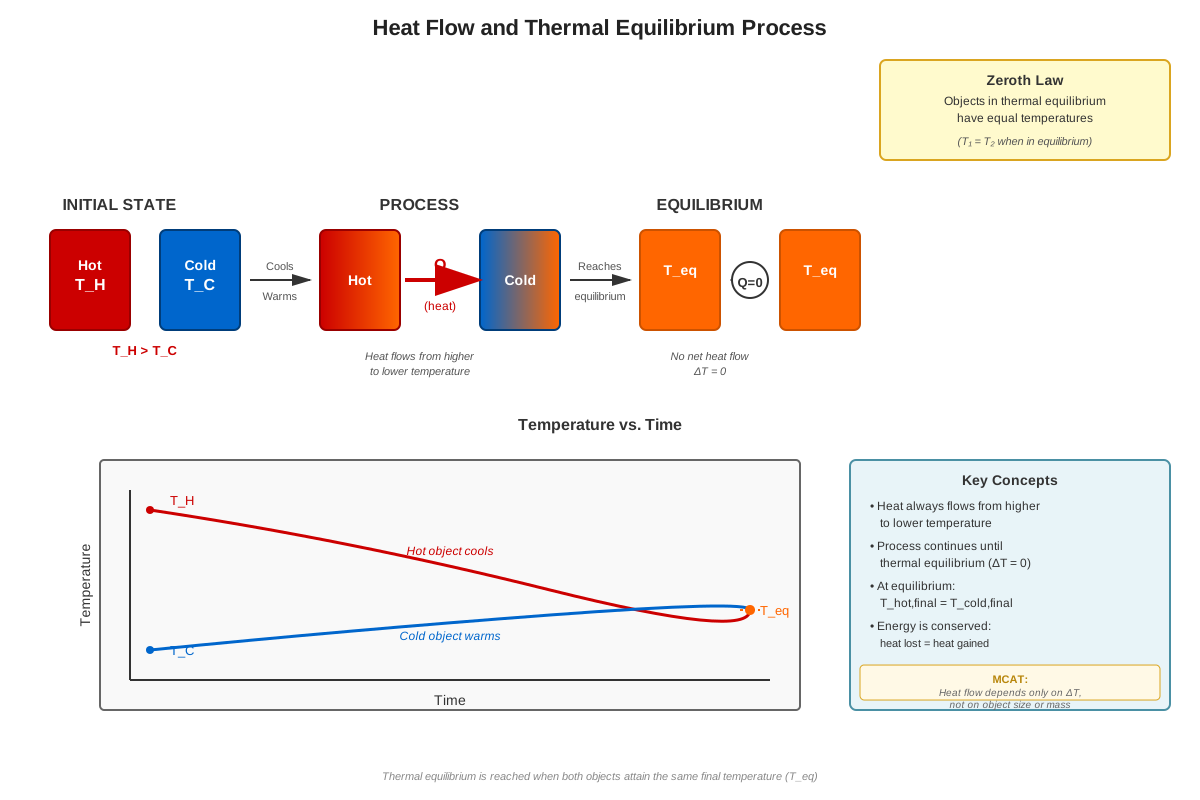
Temperature is defined as a measure of the average translational kinetic energy of particles (atoms, molecules, or ions) in a substance. More precisely, temperature quantifies the intensity of thermal energy within a system, determining the direction of spontaneous heat flow between objects. When two objects at different temperatures come into contact, heat flows from the higher temperature object to the lower temperature object until thermal equilibrium is reached—a state where both objects have the same temperature.
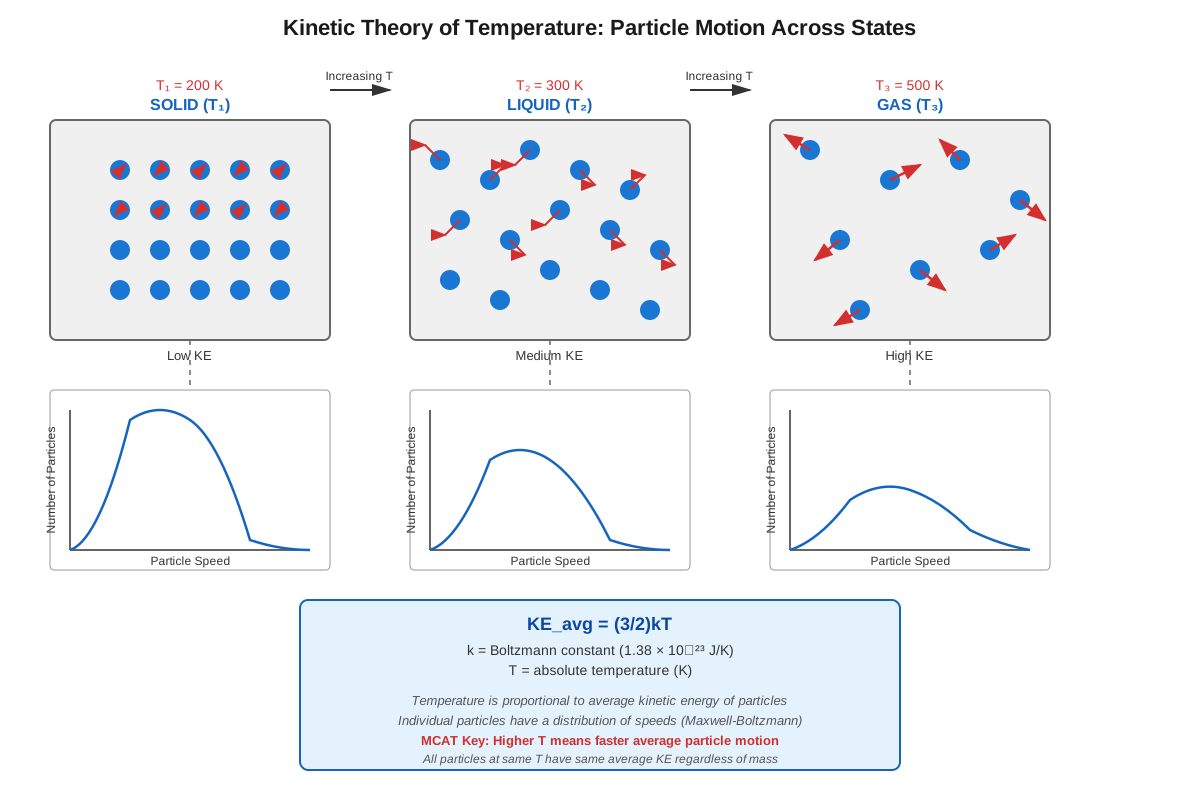
At the microscopic level, temperature reflects the average kinetic energy of random particle motion. For an ideal gas, the relationship between temperature and kinetic energy is expressed mathematically as:
KE_avg = (3/2)kTwhere k is Boltzmann's constant (1.38 × 10⁻²³ J/K) and T is the absolute temperature in Kelvin. This equation reveals that temperature is directly proportional to the average kinetic energy of gas particles. As temperature increases, particles move faster on average; as temperature decreases, particle motion slows.
Temperature is an intensive property, meaning it does not depend on the amount of substance present. A drop of boiling water has the same temperature as a pot of boiling water (both at 100°C at standard pressure), even though the pot contains vastly more thermal energy. This distinction between temperature (intensive) and heat or thermal energy (extensive) is crucial for MCAT success.
Temperature Scales
Three temperature scales appear on the MCAT: Celsius, Fahrenheit, and Kelvin. Each scale uses different reference points and unit sizes, requiring students to convert between them fluently.
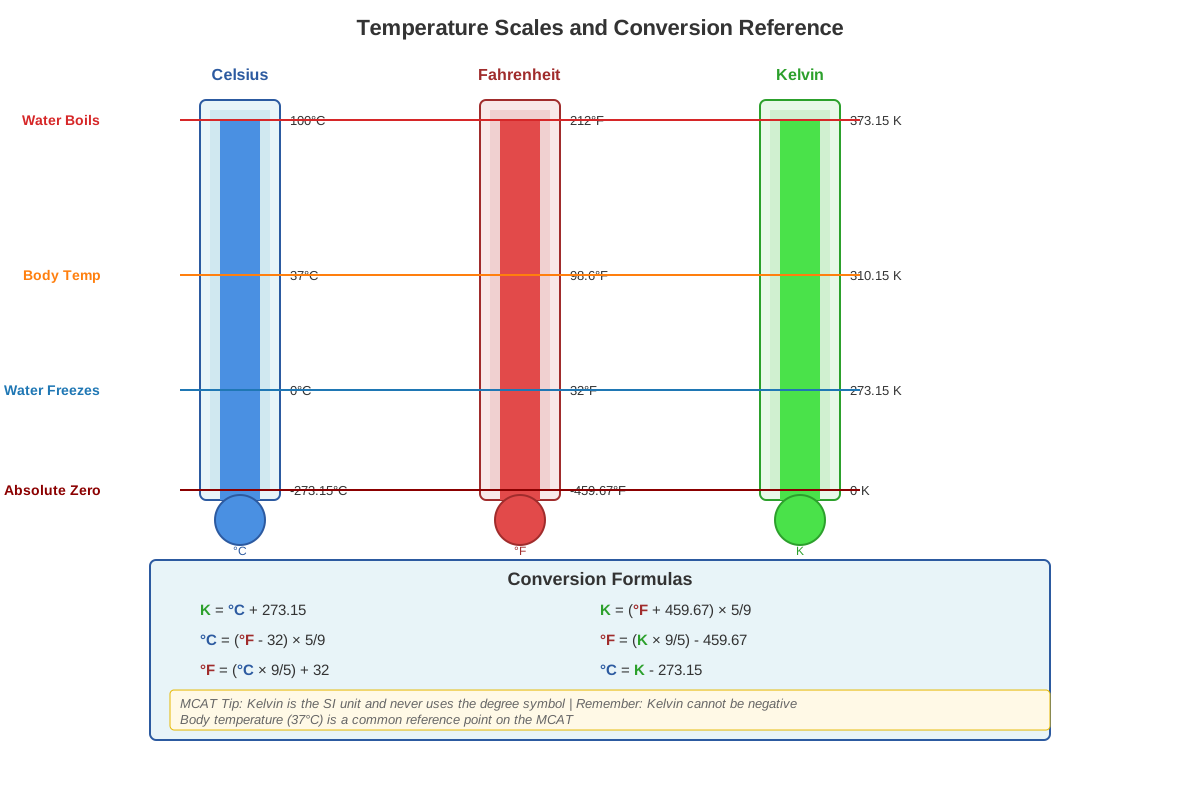
Kelvin Scale: The Kelvin scale is the absolute temperature scale used in scientific calculations. It begins at absolute zero (0 K), the theoretical temperature at which all molecular motion ceases and particles possess minimum possible kinetic energy. The Kelvin scale uses the same unit size as Celsius (one kelvin equals one degree Celsius in magnitude), but shifts the zero point. Water freezes at 273.15 K and boils at 373.15 K at standard pressure. For MCAT purposes, the approximations 273 K and 373 K are typically sufficient.
Celsius Scale: The Celsius scale (formerly centigrade) defines 0°C as the freezing point of water and 100°C as the boiling point of water at standard atmospheric pressure. This scale is commonly used in scientific contexts and in most countries worldwide. Celsius is the most frequently encountered scale in MCAT passages describing experimental conditions.
Fahrenheit Scale: The Fahrenheit scale defines 32°F as the freezing point of water and 212°F as the boiling point of water. This scale is primarily used in the United States for everyday temperature measurements. While less common in MCAT passages, students must be able to convert to and from Fahrenheit.
Temperature Scale Conversions
Mastering temperature conversions is essential for MCAT success. The following conversion formulas must be memorized:
Celsius to Kelvin:
K = °C + 273.15 (or approximately °C + 273)Kelvin to Celsius:
°C = K - 273.15 (or approximately K - 273)Celsius to Fahrenheit:
°F = (9/5)°C + 32Fahrenheit to Celsius:
°C = (5/9)(°F - 32)Fahrenheit to Kelvin (combining conversions):
K = (5/9)(°F - 32) + 273Exam Tip: For temperature changes (ΔT), converting between Celsius and Kelvin requires no adjustment because the unit sizes are identical. A change of 10°C equals a change of 10 K. However, converting temperature changes between Celsius/Kelvin and Fahrenheit requires using the 9/5 or 5/9 ratio.
Absolute Zero and the Kelvin Scale
Absolute zero (0 K, -273.15°C, -459.67°F) represents the lower limit of temperature. At absolute zero, classical physics predicts that particles would have zero kinetic energy and all molecular motion would cease. Quantum mechanics reveals that even at absolute zero, particles retain zero-point energy due to the Heisenberg uncertainty principle, but this detail exceeds MCAT scope.
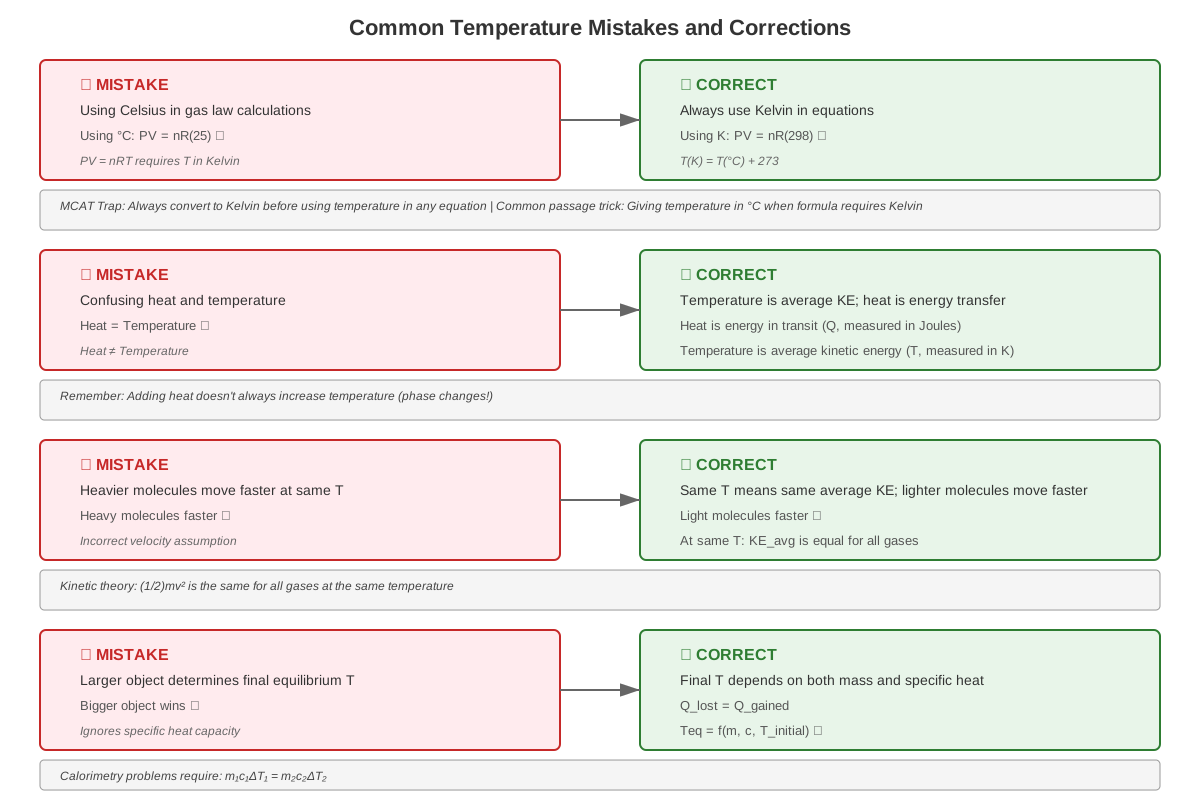
The Kelvin scale's foundation at absolute zero makes it essential for gas law calculations and thermodynamic equations. Many physics equations, including the ideal gas law (PV = nRT), require temperature in Kelvin because these relationships depend on absolute temperature. Using Celsius or Fahrenheit in such equations produces incorrect results because these scales include negative values that would yield nonsensical predictions (such as negative pressure or volume).
Temperature and Thermal Equilibrium
Thermal equilibrium exists when two or more objects in thermal contact reach the same temperature, resulting in no net heat flow between them. The Zeroth Law of Thermodynamics formalizes this concept: if object A is in thermal equilibrium with object C, and object B is in thermal equilibrium with object C, then objects A and B are in thermal equilibrium with each other. This law establishes temperature as a fundamental property that can be consistently measured.
When objects at different temperatures contact each other, heat flows from higher to lower temperature until equilibrium is achieved. The rate of heat transfer depends on the temperature difference (driving force), the thermal conductivity of materials, and the contact area. Understanding thermal equilibrium is essential for analyzing calorimetry problems, where heat lost by one substance equals heat gained by another.
Temperature vs. Heat
A critical distinction for the MCAT is differentiating temperature from heat. Temperature measures the average kinetic energy of particles (intensive property), while heat represents thermal energy in transit from one object to another (extensive property). Heat is measured in joules or calories, while temperature is measured in kelvins, degrees Celsius, or degrees Fahrenheit.
Consider this example: A swimming pool at 25°C contains far more thermal energy than a cup of water at 90°C, even though the cup has higher temperature. If you add the same amount of heat (e.g., 1000 J) to both, the cup's temperature increases much more than the pool's temperature because temperature change depends on both the heat added and the mass and specific heat capacity of the substance.
| Property | Temperature | Heat |
|---|---|---|
| Definition | Average kinetic energy of particles | Thermal energy transferred between objects |
| Type | Intensive (independent of amount) | Extensive (depends on amount) |
| Units | K, °C, °F | J, cal, kcal |
| Measurement | Thermometer | Calorimeter |
| Determines | Direction of heat flow | Amount of energy transferred |
Temperature in Biological Systems
Living organisms are highly sensitive to temperature changes. Homeothermic (warm-blooded) animals maintain constant body temperature through metabolic heat production and thermoregulation, while poikilothermic (cold-blooded) animals have body temperatures that vary with environmental temperature. Human body temperature is maintained near 37°C (98.6°F) through hypothalamic regulation involving mechanisms such as sweating, shivering, and vasodilation/vasoconstriction.
Enzyme activity is strongly temperature-dependent. As temperature increases, reaction rates generally increase due to greater kinetic energy and more frequent molecular collisions. However, excessive temperature causes protein denaturation, destroying enzyme function. Most human enzymes have optimal activity near body temperature, with activity declining sharply above 40-45°C due to structural disruption.
Temperature affects membrane fluidity, with higher temperatures increasing fluidity and lower temperatures decreasing it. Organisms adapt membrane lipid composition to maintain appropriate fluidity at their normal operating temperature. Temperature also influences oxygen binding to hemoglobin (affecting the oxygen-hemoglobin dissociation curve), metabolic rate (roughly doubling with each 10°C increase, described by the Q₁₀ temperature coefficient), and the rates of diffusion and osmosis.
Concept Relationships
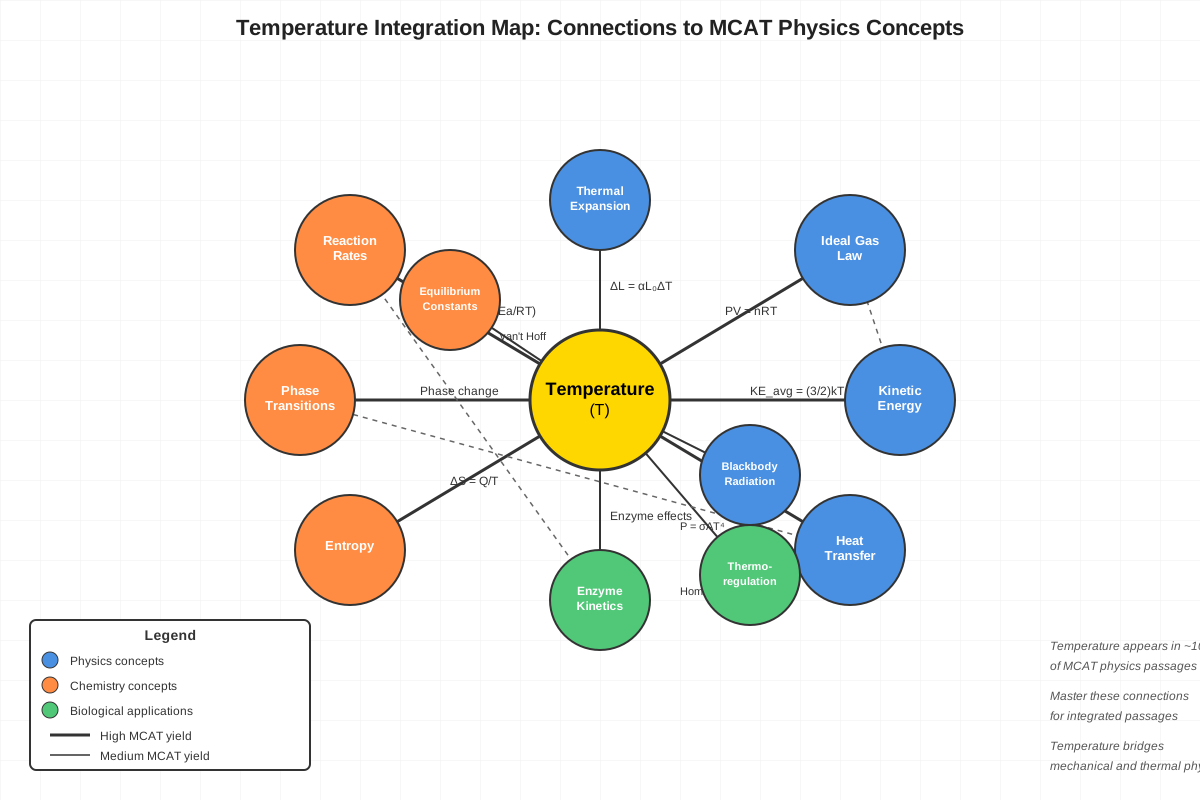
Temperature serves as a foundational concept connecting multiple areas of physics and chemistry. At the most fundamental level, temperature relates to kinetic energy through the kinetic theory of matter, establishing that temperature measures average particle motion. This connection enables understanding of why gases expand when heated (increased particle velocity leads to more forceful collisions with container walls) and why reaction rates increase with temperature (more energetic collisions overcome activation energy barriers).
Temperature → Heat Transfer: Temperature differences drive heat flow, with heat spontaneously moving from high to low temperature regions. This relationship underlies all three heat transfer mechanisms (conduction, convection, and radiation) and is essential for calorimetry calculations.
Temperature → Gas Laws: The ideal gas law (PV = nRT) directly incorporates absolute temperature, making temperature conversions to Kelvin essential. Temperature changes affect gas pressure (Gay-Lussac's Law), volume (Charles's Law), and the kinetic energy distribution of gas particles (Maxwell-Boltzmann distribution).
Temperature → Thermodynamics: Temperature appears in entropy calculations (ΔS = q/T), Gibbs free energy equations (ΔG = ΔH - TΔS), and equilibrium constant temperature dependence (van't Hoff equation). Temperature determines whether processes are spontaneous and affects the position of chemical equilibria.
Temperature → Phase Changes: Each substance has characteristic temperatures for phase transitions (melting point, boiling point). Temperature remains constant during phase changes as added heat energy breaks intermolecular forces rather than increasing kinetic energy.
Temperature → Thermal Expansion: Most substances expand when heated as increased particle motion requires more space. This relationship is quantified by coefficients of linear and volumetric thermal expansion.
The prerequisite understanding of kinetic energy enables comprehension of temperature's microscopic meaning, while knowledge of states of matter provides context for temperature-dependent phase behavior. Energy conservation principles underlie calorimetry calculations where temperature changes in different substances are related through heat transfer.
Quick check — test yourself on Temperature so far.
Try Flashcards →High-Yield Facts
⭐ Temperature measures the average kinetic energy of particles in a substance, not the total thermal energy
⭐ Absolute temperature (Kelvin) must be used in gas law calculations and thermodynamic equations
⭐ Heat flows spontaneously from higher temperature to lower temperature until thermal equilibrium is reached
⭐ A temperature change of 1°C equals a temperature change of 1 K, but absolute values differ by 273
⭐ Temperature is an intensive property (independent of amount), while heat is an extensive property (depends on amount)
- Water freezes at 0°C = 32°F = 273 K and boils at 100°C = 212°F = 373 K at standard pressure
- Absolute zero (0 K = -273°C = -459°F) is the theoretical minimum temperature where classical particle motion ceases
- Normal human body temperature is approximately 37°C = 98.6°F = 310 K
- The Celsius-to-Fahrenheit conversion involves multiplying by 9/5 and adding 32; the reverse uses 5/9 and subtracts 32
- Enzyme activity typically increases with temperature until denaturation occurs (usually above 40-45°C for human enzymes)
- The Zeroth Law of Thermodynamics establishes temperature as a transitive property defining thermal equilibrium
- Temperature affects reaction rates approximately according to the Arrhenius equation, with rates roughly doubling per 10°C increase (Q₁₀ ≈ 2)
- Thermal equilibrium means equal temperatures, not equal heat content or equal thermal energy
- The Kelvin scale has no negative values, making it suitable for ratio comparisons (200 K is twice as hot as 100 K)
- Temperature gradients drive heat transfer, with larger temperature differences producing faster heat flow
Common Misconceptions
Misconception: Temperature and heat are the same thing.
Correction: Temperature measures average kinetic energy of particles (intensive property), while heat represents thermal energy transferred between objects (extensive property). A large object at low temperature can contain more thermal energy than a small object at high temperature.
Misconception: Absolute zero means particles have no energy whatsoever.
Correction: At absolute zero, particles retain zero-point energy due to quantum mechanical effects. Absolute zero represents the minimum possible temperature where classical translational kinetic energy approaches zero, but particles still possess vibrational energy.
Misconception: A temperature change of 10°C equals a temperature change of 10°F.
Correction: Temperature changes convert between Celsius and Fahrenheit using the 9/5 ratio. A change of 10°C equals a change of 18°F (10 × 9/5 = 18). However, a change of 10°C does equal a change of 10 K because these scales have identical unit sizes.
Misconception: You can use Celsius or Fahrenheit in the ideal gas law as long as you're consistent.
Correction: The ideal gas law (PV = nRT) requires absolute temperature in Kelvin. Using Celsius or Fahrenheit produces incorrect results because these scales include negative values and don't start at absolute zero. Only the Kelvin scale properly represents the proportional relationship between temperature and other gas properties.
Misconception: Objects at the same temperature contain the same amount of thermal energy.
Correction: Thermal energy depends on temperature, mass, and specific heat capacity. Two objects at the same temperature but with different masses or compositions contain different amounts of thermal energy. Temperature indicates intensity of thermal energy, not quantity.
Misconception: During a phase change, adding heat increases temperature.
Correction: During phase transitions (melting, boiling), temperature remains constant while heat is added. The added energy breaks intermolecular forces rather than increasing kinetic energy. Only after the phase change completes does additional heat increase temperature.
Misconception: Thermal equilibrium means no heat transfer is occurring.
Correction: At thermal equilibrium, heat transfer continues in both directions at equal rates, resulting in no net heat flow. Particles continue exchanging energy through collisions, but the average energy distribution remains constant.
Misconception: Higher temperature always means faster molecular motion for all types of motion.
Correction: Temperature specifically relates to translational kinetic energy (motion through space). While higher temperatures generally increase rotational and vibrational motion as well, the direct proportionality (KE = 3/2 kT) applies specifically to translational motion of gas particles.
Worked Examples
Example 1: Temperature Scale Conversion with Gas Law Application
Problem: A sample of gas occupies 2.0 L at 25°C and 1.0 atm pressure. If the gas is heated to 100°C at constant pressure, what is the new volume?
Solution:
Step 1: Identify the appropriate gas law. Since pressure is constant and temperature and volume change, use Charles's Law: V₁/T₁ = V₂/T₂
Step 2: Convert temperatures to Kelvin (required for gas law calculations):
- T₁ = 25°C + 273 = 298 K
- T₂ = 100°C + 273 = 373 K
Step 3: Identify known values:
- V₁ = 2.0 L
- T₁ = 298 K
- T₂ = 373 K
- V₂ = ?
Step 4: Solve for V₂:
V₂ = V₁ × (T₂/T₁)
V₂ = 2.0 L × (373 K / 298 K)
V₂ = 2.0 L × 1.25
V₂ = 2.5 L
Key Insights: This problem demonstrates why Kelvin is essential for gas law calculations. If you incorrectly used Celsius (100/25 = 4), you would predict the volume quadruples to 8.0 L, which is wrong. The Kelvin scale properly accounts for the absolute temperature relationship. Notice that a 75°C increase (from 25°C to 100°C) represents only a 25% increase in absolute temperature (from 298 K to 373 K), producing a 25% volume increase.
Example 2: Temperature and Thermal Equilibrium in Calorimetry
Problem: A 50.0 g sample of metal at 95.0°C is placed in 100.0 g of water at 20.0°C in an insulated container. The final equilibrium temperature is 25.0°C. What is the specific heat capacity of the metal? (Specific heat of water = 4.18 J/g°C)
Solution:
Step 1: Apply conservation of energy. In an insulated system, heat lost by the metal equals heat gained by the water:
q_metal = -q_waterStep 2: Express heat changes using q = mcΔT:
m_metal × c_metal × ΔT_metal = -(m_water × c_water × ΔT_water)Step 3: Calculate temperature changes:
- ΔT_metal = T_final - T_initial = 25.0°C - 95.0°C = -70.0°C (negative because metal cools)
- ΔT_water = T_final - T_initial = 25.0°C - 20.0°C = +5.0°C (positive because water warms)
Step 4: Substitute known values:
(50.0 g) × c_metal × (-70.0°C) = -(100.0 g) × (4.18 J/g°C) × (5.0°C)Step 5: Solve for c_metal:
(50.0 g) × c_metal × (-70.0°C) = -2090 J
c_metal = -2090 J / [(50.0 g) × (-70.0°C)]
c_metal = -2090 J / (-3500 g°C)
c_metal = 0.60 J/g°C
Key Insights: This problem illustrates thermal equilibrium—the final temperature (25.0°C) represents the point where heat flow ceases. The metal's temperature decreased by 70°C while the water's temperature increased by only 5°C because water has much higher specific heat capacity and greater mass. Notice that for temperature changes (ΔT), Celsius and Kelvin are interchangeable because the unit sizes are identical. The negative sign in the heat equation accounts for the direction of heat flow (from hot metal to cool water). The calculated specific heat (0.60 J/g°C) is consistent with metals like zinc or iron.
Exam Strategy
When approaching MCAT questions involving temperature, first identify whether the question requires calculation or conceptual understanding. Calculation questions typically involve temperature conversions or applications to gas laws and calorimetry. Conceptual questions test understanding of temperature's physical meaning, thermal equilibrium, or the distinction between temperature and heat.
Trigger words and phrases that signal temperature concepts include: "thermal equilibrium," "heat flow," "average kinetic energy," "absolute temperature," "temperature change," "heated/cooled," "thermometer reading," "degrees Celsius/Fahrenheit/Kelvin," and "at constant temperature." When you see "ideal gas" or gas law variables (P, V, n, T), immediately check whether temperature is in Kelvin—this is a frequent trap.
For temperature conversion questions, write down the conversion formula before calculating to avoid errors. Remember that the MCAT may test whether you recognize that temperature changes between Celsius and Kelvin don't require the +273 adjustment. If a question asks about a 50°C temperature increase, this equals a 50 K increase, not 323 K.
Process-of-elimination strategies:
- Eliminate any answer choice using Celsius or Fahrenheit in gas law calculations (must be Kelvin)
- Eliminate choices that confuse temperature (intensive) with heat or thermal energy (extensive)
- For thermal equilibrium problems, the final temperature must be between the initial temperatures of the objects
- Eliminate choices suggesting heat flows from cold to hot without external work
- Watch for answer choices that incorrectly apply the +273 conversion to temperature changes
Time allocation: Simple temperature conversions should take 30-45 seconds. Gas law problems involving temperature typically require 60-90 seconds. Calorimetry problems with temperature changes may need 90-120 seconds due to multiple calculation steps. If a temperature question seems to require more than 2 minutes, you may be overcomplicating it—look for a conceptual shortcut or estimation approach.
For passage-based questions, quickly scan for temperature values and note their units. If the passage uses Celsius but the question requires gas law calculations, you'll need to convert to Kelvin. Look for graphs showing temperature-dependent phenomena (reaction rates, enzyme activity, gas properties) and note whether temperature is on the x-axis or affects the y-axis variable.
Memory Techniques
Temperature Scale Conversions Mnemonic: "Keep Counting 273" reminds you that Kelvin = Celsius + 273.
For Celsius-Fahrenheit conversion, remember "9/5 + 32" using the phrase "Nine-to-Five job starts at 32 (degrees F when water freezes)." The reverse uses 5/9 and subtracts 32.
Water's Reference Points: "Zero-Hundred-Thirty-Two" captures water's freezing (0°C, 32°F) and boiling (100°C) points. For Kelvin, add "273-373" (freezing and boiling in Kelvin).
Intensive vs. Extensive Mnemonic: "Temperature is Tiny-independent" (intensive property doesn't depend on amount). "Heat Has Heft" (extensive property depends on amount).
Absolute Zero Values: "Absolute Zero = -273°C = -460°F" (rounded). Remember it as "Negative 273 and Negative 460"—both negative, both multiples of similar digits.
Visualization Strategy: Picture temperature as the "speed" of particle jiggling. Higher temperature = faster jiggling. Heat is the energy transferred when fast-jiggling particles collide with slow-jiggling particles, speeding up the slow ones and slowing down the fast ones until all jiggle at the same average speed (thermal equilibrium).
Gas Law Temperature Reminder: "Kelvin for Kalculations" or "Absolute Temperature for All Thermodynamic equations."
Body Temperature Anchor: Remember "37-98-310" for normal body temperature (37°C, 98.6°F, 310 K). This provides a familiar reference point for estimating whether other temperatures are reasonable.
Summary
Temperature is a fundamental physics concept measuring the average translational kinetic energy of particles in a substance. Unlike heat (thermal energy in transit), temperature is an intensive property independent of the amount of substance present. The MCAT requires fluency in three temperature scales: Celsius (water freezes at 0°C, boils at 100°C), Fahrenheit (water freezes at 32°F, boils at 212°F), and Kelvin (absolute scale starting at 0 K, water freezes at 273 K). Absolute temperature in Kelvin is essential for gas law calculations and thermodynamic equations because only this scale properly represents proportional relationships starting from absolute zero. Temperature differences drive heat flow from hot to cold until thermal equilibrium is reached. In biological systems, temperature affects enzyme activity, metabolic rate, membrane fluidity, and homeostatic regulation. MCAT questions test temperature through direct conversions, gas law applications, calorimetry problems, and conceptual understanding of thermal equilibrium and the temperature-heat distinction. Success requires memorizing conversion formulas, recognizing when Kelvin is required, and understanding temperature's microscopic meaning as average particle kinetic energy.
Key Takeaways
- Temperature measures average kinetic energy of particles (intensive property), while heat measures energy transfer (extensive property)
- Always convert to Kelvin for gas law and thermodynamic calculations; Celsius and Fahrenheit produce incorrect results
- Temperature changes of 1°C equal changes of 1 K, but absolute values differ by 273
- Heat flows spontaneously from higher to lower temperature until thermal equilibrium (equal temperatures) is achieved
- Water's reference points: freezes at 0°C = 32°F = 273 K; boils at 100°C = 212°F = 373 K
- Conversion formulas: K = °C + 273; °F = (9/5)°C + 32; °C = (5/9)(°F - 32)
- Temperature affects biological processes including enzyme activity, metabolic rate, and membrane fluidity, with human body temperature maintained near 37°C = 98.6°F = 310 K
Related Topics
Heat and Heat Transfer: Understanding temperature provides the foundation for studying heat flow mechanisms (conduction, convection, radiation) and the quantitative relationship between heat and temperature change (q = mcΔT). Temperature gradients drive all heat transfer processes.
Ideal Gas Law: Temperature is a critical variable in PV = nRT, and mastering temperature conversions to Kelvin enables solving problems involving gas behavior under varying conditions. Charles's Law, Gay-Lussac's Law, and the combined gas law all depend on proper temperature handling.
Thermodynamics: Temperature appears throughout thermodynamic equations including entropy (ΔS = q/T), Gibbs free energy (ΔG = ΔH - TΔS), and the temperature dependence of equilibrium constants. Understanding absolute temperature is essential for predicting spontaneity and equilibrium position.
Kinetic Molecular Theory: Temperature's relationship to average kinetic energy connects to the Maxwell-Boltzmann distribution, explaining why reaction rates increase with temperature and how temperature affects gas pressure and volume at the molecular level.
Phase Changes and Phase Diagrams: Temperature determines phase transitions, with each substance having characteristic melting and boiling points. Phase diagrams plot pressure versus temperature to show regions of stability for different phases.
Calorimetry: Temperature changes are measured in calorimetry experiments to determine heat capacity, enthalpy changes, and energy content of substances. Mastering temperature enables quantitative analysis of energy transfer in chemical and physical processes.
Practice CTA
Now that you've mastered the core concepts of temperature, it's time to solidify your understanding through active practice. Work through the practice questions to test your ability to convert between temperature scales, apply temperature concepts to gas laws and calorimetry, and distinguish between temperature and heat. Use the flashcards to reinforce high-yield facts and conversion formulas until they become automatic. Remember: temperature appears throughout the MCAT in contexts ranging from enzyme kinetics to gas behavior—mastering this foundational concept will pay dividends across multiple question types. You've built the knowledge foundation; now build the speed and confidence through deliberate practice!
Sign up free to keep reading
Create a free AnvayaPrep account to finish this MCAT guide on Temperature — plus flashcards and practice questions.